

ASTM C1176/C1176M-20
(Practice)Standard Practice for Making Roller-Compacted Concrete in Cylinder Molds Using a Vibrating Table
General Information
- Abstract
SIGNIFICANCE AND USE
4.1 This practice is intended to be used for stiff to extremely dry concrete mixtures commonly used in roller-compacted concrete construction. This practice is used instead of rodding or internal vibration, which cannot properly consolidate concrete of this consistency (Note 1).
Note 1: Further description of this concrete consistency is given in ACI 207.5 Roller-Compacted Mass Concrete3 and 211.3 Guide for Selecting Proportions for No-Slump Concrete3. The consistency of roller-compacted concrete may be determined in accordance with Test Method C1170/C1170M.
SCOPE
1.1 This practice covers procedures for making cylindrical test specimens from concrete when the standard procedures of rodding and internal vibration, as described in Practice C31/C31M, are not practicable. This practice is applicable to freshly mixed concrete, prepared in the laboratory and the field, having a nominal maximum size aggregate of 50 mm [2 in.] or less. If the nominal maximum size aggregate is larger than 50 mm [2 in.], the practice is applicable only when performed on the fraction passing the 50-mm [2-in.] sieve with the larger aggregate being removed in accordance with Practice C172. This practice, intended for use in testing roller-compacted concrete, may be applicable to testing other types of concrete such as cement-treated aggregate and mixtures similar to soil-cement.
1.2 Two methods are provided for making concrete cylinders using a vibrating table:
1.2.1 Method A is a procedure for making test specimens in steel reusable molds attached to a vibrating table.
1.2.2 Method B is a procedure for making test specimens in single-use plastic molds that have been inserted into a metal sleeve attached to a vibrating table.
1.3 The values stated in either SI units or inch-pound units are to be regarded separately as standard. The values stated in each system may not be exact equivalents; therefore, each system shall be used independently of the other. Combining values from the two systems may result in non-conformance with the standard.
1.4 The text of this practice refers to notes and footnotes that provide explanatory material. These notes and footnotes (excluding those in tables and figures) shall not be considered as requirements of this practice.
1.5 This standard does not purport to address all of the safety concerns, if any, associated with its use. It is the responsibility of the user of this standard to establish appropriate safety, health, and environmental practices and determine the applicability of regulatory limitations prior to use.
1.6 This international standard was developed in accordance with internationally recognized principles on standardization established in the Decision on Principles for the Development of International Standards, Guides and Recommendations issued by the World Trade Organization Technical Barriers to Trade (TBT) Committee.
- Status
- Published
- Publication Date
- 30-Sep-2020
- Technical Committee
- C09 - Concrete and Concrete Aggregates
- Drafting Committee
- C09.45 - Roller-Compacted Concrete
Buy Documents
ASTM C1176/C1176M-20 - Standard Practice for Making Roller-Compacted Concrete in Cylinder Molds Using a Vibrating Table
REDLINE ASTM C1176/C1176M-20 - Standard Practice for Making Roller-Compacted Concrete in Cylinder Molds Using a Vibrating Table
Overview
ASTM C1176/C1176M-20, titled Standard Practice for Making Roller-Compacted Concrete in Cylinder Molds Using a Vibrating Table, provides essential procedures for producing cylindrical test specimens from stiff to extremely dry concrete mixtures. This standard is tailored to roller-compacted concrete (RCC), a material widely employed for heavy-duty pavements and mass concrete structures, where conventional consolidation methods like rodding or internal vibration are ineffective. ASTM C1176/C1176M-20 specifies the use of vibrating tables to achieve proper consolidation, ensuring representative and reliable test specimens for use in evaluating concrete properties.
Key Topics
Applicability:
- Designed for freshly mixed roller-compacted concrete with nominal maximum aggregate sizes up to 50 mm (2 in.)
- Can also be applied to cement-treated aggregate or no-slump concrete mixtures
Consolidation Methods:
- Method A: Formation of test specimens in reusable steel molds attached to a vibrating table
- Method B: Use of single-use plastic molds inserted within a metal sleeve on a vibrating table
Equipment and Requirements:
- Detailed specifications for molds and vibrating table construction and operation
- Procedures for specimen preparation, including sample collection, layering, consolidation, and finishing
- Guidance for calibration of the vibrating table to ensure consistent and adequate sinusoidal vibration
Unit Systems:
- Supports both SI and inch-pound units; each must be used independently to ensure compliance
Safety and Quality:
- Emphasizes establishment of appropriate safety, health, and environmental practices
- Notes on minimizing sample segregation and ensuring representative test specimens
Applications
Quality Control in Construction
This standard is vital for construction quality assurance, enabling accurate testing and assessment of roller-compacted concrete used in:- Large dams and hydraulic structures
- Industrial paving and heavy-duty roadways
- Airport runways and parking facilities
Laboratory and Field Testing
The procedures outlined are applicable to both laboratory-prepared and field-mixed samples, supporting:- Research and development of concrete mixtures
- On-site verification of delivered RCC consistency and performance
Evaluation of Other Stiff Concrete Mixtures
With adaptability to mixes such as cement-treated aggregate and soil-cement, the practice serves clients working with a broad spectrum of low-slump concretes.Compatibility with Other Testing Standards
Specimens prepared using ASTM C1176/C1176M-20 are suitable for further mechanical property evaluation such as compressive strength or splitting tensile strength under referenced ASTM procedures.
Related Standards
- ASTM C31/C31M: Practice for Making and Curing Concrete Test Specimens in the Field
- ASTM C39/C39M: Test Method for Compressive Strength of Cylindrical Concrete Specimens
- ASTM C496/C496M: Test Method for Splitting Tensile Strength of Cylindrical Concrete Specimens
- ASTM C470/C470M: Specification for Molds for Forming Concrete Test Cylinders
- ASTM C1170/C1170M: Test Method for Determining Consistency and Density of Roller-Compacted Concrete Using a Vibrating Table
- ASTM C172: Practice for Sampling Freshly Mixed Concrete
- ACI 207.5: Roller-Compacted Mass Concrete
- ACI 211.3: Guide for Selecting Proportions for No-Slump Concrete
ASTM C1176/C1176M-20 ensures standardized, repeatable procedures for the preparation of test cylinders from roller-compacted concrete and similar dry mix concretes. Adhering to this standard supports robust quality control, long-term durability assessments, and alignment with international best practices in concrete construction.
Relations
- Refers
ASTM C31/C31M-24a - Standard Practice for Making and Curing Concrete Test Specimens in the Field - Effective Date
- 01-Apr-2024
- Refers
ASTM C31/C31M-24 - Standard Practice for Making and Curing Concrete Test Specimens in the Field - Effective Date
- 01-Jan-2024
- Refers
ASTM C39/C39M-23 - Standard Test Method for Compressive Strength of Cylindrical Concrete Specimens - Effective Date
- 01-Dec-2023
- Effective Date
- 01-Apr-2020
- Refers
ASTM C31/C31M-18 - Standard Practice for Making and Curing Concrete Test Specimens in the Field - Effective Date
- 01-Jan-2018
- Refers
ASTM C39/C39M-17b - Standard Test Method for Compressive Strength of Cylindrical Concrete Specimens - Effective Date
- 01-Aug-2017
- Refers
ASTM C39/C39M-16b - Standard Test Method for Compressive Strength of Cylindrical Concrete Specimens - Effective Date
- 01-Aug-2016
- Refers
ASTM C39/C39M-16a - Standard Test Method for Compressive Strength of Cylindrical Concrete Specimens - Effective Date
- 01-Jul-2016
- Effective Date
- 01-Feb-2016
- Refers
ASTM C31/C31M-15ae1 - Standard Practice for Making and Curing Concrete Test Specimens in the Field - Effective Date
- 15-Nov-2015
- Effective Date
- 01-Aug-2014
- Refers
ASTM C39/C39M-14a - Standard Test Method for Compressive Strength of Cylindrical Concrete Specimens - Effective Date
- 01-Jun-2014
- Effective Date
- 01-Apr-2014
- Refers
ASTM C39/C39M-14 - Standard Test Method for Compressive Strength of Cylindrical Concrete Specimens - Effective Date
- 01-Feb-2014
- Effective Date
- 01-Oct-2013
Buy Documents
ASTM C1176/C1176M-20 - Standard Practice for Making Roller-Compacted Concrete in Cylinder Molds Using a Vibrating Table
REDLINE ASTM C1176/C1176M-20 - Standard Practice for Making Roller-Compacted Concrete in Cylinder Molds Using a Vibrating Table
Get Certified
Connect with accredited certification bodies for this standard

DIBt (Deutsches Institut für Bautechnik)
German Institute for Building Technology.
DIN CERTCO
DIN Group product certification.

Aboma Certification B.V.
Specialized in construction, metal, and transport sectors.
Sponsored listings
Frequently Asked Questions
ASTM C1176/C1176M-20 is a standard published by ASTM International. Its full title is "Standard Practice for Making Roller-Compacted Concrete in Cylinder Molds Using a Vibrating Table". This standard covers: SIGNIFICANCE AND USE 4.1 This practice is intended to be used for stiff to extremely dry concrete mixtures commonly used in roller-compacted concrete construction. This practice is used instead of rodding or internal vibration, which cannot properly consolidate concrete of this consistency (Note 1). Note 1: Further description of this concrete consistency is given in ACI 207.5 Roller-Compacted Mass Concrete3 and 211.3 Guide for Selecting Proportions for No-Slump Concrete3. The consistency of roller-compacted concrete may be determined in accordance with Test Method C1170/C1170M. SCOPE 1.1 This practice covers procedures for making cylindrical test specimens from concrete when the standard procedures of rodding and internal vibration, as described in Practice C31/C31M, are not practicable. This practice is applicable to freshly mixed concrete, prepared in the laboratory and the field, having a nominal maximum size aggregate of 50 mm [2 in.] or less. If the nominal maximum size aggregate is larger than 50 mm [2 in.], the practice is applicable only when performed on the fraction passing the 50-mm [2-in.] sieve with the larger aggregate being removed in accordance with Practice C172. This practice, intended for use in testing roller-compacted concrete, may be applicable to testing other types of concrete such as cement-treated aggregate and mixtures similar to soil-cement. 1.2 Two methods are provided for making concrete cylinders using a vibrating table: 1.2.1 Method A is a procedure for making test specimens in steel reusable molds attached to a vibrating table. 1.2.2 Method B is a procedure for making test specimens in single-use plastic molds that have been inserted into a metal sleeve attached to a vibrating table. 1.3 The values stated in either SI units or inch-pound units are to be regarded separately as standard. The values stated in each system may not be exact equivalents; therefore, each system shall be used independently of the other. Combining values from the two systems may result in non-conformance with the standard. 1.4 The text of this practice refers to notes and footnotes that provide explanatory material. These notes and footnotes (excluding those in tables and figures) shall not be considered as requirements of this practice. 1.5 This standard does not purport to address all of the safety concerns, if any, associated with its use. It is the responsibility of the user of this standard to establish appropriate safety, health, and environmental practices and determine the applicability of regulatory limitations prior to use. 1.6 This international standard was developed in accordance with internationally recognized principles on standardization established in the Decision on Principles for the Development of International Standards, Guides and Recommendations issued by the World Trade Organization Technical Barriers to Trade (TBT) Committee.
SIGNIFICANCE AND USE 4.1 This practice is intended to be used for stiff to extremely dry concrete mixtures commonly used in roller-compacted concrete construction. This practice is used instead of rodding or internal vibration, which cannot properly consolidate concrete of this consistency (Note 1). Note 1: Further description of this concrete consistency is given in ACI 207.5 Roller-Compacted Mass Concrete3 and 211.3 Guide for Selecting Proportions for No-Slump Concrete3. The consistency of roller-compacted concrete may be determined in accordance with Test Method C1170/C1170M. SCOPE 1.1 This practice covers procedures for making cylindrical test specimens from concrete when the standard procedures of rodding and internal vibration, as described in Practice C31/C31M, are not practicable. This practice is applicable to freshly mixed concrete, prepared in the laboratory and the field, having a nominal maximum size aggregate of 50 mm [2 in.] or less. If the nominal maximum size aggregate is larger than 50 mm [2 in.], the practice is applicable only when performed on the fraction passing the 50-mm [2-in.] sieve with the larger aggregate being removed in accordance with Practice C172. This practice, intended for use in testing roller-compacted concrete, may be applicable to testing other types of concrete such as cement-treated aggregate and mixtures similar to soil-cement. 1.2 Two methods are provided for making concrete cylinders using a vibrating table: 1.2.1 Method A is a procedure for making test specimens in steel reusable molds attached to a vibrating table. 1.2.2 Method B is a procedure for making test specimens in single-use plastic molds that have been inserted into a metal sleeve attached to a vibrating table. 1.3 The values stated in either SI units or inch-pound units are to be regarded separately as standard. The values stated in each system may not be exact equivalents; therefore, each system shall be used independently of the other. Combining values from the two systems may result in non-conformance with the standard. 1.4 The text of this practice refers to notes and footnotes that provide explanatory material. These notes and footnotes (excluding those in tables and figures) shall not be considered as requirements of this practice. 1.5 This standard does not purport to address all of the safety concerns, if any, associated with its use. It is the responsibility of the user of this standard to establish appropriate safety, health, and environmental practices and determine the applicability of regulatory limitations prior to use. 1.6 This international standard was developed in accordance with internationally recognized principles on standardization established in the Decision on Principles for the Development of International Standards, Guides and Recommendations issued by the World Trade Organization Technical Barriers to Trade (TBT) Committee.
ASTM C1176/C1176M-20 is classified under the following ICS (International Classification for Standards) categories: 91.100.30 - Concrete and concrete products. The ICS classification helps identify the subject area and facilitates finding related standards.
ASTM C1176/C1176M-20 has the following relationships with other standards: It is inter standard links to ASTM C31/C31M-24a, ASTM C31/C31M-24, ASTM C39/C39M-23, ASTM C1170/C1170M-20, ASTM C31/C31M-18, ASTM C39/C39M-17b, ASTM C39/C39M-16b, ASTM C39/C39M-16a, ASTM C192/C192M-16, ASTM C31/C31M-15ae1, ASTM C192/C192M-14, ASTM C39/C39M-14a, ASTM C1170/C1170M-14, ASTM C39/C39M-14, ASTM E11-13. Understanding these relationships helps ensure you are using the most current and applicable version of the standard.
ASTM C1176/C1176M-20 is available in PDF format for immediate download after purchase. The document can be added to your cart and obtained through the secure checkout process. Digital delivery ensures instant access to the complete standard document.
Standards Content (Sample)
This international standard was developed in accordance with internationally recognized principles on standardization established in the Decision on Principles for the
Development of International Standards, Guides and Recommendations issued by the World Trade Organization Technical Barriers to Trade (TBT) Committee.
Designation: C1176/C1176M − 20
Standard Practice for
Making Roller-Compacted Concrete in Cylinder Molds Using
a Vibrating Table
ThisstandardisissuedunderthefixeddesignationC1176/C1176M;thenumberimmediatelyfollowingthedesignationindicatestheyear
of original adoption or, in the case of revision, the year of last revision. A number in parentheses indicates the year of last reapproval.
A superscript epsilon (´) indicates an editorial change since the last revision or reapproval.
1. Scope* priate safety, health, and environmental practices and deter-
mine the applicability of regulatory limitations prior to use.
1.1 This practice covers procedures for making cylindrical
1.6 This international standard was developed in accor-
test specimens from concrete when the standard procedures of
dance with internationally recognized principles on standard-
rodding and internal vibration, as described in Practice C31/
ization established in the Decision on Principles for the
C31M,arenotpracticable.Thispracticeisapplicabletofreshly
Development of International Standards, Guides and Recom-
mixedconcrete,preparedinthelaboratoryandthefield,having
mendations issued by the World Trade Organization Technical
a nominal maximum size aggregate of 50 mm [2 in.] or less. If
Barriers to Trade (TBT) Committee.
the nominal maximum size aggregate is larger than 50 mm [2
in.], the practice is applicable only when performed on the
2. Referenced Documents
fraction passing the 50-mm [2-in.] sieve with the larger
2.1 ASTM Standards:
aggregate being removed in accordance with Practice C172.
C31/C31M Practice for Making and Curing Concrete Test
This practice, intended for use in testing roller-compacted
Specimens in the Field
concrete, may be applicable to testing other types of concrete
C39/C39M Test Method for Compressive Strength of Cylin-
such as cement-treated aggregate and mixtures similar to
drical Concrete Specimens
soil-cement.
C172 Practice for Sampling Freshly Mixed Concrete
1.2 Two methods are provided for making concrete cylin-
C192/C192M Practice for Making and Curing Concrete Test
ders using a vibrating table:
Specimens in the Laboratory
1.2.1 MethodAis a procedure for making test specimens in
C470/C470M Specification for Molds for Forming Concrete
steel reusable molds attached to a vibrating table.
Test Cylinders Vertically
1.2.2 Method B is a procedure for making test specimens in
C496/C496M Test Method for Splitting Tensile Strength of
single-use plastic molds that have been inserted into a metal
Cylindrical Concrete Specimens
sleeve attached to a vibrating table.
C1170/C1170M Test Method for Determining Consistency
1.3 The values stated in either SI units or inch-pound units
and Density of Roller-Compacted Concrete Using a Vi-
are to be regarded separately as standard. The values stated in brating Table
each system may not be exact equivalents; therefore, each
E11 Specification for Woven Wire Test Sieve Cloth and Test
system shall be used independently of the other. Combining Sieves
values from the two systems may result in non-conformance
3. Summary of Practice
with the standard.
3.1 This practice describes methods for making cylindrical
1.4 The text of this practice refers to notes and footnotes
concrete test specimens using a vibrating table. Test specimens
that provide explanatory material. These notes and footnotes
are made in cylindrical molds that are attached to the vibrating
(excluding those in tables and figures) shall not be considered
table under a 9-kg [20-lb] surcharge to facilitate consolidation.
as requirements of this practice.
1.5 This standard does not purport to address all of the
4. Significance and Use
safety concerns, if any, associated with its use. It is the
4.1 This practice is intended to be used for stiff to extremely
responsibility of the user of this standard to establish appro-
dry concrete mixtures commonly used in roller-compacted
concrete construction. This practice is used instead of rodding
This practice is under the jurisdiction of ASTM Committee C09 on Concrete
andConcreteAggregatesandisthedirectresponsibilityofSubcommitteeC09.45on
Roller-Compacted Concrete. For referenced ASTM standards, visit the ASTM website, www.astm.org, or
Current edition approved Oct. 1, 2020. Published October 2020. Originally contact ASTM Customer Service at service@astm.org. For Annual Book of ASTM
approved in 1991. Last previous edition approved in 2013 as C1176/C1176M – 13. Standards volume information, refer to the standard’s Document Summary page on
DOI: 10.1520/C1176_C1176M-20. the ASTM website.
*A Summary of Changes section appears at the end of this standard
Copyright © ASTM International, 100 Barr Harbor Drive, PO Box C700, West Conshohocken, PA 19428-2959. United States
C1176/C1176M − 20
alternative vibrating table may be substituted for the Vebe apparatus
or internal vibration, which cannot properly consolidate con-
provided it meets the specifications for the sinusoidal vibration given in
crete of this consistency (Note 1).
7.1.
NOTE 1—Further description of this concrete consistency is given in
5.3 Swivel Arm and Guide Sleeve—A metal guide sleeve
ACI 207.5 Roller-Compacted Mass Concrete and 211.3 Guide for Se-
3 with a clamp assembly or other suitable holding device
lecting Proportions for No-Slump Concrete . The consistency of roller-
mounted on a swivel arm. The swivel arm and guide sleeve
compacted concrete may be determined in accordance with Test Method
C1170/C1170M.
must be capable of holding a metal shaft attached to a 9-kg
[20-lb] cylindrical mass in a position perpendicular to the
5. Apparatus
vibratingsurfaceandallowingtheshafttoslidefreelywhenthe
clamp is released. The swivel arm must be capable of main-
5.1 Molds:
5.1.1 Type A Mold—A cylindrical mold conforming to the taining the guide sleeve in a locked position directly over the
center of the specimens to be vibrated. The swivel arm shall
requirementsofSpecificationC470/C470Mfor150-mm[6-in.]
diameter by 300-mm [12-in.] high reusable molds. Molds shall also be capable of being rotated away from the center of the
table (Note 3).
be made of steel or other hard metal not readily attacked by the
cement paste. Aluminum molds shall not be used. Molds shall
NOTE 3—The Vebe vibrating table comes equipped with the swivel arm
be equipped with permanently affixed metal slotted brackets on
and guide sleeve.
thebaseplatesothemoldscanberigidlyclampedtoavibrating
5.4 Surcharge—A cylindrical steel mass with a metal shaft
table. The top rim of the mold shall be smooth, plane, and
5 1
atleast460mm[18in.]inlengthand16 62mm[ ⁄8 6 ⁄16 in.]
paralleltothebottomofthemold.Thebottomofthemoldshall
in diameter attached perpendicularly to and embedded in the
provide a watertight seal.
center of the mass. The shaft shall slide through the guide
5.1.2 Type B Mold—A single-use plastic, cylindrical mold
sleeve without binding. The surcharge shall have a diameter of
150 mm [6 in.] in diameter and 300 mm [12 in.] in height. The
3 1
145 63mm[5 ⁄4 6 ⁄8 in.].The surcharge assembly shall have
mold specifications shall conform to Specification C470/
amassof9.0 6 0.25kg[20 6 0.5lb]includingthemassofthe
C470M for single-use plastic molds.
metal shaft (Fig. 1). If the surcharge is to be hand held, the
5.1.2.1 Mold Sleeve—A Type B cylindrical mold shall be
length of the shaft may be reduced to about 300 mm [12 in.]
inserted into a rigid cylindrical sleeve with a bottom baseplate
and fabricated with a “T” or “D” handle for gripping the
that is clamped to the vibrating table. The mold sleeve shall be
surcharge shaft to avoid slipping.
made of steel or other hard metal that does not react with
5.5 Sieve—A 50-mm [2-in.] sieve conforming to Specifica-
concrete containing portland or other hydraulic cement. The
tion E11.
sleeve shall hold firmly the plastic mold without deforming it
so that it is vertical and shall be slotted vertically with
5.6 Small Tools—Trowels, square-ended shovel and hand
adjustable clamps for tightening around the mold. The sleeve
scoops, steel trowel, wooden float, wrench, tamping rod, and
shall be hinged so that it can be opened to remove the mold
flashlight as required.
(Fig. 1) and shall also have permanently affixed slotted metal
6. Sampling
brackets so the sleeve may be rigidly clamped to the vibrating
table. The mold sleeve shall have a minimum wall thickness of 6.1 Samples of fresh concrete shall be obtained in accor-
dance with Practice C172.
3mm[ ⁄8 in.], and a minimum baseplate thickness of 6 mm
[ ⁄4 in.]. The inside diameter of the mold sleeve shall be
6.2 Concrete samples shall have a nominal maximum size
1 1
3 6 1.5 mm [ ⁄8 6 ⁄16 in.] larger than the outside diameter of
aggregateof50mm[2in.]orless.Iftheconcretehasaggregate
1 1
the Type B mold and have a height 6 to 13 mm [ ⁄4 to ⁄2 in.]
larger than 50 mm [2 in.], samples shall be obtained by wet
less than the height of the Type B mold.
sieving over a 50-mm [2-in.] sieve in accordance with Practice
C172.
5.2 Vebe Table—A vibrating table with a 20-mm [ ⁄4-in.]
thick steel deck with dimensions of approximately 380 mm [15
6.3 Concrete test specimens shall be made within 45 min
in.] in length, 250 mm [10 in.] in width, and 300 mm [12 in.]
after the completion of mixing concrete unless otherwise
in height. The vibrating table shall be constructed in such a
stipulated.
manner as to prevent flexing of the table during operati
...
This document is not an ASTM standard and is intended only to provide the user of an ASTM standard an indication of what changes have been made to the previous version. Because
it may not be technically possible to adequately depict all changes accurately, ASTM recommends that users consult prior editions as appropriate. In all cases only the current version
of the standard as published by ASTM is to be considered the official document.
Designation: C1176/C1176M − 13 C1176/C1176M − 20
Standard Practice for
Making Roller-Compacted Concrete in Cylinder Molds Using
a Vibrating Table
This standard is issued under the fixed designation C1176/C1176M; the number immediately following the designation indicates the year
of original adoption or, in the case of revision, the year of last revision. A number in parentheses indicates the year of last reapproval.
A superscript epsilon (´) indicates an editorial change since the last revision or reapproval.
1. Scope*
1.1 This practice covers procedures for making cylindrical test specimens from concrete when the standard procedures of rodding
and internal vibration, as described in Practice C31/C31M, are not practicable. This practice is applicable to freshly mixed
concrete, prepared in the laboratory and the field, having a nominal maximum size aggregate of 50 mm [2 in.] or less. If the
nominal maximum size aggregate is larger than 50 mm [2 in.], the practice is applicable only when performed on the fraction
passing the 50-mm [2-in.] sieve with the larger aggregate being removed in accordance with Practice C172. This practice, intended
for use in testing roller-compacted concrete, may be applicable to testing other types of concrete such as cement-treated aggregate
and mixtures similar to soil-cement.
1.2 Two methods are provided for making concrete cylinders using a vibrating table:
1.2.1 Method A is a procedure for making test specimens in steel reusable molds attached to a vibrating table.
1.2.2 Method B is a procedure for making test specimens in single-use plastic molds that have been inserted into a metal sleeve
attached to a vibrating table.
1.3 The values stated in either SI units or inch-pound units are to be regarded separately as standard. The values stated in each
system may not be exact equivalents; therefore, each system shall be used independently of the other. Combining values from the
two systems may result in non-conformance with the standard.
1.4 The text of this practice refers to notes and footnotes that provide explanatory material. These notes and footnotes (excluding
those in tables and figures) shall not be considered as requirements of this practice.
1.5 This standard does not purport to address all of the safety concerns, if any, associated with its use. It is the responsibility
of the user of this standard to establish appropriate safety safety, health, and healthenvironmental practices and determine the
applicability of regulatory limitations prior to use.
1.6 This international standard was developed in accordance with internationally recognized principles on standardization
established in the Decision on Principles for the Development of International Standards, Guides and Recommendations issued
by the World Trade Organization Technical Barriers to Trade (TBT) Committee.
This practice is under the jurisdiction of ASTM Committee C09 on Concrete and Concrete Aggregates and is the direct responsibility of Subcommittee C09.45 on
Roller-Compacted Concrete.
Current edition approved Dec. 15, 2013Oct. 1, 2020. Published February 2014October 2020. Originally approved in 1991. Last previous edition approved in 20082013
as C1176 – 08.C1176/C1176M – 13. DOI: 10.1520/C1176_C1176M-13.10.1520/C1176_C1176M-20.
*A Summary of Changes section appears at the end of this standard
Copyright © ASTM International, 100 Barr Harbor Drive, PO Box C700, West Conshohocken, PA 19428-2959. United States
C1176/C1176M − 20
2. Referenced Documents
2.1 ASTM Standards:
C31/C31M Practice for Making and Curing Concrete Test Specimens in the Field
C39/C39M Test Method for Compressive Strength of Cylindrical Concrete Specimens
C172 Practice for Sampling Freshly Mixed Concrete
C192/C192M Practice for Making and Curing Concrete Test Specimens in the Laboratory
C470/C470M Specification for Molds for Forming Concrete Test Cylinders Vertically
C496/C496M Test Method for Splitting Tensile Strength of Cylindrical Concrete Specimens
C1170/C1170M Test Method for Determining Consistency and Density of Roller-Compacted Concrete Using a Vibrating Table
E11 Specification for Woven Wire Test Sieve Cloth and Test Sieves
3. Summary of Practice
3.1 This practice describes methods for making cylindrical concrete test specimens using a vibrating table. Test specimens are
made in cylindrical molds that are attached to the vibrating table under a 9-kg [20-lb] surcharge to facilitate consolidation.
4. Significance and Use
4.1 This practice is intended to be used for stiff to extremely dry concrete mixtures commonly used in roller-compacted concrete
construction. This practice is used instead of rodding or internal vibration, which cannot properly consolidate concrete of this
consistency (Note 1).
NOTE 1—Further description of this concrete consistency is given in ACI 207.5 Roller-Compacted Mass Concrete and 211.3 Guide for Selecting
Proportions for No-Slump Concrete . The consistency of roller-compacted concrete may be determined in accordance with Test Method C1170/C1170M.
5. Apparatus
5.1 Molds:
5.1.1 Type A Mold—A cylindrical mold conforming to the requirements of Specification C470/C470M for 150-mm [6-in.]
diameter by 300-mm [12-in.] high reusable molds. Molds shall be made of steel or other hard metal not readily attacked by the
cement paste. Aluminum molds shall not be used. Molds shall be equipped with permanently affixed metal slotted brackets on the
baseplate so the molds can be rigidly clamped to a vibrating table. The top rim of the mold shall be smooth, plane, and parallel
to the bottom of the mold. The bottom of the mold shall provide a watertight seal.
5.1.2 Type B Mold—A single-use plastic, cylindrical mold 150 mm [6 in.] in diameter and 300 mm [12 in.] in height. The mold
specifications shall conform to Specification C470/C470M for single-use plastic molds.
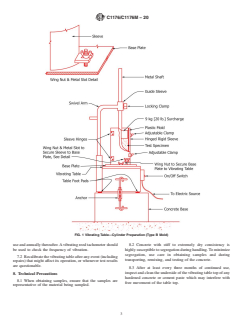
5.1.2.1 Mold Sleeve—A Type B cylindrical mold shall be inserted into a rigid cylindrical sleeve with a bottom baseplate that is
clamped to the vibrating table. The mold sleeve shall be made of steel or other hard metal that does not react with concrete
containing portland or other hydraulic cement. The sleeve shall hold firmly the plastic mold without deforming it so that it is
vertical and shall be slotted vertically with adjustable clamps for tightening around the mold. The sleeve shall be hinged so that
it can be opened to remove the mold (Fig. 1) and shall also have permanently affixed slotted metal brackets so the sleeve may be
rigidly clamped to the vibrating table. The mold sleeve shall have a minimum wall thickness of 3 mm [ ⁄8 in.], and a minimum
1 1 1
baseplate thickness of 6 mm [ ⁄4 in.]. The inside diameter of the mold sleeve shall be 3 6 1.5 mm [ ⁄8 6 ⁄16 in.] larger than the
1 1
outside diameter of the Type B mold and have a height 6 to 13 mm [ ⁄4 to ⁄2 in.] less than the height of the Type B mold.
5.2 Vebe Table—A vibrating table with a 20-mm [ ⁄4-in.] thick steel deck with dimensions of approximately 380 mm [15 in.] in
length, 250 mm [10 in.] in width, and 300 mm [12 in.] in height. The vibrating table shall be constructed in such a manner as to
prevent flexing of the table during operation. The table deck shall be activated by an electromechanical vibrator. The total mass
of the vibrator and table shall be approximately 90 kg [200 lb]. The table shall be level and clamped to a concrete floor or base
slab that has sufficient mass to prevent displacement of the apparatus during specimen preparation (Note 2).
For referenced ASTM standards, visit the ASTM website, www.astm.org, or contact ASTM Customer Service at service@astm.org. For Annual Book of ASTM Standards
volume information, refer to the standard’s Document Summary page on the ASTM website.
ACI Manual of Concrete Practice, Part 1, Materials and General Properties of Concrete, 2005, American Concrete Institute (ACI), P.O. Box 9094, Farmington Hills,
MI 48333.
C1176/C1176M − 20
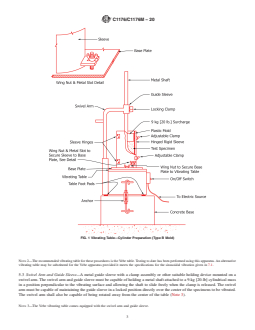
FIG. 1 Vibrating Table—Cylinder Preparation (Type B Mold)
NOTE 2—The recommended vibrating table for these procedures is the Vebe table. Testing to date has been performed using this apparatus. An alternative
vibrating table may be substituted for the Vebe apparatus provided it meets the specifications for the sinusoidal vibration given in 7.1.
5.3 Swivel Arm and Guide Sleeve—A metal guide sleeve with a clamp assembly or other suitable holding device mounted on a
swivel arm. The swivel arm and guide sleeve must be capable of holding a metal shaft attached to a 9-kg [20-lb] cylindrical mass
in a position perpendicular to the vibrating surface and allowing the shaft to slide freely when the clamp is released. The swivel
arm must be capable of maintaining the guide sleeve in a locked position directly over the center of the specimens to be vibrated.
The swivel arm shall also be capable of being rotated away from the center of the table (Note 3).
NOTE 3—The Vebe vibrating table comes equipped with the swivel arm and guide sleeve.
C1176/C1176M − 20
5 1
5.4 Surcharge—A cylindrical steel mass with a metal shaft at least 460 mm [18 in.] in length and 16 6 2 mm [ ⁄8 6 ⁄16 in.] in
diameter attached perpendicularly to and embedded in the center of the mass. The shaft shall slide through the guide sleeve without
3 1
binding. The surcharge shall have a diameter of 145 6 3 mm [5 ⁄4 6 ⁄8 in.]. The surcharge assembly shall have a mass of
9.0 6 0.25 kg [20 6 0.5 lb] including the mass of the metal shaft (Fig. 1). If the surcharge is to be hand held, the length of the
shaft may be reduced to about 300
...