

ASTM A159-83(2020)
(Specification)Standard Specification for Automotive Gray Iron Castings
General Information
- Abstract
ABSTRACT
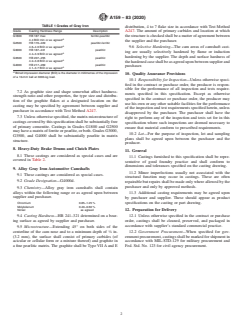
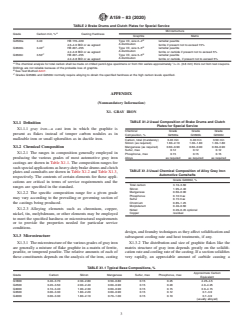
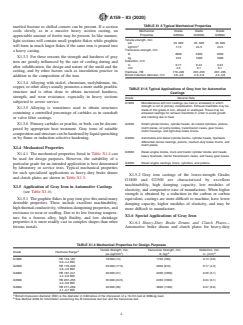
This specification covers gray iron castings for products of the automobile, truck, tractor and allied industries. The materials shall be classified into eight grades (G1800, G2500, G3000, G3500, G4000, G2500a, G3500b and G3500c) based on the range of their casting hardness, chemical composition and microstructure. Grades G1800 and G2500 shall be annealed. Alloy gray iron automotive camshafts of grade designation G4000d shall conform to the required values of casting hardness, chemical compositions of chromium, molybdenum, and nickel and microstructure. The cam areas of camshaft casting shall undergo selective hardening by flame or induction hardening and shall conform to the required values of depth and surface hardness.
SCOPE
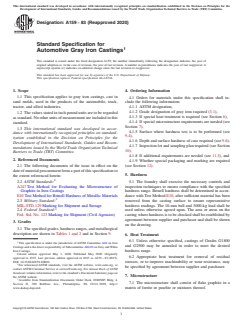
1.1 This specification applies to gray iron castings, cast in sand molds, used in the products of the automobile, truck, tractor, and allied industries.
1.2 The values stated in inch-pound units are to be regarded as standard. No other units of measurement are included in this standard.
1.3 This international standard was developed in accordance with internationally recognized principles on standardization established in the Decision on Principles for the Development of International Standards, Guides and Recommendations issued by the World Trade Organization Technical Barriers to Trade (TBT) Committee.
- Status
- Published
- Publication Date
- 30-Apr-2020
- Technical Committee
- A04 - Iron Castings
- Drafting Committee
- A04.01 - Grey and White Iron Castings
Overview
ASTM A159-83(2020) is the globally recognized standard specification developed by ASTM International for automotive gray iron castings. This specification provides requirements for the composition, microstructure, and mechanical properties of gray iron castings used in the automotive, truck, tractor, and allied industries. Covering eight grades of gray iron, ASTM A159 is an essential reference for manufacturers, suppliers, and purchasers who require consistency and quality in gray iron components for vehicles.
This international standard ensures that castings produced in accordance with its requirements deliver the expected performance in terms of durability, machinability, and resistance to wear. It also aligns with internationally accepted principles as outlined by the World Trade Organization Technical Barriers to Trade (TBT) Committee.
Key Topics
- Coverage and Scope: ASTM A159 applies to gray iron castings made in sand molds, typically used in automotive applications such as engine blocks, cylinder heads, brake drums, camshafts, clutch plates, and transmission cases.
- Classification by Grades: The standard defines eight grades (G1800, G2500, G3000, G3500, G4000, G2500a, G3500b, G3500c), distinguished by their casting hardness, chemical composition, and microstructure.
- Grades G1800 and G2500: Annealed for specific applications requiring machinability or stress relief.
- Special cases include alloy gray iron camshafts (G4000d) and heavy-duty brake drums and clutch plates (G2500a, G3500b, G3500c).
- Mechanical and Physical Properties: Specifications include Brinell hardness ranges, graphite flake size and distribution, and allowable materials for alloying such as chromium, molybdenum, and nickel.
- Ordering Information: Orders must specify ASTM designation, grade, special heat treatments or microstructure requirements, hardness test locations, and any additional purchaser needs.
- Inspection and Quality Assurance: The standard outlines responsibilities for inspection, sampling plans, and control of hardness, microstructure, and dimensions to ensure compliance.
Applications
ASTM A159-compliant gray iron castings are integral to the automotive sector due to their unique combination of properties:
- Engine Components: Cylinder blocks, heads, oil pump bodies, liners, and pistons benefit from the excellent machinability and vibration-dampening of gray iron.
- Drivetrain Parts: Flywheels, clutch housings, transmission cases, and differential carriers are often specified to various ASTM A159 grades based on required strength and wear resistance.
- Braking Systems: Heavy-duty brake drums and clutch plates require specific grades with high thermal shock resistance and controlled hardness to endure demanding conditions.
- Camshafts and Special Parts: Alloy grades and specialized hardening (e.g., induction or flame hardening for cam areas) ensure durability and longevity in camshafts and valve lifters.
- Agricultural and Heavy Equipment: Tractor and truck castings use designated grades to ensure longevity and structural integrity.
Key benefits of using ASTM A159 gray iron castings include:
- Consistent quality and performance
- Enhanced machinability
- Adaptability for complex automotive shapes
- Superior vibration damping and heat resistance
- Streamlined supply chain through standardization
Related Standards
Organizations and manufacturers referring to ASTM A159-83(2020) should also be aware of related standards for testing and marking:
- ASTM A247: Evaluating the microstructure of graphite in iron castings
- ASTM E10: Brinell hardness testing of metallic materials
- MIL-STD-129: Marking for military shipment and storage
- Fed. Std. No. 123: Civil agency shipment marking
Other related international standards cover testing methods, material certifications, and additional requirements for iron and steel castings used across the automotive supply chain.
Keywords: ASTM A159, automotive gray iron castings, iron casting specification, casting hardness, automotive engine blocks, camshaft castings, brake drum castings, gray iron grades, ASTM International, sand mold casting, microstructure requirements, foundry standards, automotive components, mechanical properties, international standard.
Relations
- Effective Date
- 01-May-2020
- Effective Date
- 01-Apr-2024
- Refers
ASTM A247-19 - Standard Test Method for Evaluating the Microstructure of Graphite in Iron Castings - Effective Date
- 01-Mar-2019
- Refers
ASTM A247-17 - Standard Test Method for Evaluating the Microstructure of Graphite in Iron Castings - Effective Date
- 01-Jul-2017
- Refers
ASTM A247-16a - Standard Test Method for Evaluating the Microstructure of Graphite in Iron Castings - Effective Date
- 01-Apr-2016
- Refers
ASTM A247-16 - Standard Test Method for Evaluating the Microstructure of Graphite in Iron Castings - Effective Date
- 15-Mar-2016
- Effective Date
- 01-May-2014
- Effective Date
- 01-Jan-2012
- Effective Date
- 01-Jun-2010
- Refers
ASTM A247-10 - Standard Test Method for Evaluating the Microstructure of Graphite in Iron Castings - Effective Date
- 01-Mar-2010
- Effective Date
- 01-Dec-2008
- Effective Date
- 01-Apr-2007
- Effective Date
- 01-Jan-2007
- Effective Date
- 01-Jan-2007
- Refers
ASTM A247-06e1 - Standard Test Method for Evaluating the Microstructure of Graphite in Iron Castings - Effective Date
- 15-Nov-2006
Get Certified
Connect with accredited certification bodies for this standard

Element Materials Technology
Materials testing and product certification.

Inštitut za kovinske materiale in tehnologije
Institute of Metals and Technology. Materials testing, metallurgical analysis, NDT.
Sponsored listings
Frequently Asked Questions
ASTM A159-83(2020) is a technical specification published by ASTM International. Its full title is "Standard Specification for Automotive Gray Iron Castings". This standard covers: ABSTRACT This specification covers gray iron castings for products of the automobile, truck, tractor and allied industries. The materials shall be classified into eight grades (G1800, G2500, G3000, G3500, G4000, G2500a, G3500b and G3500c) based on the range of their casting hardness, chemical composition and microstructure. Grades G1800 and G2500 shall be annealed. Alloy gray iron automotive camshafts of grade designation G4000d shall conform to the required values of casting hardness, chemical compositions of chromium, molybdenum, and nickel and microstructure. The cam areas of camshaft casting shall undergo selective hardening by flame or induction hardening and shall conform to the required values of depth and surface hardness. SCOPE 1.1 This specification applies to gray iron castings, cast in sand molds, used in the products of the automobile, truck, tractor, and allied industries. 1.2 The values stated in inch-pound units are to be regarded as standard. No other units of measurement are included in this standard. 1.3 This international standard was developed in accordance with internationally recognized principles on standardization established in the Decision on Principles for the Development of International Standards, Guides and Recommendations issued by the World Trade Organization Technical Barriers to Trade (TBT) Committee.
ABSTRACT This specification covers gray iron castings for products of the automobile, truck, tractor and allied industries. The materials shall be classified into eight grades (G1800, G2500, G3000, G3500, G4000, G2500a, G3500b and G3500c) based on the range of their casting hardness, chemical composition and microstructure. Grades G1800 and G2500 shall be annealed. Alloy gray iron automotive camshafts of grade designation G4000d shall conform to the required values of casting hardness, chemical compositions of chromium, molybdenum, and nickel and microstructure. The cam areas of camshaft casting shall undergo selective hardening by flame or induction hardening and shall conform to the required values of depth and surface hardness. SCOPE 1.1 This specification applies to gray iron castings, cast in sand molds, used in the products of the automobile, truck, tractor, and allied industries. 1.2 The values stated in inch-pound units are to be regarded as standard. No other units of measurement are included in this standard. 1.3 This international standard was developed in accordance with internationally recognized principles on standardization established in the Decision on Principles for the Development of International Standards, Guides and Recommendations issued by the World Trade Organization Technical Barriers to Trade (TBT) Committee.
ASTM A159-83(2020) is classified under the following ICS (International Classification for Standards) categories: 77.140.80 - Iron and steel castings. The ICS classification helps identify the subject area and facilitates finding related standards.
ASTM A159-83(2020) has the following relationships with other standards: It is inter standard links to ASTM A159-83(2015), ASTM A247-24, ASTM A247-19, ASTM A247-17, ASTM A247-16a, ASTM A247-16, ASTM E10-14, ASTM E10-12, ASTM E10-10, ASTM A247-10, ASTM E10-08, ASTM E10-07a, ASTM E10-07e1, ASTM E10-07, ASTM A247-06e1. Understanding these relationships helps ensure you are using the most current and applicable version of the standard.
ASTM A159-83(2020) is available in PDF format for immediate download after purchase. The document can be added to your cart and obtained through the secure checkout process. Digital delivery ensures instant access to the complete standard document.
Standards Content (Sample)
This international standard was developed in accordance with internationally recognized principles on standardization established in the Decision on Principles for the
Development of International Standards, Guides and Recommendations issued by the World Trade Organization Technical Barriers to Trade (TBT) Committee.
Designation:A159 −83 (Reapproved 2020)
Standard Specification for
Automotive Gray Iron Castings
This standard is issued under the fixed designation A159; the number immediately following the designation indicates the year of
original adoption or, in the case of revision, the year of last revision. A number in parentheses indicates the year of last reapproval. A
superscript epsilon (´) indicates an editorial change since the last revision or reapproval.
This standard has been approved for use by agencies of the U.S. Department of Defense.
This specification replaces Federal specification AA-I-653A.
1. Scope 4. Ordering Information
1.1 This specification applies to gray iron castings, cast in
4.1 Orders for materials under this specification shall in-
sand molds, used in the products of the automobile, truck, clude the following information:
tractor, and allied industries.
4.1.1 ASTM designation,
4.1.2 Grade designation of gray iron required (3.1),
1.2 The values stated in inch-pound units are to be regarded
4.1.3 If special heat treatment is required (see Section 6),
as standard. No other units of measurement are included in this
4.1.4 If special microstructure requirements are needed (see
standard.
Section 7),
1.3 This international standard was developed in accor-
4.1.5 Surface where hardness test is to be performed (see
dance with internationally recognized principles on standard-
9.4),
ization established in the Decision on Principles for the
4.1.6 Depth and surface hardness of case required (see 9.6),
Development of International Standards, Guides and Recom-
4.1.7 Inspection lot and sampling plan required (see Section
mendations issued by the World Trade Organization Technical
10),
Barriers to Trade (TBT) Committee.
4.1.8 If additional requirements are needed (see 11.3), and
2. Referenced Documents
4.1.9 Whether special packaging and marking are required
(see Section 12).
2.1 The following documents of the issue in effect on the
dateofmaterialprocurementformapartofthisspecificationto
the extent referenced herein: 5. Hardness
2.2 ASTM Standards: 5.1 The foundry shall exercise the necessary controls and
A247 Test Method for Evaluating the Microstructure of inspection techniques to ensure compliance with the specified
Graphite in Iron Castings hardness range. Brinell hardness shall be determined in accor-
E10 Test Method for Brinell Hardness of Metallic Materials dance with Test Method E10, after sufficient material has been
2.3 Military Standard: removed from the casting surface to ensure representative
MIL-STD-129 Marking for Shipment and Storage hardness readings. The 10-mm ball and 3000-kg load shall be
2.4 Federal Standard: used unless otherwise agreed upon. The area or areas on the
Fed. Std. No. 123 Marking for Shipment (Civil Agencies)
casting where hardness is to be checked shall be established by
agreement between supplier and purchaser and shall be shown
3. Grades
on the drawing.
3.1 The specified grades, hardness ranges, and metallurgical
description are shown in Tables 1 and 2 and in Section 9.
6. Heat Treatment
6.1 Unless otherwise specified, castings of Grades G1800
This specification is under the jurisdiction of ASTM Committee A04 on Iron
and G2500 may be annealed in order to meet the desired
CastingsandisthedirectresponsibilityofSubcommitteeA04.01onGreyandWhite
Iron Castings.
hardness range.
Current edition approved May 1, 2020. Published May 2020. Originally
6.2 Appropriate heat treatment for removal of residual
approved in 1935. Last previous edition approved in 2015 as A159 – 83 (2015).
DOI: 10.1520/A0159-83R20.
stresses, or to improve machinability or wear resistance, may
For referenced ASTM standards, visit the ASTM website, www.astm.org, or
be specified by agreement between supplier and purchaser.
contact ASTM Customer Service at service@astm.org. For Annual Book of ASTM
Standards volume information, refer to the standard’s Document Summary page on
the ASTM website. 7. Microstructure
Available from Standardization Documents Order Desk, DODSSP, Bldg. 4,
7.1 The microstructure shall consist of flake graphite in a
Section D, 700 Robbins Ave., Philadelphia, PA 19111-5098, http://
www.dodssp.daps.mil. matrix of ferrite or pearlite or mixtures thereof.
Copyright © ASTM International, 100 Barr Harbor Drive, PO Box C700, West Conshohocken, PA 19428-2959. United States
A159−83 (2020)
TABLE 1 Grades of Gray Iron
distribution, 4 to 7 flake size in accordance with Test Method
Grade Casting Hardness Range Description A247. The amount of primary carbides and location at which
G1800 HB 187 max ferritic-pearlitic the structure is checked shall be a matter of agreement between
A
4.4 BID min or as agreed
the supplier and the purchaser.
G2500 HB 170–229 pearlitic-ferritic
A
4.6–4.0 BID or as agreed
9.6 Selective Hardening—The cam areas of camshaft cast-
G3000 HB 187–241 pearlitic
ing are usually selectively hardened by flame or induction
A
4.4–3.9 BID or as agreed
hardening by the supplier. The depth and surface hardness of
G3500 HB 207–255 pearlitic
A
4.2–3.8 BID or as agreed
thehardenedcaseshallbeasagreeduponbetweensupplierand
G4000 HB 217–269 pearlitic
purchaser.
A
4.1–3.7 BID or as agreed
A
Brinell impression diameter (BID) is the diameter in millimetres of the impression 10. Quality Assurance Provisions
of a 10-mm ball at 3000-kg load.
10.1 Responsibility for Inspection—Unless otherwise speci-
fied in the contract or purchase order, the producer is respon-
sible for the performance of all inspection and tests require-
7.2 As graphite size and shape somewhat affect hardness-
ments specified in this specification. Except as otherwise
strength ratio and other properties, the type size and distribu-
specified in the contract or purchase order, the producer may
tion of the graphite flakes at a designated location on the
use his own or any other suitable facilities for the performance
casting may be specified by agreement between supplier and
of the inspection and test requirements specified herein, unless
purchaser in accordance with Test Method A247.
disapproved by the purchaser. The purchaser shall have the
7.3 Unless otherwise specified, the matrix microstructure of
right to perform any of the inspection and tests set for in this
castingscoveredbythisspecificationshallbesubstantiallyfree
specification where such inspections are deemed necessary to
of primary cementite. Castings in Grades G1800 and G2500
ensure that material conform to prescribed requirements.
mayhaveamatrixofferriteorpearlite,orboth.GradesG3000,
10.2 Lot—For the purpose of inspection, lot and sampling
G3500, and G4000 shall be substantially pearlite in matrix
plans shall be agreed upon between the purchaser and the
structure.
producer.
8. Heavy-Duty Brake Drums and Clutch Plates
11. General
8.1 These castings are considered as special cases and are
11.1 Castings furnished to this specification shall be repre-
covered in Table 2.
sentative of good foundry practice and shall conform to
dimensions and tolerances specified on the casting drawing.
9. Alloy Gray Iron Automotive Camshafts
11.2 Minor imperfections usually not associated with the
9.1 These castings are considered as special cases.
structural function may occur in castings. These are often
9.2 Grade Designation—G4000d.
repairable but repairs shall be made only where allowed by the
purchaser and only by approved methods.
9.3 Chemistry—Alloy gray iron camshafts shall contain
alloys within the following range or as agreed upon between
11.3 Additional casting requirements may be agreed upon
supplier and purchaser.
by purchaser and supplier. These should appear as product
specifications on the casting or part drawing.
Chromium 0.85–1.25 %
Molybdenum 0.40–0.60 %
Nickel as agreed 12. Preparation for Delivery
9.4 Casting Hardness—HB 241–321 determined on a bear-
12.1 Unless otherwise specified in the contract or purchase
ing surface as agreed by supplier and purchaser.
order, castings shall be cleaned, preserved, and packaged in
accordance with supplier’s standard commercial practice.
9.5 Microstructure—Extending 45° on both sides of the
centerline of the cam nose and to a minimum depth of ⁄8 in. 12.2 Government Procurement—When specified for gov-
(3.2 mm), the surface shall consist of primary carbides (of ernment procurement, castings shall be marked for shipment in
acicular or cellular form or a mixture thereof) and graphite in accordance with MIL-STD-129 for military procurement and
a fine pearlitic matrix. The graphite shall be Type VIIAand E Fed. Std. No. 123 for civil agency procurement.
A159−83 (2020)
TABLE 2 Brake Drums and Clutch Plates for Special Service
Microstructure
A
Grade Carbon min, % Casting Hardness
Graphite Matrix
B
G2500a 3.40 HB 170–229 Type VII, size 2–4 lamellar pearlite
A distribution
4.6–4.0 BID or as agreed ferrite if present not to exceed 15%
C B
G3500b 3.40 HB 207–255 Type VII, size 3–5 lamellar pearlite
A distribution
4.2–3.8 BID or as agreed ferrite or carbide if present not to exceed 5%
C B
G3500c 3.50 HB 207–255 Type VII, size 3–5 lamellar pearlite
A distribution
4.2–3.8 BID or as agreed ferrite or carbide, if present not to exceed 5%
A
The chemical analysis for total carbon shall be made on chilled pencil-type specimens or from thin wafers approximately ⁄32 in. (0.8 mm) thick cut from test coupons.
Drillings are not reliable because of the probable loss of graphite.
B
See Test Method A247.
C
Grades G3500b and G3500c normally require alloying to obtain the specified hardness at the high carbon levels specified.
APPENDIX
(Nonmandatory Information)
X1. GRAY IRON
TABLE X1.2 Usual Composition of Brake Drums and Clutch
X1.1 Definition
Plates for Special Service
X1.1.1 gray iron—a cast iron in which the graphite is
Chemical Grade Grade Grade
present as flakes instead of temper carbon nodules as in
Composition, % G2500a G3500b G3500c
malleable iron or small spherulites as in ductile iron.
Carbon, total (mandatory) 3.40 min 3.40 min 3.50 min
Silicon (as required) 1.60–2.10 1.30–1.80 1.30–1.80
X1.2 Chemical Composition Manganese (as required) 0.60–0.90 0.60–0.90 0.60–0.90
Sulfur, max 0.12 0.12 0.12
X1.2.1 The ranges in composition generally employed in
Phosphorus, max 0.15 0.15 0.15
Alloys as required as required as required
producing the various grades of most automotive gray iron
castings are shown in Table X1.1. The composition ranges for
suchspecialapplicationsasheavy-dutybrakedrumsandclutch
TABLE X1.3 Usual Chemical Composition of Alloy Gray Iron
plates and camshafts are shown in Table X1.2 and Table X1.3,
Automotive Camshafts
respectively. The contents of certain elements for these appli-
Grade G4000d, %
cations are critical in terms of service requirements and
...