

ASTM D83-84(2020)
(Specification)Standard Specification for Red Lead Pigment
General Information
- Abstract
ABSTRACT
This specification covers four grades of red pigment commercially known as red lead. The pigment may be purchased in the dry form or as a paste in oil. Chemical analysis and coarse particle shall be tested to meet the requirements prescribed. Pigment, linseed oil, and moisture and other volatile matter in paste in oil shall be tested to meet the requirements prescribed.
SCOPE
1.1 This specification covers four grades of red pigment commercially known as red lead. The pigment may be purchased in the dry form or as a paste in oil.
1.2 The values stated in inch-pound units are to be regarded as standard. The values given in parentheses are mathematical conversions to SI units that are provided for information only and are not considered standard.
1.3 This international standard was developed in accordance with internationally recognized principles on standardization established in the Decision on Principles for the Development of International Standards, Guides and Recommendations issued by the World Trade Organization Technical Barriers to Trade (TBT) Committee.
- Status
- Published
- Publication Date
- 31-May-2020
- Technical Committee
- D01 - Paint and Related Coatings, Materials, and Applications
- Drafting Committee
- D01.31 - Pigment Specifications


Overview
ASTM D83-84(2020): Standard Specification for Red Lead Pigment is an international standard developed by ASTM International. This specification covers four commercial grades of red lead pigment (also known as lead tetra oxide or Pb₃O₄), which can be purchased in dry form or as a paste in oil. The document defines the requirements for chemical composition, physical properties, and testing methods to ensure product consistency, quality, and performance for industrial applications. This standard aligns with global best practices in standardization and is recognized under the WTO Technical Barriers to Trade (TBT) principles.
Key Topics
- Grades of Red Lead Pigment: The specification includes four grades, differentiated by purity (85%, 95%, 97%, and 98% minimum content of red lead).
- Product Forms: Red lead can be supplied as a dry powder or as a paste in linseed oil, each with specific requirements for composition and storage.
- Testing and Quality Control:
- Chemical analysis must verify compliance with red lead content, impurity limits, and lead monoxide content.
- Coarse particle size is measured to ensure pigment fineness using standardized sieve tests.
- For pastes, moisture, volatile matter, and oil content are tested to maintain consistent application properties.
- Sampling Requirements: Sampling procedures are specified to ensure representative quality checks across production batches.
- Paint Formulation Guidance: The standard offers typical mixing ratios for preparing paint from red lead pigment or paste, emphasizing application quality such as drying to a hard, elastic film without defects.
Applications
Red lead pigment specified under ASTM D83-84(2020) is primarily used in protective coating systems, particularly for steel and iron structures. Common applications include:
- Anti-corrosive Paints: Red lead provides effective corrosion resistance, making it widely used in primers for bridges, pipelines, ship hulls, and marine infrastructure.
- Industrial Coatings: Suitable for long-lasting surface protection in harsh environments, such as chemical plants, refineries, and power stations.
- Historic and Restoration Work: The specification supports consistent pigment properties necessary for traditional methods and repair of historic buildings or machinery.
In both dry and paste forms, adherence to this ASTM standard ensures product reliability, compatibility with linseed oil-based paint systems, and predictable performance during application and storage.
Related Standards
- ASTM D49: Test Methods of Chemical Analysis of Red Lead - referenced for chemical composition validation.
- ASTM D185: Test Methods for Coarse Particles in Pigments - used to assess particle size distribution.
- ASTM D1208: Test Methods for Common Properties of Certain Pigments - applied for testing pigment, oil, and moisture/volatile matter content in paste products.
These referenced standards are critical for laboratories and quality assurance teams conducting compliance testing on red lead pigment products as specified in ASTM D83-84(2020).
By adhering to ASTM D83-84(2020), manufacturers and end users ensure that red lead pigment supplied for industrial and protective coatings meets recognized international quality benchmarks, promoting safety, durability, and regulatory compliance across diverse applications.
Relations
- Effective Date
- 01-Jun-2020
- Effective Date
- 01-Jun-2020
- Effective Date
- 01-Jun-2019
- Effective Date
- 01-Dec-2014
- Effective Date
- 01-Nov-2012
- Effective Date
- 01-Jul-2008
- Effective Date
- 01-Jul-2007
- Effective Date
- 01-Jun-2007
- Refers
ASTM D185-84(1999) - Standard Test Methods for Coarse Particles in Pigments, Pastes, and Paints - Effective Date
- 10-May-1999
- Effective Date
- 10-Nov-1996
- Effective Date
- 10-Nov-1996
- Effective Date
- 01-Jan-1996
- Effective Date
- 20-Dec-1983
Frequently Asked Questions
ASTM D83-84(2020) is a technical specification published by ASTM International. Its full title is "Standard Specification for Red Lead Pigment". This standard covers: ABSTRACT This specification covers four grades of red pigment commercially known as red lead. The pigment may be purchased in the dry form or as a paste in oil. Chemical analysis and coarse particle shall be tested to meet the requirements prescribed. Pigment, linseed oil, and moisture and other volatile matter in paste in oil shall be tested to meet the requirements prescribed. SCOPE 1.1 This specification covers four grades of red pigment commercially known as red lead. The pigment may be purchased in the dry form or as a paste in oil. 1.2 The values stated in inch-pound units are to be regarded as standard. The values given in parentheses are mathematical conversions to SI units that are provided for information only and are not considered standard. 1.3 This international standard was developed in accordance with internationally recognized principles on standardization established in the Decision on Principles for the Development of International Standards, Guides and Recommendations issued by the World Trade Organization Technical Barriers to Trade (TBT) Committee.
ABSTRACT This specification covers four grades of red pigment commercially known as red lead. The pigment may be purchased in the dry form or as a paste in oil. Chemical analysis and coarse particle shall be tested to meet the requirements prescribed. Pigment, linseed oil, and moisture and other volatile matter in paste in oil shall be tested to meet the requirements prescribed. SCOPE 1.1 This specification covers four grades of red pigment commercially known as red lead. The pigment may be purchased in the dry form or as a paste in oil. 1.2 The values stated in inch-pound units are to be regarded as standard. The values given in parentheses are mathematical conversions to SI units that are provided for information only and are not considered standard. 1.3 This international standard was developed in accordance with internationally recognized principles on standardization established in the Decision on Principles for the Development of International Standards, Guides and Recommendations issued by the World Trade Organization Technical Barriers to Trade (TBT) Committee.
ASTM D83-84(2020) is classified under the following ICS (International Classification for Standards) categories: 87.060.10 - Pigments and extenders. The ICS classification helps identify the subject area and facilitates finding related standards.
ASTM D83-84(2020) has the following relationships with other standards: It is inter standard links to ASTM D83-84(2014), ASTM D49-83(2020), ASTM D1208-96(2019), ASTM D49-83(2014), ASTM D1208-96(2012), ASTM D49-83(2008)e1, ASTM D185-07, ASTM D1208-96(2007), ASTM D185-84(1999), ASTM D1208-96, ASTM D1208-96(2002), ASTM D49-83(1996)e1, ASTM D49-83(2002). Understanding these relationships helps ensure you are using the most current and applicable version of the standard.
ASTM D83-84(2020) is available in PDF format for immediate download after purchase. The document can be added to your cart and obtained through the secure checkout process. Digital delivery ensures instant access to the complete standard document.
Standards Content (Sample)
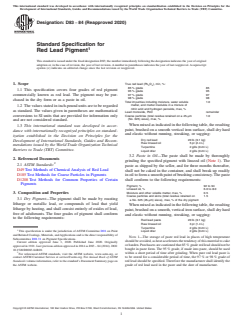
This international standard was developed in accordance with internationally recognized principles on standardization established in the Decision on Principles for the
Development of International Standards, Guides and Recommendations issued by the World Trade Organization Technical Barriers to Trade (TBT) Committee.
Designation: D83 −84 (Reapproved 2020)
Standard Specification for
Red Lead Pigment
This standard is issued under the fixed designation D83; the number immediately following the designation indicates the year of original
adoption or, in the case of revision, the year of last revision.Anumber in parentheses indicates the year of last reapproval.Asuperscript
epsilon (´) indicates an editorial change since the last revision or reapproval.
1. Scope
True red lead (Pb O ), min, %:
3 4
85 % grade 85
1.1 This specification covers four grades of red pigment
95 % grade 95
commercially known as red lead. The pigment may be pur- 97 % grade 97
98 % grade 98
chased in the dry form or as a paste in oil.
Total impurities including moisture, water soluble 1.0
matter, and matter insoluble in a mixture of
1.2 The values stated in inch-pound units are to be regarded
nitric acid and hydrogen peroxide, max, %
as standard. The values given in parentheses are mathematical
Lead monoxide, PbO remainder
conversions to SI units that are provided for information only
Coarse particles (total residue retained on a 45-µm 1.0
(No. 325) sieve), max, %
and are not considered standard.
Whenmixedasindicatedinthefollowingtable,theresulting
1.3 This international standard was developed in accor-
paint, brushed on a smooth vertical iron surface, shall dry hard
dance with internationally recognized principles on standard-
and elastic without running, streaking, or sagging:
ization established in the Decision on Principles for the
Dry red lead 20 lb (9.1 kg)
Development of International Standards, Guides and Recom-
Raw linseed oil 5 pt (2.4 L)
mendations issued by the World Trade Organization Technical
Turpentine 2 gills (0.24 L)
Barriers to Trade (TBT) Committee.
Liquid drier 2 gills (0.24 L)
3.2 Paste in Oil—The paste shall be made by thoroughly
2. Referenced Documents
grinding the specified pigment with linseed oil (Note 1). The
2.1 ASTM Standards:
paste as shipped by the seller, and for three months thereafter,
D49 Test Methods of Chemical Analysis of Red Lead
shall not be caked in the container, and shall break up readily
D185 Test Methods for Coarse Particles in Pigments
inoiltoformasmoothpaintofbrushingconsistency.Thepaste
D1208 Test Methods for Common Properties of Certain
shall conform to the following requirements:
Pigments
Pigment, % 92 to 94
Linseed oil, % 6.0 to 8.0
3. Composition and Properties Moisture and other volatile matter, max, % 0.5
Coarse particles and skins (total residue retained on 1.5
3.1 Dry Pigment—The pigment shall be made by roasting
a No. 325 (45-µm) sieve), max, % of the dry pigment
litharge or metallic lead, or compounds of lead that yield
Whenmixedasindicatedinthefollowingtable,theresulting
litharge by heating, and shall consist entirely of oxides of lead,
paint, brushed on a smooth, vertical iron surface, shall dry hard
free of adulterants. The four grades of pigment shall conform
and elastic without running, streaking, or sagging:
to the following requirements:
Red lead paste 20 lb (9.1 kg)
Raw linseed oil 3 pt (1.4 L)
Turpentine 2 gills (0.24 L)
This specification is under the jurisdiction of ASTM Committee D01 on Paint Liquid drier 2 gills (0.24 L)
and Related Coatings, Materials, andApplications and is the direct responsibility of
NOTE 1—The storage of paste red lead in places of high temperature
Subcommittee D01.31 on Pigment S
...