

ASTM D8148-22
(Test Method)Standard Test Method for Spectroscopic Determination of Haze in Fuels
General Information
- Abstract
SIGNIFICANCE AND USE
5.1 It has long been the practice to include in fuel specifications a requirement that the fuel is clear and bright.
5.2 One primary cause for failure to meet this specification requirement is the occurrence of a cloudy or hazy appearance caused by suspended solid particulates or water or some combination of both.
5.2.1 This cloudiness or haze can range from barely visible to opaque.
5.3 This test method provides an objective analytical means for providing a haze rating that does not depend on subjective visual ratings that typically vary with operator and lighting conditions.
SCOPE
1.1 This test method covers a spectroscopic procedure for determining the level of suspended water and particulate contamination (haze) in liquid middle distillate fuels including those blended with synthesized hydrocarbons or biofuels.
1.1.1 An ordinal, whole-number, Instrument Haze Rating (IHR) from 1 to 6 and a Haze Clarity Index (HCI) from 50.0 to 100.0 are determined on a test specimen at a temperature of 22.0 °C ± 2.0 °C.
1.1.1.1 The stated precision only applies at this temperature.
1.1.1.2 Fuels analyzed at other test specimen temperatures may not be as precise.
1.2 The values stated in SI units are to be regarded as standard. Other units of measurement included in this standard are defined in Section 3.
1.3 This standard does not purport to address all of the safety concerns, if any, associated with its use. It is the responsibility of the user of this standard to establish appropriate safety, health, and environmental practices and determine the applicability of regulatory limitations prior to use.
1.4 This international standard was developed in accordance with internationally recognized principles on standardization established in the Decision on Principles for the Development of International Standards, Guides and Recommendations issued by the World Trade Organization Technical Barriers to Trade (TBT) Committee.
- Status
- Published
- Publication Date
- 31-Mar-2022
- Technical Committee
- D02 - Petroleum Products, Liquid Fuels, and Lubricants
- Drafting Committee
- D02.14 - Stability, Cleanliness and Compatibility of Liquid Fuels
Overview
ASTM D8148-22: Standard Test Method for Spectroscopic Determination of Haze in Fuels is a test method developed by ASTM International. This standard provides a spectroscopic procedure to objectively determine the level of suspended water and particulate contamination-referred to as "haze"-in liquid middle distillate fuels, including those blended with synthesized hydrocarbons or biofuels. Clear and bright fuels are a longstanding requirement in fuel specifications, as haze can impair fuel performance and handling. By utilizing optical and nephelometric principles, this test method delivers precise, operator-independent ratings, helping organizations meet quality and regulatory requirements.
Key Topics
- Objective Haze Measurement: Unlike traditional visual inspections that are subject to operator and lighting variability, ASTM D8148-22 provides an analytical, standardized haze rating using spectroscopic assessment.
- Instrument Haze Rating (IHR): The method assigns a whole-number rating from 1 (clear) to 6 (very hazy or opaque), corresponding to established visual rating schemes.
- Haze Clarity Index (HCI): This quantified index ranges from 50.0 to 100.0, offering finer discrimination of haze intensity within each IHR.
- Controlled Test Conditions: The test is conducted at 22.0 °C ± 2.0 °C for optimal accuracy, though other temperatures can be used with reduced precision.
- Applicability to Biofuel and Synthetic Blends: ASTM D8148-22 supports a wide range of fuel types, including those blended with synthesized hydrocarbons and biofuels, aligning with trends in sustainable fuel development.
- Quality Assurance: Daily calibration and quality control steps are prescribed, using standardized reference materials and calibration sets, ensuring both reliability and repeatability.
Applications
The ASTM D8148-22 haze determination method is widely applicable in the petroleum, transportation, and energy sectors, where fuel cleanliness and clarity are critical for:
- Fuel Specification Compliance: Ensuring fuels meet “clear and bright” specifications before distribution or sale.
- Product Quality Assurance: Supporting robust quality control during production, blending, storage, and transfer operations.
- Fuel Handling and Distribution: Preventing operational issues and equipment clogging caused by particulate or water contamination.
- Blended Fuels Analysis: Objective measurement for fuels containing renewable or synthetic components.
- Regulatory Reporting: Providing recognized, traceable test results to meet environmental and trade requirements.
Routine use of ASTM D8148-22 aids refiners, storage terminals, transporters, and fuel retailers in maintaining product integrity, reducing subjectivity, and optimizing operational risk management.
Related Standards
To enhance comprehensive fuel testing and quality assurance, ASTM D8148-22 works in conjunction with several other ASTM standards:
- ASTM D4057: Standard Practice for Manual Sampling of Petroleum and Petroleum Products
- ASTM D4175: Terminology Relating to Petroleum Products, Liquid Fuels, and Lubricants
- ASTM D4176: Test Method for Free Water and Particulate Contamination in Distillate Fuels (Visual Inspection Procedures)
- ASTM D4177: Practice for Automatic Sampling of Petroleum and Petroleum Products
- ASTM D6300: Practice for Determination of Precision and Bias Data for Use in Test Methods for Petroleum Products, Liquid Fuels, and Lubricants
Organizations seeking comprehensive fuel cleanliness and quality management should consider integrating these standards into their quality control frameworks.
Keywords: ASTM D8148-22, haze in fuels, spectroscopic haze determination, fuel clarity, Instrument Haze Rating, Haze Clarity Index, fuel specification, petroleum product quality, fuel contamination, biofuels testing, middle distillate fuels, ASTM standards.
Relations
- Effective Date
- 01-Mar-2024
- Refers
ASTM D4175-23a - Standard Terminology Relating to Petroleum Products, Liquid Fuels, and Lubricants - Effective Date
- 15-Dec-2023
- Effective Date
- 01-Dec-2023
- Refers
ASTM D4175-23e1 - Standard Terminology Relating to Petroleum Products, Liquid Fuels, and Lubricants - Effective Date
- 01-Jul-2023
- Effective Date
- 01-Dec-2019
- Effective Date
- 01-Apr-2016
- Effective Date
- 01-Jun-2015
- Effective Date
- 01-Jun-2014
- Effective Date
- 01-Jun-2014
- Effective Date
- 01-May-2014
- Effective Date
- 01-Dec-2013
- Effective Date
- 15-Jul-2013
- Refers
ASTM D4057-06(2011) - Standard Practice for Manual Sampling of Petroleum and Petroleum Products - Effective Date
- 01-Jun-2011
- Effective Date
- 01-Jun-2009
- Effective Date
- 15-Dec-2008
Get Certified
Connect with accredited certification bodies for this standard

Element Materials Technology
Materials testing and product certification.

ABS Group Brazil
ABS Group certification services in Brazil.

ABS Quality Evaluations Inc.
American Bureau of Shipping quality certification.
Sponsored listings
Frequently Asked Questions
ASTM D8148-22 is a standard published by ASTM International. Its full title is "Standard Test Method for Spectroscopic Determination of Haze in Fuels". This standard covers: SIGNIFICANCE AND USE 5.1 It has long been the practice to include in fuel specifications a requirement that the fuel is clear and bright. 5.2 One primary cause for failure to meet this specification requirement is the occurrence of a cloudy or hazy appearance caused by suspended solid particulates or water or some combination of both. 5.2.1 This cloudiness or haze can range from barely visible to opaque. 5.3 This test method provides an objective analytical means for providing a haze rating that does not depend on subjective visual ratings that typically vary with operator and lighting conditions. SCOPE 1.1 This test method covers a spectroscopic procedure for determining the level of suspended water and particulate contamination (haze) in liquid middle distillate fuels including those blended with synthesized hydrocarbons or biofuels. 1.1.1 An ordinal, whole-number, Instrument Haze Rating (IHR) from 1 to 6 and a Haze Clarity Index (HCI) from 50.0 to 100.0 are determined on a test specimen at a temperature of 22.0 °C ± 2.0 °C. 1.1.1.1 The stated precision only applies at this temperature. 1.1.1.2 Fuels analyzed at other test specimen temperatures may not be as precise. 1.2 The values stated in SI units are to be regarded as standard. Other units of measurement included in this standard are defined in Section 3. 1.3 This standard does not purport to address all of the safety concerns, if any, associated with its use. It is the responsibility of the user of this standard to establish appropriate safety, health, and environmental practices and determine the applicability of regulatory limitations prior to use. 1.4 This international standard was developed in accordance with internationally recognized principles on standardization established in the Decision on Principles for the Development of International Standards, Guides and Recommendations issued by the World Trade Organization Technical Barriers to Trade (TBT) Committee.
SIGNIFICANCE AND USE 5.1 It has long been the practice to include in fuel specifications a requirement that the fuel is clear and bright. 5.2 One primary cause for failure to meet this specification requirement is the occurrence of a cloudy or hazy appearance caused by suspended solid particulates or water or some combination of both. 5.2.1 This cloudiness or haze can range from barely visible to opaque. 5.3 This test method provides an objective analytical means for providing a haze rating that does not depend on subjective visual ratings that typically vary with operator and lighting conditions. SCOPE 1.1 This test method covers a spectroscopic procedure for determining the level of suspended water and particulate contamination (haze) in liquid middle distillate fuels including those blended with synthesized hydrocarbons or biofuels. 1.1.1 An ordinal, whole-number, Instrument Haze Rating (IHR) from 1 to 6 and a Haze Clarity Index (HCI) from 50.0 to 100.0 are determined on a test specimen at a temperature of 22.0 °C ± 2.0 °C. 1.1.1.1 The stated precision only applies at this temperature. 1.1.1.2 Fuels analyzed at other test specimen temperatures may not be as precise. 1.2 The values stated in SI units are to be regarded as standard. Other units of measurement included in this standard are defined in Section 3. 1.3 This standard does not purport to address all of the safety concerns, if any, associated with its use. It is the responsibility of the user of this standard to establish appropriate safety, health, and environmental practices and determine the applicability of regulatory limitations prior to use. 1.4 This international standard was developed in accordance with internationally recognized principles on standardization established in the Decision on Principles for the Development of International Standards, Guides and Recommendations issued by the World Trade Organization Technical Barriers to Trade (TBT) Committee.
ASTM D8148-22 is classified under the following ICS (International Classification for Standards) categories: 75.160.20 - Liquid fuels. The ICS classification helps identify the subject area and facilitates finding related standards.
ASTM D8148-22 has the following relationships with other standards: It is inter standard links to ASTM D6300-24, ASTM D4175-23a, ASTM D6300-23a, ASTM D4175-23e1, ASTM D6300-19a, ASTM D6300-16, ASTM D6300-15, ASTM D6300-14a, ASTM D6300-14ae1, ASTM D6300-14, ASTM D6300-13a, ASTM D6300-13, ASTM D4057-06(2011), ASTM D4176-04(2009), ASTM D6300-08. Understanding these relationships helps ensure you are using the most current and applicable version of the standard.
ASTM D8148-22 is available in PDF format for immediate download after purchase. The document can be added to your cart and obtained through the secure checkout process. Digital delivery ensures instant access to the complete standard document.
Standards Content (Sample)
This international standard was developed in accordance with internationally recognized principles on standardization established in the Decision on Principles for the
Development of International Standards, Guides and Recommendations issued by the World Trade Organization Technical Barriers to Trade (TBT) Committee.
Designation: D8148 − 22
Standard Test Method for
Spectroscopic Determination of Haze in Fuels
This standard is issued under the fixed designation D8148; the number immediately following the designation indicates the year of
original adoption or, in the case of revision, the year of last revision. A number in parentheses indicates the year of last reapproval. A
superscript epsilon (´) indicates an editorial change since the last revision or reapproval.
1. Scope* D4176 Test Method for FreeWater and Particulate Contami-
nation in Distillate Fuels (Visual Inspection Procedures)
1.1 This test method covers a spectroscopic procedure for
D4177 Practice for Automatic Sampling of Petroleum and
determining the level of suspended water and particulate
Petroleum Products
contamination (haze) in liquid middle distillate fuels including
D6300 Practice for Determination of Precision and Bias
those blended with synthesized hydrocarbons or biofuels.
Data for Use in Test Methods for Petroleum Products,
1.1.1 An ordinal, whole-number, Instrument Haze Rating
Liquid Fuels, and Lubricants
(IHR) from 1 to 6 and a Haze Clarity Index (HCI) from 50.0 to
100.0 are determined on a test specimen at a temperature of
3. Terminology
22.0 °C 6 2.0 °C.
1.1.1.1 Thestatedprecisiononlyappliesatthistemperature.
3.1 Definitions—For definitions of terms used in this test
1.1.1.2 Fuels analyzed at other test specimen temperatures method, refer to Terminology D4175.
may not be as precise.
3.2 Definitions of Terms Specific to This Standard:
1.2 The values stated in SI units are to be regarded as 3.2.1 check standard cuvette, n—cuvette containing a certi-
standard. Other units of measurement included in this standard
fied solid semi-transparent material that is used to confirm
are defined in Section 3. instrument operation and calibration.
1.3 This standard does not purport to address all of the
3.2.2 clear-and-bright (also termed clean-and-bright),
safety concerns, if any, associated with its use. It is the adj—aconditioninwhichthefuelisfreeofhazeorcloudiness.
responsibility of the user of this standard to establish appro-
3.2.2.1 Discussion—This clear and bright definition does
priate safety, health, and environmental practices and deter- not consider the presence of visible water droplets or solid
mine the applicability of regulatory limitations prior to use.
particulates and is restricted to the presence of visible haze or
1.4 This international standard was developed in accor- cloudiness in the sample.
dance with internationally recognized principles on standard-
3.2.3 crown glass, n—a type of optical glass having a low
ization established in the Decision on Principles for the
refractive index and low dispersion.
Development of International Standards, Guides and Recom-
3.2.4 cuvette transfer time, n—a user-set timed event that
mendations issued by the World Trade Organization Technical
limits the amount of time the operator has to prepare the test
Barriers to Trade (TBT) Committee.
specimen and instrument for analysis.
3.2.5 Haze Clarity Index (HCI), n—a numerical value from
2. Referenced Documents
50.0 to 100.0 that indicates fuel clarity derived from spectro-
2.1 ASTM Standards:
scopic measurements and an algorithm.
D4057 Practice for Manual Sampling of Petroleum and
3.2.5.1 Discussion—The HCI values increase with sample
Petroleum Products
clarity and ranges from 100.0 HCI (very clear and bright) to
D4175 Terminology Relating to Petroleum Products, Liquid
50.0 HCI (very cloudy and opaque). Accordingly, a fuel with
Fuels, and Lubricants
an HCI value of 90.0 has less haze than a fuel with an HCI
value of 80.0. HCI can be used to evaluate haze intensity
changes within a given IHR.
This test method is under the jurisdiction of ASTM Committee D02 on
Petroleum Products, Liquid Fuels, and Lubricants and is the direct responsibility of 3.2.6 Instrument Haze Rating (IHR), n—an ordinal, whole-
Subcommittee D02.14 on Stability, Cleanliness and Compatibility of Liquid Fuels.
number from 1 to 6, that corresponds to haze ratings defined in
Current edition approved April 1, 2022. Published April 2022. Originally
Test Method D4176, Procedure 2 and is assigned to the test
approved in 2017. Last previous edition approved in 2017 as D8148 – 17. DOI:
specimen based upon spectroscopic measurements and an
10.1520/D8148-22.
For referenced ASTM standards, visit the ASTM website, www.astm.org, or
algorithm.
contact ASTM Customer Service at service@astm.org. For Annual Book of ASTM
3.2.7 optically clear, adj—transparent to light having wave-
Standards volume information, refer to the standard’s Document Summary page on
the ASTM website. lengths from 340 nm to 2500 nm.
*A Summary of Changes section appears at the end of this standard
Copyright © ASTM International, 100 Barr Harbor Drive, PO Box C700, West Conshohocken, PA 19428-2959. United States
D8148 − 22
3.2.8 sample shaking time, n—a user-set timed event that 6. Apparatus
establishes the duration of sample agitation or swirling prior to 3
6.1 Haze Rating Instrument, meeting the following speci-
beginning test specimen preparation.
fications:
3.3 Abbreviations:
NOTE 1—All precision testing has been performed using Color Choice
3.3.1 D—depth
hzandClarityChoicehzinstruments.Theprecisionsstatisticsprovidedin
Section 16 will not apply to tests performed using other instrumentation.
3.3.2 H—height
6.1.1 The instruments are portable and self-contained units
3.3.3 HCI—Haze Clarity Index
operating on an alternating current (ac) power source. Power
3.3.4 IHR—Instrument Haze Rating
cords are furnished for various voltages.
3.3.5 IR—infrared 6.1.2 Bothinstrumentmodelsareidenticallysizedandshare
the same control panel as shown in Fig. 1.
3.3.6 LED—light emitting diode
6.1.3 All of the controls are located in a push-button array
3.3.7 NIR—near-infrared
on the control panel. Both instrument types may also be
controlled by the touch screen or by computer mouse.
3.3.8 W—width
6.1.4 The spectrometer, nephelometric sensors, and test
specimen temperature measuring device are located in the test
4. Summary of Test Method
specimen cuvette chamber.
4.1 The test unit (sample) is conditioned (allowed to heat or
6.1.4.1 Spectrometer/Nephelometer, consisting of a combi-
cool) to a test temperature of 22.0 °C 6 2.0 °C. Warning—
nation of a near-infrared (NIR) light-emitting diode (LED)
Some laboratory analyzed fuel samples may not exhibit the
light source and photodiodes positioned to measure transmis-
presence of haze found when the sample was originally
sion and scatter across the test specimen.
collected. See Appendix X1.
6.1.4.2 Temperature Measuring Device, non-contact infra-
4.2 Proprietary optics, software, and calibration materials
red (IR) thermopile-based temperature sensor, with an accu-
are used to provide a numerical Instrument Haze Rating (IHR)
racy of 62.0 °C and a range of 4.0 °C to 38.0 °C.
and Haze Clarity Index (HCI) of the fuel sample after a test 3
6.2 Check Standard Cuvette(s), oneormore10.0mmWby
specimenisplacedintoanopticallyclearcuvetteandmeasured
15.0 mm D by 38.0 mm H inside dimension crown glass
according to Beer-Lambert Law for percent transmittance and
cuvettes having four optically clear walls that contain a
nephelometric principles for percent light scatter.
certified solid semi-transparent material (optional).
4.2.1 The IHR and HCI are obtained by comparison of the
6.3 Crown Glass Cuvette, inside dimensions 10.0 mmWby
measurements in 4.2 to a previously prepared calibration curve
15.0 mm D by 38 mm H; optically clear on all four sides.
and applied to an algorithm to obtain:
6.3.1 Cuvette dimensions are 60.1 mm.
4.2.1.1 An ordinal instrument haze rating (IHR) from 1 to 6
corresponding to those described for Test Method D4176, 6.4 Printer, (optional).
Procedure 2.
4.2.1.2 AHaze Clarity Index (HCI) from 50.0 to 100.0 that 3
The sole source of supply for the apparatus, calibration materials and check
may be used to evaluate haze intensity in general.
standardcuvettesknowntothecommitteeatthistimeisChoiceAnalytical,Inc.,527
21st St., Suite 327, Galveston, TX 77550, www.choiceanalytical.com. If you are
aware of alternative suppliers, please provide this information to ASTM Interna-
5. Significance and Use
tional Headquarters.Your comments will receive careful consideration at a meeting
of the responsible technical committee, which you may attend.
5.1 It has long been the practice to include in fuel specifi-
cations a requirement that the fuel is clear and bright.
5.2 One primary cause for failure to meet this specification
requirement is the occurrence of a cloudy or hazy appearance
caused by suspended solid particulates or water or some
combination of both.
5.2.1 This cloudiness or haze can range from barely visible
to opaque.
5.3 This test method provides an objective analytical means
for providing a haze rating that does not depend on subjective
visual ratings that typically vary with operator and lighting
conditions. FIG. 1 Haze Apparatus Models
D8148 − 22
6.5 Temperature-Controlled Bath, of suitable dimensions operator experience, sample characteristics, or other factors;
and capable of controlling the sample container temperature however precision and bias data provided in Section 16 do not
within 60.5 °C of the desired temperature for laboratory tests apply.
that require measurements to be made at a specific temperature 10.2.2 Activate the displayed Save button and upon confir-
(optional). mation that settings have been successfully saved, activate the
Next or Home button to exit the Update Haze Settings mode.
7. Reagents and Materials
11. Calibration
7.1 Purity of Reagents—Reagent grade chemicals shall be
used in all tests. Unless otherwise indicated, it is intended that
11.1 Obtain a temperature-conditioned (see 12.1) high pu-
all reagents shall conform to the specifications of the Commit-
rity dodecane (7.3) material and a temperature-conditioned
teeonAnalyticalReagentsoftheAmericanChemicalSociety,
(see 12.1) instrument manufacturer supplied haze calibration
where such specifications are available. Other grades may be
set (7.2).
used, provided it is first ascertained that the reagent is of
11.2 Follow manufacturer’s recommendations to enter the
sufficiently high purity to permit its use without lessening the
Haze Calibration mode.
accuracy of the determination.
11.2.1 Activate the Next button to display the calibration
7.2 Haze Calibration Set, consisting of six calibration
queue; Calibration Reference is highlighted.
materials certified to correspond to the ordinal number 1 to 6
11.2.2 Activate the Next button to display the analysis Start
haze rating described by Test Method D4176, Procedure 2.
screen.
7.2.1 Haze Calibration Sets are stable for up to one year
11.3 Analyze the dodecane as the reference material as
unopened.
follows:
7.2.2 Select proprietary quality control procedures are em-
11.3.1 Vigorously shake the dodecane sample to suspend
ployed to ensure calibration set consistency.
any sediment or silt.
7.3 n-Dodecane, CH (CH ) CH ≥99.0% purity.
3 2 10 3
11.3.2 Carefully inspect the container to ensure all sediment
7.4 Expendable materials needed to perform the test consist and silt is suspended.
of the following: 11.3.3 Briefly place the container on a stable surface and
7.4.1 Disposabledispensingpipet,approximate5mLcapac- allow visible air bubbles to rise or dissipate (typically less than
ity. 30.0 s).
7.4.2 Lint-free optical lens wipes.
11.3.4 Once air bubbles have risen or dissipated, promptly
activate the instrument by pressing the Start button (sample
8. Hazards
shaking time starts).
11.3.5 During the time allowed, gently shake or swirl the
8.1 Hazards are typical of those experienced when handling
dodecane to ensure sediment or silt remains suspended in the
fuel. There are no additional hazards associated with this test
sample.
method.
11.3.6 Once sample shaking time has elapsed, as prompted
9. Sampling by the instrument, cease agitation (cuvette transfer time starts).
11.3.7 The instrument automatically displays and counts
9.1 Obtain a test unit (sample) in accordance with Practice
down the cuvette transfer time.
D4057 or Practice D4177.
11.3.7.1 Open the dodecane sample container and use a
disposable dispensing pipette (7.4.1) to promptly rinse a clean
10. Preparation of Apparatus
cuvette (6.3) with the material to be tested.
10.1 Power-up (turn on) the apparatus and allow sufficient
11.3.7.2 Dispose of the rinse material and use the pipette to
warm-up time as indicated by the instrument ready status
fill the cuvette to its 80 % to 90 % full capacity (approximately
message located on the apparatus home screen.
5 mL of test specimen).
10.2 Follow manufacturer’s recommendations to enter the
11.3.7.3 Clean all four cuvette optical surfaces to remove
Update Haze Settings mode.
any smudges or liquids with a lint free wipe (7.4.2). Open the
10.2.1 Highlight each respective field and set sample shak-
test compartment and place the test specimen into the instru-
ing time to 15.0 s, cuvette transfer time to 45.0 s, and time
ment haze cuvette holder.
between scans to 1000.0 ms using the on-screen numeric
11.3.8 When the cuvette is installed and its testing chamber
display.
is closed within the allotted cuvette transfer time, the test
10.2.1.1 Users may choose alternative sample shaking,
specimen analysis is performed automatically.
cuvettetransfertimes,andbetweenscantimestoaccommodate
11.3.9 Removethecuvetteanddisposeofthetestspecimen.
11.4 Follow on screen instructions to analyze each of the
calibration materials to createa1to6 instrument haze rating
ACS Reagent Chemicals, Specifications and Procedures for Reagents and
Standard-Grade Reference Materials, American Chemical Society, Washington,
calibration curve.
DC. For suggestions on the testing of reagents not listed by theAmerican Chemical
11.4.1 Following the reference material analysis, the cali-
Society, see Analar Standards for Laboratory Chemicals, BDH Ltd., Poole, Dorset,
bration queue is displayed and calibration point one is high-
U.K., and the United States Pharmacopeia and National Formulary, U.S. Pharma-
copeial Convention, Inc. (USPC), Rockville, MD. lighted.
D8148 − 22
11.4.2 Activate the Next button to display the analysis Start 15. Quality Control
screen.
15.1 Each day of
...
This document is not an ASTM standard and is intended only to provide the user of an ASTM standard an indication of what changes have been made to the previous version. Because
it may not be technically possible to adequately depict all changes accurately, ASTM recommends that users consult prior editions as appropriate. In all cases only the current version
of the standard as published by ASTM is to be considered the official document.
Designation: D8148 − 17 D8148 − 22
Standard Test Method for
Spectroscopic Determination of Haze in Fuels
This standard is issued under the fixed designation D8148; the number immediately following the designation indicates the year of
original adoption or, in the case of revision, the year of last revision. A number in parentheses indicates the year of last reapproval. A
superscript epsilon (´) indicates an editorial change since the last revision or reapproval.
1. Scope Scope*
1.1 This test method covers a spectroscopic procedure for determining the level of suspended water and particulate contamination
(haze) in liquid middle distillate fuels including those blended with synthesized hydrocarbons or biofuels.
1.1.1 An ordinal, whole-number, Instrument Haze Rating (IHR) from 1 to 6 and a Haze Clarity Index (HCI) from 50.0 to 100.0
are determined on a test specimen at a temperature of 22.0 °C 6 2.0 °C.
1.1.1.1 The stated precision only applies at this temperature.
1.1.1.2 Fuels analyzed at other test specimen temperatures may not be as precise.
1.2 The values stated in SI units are to be regarded as standard. Other units of measurement included in this standard are defined
in Section 3.
1.3 This standard does not purport to address all of the safety concerns, if any, associated with its use. It is the responsibility
of the user of this standard to establish appropriate safety, health, and environmental practices and determine the applicability of
regulatory limitations prior to use.
1.4 This international standard was developed in accordance with internationally recognized principles on standardization
established in the Decision on Principles for the Development of International Standards, Guides and Recommendations issued
by the World Trade Organization Technical Barriers to Trade (TBT) Committee.
2. Referenced Documents
2.1 ASTM Standards:
D4057 Practice for Manual Sampling of Petroleum and Petroleum Products
D4175 Terminology Relating to Petroleum Products, Liquid Fuels, and Lubricants
D4176 Test Method for Free Water and Particulate Contamination in Distillate Fuels (Visual Inspection Procedures)
D4177 Practice for Automatic Sampling of Petroleum and Petroleum Products
D6300 Practice for Determination of Precision and Bias Data for Use in Test Methods for Petroleum Products, Liquid Fuels, and
Lubricants
3. Terminology
3.1 Definitions—For definitions of terms used in this test method, refer to Terminology D4175.
This test method is under the jurisdiction of ASTM Committee D02 on Petroleum Products, Liquid Fuels, and Lubricants and is the direct responsibility of Subcommittee
D02.14 on on Stability, Cleanliness and Compatibility of Liquid Fuels.
Current edition approved Oct. 1, 2017April 1, 2022. Published November 2017April 2022. Originally approved in 2017. Last previous edition approved in 2017 as
D8148 – 17. DOI: 10.1520/D8148-17.10.1520/D8148-22.
For referenced ASTM standards, visit the ASTM website, www.astm.org, or contact ASTM Customer Service at service@astm.org. For Annual Book of ASTM Standards
volume information, refer to the standard’s Document Summary page on the ASTM website.
*A Summary of Changes section appears at the end of this standard
Copyright © ASTM International, 100 Barr Harbor Drive, PO Box C700, West Conshohocken, PA 19428-2959. United States
D8148 − 22
3.2 Definitions of Terms Specific to This Standard:
3.2.1 check standard cuvette, n—cuvette containing a certified solid semi-transparent material that is used to confirm instrument
operation and calibration.
3.2.2 clear-and-bright (also termed clean-and-bright), adj—a condition in which the fuel is free of haze or cloudiness.
3.2.2.1 Discussion—
This clear and bright definition does not consider the presence of visible water droplets or solid particulates and is restricted to the
presence of visible haze or cloudiness in the sample.
3.2.3 crown glass, n—a type of optical glass having a low refractive index and low dispersion.
3.2.4 cuvette transfer time, n—a user-set timed event that limits the amount of time the operator has to prepare the test specimen
and instrument for analysis.
3.2.5 Haze Clarity Index (HCI), n—a numerical value from 50.0 to 100.0 that indicates fuel clarity derived from spectroscopic
measurements and an algorithm.
3.2.5.1 Discussion—
The HCI values increase with sample clarity and ranges from 100.0 HCI (very clear and bright) to 50.0 HCI (very cloudy and
opaque). Accordingly, a fuel with an HCI value of 90.0 has less haze than a fuel with an HCI value of 80.0. HCI can be used to
evaluate haze intensity changes within a given IHR.
3.2.6 Instrument Haze Rating (IHR), n—an ordinal, whole-number from 1 to 6, that corresponds to haze ratings defined in Test
Method D4176, Procedure 2 and is assigned to the test specimen based upon spectroscopic measurements and an algorithm.
3.2.7 optically clear, adj—transparent to light having wavelengths from 340 nm to 2500 nm.
3.2.8 sample shaking time, n—a user-set timed event that establishes the duration of sample agitation or swirling prior to beginning
test specimen preparation.
3.3 Abbreviations:
3.3.1 D—depth
3.3.2 H—height
3.3.3 HCI—Haze Clarity Index
3.3.4 IHR—Instrument Haze Rating
3.3.5 IR—infrared
3.3.6 LED—light emitting diode
3.3.7 NIR—near-infrared
3.3.8 W—width
4. Summary of Test Method
4.1 The test unit (sample) is conditioned (allowed to heat or cool) to a test temperature of 22.0 °C 6 2.0 °C. Warning—Some
laboratory analyzed fuel samples may not exhibit the presence of haze found when the sample was originally collected. See
Appendix X1.
4.2 Proprietary optics, software, and calibration materials are used to provide a numerical Instrument Haze Rating (IHR) and Haze
D8148 − 22
Clarity Index (HCI) of the fuel sample after a test specimen is placed into an optically clear cuvette and measured according to
Beer-Lambert Law for percent transmittance and nephelometric principles for percent light scatter.
4.2.1 The IHR and HCI are obtained by comparison of the measurements in 4.2 to a previously prepared calibration curve and
applied to an algorithm to obtain:
4.2.1.1 An ordinal instrument haze rating (IHR) from 1 to 6 corresponding to those described for Test Method D4176, Procedure
2.
4.2.1.2 A Haze Clarity Index (HCI) from 50.0 to 100.0 that may be used to evaluate haze intensity in general.
5. Significance and Use
5.1 It has long been the practice to include in fuel specifications a requirement that the fuel is clear and bright.
5.2 One primary cause for failure to meet this specification requirement is the occurrence of a cloudy or hazy appearance caused
by suspended solid particulates or water or some combination of both.
5.2.1 This cloudiness or haze can range from barely visible to opaque.
5.3 This test method provides an objective analytical means for providing a haze rating that does not depend on subjective visual
ratings that typically vary with operator and lighting conditions.
6. Apparatus
6.1 Haze Rating Instrument, meeting the following specifications:
NOTE 1—All precision testing has been performed using Color Choice hz and Clarity Choice hz instruments. The precisions statistics provided in Section
16 will not apply to tests performed using other instrumentation.
6.1.1 The instruments are portable and self-contained units operating on an alternating current (ac) power source. Power cords are
furnished for various voltages.
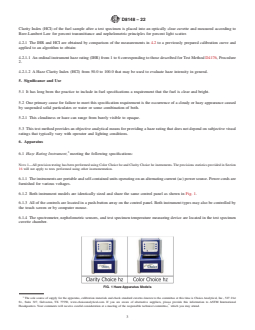
6.1.2 Both instrument models are identically sized and share the same control panel as shown in Fig. 1.
6.1.3 All of the controls are located in a push-button array on the control panel. Both instrument types may also be controlled by
the touch screen or by computer mouse.
6.1.4 The spectrometer, nephelometric sensors, and test specimen temperature measuring device are located in the test specimen
cuvette chamber.
FIG. 1 Haze Apparatus Models
The sole source of supply for the apparatus, calibration materials and check standard cuvettes known to the committee at this time is Choice Analytical, Inc., 527 21st
St., Suite 327, Galveston, TX 77550, www.choiceanalytical.com. If you are aware of alternative suppliers, please provide this information to ASTM International
Headquarters. Your comments will receive careful consideration at a meeting of the responsible technical committee, which you may attend.
D8148 − 22
6.1.4.1 Spectrometer/Nephelometer, consisting of a combination of a near-infrared (NIR) light-emitting diode (LED) light source
and photodiodes positioned to measure transmission and scatter across the test specimen.
6.1.4.2 Temperature Measuring Device, non-contact infrared (IR) thermopile-based temperature sensor, with an accuracy of
62.0 °C and a range of 4.0 °C to 38.0 °C.
6.2 Check Standard Cuvette(s), one or more 10.0 mm W by 15.0 mm D by 38.0 mm H inside dimension crown glass cuvettes
having four optically clear walls that contain a certified solid semi-transparent material (optional).
6.3 Crown Glass Cuvette, inside dimensions 10.0 mm W by 15.0 mm D by 38 mm H; optically clear on all four sides.
6.3.1 Cuvette dimensions are 60.1 mm.
6.4 Printer, (optional).
6.5 Temperature-Controlled Bath, of suitable dimensions and capable of controlling the sample container temperature within
60.5 °C of the desired temperature for laboratory tests that require measurements to be made at a specific temperature (optional).
7. Reagents and Materials
7.1 Purity of Reagents—Reagent grade chemicals shall be used in all tests. Unless otherwise indicated, it is intended that all
reagents shall conform to the specifications of the Committee on Analytical Reagents of the American Chemical Society, where
such specifications are available. Other grades may be used, provided it is first ascertained that the reagent is of sufficiently high
purity to permit its use without lessening the accuracy of the determination.
7.2 Haze Calibration Set, consisting of six calibration materials certified to correspond to the ordinal number 1 to 6 haze rating
described by Test Method D4176, Procedure 2.
7.2.1 Haze Calibration Sets are stable for up to one year unopened.
7.2.2 Select proprietary quality control procedures are employed to ensure calibration set consistency.
7.3 n-Dodecane, CH (CH ) CH ≥99.0% purity.
3 2 10 3
7.4 Expendable materials needed to perform the test consist of the following:
7.4.1 Disposable dispensing pipet, approximate 5 mL capacity.
7.4.2 Lint-free optical lens wipes.
8. Hazards
8.1 Hazards are typical of those experienced when handling fuel. There are no additional hazards associated with this test method.
9. Sampling
9.1 Obtain a test unit (sample) in accordance with Practice D4057 or Practice D4177.
10. Preparation of Apparatus
10.1 Power-up (turn on) the apparatus and allow sufficient warm-up time as indicated by the instrument ready status message
located on the apparatus home screen.
ACS Reagent Chemicals, Specifications and Procedures for Reagents and Standard-Grade Reference Materials, American Chemical Society, Washington, DC. For
suggestions on the testing of reagents not listed by the American Chemical Society, see Analar Standards for Laboratory Chemicals, BDH Ltd., Poole, Dorset, U.K., and
the United States Pharmacopeia and National Formulary, U.S. Pharmacopeial Convention, Inc. (USPC), Rockville, MD.
D8148 − 22
10.2 Follow manufacturer’s recommendations to enter the Update Haze Settings mode.
10.2.1 Highlight each respective field and set sample shaking time to 15.0 s, cuvette transfer time to 45.0 s, and time between scans
to 1000.0 ms using the on-screen numeric display.
10.2.1.1 Users may choose alternative sample shaking, cuvette transfer times, and between scan times to accommodate operator
experience, sample characteristics, or other factors; however precision and bias data provided in Section 16 do not apply.
10.2.2 Activate the displayed Save button and upon confirmation that settings have been successfully saved, activate the Next or
Home button to exit the Update Haze Settings mode.
11. Calibration
11.1 Obtain a temperature-conditioned (see 12.1) high purity dodecane (7.3) material and a temperature-conditioned (see 12.1)
instrument manufacturer supplied haze calibration set (7.2).
11.2 Follow manufacturer’s recommendations to enter the Haze Calibration mode.
11.2.1 Activate the Next button to display the calibration queue; Calibration Reference is highlighted.
11.2.2 Activate the Next button to display the analysis Start screen.
11.3 Analyze the dodecane as the reference material as follows:
11.3.1 Vigorously shake the dodecane sample to suspend any sediment or silt.
11.3.2 Carefully inspect the container to ensure all sediment and silt is suspended.
11.3.3 Briefly place the container on a stable surface and allow visible air bubbles to rise or dissipate (typically less than 30.0 s).
11.3.4 Once air bubbles have risen or dissipated, promptly activate the instrument by pressing the Start button (sample shaking
time starts).
11.3.5 During the time allowed, gently shake or swirl the dodecane to ensure sediment or silt remains suspended in the sample.
11.3.6 Once sample shaking time has elapsed, as prompted by the instrument, cease agitation (cuvette transfer time starts).
11.3.7 The instrument automatically displays and counts down the cuvette transfer time.
11.3.7.1 Open the dodecane sample container and use a disposable dispensing pipette (7.4.1) to promptly rinse a clean cuvette
(6.3) with the material to be tested.
11.3.7.2 Dispose of the rinse material and use the pipette to fill the cuvette to its 80 % to 90 % full capacity (approximately 5 mL
of test specimen).
11.3.7.3 Clean all four cuvette optical surfaces to remove any smudges or liquids with a lint free wipe (7.4.2). Open the test
compartment and place the test specimen into the instrument haze cuvette holder.
11.3.8 When the cuvette is installed and its testing chamber is closed within the allotted cuvette transfer time, the test specimen
analysis is performed automatically.
11.3.9 Remove the cuvette and dispose of the test specimen.
11.4 Follow on screen instructions to analyze each of the calibration materials to create a 1 to 6 instrument haze rating calibration
curve.
D8148 − 22
11.4.1 Following the reference material analysis, the calibration queue is displayed and calibration point one is highlighted.
11.4.2 Activate the Next button to display the analysis Start screen.
11.4.3 Follow procedures described for the dodecane reference material in 11.3.1 – 11.3.9 to analyze the haze rating 1 calibration
material.
11.4.4 Following the calibration point 1 analysis, the calibration queue is again displayed and calibration point 2 is highlighted.
11.4.5 Follow procedures described in 11.4.2 and 11.4.3 to analyze calibration point 2 and each of the four remaining haze rating
calibration materials.
11.5 Following analysis of the haze reference and all six calibration materials, activate the displayed Next button to enter the
calibration review screen.
11.6 Confirm that each of the 1 to 6 calibration points has an HCI value.
11.7 Highlight then activate the Calibration Accept button.
11.8 When the Calibration Accepted message
...