

ASTM C1689-21
(Practice)Standard Practice for Subsampling of Uranium Hexafluoride
General Information
- Abstract
SIGNIFICANCE AND USE
5.1 Uranium hexafluoride is normally produced and handled in large (typically 1- to 14-ton) quantities and must, therefore be characterized by reference to representative samples. The samples are used to determine compliance with the applicable commercial Specifications C996 and C787 by means of the appropriate test method (for example, Test Method C761 and references therein). The quantities involved, physical properties, chemical reactivity, and hazardous nature of UF6 are such that for representative sampling, specially designated equipment must be used and operated in accordance with the most carefully controlled and stringent procedures. This practice indicates appropriate principles, equipment and procedures currently in use for subsampling of liquid UF6. It is used by UF6 converters, enrichers and fuel fabricators to review the effectiveness of existing procedures or to design equipment and procedures for future use. Other subsampling procedures such as UF6 vapor sampling are not directly representative of the chemical quality of liquid UF6.
5.2 It is emphasized that this test guide is not meant to address conventional or nuclear criticality safety issues, nor does it address the conditioning of subsample tubes to make them suitable for transport.
SCOPE
1.1 This practice is applicable to subsampling uranium hexafluoride (UF6), using heat liquefaction techniques, from bulk containers, obtained in conformance with Practices C1052, C1703, and C1883, into smaller sample containers, which are required for laboratory analyses.
1.2 The values stated in SI units are to be regarded as standard. No other units of measurement are included in this standard.
1.3 It is assumed that the liquid UF6 being sampled comprises a single quality and quantity of material. This practice does not address any special additional arrangement that might be required for taking proportional or composite samples.
1.4 The number of samples to be taken, their nominal sample weight, and their disposition shall be agreed upon between the parties.
1.5 The scope of this practice does not include provisions for preventing criticality incidents.
1.6 This standard does not purport to address all of the safety concerns, if any, associated with its use. It is the responsibility of the user of this standard to establish appropriate safety and health practices and determine the applicability of regulatory limitations prior to use.
1.7 This international standard was developed in accordance with internationally recognized principles on standardization established in the Decision on Principles for the Development of International Standards, Guides and Recommendations issued by the World Trade Organization Technical Barriers to Trade (TBT) Committee.
- Status
- Published
- Publication Date
- 31-Jan-2021
- Technical Committee
- C26 - Nuclear Fuel Cycle
- Drafting Committee
- C26.05 - Methods of Test
Overview
ASTM C1689-21: Standard Practice for Subsampling of Uranium Hexafluoride provides comprehensive guidance on obtaining representative subsamples of liquid uranium hexafluoride (UF6) from bulk containers for laboratory analysis. This international ASTM standard addresses the specialized equipment, handling procedures, and stringent quality controls required for safe and effective subsampling of UF6-a highly reactive and hazardous chemical essential in the nuclear fuel cycle. The standard is a critical resource for organizations such as UF6 converters, uranium enrichers, and nuclear fuel fabricators seeking to validate or design subsampling equipment and procedures according to commercial specifications.
Key Topics
- Representative Subsampling: Ensures that the subsamples accurately reflect the chemical quality of the bulk liquid UF6, which is commonly processed and transported in large quantities (1-14 tons).
- Subsampling Methods: Describes two main approaches-homogenization via agitation and homogenization via convection-using specially designed rigs and vacuum manifold systems resistant to UF6 corrosion.
- Equipment Requirements: Details construction materials (such as nickel, high nickel alloys, and polychlorotrifluoroethylene) for sample bottles, tubes (e.g., P10), knockout cylinders, and filtration units to withstand UF6’s highly corrosive nature.
- Safety and Handling: Emphasizes the hazardous and toxic nature of UF6, outlining critical safety measures, use of personal protective equipment, laboratory ventilation standards, and adherence to safety data practices.
- Homogeneity Assurance: Stresses the importance of homogenizing bulk UF6 to ensure representative sampling, including temperature and agitation protocols.
- Minimizing Cross-Contamination: Recommends flushing sampling systems with initial material aliquots and calls for rigorous system cleaning between uses.
- Sample Disposition: Clarifies that the number, type, and intended use of subsamples must be determined by agreement between all parties involved.
Applications
ASTM C1689-21 is widely used across different sectors of the nuclear industry for:
- Quality Assurance and Compliance: Provides standardized procedures to obtain subsamples used in the assessment of compliance with commercial specifications such as ASTM C996 and C787.
- Analytical Testing: Subsamples collected under this standard support various laboratory analyses-such as isotopic abundance, purity, measurement of metallic and non-metallic impurities, and detection of halohydrocarbons-using appropriate test methods (e.g., ASTM C761).
- Fuel Fabrication and Enrichment: Facilitates process and product control in uranium conversion, enrichment, and nuclear fuel manufacturing by ensuring quality control samples are representative and reliable.
- Equipment Validation: Used in designing and reviewing subsampling systems to meet both regulatory and operational requirements for handling UF6.
- International Shipment Preparation: Complements procedures for packaging and transportation by ensuring high-integrity sampling prior to regulatory shipments (though it does not cover shipping requirements directly).
Related Standards
To ensure broad compatibility and regulatory compliance, users of ASTM C1689-21 should be familiar with relevant referenced documents and standards, including:
- ASTM C761: Test Methods for Chemical, Mass Spectrometric, Spectrochemical, Nuclear, and Radiochemical Analysis of Uranium Hexafluoride.
- ASTM C787 & C996: Specifications for commercial and enriched uranium hexafluoride.
- ASTM C859: Terminology Relating to Nuclear Materials.
- ASTM C1052, C1703, C1883: Practices covering sampling from gaseous and liquid UF6.
- ANSI N14.1: Uranium Hexafluoride Packaging for Transport.
- ISO 7195: Packaging of Uranium Hexafluoride for Transport.
- USEC-651: Good Handling Practices for Uranium Hexafluoride.
Keywords: uranium hexafluoride, UF6, subsampling, nuclear laboratory, ASTM C1689-21, subsampling equipment, nuclear fuel cycle, hazardous materials, representative sampling, quality compliance, uranium analysis.
Relations
- Effective Date
- 01-Jan-2024
- Effective Date
- 01-Jul-2020
- Effective Date
- 01-Mar-2020
- Effective Date
- 01-Mar-2020
- Effective Date
- 15-Jun-2019
- Effective Date
- 01-Feb-2018
- Effective Date
- 01-Jul-2015
- Effective Date
- 01-Jul-2015
- Effective Date
- 15-Jun-2014
- Effective Date
- 15-Jan-2014
- Effective Date
- 01-Jun-2013
- Effective Date
- 01-May-2013
- Effective Date
- 01-Jun-2011
- Effective Date
- 15-May-2011
- Effective Date
- 01-Nov-2010
Get Certified
Connect with accredited certification bodies for this standard

DNV
DNV is an independent assurance and risk management provider.

Lloyd's Register
Lloyd's Register is a global professional services organisation specialising in engineering and technology.
DNV Energy Systems
Energy and renewable energy certification.
Sponsored listings
Frequently Asked Questions
ASTM C1689-21 is a standard published by ASTM International. Its full title is "Standard Practice for Subsampling of Uranium Hexafluoride". This standard covers: SIGNIFICANCE AND USE 5.1 Uranium hexafluoride is normally produced and handled in large (typically 1- to 14-ton) quantities and must, therefore be characterized by reference to representative samples. The samples are used to determine compliance with the applicable commercial Specifications C996 and C787 by means of the appropriate test method (for example, Test Method C761 and references therein). The quantities involved, physical properties, chemical reactivity, and hazardous nature of UF6 are such that for representative sampling, specially designated equipment must be used and operated in accordance with the most carefully controlled and stringent procedures. This practice indicates appropriate principles, equipment and procedures currently in use for subsampling of liquid UF6. It is used by UF6 converters, enrichers and fuel fabricators to review the effectiveness of existing procedures or to design equipment and procedures for future use. Other subsampling procedures such as UF6 vapor sampling are not directly representative of the chemical quality of liquid UF6. 5.2 It is emphasized that this test guide is not meant to address conventional or nuclear criticality safety issues, nor does it address the conditioning of subsample tubes to make them suitable for transport. SCOPE 1.1 This practice is applicable to subsampling uranium hexafluoride (UF6), using heat liquefaction techniques, from bulk containers, obtained in conformance with Practices C1052, C1703, and C1883, into smaller sample containers, which are required for laboratory analyses. 1.2 The values stated in SI units are to be regarded as standard. No other units of measurement are included in this standard. 1.3 It is assumed that the liquid UF6 being sampled comprises a single quality and quantity of material. This practice does not address any special additional arrangement that might be required for taking proportional or composite samples. 1.4 The number of samples to be taken, their nominal sample weight, and their disposition shall be agreed upon between the parties. 1.5 The scope of this practice does not include provisions for preventing criticality incidents. 1.6 This standard does not purport to address all of the safety concerns, if any, associated with its use. It is the responsibility of the user of this standard to establish appropriate safety and health practices and determine the applicability of regulatory limitations prior to use. 1.7 This international standard was developed in accordance with internationally recognized principles on standardization established in the Decision on Principles for the Development of International Standards, Guides and Recommendations issued by the World Trade Organization Technical Barriers to Trade (TBT) Committee.
SIGNIFICANCE AND USE 5.1 Uranium hexafluoride is normally produced and handled in large (typically 1- to 14-ton) quantities and must, therefore be characterized by reference to representative samples. The samples are used to determine compliance with the applicable commercial Specifications C996 and C787 by means of the appropriate test method (for example, Test Method C761 and references therein). The quantities involved, physical properties, chemical reactivity, and hazardous nature of UF6 are such that for representative sampling, specially designated equipment must be used and operated in accordance with the most carefully controlled and stringent procedures. This practice indicates appropriate principles, equipment and procedures currently in use for subsampling of liquid UF6. It is used by UF6 converters, enrichers and fuel fabricators to review the effectiveness of existing procedures or to design equipment and procedures for future use. Other subsampling procedures such as UF6 vapor sampling are not directly representative of the chemical quality of liquid UF6. 5.2 It is emphasized that this test guide is not meant to address conventional or nuclear criticality safety issues, nor does it address the conditioning of subsample tubes to make them suitable for transport. SCOPE 1.1 This practice is applicable to subsampling uranium hexafluoride (UF6), using heat liquefaction techniques, from bulk containers, obtained in conformance with Practices C1052, C1703, and C1883, into smaller sample containers, which are required for laboratory analyses. 1.2 The values stated in SI units are to be regarded as standard. No other units of measurement are included in this standard. 1.3 It is assumed that the liquid UF6 being sampled comprises a single quality and quantity of material. This practice does not address any special additional arrangement that might be required for taking proportional or composite samples. 1.4 The number of samples to be taken, their nominal sample weight, and their disposition shall be agreed upon between the parties. 1.5 The scope of this practice does not include provisions for preventing criticality incidents. 1.6 This standard does not purport to address all of the safety concerns, if any, associated with its use. It is the responsibility of the user of this standard to establish appropriate safety and health practices and determine the applicability of regulatory limitations prior to use. 1.7 This international standard was developed in accordance with internationally recognized principles on standardization established in the Decision on Principles for the Development of International Standards, Guides and Recommendations issued by the World Trade Organization Technical Barriers to Trade (TBT) Committee.
ASTM C1689-21 is classified under the following ICS (International Classification for Standards) categories: 27.120.30 - Fissile materials and nuclear fuel technology. The ICS classification helps identify the subject area and facilitates finding related standards.
ASTM C1689-21 has the following relationships with other standards: It is inter standard links to ASTM C859-24, ASTM C1052-20, ASTM C787-20, ASTM C996-20, ASTM C1883-19, ASTM C761-18, ASTM C996-15, ASTM C787-15, ASTM C859-14a, ASTM C859-14, ASTM C859-13a, ASTM C859-13, ASTM C787-11, ASTM C761-11, ASTM C859-10b. Understanding these relationships helps ensure you are using the most current and applicable version of the standard.
ASTM C1689-21 is available in PDF format for immediate download after purchase. The document can be added to your cart and obtained through the secure checkout process. Digital delivery ensures instant access to the complete standard document.
Standards Content (Sample)
This international standard was developed in accordance with internationally recognized principles on standardization established in the Decision on Principles for the
Development of International Standards, Guides and Recommendations issued by the World Trade Organization Technical Barriers to Trade (TBT) Committee.
Designation: C1689 − 21
Standard Practice for
Subsampling of Uranium Hexafluoride
This standard is issued under the fixed designation C1689; the number immediately following the designation indicates the year of
original adoption or, in the case of revision, the year of last revision. A number in parentheses indicates the year of last reapproval. A
superscript epsilon (´) indicates an editorial change since the last revision or reapproval.
1. Scope C761 Test Methods for Chemical, Mass Spectrometric,
Spectrochemical, Nuclear, and Radiochemical Analysis of
1.1 This practice is applicable to subsampling uranium
Uranium Hexafluoride
hexafluoride (UF ), using heat liquefaction techniques, from
C787 Specification for Uranium Hexafluoride for Enrich-
bulk containers, obtained in conformance with Practices
ment
C1052, C1703, and C1883, into smaller sample containers,
C859 Terminology Relating to Nuclear Materials
which are required for laboratory analyses.
C996 Specification for Uranium Hexafluoride Enriched to
1.2 The values stated in SI units are to be regarded as
Less Than 5 % U
standard. No other units of measurement are included in this
C1052 Practice for Bulk Sampling of Liquid Uranium
standard.
Hexafluoride
1.3 It is assumed that the liquid UF being sampled com- C1703 Practice for Sampling of Gaseous Uranium
Hexafluoride for Enrichment
prises a single quality and quantity of material. This practice
does not address any special additional arrangement that might C1883 Practice for Sampling of Gaseous Enriched Uranium
Hexafluoride
be required for taking proportional or composite samples.
2.2 Other Documents:
1.4 The number of samples to be taken, their nominal
ANSI N14.1 Uranium Hexafluoride: Packaging for Trans-
sample weight, and their disposition shall be agreed upon
port
between the parties.
ISO 7195 Packaging of Uranium Hexafluoride (UF ) for
1.5 The scope of this practice does not include provisions
Transport
for preventing criticality incidents.
USEC-651 The UF Manual: Good Handling Practices for
1.6 This standard does not purport to address all of the
Uranium Hexafluoride, latest revision
safety concerns, if any, associated with its use. It is the
responsibility of the user of this standard to establish appro-
3. Terminology
priate safety, health, and environmental practices and deter-
3.1 Definitions:
mine the applicability of regulatory limitations prior to use.
3.1.1 Terms shall be defined in accordance with Terminol-
1.7 This international standard was developed in accor-
ogy C859 except for the following:
dance with internationally recognized principles on standard-
3.1.2 sample bottle—the vessel (typically a 1S or 2S bottle)
ization established in the Decision on Principles for the
into which the sample of UF is withdrawn from the container
Development of International Standards, Guides and Recom-
for transfer to the laboratory, analysis or dispatch to the
mendations issued by the World Trade Organization Technical
customer.
Barriers to Trade (TBT) Committee.
3.1.3 subsample tube—the small vessel (for example, a P10
tube) into which a subsample of UF is withdrawn from the
2. Referenced Documents 6
sample bottle for analysis of UF quality or dispatch to the
2 6
2.1 ASTM Standards:
customer.
3.1.3.1 Discussion—Polychlorotrifluoroethylene P10 tubes
are widely accepted by the industry for subsample collection
This practice is under the jurisdiction of ASTM Committee C26 on Nuclear
Fuel Cycle and is the direct responsibility of Subcommittee C26.05 on Methods of
Test.
Current edition approved Feb. 1, 2021. Published March 2021. Originally Available from American National Standards Institute (ANSI), 25 W. 43rd St.,
approved in 2008. Last previous edition approved in 2014 as C1689 – 08a (2014). 4th Floor, New York, NY 10036, http://www.ansi.org.
DOI: 10.1520/C1689-21. Available from International Organization for Standardization (ISO), ISO
For referenced ASTM standards, visit the ASTM website, www.astm.org, or Central Secretariat, Chemin de Blandonnet 8, CP 401, 1214 Vernier, Geneva,
contact ASTM Customer Service at service@astm.org. For Annual Book of ASTM Switzerland, https://www.iso.org.
Standards volume information, refer to the standard’s Document Summary page on Available from Centrus Energy Corporation, 6901 Rockledge Drive, Bethesda,
the ASTM website. MD 20817.
Copyright © ASTM International, 100 Barr Harbor Drive, PO Box C700, West Conshohocken, PA 19428-2959. United States
C1689 − 21
and subsequent UF quality analyses or dispatch to the cus- currently in use for subsampling of liquid UF . It is used by
6 6
tomer. Other types of subsample tubes, for example P-20, P-80, UF converters, enrichers and fuel fabricators to review the
or P100 , can be used for internal subsample collection and effectiveness of existing procedures or to design equipment and
processing. Dispatch of these subsample tubes may be agreed procedures for future use. Other subsampling procedures such
upon by buyer and seller and subject to (local) transport as UF vapor sampling are not directly representative of the
regulations. chemical quality of liquid UF .
3.1.4 subsample rig—the equipment to perform the transfer
5.2 It is emphasized that this test guide is not meant to
of liquid UF from the sample bottle into the subsample tube,
6 address conventional or nuclear criticality safety issues, nor
typically a vacuum manifold equipped with heating and a
does it address the conditioning of subsample tubes to make
liquid nitrogen trap.
them suitable for transport.
4. Summary of Practice
6. Apparatus
4.1 Two methods of withdrawing a subsample of UF are
6.1 Hot Water Bath.
described which differ based on safety requirements namely:
(1) homogenizing of liquefied UF by agitation before liquid
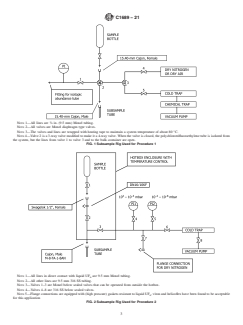
6.2 Subsample Rig—For Procedures 1 and 2 see Figs. 1 and
transfer, and (2) homogenizing of liquefied UF by convection
2, respectively. Materials of construction in direct contact with
before liquid transfer. The first method involves homogeniza-
liquid UF are made from nickel, high nickel alloys, or
tion of liquefied UF in a sample bottle by vigorous shaking.
materials having comparable resistance to UF corrosion.
Subsequently the sample bottle is inverted and connected to the
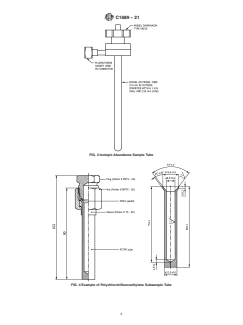
6.3 Gaseous Isotopic Abundance Sample Tube (Fig. 3).
top of a heated vacuum-manifold system, and the subsample
tube is attached to the appropriate port of the system. The 6.4 Polychlorotrifluoroethylene Subsample Tube and Clos-
ing Disc (Fig. 4)—The tube must be of uniform density, free
system is evacuated and the liquid UF allowed to flow by
gravity into the subsample tube. In the second method the from cracks or occlusions and able to withstand temperatures
from –195 °C to +150 °C. Materials of construction in direct
sample bottle containing solid UF is connected to the top of a
manifold system, and a subsample tube is attached to the contact with liquid UF are made from
polychlorotrifluoroethylene, PTFE/TFE (gaskets), or materials
appropriate port of the system. The whole system is enclosed in
secondary containment that can be heated (hot-box). After having comparable resistance to UF corrosion.
evacuation the complete system is heated for specific period
6.5 Flare Nut and Plug—Flare nuts and plugs for subsample
(typically >1.5 h) to allow for complete homogenization of the
tube closure, storage and transport can be constructed from
liquid UF by convection. Subsequently the liquid UF is
6 6
Monel, nickel, high nickel alloys or 316 SS.
allowed to flow by gravity either directly or via graduated
6.6 Polychlorotrifluoroethylene Knockout Cylinder (Fig. 5),
volume into the subsample tube.
closed with a Cajon M-16 VCR-1 female nut and an M-16
4.2 For both methods of sampling, the presence of residues
VCR-4 male nut or equivalent.
may have significant implications for the quality of UF . For
safety and quality reasons, sample bottles and subsample tubes NOTE 1—Brand names mentioned in this practice are intended to be
typical, not limiting. Another brand with comparable characteristics could
shall be clean, dry, and empty before filling.
perform equally well.
4.3 Various types of sample bottles and tubes are in use and
6.7 Nickel Filter Disc, porous, 2μm, free of chromium (Fig.
are described in detail in the applicable national and interna-
6).
tional standards, for example, ANSI N14.1 and ISO 7195. For
a given type of sample bottle, the detailed configuration, for
NOTE 2—The filter disc should weigh approximately 1 g. It should be
example valve orientation, terminal fittings and the like, may made of nickel powder produced from carbonyl nickel and formed by the
no pressure sintering method in graphite or ceramic molds.
vary. Hence the type and configuration of bottles used for the
withdrawal of samples shall be agreed upon between the
6.8 Gas Sample Cylinder.
parties.
6.9 Heat Sources—Heat gun (or an equivalent) and heat
5. Significance and Use lamps.
5.1 Uranium hexafluoride is normally produced and handled
6.10 Dewar Flask, for liquid nitrogen, stainless steel.
in large (typically 1- to 14-ton) quantities and must, therefore
be characterized by reference to representative samples. The
7. Hazards
samples are used to determine compliance with the applicable
7.1 Uranium hexafluoride (UF ) is radioactive, toxic, and
commercial Specifications C996 and C787 by means of the
highly reactive especially with reducing substances and mois-
appropriate test method (for example, Test Method C761 and
ture. Appropriate laboratory facilities, materials of
references therein). The quantities involved, physical
construction, and techniques shall be utilized when handling
properties, chemical reactivity, and hazardous nature of UF
UF (see for example USEC-651).
are such that for representative sampling, specially designated
equipment must be used and operated in accordance with the 7.2 Follow all safety procedures for handling uranium and
most carefully controlled and stringent procedures. This prac- UF provided by the facility. Review the Safety Data Sheet
tice indicates appropriate principles, equipment and procedures (SDS) for UF6 prior to performing the procedure.
C1689 − 21
NOTE 1—All lines are ⁄8 in. (9.5 mm) Monel tubing.
NOTE 2—All valves are Monel diaphragm type valves.
NOTE 3—The valves and lines are wrapped with heating tape to maintain a system temperature of about 80 °C.
NOTE 4—Valve 2 is a 3-way valve modified to make it a 4-way valve. When the valve is closed, the polychlorotrifluoroethylene tube is isolated from
the system, but the lines from valve 1 to valve 3 and to the bulk container are open.
FIG. 1 Subsample Rig Used for Procedure 1
NOTE 1—All lines in direct contact with liquid UF are 9.5 mm Monel tubing.
NOTE 2—All other lines are 9.5 mm 316 SS tubing.
NOTE 3—Valves 1–3 are Monel below sealed valves that can be operated from outside the hotbox.
NOTE 4—Valves 4–8 are 316 SS below sealed valves.
NOTE 5—Flange connections are equipped with (high pressure) gaskets resistant to liquid UF , viton and helicoflex have been found to be acceptable
for this application
FIG. 2 Subsample Rig Used for Procedure 2
C1689 − 21
FIG. 3 Isotopic Abundance Sample Tube
FIG. 4 Example of Polychlorotrifluoroethylene Subsample Tube
C1689 − 21
FIG. 5 Example of Polychlorotrifluoroethylene Knock-out Tube
FIG. 6 Filter Disc Unit for Determination of Soluble and Insoluble Chromium
C1689 − 21
7.3 Perform subsampling operations in a laboratory hood. analysis. Alternative procedures to prevent cross-
Hoods should be regularly inspected for proper air flow contamination are possible and should be validated individu-
ally.
7.4 When released to atmosphere, gaseous UF reacts with
8.5 If sample bottles are taken for an analytical need such as
moisture to produce HF gas and toxic UO F particulates. Use
2 2
liquid UF subsampling for P10 tubes or liquid UF transfer for
6 6
sufficient ventilation or respiratory protection to avoid breath-
FTIR quantification, it is recommended, in order to minimize
ing fumes. Use appropriate personal protective equipment such
the gas phase contribution to the sample bottle, to fill the bottle
as gloves, eye, and face protection.
with more than 10 % of its total volume.
7.5 Hydrofluoric acid is a highly corrosive acid that can
9. Subsampling Schemes for UF Specification Analyses
severely burn skin, eyes, and mucous membranes. Hydroflu-
oric acid differs from other acids because the fluoride ion
9.1 The number and type of subsamples taken from a
readily penetrates the skin, causing destruction of deep tissue
sample bottle (typically 1S or 2S bottle) depends both on the
layers. Unlike other acids that are rapidly neutralized, hydro-
sampling requirements (natural UF , enriched UF and particu-
6 6
fluoric acid reactions with tissue may continue for days if left
lar agreements between buyer and seller) and the available
untreated. Familiarization and compliance with the Safety Data
equipment. Below are some typical examples of analyses that
Sheet is essential
can be performed and their appropriate subsample tubes.
7.5.1 Use gloves designed for use with cryogenic
9.2 Uranium isotopic abundance analyses can be performed
substances, and wear goggles or a face shield when handling
using a isotopic abundance sample tube (Fig. 3, uranium
bulk quantities of liquid nitrogen.
content approximately 4 g), a polychlorotrifluoroethylene tube
(P10, Fig. 4, UF6 content >7 g) or alternatively measured
8. Principles
directly in the gas phase using the 1S or 2S sample bottle.
8.1 The essential purpose of the sample is to be represen-
9.3 For uranium purity determination a pol
...
This document is not an ASTM standard and is intended only to provide the user of an ASTM standard an indication of what changes have been made to the previous version. Because
it may not be technically possible to adequately depict all changes accurately, ASTM recommends that users consult prior editions as appropriate. In all cases only the current version
of the standard as published by ASTM is to be considered the official document.
Designation: C1689 − 08a (Reapproved 2014) C1689 − 21
Standard Practice for
Subsampling of Uranium Hexafluoride
This standard is issued under the fixed designation C1689; the number immediately following the designation indicates the year of
original adoption or, in the case of revision, the year of last revision. A number in parentheses indicates the year of last reapproval. A
superscript epsilon (´) indicates an editorial change since the last revision or reapproval.
1. Scope
1.1 This practice is applicable to subsampling uranium hexafluoride (UF ), using heat liquefaction techniques, from bulk
containers, obtained in conformance with Practices C1052, C1703, and C1883, into smaller sample containers, which are required
for laboratory analyses.
1.2 The values stated in SI units are to be regarded as standard. No other units of measurement are included in this standard.
1.3 It is assumed that the liquid UF being sampled comprises a single quality and quantity of material. This practice does not
address any special additional arrangement that might be required for taking proportional or composite samples.
1.4 The number of samples to be taken, their nominal sample weight, and their disposition shall be agreed upon between the
parties.
1.5 The scope of this practice does not include provisions for preventing criticality incidents.
1.6 This standard does not purport to address all of the safety concerns, if any, associated with its use. It is the responsibility of
the user of this standard to establish appropriate safety and health practices and determine the applicability of regulatory
limitations prior to use.
1.7 This international standard was developed in accordance with internationally recognized principles on standardization
established in the Decision on Principles for the Development of International Standards, Guides and Recommendations issued
by the World Trade Organization Technical Barriers to Trade (TBT) Committee.
2. Referenced Documents
2.1 ASTM Standards:
C761 Test Methods for Chemical, Mass Spectrometric, Spectrochemical, Nuclear, and Radiochemical Analysis of Uranium
Hexafluoride
C787 Specification for Uranium Hexafluoride for Enrichment
C859 Terminology Relating to Nuclear Materials
C996 Specification for Uranium Hexafluoride Enriched to Less Than 5 % U
C761C1052 Test Methods for Chemical, Mass Spectrometric, Spectrochemical, Nuclear, and Radiochemical Analysis of
This practice is under the jurisdiction of ASTM Committee C26 on Nuclear Fuel Cycle and is the direct responsibility of Subcommittee C26.05 on Methods of Test.
Current edition approved Jan. 1, 2014Feb. 1, 2021. Published February 2014March 2021. Originally approved in 2008. Last previous edition approved in 20082014 as
C1689 – 08a.C1689 – 08a (2014). DOI: 10.1520/C1689-08aR14.10.1520/C1689-21.
For referenced ASTM standards, visit the ASTM website, www.astm.org, or contact ASTM Customer Service at service@astm.org. For Annual Book of ASTM Standards
volume information, refer to the standard’s Document Summary page on the ASTM website.
Copyright © ASTM International, 100 Barr Harbor Drive, PO Box C700, West Conshohocken, PA 19428-2959. United States
C1689 − 21
Practice for Bulk Sampling of Liquid Uranium Hexafluoride
C1052C1703 Practice for Bulk Sampling of LiquidGaseous Uranium Hexafluoride for Enrichment
C1883 Practice for Sampling of Gaseous Enriched Uranium Hexafluoride
2.2 Other Documents:
ANSI N14.1 Uranium Hexafluoride: Packaging for Transport
ISO/DISISO 7195 Packaging of Uranium Hexafluoride (UF ) for Transport
USEC-651 The UF Manual: Good Handling Practices for Uranium Hexafluoride, latest revision
3. Terminology
3.1 Definitions:
3.1.1 Terms shall be defined in accordance with Terminology C859 except for the following:Terms shall be defined in accordance
with Terminology C859 except for the following:
3.1.2 sample bottle—the vessel (typically a 1S or 2S bottle) into which the sample of UF is withdrawn from the container for
transfer to the laboratory, analysis or dispatch to the customer.
3.1.3 subsample tube—the small vessel (for example, a P10 tubetube)) into which a subsample of UF is withdrawn from the
sample bottle for analysis of UF quality or dispatch to the customer.
3.1.3.1 Discussion—
Polychlorotrifluoroethylene P10 tubes are widely accepted by the industry for subsample collection and subsequent UF quality
analyses or dispatch to the customer. Other types of subsample tubes, for example P-20, P-80, or P100 , can be used for internal
subsample collection and processing. Dispatch of these subsample tubes may be agreed upon by buyer and seller and subject to
(local) transport regulations.
3.1.4 subsample rig—the equipment to perform the transfer of liquid UF from the sample bottle into the subsample tube, typically
a vacuum manifold equipped with heating and a liquid nitrogen trap.
4. Summary of Practice
4.1 Two methods of withdrawing a subsample of UF are described which differ based on safety requirements namely: (1)
homogenizing of liquefied UF by agitation before liquid transfer, and (2) homogenizing of liquefied UF by convection before
6 6
liquid transfer. The first method involves homogenization of liquifiedliquefied UF in a sample bottle by vigorous shaking.
Subsequently the sample bottle is inverted and connected to the top of a heated vacuum-manifold system, and the subsample tube
is attached to the appropriate port of the system. The system is evacuated and the liquid UF allowed to flow by gravity into the
subsample tube. In the second method the sample bottle containing solid UF is connected to the top of a manifold system, and
a subsample tube is attached to the appropriate port of the system. The whole system is enclosed in secondary containment that
can be heated (hot-box). After evacuation the complete system is heated for specific period (typically > 1.5 hr) >1.5 h) to allow
for complete homogenization of the liquid UF by convection. Subsequently the liquid UF is allowed to flow by gravity either
6 6
directly or via graduated volume into the subsample tube.
4.2 For both methods of sampling, the presence of residues may have significant implications for the quality of UF . For safety
and quality reasons, sample bottles and subsample tubes shall be clean, dry, and empty before filling.
4.3 Various types of sample bottles and tubes are in use and are described in detail in the applicable national and international
standards, for example, ANSI N14.1 and ISO/DISISO 7195. For a given type of sample bottle, the detailed configuration, for
example valve orientation, terminal fittings and the like, may vary. Hence the type and configuration of bottles used for the
withdrawal of samples shall be agreed upon between the parties.
5. Significance and Use
5.1 Uranium hexafluoride is normally produced and handled in large (typically 1- to 14-ton) quantities and must, therefore be
Available from American National Standards Institute (ANSI), 25 W. 43rd St., 4th Floor, New York, NY 10036, http://www.ansi.org.
Available from International Organization for Standardization (ISO), 1, ch. de la Voie-Creuse, Case postale 56, CH-1211, Geneva 20, Switzerland, http://www.iso.ch.ISO
Central Secretariat, Chemin de Blandonnet 8, CP 401, 1214 Vernier, Geneva, Switzerland, https://www.iso.org.
Available from United States Enrichment Corp., 6903 Rockledge Dr., Bethesda, MD 20817, http://www.usec.com.Centrus Energy Corporation, 6901 Rockledge Drive,
Bethesda, MD 20817.
C1689 − 21
characterized by reference to representative samples. The samples are used to determine compliance with the applicable
commercial Specifications C996 and C787 by means of the appropriate test method (for example, Test Method C761 and
references therein). The quantities involved, physical properties, chemical reactivity, and hazardous nature of UF are such that for
representative sampling, specially designated equipment must be used and operated in accordance with the most carefully
controlled and stringent procedures. This practice indicates appropriate principles, equipment and procedures currently in use for
subsampling of liquid UF . It is used by UF converters, enrichers and fuel fabricators to review the effectiveness of existing
6 6
procedures or to design equipment and procedures for future use. Other subsampling procedures such as UF vapor sampling are
not directly representative of the chemical quality of liquid UF .
5.2 It is emphasized that this test guide is not meant to address conventional or nuclear criticality safety issues.issues, nor does
it address the conditioning of subsample tubes to make them suitable for transport.
6. Apparatus
6.1 Hot Water Bath.
6.2 Subsample Rig—For ProcedureProcedures 1 see Fig. 1and Procedure 2 see Fig. 2Figs. 1 and 2. , respectively. Materials of
construction in direct contact with liquid UF are made from nickel, high nickel alloys, or materials having comparable resistance
to UF corrosion.
6.3 Gaseous Isotopic Abundance Sample Tube (Fig. 3).
6.4 Polychlorotrifluoroethylene Subsample Tube and Closing Disc (Fig. 4)—)—The tube must be of uniform density, free from
cracks or occlusions and able to withstand temperatures from –195°C–195 °C to +150°C. +150 °C. Materials of construction in
direct contact with liquid UF are made from polychlorotrifluoroethylene, PTFE/TFE (gaskets), or materials having comparable
resistance to UF corrosion.
6.5 Flare Nut and Plug—Flare nuts and plugs for subsample tube closure, storage and transport can be constructed from Monel,
nickel, high nickel alloys or 316 SS.
NOTE 1—All lines are ⁄8 in. (9.5 mm) Monel tubing.
NOTE 2—All valves are Monel diaphragm type valves.
NOTE 3—The valves and lines are wrapped with heating tape to maintain a system temperature of about 80°C.80 °C.
NOTE 4—Valve 2 is a 3-way valve modified to make it a 4-way valve. When the valve is closed, the polychlorotrifluoroethylene tube is isolated from
the system, but the lines from valve 1 to valve 3 and to the bulk container are open.
FIG. 1 Subsample Rig Used for Procedure 1
C1689 − 21
NOTE 1—All lines in direct contact with liquid UF are ⁄8 in. (9.5 mm) 9.5 mm Monel tubing.
NOTE 2—All other lines are ⅜ in. (9.5 mm) 9.5 mm 316 SS tubing.
NOTE 3—Valves 1–3 are Monel below sealed valves that can be operated from outside the hotbox.
NOTE 4—Valves 4–8 are 316 SS below sealed valves.
NOTE 5—Flange connections are equipped with helicoflex (high pressure) gaskets. gaskets resistant to liquid UF , viton and helicoflex have been found
to be acceptable for this application
FIG. 2 Subsample Rig Used for Procedure 2
6.6 Polychlorotrifluoroethylene Knockout Cylinder (Fig. 5),closed with a Cajon M-16 VCR-1 female nut and an M-16 VCR-4
male nut or equivalent.
NOTE 1—Brand names mentioned in this practice are intended to be typical, not limiting. Another brand with comparable characteristics could perform
equally well.
6.7 Nickel Filter Disc, porous, 2μm, free of chromium (Fig. 6).
NOTE 2—The filterdisc filter disc should weigh approximately 1 g. It should be made of nickel powder produced from carbonyl nickel and formed by
the no pressure sintering method in graphite or ceramic molds.
6.8 Gas Sample Cylinder.
6.9 Heat Sources—Heat gun (or an equivalent) and heat lamps.
6.10 Dewar Flask, for liquid nitrogen, stainless steel.
7. Hazards
7.1 Uranium hexafluoride (UF ) is radioactive, toxic, and highly reactive especially in the presence of with reducing substances
and moisture. Safe techniques mustAppropriate laboratory facilities, materials of construction, and techniques shall be utilized
when handling UF . Suitable handling procedures are described in USEC-651. (see for example USEC-651).
C1689 − 21
FIG. 3 Isotopic Abundance Sample Tube.Tube
FIG. 4 Example of a Polychlorotrifluoroethylene Subsample Tube
C1689 − 21
FIG. 5 Example of a Polychlorotrifluoroethylene Knock-out Tube
FIG. 6 Filter Disc Unit for Determination of Soluble and Insoluble Chromium
C1689 − 21
7.2 Follow all safety procedures for handling uranium and UF as provided by your facility.the facility. Review the Safety Data
Sheet (SDS) for UF6 prior to performing the procedure.
7.3 Review Material Safety Data Sheets for UF and all chemicals associated with this method prior to performance.
7.3 Perform subsampling operations in a fume hood that has been verified operable and has undergone regular inspections to
ensure proper airflow.laboratory hood. Hoods should be regularly inspected for proper air flow
7.4 When released to atmosphere, gaseous UF reacts with moisture to produce HF gas and toxic UO F particulates (a white
6 2 2
amorphous solid) and becomes readily visible as a white cloud. The corrosive nature of HF and UFparticulates. Use sufficient
ventilation can result in skin burns and lung impairment. Medical evaluation is mandatory after contact with HF or UFor
respiratory . When water-soluble UO protection to avoid F is inhaled or ingested in large quantities it can be toxic to the
6 2 2
kidneys.breathing fumes. Use appropriate personal protective equipment such as gloves, eye, and face protection.
7.5 Hydrofluoric acid is a highly corrosive acid that can severely burn skin, eyes, and mucous membranes. Hydrofluoric acid
differs from other acids because the fluoride ion readily penetrates the skin, causing destruction of deep tissue layers. Unlike other
acids that are rapidly neutralized, hydrofluoric acid reactions with tissue may continue for days if left untreated. Familiarization
and compliance with the Safety Data Sheet is essential
7.5.1 Use gloves designed for use with cryogenic substances, and wear goggles or a face shield when handling bulk quantities of
liquid nitrogen.
8. Principles
8.1 The essential purpose of the sample is to be representative of the bulk material for the purpose of determining compliance with
the applicable material specification. To ensure that the sample is representative for this purpose, certain principles, as described
below, must be observed.
8.2 Special attention must be given to ensuring that the bulk material, from which the sample is withdrawn, is homogeneous. In
practice, the low viscosity, and hence easy mobility of liquid UF facilitates the process of homogenization by the action of
convection currents within the bulk upon heating. It is necessary to determine and establish for each set of subsampling equipment
the physical conditions, normally a combination of the minimum time and temperature for which liquefied uranium hexafluoride
is held, which guaranty homogeneity of the bulk UF .
8.3 Uranium
...