

ASTM B608-18
(Specification)Standard Specification for Welded Copper-Alloy Pipe
General Information
- Abstract
ABSTRACT
This specification covers arc-welded copper-alloy pipe for use in brackish water or seawater piping systems. The pipe shall be made from annealed copper alloy sheet or plate that conforms to the requirements specified for copper alloys with UNS nos. C61300, C61400 C70620 and C71520. These specifications reference test methods E 62, E 76, and E 478 for the appropriate chemical analysis. Welded joints shall be made either manually or automatically by an arc-welding process. The pipe material shall conform to the chemical composition requirements prescribed. With test taken across any weld, the pipe shall be capable of conforming to the required transverse tensional strength value. The transverse-face and root-guided bend test shall be taken with the weld in the center of the test specimen and there shall be no open defects exceeding the required value measured in any direction on the convex surface of the specimen when tested in accordance with test methods E 190. Each length of pipe shall be capable of withstanding an internal hydrostatic pressure without showing evidence of weakness, defects, or leakage. All welded joints in any individual length of pipe shall be radiographed completely. Weld thickness shall conform to wall-thickness requirements after removal of reinforcement.
SIGNIFICANCE AND USE
16.1 For purposes of determining compliance with the specified limits for requirements of the properties listed in the following table, an observed value or a calculated value shall be rounded as indicated in accordance with the rounding method of Practice E29.
Property
Rounded Unit for Observed or Calculated Value
Chemical composition
nearest unit in the last right-hand
significant digit used in expressing
the limiting value
Tensile strength
nearest ksi (5 MPa)
SCOPE
1.1 This specification establishes the requirements for arc-welded pipe for use in brackish water or seawater piping systems.
1.2 Units—The values stated in inch-pound units are to be regarded as standard. The values given in parentheses are mathematical conversions to SI units that are provided for information only and are not considered standard.
1.3 The following hazard statement pertains only to the test method described in 8.2 and 14.3.2 of this specification: This standard does not purport to address all of the safety concerns, if any, associated with its use. It is the responsibility of the user of this standard to establish appropriate safety, health, and environmental practices and determine the applicability of regulatory limitations prior to use.
1.4 This international standard was developed in accordance with internationally recognized principles on standardization established in the Decision on Principles for the Development of International Standards, Guides and Recommendations issued by the World Trade Organization Technical Barriers to Trade (TBT) Committee.
- Status
- Published
- Publication Date
- 30-Sep-2018
- Technical Committee
- B05 - Copper and Copper Alloys
- Drafting Committee
- B05.04 - Pipe and Tube
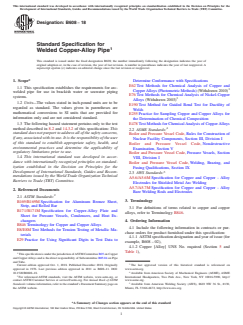
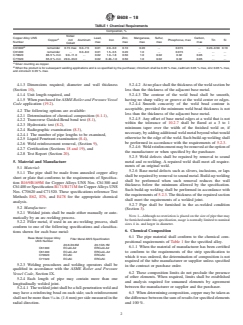
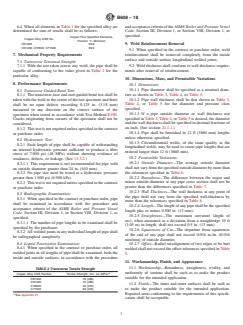
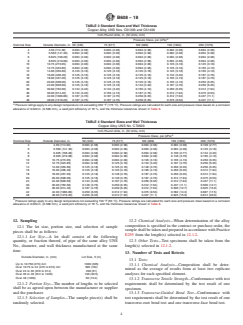
Overview
ASTM B608-18: Standard Specification for Welded Copper-Alloy Pipe defines the requirements for arc-welded copper-alloy pipe used in brackish water or seawater piping systems. Issued by ASTM International, this standard ensures that pipe manufactured from specified copper alloys (UNS C61300, C61400, C70620, and C71520) maintains high quality for demanding environments, such as marine and industrial applications. The standard outlines requirements for material composition, manufacturing processes, mechanical properties, testing methods, marking, and packaging, providing a comprehensive foundation for the use of welded copper-alloy pipes.
Key Topics
Material Requirements
- Welded pipe must be produced from annealed copper-alloy sheet or plate that conforms to referenced ASTM material standards.
- Eligible copper alloys include UNS C61300, C61400, C70620, and C71520.
- Chemical composition must meet specified limits, verified by recognized test methods (e.g., ASTM E478).
Manufacturing
- Joints are to be created by manual or automatic arc-welding.
- Weld filler metals must comply with relevant AWS standards.
- Welds should be full-penetration, matching or exceeding the wall thickness of the base material.
- All welded joints in pipe lengths must be radiographically examined as required.
Mechanical and Performance Testing
- Pipes must pass transverse tensile strength requirements per their alloy group.
- Guided bend and hydrostatic pressure tests ensure weld integrity and leak resistance.
- Tolerances on diameter, roundness, wall thickness, and straightness are strictly specified.
Quality, Marking, and Certification
- Each pipe length must be marked with the specification number, alloy type, size, and manufacturer's trademark.
- Certification and test reports are required when specified in purchase documents.
- Rejection and retesting procedures are included to maintain product compliance.
Applications
Welded copper-alloy pipes manufactured to ASTM B608-18 are primarily designed for brackish or seawater piping systems where corrosion resistance, durability, and mechanical strength are critical. Key application areas include:
- Marine piping systems (ballast, bilge, firefighting, cooling, and seawater supply lines)
- Desalination plants
- Offshore platforms
- Industrial chemical processing plants
- Condenser and heat exchanger systems
The robust specifications for mechanical properties and corrosion resistance in ASTM B608-18 make these copper-alloy pipes ideal for harsh environments where reliability is paramount.
Related Standards
When working with welded copper-alloy piping, compliance with related ASTM, AWS, and ASME standards is essential:
- ASTM B169/B169M: Aluminum Bronze Sheet, Strip, and Rolled Bar
- ASTM B171/B171M: Copper-Alloy Plate and Sheet for Pressure Vessels, Condensers, and Heat Exchangers
- ASTM E8/E8M: Test Methods for Tension Testing of Metallic Materials
- ASTM E190: Guided Bend Test for Ductility of Welds
- ASTM E255: Sampling Copper and Copper Alloys for Chemical Composition
- ASTM E478: Chemical Analysis of Copper Alloys
- AWS A5.6/A5.6M and A5.7/A5.7M: Welding Electrodes and Rods for Copper Alloys
- ASME Boiler and Pressure Vessel Code Sections III, V, VIII, and IX: Design, Nondestructive Examination, and Welding Qualifications
ASTM B608-18 provides a vital specification for manufacturers, specifiers, and end-users seeking reliable, high-performance welded copper-alloy piping solutions in marine and corrosive environments. Adhering to this standard ensures long-term performance, safety, and regulatory compliance in demanding applications.
Relations
- Effective Date
- 01-Oct-2018
- Effective Date
- 01-Jan-2024
- Effective Date
- 01-Apr-2020
- Effective Date
- 01-Aug-2019
- Effective Date
- 01-Jan-2019
- Effective Date
- 01-Oct-2018
- Effective Date
- 15-Jul-2016
- Effective Date
- 01-May-2015
- Effective Date
- 01-Feb-2015
- Effective Date
- 01-Jun-2013
- Effective Date
- 15-Oct-2012
- Effective Date
- 01-Dec-2011
- Effective Date
- 01-Jun-2011
- Effective Date
- 01-Jan-2011
- Effective Date
- 01-Jan-2011
Get Certified
Connect with accredited certification bodies for this standard

Element Materials Technology
Materials testing and product certification.

Inštitut za kovinske materiale in tehnologije
Institute of Metals and Technology. Materials testing, metallurgical analysis, NDT.
Sponsored listings
Frequently Asked Questions
ASTM B608-18 is a technical specification published by ASTM International. Its full title is "Standard Specification for Welded Copper-Alloy Pipe". This standard covers: ABSTRACT This specification covers arc-welded copper-alloy pipe for use in brackish water or seawater piping systems. The pipe shall be made from annealed copper alloy sheet or plate that conforms to the requirements specified for copper alloys with UNS nos. C61300, C61400 C70620 and C71520. These specifications reference test methods E 62, E 76, and E 478 for the appropriate chemical analysis. Welded joints shall be made either manually or automatically by an arc-welding process. The pipe material shall conform to the chemical composition requirements prescribed. With test taken across any weld, the pipe shall be capable of conforming to the required transverse tensional strength value. The transverse-face and root-guided bend test shall be taken with the weld in the center of the test specimen and there shall be no open defects exceeding the required value measured in any direction on the convex surface of the specimen when tested in accordance with test methods E 190. Each length of pipe shall be capable of withstanding an internal hydrostatic pressure without showing evidence of weakness, defects, or leakage. All welded joints in any individual length of pipe shall be radiographed completely. Weld thickness shall conform to wall-thickness requirements after removal of reinforcement. SIGNIFICANCE AND USE 16.1 For purposes of determining compliance with the specified limits for requirements of the properties listed in the following table, an observed value or a calculated value shall be rounded as indicated in accordance with the rounding method of Practice E29. Property Rounded Unit for Observed or Calculated Value Chemical composition nearest unit in the last right-hand significant digit used in expressing the limiting value Tensile strength nearest ksi (5 MPa) SCOPE 1.1 This specification establishes the requirements for arc-welded pipe for use in brackish water or seawater piping systems. 1.2 Units—The values stated in inch-pound units are to be regarded as standard. The values given in parentheses are mathematical conversions to SI units that are provided for information only and are not considered standard. 1.3 The following hazard statement pertains only to the test method described in 8.2 and 14.3.2 of this specification: This standard does not purport to address all of the safety concerns, if any, associated with its use. It is the responsibility of the user of this standard to establish appropriate safety, health, and environmental practices and determine the applicability of regulatory limitations prior to use. 1.4 This international standard was developed in accordance with internationally recognized principles on standardization established in the Decision on Principles for the Development of International Standards, Guides and Recommendations issued by the World Trade Organization Technical Barriers to Trade (TBT) Committee.
ABSTRACT This specification covers arc-welded copper-alloy pipe for use in brackish water or seawater piping systems. The pipe shall be made from annealed copper alloy sheet or plate that conforms to the requirements specified for copper alloys with UNS nos. C61300, C61400 C70620 and C71520. These specifications reference test methods E 62, E 76, and E 478 for the appropriate chemical analysis. Welded joints shall be made either manually or automatically by an arc-welding process. The pipe material shall conform to the chemical composition requirements prescribed. With test taken across any weld, the pipe shall be capable of conforming to the required transverse tensional strength value. The transverse-face and root-guided bend test shall be taken with the weld in the center of the test specimen and there shall be no open defects exceeding the required value measured in any direction on the convex surface of the specimen when tested in accordance with test methods E 190. Each length of pipe shall be capable of withstanding an internal hydrostatic pressure without showing evidence of weakness, defects, or leakage. All welded joints in any individual length of pipe shall be radiographed completely. Weld thickness shall conform to wall-thickness requirements after removal of reinforcement. SIGNIFICANCE AND USE 16.1 For purposes of determining compliance with the specified limits for requirements of the properties listed in the following table, an observed value or a calculated value shall be rounded as indicated in accordance with the rounding method of Practice E29. Property Rounded Unit for Observed or Calculated Value Chemical composition nearest unit in the last right-hand significant digit used in expressing the limiting value Tensile strength nearest ksi (5 MPa) SCOPE 1.1 This specification establishes the requirements for arc-welded pipe for use in brackish water or seawater piping systems. 1.2 Units—The values stated in inch-pound units are to be regarded as standard. The values given in parentheses are mathematical conversions to SI units that are provided for information only and are not considered standard. 1.3 The following hazard statement pertains only to the test method described in 8.2 and 14.3.2 of this specification: This standard does not purport to address all of the safety concerns, if any, associated with its use. It is the responsibility of the user of this standard to establish appropriate safety, health, and environmental practices and determine the applicability of regulatory limitations prior to use. 1.4 This international standard was developed in accordance with internationally recognized principles on standardization established in the Decision on Principles for the Development of International Standards, Guides and Recommendations issued by the World Trade Organization Technical Barriers to Trade (TBT) Committee.
ASTM B608-18 is classified under the following ICS (International Classification for Standards) categories: 77.150.30 - Copper products. The ICS classification helps identify the subject area and facilitates finding related standards.
ASTM B608-18 has the following relationships with other standards: It is inter standard links to ASTM B608-11, ASTM E8/E8M-24, ASTM B169/B169M-20, ASTM B846-19a, ASTM B846-19, ASTM B171/B171M-18, ASTM E8/E8M-16, ASTM B169/B169M-15, ASTM E8/E8M-15, ASTM E8/E8M-13, ASTM B171/B171M-12, ASTM E8/E8M-11, ASTM B846-11a, ASTM B171/B171M-11e1, ASTM B171/B171M-11. Understanding these relationships helps ensure you are using the most current and applicable version of the standard.
ASTM B608-18 is available in PDF format for immediate download after purchase. The document can be added to your cart and obtained through the secure checkout process. Digital delivery ensures instant access to the complete standard document.
Standards Content (Sample)
This international standard was developed in accordance with internationally recognized principles on standardization established in the Decision on Principles for the
Development of International Standards, Guides and Recommendations issued by the World Trade Organization Technical Barriers to Trade (TBT) Committee.
Designation: B608 −18
Standard Specification for
Welded Copper-Alloy Pipe
This standard is issued under the fixed designation B608; the number immediately following the designation indicates the year of
original adoption or, in the case of revision, the year of last revision. A number in parentheses indicates the year of last reapproval. A
superscript epsilon (´) indicates an editorial change since the last revision or reapproval.
1. Scope* Determine Conformance with Specifications
E62 Test Methods for Chemical Analysis of Copper and
1.1 This specification establishes the requirements for arc-
CopperAlloys (Photometric Methods)(Withdrawn 2010)
welded pipe for use in brackish water or seawater piping
E76 Test Methods for Chemical Analysis of Nickel-Copper
systems.
Alloys (Withdrawn 2003)
1.2 Units—The values stated in inch-pound units are to be
E190 Test Method for Guided Bend Test for Ductility of
regarded as standard. The values given in parentheses are
Welds
mathematical conversions to SI units that are provided for
E255 Practice for Sampling Copper and Copper Alloys for
information only and are not considered standard.
the Determination of Chemical Composition
1.3 The following hazard statement pertains only to the test E478 Test Methods for ChemicalAnalysis of CopperAlloys
method described in 8.2 and 14.3.2 of this specification: This
2.2 ASME Standards:
standarddoesnotpurporttoaddressallofthesafetyconcerns,
Boiler and Pressure Vessel Code, Rules for Construction of
ifany,associatedwithitsuse.Itistheresponsibilityoftheuser
Nuclear Facility Components, Section III, Division I
of this standard to establish appropriate safety, health, and
Boiler and Pressure Vessel Code, Nondestructive
environmental practices and determine the applicability of
Examination, Section V
regulatory limitations prior to use.
Boiler and Pressure Vessel Code, Pressure Vessels, Section
1.4 This international standard was developed in accor-
VIII, Division I
dance with internationally recognized principles on standard-
Boiler and Pressure Vessel Code, Welding, Brazing, and
ization established in the Decision on Principles for the
Fusing Qualifications, Section IX
Development of International Standards, Guides and Recom- 5
2.3 AWS Standards:
mendations issued by the World Trade Organization Technical
A5.6/A5.6M Specification for Copper and Copper - Alloy
Barriers to Trade (TBT) Committee.
Electrodes for Shielded Metal Arc Welding
A5.7/A5.7M Specification for Copper and Copper - Alloy
2. Referenced Documents
Bare Welding Rods and Electrodes
2.1 ASTM Standards:
3. Terminology
B169/B169M Specification for Aluminum Bronze Sheet,
Strip, and Rolled Bar
3.1 For definitions of terms related to copper and copper
B171/B171M Specification for Copper-Alloy Plate and
alloys, refer to Terminology B846.
Sheet for Pressure Vessels, Condensers, and Heat Ex-
changers
4. Ordering Information
B846 Terminology for Copper and Copper Alloys
4.1 Include the following information in contracts or pur-
E8/E8M Test Methods for Tension Testing of Metallic Ma-
chase orders for product furnished under this specification:
terials
4.1.1 ASTM specification designation and year of issue (for
E29 Practice for Using Significant Digits in Test Data to
example, B608 – 02),
4.1.2 Copper [Alloy] UNS No. required (Section 5 and
Table 1),
ThisspecificationisunderthejurisdictionofASTMCommitteeB05onCopper
and CopperAlloys and is the direct responsibility of Subcommittee B05.04 on Pipe
and Tube.
Current edition approved Oct. 1, 2018. Published December 2018. Originally The last approved version of this historical standard is referenced on
approved in 1976. Last previous edition approved in 2011 as B608–11. DOI: www.astm.org.
10.1520/B0608–18. Available from American Society of Mechanical Engineers (ASME), ASME
For referenced ASTM standards, visit the ASTM website, www.astm.org, or International Headquarters, Two Park Ave., New York, NY 10016-5990, http://
contact ASTM Customer Service at service@astm.org. For Annual Book of ASTM www.asme.org.
Standards volume information, refer to the standard’s Document Summary page on Available from American Welding Society (AWS), 8669 NW 36 St., #130,
the ASTM website. Miami, FL 33166-6672, http://www.aws.org.
*A Summary of Changes section appears at the end of this standard
Copyright © ASTM International, 100 Barr Harbor Drive, PO Box C700, West Conshohocken, PA 19428-2959. United States
B608 − 18
TABLE 1 Chemical Requirements
Composition, %
Nickel
Copper Alloy UNS Lead, Zinc, Manganese, Sulfur, Carbon,
A
Copper incl Aluminum Iron Phosphorus, max Tin Si
Number max max max max max
Cobalt
B
C61300 remainder 0.15 max 6.0–7.5 0.01 2.0–3.0 0.10 0.20 . 0.015 . 0.20–0.50 0.10
C61400 remainder . 6.0–8.0 0.01 1.5–3.5 0.20 1.0 . 0.015 . . .
C70620 86.5 % min 9.0–11.0 . 0.02 1.0–1.8 0.50 1.0 0.02 0.02 0.05 . .
C71520 65.0 % min 29.0–33.0 . 0.02 0.40–1.0 0.50 1.0 0.02 0.02 0.05 . .
A
Silver counting as copper.
B
When the product is for subsequent welding applications and is so specified by the purchaser, chromium shall be 0.05 % max, cadmium 0.05 % max, zinc 0.05 % max,
and zirconium 0.05 % max.
4.1.3 Dimensions required; diameter and wall thickness 5.2.4.2 Atnoplaceshallthethicknessoftheweldsectionbe
(Section 10), less than the thickness of the adjacent base metal.
4.1.4 Unit length required, and 5.2.4.3 The contour of the weld bead shall be smooth,
4.1.5 WhenpurchasedforASMEBoilerandPressureVessel having no sharp valley or groove at the weld center or edges.
Code application (19.2). 5.2.4.4 Smooth concavity of the weld bead contour is
acceptable, provided the minimum weld bead thickness is not
4.2 The following options are available:
less than the thickness of the adjacent base metal.
4.2.1 Determination of chemical composition (6.1.1),
5.2.4.5 Any offset of base metal edges at a weld that is not
4.2.2 Transverse Guided-Bend bend test (8.1),
within the tolerance of 10.2.7 shall be flared ata3to1
4.2.3 Hydrostatic test (8.2),
minimum taper over the width of the finished weld or, if
4.2.4 Radiographic examination (8.3),
necessary,byaddingadditionalweldmetalbeyondwhatwould
4.2.4.1 The number of pipe lengths to be examined,
otherwise be the edge of the weld. Such build-up welding shall
4.2.5 Liquid Penetrant examination (8.4),
be performed in accordance with the requirements of 5.2.3.
4.2.6 Weld reinforcement removal, (Section 9),
5.2.4.6 Weldreinforcementmayberemovedattheoptionof
4.2.7 Certification (Sections 18 and 19), and
the manufacturer or when specified by the purchaser.
4.2.8 Test Report (Section 20).
5.2.5 Weld defects shall be repaired by removal to sound
5. Material and Manufacture metal and re-welding. A repaired weld shall meet all require-
ments of an original weld.
5.1 Material:
5.2.6 Base metal defects such as slivers, inclusions, or laps
5.1.1 The pipe shall be made from annealed copper alloy
shall be repaired by removal to sound metal. Build-up welding
sheet or plate that conforms to the requirements of Specifica-
shall be performed when such removal reduces the wall
tion B169/B169M for Copper Alloys UNS Nos. C61300 and
thickness below the minimum allowed by the specification.
C61400 or Specification B171/B171M for CopperAlloys UNS
Such build-up welding shall be performed in accordance with
Nos. C70620 and C71520. These specifications reference Test
the requirements of 5.2.3.The thickness of the repaired section
Methods E62, E76, and E478 for the appropriate chemical
shall meet the requirements of a welded joint.
analysis.
5.2.7 Pipe shall be furnished in the as-welded condition
5.2 Manufacture:
(Section 3).
5.2.1 Welded joints shall be made either manually or auto-
NOTE 1—Although no restriction is placed on the size of pipe that may
matically by an arc-welding process.
be furnished under this specification, usage is normally limited to nominal
5.2.2 Filler metal, if used in an arc-welding process, shall
sizes 4 in. and larger in diameter.
conform to one of the following specifications and classifica-
6. Chemical Composition
tions shown for each base metal:
Base Metal Copper Alloy 6.1 The pipe material shall conform to the chemical com-
Filler Metal AWS Specification
UNS Number
positional requirements of Table 1 for the specified alloy.
A5.6/A5.6M A5.7/A5.7M
6.1.1 When the material of manufacturer has been certified
C61300 ECuAl-A2 ERCuAl-A2
C61400 ECuAl–A2 ERCuAl–A2 to conform to the requirements of the strip specification to
C70620 ECuNi ERCuNi
which it was ordered, the determination of composition is not
C71520 ECuNi ERCuNi
required of the tube manufacturer or supplier unless specified
5.2.3 Welding procedures and welding operators shall be
in the contract or purchase order.
qualified in accordance with the ASME Boiler and Pressure
6.2 These composition limits do not preclude the presence
Vessel Code, Section IX.
of other elements. When required, limits shall be established
5.2.4 Each length of pipe may contain more than one
and analysis required for unnamed elements by agreement
longitudinally welded joint.
between the manufacturer or supplier and the purchaser.
5.2.4.1 Theweldedjointshallbeafull-penetrationweldand
may have a reinforcing bead on each side; such reinforcement 6.3 When determining composition, copper may be taken as
shallnotbemorethan ⁄16in.(1.6mm)persidemeasuredinthe thedifferencebetweenthesumofresultsforspecifiedelements
radial direction. and 100 %.
B608 − 18
6.4 When all elements in Table 1 for the specified alloy are andacceptancecriteriaoftheASMEBoilerandPressureVessel
determined the sum of results shall be as follows: Code, Section III, Division 1, or Section VIII, Division 1, as
specified.
Copper Plus Specified Elements,
Copper Alloy UNS No.
Percent, %, Minimum
C61300 99.8 9. Weld Reinforcement Removal
C61400, C70620, C71520 99.5
9.1 When specified in the contract or purchase order, weld
7. Mechanical Property Requirements reinforcement shall be removed completely from the inside
surface and outside surface longitudinal welded joints.
7.1 Transverse Tensional Strength:
7.1.1 With the test taken across any weld, the pipe shall be 9.2 Weld thickness shall conform to wall-thickness require-
capable of conforming to the value given in Table 2 for the ments after removal of reinforcement.
particular alloy.
10. Dimensions, Mass, and Permissible Variations
8. Performance Requirements
10.1 Dimensions:
10.1.1 Pipe diameter shall be specified as a nominal diam-
8.1 Transverse Guided-Bend Test:
eter as shown in Table 3, Table 4,or Table 5.
8.1.1 The transverse-face and root-guided bend test shall be
10.1.2 Pipe wall thickness shall be that shown in Table 3,
taken with the weld in the center of the test specimen and there
Table 4,or Table 5 for the diameter and pressure class
shall be no open defects exceeding 0.125 in. (3.18 mm)
specified.
measured in any direction on the convex surface of the
10.1.3 If a pipe outside diameter or wall thickness not
specimen when tested in accordance with Test Method E190.
specified in Table 3, Table 4,or Table 5 is desired, the diameter
Cracks originating from corners of the specimen shall not be
and the wall thickness shall be specified in decimal fractions of
considered.
an inch. (See section 21.1.1.)
8.1.2 Thistestisnotrequiredunlessspecifiedinthecontract
10.1.4 Pipe shall be furnished in 12 ft (3660 mm) lengths
or purchase order.
unless otherwise specified.
8.2 Hydrostatic Test:
10.1.5 Circumferential welds, of the same quality as the
8.2.1 Each length of pipe shall be capable of withstanding
longitudinal welds, may be used to create pipe lengths that are
an internal hydrostatic pressure sufficient to produce a fiber
ordered longer than 12 ft (3660 mm).
stress of 7 000 psi (48 MPa) without showing evidence of
10.2 Permissible Variations:
weakness, defects, or leakage. (See 15.3.2.)
10.2.1 Outside Diameter—The average outside diameter
8.2.1.1 This requirement is not recommended for pipe with
shallnotvaryfromthespecifiedoutsidediameterbymorethan
an outside diameter greater than 24 in. (610 mm).
the tolerances specified in Table 6.
8.2.2 No pipe size need be tested at a hydrostatic pressure
10.2.2 Roundness—The difference between the major and
greater than 1 000 psi (6 900 kPa).
minor outside-diameter at any pipe cross section shall not be
8.2.3 Thistestisnotrequiredunlessspecifiedinthecontract
greater than the differences specified in Table 7.
or purchase order.
10.2.3 Wall Thickness—The wall thickness at any point of
8.3 Radiographic Examination:
the pipe shall not vary from the specified wall-thickness by
8.3.1 When specified in the contract or purchase order, pipe
more than the tolerances specified in Table 8.
shall be examined in accordance with the procedure and
10.2.4 Length—The length of any pipe shall be the specified
acceptance criteria of the ASME Boiler and Pressure Vessel
length plus or minus 0.500 in. (13 mm).
Code, Section III, Division 1, or Section VIII, Division 1, as
10.2.5 Straightness—The maximum curvature (depth of
specified.
arc), when measured as a deviation from a straightedge 10 ft
8.3.1.1 The number of pipe lengths to be examined shall be
(3.05 m) in length, shall not exceed 0.5 in. (13 mm).
specified by the purchaser.
10.2.6 Squareness of Cut—The departure from squareness
8.3.2 Allweldedjointsinanyindividuallengthofpipeshall
of the end of any pipe shall not exceed 0.016 in./in. (0.016
be radiographed completely.
mm/mm) of outside diameter.
8.4 Liquid Penetration Examination:
10.2.7 Offset—Radial misalignment of two edges to be butt
8.4.1 When specified in the contract or purchase order, all
welded shall not exceed the offset tolerances specified in Table
welded joints in all lengths of pipe shall be examined, both the
9.
inside and outside surfaces, in accordance with the procedure
11. Workmanship, Finish, and Appearance
11.1 Workmanship—Roundness, straightness, ovality, and
TABLE 2 Transverse Tensile Strength
A uniformity of contour shall be such as to make the product
Copper Alloy UNS Number Tensile Strength, min, ksi (MPa)
suitable for the intended application.
C61300 70 (485)
C61400 70 (485)
11.2 Finish—The inner and outer surfaces shall be such as
C70620 40 (275)
to make the product suitable for the intended application.
C71520 50 (345)
A Repaired areas conforming to the requirements of this specifi-
See Appendix X1.
cation shall be acceptable.
B608 − 18
TABLE 3 Standard Sizes and Wall Thickness
Copper Alloy UNS Nos. C61300 and C61400
Inch-Pound Units, in. (SI Units, mm)
A
Pressure Class, psi (kPa)
Nominal Size Outside Diameter, in. 50 (345) 75 (517) 100 (689) 150 (1034) 200 (1379)
4 4.50 (114.30) 0.094 (2.38) 0.094 (2.38) 0.094 (2.38) 0.094 (2.38) 0.094 (2.38)
5 5.563 (141.30) 0.094 (2.38) 0.094 (2.38) 0.094 (2.38) 0.094 (2.38) 0.094 (2.38)
6 6.625 (168.28) 0.094 (2.38) 0.094 (2.38) 0.094 (2.38) 0.094 (2.38) 0.094 (2.38)
8 8.625 (219.08) 0.094 (2.38) 0.094 (2.38) 0.094 (2.38) 0.094 (2.38) 0.094 (2.38)
10 10.75 (273.05) 0.094 (2.38) 0.094 (2.38) 0.094 (2.38) 0.125 (3.18) 0.125 (3.18)
12 12.75 (323.85) 0.094 (2.38) 0.094 (2.38) 0.094 (2.38) 0.125 (3.18) 0.165 (4.19)
14 14.00 (355.60) 0.125 (3.18) 0.125 (3.18) 0.125 (3.18) 0.125 (3.18) 0.165 (4.19)
16 16.00 (406.40) 0.125 (3.18) 0.125 (3.18) 0.125 (3.18) 0.134 (3.40) 0.187 (4.76)
18 18.00 (457.20) 0.125 (3.18) 0.125 (3.18) 0.125 (3.18) 0.165 (4.19) 0.187 (4.76)
20 20.00 (508.00) 0.125 (3.18) 0.125 (3.18) 0.125 (3.18) 0.165 (4.19) 0.250 (6.35)
24 24.00 (609.60) 0.125 (3.18) 0.125 (3.18) 0.134 (3.40) 0.187 (4.76) 0.250 (6.35)
30 30.00 (762.00) 0.134 (3.40) 0.134 (3.40) 0.165 (4.19) 0.250 (6.35) 0.312 (7.94)
36 36.00 (914.40) 0.134 (3.40) 0.165 (4.19) 0.187 (4.76) 0.312 (7.94) 0.375 (9.53)
42 42.00 (1066.80) 0.187 (4.76) 0.187 (4.76) 0.250 (6.35) 0.312 (7.94) 0.437 (11.1)
48 48.00 (1219.20) 0.187 (4.76) 0.187 (4.76) 0.250 (6.35) 0.375 (9.53) 0.437 (11.1)
A
Pressure ratings apply to any design temperature not exceeding 350 °F (176 °C). Pressure ratings are calculated for each size and pressure class based on a corrosion
allowance of 0.020 in. (0.508 mm), a weld joint efficiency of 70 %, and the thickness tolerances shown in Table 8.
TABLE 4 Standard Sizes and Wall Thickness
Copper Alloy UNS No. C70620
Inch-Pound Units, in. (SI Units, mm)
A
Pressure Class, psi (kPa)
Nominal Size Outside Diameter, in. 50 (345) 75 (517) 100 (689) 150 (1034) 200 (1379)
4 4.50 (114.30) 0.094 (2.38) 0.094 (2.38) 0.094 (2.38) 0.094 (2.38) 0.109 (2.77)
5 5.563 (141.30) 0.094 (2.38) 0.094 (2.38) 0.094 (2.38) 0.094 (2.38) 0.125 (3.18)
6 6.625 (168.28) 0.094 (2.38) 0.094 (2.38) 0.094 (2.38) 0.109 (2.77) 0.134 (3.40)
8 8.625 (219.08) 0.094 (2.38) 0.094 (2.38) 0.094 (2.38) 0.148 (
...
This document is not an ASTM standard and is intended only to provide the user of an ASTM standard an indication of what changes have been made to the previous version. Because
it may not be technically possible to adequately depict all changes accurately, ASTM recommends that users consult prior editions as appropriate. In all cases only the current version
of the standard as published by ASTM is to be considered the official document.
Designation: B608 − 11 B608 − 18
Standard Specification for
Welded Copper-Alloy Pipe
This standard is issued under the fixed designation B608; the number immediately following the designation indicates the year of
original adoption or, in the case of revision, the year of last revision. A number in parentheses indicates the year of last reapproval. A
superscript epsilon (´) indicates an editorial change since the last revision or reapproval.
1. Scope*
1.1 This specification establishes the requirements for arc-welded pipe for use in brackish water or seawater piping systems.
1.2 Units—The values stated in inch-pound units are to be regarded as standard. The values given in parentheses are
mathematical conversions to SI units that are provided for information only and are not considered standard.
1.3 The following hazard statement pertains only to the test method described in 8.2 and 14.3.2 of this specification:This
standard does not purport to address all of the safety concerns, if any, associated with its use. It is the responsibility of the user
of this standard to establish appropriate safety safety, health, and healthenvironmental practices and determine the applicability
of regulatory limitations prior to use.
1.4 This international standard was developed in accordance with internationally recognized principles on standardization
established in the Decision on Principles for the Development of International Standards, Guides and Recommendations issued
by the World Trade Organization Technical Barriers to Trade (TBT) Committee.
2. Referenced Documents
2.1 ASTM Standards:
B169/B169M Specification for Aluminum Bronze Sheet, Strip, and Rolled Bar
B171/B171M Specification for Copper-Alloy Plate and Sheet for Pressure Vessels, Condensers, and Heat Exchangers
B846 Terminology for Copper and Copper Alloys
E8E8/E8M Test Methods for Tension Testing of Metallic Materials [Metric] E0008_E0008M
E29 Practice for Using Significant Digits in Test Data to Determine Conformance with Specifications
E62 Test Methods for Chemical Analysis of Copper and Copper Alloys (Photometric Methods) (Withdrawn 2010)
E76 Test Methods for Chemical Analysis of Nickel-Copper Alloys (Withdrawn 2003)
E190 Test Method for Guided Bend Test for Ductility of Welds
E255 Practice for Sampling Copper and Copper Alloys for the Determination of Chemical Composition
E478 Test Methods for Chemical Analysis of Copper Alloys
2.2 AWS Standards:
A 5.6 Covered Copper-Alloy Arc-Welding Electrodes
A 5.7 Copper and Copper-Alloy Welding Rods
2.2 ASME Standards:
Boiler and Pressure Vessel Code, Nuclear Power Plant Rules for Construction of Nuclear Facility Components, Section III,
Division I
Boiler and Pressure Vessel Code, Nondestructive Examination, Section V
Boiler and Pressure Vessel Code, Pressure Vessels, Section VIII, Division I
Boiler and Pressure Vessel Code, Welding Welding, Brazing, and Fusing Qualifications, Section IX
This specification is under the jurisdiction of ASTM Committee B05 on Copper and Copper Alloys and is the direct responsibility of Subcommittee B05.04 on Pipe and
Tube.
Current edition approved Oct. 1, 2011Oct. 1, 2018. Published November 2011December 2018. Originally approved in 1976. Last previous edition approved in 20072011
as B608 – 07.B608–11. DOI: 10.1520/B0608-11.10.1520/B0608–18.
For referenced ASTM standards, visit the ASTM website, www.astm.org, or contact ASTM Customer Service at service@astm.org. For Annual Book of ASTM Standards
volume information, refer to the standard’sstandard’s Document Summary page on the ASTM website.
The last approved version of this historical standard is referenced on www.astm.org.
Available from American Welding Society (AWS), 550 NW LeJeune Rd., Miami, FL 33126, http://www.aws.org.
Available from American Society of Mechanical Engineers (ASME), ASME International Headquarters, ThreeTwo Park Ave., New York, NY 10016-5990,
http://www.asme.org.
*A Summary of Changes section appears at the end of this standard
Copyright © ASTM International, 100 Barr Harbor Drive, PO Box C700, West Conshohocken, PA 19428-2959. United States
B608 − 18
2.3 AWS Standards:
A5.6/A5.6M Specification for Copper and Copper - Alloy Electrodes for Shielded Metal Arc Welding
A5.7/A5.7M Specification for Copper and Copper - Alloy Bare Welding Rods and Electrodes
3. Terminology
3.1 For definitions of terms related to copper and copper alloys, refer to Terminology B846.
4. Ordering Information
4.1 Include the following information in contracts or purchase orders for product furnished under this specification:
4.1.1 ASTM specification designation and year of issue,issue (for example, B608 – 02),
4.1.2 Copper alloy[Alloy] UNS No. required (Section 5 and Table 1),
4.1.3 Dimensions required; diameter and wall thickness (Section 10),
4.1.4 Unit length required, and
4.1.5 When purchased for ASME Boiler and Pressure Vessel Code application (section (19.2).
4.2 The following options are available:
4.2.1 Determination of chemical composition (Section (6.1.1),
4.2.2 Transverse Guided-Bend bend test (Section (8.1),
4.2.3 Hydrostatic test (Section (8.2),
4.2.4 Radiographic examination (Section (8.3),
4.2.4.1 The number of pipe lengths to be examined,
4.2.5 Liquid Penetrant examination (Section (8.4),
4.2.6 Weld reinforcement removal, (Section 9),
4.2.7 Certification (Section(Sections 1818 and 19), and (Section 19)
4.2.8 Test Report (Section 20).
5. Material and Manufacture
5.1 Material:
5.1.1 The pipe shall be made from annealed copper alloy sheet or plate that conforms to the requirements of Specification
B169/B169M for Copper Alloys UNS Nos. C61300 and C61400 or Specification B171/B171M for Copper Alloys UNS Nos.
C70620 and C71520. These specifications reference Test Methods E62, E76, and E478 for the appropriate chemical analysis.
5.2 Manufacture:
5.2.1 Welded joints shall be made either manually or automatically by an arc-welding process.
5.2.2 Filler metal, if used in an arc-welding process, shall conform to one of the following specifications and classifications
shown for each base metal:
Base Metal Copper Alloy Filler Metal AWS Specification
UNS Number A5.6 A5.7
Base Metal Copper Alloy
Filler Metal AWS Specification
UNS Number
A5.6/A5.6M A5.7/A5.7M
C61300 ECuAl-A2 ERCuAl-A2
C61400 ECuAl–A2 ERCuAl–A2
C70620 ECuNi ERCuNi
C71520 ECuNi ERCuNi
TABLE 1 Chemical Requirements
Composition, %
Nickel
Copper Alloy UNS Lead, Zinc, Manganese, Sulfur, Carbon,
A
Copper incl Aluminum Iron Phosphorus, max Tin Si
Number max max max max max
Cobalt
B
C61300 remainder 0.15 max 6.0–7.5 0.01 2.0–3.0 0.10 0.20 . 0.015 . 0.20–0.50 0.10
C61400 remainder . 6.0–8.0 0.01 1.5–3.5 0.20 1.0 . 0.015 . . .
C70620 86.5 % min 9.0–11.0 . 0.02 1.0–1.8 0.50 1.0 0.02 0.02 0.05 . .
C71520 65.0 % min 29.0–33.0 . 0.02 0.40–1.0 0.50 1.0 0.02 0.02 0.05 . .
A
Silver counting as copper.
B
When the product is for subsequent welding applications and is so specified by the purchaser, chromium shall be 0.05 % max, cadmium 0.05 % max, zinc 0.05 % max,
and zirconium 0.05 % max.
Available from American Welding Society (AWS), 8669 NW 36 St., #130, Miami, FL 33166-6672, http://www.aws.org.
B608 − 18
5.2.3 Welding procedures and welding operators shall be qualified in accordance with the ASME Boiler and Pressure Vessel
Code, Section IX.
5.2.4 Each length of pipe may contain more than one longitudinally welded joint.
5.2.4.1 The welded joint shall be a full-penetration weld and may have a reinforcing bead on each side; such reinforcement shall
not be more than ⁄16 in. (1.6 mm) per side measured in the radial direction.
5.2.4.2 At no place shall the thickness of the weld section be less than the thickness of the adjacent base metal.
5.2.4.3 The contour of the weld bead shall be smooth, having no sharp valley or groove at the weld center or edges.
5.2.4.4 Smooth concavity of the weld bead contour is acceptable, provided the minimum weld bead thickness is not less than
the thickness of the adjacent base metal.
5.2.4.5 Any offset of base metal edges at a weld that is not within the tolerance of 10.2.710.2.7 shall be flared at a 3 to 1
minimum taper over the width of the finished weld, orweld or, if necessary, by adding additional weld metal beyond what would
otherwise be the edge of the weld. Such build-up welding shall be performed in accordance with the requirements of 5.2.3.
5.2.4.6 Weld reinforcement may be removed at the option of the manufacturer or when specified by the purchaser.
5.2.5 Weld defects shall be repaired by removal to sound metal and re-welding. A repaired weld shall meet all requirements of
an original weld.
5.2.6 Base metal defects such as slivers, inclusions, or laps shall be repaired by removal to sound metal. Build-up welding shall
be performed when such removal reduces the wall thickness below the minimum allowed by the specification. Such build-up
welding shall be performed in accordance with the requirements of 5.2.3. The thickness of the repaired section shall meet the
requirements of a welded joint.
5.2.7 Pipe shall be furnished in the as-welded condition (Section 3).
NOTE 1—Although no restriction is placed on the size of pipe that may be furnished under this specification, usage is normally limited to nominal sizes
4 in. and larger in diameter.
6. Chemical Composition
6.1 The pipe material shall conform to the chemical compositional requirements of Table 1 for the specified alloy.
6.1.1 When the material of manufacturer has been certified to conform to the requirements of the strip specification to which
it was ordered, the determination of composition is not required of the tube manufacturer or supplier unless specified in the contract
or purchase order.
6.2 These composition limits do not preclude the presence of other elements. When required, limits shall be established and
analysis required for unnamed elements by agreement between the manufacturer or supplier and the purchaser.
6.3 When determining composition, copper may be taken as the difference between the sum of results for specified elements
and 100 %.
6.4 When all elements in Table 1 for the specified alloy are determined the sum of results shall be as follows:
Copper Plus Specified Elements,
Copper Alloy UNS No.
Percent, %, Minimum
C61300 99.8
C61400, C70620, C71520 99.5
7. Mechanical Property Requirements
7.1 Transverse Tensional Strength:
7.1.1 With the test taken across any weld, the pipe shall be capable of conforming to the value given in Table 2 for the particular
alloy.
8. Performance Requirements
8.1 Transverse Guided-Bend Test:
8.1.1 The transverse-face and root-guided bend test shall be taken with the weld in the center of the test specimen and there
shall be no open defects exceeding 0.125 in. (3.18 mm) measured in any direction on the convex surface of the specimen when
tested in accordance with Test MethodsMethod E190. Cracks originating from corners of the specimen shall not be considered.
8.1.2 This test is not required unless specified in the contract or purchase order.
TABLE 2 Transverse Tensile Strength
A
Copper Alloy UNS Number Tensile Strength, min, ksi (MPa)
C61300 70 (485)
C61400 70 (485)
C70620 40 (275)
C71520 50 (345)
A
See Appendix X1.
B608 − 18
8.2 Hydrostatic Test:
8.2.1 Each length of pipe shall be capable of withstanding an internal hydrostatic pressure sufficient to produce a fiber stress
of 7 000 psi (48 MPa) without showing evidence of weakness, defects, or leakage. (See 15.3.2.)
8.2.1.1 This requirement is not recommended for pipe with an outside diameter greater than 24 in. (610 mm).
8.2.2 No pipe size need be tested at a hydrostatic pressure greater than 1 000 psi (6 900 kPa).
8.2.3 This test is not required unless specified in the contract or purchase order.
8.3 Radiographic Examination:
8.3.1 When specified in the contract or purchase order, pipe shall be examined in accordance with the procedure and acceptance
criteria of the ASME Boiler and Pressure Vessel Code, Section III, Division 1, or Section VIII, Division 1, as specified.
8.3.1.1 The number of pipe lengths to be examined shall be specified by the purchaser.
8.3.2 All welded joints in any individual length of pipe shall be radiographed completely.
8.4 Liquid Penetration Examination:
8.4.1 When specified in the contract or purchase order, all welded joints in all lengths of pipe shall be examined, both the inside
and outside surfaces, in accordance with the procedure and acceptance criteria of the ASME Boiler and Pressure Vessel Code,
Section III, Division 1, or Section VIII, Division 1, as specified.
9. Weld Reinforcement Removal
9.1 When specified in the contract or purchase order, weld reinforcement shall be removed completely from the inside surface
and outside surface longitudinal welded joints.
9.2 Weld thickness shall conform to wall-thickness requirements after removal of reinforcement.
10. Dimensions, Mass, and Permissible Variations
10.1 Dimensions:
10.1.1 Pipe diameter shall be specified as a nominal diameter as shown in Table 3, Table 4, or Table 5.
10.1.2 Pipe wall thickness shall be that shown in Table 3, Table 4, or Table 5 for the diameter and pressure class specified.
10.1.3 If a pipe outside-diameter or wall-thickness outside diameter or wall thickness not specified in Table 3, Table 4, or Table
5 is desired, the diameter and the wall thickness shall be specified in decimal fractions of an inch. (See section 21.1.1.)
10.1.4 Pipe shall be furnished in 12 ft (3660 mm) lengths unless otherwise specified.
10.1.5 Circumferential welds, of the same quality as the longitudinal welds, may be used to create pipe lengths that are ordered
longer than 12 ft (3660 mm).
10.2 Permissible Variations:
10.2.1 Outside Diameter—The average outside-diameter outside diameter shall not vary from the specified outside-diameter
outside diameter by more than the tolerances specified in Table 6.
10.2.2 Roundness—The difference between the major and minor outside-diameter at any pipe cross section shall not be greater
than the differences specified in Table 7.
10.2.3 Wall Thickness—The wall thickness at any point of the pipe shall not vary from the specified wall-thickness by more than
the tolerances specified in Table 8.
TABLE 3 Standard Sizes and Wall Thickness
Copper Alloy UNS Nos. C61300 and C61400
Inch-Pound Units, in. (SI Units, mm)
A
Pressure Class, psi (kPa)
Nominal Size Outside Diameter, in. 50 (345) 75 (517) 100 (689) 150 (1034) 200 (1379)
4 4.50 (114.30) 0.094 (2.38) 0.094 (2.38) 0.094 (2.38) 0.094 (2.38) 0.094 (2.38)
5 5.563 (141.30) 0.094 (2.38) 0.094 (2.38) 0.094 (2.38) 0.094 (2.38) 0.094 (2.38)
6 6.625 (168.28) 0.094 (2.38) 0.094 (2.38) 0.094 (2.38) 0.094 (2.38) 0.094 (2.38)
8 8.625 (219.08) 0.094 (2.38) 0.094 (2.38) 0.094 (2.38) 0.094 (2.38) 0.094 (2.38)
10 10.75 (273.05) 0.094 (2.38) 0.094 (2.38) 0.094 (2.38) 0.125 (3.18) 0.125 (3.18)
12 12.75 (323.85) 0.094 (2.38) 0.094 (2.38) 0.094 (2.38) 0.125 (3.18) 0.165 (4.19)
14 14.00 (355.60) 0.125 (3.18) 0.125 (3.18) 0.125 (3.18) 0.125 (3.18) 0.165 (4.19)
16 16.00 (406.40) 0.125 (3.18) 0.125 (3.18) 0.125 (3.18) 0.134 (3.40) 0.187 (4.76)
18 18.00 (457.20) 0.125 (3.18) 0.125 (3.18) 0.125 (3.18) 0.165 (4.19) 0.187 (4.76)
20 20.00 (508.00) 0.125 (3.18) 0.125 (3.18) 0.125 (3.18) 0.165 (4.19) 0.250 (6.35)
24 24.00 (609.60) 0.125 (3.18) 0.125 (3.18) 0.134 (3.40) 0.187 (4.76) 0.250 (6.35)
30 30.00 (762.00) 0.134 (3.40) 0.134 (3.40) 0.165 (4.19) 0.250 (6.35) 0.312 (7.94)
36 36.00 (914.40) 0.134 (3.40) 0.165 (4.19) 0.187 (4.76) 0.312 (7.94) 0.375 (9.53)
42 42.00 (1066.80) 0.187 (4.76) 0.187 (4.76) 0.250 (6.35) 0.312 (7.94) 0.437 (11.1)
48 48.00 (1219.20) 0.187 (4.76) 0.187 (4.76) 0.250 (6.35) 0.375 (9.53) 0.437 (11.1)
A
Pressure ratings apply to any design temperature not exceeding 350°F (176°C).350 °F (176 °C). Pressure ratings are calculated for each size and pressure class based
on a corrosion allowance of 0.020 in. (0.508 mm), a weld joint efficiency of 70 %, and the thickness tolerances shown in Table 8.
B608 − 18
TABLE 4 Standard Sizes and Wall Thickness
Copper Alloy UNS No. C70620
Inch-Pound Units, in. (SI Units, mm)
A
Pressure Class, psi (kPa)
Nominal Size Outside Diameter, in. 50 (345) 75 (517) 100 (689) 150 (1034) 200 (1379)
4 4.50 (114.30) 0.094 (2.38) 0.094 (2.38) 0.094 (2.38) 0.094 (2.38) 0.109 (2.77)
5 5.563 (141.30) 0.094 (2.38) 0.094 (2.38) 0.094 (2.38) 0.094 (2.38) 0.125 (3.18)
6 6.625 (168.28) 0.094 (2.38) 0.094 (2.38) 0.094 (2.38) 0.109 (2.77) 0.134 (3.40)
8 8.625 (219.08) 0.094 (2.38) 0.094 (2.38) 0.094 (2.38) 0.148 (3.76) 0.165 (4.19)
10 10.75 (273.05) 0.094 (2.38) 0.094 (2.38) 0.125 (3.18) 0.165 (4.19) 0.250 (6.35)
12 12.75 (323.85) 0.094 (2.38) 0.125 (3.18) 0.134 (3.40) 0.187 (4.76) 0.250 (6.35)
14 14.00 (355.60) 0.125 (3.18) 0.125 (3.18) 0.148 (3.76) 0.250 (6.35) 0.250 (6.35)
16 16.00 (406.40) 0.125 (3.18) 0.125 (3.18) 0.165 (4.19) 0.250 (6.35) 0.312 (7.94)
18 18.00 (457.20) 0.125 (3.18) 0.148 (3.76) 0.187 (4.76) 0.250 (6.35) 0.312 (7.94)
20 20.00 (508.00) 0.125 (3.18) 0.148 (3.76) 0.187 (4.76) 0.312 (7.94) 0.375 (9.53)
24 24.00 (609.60) 0.134 (3.40) 0.187 (4.76) 0.250 (6.35) 0.312 (7.94) 0.437 (11.1)
30 30.00 (762.00) 0.148 (3.76) 0.250 (6.35) 0.312 (7.94) 0.437 (11.1) 0.500 (12.7)
36 36.00 (914.40) 0.187 (4.76) 0.250 (6.35) 0.312 (7.94) 0.500 (12.7) 0.625 (15.9)
42 42.00 (1066.80) 0.250 (6.35) 0.312 (7.94) 0.375 (9.53) 0.562 (14.3) 0.687 (17.5)
48 48.00 (1219.20) 0.250 (6.35) 0.312 (7.94) 0.437 (11.1) 0.625 (15.9) 0.812 (20.6)
A
Pressure ratings apply to any design temperature not exceeding 150°F (65°C).150 °F (65 °C). Pressure ratings are calculated for each size and pressure class based
on a corrosion allowance of 0.020 in. (0.508 mm), a weld joint efficiency of 70 %, and the thickness tolerances shown in Table 8.
TABLE 5 Standard Sizes and Wall Thicknesses
Copper Alloy UNS No. C71520
Inch-Pound Units, in. (SI Units
...