

ASTM D7276-16(2023)
(Guide)Standard Guide for Analysis and Interpretation of Test Data for Articulating Concrete Block (ACB) Revetment Systems in Open Channel Flow
General Information
- Abstract
SIGNIFICANCE AND USE
5.1 This standard is intended for use by researchers and designers to assess the stability of articulating concrete block (ACB) revetment systems in order to achieve stable hydraulic performance under the erosive force of flowing water.
5.2 An articulating concrete block system is comprised of a matrix of individual concrete blocks placed together to form an erosion-resistant revetment with specific hydraulic performance characteristics. The system includes a filter layer compatible with the subsoil which allows infiltration and exfiltration to occur while providing particle retention. The filter layer may be comprised of a geotextile, properly graded granular media, or both. The blocks within the matrix shall be dense and durable, and the matrix shall be flexible and porous.
5.3 Articulating concrete block systems are used to provide erosion protection to underlying soil materials from the forces of flowing water. The term “articulating,” as used in this standard, implies the ability of individual blocks of the system to conform to changes in the subgrade while remaining interconnected by virtue of block interlock or additional system components such as cables, ropes, geotextiles, geogrids, or other connecting devices, or combinations thereof.
5.4 The definition of articulating concrete block systems does not distinguish between interlocking and non-interlocking block geometries, between cable-tied and non-cable-tied systems, between vegetated and non-vegetated systems or between methods of manufacturing or placement. This standard does not specify size restrictions for individual block units. Block systems are available in either open-cell or closed-cell varieties.
SCOPE
1.1 The purpose of this guide is to provide recommended guidelines for the analysis and interpretation of hydraulic test data for articulating concrete block (ACB) revetment systems under steep slope, high velocity flow conditions in a rectangular open channel. Data from tests performed under controlled laboratory conditions are used to quantify stability performance of ACB systems under hydraulic loading. This guide is intended to be used in conjunction with Test Method D7277.
1.2 This guide offers an organized collection of information or a series of options and does not recommend a specific course of action. This document cannot replace education or experience and should be used in conjunction with professional judgment. Not all aspects of this guide may be applicable in all circumstances. This ASTM standard is not intended to represent or replace the standard of care by which adequacy of a given professional service must be judged, nor can this document be applied without considerations of a project’s many unique aspects. The word “Standard” in the title of this document means only that the document has been approved through the ASTM consensus process.
1.3 The values stated in inch-pound units are to be regarded as standard. The user of the standard is responsible for any and all conversions to other systems of units. Reporting of test results in units other than inch-pound shall not be regarded as nonconformance with this test method.
1.4 This standard does not purport to address all of the safety concerns, if any, associated with its use. It is the responsibility of the user of this standard to establish appropriate safety, health, and environmental practices and determine the applicability of regulatory limitations prior to use.
1.5 This international standard was developed in accordance with internationally recognized principles on standardization established in the Decision on Principles for the Development of International Standards, Guides and Recommendations issued by the World Trade Organization Technical Barriers to Trade (TBT) Committee.
- Status
- Published
- Publication Date
- 31-Jul-2023
- Technical Committee
- D18 - Soil and Rock
- Drafting Committee
- D18.25 - Erosion and Sediment Control Technology
Overview
ASTM D7276-16(2023): Standard Guide for Analysis and Interpretation of Test Data for Articulating Concrete Block (ACB) Revetment Systems in Open Channel Flow provides guidelines for researchers, engineers, and designers to assess the hydraulic stability of articulating concrete block (ACB) systems in open channels. This standard focuses on the use of laboratory-generated test data to evaluate how ACB revetment systems perform under erosive forces caused by steep slope and high-velocity water flows.
ACB revetment systems are formed by placing individual concrete blocks together in a matrix, often accompanied by a filter layer of geotextile, granular media, or both, to achieve erosion resistance while allowing water infiltration and exfiltration. These systems are designed to offer flexibility, durability, and porosity, adapting to changes in the subgrade while preserving overall integrity.
Key Topics
- Hydraulic Stability Assessment: The guide outlines how to analyze test data from laboratory simulations of open channel flows, focusing on key hydraulic parameters such as discharge, velocity, flow depth, slope, energy grade line, and shear stress.
- Evaluation Criteria: The standard describes the process for identifying threshold hydraulic conditions-such as peak velocity and shear stress-at the point just upstream from system failure or the onset of instability.
- System Components and Configurations: This guide applies to a variety of ACB system designs, regardless of block geometry, use of cables or interlocking devices, presence of vegetation, or construction methodology.
- Use of Test Method D7277: Analysis is intended to be conducted using controlled tests performed in accordance with ASTM D7277.
- Reporting Requirements: Proper documentation is emphasized, including personnel involved, test setup details, measured and computed data, and the rationale behind interpretations.
Applications
- Erosion Protection: ACB revetment systems are widely used to prevent erosion of soil in channels, levees, banks, and overflows where high-velocity water threatens underlying structures or landscapes.
- Design Validation: The test data analysis and interpretation procedures guided by ASTM D7276 help engineers select and validate the right ACB system for specific project requirements, with quantifiable stability parameters.
- Project Specification: Hydraulic engineers and specifiers use this standard to confirm that proposed or installed block systems meet necessary stability thresholds under anticipated open channel flow conditions.
- Quality Control: Its reporting and data interpretation guidelines are valuable for laboratory technicians, quality assurance professionals, and regulatory reviewers during product qualification and certification processes.
- Flexible and Adaptable Systems: The versatility in block types, connection methods, and filter layers covered by this standard allows its application across diverse civil infrastructure, including flood channels, spillways, and riverbanks.
Related Standards
- ASTM D7277 - Test Method for Performance Testing of Articulating Concrete Block (ACB) Revetment Systems for Hydraulic Stability in Open Channel Flow
- ASTM D6684 - Specification for Materials and Manufacture of Articulating Concrete Block (ACB) Systems
- ASTM D6884 - Practice for Installation of Articulating Concrete Block (ACB) Revetment Systems
- ASTM D653 - Terminology Relating to Soil, Rock, and Contained Fluids
- ASTM D6026 - Practice for Using Significant Digits and Data Records in Geotechnical Data
By following ASTM D7276-16(2023), professionals can optimize the design, analysis, and deployment of erosion-control systems, ensuring reliable channel protection and long-term hydraulic stability under varying open channel flow conditions. Incorporating this standard into project planning supports compliance with internationally recognized principles and best practices for erosion control and channel stability.
Keywords: articulating concrete blocks, ACB revetment, erosion control, open channel flow, hydraulic stability, stability analysis, ASTM D7276, test data interpretation, channel protection, filter layer, block systems, erosion-resistant revetment.
Relations
- Effective Date
- 01-Dec-2018
- Effective Date
- 01-Nov-2015
- Effective Date
- 01-Aug-2014
- Effective Date
- 01-Sep-2011
- Effective Date
- 01-May-2010
- Effective Date
- 01-May-2010
- Effective Date
- 01-Jan-2009
- Effective Date
- 01-Dec-2008
- Effective Date
- 01-Nov-2008
- Effective Date
- 01-Aug-2008
- Effective Date
- 15-Dec-2007
- Effective Date
- 01-Nov-2007
- Effective Date
- 01-Aug-2007
- Effective Date
- 01-Jul-2007
- Effective Date
- 01-May-2007
Get Certified
Connect with accredited certification bodies for this standard

DIBt (Deutsches Institut für Bautechnik)
German Institute for Building Technology.
DIN CERTCO
DIN Group product certification.

Aboma Certification B.V.
Specialized in construction, metal, and transport sectors.
Sponsored listings
Frequently Asked Questions
ASTM D7276-16(2023) is a guide published by ASTM International. Its full title is "Standard Guide for Analysis and Interpretation of Test Data for Articulating Concrete Block (ACB) Revetment Systems in Open Channel Flow". This standard covers: SIGNIFICANCE AND USE 5.1 This standard is intended for use by researchers and designers to assess the stability of articulating concrete block (ACB) revetment systems in order to achieve stable hydraulic performance under the erosive force of flowing water. 5.2 An articulating concrete block system is comprised of a matrix of individual concrete blocks placed together to form an erosion-resistant revetment with specific hydraulic performance characteristics. The system includes a filter layer compatible with the subsoil which allows infiltration and exfiltration to occur while providing particle retention. The filter layer may be comprised of a geotextile, properly graded granular media, or both. The blocks within the matrix shall be dense and durable, and the matrix shall be flexible and porous. 5.3 Articulating concrete block systems are used to provide erosion protection to underlying soil materials from the forces of flowing water. The term “articulating,” as used in this standard, implies the ability of individual blocks of the system to conform to changes in the subgrade while remaining interconnected by virtue of block interlock or additional system components such as cables, ropes, geotextiles, geogrids, or other connecting devices, or combinations thereof. 5.4 The definition of articulating concrete block systems does not distinguish between interlocking and non-interlocking block geometries, between cable-tied and non-cable-tied systems, between vegetated and non-vegetated systems or between methods of manufacturing or placement. This standard does not specify size restrictions for individual block units. Block systems are available in either open-cell or closed-cell varieties. SCOPE 1.1 The purpose of this guide is to provide recommended guidelines for the analysis and interpretation of hydraulic test data for articulating concrete block (ACB) revetment systems under steep slope, high velocity flow conditions in a rectangular open channel. Data from tests performed under controlled laboratory conditions are used to quantify stability performance of ACB systems under hydraulic loading. This guide is intended to be used in conjunction with Test Method D7277. 1.2 This guide offers an organized collection of information or a series of options and does not recommend a specific course of action. This document cannot replace education or experience and should be used in conjunction with professional judgment. Not all aspects of this guide may be applicable in all circumstances. This ASTM standard is not intended to represent or replace the standard of care by which adequacy of a given professional service must be judged, nor can this document be applied without considerations of a project’s many unique aspects. The word “Standard” in the title of this document means only that the document has been approved through the ASTM consensus process. 1.3 The values stated in inch-pound units are to be regarded as standard. The user of the standard is responsible for any and all conversions to other systems of units. Reporting of test results in units other than inch-pound shall not be regarded as nonconformance with this test method. 1.4 This standard does not purport to address all of the safety concerns, if any, associated with its use. It is the responsibility of the user of this standard to establish appropriate safety, health, and environmental practices and determine the applicability of regulatory limitations prior to use. 1.5 This international standard was developed in accordance with internationally recognized principles on standardization established in the Decision on Principles for the Development of International Standards, Guides and Recommendations issued by the World Trade Organization Technical Barriers to Trade (TBT) Committee.
SIGNIFICANCE AND USE 5.1 This standard is intended for use by researchers and designers to assess the stability of articulating concrete block (ACB) revetment systems in order to achieve stable hydraulic performance under the erosive force of flowing water. 5.2 An articulating concrete block system is comprised of a matrix of individual concrete blocks placed together to form an erosion-resistant revetment with specific hydraulic performance characteristics. The system includes a filter layer compatible with the subsoil which allows infiltration and exfiltration to occur while providing particle retention. The filter layer may be comprised of a geotextile, properly graded granular media, or both. The blocks within the matrix shall be dense and durable, and the matrix shall be flexible and porous. 5.3 Articulating concrete block systems are used to provide erosion protection to underlying soil materials from the forces of flowing water. The term “articulating,” as used in this standard, implies the ability of individual blocks of the system to conform to changes in the subgrade while remaining interconnected by virtue of block interlock or additional system components such as cables, ropes, geotextiles, geogrids, or other connecting devices, or combinations thereof. 5.4 The definition of articulating concrete block systems does not distinguish between interlocking and non-interlocking block geometries, between cable-tied and non-cable-tied systems, between vegetated and non-vegetated systems or between methods of manufacturing or placement. This standard does not specify size restrictions for individual block units. Block systems are available in either open-cell or closed-cell varieties. SCOPE 1.1 The purpose of this guide is to provide recommended guidelines for the analysis and interpretation of hydraulic test data for articulating concrete block (ACB) revetment systems under steep slope, high velocity flow conditions in a rectangular open channel. Data from tests performed under controlled laboratory conditions are used to quantify stability performance of ACB systems under hydraulic loading. This guide is intended to be used in conjunction with Test Method D7277. 1.2 This guide offers an organized collection of information or a series of options and does not recommend a specific course of action. This document cannot replace education or experience and should be used in conjunction with professional judgment. Not all aspects of this guide may be applicable in all circumstances. This ASTM standard is not intended to represent or replace the standard of care by which adequacy of a given professional service must be judged, nor can this document be applied without considerations of a project’s many unique aspects. The word “Standard” in the title of this document means only that the document has been approved through the ASTM consensus process. 1.3 The values stated in inch-pound units are to be regarded as standard. The user of the standard is responsible for any and all conversions to other systems of units. Reporting of test results in units other than inch-pound shall not be regarded as nonconformance with this test method. 1.4 This standard does not purport to address all of the safety concerns, if any, associated with its use. It is the responsibility of the user of this standard to establish appropriate safety, health, and environmental practices and determine the applicability of regulatory limitations prior to use. 1.5 This international standard was developed in accordance with internationally recognized principles on standardization established in the Decision on Principles for the Development of International Standards, Guides and Recommendations issued by the World Trade Organization Technical Barriers to Trade (TBT) Committee.
ASTM D7276-16(2023) is classified under the following ICS (International Classification for Standards) categories: 91.100.30 - Concrete and concrete products. The ICS classification helps identify the subject area and facilitates finding related standards.
ASTM D7276-16(2023) has the following relationships with other standards: It is inter standard links to ASTM D6684-18, ASTM D6884-03(2015)e1, ASTM D653-14, ASTM D653-11, ASTM D6684-04(2010), ASTM D6884-03(2010), ASTM D653-09, ASTM D653-08a, ASTM D653-08, ASTM D7277-08, ASTM D653-07f, ASTM D653-07e, ASTM D653-07d, ASTM D653-07c, ASTM D653-07b. Understanding these relationships helps ensure you are using the most current and applicable version of the standard.
ASTM D7276-16(2023) is available in PDF format for immediate download after purchase. The document can be added to your cart and obtained through the secure checkout process. Digital delivery ensures instant access to the complete standard document.
Standards Content (Sample)
This international standard was developed in accordance with internationally recognized principles on standardization established in the Decision on Principles for the
Development of International Standards, Guides and Recommendations issued by the World Trade Organization Technical Barriers to Trade (TBT) Committee.
Designation: D7276 − 16 (Reapproved 2023)
Standard Guide for
Analysis and Interpretation of Test Data for Articulating
Concrete Block (ACB) Revetment Systems in Open Channel
Flow
This standard is issued under the fixed designation D7276; the number immediately following the designation indicates the year of
original adoption or, in the case of revision, the year of last revision. A number in parentheses indicates the year of last reapproval. A
superscript epsilon (´) indicates an editorial change since the last revision or reapproval.
1. Scope ization established in the Decision on Principles for the
Development of International Standards, Guides and Recom-
1.1 The purpose of this guide is to provide recommended
mendations issued by the World Trade Organization Technical
guidelines for the analysis and interpretation of hydraulic test
Barriers to Trade (TBT) Committee.
data for articulating concrete block (ACB) revetment systems
under steep slope, high velocity flow conditions in a rectangu-
2. Referenced Documents
lar open channel. Data from tests performed under controlled
laboratory conditions are used to quantify stability perfor-
2.1 ASTM Standards:
mance of ACB systems under hydraulic loading. This guide is
D653 Terminology Relating to Soil, Rock, and Contained
intended to be used in conjunction with Test Method D7277.
Fluids
D6026 Practice for Using Significant Digits and Data Re-
1.2 This guide offers an organized collection of information
cords in Geotechnical Data
or a series of options and does not recommend a specific course
D6684 Specification for Materials and Manufacture of Ar-
of action. This document cannot replace education or experi-
ticulating Concrete Block (ACB) Systems
ence and should be used in conjunction with professional
D6884 Practice for Installation of Articulating Concrete
judgment. Not all aspects of this guide may be applicable in all
Block (ACB) Revetment Systems
circumstances. This ASTM standard is not intended to repre-
D7277 Test Method for Performance Testing of Articulating
sent or replace the standard of care by which adequacy of a
Concrete Block (ACB) Revetment Systems for Hydraulic
given professional service must be judged, nor can this
Stability in Open Channel Flow
document be applied without considerations of a project’s
many unique aspects. The word “Standard” in the title of this
3. Terminology
document means only that the document has been approved
through the ASTM consensus process.
3.1 For definitions of common terms used in this standard,
see Terminology D653.
1.3 The values stated in inch-pound units are to be regarded
as standard. The user of the standard is responsible for any and
4. Summary of Guide
all conversions to other systems of units. Reporting of test
results in units other than inch-pound shall not be regarded as
4.1 The analysis and interpretation of data from hydraulic
nonconformance with this test method.
tests of articulating concrete block (ACB) revetment systems is
1.4 This standard does not purport to address all of the
essential to the selection and design of a suitable system for a
safety concerns, if any, associated with its use. It is the
specific application. This guide provides guidelines for assist-
responsibility of the user of this standard to establish appro-
ing designers and specifiers in developing a correspondence
priate safety, health, and environmental practices and deter-
between the test data and the stability parameters used for
mine the applicability of regulatory limitations prior to use.
design.
1.5 This international standard was developed in accor-
4.2 This standard addresses the analysis of hydraulic test
dance with internationally recognized principles on standard-
data that is generated from a test or series of tests conducted in
accordance with Test Method D7277.
This guide is under the jurisdiction of ASTM Committee D18 on Soil and Rock
and is the direct responsibility of Subcommittee D18.25 on Erosion and Sediment
Control Technology. For referenced ASTM standards, visit the ASTM website, www.astm.org, or
Current edition approved Aug. 1, 2023. Published August 2023. Originally contact ASTM Customer Service at service@astm.org. For Annual Book of ASTM
approved in 2008. Last previous edition approved in 2016 as D7276 - 16. DOI: Standards volume information, refer to the standard’s Document Summary page on
10.1520/D7276-16R23. the ASTM website.
Copyright © ASTM International, 100 Barr Harbor Drive, PO Box C700, West Conshohocken, PA 19428-2959. United States
D7276 − 16 (2023)
5. Significance and Use means for delivering water to the test section. Alternatively, the
discharge may be computed at each of the measurement
5.1 This standard is intended for use by researchers and
cross-sections by the continuity equation:
designers to assess the stability of articulating concrete block
Q 5 A V (1)
(ACB) revetment systems in order to achieve stable hydraulic ~ !
0.6
performance under the erosive force of flowing water.
where:
5.2 An articulating concrete block system is comprised of a
V = centerline point velocity at six-tenths of the depth of
0.6
matrix of individual concrete blocks placed together to form an
flow at each station, ft/s, (L/T), and
erosion-resistant revetment with specific hydraulic perfor-
A = the cross-sectional area of flow at the same station,
mance characteristics. The system includes a filter layer
measured perpendicular to the direction of flow,
2 2
compatible with the subsoil which allows infiltration and
ft (L ).
exfiltration to occur while providing particle retention. The
6.2.2.1 The accuracy of the discharge measurement shall be
filter layer may be comprised of a geotextile, properly graded
reported as described in Section 7 of this standard.
granular media, or both. The blocks within the matrix shall be
6.2.3 Flow Depth, y, is computed as the difference in the
dense and durable, and the matrix shall be flexible and porous.
measured centerline water surface elevation and the elevation
5.3 Articulating concrete block systems are used to provide
of the revetment surface, corrected for the slope angle θ as
erosion protection to underlying soil materials from the forces
appropriate, at each measurement station:
of flowing water. The term “articulating,” as used in this
y 5 h 2 z cosθ (2)
standard, implies the ability of individual blocks of the system ~ !
i i i
to conform to changes in the subgrade while remaining
where:
interconnected by virtue of block interlock or additional system
y = depth of flow at station i (perpendicular to the bed), ft
i
components such as cables, ropes, geotextiles, geogrids, or
(L),
other connecting devices, or combinations thereof.
h = water surface elevation at station i, ft (L),
i
5.4 The definition of articulating concrete block systems z = bed elevation (top of blocks) at station i, ft (L), and
i
does not distinguish between interlocking and non-interlocking θ = slope angle measured from the horizontal.
block geometries, between cable-tied and non-cable-tied
6.2.4 Energy Grade Slope, S , at each measurement station
f
systems, between vegetated and non-vegetated systems or
is calculated from other measured or computed variables as:
between methods of manufacturing or placement. This stan-
n V 1
~ !
dard does not specify size restrictions for individual block i
S 5 (3)
F G
fi 4/3
K y
units. Block systems are available in either open-cell or u i
closed-cell varieties.
where:
S = slope of the energy grade line at station i, ft/ft (L/L),
6. Procedure fi
n = Manning’s resistance coefficient,
6.1 Data Analysis:
V = velocity at station i, ft/s (L/T), and
i
6.1.1 This section describes the analysis and interpretation
K = units conversion coefficient, equal to 1.486 for U.S.
u
of the data collected during a test, including the determination
Customary Units and 1.0 for SI Units.
of hydraulic conditions, qualitative observations and descrip-
6.2.4.1 Eq 3 assumes that the flume walls are significantly
tions of any damage to the revetment system, and quantifica-
smoother than the revetment surface, such that the total
tion of threshold hydraulic stability values resulting from this
resistance is due solely to the roughness of the bed.
analysis that are characteristic of the tested system.
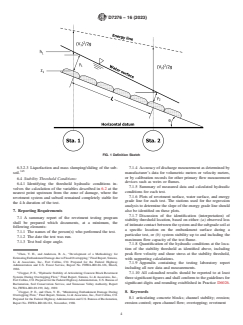
6.2.5 Step-Forewater Analysis—Knowing the total dis-
6.1.2 Typical test environments incorporate a flow regime
charge Q, flume width b, and the elevations of the water
that is supercritical, characterized by high velocities with
surface and revetment surface at each of the measurement
relatively shallow depths of flow. In supercritical flow, small
stations, a forewater calculation can be performed to obtain the
variations in measured depth can result in relatively large
optimal value of the Manning’s n coefficient.
variations in calculated energy and shear stress. The analytical
methods suggested in this section have been selected based on
6.2.5.1 For supercritical flow, it is recommended that the
their suitability to analyze these hydraulic conditions. water surface profile be computed by solving the momentum
equation using the standard step method and proceeding in the
6.2 Hydraulic Conditions:
downstream direction:
6.2.1 Accurately quantifying the hydraulic conditions that
existed during the test is fundamental to the establishment of
1 L
h 5 h 1 v 1v v 2 v 2 S 1S (4)
~ ! ~ ! ~ !
2 1 1 2 1 2 f1 f2
stability performance thresholds. The important hydraulic vari- 2g 2
ables that characterize open channel flow include total dis-
where:
charge Q, section-averaged velocity V, flow depth y, slope of
h , h = upstream and downstream water surface eleva-
1 2
the energy grade line S , resistance coefficient (for example,
f
tions at stations 1 and 2, ft (L),
Manning n-value), and boundary shear stress τ.
v , v = upstream and downstream velocity at stations 1
1 2
6.2.2 Total Discharge, Q, is determined by use of a primary
and 2, ft/s (L/T),
flow measurement device such as an in-line flow meter, weir,
Ls = slope length between stations 1 and 2, ft (L), and
Parshall flume, or other device appropriate to the facility’s
D7276 − 16 (2023)
representative depth associated with that determination.
S , S = upstream and downstream energy grade slopes at
f1 f2
Typically, a linear regression is performed to determine the
stations 1 and 2 as defined by Eq 3, ft/ft (L/L).
slope of the energy grade line. The measured depths from the
NOTE 1—Other numerical methods are available for computing the
water surface profile, for example the direct step method. The standard
stations used in this regression analysis are averaged to
step method is being recommended here because it allows computation of
determine the representative depth y in order to calculate the
hydraulic conditions at the actual locations of the flume measurement
bed shear stress.
stations.
6.2.8.2 Alternatively, the momentum equation across a rep-
6.2.5.2 The objective function to be minimized is defined
resentative control volume of finite length L may be used to
as:
calculate τ :
i
n
ξ 5 abs h 2 h (5)
~ !
pred obs
( γ 1 γ 1 1
i5i 2 2 2
τ 5 y 1y sinθ1 y 2 y cosθ 2 ρq 2 (8)
~ ! F ~ ! S DG
0 1 2 1 2
2 L 2 y y
2 1
where:
where:
i = beginning station for analysis,
3 3
γ = unit weight of water, 62.4 lb/ft (M ⁄L ),
i = ending station for analysis,
n
y , y = flow depths at the upstream and downstream ends of
h = predicted water surface elevation at station i , ft (L),
1 2
pred i
the control volume, respectively, ft (L),
and
v , v = flow velocity at the upstream and downstream ends
h = observed water surface elevation at station i , ft (L).
1 2
obs i
of the control volume, respectively, ft/s (L/T),
6.2.5.3 By examining a range of Manning’s n values, the
L = length of the control volume along the slope, ft (L),
optimal Manning’s n is identified as that which yields the 3 3
ρ = unit mass of water, 1.94 slugs/ft (M ⁄L ), and
3 3
minimum value of the objective function defined by Eq 5. The
q = unit discharge, ft /s per foot width (L /T per L
optimal Mannings n value is then used to calculate the water
width).
surface elevation that best fits the observed data. An example
6.2.
...