

ASTM A506-16(2021)
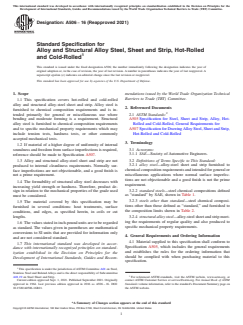
(Specification)Standard Specification for Alloy and Structural Alloy Steel, Sheet and Strip, Hot-Rolled and Cold-Rolled
General Information
- Abstract
ABSTRACT
This specification covers the standard for hot-rolled and cold-rolled alloy and structural alloy-steel sheet and strip. The material shall be furnished in several conditions: heat treatments such as hot-rolling and cold rolling; surface conditions; and edges, as specified herein, in coils or cut lengths. Heat analysis shall be performed on the material and shall conform to the required chemical compositions for carbon, manganese, phosphorus, sulfur, silicon, copper, nickel, chromium, molybdenum, and vanadium. Materials in the annealed, normalized, or normalized-and-tempered condition shall be capable of meeting the longitudinal bend test requirements. Two tension tests and two hardness tests shall be made from coupons obtained from each heat (cast) and heat treatment lot.
SCOPE
1.1 This specification covers hot-rolled and cold-rolled alloy and structural alloy-steel sheet and strip. Alloy steel is furnished to chemical composition requirements and is intended primarily for general or miscellaneous use where bending and moderate forming is a requirement. Structural alloy steel is furnished to chemical composition requirements and to specific mechanical property requirements which may include tension tests, hardness tests, or other commonly accepted mechanical tests.
1.2 If material of a higher degree of uniformity of internal soundness and freedom from surface imperfections is required, reference should be made to Specification A507.
1.3 Alloy and structural alloy-steel sheet and strip are not produced to internal cleanliness requirements. Normally surface imperfections are not objectionable, and a good finish is not a prime requirement.
1.4 The formability of structural alloy steel decreases with increasing yield strength or hardness. Therefore, product design in relation to the mechanical properties of the grade used must be considered.
1.5 The material covered by this specification may be furnished in several conditions: heat treatments, surface conditions, and edges, as specified herein, in coils or cut lengths.
1.6 The values stated in inch-pound units are to be regarded as standard. The values given in parentheses are mathematical conversions to SI units that are provided for information only and are not considered standard.
1.7 This international standard was developed in accordance with internationally recognized principles on standardization established in the Decision on Principles for the Development of International Standards, Guides and Recommendations issued by the World Trade Organization Technical Barriers to Trade (TBT) Committee.
- Status
- Published
- Publication Date
- 31-Aug-2021
- Technical Committee
- A01 - Steel, Stainless Steel and Related Alloys
- Drafting Committee
- A01.19 - Steel Sheet and Strip

Overview
ASTM A506-16(2021), Standard Specification for Alloy and Structural Alloy Steel, Sheet and Strip, Hot-Rolled and Cold-Rolled, establishes requirements for a diverse range of hot-rolled and cold-rolled alloy and structural alloy steel sheet and strip. Developed by ASTM International, this standard specifies material characteristics, surface and edge conditions, and testing requirements, supporting consistent quality in the supply chain. It applies to products supplied in coils or cut lengths, suitable for both general-use and applications needing specific mechanical properties. ASTM A506 is widely recognized in industries where bending and forming are necessary, covering both regular alloy steel and structural alloy steel with more stringent mechanical requirements.
Key Topics
Material Conditions:
- Supplied as hot-rolled or cold-rolled steel, in conditions such as as-rolled, annealed, normalized, or normalized-and-tempered.
- Available in multiple finishes and edge types, based on purchaser specification.
Chemical Composition:
- Requires heat analysis for key elements: carbon, manganese, phosphorus, sulfur, silicon, copper, nickel, chromium, molybdenum, and vanadium.
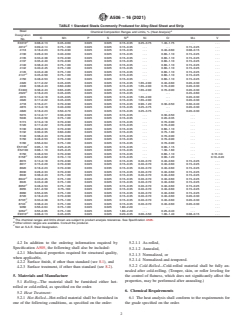
- Chemical ranges are specified for standard and non-standard steels.
Mechanical Properties:
- For structural alloy steel, tension, hardness, and bend test requirements may be specified.
- Regular alloy steel is not subject to mandatory mechanical testing.
- The formability of steel decreases with higher yield strength or hardness, impacting the suitability for certain fabrication processes.
Product Forms:
- Supplied in coils or cut lengths.
- Edge conditions and surface treatments can be customized, if specified.
Surface Requirements:
- Hot-rolled steel typically retains scale unless descaling is specified.
- Cold-rolled steel generally has a dull matte finish and is supplied oiled unless ordered dry.
Applications
ASTM A506-16(2021) is essential when specifying alloy and structural alloy steel sheet and strip for:
- Automotive components: Suitable for parts requiring bending and forming, such as brackets, frames, and supports.
- Industrial machinery: Used in the fabrication of machine parts and components that need specific strength and surface characteristics.
- Construction: Applied in structural applications where specific mechanical properties are necessary for safety and performance.
- General engineering: Useful for products where moderate forming or bending is required, and surface finish is not the primary concern.
These steel sheets and strips offer versatility, serving both general-purpose uses and critical structural roles, depending on the composition and mechanical property requirements.
Related Standards
When working with ASTM A506-16(2021), consider referencing these related standards for additional requirements or broader applications:
- ASTM A505: General requirements for steel, sheet and strip, alloy, hot-rolled and cold-rolled.
- ASTM A507: Specification for drawing alloy steel, sheet and strip, with higher internal cleanliness and soundness requirements.
- SAE Standards: For standard steel chemical compositions applied in automotive and engineering applications.
Summary
ASTM A506-16(2021) delivers a reliable framework for ordering and utilizing hot-rolled and cold-rolled alloy and structural alloy steel sheet and strip, ensuring compliance with standardized chemical and mechanical requirements. Its flexibility in surface condition, edges, and mechanical testing makes it a practical choice for manufacturers, engineers, and specifiers across a range of industrial sectors. For best results, careful selection of grade and property requirements in line with end-use needs is essential.
Relations
- Effective Date
- 01-May-2012
- Effective Date
- 01-May-2012
- Effective Date
- 01-Apr-2010
- Effective Date
- 01-Mar-2006
- Effective Date
- 01-Dec-2005
- Effective Date
- 01-Mar-2005
- Effective Date
- 01-Mar-2004
- Effective Date
- 10-May-2000
- Effective Date
- 10-Mar-2000
Get Certified
Connect with accredited certification bodies for this standard

Element Materials Technology
Materials testing and product certification.

Inštitut za kovinske materiale in tehnologije
Institute of Metals and Technology. Materials testing, metallurgical analysis, NDT.
Sponsored listings
Frequently Asked Questions
ASTM A506-16(2021) is a technical specification published by ASTM International. Its full title is "Standard Specification for Alloy and Structural Alloy Steel, Sheet and Strip, Hot-Rolled and Cold-Rolled". This standard covers: ABSTRACT This specification covers the standard for hot-rolled and cold-rolled alloy and structural alloy-steel sheet and strip. The material shall be furnished in several conditions: heat treatments such as hot-rolling and cold rolling; surface conditions; and edges, as specified herein, in coils or cut lengths. Heat analysis shall be performed on the material and shall conform to the required chemical compositions for carbon, manganese, phosphorus, sulfur, silicon, copper, nickel, chromium, molybdenum, and vanadium. Materials in the annealed, normalized, or normalized-and-tempered condition shall be capable of meeting the longitudinal bend test requirements. Two tension tests and two hardness tests shall be made from coupons obtained from each heat (cast) and heat treatment lot. SCOPE 1.1 This specification covers hot-rolled and cold-rolled alloy and structural alloy-steel sheet and strip. Alloy steel is furnished to chemical composition requirements and is intended primarily for general or miscellaneous use where bending and moderate forming is a requirement. Structural alloy steel is furnished to chemical composition requirements and to specific mechanical property requirements which may include tension tests, hardness tests, or other commonly accepted mechanical tests. 1.2 If material of a higher degree of uniformity of internal soundness and freedom from surface imperfections is required, reference should be made to Specification A507. 1.3 Alloy and structural alloy-steel sheet and strip are not produced to internal cleanliness requirements. Normally surface imperfections are not objectionable, and a good finish is not a prime requirement. 1.4 The formability of structural alloy steel decreases with increasing yield strength or hardness. Therefore, product design in relation to the mechanical properties of the grade used must be considered. 1.5 The material covered by this specification may be furnished in several conditions: heat treatments, surface conditions, and edges, as specified herein, in coils or cut lengths. 1.6 The values stated in inch-pound units are to be regarded as standard. The values given in parentheses are mathematical conversions to SI units that are provided for information only and are not considered standard. 1.7 This international standard was developed in accordance with internationally recognized principles on standardization established in the Decision on Principles for the Development of International Standards, Guides and Recommendations issued by the World Trade Organization Technical Barriers to Trade (TBT) Committee.
ABSTRACT This specification covers the standard for hot-rolled and cold-rolled alloy and structural alloy-steel sheet and strip. The material shall be furnished in several conditions: heat treatments such as hot-rolling and cold rolling; surface conditions; and edges, as specified herein, in coils or cut lengths. Heat analysis shall be performed on the material and shall conform to the required chemical compositions for carbon, manganese, phosphorus, sulfur, silicon, copper, nickel, chromium, molybdenum, and vanadium. Materials in the annealed, normalized, or normalized-and-tempered condition shall be capable of meeting the longitudinal bend test requirements. Two tension tests and two hardness tests shall be made from coupons obtained from each heat (cast) and heat treatment lot. SCOPE 1.1 This specification covers hot-rolled and cold-rolled alloy and structural alloy-steel sheet and strip. Alloy steel is furnished to chemical composition requirements and is intended primarily for general or miscellaneous use where bending and moderate forming is a requirement. Structural alloy steel is furnished to chemical composition requirements and to specific mechanical property requirements which may include tension tests, hardness tests, or other commonly accepted mechanical tests. 1.2 If material of a higher degree of uniformity of internal soundness and freedom from surface imperfections is required, reference should be made to Specification A507. 1.3 Alloy and structural alloy-steel sheet and strip are not produced to internal cleanliness requirements. Normally surface imperfections are not objectionable, and a good finish is not a prime requirement. 1.4 The formability of structural alloy steel decreases with increasing yield strength or hardness. Therefore, product design in relation to the mechanical properties of the grade used must be considered. 1.5 The material covered by this specification may be furnished in several conditions: heat treatments, surface conditions, and edges, as specified herein, in coils or cut lengths. 1.6 The values stated in inch-pound units are to be regarded as standard. The values given in parentheses are mathematical conversions to SI units that are provided for information only and are not considered standard. 1.7 This international standard was developed in accordance with internationally recognized principles on standardization established in the Decision on Principles for the Development of International Standards, Guides and Recommendations issued by the World Trade Organization Technical Barriers to Trade (TBT) Committee.
ASTM A506-16(2021) is classified under the following ICS (International Classification for Standards) categories: 77.140.50 - Flat steel products and semi-products. The ICS classification helps identify the subject area and facilitates finding related standards.
ASTM A506-16(2021) has the following relationships with other standards: It is inter standard links to ASTM A507-12, ASTM A505-12, ASTM A507-10, ASTM A507-06, ASTM A507-05, ASTM A505-00(2005), ASTM A507-04, ASTM A507-00, ASTM A505-00. Understanding these relationships helps ensure you are using the most current and applicable version of the standard.
ASTM A506-16(2021) is available in PDF format for immediate download after purchase. The document can be added to your cart and obtained through the secure checkout process. Digital delivery ensures instant access to the complete standard document.
Standards Content (Sample)
This international standard was developed in accordance with internationally recognized principles on standardization established in the Decision on Principles for the
Development of International Standards, Guides and Recommendations issued by the World Trade Organization Technical Barriers to Trade (TBT) Committee.
Designation: A506 −16 (Reapproved 2021)
Standard Specification for
Alloy and Structural Alloy Steel, Sheet and Strip, Hot-Rolled
and Cold-Rolled
This standard is issued under the fixed designation A506; the number immediately following the designation indicates the year of
original adoption or, in the case of revision, the year of last revision. A number in parentheses indicates the year of last reapproval. A
superscript epsilon (´) indicates an editorial change since the last revision or reapproval.
This standard has been approved for use by agencies of the U.S. Department of Defense.
1. Scope mendations issued by the World Trade Organization Technical
Barriers to Trade (TBT) Committee.
1.1 This specification covers hot-rolled and cold-rolled
alloy and structural alloy-steel sheet and strip. Alloy steel is
2. Referenced Documents
furnished to chemical composition requirements and is in-
tended primarily for general or miscellaneous use where 2.1 ASTM Standards:
bending and moderate forming is a requirement. Structural A505 Specification for Steel, Sheet and Strip, Alloy, Hot-
alloy steel is furnished to chemical composition requirements Rolled and Cold-Rolled, General Requirements for
and to specific mechanical property requirements which may A507 SpecificationforDrawingAlloySteel,SheetandStrip,
Hot-Rolled and Cold-Rolled
include tension tests, hardness tests, or other commonly
accepted mechanical tests.
3. Terminology
1.2 If material of a higher degree of uniformity of internal
soundness and freedom from surface imperfections is required, 3.1 Acronyms:
3.1.1 SAE—Society of Automotive Engineers.
reference should be made to Specification A507.
3.2 Definitions of Terms Specific to This Standard:
1.3 Alloy and structural alloy-steel sheet and strip are not
3.2.1 alloy steel—alloy-steel sheet and strip furnished to
produced to internal cleanliness requirements. Normally sur-
chemicalcompositionrequirementsandintendedforgeneralor
face imperfections are not objectionable, and a good finish is
miscellaneous applications where normal surface imperfec-
not a prime requirement.
tions are not objectionable and a good finish is not the prime
1.4 The formability of structural alloy steel decreases with
requirement.
increasing yield strength or hardness. Therefore, product de-
3.2.2 standard steels—steel chemical compositions defined
sign in relation to the mechanical properties of the grade used
as “standard” by SAE, shown in Table 1.
must be considered.
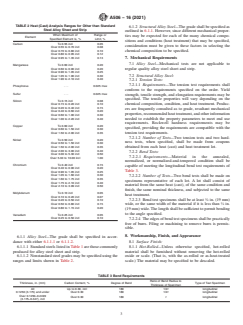
3.2.3 steels other than standard—steel chemical composi-
1.5 The material covered by this specification may be
tions other than those defined as “standard,” and furnished to
furnished in several conditions: heat treatments, surface
the composition limits shown in Table 2.
conditions, and edges, as specified herein, in coils or cut
lengths.
3.2.4 structural alloy steel—alloy-steelsheetandstripmeet-
ing the requirements of regular quality and also produced to
1.6 The values stated in inch-pound units are to be regarded
specific mechanical property requirements.
as standard. The values given in parentheses are mathematical
conversions to SI units that are provided for information only
4. General Requirements and Ordering Information
and are not considered standard.
4.1 Material supplied to this specification shall conform to
1.7 This international standard was developed in accor-
Specification A505, which includes the general requirements
dance with internationally recognized principles on standard-
and establishes the rules for the ordering information that
ization established in the Decision on Principles for the
should be complied with when purchasing material to this
Development of International Standards, Guides and Recom-
specification.
This specification is under the jurisdiction of ASTM Committee A01 on Steel,
Stainless Steel and Related Alloys and is the direct responsibility of Subcommittee
A01.19 on Steel Sheet and Strip. For referenced ASTM standards, visit the ASTM website, www.astm.org, or
Current edition approved Sept. 1, 2021. Published September 2021. Originally contact ASTM Customer Service at service@astm.org. For Annual Book of ASTM
approved in 1964. Last previous edition approved in 2016 as A506 – 16. DOI: Standards volume information, refer to the standard’s Document Summary page on
10.1520/A0506-16R21. the ASTM website.
*A Summary of Changes section appears at the end of this standard
Copyright © ASTM International, 100 Barr Harbor Drive, PO Box C700, West Conshohocken, PA 19428-2959. United States
A506 − 16 (2021)
TABLE 1 Standard Steels Commonly Produced for Alloy-Steel Sheet and Strip
A
Steel
Chemical Composition Ranges and Limits, % (Heat Analysis)
Designation
B
CMn P S Si Ni Cr Mo V
No.
C
E3310 0.08–0.13 0.45–0.60 0.025 0.025 0.15–0.35 3.25–3.75 1.40–1.75 . . . . . .
C
4012 0.09–0.14 0.75–1.00 0.025 0.025 0.15–0.35 . . . . . . 0.15–0.25 . . .
4118 0.18–0.23 0.70–0.90 0.025 0.025 0.15–0.35 . . . 0.40–0.60 0.08–0.15 . . .
4130 0.28–0.33 0.40–0.60 0.025 0.025 0.15–0.35 . . . 0.80–1.10 0.15–0.25 . . .
4135 0.33–0.38 0.70–0.90 0.025 0.025 0.15–0.35 . . . 0.80–1.10 0.15–0.25 . . .
4137 0.35–0.40 0.70–0.90 0.025 0.025 0.15–0.35 . . . 0.80–1.10 0.15–0.25 . . .
4140 0.38–0.43 0.75–1.00 0.025 0.025 0.15–0.35 . . . 0.80–1.10 0.15–0.25 . . .
4142 0.40–0.45 0.75–1.00 0.025 0.025 0.15–0.35 . . . 0.80–1.10 0.15–0.25 . . .
4145 0.43–0.48 0.75–1.00 0.025 0.025 0.15–0.35 . . . 0.80–1.10 0.15–0.25 . . .
C
4147 0.45–0.50 0.75–1.00 0.025 0.025 0.15–0.35 . . . 0.80–1.10 0.15–0.25 . . .
4150 0.48–0.53 0.75–1.00 0.025 0.025 0.15–0.35 . . . 0.80–1.10 0.15–0.25 . . .
4320 0.17–0.22 0.45–0.65 0.025 0.025 0.15–0.35 1.65–2.00 0.40–0.60 0.20–0.30 . . .
4340 0.38–0.43 0.60–0.80 0.025 0.025 0.15–0.35 1.65–2.00 0.70–0.90 0.20–0.30 . . .
E4340 0.38–0.43 0.65–0.85 0.025 0.025 0.15–0.35 1.65–2.00 0.70–0.90 0.20–0.30 . . .
C
4520 0.18–0.23 0.45–0.65 0.025 0.025 0.15–0.35 . . . . . . 0.45–0.60 . . .
4615 0.13–0.18 0.45–0.65 0.025 0.025 0.15–0.35 1.65–2.00 . . . 0.20–0.30 . . .
4620 0.17–0.22 0.45–0.65 0.025 0.025 0.15–0.35 1.65–2.00 . . . 0.20–0.30 . . .
4718 0.16–0.21 0.70–0.90 0.025 0.025 0.15–0.35 0.90–1.20 0.30–0.50 0.30–0.40 . . .
4815 0.13–0.18 0.40–0.60 0.025 0.025 0.15–0.35 3.25–3.75 . . . 0.20–0.30 . . .
4820 0.18–0.23 0.50–0.70 0.025 0.025 0.15–0.35 3.25–3.75 . . . 0.20–0.30 . . .
5015 0.12–0.17 0.30–0.50 0.025 0.025 0.15–0.35 . . . 0.30–0.50 . . . . . .
5046 0.43–0.50 0.75–1.00 0.025 0.025 0.15–0.35 . . . 0.20–0.35 . . . . . .
5115 0.13–0.18 0.70–0.90 0.025 0.025 0.15–0.35 . . . 0.70–0.90 . . . . . .
5120 0.17–0.22 0.70–0.90 0.025 0.025 0.15–0.35 . . . 0.70–0.90 . . . . . .
5130 0.28–0.33 0.70–0.90 0.025 0.025 0.15–0.35 . . . 0.80–1.10 . . . . . .
5132 0.30–0.35 0.60–0.80 0.025 0.025 0.15–0.35 . . . 0.75–1.00 . . . . . .
5140 0.38–0.43 0.70–0.90 0.025 0.025 0.15–0.35 . . . 0.70–0.90 . . . . . .
5150 0.48–0.53 0.70–0.90 0.025 0.025 0.15–0.35 . . . 0.70–0.90 . . . . . .
5160 0.56–0.64 0.75–1.00 0.025 0.025 0.15–0.35 . . . 0.70–0.90 . . . . . .
C
E51100 0.95–1.10 0.25–0.45 0.025 0.025 0.15–0.35 . . . 0.90–1.15 . . . . . .
E52100 0.98–1.10 0.25–0.45 0.025 0.025 0.15–0.35 . . . 1.30–1.60 . . . . . .
6150 0.48–0.53 0.70–0.90 0.025 0.025 0.15–0.35 . . . 0.80–1.10 . . . 0.15 min
C
6158 0.55–0.62 0.70–1.10 0.025 0.025 0.15–0.35 . . . 0.90–1.20 . . . 0.10–0.20
8615 0.13–0.18 0.70–0.90 0.025 0.025 0.15–0.35 0.40–0.70 0.40–0.60 0.15–0.25 . . .
8617 0.15–0.20 0.70–0.90 0.025 0.025 0.15–0.35 0.40–0.70 0.40–0.60 0.15–0.25 . . .
8620 0.18–0.23 0.70–0.90 0.035 0.035 0.15–0.35 0.40–0.70 0.40–0.60 0.15–0.25 . . .
8630 0.28–0.33 0.70–0.90 0.025 0.025 0.15–0.35 0.40–0.70 0.40–0.60 0.15–0.25 . . .
8640 0.38–0.43 0.75–1.00 0.025 0.025 0.15–0.35 0.40–0.70 0.40–0.60 0.15–0.25 . . .
C
8642 0.40–0.45 0.75–1.00 0.025 0.025 0.15–0.35 0.40–0.70 0.40–0.60 0.15–0.25 . . .
8645 0.43–0.48 0.75–1.00 0.025 0.025 0.15–0.35 0.40–0.70 0.40–0.60 0.15–0.25 . . .
C
8650 0.48–0.53 0.75–1.00 0.025 0.025 0.15–0.35 0.40–0.70 0.40–0.60 0.15–0.25 . . .
8655 0.51–0.59 0.75–100 0.025 0.025 0.15–0.35 0.40–0.70 0.40–0.60 0.15–0.25 . . .
8660 0.55–0.65 0.75–1.00 0.025 0.025 0.15–0.35 0.40–0.70 0.40–0.60 0.15–0.25 . . .
8720 0.18–0.23 0.70–0.90 0.025 0.025 0.15–0.35 0.40–0.70 0.40–0.60 0.20–0.30 . . .
C
8735 0.33–0.38 0.75–1.00 0.025 0.025 0.15–0.35 0.40–0.70 0.40–0.60
...