

ASTM D3527-23
(Test Method)Standard Test Method for Life Performance of Automotive Wheel Bearing Grease
General Information
- Abstract
SIGNIFICANCE AND USE
5.1 This test method differentiates among wheel bearing greases having distinctly different high-temperature characteristics. It is not the equivalent of longtime service tests, nor is it intended to distinguish between the products having similar high-temperature performance properties.
5.2 This test method has proven to be helpful in screening greases with respect to life performance for automotive wheel bearing applications.
SCOPE
1.1 This test method covers a laboratory procedure for evaluating the high-temperature life performance of wheel bearing greases when tested under prescribed conditions.
Note 1: Changes to this test method in the 1985 revision increased test severity. Results will not be comparable with data from earlier procedures.
1.2 The values stated in SI units are to be regarded as standard. No other units of measurement are included in this standard.
1.2.1 Exception—Apparatus dimensions in inches are to be regarded as the standard.
1.3 This standard does not purport to address all of the safety concerns, if any, associated with its use. It is the responsibility of the user of this standard to establish appropriate safety, health, and environmental practices and determine the applicability of regulatory limitations prior to use. For specific warning statements, see 8.1 – 8.4.
1.4 This international standard was developed in accordance with internationally recognized principles on standardization established in the Decision on Principles for the Development of International Standards, Guides and Recommendations issued by the World Trade Organization Technical Barriers to Trade (TBT) Committee.
- Status
- Published
- Publication Date
- 28-Feb-2023
- Technical Committee
- D02 - Petroleum Products, Liquid Fuels, and Lubricants
- Drafting Committee
- D02.G0.05 - Functional Tests - Temperature
Overview
ASTM D3527-23 is the internationally recognized standard test method for evaluating the life performance of automotive wheel bearing greases under high-temperature laboratory conditions. Developed by ASTM International, this method provides a controlled means to differentiate between greases based on their high-temperature characteristics, specifically for automotive wheel bearing applications. While not intended to replace long-term service testing or distinguish products with similar performance, it is valuable for initial screening and quality assessment.
This standard applies laboratory procedures to simulate the performance of lubricating greases formulated for high-speed, high-temperature usage in automotive wheel bearings. It outlines the apparatus specifications, test procedures, reporting requirements, and safety considerations necessary for reliable and repeatable evaluations.
Key Topics
- Purpose: The test method is designed to distinguish greases with significantly different high-temperature life performance characteristics for automotive wheel bearings.
- Test Conditions: Greases are subjected to consistent load, speed, and temperature in a specialized hub-spindle-bearing assembly under laboratory control.
- Performance Metric: The main result is the grease life, defined by the number of operational hours until a preset torque limit is exceeded.
- Apparatus and Materials: Requires a custom wheel hub-spindle assembly, specified bearings, regulated heating, and specialized reagents for cleaning and preparation.
- Precision and Repeatability: The method includes guidelines for repeatability and reproducibility, ensuring credibility of comparative results between qualified laboratories.
- Safety and Compliance: The standard alerts users to potential hazards (such as use of flammable solvents) and emphasizes the need for proper safety, health, and environmental procedures.
Applications
ASTM D3527-23 is primarily used in:
- Product Development and Quality Control: Grease manufacturers and automotive suppliers use this test to assess the expected high-temperature life of wheel bearing greases, streamlining product selection and formulation adjustments.
- Comparative Screening: Automotive OEMs (original equipment manufacturers) leverage this method to compare candidate greases before field or bench testing, ensuring only greases with superior performance move forward in the evaluation process.
- Regulatory and Supply Chain Specifications: This method supports compliance with automotive industry regulations and supplier quality assurance programs by providing a standardized approach to grease selection.
- Industry and Military Standards: Due to its robust framework, this method is referenced in various industry and military standards, helping ensure reliable and consistent lubrication in demanding wheel bearing environments.
Related Standards
Understanding ASTM D3527-23 in context can be enhanced by familiarity with the following related standards:
- AFBMA Standard 19 (ANSI B.3.19-1975): Specifies the bearings utilized in the test apparatus.
- ASTM D4950: Standard Specification for Lubricants for Automotive Service Filling.
- ASTM D2266: Standard Test Method for Wear Preventive Characteristics of Lubricating Grease (Four-Ball Method).
- ASTM D3336: Standard Test Method for Life of Lubricating Greases in Ball Bearings at Elevated Temperatures.
Practical Value
Using ASTM D3527-23 provides:
- Reliable, comparative data on wheel bearing grease performance under high-temperature conditions
- Improved decision-making in lubricant selection for critical automotive applications
- Support for quality assurance processes by screening out products with insufficient high-temperature life
- Alignment with international best practices, contributing to safety, reliability, and performance in automotive wheel bearing applications
By integrating ASTM D3527-23 into laboratory and production workflows, stakeholders enable higher durability and performance in modern vehicles, meeting both industry and customer expectations for quality and longevity.
Get Certified
Connect with accredited certification bodies for this standard

Element Materials Technology
Materials testing and product certification.

ABS Group Brazil
ABS Group certification services in Brazil.

ABS Quality Evaluations Inc.
American Bureau of Shipping quality certification.
Sponsored listings
Frequently Asked Questions
ASTM D3527-23 is a standard published by ASTM International. Its full title is "Standard Test Method for Life Performance of Automotive Wheel Bearing Grease". This standard covers: SIGNIFICANCE AND USE 5.1 This test method differentiates among wheel bearing greases having distinctly different high-temperature characteristics. It is not the equivalent of longtime service tests, nor is it intended to distinguish between the products having similar high-temperature performance properties. 5.2 This test method has proven to be helpful in screening greases with respect to life performance for automotive wheel bearing applications. SCOPE 1.1 This test method covers a laboratory procedure for evaluating the high-temperature life performance of wheel bearing greases when tested under prescribed conditions. Note 1: Changes to this test method in the 1985 revision increased test severity. Results will not be comparable with data from earlier procedures. 1.2 The values stated in SI units are to be regarded as standard. No other units of measurement are included in this standard. 1.2.1 Exception—Apparatus dimensions in inches are to be regarded as the standard. 1.3 This standard does not purport to address all of the safety concerns, if any, associated with its use. It is the responsibility of the user of this standard to establish appropriate safety, health, and environmental practices and determine the applicability of regulatory limitations prior to use. For specific warning statements, see 8.1 – 8.4. 1.4 This international standard was developed in accordance with internationally recognized principles on standardization established in the Decision on Principles for the Development of International Standards, Guides and Recommendations issued by the World Trade Organization Technical Barriers to Trade (TBT) Committee.
SIGNIFICANCE AND USE 5.1 This test method differentiates among wheel bearing greases having distinctly different high-temperature characteristics. It is not the equivalent of longtime service tests, nor is it intended to distinguish between the products having similar high-temperature performance properties. 5.2 This test method has proven to be helpful in screening greases with respect to life performance for automotive wheel bearing applications. SCOPE 1.1 This test method covers a laboratory procedure for evaluating the high-temperature life performance of wheel bearing greases when tested under prescribed conditions. Note 1: Changes to this test method in the 1985 revision increased test severity. Results will not be comparable with data from earlier procedures. 1.2 The values stated in SI units are to be regarded as standard. No other units of measurement are included in this standard. 1.2.1 Exception—Apparatus dimensions in inches are to be regarded as the standard. 1.3 This standard does not purport to address all of the safety concerns, if any, associated with its use. It is the responsibility of the user of this standard to establish appropriate safety, health, and environmental practices and determine the applicability of regulatory limitations prior to use. For specific warning statements, see 8.1 – 8.4. 1.4 This international standard was developed in accordance with internationally recognized principles on standardization established in the Decision on Principles for the Development of International Standards, Guides and Recommendations issued by the World Trade Organization Technical Barriers to Trade (TBT) Committee.
ASTM D3527-23 is classified under the following ICS (International Classification for Standards) categories: 75.100 - Lubricants, industrial oils and related products. The ICS classification helps identify the subject area and facilitates finding related standards.
ASTM D3527-23 is available in PDF format for immediate download after purchase. The document can be added to your cart and obtained through the secure checkout process. Digital delivery ensures instant access to the complete standard document.
Standards Content (Sample)
This international standard was developed in accordance with internationally recognized principles on standardization established in the Decision on Principles for the
Development of International Standards, Guides and Recommendations issued by the World Trade Organization Technical Barriers to Trade (TBT) Committee.
Designation: D3527 − 23
Standard Test Method for
Life Performance of Automotive Wheel Bearing Grease
This standard is issued under the fixed designation D3527; the number immediately following the designation indicates the year of
original adoption or, in the case of revision, the year of last revision. A number in parentheses indicates the year of last reapproval. A
superscript epsilon (´) indicates an editorial change since the last revision or reapproval.
INTRODUCTION
This standard is based on a test rig that was originally designed in the 1960s. Since the standard was
first published, there have been several attempts to revise the equipment and test procedure to improve
the precision of the test. Since the first publication, there have been many advances in the quality of
the hardware and automated control systems have superseded manual and analogue controls.
Several generations of test rig are still in commercial use, each potentially having their own issues
relating to certification and contributing to the overall poor precision of this test. The Subcommittee
responsible for this standard is aware of these issues, but has been unable to obtain sufficient interest
to conduct an ILS program required to evaluate possible revisions and establish updated precision and
bias data for comparison to the current test.
A 2017 ballot to withdraw this standard was unsuccessful and the standard will be re-approved to
meet the needs of users and its inclusion in other industry and military standards, even though the hub
design is obsolete. Work is underway to develop a replacement test that will better represent
contemporary bearing designs and offer a selection of test conditions.
1. Scope* mendations issued by the World Trade Organization Technical
Barriers to Trade (TBT) Committee.
1.1 This test method covers a laboratory procedure for
evaluating the high-temperature life performance of wheel
2. Referenced Documents
bearing greases when tested under prescribed conditions.
2.1 AFBMA Standard:
NOTE 1—Changes to this test method in the 1985 revision increased test
AFBMA Standard 19, 1974 (ANSI B. 3.19-1975)
severity. Results will not be comparable with data from earlier procedures.
1.2 The values stated in SI units are to be regarded as
3. Terminology
standard. No other units of measurement are included in this
3.1 Definitions:
standard.
3.1.1 lubricant, n—any material interposed between two
1.2.1 Exception—Apparatus dimensions in inches are to be
surfaces that reduces the friction or wear between them.
regarded as the standard.
3.1.2 lubricating grease, n—a semi-fluid to solid product of
1.3 This standard does not purport to address all of the
a dispersion of a thickener in a liquid lubricant.
safety concerns, if any, associated with its use. It is the
3.1.2.1 Discussion—The dispersion of the thickener forms a
responsibility of the user of this standard to establish appro-
two-phase system and immobilizes the liquid lubricant by
priate safety, health, and environmental practices and deter-
surface tension and other physical forces. Other ingredients are
mine the applicability of regulatory limitations prior to use.
commonly included to impart special properties.
For specific warning statements, see 8.1 – 8.4.
3.1.3 thickener, n—in lubricating grease, a substance com-
1.4 This international standard was developed in accor-
posed of finely-divided particles dispersed in a liquid lubricant
dance with internationally recognized principles on standard-
to form the product’s structure.
ization established in the Decision on Principles for the
3.1.3.1 Discussion—The solid thickener can be fibers (such
Development of International Standards, Guides and Recom-
as various metallic soaps) or plates or spheres (such as certain
non-soap thickeners) which are insoluble or, at the most, only
This test method is under the jurisdiction of ASTM Committee D02 on
very slightly soluble in the liquid lubricant. The general
Petroleum Products, Liquid Fuels, and Lubricants and is the direct responsibility of
Subcommittee D02.G0.05 on Functional Tests - Temperature.
Current edition approved March 1, 2023. Published May 2023. Originally
approved in 1976. Last previous edition approved in 2021 as D3527 – 21. DOI: Available from American National Standards Institute (ANSI), 25 W. 43rd St.,
10.1520/D3527-23. 4th Floor, New York, NY 10036, http://www.ansi.org.
*A Summary of Changes section appears at the end of this standard
Copyright © ASTM International, 100 Barr Harbor Drive, PO Box C700, West Conshohocken, PA 19428-2959. United States
D3527 − 23
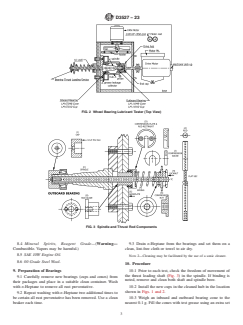
NOTE 1—Caution should be taken when modifying older units since some may still contain asbestos insulation leading to a possible inhalation hazard.
FIG. 1 Wheel Bearing Lubricant Tester (Elevation View)
requirements are that the solid particles be extremely small, 6. Apparatus
uniformly dispersed, and capable of forming a relatively stable,
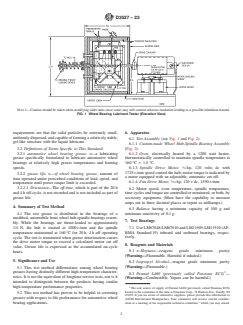
6.1 Test Assembly (see Fig. 1 and Fig. 2).
gel-like structure with the liquid lubricant.
6.1.1 Custom-made Wheel Hub-Spindle-Bearing Assembly
3.2 Definitions of Terms Specific to This Standard: (Fig. 3).
3.2.1 automotive wheel bearing grease, n—a lubricating 6.1.2 Oven, electrically heated by a 1200 watt heater,
grease specifically formulated to lubricate automotive wheel thermostatically controlled to maintain spindle temperature at
bearings at relatively high grease temperatures and bearing 160 °C 6 1.5 °C.
speeds. 6.1.3 Spindle Drive Motor, ⁄4 hp, 120 volts dc with
1725 r ⁄min speed control the hub; motor torque is indicated by
3.2.2 grease life, n—of wheel bearing grease, amount of
a meter equipped with an adjustable, automatic cut-off.
time operated under prescribed conditions of load, speed, and
6.1.4 Fan Drive Motor, ⁄30 hp, 120 v dc, 1550 r ⁄min.
temperature until preset torque limit is exceeded.
3.2.2.1 Discussion—The off-time, which is part of the 20 h
6.2 Motor speed, oven temperature, spindle temperature,
and 4 h off-cycle, is not recorded and is not included as part of
time cycles and torque are controlled or monitored, or both, by
grease life.
accessory equipment. (Must have the capability to measure
amps out to three decimal places or report as milliamps.)
4. Summary of Test Method
6.3 Balance having a minimum capacity of 100 g and
4.1 The test grease is distributed in the bearings of a
minimum sensitivity of 0.1 g.
modified, automobile front wheel hub-spindle-bearings assem-
7. Test Bearings
bly. While the bearings are thrust-loaded to approximately
111 N, the hub is rotated at 1000 r ⁄min and the spindle 7.1 Use LM67048-LM67010 and LM11949-LM11910 (AF-
BMA Standard 19) inboard and outboard bearings, respec-
temperature maintained at 160 °C for 20 h, 4 h off operating
cycle. The test is terminated when grease deterioration causes tively.
the drive motor torque to exceed a calculated motor cut off
8. Reagents and Materials
value. Grease life is expressed as the accumulated on-cycle
8.1 n-Heptane—reagent grade minimum purity
hours.
(Warning—Flammable. Harmful if inhaled.)
5. Significance and Use
8.2 Isopropyl Alcohol—reagent grade minimum purity
(Warning—Flammable.)
5.1 This test method differentiates among wheel bearing
greases having distinctly different high-temperature character-
8.3 Penmul L460 (previously called Penetone ECS) —
istics. It is not the equivalent of longtime service tests, nor is it
(Warning—Combustible. Vapors can be harmful.)
intended to distinguish between the products having similar
high-temperature performance properties. 3
The sole source of supply of Penmul L460 (previously called Penetone ECS)
known to the committee at this time is Penetone Corp., 74 Hudson Ave., Tenafly, NJ
5.2 This test method has proven to be helpful in screening
07670. If you are aware of alternative suppliers, please provide this information to
greases with respect to life performance for automotive wheel
ASTM International Headquarters. Your comments will receive careful consider-
bearing applications. ation at a meeting of the responsible technical committee, which you may attend.
D3527 − 23
FIG. 2 Wheel Bearing Lubricant Tester (Top View)
FIG. 3 Spindle and Thrust Rod Components
8.4 Mineral Spirits, Reagent Grade—(Warning— 9.3 Drain n-Heptane from the bearings and set them on a
Combustible. Vapors may be harmful.) clean, lint-free cloth or towel to air dry.
8.5 SAE 10W Engine Oil.
NOTE 2—Cleaning may be facilitated by the use of a sonic cleaner.
8.6 00 Grade Steel Wool.
10. Procedure
9. Preparation of Bearings 10.1 Prior to each test, check the freedom of movement of
the thrust loading shaft (Fig. 3) in the spindle. If binding is
9.1 Carefully remove new bearings (cups and cones) from
noted, remove and clean both shaft and spindle bore.
their packages and place in a suitable clean container. Wash
with n-Heptane to remove all rust preventative. 10.2 Install the new cups in the cleaned hub in the location
shown in Figs. 1 and 2.
9.2 Repeat washing with n-Heptane two additional times to
be certain all rust preventative has been removed. Use a clean 10.3 Weigh an inboard and outboard bearing cone to the
beaker each time. nearest 0.1 g. Fill the cones with test grease using an extra set
D3527 − 23
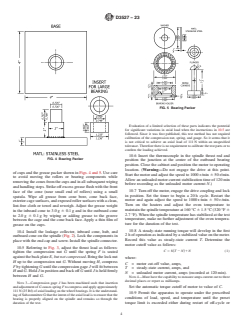
FIG. 5 Bearing Packer
Evaluation of a limited selection of these parts indicates the potential
for significant variations in axial load when the instructions in 10.5 are
followed. Since it was first published, this test method has not required
calibration of the compression nut, spring, and gauge. So it seems that it
is not critical to achieve an axial load of 111 N within an unspecified
tolerance. Therefore there is no requirement to calibrate the test parts or to
confirm the loading achieved.
10.6 Insert the thermoco
...
This document is not an ASTM standard and is intended only to provide the user of an ASTM standard an indication of what changes have been made to the previous version. Because
it may not be technically possible to adequately depict all changes accurately, ASTM recommends that users consult prior editions as appropriate. In all cases only the current version
of the standard as published by ASTM is to be considered the official document.
Designation: D3527 − 21 D3527 − 23
Standard Test Method for
Life Performance of Automotive Wheel Bearing Grease
This standard is issued under the fixed designation D3527; the number immediately following the designation indicates the year of
original adoption or, in the case of revision, the year of last revision. A number in parentheses indicates the year of last reapproval. A
superscript epsilon (´) indicates an editorial change since the last revision or reapproval.
INTRODUCTION
This standard is based on a test rig that was originally designed in the 1960s. Since the standard was
first published, there have been several attempts to revise the equipment and test procedure to improve
the precision of the test. Since the first publication, there have been many advances in the quality of
the hardware and automated control systems have superseded manual and analogue controls.
Several generations of test rig are still in commercial use, each potentially having their own issues
relating to certification and contributing to the overall poor precision of this test. The Subcommittee
responsible for this standard is aware of these issues, but has been unable to obtain sufficient interest
to conduct an ILS program required to evaluate possible revisions and establish updated precision and
bias data for comparison to the current test.
A 2017 ballot to withdraw this standard was unsuccessful and the standard will be re-approved to
meet the needs of users and its inclusion in other industry and military standards, even though the hub
design is obsolete. Work is underway to develop a replacement test that will better represent
contemporary bearing designs and offer a selection of test conditions.
1. Scope*
1.1 This test method covers a laboratory procedure for evaluating the high-temperature life performance of wheel bearing greases
when tested under prescribed conditions.
NOTE 1—Changes to this test method in the 1985 revision increased test severity. Results will not be comparable with data from earlier procedures.
1.2 The values stated in SI units are to be regarded as standard. No other units of measurement are included in this standard.
1.2.1 Exception—Apparatus dimensions in inches are to be regarded as the standard.
1.3 This standard does not purport to address all of the safety concerns, if any, associated with its use. It is the responsibility
of the user of this standard to establish appropriate safety, health, and environmental practices and determine the applicability of
regulatory limitations prior to use. For specific warning statements, see 8.1 – 8.4.
1.4 This international standard was developed in accordance with internationally recognized principles on standardization
established in the Decision on Principles for the Development of International Standards, Guides and Recommendations issued
by the World Trade Organization Technical Barriers to Trade (TBT) Committee.
This test method is under the jurisdiction of ASTM Committee D02 on Petroleum Products, Liquid Fuels, and Lubricants and is the direct responsibility of Subcommittee
D02.G0.05 on Functional Tests - Temperature.
Current edition approved Nov. 1, 2021March 1, 2023. Published November 2021May 2023. Originally approved in 1976. Last previous edition approved in 20182021
as D3527 – 18.D3527 – 21. DOI: 10.1520/D3527-21.10.1520/D3527-23.
*A Summary of Changes section appears at the end of this standard
Copyright © ASTM International, 100 Barr Harbor Drive, PO Box C700, West Conshohocken, PA 19428-2959. United States
D3527 − 23
2. Referenced Documents
2.1 AFBMA Standard:
AFBMA Standard 19, 1974 (ANSI B. 3.19-1975)
3. Terminology
3.1 Definitions:
3.1.1 lubricant, n—any material interposed between two surfaces that reduces the friction or wear between them.
3.1.2 lubricating grease, n—a semi-fluid to solid product of a dispersion of a thickener in a liquid lubricant.
3.1.2.1 Discussion—
The dispersion of the thickener forms a two-phase system and immobilizes the liquid lubricant by surface tension and other
physical forces. Other ingredients are commonly included to impart special properties.
3.1.3 thickener, n—in lubricating grease, a substance composed of finely-divided particles dispersed in a liquid lubricant to form
the product’s structure.
3.1.3.1 Discussion—
The solid thickener can be fibers (such as various metallic soaps) or plates or spheres (such as certain non-soap thickeners) which
are insoluble or, at the most, only very slightly soluble in the liquid lubricant. The general requirements are that the solid particles
be extremely small, uniformly dispersed, and capable of forming a relatively stable, gel-like structure with the liquid lubricant.
3.2 Definitions of Terms Specific to This Standard:
3.2.1 automotive wheel bearing grease, n—a lubricating grease specifically formulated to lubricate automotive wheel bearings at
relatively high grease temperatures and bearing speeds.
3.2.2 grease life, n—of wheel bearing grease, amount of time operated under prescribed conditions of load, speed, and temperature
until preset torque limit is exceeded.
3.2.2.1 Discussion—
The off-time, which is part of the 20 h and 4 h off-cycle, is not recorded and is not included as part of grease life.
4. Summary of Test Method
4.1 The test grease is distributed in the bearings of a modified, automobile front wheel hub-spindle-bearings assembly. While the
bearings are thrust-loaded to approximately 111 N, the hub is rotated at 1000 r ⁄min and the spindle temperature maintained at
160 °C for 20 h, 4 h off operating cycle. The test is terminated when grease deterioration causes the drive motor torque to exceed
a calculated motor cut off value. Grease life is expressed as the accumulated on-cycle hours.
5. Significance and Use
5.1 This test method differentiates among wheel bearing greases having distinctly different high-temperature characteristics. It is
not the equivalent of longtime service tests, nor is it intended to distinguish between the products having similar high-temperature
performance properties.
5.2 This test method has proven to be helpful in screening greases with respect to life performance for automotive wheel bearing
applications.
6. Apparatus
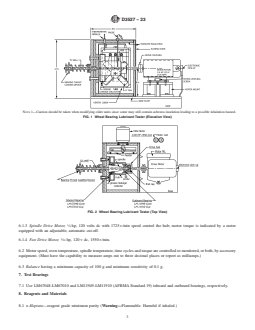
6.1 Test Assembly (see Fig. 1 and Fig. 2).
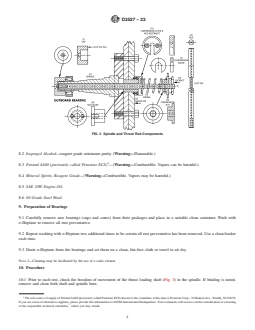
6.1.1 Custom-made Wheel Hub-Spindle-Bearing Assembly (Fig. 3).
6.1.2 Oven, electrically heated by a 1200 watt heater, thermostatically controlled to maintain spindle temperature at 160 °C 6
1.5 °C.
Available from American National Standards Institute (ANSI), 25 W. 43rd St., 4th Floor, New York, NY 10036, http://www.ansi.org.
D3527 − 23
NOTE 1—Caution should be taken when modifying older units since some may still contain asbestos insulation leading to a possible inhalation hazard.
FIG. 1 Wheel Bearing Lubricant Tester (Elevation View)
FIG. 2 Wheel Bearing Lubricant Tester (Top View)
6.1.3 Spindle Drive Motor, ⁄4 hp, 120 volts dc with 1725 r ⁄min speed control the hub; motor torque is indicated by a meter
equipped with an adjustable, automatic cut-off.
6.1.4 Fan Drive Motor, ⁄30 hp, 120 v dc, 1550 r ⁄min.
6.2 Motor speed, oven temperature, spindle temperature, time cycles and torque are controlled or monitored, or both, by accessory
equipment. (Must have the capability to measure amps out to three decimal places or report as milliamps.)
6.3 Balance having a minimum capacity of 100 g and minimum sensitivity of 0.1 g.
7. Test Bearings
7.1 Use LM67048-LM67010 and LM11949-LM11910 (AFBMA Standard 19) inboard and outboard bearings, respectively.
8. Reagents and Materials
8.1 n-Heptane—reagent grade minimum purity (Warning—Flammable. Harmful if inhaled.)
D3527 − 23
FIG. 3 Spindle and Thrust Rod Components
8.2 Isopropyl Alcohol—reagent grade minimum purity (Warning—Flammable.)
8.3 Penmul L460 (previously called Penetone ECS) —(Warning—Combustible. Vapors can be harmful.)
8.4 Mineral Spirits, Reagent Grade—(Warning—Combustible. Vapors may be harmful.)
8.5 SAE 10W Engine Oil.
8.6 00 Grade Steel Wool.
9. Preparation of Bearings
9.1 Carefully remove new bearings (cups and cones) from their packages and place in a suitable clean container. Wash with
n-Heptane to remove all rust preventative.
9.2 Repeat washing with n-Heptane two additional times to be certain all rust preventative has been removed. Use a clean beaker
each time.
9.3 Drain n-Heptane from the bearings and set them on a clean, lint-free cloth or towel to air dry.
NOTE 2—Cleaning may be facilitated by the use of a sonic cleaner.
10. Procedure
10.1 Prior to each test, check the freedom of movement of the thrust loading shaft (Fig. 3) in the spindle. If binding is noted,
remove and clean both shaft and spindle bore.
The sole source of supply of Penmul L460 (previously called Penetone ECS) known to the committee at this time is Penetone Corp., 74 Hudson Ave., Tenafly, NJ 07670.
If you are aware of alternative suppliers, please provide this information to ASTM International Headquarters. Your comments will receive careful consideration at a meeting
of the responsible technical committee, which you may attend.
D3527 − 23
FIG. 4 Bearing Packer
10.2 Install the new cups in the cleaned hub in the location shown in Figs. 1 and 2.
10.3 Weigh an inboard and outboard bearing cone to the nearest 0.1 g. Fill the cones with test grease using an extra set of cups
and the grease packer shown in Figs. 4 and 5. Use care to avoid moving the rollers or bearing components while removing the
cones from the cups and in all subsequent wiping and handling steps. Strike off excess grease flush with the front face of the cone
(near small end of rollers) using a small spatula. Wipe all grease from cone bore, cone back face, exterior cage surfaces, and
exposed roller surfaces with a clean, lint-free cloth or towel and reweigh. Adjust
...