


ASTM D4057-12(2018)
(Practice)Standard Practice for Manual Sampling of Petroleum and Petroleum Products
Standard Practice for Manual Sampling of Petroleum and Petroleum Products
SIGNIFICANCE AND USE
4.1 Samples of petroleum and petroleum products are obtained for many reasons, including the determination of chemical and physical properties. These properties may be used for: calculating standard volumes; establishing product value; and often safety and regulatory reporting.
4.2 There are inherent limitations when performing any type of sampling, any one of which may affect the representative nature of the sample. As examples, a spot sample provides a sample from only one particular point in the tank, vessel compartment, or pipeline. In the case of running or all-level samples, the sample only represents the column of material from which it was taken.
4.3 Based on the product, and testing to be performed, this practice provides guidance on sampling equipment, container preparation, and manual sampling procedures for petroleum and petroleum products of a liquid, semi-liquid, or solid state, from the storage tanks, flowlines, pipelines, marine vessels, process vessels, drums, cans, tubes, bags, kettles, and open discharge streams into the primary sample container.
SCOPE
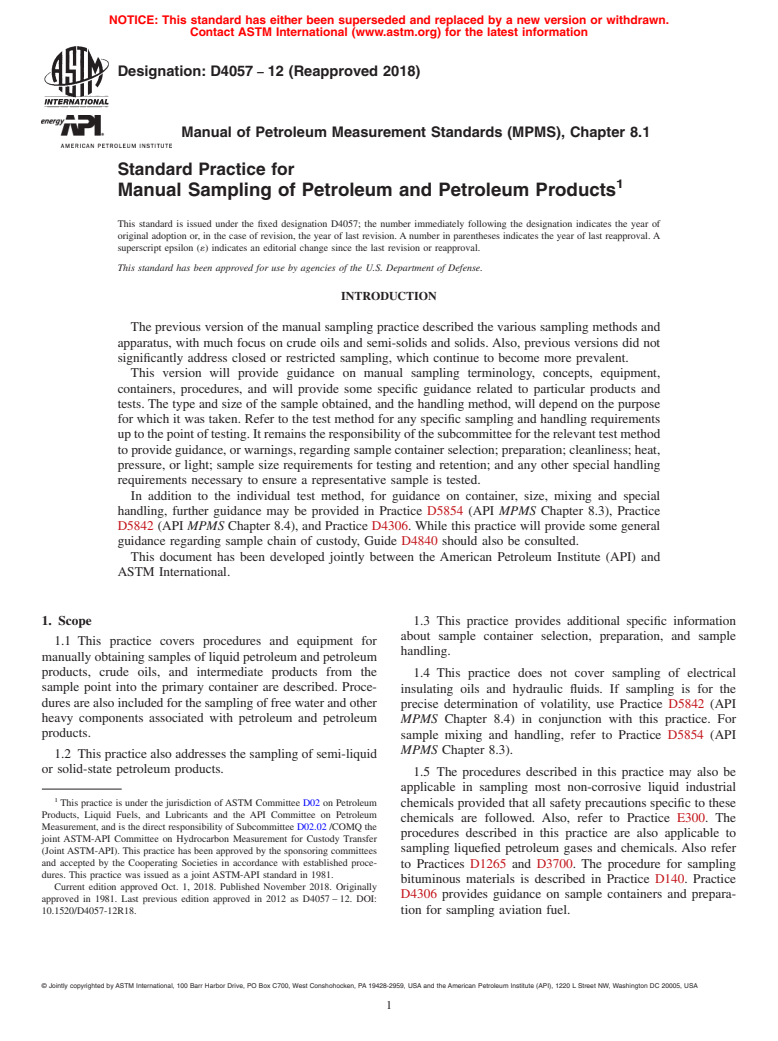
1.1 This practice covers procedures and equipment for manually obtaining samples of liquid petroleum and petroleum products, crude oils, and intermediate products from the sample point into the primary container are described. Procedures are also included for the sampling of free water and other heavy components associated with petroleum and petroleum products.
1.2 This practice also addresses the sampling of semi-liquid or solid-state petroleum products.
1.3 This practice provides additional specific information about sample container selection, preparation, and sample handling.
1.4 This practice does not cover sampling of electrical insulating oils and hydraulic fluids. If sampling is for the precise determination of volatility, use Practice D5842 (API MPMS Chapter 8.4) in conjunction with this practice. For sample mixing and handling, refer to Practice D5854 (API MPMS Chapter 8.3).
1.5 The procedures described in this practice may also be applicable in sampling most non-corrosive liquid industrial chemicals provided that all safety precautions specific to these chemicals are followed. Also, refer to Practice E300. The procedures described in this practice are also applicable to sampling liquefied petroleum gases and chemicals. Also refer to Practices D1265 and D3700. The procedure for sampling bituminous materials is described in Practice D140. Practice D4306 provides guidance on sample containers and preparation for sampling aviation fuel.
1.6 Units—The values stated in SI units are to be regarded as the standard. USC units are reflected in parentheses.
1.7 This standard does not purport to address all of the safety concerns, if any, associated with its use. It is the responsibility of the user of this standard to establish appropriate safety, health, and environmental practices and determine the applicability of regulatory limitations prior to use.
1.8 This international standard was developed in accordance with internationally recognized principles on standardization established in the Decision on Principles for the Development of International Standards, Guides and Recommendations issued by the World Trade Organization Technical Barriers to Trade (TBT) Committee.
General Information
Buy Standard
Standards Content (Sample)
NOTICE: This standard has either been superseded and replaced by a new version or withdrawn.
Contact ASTM International (www.astm.org) for the latest information
Designation: D4057 − 12 (Reapproved 2018)
Manual of Petroleum Measurement Standards (MPMS), Chapter 8.1
Standard Practice for
Manual Sampling of Petroleum and Petroleum Products
This standard is issued under the fixed designation D4057; the number immediately following the designation indicates the year of
original adoption or, in the case of revision, the year of last revision. A number in parentheses indicates the year of last reapproval. A
superscript epsilon (´) indicates an editorial change since the last revision or reapproval.
This standard has been approved for use by agencies of the U.S. Department of Defense.
INTRODUCTION
The previous version of the manual sampling practice described the various sampling methods and
apparatus, with much focus on crude oils and semi-solids and solids. Also, previous versions did not
significantly address closed or restricted sampling, which continue to become more prevalent.
This version will provide guidance on manual sampling terminology, concepts, equipment,
containers, procedures, and will provide some specific guidance related to particular products and
tests. The type and size of the sample obtained, and the handling method, will depend on the purpose
for which it was taken. Refer to the test method for any specific sampling and handling requirements
uptothepointoftesting.Itremainstheresponsibilityofthesubcommitteefortherelevanttestmethod
to provide guidance, or warnings, regarding sample container selection; preparation; cleanliness; heat,
pressure, or light; sample size requirements for testing and retention; and any other special handling
requirements necessary to ensure a representative sample is tested.
In addition to the individual test method, for guidance on container, size, mixing and special
handling, further guidance may be provided in Practice D5854 (API MPMS Chapter 8.3), Practice
D5842 (API MPMS Chapter 8.4), and Practice D4306. While this practice will provide some general
guidance regarding sample chain of custody, Guide D4840 should also be consulted.
This document has been developed jointly between the American Petroleum Institute (API) and
ASTM International.
1. Scope 1.3 This practice provides additional specific information
about sample container selection, preparation, and sample
1.1 This practice covers procedures and equipment for
handling.
manually obtaining samples of liquid petroleum and petroleum
products, crude oils, and intermediate products from the
1.4 This practice does not cover sampling of electrical
sample point into the primary container are described. Proce-
insulating oils and hydraulic fluids. If sampling is for the
duresarealsoincludedforthesamplingoffreewaterandother
precise determination of volatility, use Practice D5842 (API
heavy components associated with petroleum and petroleum
MPMS Chapter 8.4) in conjunction with this practice. For
products.
sample mixing and handling, refer to Practice D5854 (API
MPMS Chapter 8.3).
1.2 This practice also addresses the sampling of semi-liquid
or solid-state petroleum products.
1.5 The procedures described in this practice may also be
applicable in sampling most non-corrosive liquid industrial
This practice is under the jurisdiction ofASTM Committee D02 on Petroleum chemicals provided that all safety precautions specific to these
Products, Liquid Fuels, and Lubricants and the API Committee on Petroleum
chemicals are followed. Also, refer to Practice E300. The
Measurement, and is the direct responsibility of Subcommittee D02.02 /COMQ the
procedures described in this practice are also applicable to
joint ASTM-API Committee on Hydrocarbon Measurement for Custody Transfer
sampling liquefied petroleum gases and chemicals. Also refer
(Joint ASTM-API). This practice has been approved by the sponsoring committees
and accepted by the Cooperating Societies in accordance with established proce-
to Practices D1265 and D3700. The procedure for sampling
dures. This practice was issued as a joint ASTM-API standard in 1981.
bituminous materials is described in Practice D140. Practice
Current edition approved Oct. 1, 2018. Published November 2018. Originally
D4306 provides guidance on sample containers and prepara-
approved in 1981. Last previous edition approved in 2012 as D4057 – 12. DOI:
10.1520/D4057-12R18. tion for sampling aviation fuel.
© Jointly copyrighted by ASTM International, 100 Barr Harbor Drive, PO Box C700, West Conshohocken, PA 19428-2959, USA and the American Petroleum Institute (API), 1220 L Street NW, Washington DC 20005, USA
D4057 − 12 (2018)
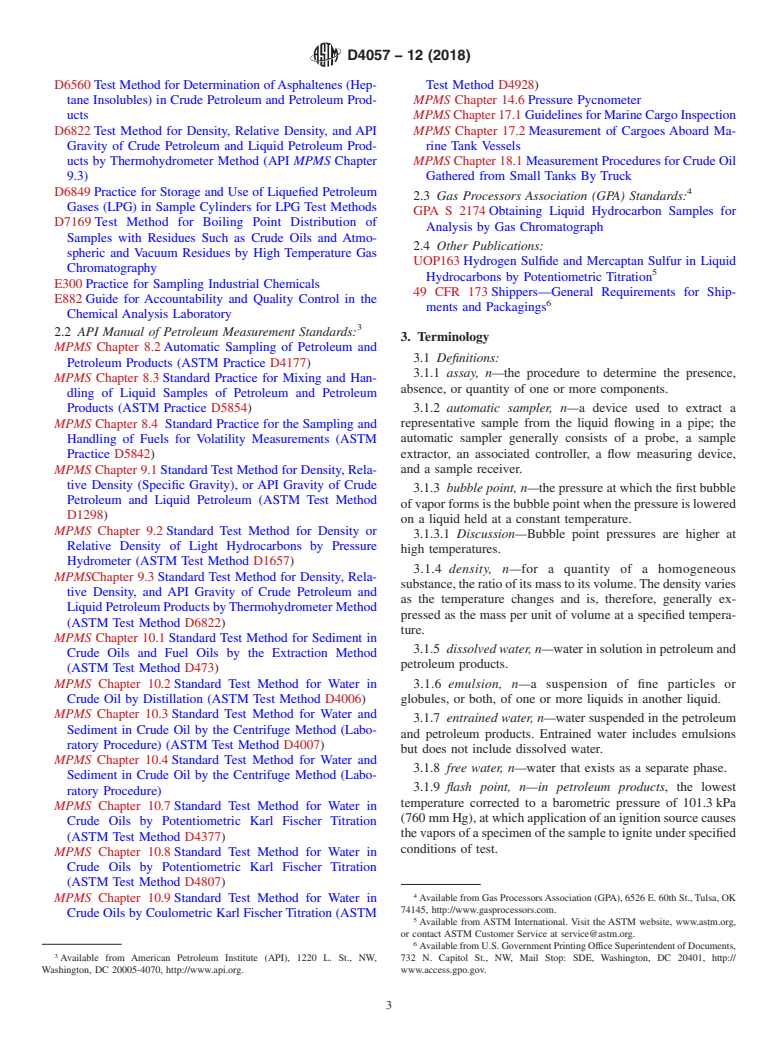
1.6 Units—The values stated in SI units are to be regarded D2172 Test Methods for Quantitative Extraction of Asphalt
as the standard. USC units are reflected in parentheses. Binder from Asphalt Mixtures
D2622 Test Method for Sulfur in Petroleum Products by
1.7 This standard does not purport to address all of the
Wavelength Dispersive X-ray Fluorescence Spectrometry
safety concerns, if any, associated with its use. It is the
D3230 Test Method for Salts in Crude Oil (Electrometric
responsibility of the user of this standard to establish appro-
Method)
priate safety, health, and environmental practices and deter-
mine the applicability of regulatory limitations prior to use. D3700 Practice for Obtaining LPG Samples Using a Float-
ing Piston Cylinder
1.8 This international standard was developed in accor-
dance with internationally recognized principles on standard- D4006 Test Method for Water in Crude Oil by Distillation
ization established in the Decision on Principles for the (API MPMSChapter 10.2)
Development of International Standards, Guides and Recom-
D4007 Test Method forWater and Sediment in Crude Oil by
mendations issued by the World Trade Organization Technical
the Centrifuge Method (Laboratory Procedure) (API
Barriers to Trade (TBT) Committee.
MPMS Chapter 10.3)
D4177 Practice for Automatic Sampling of Petroleum and
2. Referenced Documents
Petroleum Products (API MPMS Chapter 8.2)
2.1 ASTM Standards:
D4294 Test Method for Sulfur in Petroleum and Petroleum
D86 Test Method for Distillation of Petroleum Products and
Products by Energy Dispersive X-ray Fluorescence Spec-
Liquid Fuels at Atmospheric Pressure
trometry
D97 Test Method for Pour Point of Petroleum Products
D4306 Practice for Aviation Fuel Sample Containers for
D140 Practice for Sampling Asphalt Materials
Tests Affected by Trace Contamination
D217 Test Methods for Cone Penetration of Lubricating
D4377 Test Method forWater in Crude Oils by Potentiomet-
Grease
ric Karl Fischer Titration (API MPMS Chapter 10.7)
D244 Test Methods and Practices for Emulsified Asphalts
D4530 Test Method for Determination of Carbon Residue
D268 Guide for Sampling and Testing Volatile Solvents and
(Micro Method)
Chemical Intermediates for Use in Paint and Related
D4629 Test Method for Trace Nitrogen in Liquid Hydrocar-
Coatings and Material
bons by Syringe/Inlet Oxidative Combustion and Chemi-
D287 Test Method for API Gravity of Crude Petroleum and
luminescence Detection
Petroleum Products (Hydrometer Method)
D4807 Test Method for Sediment in Crude Oil by Mem-
D323 TestMethodforVaporPressureofPetroleumProducts
brane Filtration (API MPMS Chapter 10.8)
(Reid Method)
D4840 Guide for Sample Chain-of-Custody Procedures
D346 Practice for Collection and Preparation of Coke
D4928 Test Method for Water in Crude Oils by Coulometric
Samples for Laboratory Analysis
Karl Fischer Titration (API MPMS Chapter 10.9)
D445 Test Method for Kinematic Viscosity of Transparent
D4929 Test Method for Determination of Organic Chloride
and Opaque Liquids (and Calculation of Dynamic Viscos-
Content in Crude Oil
ity)
D5002 Test Method for Density and Relative Density of
D473 Test Method for Sediment in Crude Oils and Fuel Oils
by the Extraction Method (API MPMS Chapter 10.1) Crude Oils by Digital Density Analyzer
D664 Test Method for Acid Number of Petroleum Products D5191 Test Method for Vapor Pressure of Petroleum Prod-
by Potentiometric Titration
ucts (Mini Method)
D977 Specification for Emulsified Asphalt D5762 Test Method for Nitrogen in Liquid Hydrocarbons,
D1265 Practice for Sampling Liquefied Petroleum (LP)
Petroleum and Petroleum Products by Boat-Inlet Chemi-
Gases, Manual Method
luminescence
D1267 Test Method for Gauge Vapor Pressure of Liquefied
D5842 Practice for Sampling and Handling of Fuels for
Petroleum (LP) Gases (LP-Gas Method)
Volatility Measurement (API MPMS Chapter 8.4)
D1298 Test Method for Density, Relative Density, or API
D5853 Test Method for Pour Point of Crude Oils
Gravity of Crude Petroleum and Liquid Petroleum Prod-
D5854 Practice for Mixing and Handling of Liquid Samples
ucts by Hydrometer Method (API MPMS Chapter 9.1)
of Petroleum and Petroleum Products (API MPMS Chap-
D1657 Test Method for Density or Relative Density of Light
ter 8.3)
Hydrocarbons by Pressure Hydrometer (API MPMS
D5863 Test Methods for Determination of Nickel,
Chapter 9.2)
Vanadium, Iron, and Sodium in Crude Oils and Residual
D1838 TestMethodforCopperStripCorrosionbyLiquefied
Fuels by Flame Atomic Absorption Spectrometry
Petroleum (LP) Gases
D6299 Practice for Applying Statistical Quality Assurance
D1856 Test Method for Recovery ofAsphalt From Solution
and Control Charting Techniques to Evaluate Analytical
by Abson Method
Measurement System Performance
D6377 Test Method for Determination of Vapor Pressure of
For referenced ASTM standards, visit the ASTM website, www.astm.org, or
Crude Oil: VPCR (Expansion Method)
x
contact ASTM Customer Service at service@astm.org. For Annual Book of ASTM
D6470 Test Method for Salt in Crude Oils (Potentiometric
Standards volume information, refer to the standard’s Document Summary page on
the ASTM website. Method)
D4057 − 12 (2018)
D6560 Test Method for Determination ofAsphaltenes (Hep- Test Method D4928)
tane Insolubles) in Crude Petroleum and Petroleum Prod- MPMS Chapter 14.6 Pressure Pycnometer
ucts MPMSChapter17.1 GuidelinesforMarineCargoInspection
D6822 Test Method for Density, Relative Density, and API MPMS Chapter 17.2 Measurement of Cargoes Aboard Ma-
Gravity of Crude Petroleum and Liquid Petroleum Prod- rine Tank Vessels
ucts by Thermohydrometer Method (API MPMS Chapter MPMS Chapter 18.1 Measurement Procedures for Crude Oil
9.3) Gathered from Small Tanks By Truck
D6849 Practice for Storage and Use of Liquefied Petroleum
2.3 Gas Processors Association (GPA) Standards:
Gases (LPG) in Sample Cylinders for LPG Test Methods
GPA S 2174 Obtaining Liquid Hydrocarbon Samples for
D7169 Test Method for Boiling Point Distribution of
Analysis by Gas Chromatograph
Samples with Residues Such as Crude Oils and Atmo-
2.4 Other Publications:
spheric and Vacuum Residues by High Temperature Gas
UOP163 Hydrogen Sulfide and Mercaptan Sulfur in Liquid
Chromatography
Hydrocarbons by Potentiometric Titration
E300 Practice for Sampling Industrial Chemicals
49 CFR 173 Shippers—General Requirements for Ship-
E882 Guide for Accountability and Quality Control in the
ments and Packagings
Chemical Analysis Laboratory
2.2 API Manual of Petroleum Measurement Standards:
3. Terminology
MPMS Chapter 8.2 Automatic Sampling of Petroleum and
3.1 Definitions:
Petroleum Products (ASTM Practice D4177)
3.1.1 assay, n—the procedure to determine the presence,
MPMS Chapter 8.3 Standard Practice for Mixing and Han-
absence, or quantity of one or more components.
dling of Liquid Samples of Petroleum and Petroleum
Products (ASTM Practice D5854) 3.1.2 automatic sampler, n—a device used to extract a
representative sample from the liquid flowing in a pipe; the
MPMS Chapter 8.4 Standard Practice for the Sampling and
Handling of Fuels for Volatility Measurements (ASTM automatic sampler generally consists of a probe, a sample
extractor, an associated controller, a flow measuring device,
Practice D5842)
MPMS Chapter 9.1 Standard Test Method for Density, Rela- and a sample receiver.
tive Density (Specific Gravity), or API Gravity of Crude
3.1.3 bubble point, n—the pressure at which the first bubble
Petroleum and Liquid Petroleum (ASTM Test Method
ofvaporformsisthebubblepointwhenthepressureislowered
D1298)
on a liquid held at a constant temperature.
MPMS Chapter 9.2 Standard Test Method for Density or
3.1.3.1 Discussion—Bubble point pressures are higher at
Relative Density of Light Hydrocarbons by Pressure
high temperatures.
Hydrometer (ASTM Test Method D1657)
3.1.4 density, n—for a quantity of a homogeneous
MPMSChapter 9.3 Standard Test Method for Density, Rela-
substance,theratioofitsmasstoitsvolume.Thedensityvaries
tive Density, and API Gravity of Crude Petroleum and
as the temperature changes and is, therefore, generally ex-
LiquidPetroleumProductsbyThermohydrometerMethod
pressed as the mass per unit of volume at a specified tempera-
(ASTM Test Method D6822)
ture.
MPMS Chapter 10.1 Standard Test Method for Sediment in
3.1.5 dissolved water, n—water in solution in petroleum and
Crude Oils and Fuel Oils by the Extraction Method
petroleum products.
(ASTM Test Method D473)
MPMS Chapter 10.2 Standard Test Method for Water in 3.1.6 emulsion, n—a suspension of fine particles or
Crude Oil by Distillation (ASTM Test Method D4006) globules, or both, of one or more liquids in another liquid.
MPMS Chapter 10.3 Standard Test Method for Water and
3.1.7 entrained water, n—water suspended in the petroleum
Sediment in Crude Oil by the Centrifuge Method (Labo-
and petroleum products. Entrained water includes emulsions
ratory Procedure) (ASTM Test Method D4007)
but does not include dissolved water.
MPMS Chapter 10.4 Standard Test Method for Water and
3.1.8 free water, n—water that exists as a separate phase.
Sediment in Crude Oil by the Centrifuge Method (Labo-
3.1.9 flash point, n—in petroleum products, the lowest
ratory Procedure)
temperature corrected to a barometric pressure of 101.3 kPa
MPMS Chapter 10.7 Standard Test Method for Water in
(760 mmHg),atwhichapplicationofanignitionsourcecauses
Crude Oils by Potentiometric Karl Fischer Titration
thevaporsofaspecimenofthesampletoigniteunderspecified
(ASTM Test Method D4377)
conditions of test.
MPMS Chapter 10.8 Standard Test Method for Water in
Crude Oils by Potentiometric Karl Fischer Titration
(ASTM Test Method D4807)
MPMS Chapter 10.9 Standard Test Method for Water in Available from Gas ProcessorsAssociation (GPA), 6526 E. 60th St.,Tulsa, OK
74145, http://www.gasprocessors.com.
Crude Oils by Coulometric Karl Fischer Titration (ASTM
Available from ASTM International. Visit the ASTM website, www.astm.org,
or contact ASTM Customer Service at service@astm.org.
AvailablefromU.S.GovernmentPrintingOfficeSuperintendentofDocuments,
Available from American Petroleum Institute (API), 1220 L. St., NW, 732 N. Capitol St., NW, Mail Stop: SDE, Was
...
This document is not an ASTM standard and is intended only to provide the user of an ASTM standard an indication of what changes have been made to the previous version. Because
it may not be technically possible to adequately depict all changes accurately, ASTM recommends that users consult prior editions as appropriate. In all cases only the current version
of the standard as published by ASTM is to be considered the official document.
Designation: D4057 − 12 D4057 − 12 (Reapproved 2018)
Manual of Petroleum Measurement Standards (MPMS), Chapter 8.1
Standard Practice for
Manual Sampling of Petroleum and Petroleum Products
This standard is issued under the fixed designation D4057; the number immediately following the designation indicates the year of
original adoption or, in the case of revision, the year of last revision. A number in parentheses indicates the year of last reapproval. A
superscript epsilon (´) indicates an editorial change since the last revision or reapproval.
This standard has been approved for use by agencies of the U.S. Department of Defense.
INTRODUCTION
The previous version of the manual sampling practice described the various sampling methods and
apparatus, with much focus on crude oils and semi-solids and solids. Also, previous versions did not
significantly address closed or restricted sampling, which continue to become more prevalent.
This version will provide guidance on manual sampling terminology, concepts, equipment,
containers, procedures, and will provide some specific guidance related to particular products and
tests. The type and size of the sample obtained, and the handling method, will depend on the purpose
for which it was taken. Refer to the test method for any specific sampling and handling requirements
up to the point of testing. It remains the responsibility of the subcommittee for the relevant test method
to provide guidance, or warnings, regarding sample container selection; preparation; cleanliness; heat,
pressure, or light; sample size requirements for testing and retention; and any other special handling
requirements necessary to ensure a representative sample is tested.
In addition to the individual test method, for guidance on container, size, mixing and special
handling, further guidance may be provided in Practice D5854 (API MPMS Chapter 8.3), Practice
D5842 (API MPMS Chapter 8.4), and Practice D4306. While this practice will provide some general
guidance regarding sample chain of custody, Guide D4840 should also be consulted.
This document has been developed jointly between the American Petroleum Institute (API) and
ASTM International.
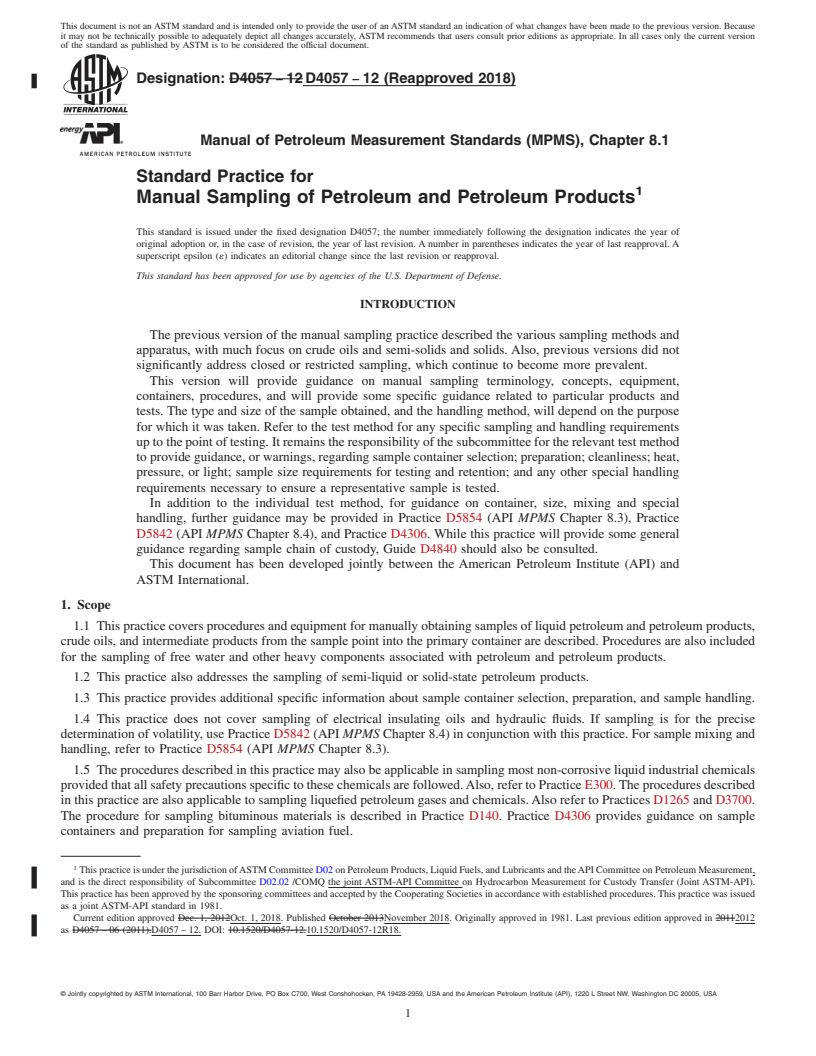
1. Scope
1.1 This practice covers procedures and equipment for manually obtaining samples of liquid petroleum and petroleum products,
crude oils, and intermediate products from the sample point into the primary container are described. Procedures are also included
for the sampling of free water and other heavy components associated with petroleum and petroleum products.
1.2 This practice also addresses the sampling of semi-liquid or solid-state petroleum products.
1.3 This practice provides additional specific information about sample container selection, preparation, and sample handling.
1.4 This practice does not cover sampling of electrical insulating oils and hydraulic fluids. If sampling is for the precise
determination of volatility, use Practice D5842 (API MPMS Chapter 8.4) in conjunction with this practice. For sample mixing and
handling, refer to Practice D5854 (API MPMS Chapter 8.3).
1.5 The procedures described in this practice may also be applicable in sampling most non-corrosive liquid industrial chemicals
provided that all safety precautions specific to these chemicals are followed. Also, refer to Practice E300. The procedures described
in this practice are also applicable to sampling liquefied petroleum gases and chemicals. Also refer to Practices D1265 and D3700.
The procedure for sampling bituminous materials is described in Practice D140. Practice D4306 provides guidance on sample
containers and preparation for sampling aviation fuel.
This practice is under the jurisdiction of ASTM Committee D02 on Petroleum Products, Liquid Fuels, and Lubricants and the API Committee on Petroleum Measurement,
and is the direct responsibility of Subcommittee D02.02 /COMQ the joint ASTM-API Committee on Hydrocarbon Measurement for Custody Transfer (Joint ASTM-API).
This practice has been approved by the sponsoring committees and accepted by the Cooperating Societies in accordance with established procedures. This practice was issued
as a joint ASTM-API standard in 1981.
Current edition approved Dec. 1, 2012Oct. 1, 2018. Published October 2013November 2018. Originally approved in 1981. Last previous edition approved in 20112012
as D4057 – 06 (2011).D4057 – 12. DOI: 10.1520/D4057-12.10.1520/D4057-12R18.
© Jointly copyrighted by ASTM International, 100 Barr Harbor Drive, PO Box C700, West Conshohocken, PA 19428-2959, USA and the American Petroleum Institute (API), 1220 L Street NW, Washington DC 20005, USA
D4057 − 12 (2018)
1.6 Units—The values stated in SI units are to be regarded as the standard. USC units are reflected in parentheses.
1.7 This standard does not purport to address all of the safety concerns, if any, associated with its use. It is the responsibility
of the user of this standard to establish appropriate safety safety, health, and healthenvironmental practices and determine the
applicability of regulatory limitations prior to use.
1.8 This international standard was developed in accordance with internationally recognized principles on standardization
established in the Decision on Principles for the Development of International Standards, Guides and Recommendations issued
by the World Trade Organization Technical Barriers to Trade (TBT) Committee.
2. Referenced Documents
2.1 ASTM Standards:
D86 Test Method for Distillation of Petroleum Products and Liquid Fuels at Atmospheric Pressure
D97 Test Method for Pour Point of Petroleum Products
D140 Practice for Sampling Asphalt Materials
D217 Test Methods for Cone Penetration of Lubricating Grease
D244 Test Methods and Practices for Emulsified Asphalts
D268 Guide for Sampling and Testing Volatile Solvents and Chemical Intermediates for Use in Paint and Related Coatings and
Material
D287 Test Method for API Gravity of Crude Petroleum and Petroleum Products (Hydrometer Method)
D323 Test Method for Vapor Pressure of Petroleum Products (Reid Method)
D346 Practice for Collection and Preparation of Coke Samples for Laboratory Analysis
D445 Test Method for Kinematic Viscosity of Transparent and Opaque Liquids (and Calculation of Dynamic Viscosity)
D473 Test Method for Sediment in Crude Oils and Fuel Oils by the Extraction Method (API MPMS Chapter 10.1)
D664 Test Method for Acid Number of Petroleum Products by Potentiometric Titration
D977 Specification for Emulsified Asphalt
D1265 Practice for Sampling Liquefied Petroleum (LP) Gases, Manual Method
D1267 Test Method for Gauge Vapor Pressure of Liquefied Petroleum (LP) Gases (LP-Gas Method)
D1298 Test Method for Density, Relative Density, or API Gravity of Crude Petroleum and Liquid Petroleum Products by
Hydrometer Method (API MPMS Chapter 9.1)
D1657 Test Method for Density or Relative Density of Light Hydrocarbons by Pressure Hydrometer (API MPMS Chapter 9.2)
D1838 Test Method for Copper Strip Corrosion by Liquefied Petroleum (LP) Gases
D1856 Test Method for Recovery of Asphalt From Solution by Abson Method
D2172 Test Methods for Quantitative Extraction of Asphalt Binder from Asphalt Mixtures
D2622 Test Method for Sulfur in Petroleum Products by Wavelength Dispersive X-ray Fluorescence Spectrometry
D3230 Test Method for Salts in Crude Oil (Electrometric Method)
D3700 Practice for Obtaining LPG Samples Using a Floating Piston Cylinder
D4006 Test Method for Water in Crude Oil by Distillation (API MPMSChapter 10.2)
D4007 Test Method for Water and Sediment in Crude Oil by the Centrifuge Method (Laboratory Procedure) (API MPMS
Chapter 10.3)
D4177 Practice for Automatic Sampling of Petroleum and Petroleum Products (API MPMS Chapter 8.2)
D4294 Test Method for Sulfur in Petroleum and Petroleum Products by Energy Dispersive X-ray Fluorescence Spectrometry
D4306 Practice for Aviation Fuel Sample Containers for Tests Affected by Trace Contamination
D4377 Test Method for Water in Crude Oils by Potentiometric Karl Fischer Titration (API MPMS Chapter 10.7)
D4530 Test Method for Determination of Carbon Residue (Micro Method)
D4629 Test Method for Trace Nitrogen in Liquid Hydrocarbons by Syringe/Inlet Oxidative Combustion and Chemiluminescence
Detection
D4807 Test Method for Sediment in Crude Oil by Membrane Filtration (API MPMS Chapter 10.8)
D4840 Guide for Sample Chain-of-Custody Procedures
D4928 Test Method for Water in Crude Oils by Coulometric Karl Fischer Titration (API MPMS Chapter 10.9)
D4929 Test Method for Determination of Organic Chloride Content in Crude Oil
D5002 Test Method for Density and Relative Density of Crude Oils by Digital Density Analyzer
D5191 Test Method for Vapor Pressure of Petroleum Products (Mini Method)
D5762 Test Method for Nitrogen in Liquid Hydrocarbons, Petroleum and Petroleum Products by Boat-Inlet Chemiluminescence
D5842 Practice for Sampling and Handling of Fuels for Volatility Measurement (API MPMS Chapter 8.4)
D5853 Test Method for Pour Point of Crude Oils
D5854 Practice for Mixing and Handling of Liquid Samples of Petroleum and Petroleum Products (API MPMS Chapter 8.3)
For referenced ASTM standards, visit the ASTM website, www.astm.org, or contact ASTM Customer Service at service@astm.org. For Annual Book of ASTM Standards
volume information, refer to the standard’s Document Summary page on the ASTM website.
D4057 − 12 (2018)
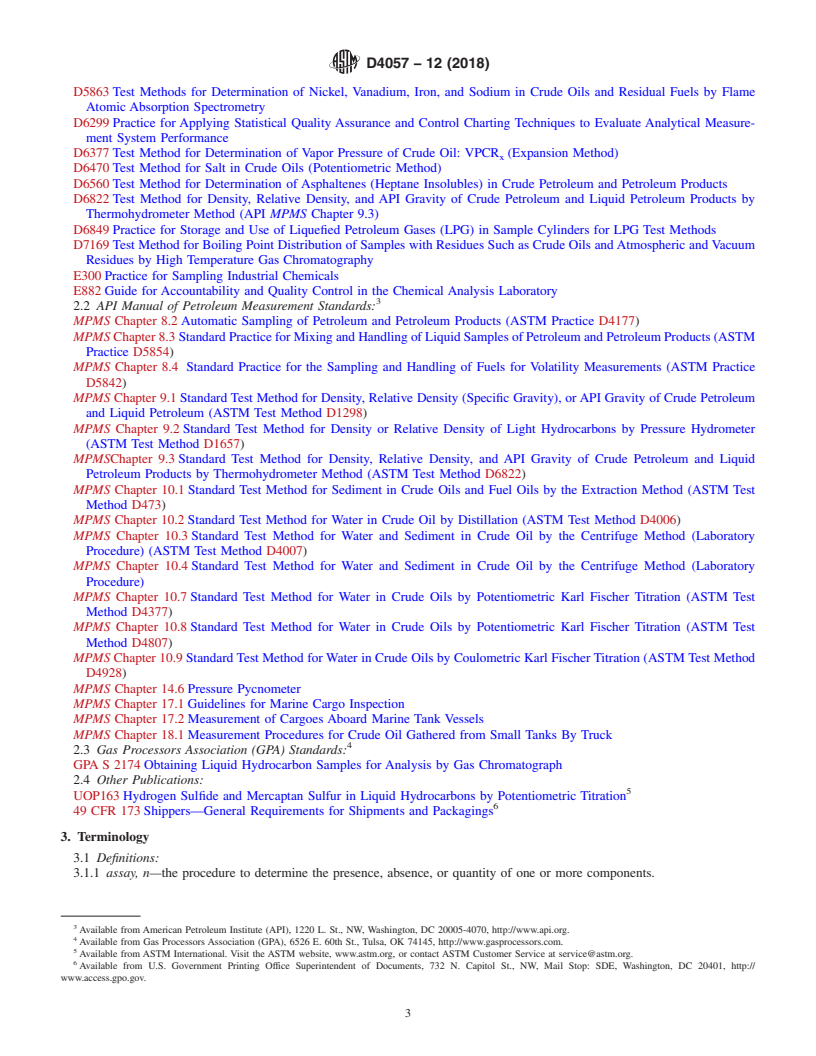
D5863 Test Methods for Determination of Nickel, Vanadium, Iron, and Sodium in Crude Oils and Residual Fuels by Flame
Atomic Absorption Spectrometry
D6299 Practice for Applying Statistical Quality Assurance and Control Charting Techniques to Evaluate Analytical Measure-
ment System Performance
D6377 Test Method for Determination of Vapor Pressure of Crude Oil: VPCR (Expansion Method)
x
D6470 Test Method for Salt in Crude Oils (Potentiometric Method)
D6560 Test Method for Determination of Asphaltenes (Heptane Insolubles) in Crude Petroleum and Petroleum Products
D6822 Test Method for Density, Relative Density, and API Gravity of Crude Petroleum and Liquid Petroleum Products by
Thermohydrometer Method (API MPMS Chapter 9.3)
D6849 Practice for Storage and Use of Liquefied Petroleum Gases (LPG) in Sample Cylinders for LPG Test Methods
D7169 Test Method for Boiling Point Distribution of Samples with Residues Such as Crude Oils and Atmospheric and Vacuum
Residues by High Temperature Gas Chromatography
E300 Practice for Sampling Industrial Chemicals
E882 Guide for Accountability and Quality Control in the Chemical Analysis Laboratory
2.2 API Manual of Petroleum Measurement Standards:
MPMS Chapter 8.2 Automatic Sampling of Petroleum and Petroleum Products (ASTM Practice D4177)
MPMS Chapter 8.3 Standard Practice for Mixing and Handling of Liquid Samples of Petroleum and Petroleum Products (ASTM
Practice D5854)
MPMS Chapter 8.4 Standard Practice for the Sampling and Handling of Fuels for Volatility Measurements (ASTM Practice
D5842)
MPMS Chapter 9.1 Standard Test Method for Density, Relative Density (Specific Gravity), or API Gravity of Crude Petroleum
and Liquid Petroleum (ASTM Test Method D1298)
MPMS Chapter 9.2 Standard Test Method for Density or Relative Density of Light Hydrocarbons by Pressure Hydrometer
(ASTM Test Method D1657)
MPMSChapter 9.3 Standard Test Method for Density, Relative Density, and API Gravity of Crude Petroleum and Liquid
Petroleum Products by Thermohydrometer Method (ASTM Test Method D6822)
MPMS Chapter 10.1 Standard Test Method for Sediment in Crude Oils and Fuel Oils by the Extraction Method (ASTM Test
Method D473)
MPMS Chapter 10.2 Standard Test Method for Water in Crude Oil by Distillation (ASTM Test Method D4006)
MPMS Chapter 10.3 Standard Test Method for Water and Sediment in Crude Oil by the Centrifuge Method (Laboratory
Procedure) (ASTM Test Method D4007)
MPMS Chapter 10.4 Standard Test Method for Water and Sediment in Crude Oil by the Centrifuge Method (Laboratory
Procedure)
MPMS Chapter 10.7 Standard Test Method for Water in Crude Oils by Potentiometric Karl Fischer Titration (ASTM Test
Method D4377)
MPMS Chapter 10.8 Standard Test Method for Water in Crude Oils by Potentiometric Karl Fischer Titration (ASTM Test
Method D4807)
MPMS Chapter 10.9 Standard Test Method for Water in Crude Oils by Coulometric Karl Fischer Titration (ASTM Test Method
D4928)
MPMS Chapter 14.6 Pressure Pycnometer
MPMS Chapter 17.1 Guidelines for Marine Cargo Inspection
MPMS Chapter 17.2 Measurement of Cargoes Aboard Marine Tank Vessels
MPMS Chapter 18.1 Measurement Procedures for Crude Oil Gathered from Small Tanks By Truck
2.3 Gas Processors Association (GPA) Standards:
GPA S 2174 Obtaining Liquid Hydrocarbon Samples for Analysis by Gas Chromatograph
2.4 Other Publications:
UOP163 Hydrogen Sulfide and Mercaptan Sulfur in Liquid Hydrocarbons by Potentiometric Titration
49 CFR 173 Shippers—General Requirements for Shipments and Packagings
3. Terminology
3.1 Definitions:
3.1.1 assay, n—the procedure to determine the presence, absence, or quantity of one or more components.
Available from American Petroleum Institute (API), 1220 L. St., NW, Washington, DC 20005-4070, http://www.api.org.
Available from Gas Processors Association (GPA), 6526 E. 60th St., Tulsa, OK 74145, http://www.gasprocessors.com.
Available from ASTM International. Visit the ASTM website, www.astm.org, or contact ASTM Customer Service at service@astm.org.
Available from U.S. Government Printing Office Superintendent of Documents, 732 N. Capitol St., NW, Mail Stop: SDE, Washington, DC 20401, http://
www.access.gpo.gov.
D4057 − 12 (2018)
3.1.2 automatic sampler, n—a device used to extract a representative sample from the liquid flowing in a pipe; the automatic
sampler generally consists of a probe, a sample extractor, an associated controller, a flow measuring device, and a sample receiver.
3.1.3 bubble point, n—the pressure at which the first bubble of vapor forms is the bubble point when the pressure is lowered
on a liquid held at a constant temperature.
3.1.3.1 Discussion—
Bubble point pressures are higher at high temperatures.
3.1.4 density, n—for a quantity of a homogeneous substance, the ratio of its mass to its volume. The density varies as the
temperature changes and is, therefore, generally expressed as the mass per unit of volume at a specified temperature.
3.1.5 dissolved water, n—water in solution in petroleum and petroleum products.
...
Questions, Comments and Discussion
Ask us and Technical Secretary will try to provide an answer. You can facilitate discussion about the standard in here.