

ASTM E2395-21
(Specification)Standard Specification for Voluntary Security Performance of Window and Door Assemblies with Glazing Impact
General Information
- Abstract
ABSTRACT
This specification covers voluntary performance requirements and methods of laboratory tests for the resistance to forced entry of window and door assemblies. The capability of window and door assemblies to frustrate opportunistic entry by unskilled and semi-skilled intruders is addressed by the specification. However, detention facilities or window and door assemblies attacked by professional, sophisticated intruders are not addressed. The specified requirements are limited to window and door assemblies only as manufactured, regardless of their materials or method of manufacture. They do not include requirements for secondary or storm windows and doors, doors intended for vehicular access, or skylights. The window assemblies, sliding door assemblies, and swinging door assemblies shall be subject to forced entry test through the hand manipulation test. Assembly glazed area shall be subject to a missile impact test.
SCOPE
1.1 This specification covers performance requirements and methods of test for the resistance to forced entry of window and door assemblies. This specification addresses the capability of window and door assemblies to frustrate and potentially delay or deter opportunistic entry by unskilled and semi-skilled intruders. This specification does not address detention facilities or window and door assemblies attacked by professional, sophisticated intruders.
1.2 This specification is used for the testing of complete window and door assemblies including assault to the infill glazing. Direct assault to the infill glazing at the specified threat level is not included in other ASTM test methods that address fenestration security performance.
1.3 These requirements are limited to window and door assemblies only as manufactured, regardless of their materials or method of manufacture. They do not include requirements for secondary or storm windows and doors, doors intended for vehicular access, or skylights. This is a laboratory test, not a field test that simulates an installed condition.
1.4 The values stated in SI units are to be regarded as standard. The values given in parentheses after SI units are provided for information only and are not considered standard. Certain values contained in reference documents cited and quoted herein may be stated in inch-pound units and must be converted by the user.
1.5 This standard does not purport to address all of the safety concerns, if any, associated with its use. It is the responsibility of the user of this standard to establish appropriate safety, health, and environmental practices and determine the applicability of regulatory limitations prior to use.
1.6 This international standard was developed in accordance with internationally recognized principles on standardization established in the Decision on Principles for the Development of International Standards, Guides and Recommendations issued by the World Trade Organization Technical Barriers to Trade (TBT) Committee.
- Status
- Published
- Publication Date
- 30-Sep-2021
- Technical Committee
- E06 - Performance of Buildings
- Drafting Committee
- E06.51 - Performance of Windows, Doors, Skylights and Curtain Walls
Buy Documents
ASTM E2395-21 - Standard Specification for Voluntary Security Performance of Window and Door Assemblies with Glazing Impact
REDLINE ASTM E2395-21 - Standard Specification for Voluntary Security Performance of Window and Door Assemblies with Glazing Impact
Overview
ASTM E2395-21: Standard Specification for Voluntary Security Performance of Window and Door Assemblies with Glazing Impact establishes laboratory test methods and performance requirements for the forced entry resistance of window and door assemblies, including their glazing components. Developed by ASTM International, this security standard is designed to assess the ability of window and door systems-regardless of material or method of manufacture-to deter or delay opportunistic forced entry attempts by unskilled and semi-skilled intruders. It is not intended for assemblies designed for detention facilities or for resisting professional and highly sophisticated intrusion. The standard focuses exclusively on primary window and door products, excluding secondary doors, storm windows, vehicular doors, and skylights.
Key Topics
- Forced Entry Resistance: Specifies test methods for assessing the ability of window, sliding door, and swinging door assemblies to withstand attempts at unauthorized entry through hand manipulation.
- Glazing Impact Testing: Incorporates missile impact tests for the glazing areas to evaluate resistance against forced entry and breakage under specific threat levels.
- Product Qualification: Provides criteria for rating products based on laboratory performance, including substitution rules for glazing thickness and material type.
- Pass/Fail Requirements: Outlines conditions under which assemblies are considered compliant, primarily based on their ability to prevent the formation of penetrable openings.
- Test Specimens and Methods: Describes the complete assembly configuration required for testing and cross-references related ASTM standards used in the procedures.
Applications
ASTM E2395-21 is suitable for:
- Manufacturers: Qualifying and rating window and door assemblies for security applications in residential and commercial construction.
- Architects and Specifiers: Specifying windows and doors with verified resistance to opportunistic forced entry incidents.
- Building and Security Consultants: Evaluating the appropriateness of window and door products for projects requiring enhanced security performance.
- Quality Control Laboratories: Conducting laboratory testing of window and door assemblies to confirm compliance with voluntary security standards.
Complying with ASTM E2395-21 improves the security performance credentials of window and door assemblies, enhancing protection for occupants and property while helping manufacturers meet regulatory and market expectations regarding fenestration security.
Related Standards
The performance assessment and test methods referenced in ASTM E2395-21 are closely linked to other industry standards:
- ASTM E631: Terminology of Building Constructions
- ASTM E1886: Performance of Exterior Windows, Curtain Walls, Doors, and Impact Protective Systems Impacted by Missile(s)
- ASTM E1996: Performance of Exterior Windows and Doors Impacted by Windborne Debris in Hurricanes
- ASTM F476: Security of Swinging Door Assemblies
- ASTM F588: Forced Entry Resistance of Window Assemblies, Excluding Glazing Impact
- ASTM F842: Forced Entry Resistance of Sliding Door Assemblies, Excluding Glazing Impact
- ASTM F1233: Security Glazing Materials and Systems
- AAMA/WDMA/CSA 101/I.S.2/A440 (NAFS): North American Fenestration Standard/Specification
These related standards provide a comprehensive framework for fenestration product specification, combining forced entry, impact, and glazing qualifications for robust window and door security solutions.
Keywords: forced entry resistance, glazed window assemblies, security doors, glazing impact test, ASTM E2395-21, security windows, window and door assemblies, fenestration security, security performance, laboratory testing, swinging doors, sliding doors.
Relations
- Effective Date
- 01-Oct-2019
- Effective Date
- 01-Mar-2015
- Effective Date
- 01-Nov-2014
- Effective Date
- 01-Oct-2014
- Effective Date
- 01-Jun-2014
- Effective Date
- 01-May-2014
- Effective Date
- 01-May-2014
- Effective Date
- 01-Oct-2013
- Effective Date
- 01-Sep-2013
- Effective Date
- 01-May-2013
- Effective Date
- 01-May-2013
- Effective Date
- 01-Nov-2012
- Effective Date
- 01-Jun-2012
- Effective Date
- 15-Apr-2012
- Effective Date
- 01-Apr-2009
Buy Documents
ASTM E2395-21 - Standard Specification for Voluntary Security Performance of Window and Door Assemblies with Glazing Impact
REDLINE ASTM E2395-21 - Standard Specification for Voluntary Security Performance of Window and Door Assemblies with Glazing Impact
Get Certified
Connect with accredited certification bodies for this standard

DIBt (Deutsches Institut für Bautechnik)
German Institute for Building Technology.
DIN CERTCO
DIN Group product certification.

Aboma Certification B.V.
Specialized in construction, metal, and transport sectors.
Sponsored listings
Frequently Asked Questions
ASTM E2395-21 is a technical specification published by ASTM International. Its full title is "Standard Specification for Voluntary Security Performance of Window and Door Assemblies with Glazing Impact". This standard covers: ABSTRACT This specification covers voluntary performance requirements and methods of laboratory tests for the resistance to forced entry of window and door assemblies. The capability of window and door assemblies to frustrate opportunistic entry by unskilled and semi-skilled intruders is addressed by the specification. However, detention facilities or window and door assemblies attacked by professional, sophisticated intruders are not addressed. The specified requirements are limited to window and door assemblies only as manufactured, regardless of their materials or method of manufacture. They do not include requirements for secondary or storm windows and doors, doors intended for vehicular access, or skylights. The window assemblies, sliding door assemblies, and swinging door assemblies shall be subject to forced entry test through the hand manipulation test. Assembly glazed area shall be subject to a missile impact test. SCOPE 1.1 This specification covers performance requirements and methods of test for the resistance to forced entry of window and door assemblies. This specification addresses the capability of window and door assemblies to frustrate and potentially delay or deter opportunistic entry by unskilled and semi-skilled intruders. This specification does not address detention facilities or window and door assemblies attacked by professional, sophisticated intruders. 1.2 This specification is used for the testing of complete window and door assemblies including assault to the infill glazing. Direct assault to the infill glazing at the specified threat level is not included in other ASTM test methods that address fenestration security performance. 1.3 These requirements are limited to window and door assemblies only as manufactured, regardless of their materials or method of manufacture. They do not include requirements for secondary or storm windows and doors, doors intended for vehicular access, or skylights. This is a laboratory test, not a field test that simulates an installed condition. 1.4 The values stated in SI units are to be regarded as standard. The values given in parentheses after SI units are provided for information only and are not considered standard. Certain values contained in reference documents cited and quoted herein may be stated in inch-pound units and must be converted by the user. 1.5 This standard does not purport to address all of the safety concerns, if any, associated with its use. It is the responsibility of the user of this standard to establish appropriate safety, health, and environmental practices and determine the applicability of regulatory limitations prior to use. 1.6 This international standard was developed in accordance with internationally recognized principles on standardization established in the Decision on Principles for the Development of International Standards, Guides and Recommendations issued by the World Trade Organization Technical Barriers to Trade (TBT) Committee.
ABSTRACT This specification covers voluntary performance requirements and methods of laboratory tests for the resistance to forced entry of window and door assemblies. The capability of window and door assemblies to frustrate opportunistic entry by unskilled and semi-skilled intruders is addressed by the specification. However, detention facilities or window and door assemblies attacked by professional, sophisticated intruders are not addressed. The specified requirements are limited to window and door assemblies only as manufactured, regardless of their materials or method of manufacture. They do not include requirements for secondary or storm windows and doors, doors intended for vehicular access, or skylights. The window assemblies, sliding door assemblies, and swinging door assemblies shall be subject to forced entry test through the hand manipulation test. Assembly glazed area shall be subject to a missile impact test. SCOPE 1.1 This specification covers performance requirements and methods of test for the resistance to forced entry of window and door assemblies. This specification addresses the capability of window and door assemblies to frustrate and potentially delay or deter opportunistic entry by unskilled and semi-skilled intruders. This specification does not address detention facilities or window and door assemblies attacked by professional, sophisticated intruders. 1.2 This specification is used for the testing of complete window and door assemblies including assault to the infill glazing. Direct assault to the infill glazing at the specified threat level is not included in other ASTM test methods that address fenestration security performance. 1.3 These requirements are limited to window and door assemblies only as manufactured, regardless of their materials or method of manufacture. They do not include requirements for secondary or storm windows and doors, doors intended for vehicular access, or skylights. This is a laboratory test, not a field test that simulates an installed condition. 1.4 The values stated in SI units are to be regarded as standard. The values given in parentheses after SI units are provided for information only and are not considered standard. Certain values contained in reference documents cited and quoted herein may be stated in inch-pound units and must be converted by the user. 1.5 This standard does not purport to address all of the safety concerns, if any, associated with its use. It is the responsibility of the user of this standard to establish appropriate safety, health, and environmental practices and determine the applicability of regulatory limitations prior to use. 1.6 This international standard was developed in accordance with internationally recognized principles on standardization established in the Decision on Principles for the Development of International Standards, Guides and Recommendations issued by the World Trade Organization Technical Barriers to Trade (TBT) Committee.
ASTM E2395-21 is classified under the following ICS (International Classification for Standards) categories: 91.060.50 - Doors and windows. The ICS classification helps identify the subject area and facilitates finding related standards.
ASTM E2395-21 has the following relationships with other standards: It is inter standard links to ASTM E1886-19, ASTM E631-15, ASTM E631-14, ASTM E1996-14a, ASTM E1996-14, ASTM F588-14, ASTM F842-14, ASTM E1886-13a, ASTM E1886-13, ASTM F1233-08(2013), ASTM F842-13, ASTM E1996-12a, ASTM F842-12, ASTM E1996-12, ASTM E1996-09. Understanding these relationships helps ensure you are using the most current and applicable version of the standard.
ASTM E2395-21 is available in PDF format for immediate download after purchase. The document can be added to your cart and obtained through the secure checkout process. Digital delivery ensures instant access to the complete standard document.
Standards Content (Sample)
This international standard was developed in accordance with internationally recognized principles on standardization established in the Decision on Principles for the
Development of International Standards, Guides and Recommendations issued by the World Trade Organization Technical Barriers to Trade (TBT) Committee.
Designation:E2395 −21
Standard Specification for
Voluntary Security Performance of Window and Door
Assemblies with Glazing Impact
This standard is issued under the fixed designation E2395; the number immediately following the designation indicates the year of
original adoption or, in the case of revision, the year of last revision.Anumber in parentheses indicates the year of last reapproval.A
superscript epsilon (´) indicates an editorial change since the last revision or reapproval.
1. Scope ization established in the Decision on Principles for the
Development of International Standards, Guides and Recom-
1.1 This specification covers performance requirements and
mendations issued by the World Trade Organization Technical
methods of test for the resistance to forced entry of window
Barriers to Trade (TBT) Committee.
and door assemblies. This specification addresses the capabil-
ity of window and door assemblies to frustrate and potentially
2. Referenced Documents
delayordeteropportunisticentrybyunskilledandsemi-skilled
2.1 ASTM Standards:
intruders. This specification does not address detention facili-
E631Terminology of Building Constructions
ties or window and door assemblies attacked by professional,
E1886Test Method for Performance of Exterior Windows,
sophisticated intruders.
Curtain Walls, Doors, and Impact Protective Systems
1.2 This specification is used for the testing of complete
Impacted by Missile(s) and Exposed to Cyclic Pressure
window and door assemblies including assault to the infill
Differentials
glazing. Direct assault to the infill glazing at the specified
E1996Specification for Performance of Exterior Windows,
threat level is not included in other ASTM test methods that
Curtain Walls, Doors, and Impact Protective Systems
address fenestration security performance.
Impacted by Windborne Debris in Hurricanes
E2025TestMethodforEvaluatingFenestrationComponents
1.3 These requirements are limited to window and door
andAssemblies for Resistance to Impact Energies (With-
assemblies only as manufactured, regardless of their materials
drawn 2015)
or method of manufacture. They do not include requirements
F476Test Methods for Security of Swinging Door Assem-
for secondary or storm windows and doors, doors intended for
blies
vehicular access, or skylights. This is a laboratory test, not a
F588Test Methods for Measuring the Forced Entry Resis-
field test that simulates an installed condition.
tance of Window Assemblies, Excluding Glazing Impact
1.4 The values stated in SI units are to be regarded as
F842Test Methods for Measuring the Forced Entry Resis-
standard. The values given in parentheses after SI units are
tance of Sliding Door Assemblies, Excluding Glazing
providedforinformationonlyandarenotconsideredstandard.
Impact
Certain values contained in reference documents cited and
F1233Test Method for Security Glazing Materials And
quoted herein may be stated in inch-pound units and must be
Systems
converted by the user.
2.2 AAMA Standards:
1.5 This standard does not purport to address all of the
AAMA/WDMA/CSA 101/I.S.2/A440 NAFS – North
safety concerns, if any, associated with its use. It is the
American Fenestration Standard/Specification for
responsibility of the user of this standard to establish appro-
windows, doors, and skylights
priate safety, health, and environmental practices and deter-
AAMA 1304Voluntary Specification for Forced Entry Re-
mine the applicability of regulatory limitations prior to use.
sistance of Side-Hinged Door Systems
1.6 This international standard was developed in accor-
dance with internationally recognized principles on standard-
For referenced ASTM standards, visit the ASTM website, www.astm.org, or
contact ASTM Customer Service at service@astm.org. For Annual Book of ASTM
Standards volume information, refer to the standard’s Document Summary page on
This specification is under the jurisdiction of ASTM Committee E06 on the ASTM website.
Performance of Buildings and is the direct responsibility of Subcommittee E06.51 The last approved version of this historical standard is referenced on
on Performance of Windows, Doors, Skylights and Curtain Walls. www.astm.org.
Current edition approved Oct. 1, 2021. Published December 2021. Originally Available from American Architectural Manufacturers Association (AAMA),
approved in 2005. Last previous edition approved in 2018 as E2395–18. DOI: 1827 Walden Office Square, Suite 550, Schaumburg, IL 60173-4268, http://
10.1520/E2395-21. www.aamanet.org.
Copyright © ASTM International, 100 Barr Harbor Drive, PO Box C700, West Conshohocken, PA 19428-2959. United States
E2395−21
3. Terminology 5.1.5 The same test specimen shall be used for each test
sequence required by this specification.
3.1 Definitions:
5.1.6 Windows or doors tested with more than one locking
3.1.1 General terms used in this standard specification are
device shall not qualify windows or doors with fewer locking
defined in Terminology E631.
devices regardless of size.
3.1.2 Terms common to this standard specification and Test
Methods E2025, F476, F588, F842 and F1233 are defined in
6. Test Methods
the respective document unless defined herein.
6.1 Window Assemblies Forced Entry Test:
3.2 Definitions of Terms Specific to This Standard:
3.2.1 door slab—a swinging door panel, blank, or leaf.
6.1.1 Prepare the specimen as outlined in Section 9 of Test
Methods F588.
3.2.2 interlayer—a layer of material acting as an adhesive
6.1.2 Hand Manipulation Test:
betweenpliesofglazing,whichaddsadditionalperformanceto
the finished product. For example: impact resistance, solar 6.1.2.1 Lift, push, pull or otherwise manipulate by hand the
control, and acoustical insulation. sash or panel relative to the clearances within the frame, while
attempting to open the sash or panel.
4. Performance Requirements
6.1.2.2 This test shall be conducted continuously for five
minutes.
4.1 Products shall be tested to the following levels as
described in Table 1.
6.1.3 Perform the tests using the desired level from Section
4 of this specification in accordance with the procedure
5. Test Specimens
outlined in Section 10 of Test Methods F588.
5.1 Window and Door Assemblies:
6.2 Sliding Door Assemblies Forced Entry Test:
5.1.1 One test specimen for each product design seeking
6.2.1 Prepare the specimen as outlined in Section9 of Test
qualification shall be submitted.
Methods F842.
5.1.2 Window and door assemblies tested for conformance
6.2.2 Perform Hand Manipulation Test in 6.1.2.
tothisspecificationshallbecompletespecimensrepresentative
6.2.3 Perform the tests in accordance with the procedure
of those produced by the manufacturer or fabricator. (AAMA/
outlined in Section10 of Test Methods F842.
WDMA/CSA 101/I.S.2/A440 contains reference sizes which
may prove useful in coordinating with window and door
6.3 Swinging Door Assemblies Forced Entry Test:
performance requirements not included in this specification.)
6.3.1 Prepare and test the specimen as outlined in Annex
5.1.3 A test specimen shall be of the assembly size for
A1.
which ratings are sought.
6.4 Assembly Glazed Area Intrusion Test:
5.1.4 A test specimen shall contain the entire panel, door
6.4.1 Conduct missile impact testing in accordance with
slab or sash configurations, locking devices, hardware, inter-
Test Method E1886 with no air pressure cycling.
locking details, meeting rail details, and glazing for which
rating is sought. 6.4.1.1 The missile size shall be as specified in Table 1.
TABLE 1 Assembly Performance Requirements
NOTE 1—Assemblies tested to the impact requirements of Specification E1996 for any missile level automatically qualifies any lesser missile level.
Glazed Area
Performance
Product Type Performance Requirements Intrusion Test
Level
(Tested to 6.4)
Window Assemblies L1 Minimum Performance Grade 10 in accordance with Annex A1 of ASTM E1996 Missile A
Tested to 6.1 ASTM F588
L2 Grade 10 in accordance with Annex A1 of ASTM F588 ASTM E1996 Missile B
L3 Grade 20 in accordance with Annex A1 of ASTM F588 ASTM E1996 Missile C
L4 Grade 30 in accordance with Annex A1 of ASTM F588 ASTM E1996 Missile C
L5 Grade 40 in accordance with Annex A1 of ASTM F588 ASTM E1996 Missile C plus
ASTM F1233 Class 1
Sliding Door Assemblies L1 Minimum Performance Grade 10 in accordance with Annex A1 of ASTM E1996 Missile A
Tested to 6.2 ASTM F842
L2 Grade 10 in accordance with Annex A1 of ASTM F842 ASTM E1996 Missile B
L3 Grade 20 in accordance with Annex A1 of ASTM F842 ASTM E1996 Missile C
L4 Grade 30 in accordance with Annex A1 of ASTM F842 ASTM E1996 Missile C
L5 Grade 40 in accordance with Annex A1 of ASTM F842 ASTM E1996 Missile C plus
ASTM F1233 Class 1
Swinging Door Assemblies L1 Minimum Performance Grade 10 in accordance with ASTM F476 ASTM E1996 Missile A
Tested to 6.3 2g small missile
L2 Grade 10 in accordance with ASTM F476 ASTM E1996 Missile B
L3 Grade 20 in accordance with ASTM F476 ASTM E1996 Missile C
L4 Grade 30 in accordance with ASTM F476 ASTM E1996 Missile C
L5 Grade 40 in accordance with ASTM F476 ASTM E1996 Missile C plus
ASTM F1233 Class 1
E2395−21
6.4.1.2 Impact the specimen twice. The exception to this 7.1.2 Level 5 is met when the test specimen resists the
secondimpactisifbothdimensionsoftheglazingarelessthan missile impacts, without missile penetration of the inner plane
420mm(17in.),inwhichcasethereisonlyonecenterimpact. oftheinfillandthen,shallpass10.2.4.2(BodyPassage)ofTest
6.4.1.3 The first impact shall be within a 65 mm (2.5 in.) Method F1233 when tested in accordance with 6.4.2.
radius circle located at the center of the glazing.
6.4.1.4 The second impact shall be within a 65 mm (2.5 in.) 8. Product Qualification
radius circle with the center located within 150 mm (6 in.) of
8.1 Products shall be qualified as passing and shall be rated
a corner.
when the following conditions have been met:
6.4.2 For performance level L5 products, on the same
8.1.1 Test specimens shall be tested following the appropri-
specimen, conduct manual forced entry testing after missile
ate test method (Window Assemblies, Sliding Door
impact in accordance with 10.2 of Test Method F1233 using
Assemblies, or Swinging Door Assemblies) in this specifica-
Class I Sequence specified in Table 2.
tion and comply with the pass/fail criteria established in 7.1.
6.4.2.1 The required ten impacts shall be entirely within a
8.2 Substitutions shall be in accordance with the following
150 mm (6 in.) radius circle having its center located 150 mm
criteria:
(6in.)fromanedgeandfromthemissileimpactpoint(Fig.1).
8.2.1 Successful tests of a window or door assembly shall
7. Pass/Fail Criteria
qualify other assemblies with thicker or equal glazing and
thicker or equal identical formulation of interlayer or film
The following two sets of pass/fail criteria shall apply for
materials of the same glass type and treatment, provided the
this specification:
glazing details are unchanged other than to accommodate any
7.1 WindowAssemblies,SlidingDoorAssemblies,orSwing-
variations in overall glazing thickness.
ing Door Assemblies:
8.2.1.1 Glazing detail changes shall demonstrate equivalent
7.1.1 Level 1–4 is met when no opening is formed through
performance through a review of materials or by engineering
which a 76 mm (3 in.) diameter solid sphere can pass through
analysis.
the specimen using a horizontally applied force of 18 N (4 lb)
or less. These criteria will apply when the free passage of the 8.2.2 Products which have been tested and rated by this
shape is made through a hole in any portion of the test specificationshallqualifyidenticalassembliesthatareequalto
specimen. or smaller than both the width and height of the test specimen.
FIG. 1Example of Missile Impact and Hammer Strike Zone Locations
E2395−21
8.2.3 Glazing material colors may be changed provided the 9.1.1.1 Detaileddescriptionoftherequiredtestspecimen(s)
glazing construction remains unchanged. Heat-treated glass and report test results using the requirements of the Report
shall not qualify annealed glass material, and FT shall not section of Test Methods F588.
qualify HS or AN. 9.1.1.2 Detailed description of glazing materials including
glass type, glass treatment, glass thickness, and component
8.2.4 Successful tests of a window or door assembly that
manufacturers and report indicating test results in accordance
contains single lite glazing (monolithic or laminated) shall
with the test requirements of 6.4.
qualify multiple lite glazing (insulating) units provided the
9.1.1.3 State the level that was successfully achieved.
requirements of 8.2.1 and 8.2.2 are satisfied.
9.1.2 Sliding Door Assemblies:
8.2.5 Successful tests of a window or door assembly that
9.1.2.1 Detaileddescriptionoftherequiredtestspecimen(s)
contains construction to improve thermal efficiency of the
and report test results using the requirements of the Report
frameorsash,shallqualifyotherassembliesthatdonotcontain
section of Test Methods F842.
construction to improve thermal efficiency provided the same
9.1.2.2 Detailed description of glazing materials including
e
...
This document is not an ASTM standard and is intended only to provide the user of an ASTM standard an indication of what changes have been made to the previous version. Because
it may not be technically possible to adequately depict all changes accurately, ASTM recommends that users consult prior editions as appropriate. In all cases only the current version
of the standard as published by ASTM is to be considered the official document.
Designation: E2395 − 18 E2395 − 21
Standard Specification for
Voluntary Security Performance of Window and Door
Assemblies with Glazing Impact
This standard is issued under the fixed designation E2395; the number immediately following the designation indicates the year of
original adoption or, in the case of revision, the year of last revision. A number in parentheses indicates the year of last reapproval. A
superscript epsilon (´) indicates an editorial change since the last revision or reapproval.
1. Scope
1.1 This specification covers performance requirements and methods of test for the resistance to forced entry of window and door
assemblies. This specification addresses the capability of window and door assemblies to frustrate and potentially delay or deter
opportunistic entry by unskilled and semi-skilled intruders. This specification does not address detention facilities or window and
door assemblies attacked by professional, sophisticated intruders.
1.2 This specification is used for the testing of complete window and door assemblies including assault to the infill glazing. Direct
assault to the infill glazing at the specified threat level is not included in other ASTM test methods that address fenestration security
performance.
1.3 These requirements are limited to window and door assemblies only as manufactured, regardless of their materials or method
of manufacture. They do not include requirements for secondary or storm windows and doors, doors intended for vehicular access,
or skylights. This is a laboratory test, not a field test that simulates an installed condition.
1.4 AllThe values are stated in SI units and are to be regarded as standard. Values The values given in parentheses are for
information only. after SI units are provided for information only and are not considered standard. Certain values contained in
reference documents cited and quoted herein may be stated in inch-pound units and must be converted by the user.
1.5 This standard does not purport to address all of the safety concerns, if any, associated with its use. It is the responsibility
of the user of this standard to establish appropriate safety, health, and environmental practices and determine the applicability of
regulatory limitations prior to use.
1.6 This international standard was developed in accordance with internationally recognized principles on standardization
established in the Decision on Principles for the Development of International Standards, Guides and Recommendations issued
by the World Trade Organization Technical Barriers to Trade (TBT) Committee.
2. Referenced Documents
2.1 ASTM Standards:
E631 Terminology of Building Constructions
E1886 Test Method for Performance of Exterior Windows, Curtain Walls, Doors, and Impact Protective Systems Impacted by
Missile(s) and Exposed to Cyclic Pressure Differentials
This specification is under the jurisdiction of ASTM Committee E06 on Performance of Buildings and is the direct responsibility of Subcommittee E06.51 on Performance
of Windows, Doors, Skylights and Curtain Walls.
Current edition approved July 15, 2018Oct. 1, 2021. Published August 2018December 2021. Originally approved in 2005. Last previous edition approved in 20132018
as E2395–06 (2013). –18. DOI: 10.1520/E2395–18.10.1520/E2395-21.
For referenced ASTM standards, visit the ASTM website, www.astm.org, or contact ASTM Customer Service at service@astm.org. For Annual Book of ASTM Standards
volume information, refer to the standard’s Document Summary page on the ASTM website.
Copyright © ASTM International, 100 Barr Harbor Drive, PO Box C700, West Conshohocken, PA 19428-2959. United States
E2395 − 21
E1996 Specification for Performance of Exterior Windows, Curtain Walls, Doors, and Impact Protective Systems Impacted by
Windborne Debris in Hurricanes
E2025 Test Method for Evaluating Fenestration Components and Assemblies for Resistance to Impact Energies (Withdrawn
2015)
F476 Test Methods for Security of Swinging Door Assemblies
F588 Test Methods for Measuring the Forced Entry Resistance of Window Assemblies, Excluding Glazing Impact
F842 Test Methods for Measuring the Forced Entry Resistance of Sliding Door Assemblies, Excluding Glazing Impact
F1233 Test Method for Security Glazing Materials And Systems
2.2 AAMA Standards:
AAMA/WDMA/CSA 101/I.S.2/A440 NAFS – North American Fenestration Standard/Specification for windows, doors, and
skylights
AAMA 1304 Voluntary Specification for Forced Entry Resistance of Side-Hinged Door Systems
The last approved version of this historical standard is referenced on www.astm.org.
Available from American Architectural Manufacturers Association (AAMA), 1827 Walden Office Square, Suite 550, Schaumburg, IL 60173-4268, http://
www.aamanet.org.
E2395 − 21
3. Terminology
3.1 Definitions:
3.1.1 General terms used in this standard specification are defined in Terminology E631.
3.1.2 Terms common to this standard specification and Test Methods E2025, F476, F588, F842 and F1233 are defined in the
respective document unless defined herein.
3.2 Definitions of Terms Specific to This Standard:
3.2.1 door slab—a swinging door panel, blank, or leaf.
3.2.2 interlayer—a layer of material acting as an adhesive between plies of glazing, which adds additional performance to the
finished product. For example: impact resistance, solar control, and acoustical insulation.
4. Performance Requirements
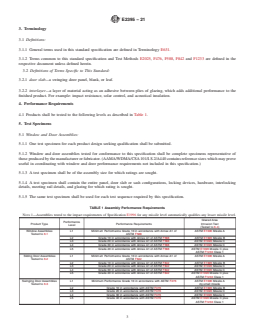
4.1 Products shall be tested to the following levels as described in Table 1.
5. Test Specimens
5.1 Window and Door Assemblies:
5.1.1 One test specimen for each product design seeking qualification shall be submitted.
5.1.2 Window and door assemblies tested for conformance to this specification shall be complete specimens representative of
those produced by the manufacturer or fabricator. (AAMA/WDMA/CSA 101/I.S.2/A440 contains reference sizes which may prove
useful in coordinating with window and door performance requirements not included in this specification.)
5.1.3 A test specimen shall be of the assembly size for which ratings are sought.
5.1.4 A test specimen shall contain the entire panel, door slab or sash configurations, locking devices, hardware, interlocking
details, meeting rail details, and glazing for which rating is sought.
5.1.5 The same test specimen shall be used for each test sequence required by this specification.
TABLE 1 Assembly Performance Requirements
NOTE 1—Assemblies tested to the impact requirements of Specification E1996 for any missile level automatically qualifies any lesser missile level.
Glazed Area
Performance
Product Type Performance Requirements Intrusion Test
Level
(Tested to 6.4)
Window Assemblies L1 Minimum Performance Grade 10 in accordance with Annex A1 of ASTM E1996 Missile A
Tested to 6.1 ASTM F588
L2 Grade 10 in accordance with Annex A1 of ASTM F588 ASTM E1996 Missile B
L3 Grade 20 in accordance with Annex A1 of ASTM F588 ASTM E1996 Missile C
L4 Grade 30 in accordance with Annex A1 of ASTM F588 ASTM E1996 Missile C
L5 Grade 40 in accordance with Annex A1 of ASTM F588 ASTM E1996 Missile C plus
ASTM F1233 Class 1
Sliding Door Assemblies L1 Minimum Performance Grade 10 in accordance with Annex A1 of ASTM E1996 Missile A
Tested to 6.2 ASTM F842
L2 Grade 10 in accordance with Annex A1 of ASTM F842 ASTM E1996 Missile B
L3 Grade 20 in accordance with Annex A1 of ASTM F842 ASTM E1996 Missile C
L4 Grade 30 in accordance with Annex A1 of ASTM F842 ASTM E1996 Missile C
L5 Grade 40 in accordance with Annex A1 of ASTM F842 ASTM E1996 Missile C plus
ASTM F1233 Class 1
Swinging Door Assemblies L1 Minimum Performance Grade 10 in accordance with ASTM F476 ASTM E1996 Missile A
Tested to 6.3 2g small missile
L2 Grade 10 in accordance with ASTM F476 ASTM E1996 Missile B
L3 Grade 20 in accordance with ASTM F476 ASTM E1996 Missile C
L4 Grade 30 in accordance with ASTM F476 ASTM E1996 Missile C
L5 Grade 40 in accordance with ASTM F476 ASTM E1996 Missile C plus
ASTM F1233 Class 1
E2395 − 21
5.1.6 Windows or doors tested with more than one locking device shall not qualify windows or doors with fewer locking devices
regardless of size.
6. Test Methods
6.1 Window Assemblies Forced Entry Test:
6.1.1 Prepare the specimen as outlined in Section 9 of Test Methods F588.
6.1.2 Hand Manipulation Test:
6.1.2.1 Lift, push, pull or otherwise manipulate by hand the sash or panel relative to the clearances within the frame, while
attempting to open the sash or panel.
6.1.2.2 This test shall be conducted continuously for five minutes.
6.1.3 Perform the tests using the desired level from Section 4 of this specification in accordance with the procedure outlined in
Section 10 of Test Methods F588.
6.2 Sliding Door Assemblies Forced Entry Test:
6.2.1 Prepare the specimen as outlined in Section 9 of Test Methods F842.
6.2.2 Perform Hand Manipulation Test in 6.1.2.
6.2.3 Perform the tests in accordance with the procedure outlined in Section 10 of Test Methods F842.
6.3 Swinging Door Assemblies Forced Entry Test:
6.3.1 Prepare and test the specimen as outlined in Annex A1.
6.4 Assembly Glazed Area Intrusion Test:
6.4.1 Conduct missile impact testing in accordance with Test Method E1886 with no air pressure cycling.
6.4.1.1 The missile size shall be as specified in Table 1.
6.4.1.2 Impact the specimen twice. The exception to this second impact is if both dimensions of the glazing are less than 420 mm
(17 in.), in which case there is only one center impact.
6.4.1.3 The first impact shall be within a 65 mm (2.5 in.) radius circle located at the center of the glazing.
6.4.1.4 The second impact shall be within a 65 mm (2.5 in.) radius circle with the center located within 150 mm (6 in.) of a corner.
6.4.2 For performance level L5 products, on the same specimen, conduct manual forced entry testing after missile impact in
accordance with 9.210.2 of Test Method F1233 using Class I Sequence specified in Table 2.
6.4.2.1 The required ten impacts shall be entirely within a 150 mm (6 in.) radius circle having its center located 150 mm (6 in.)
from an edge and from the missile impact point (Fig. 1).
7. Pass/Fail Criteria
The following two sets of pass/fail criteria shall apply for this specification:
7.1 Window Assemblies, Sliding Door Assemblies, or Swinging Door Assemblies:
7.1.1 Level 1–4 is met when no opening is formed through which a 76 mm (3 in.) diameter solid sphere can pass through the
E2395 − 21
FIG. 1 Example of Missile Impact and Hammer Strike Zone Locations
specimen using a horizontally applied force of 18 N (4 lb) or less. These criteria will apply when the free passage of the shape
is made through a hole in any portion of the test specimen.
7.1.2 Level 5 is met when the test specimen resists the missile impacts, without missile penetration of the inner plane of the infill
and then, shall pass 10.2.4.2 (Body Passage) of Test Method F1233 when tested in accordance with 6.4.2.
8. Product Qualification
8.1 Products shall be qualified as passing and shall be rated when the following conditions have been met:
8.1.1 Test specimens shall be tested following the appropriate test method (Window Assemblies, Sliding Door Assemblies, or
Swinging Door Assemblies) in this specification and comply with the pass/fail criteria established in 7.1.
8.2 Substitutions shall be in accordance with the following criteria:
8.2.1 Successful tests of a window or door assembly shall qualify other assemblies with thicker or equal glazing and thicker or
equal identical formulation of interlayer or film materials of the same glass type and treatment, provided the glazing details are
unchanged other than to accommodate any variations in overall glazing thickness.
8.2.1.1 Glazing detail changes shall demonstrate equivalent performance through a review of materials or by engineering analysis.
8.2.2 Products which have been tested and rated by this specification shall qualify identical assemblies that are equal to or smaller
than both the width and height of the test specimen.
8.2.3 Glazing material colors may be changed provided the glazing construction remains unchanged. Heat-treated glass shall not
qualify annealed glass material, and FT shall not qualify HS or AN.
E2395 − 21
8.2.4 Successful tests of a window or door assembly that contains single lite glazing (monolithic or laminated) shall qualify
multiple lite glazing (insulating) units provided the requirements of 8.2.1 and 8.2.2 are satisfied.
8.2.5 Successful tests of a window or door assembly that contains construction to improve thermal efficiency of the frame or sash,
shall qualify other assemblies that do not contain construction to improve thermal efficiency provided the same extrusions are used
and the requirements of 8.2.1 and 8.2.2 are satisfied.
8.2.6 When composite window or door assemblies are evaluated for conformance with this specification, each product type of the
assembly shall be tested separately.
8.2.6.1 Assemblies successfully tested can be combined provided the structural supports and connections between assemblies have
been designed for all other required loads.
8.2.7 Different product types can be combined into a combination assembly provided the structural supports and connections
between assemblies have been designed for the required loads.
8.2.8 Substitution of glazing material c
...