

ASTM D7110-21
(Test Method)Standard Test Method for Determining the Viscosity-Temperature Relationship of Used and Soot-Containing Engine Oils at Low Temperatures
General Information
- Abstract
SIGNIFICANCE AND USE
5.1 Significance of Low Temperature, Low Shear Rate, Engine Oil Rheology—The low-temperature, low-shear viscometric behavior of an engine oil, whether new, used, or sooted, determines whether the oil will flow to the sump inlet screen, then to the oil pump, then to the sites in the engine requiring lubrication in sufficient quantity to prevent engine damage immediately or ultimately after cold temperature starting. Two forms of flow problems have been identified,3 flow-limited and air-binding behavior. The first form of flow restriction, flow-limited behavior, is associated with the oil's viscosity; the second, air-binding behavior, is associated with gelation.
5.2 Significance of the Test Method—The temperature-scanning technique employed by this test method was designed to determine the susceptibility of the engine oil to flow-limited and air-binding response to slow cooling conditions by providing continuous information on the rheological condition of the oil over the temperature range of use.3,4,5 In this way, both viscometric and gelation response are obtained in one test.
Note 1: This test method is one of three related to pumpability related problems. Measurement of low-temperature viscosity by the two other pumpability test methods, D3829 and D4684, hold the sample in a quiescent state and generate the apparent viscosity of the sample at shear rates ranging up to 15 s-1 and shear stresses up to 525 Pa at a previously selected temperature. Such difference in test parameters (shear rate, shear stress, sample motion, temperature scanning, and so forth) can lead to differences in the measured apparent viscosity among these methods with some test oils, particularly when other rheological factors associated with gelation are present. In addition, the three methods differ considerably in cooling rates.
5.3 Gelation Index and Gelation Index Temperature—This test method has been further developed to yield parameters called the Gelation Index and Gelation Ind...
SCOPE
1.1 This test method covers how to measure the apparent viscosity of used and soot-containing engine oils at low temperatures.
1.2 A shear rate of approximately 0.2 s-1 is produced at shear stresses below 200 Pa. Apparent viscosity is measured continuously as the sample is cooled at a rate of 3 °C per hour over the range of −5 °C to −40 °C.
1.3 The measurements resulting from this test method are viscosity, the maximum rate of viscosity increase (Gelation Index) and the temperature at which the Gelation Index occurs.
1.4 Applicability to petroleum products other than engine oils has not been determined in preparing this test method.
1.5 The values stated in SI units are to be regarded as standard. No other units of measurement are included in this standard.
1.6 This standard does not purport to address all of the safety concerns, if any, associated with its use. It is the responsibility of the user of this standard to establish appropriate safety, health, and environmental practices and determine the applicability of regulatory limitations prior to use.
1.7 This international standard was developed in accordance with internationally recognized principles on standardization established in the Decision on Principles for the Development of International Standards, Guides and Recommendations issued by the World Trade Organization Technical Barriers to Trade (TBT) Committee.
- Status
- Published
- Publication Date
- 31-Dec-2020
- Technical Committee
- D02 - Petroleum Products, Liquid Fuels, and Lubricants
- Drafting Committee
- D02.07 - Flow Properties
Buy Documents
ASTM D7110-21 - Standard Test Method for Determining the Viscosity-Temperature Relationship of Used and Soot-Containing Engine Oils at Low Temperatures
REDLINE ASTM D7110-21 - Standard Test Method for Determining the Viscosity-Temperature Relationship of Used and Soot-Containing Engine Oils at Low Temperatures
Overview
ASTM D7110-21 is the ASTM International standard test method for determining the viscosity-temperature relationship of used and soot-containing engine oils at low temperatures. This method is essential for understanding engine oil performance under cold start conditions by assessing both the apparent viscosity and gelation tendencies of lubricants. The ability of engine oil to flow adequately during cold temperatures is critical for ensuring proper lubrication and preventing engine damage during startup.
The procedure uses a temperature-scanning technique to provide continuous rheological information as the oil is slowly cooled. This method specifically targets potential "flow-limited" and "air-binding" (gelation) issues, providing a comprehensive assessment in a single test.
Key Topics
- Viscosity-Temperature Relationship: This standard measures how the apparent viscosity of used and soot-laden engine oils changes as temperature decreases, focusing on the critical range from −5 °C to −40 °C.
- Importance of Low-Temperature Performance: Engine oils must remain fluid at low temperatures to ensure that they quickly reach vital engine components after a cold start. Poor flow can cause wear, or even severe engine failure.
- Gelation Index and Gelation Index Temperature: The test quantifies the maximum rate of viscosity increase (Gelation Index) and the specific temperature at which this occurs, giving insight into the oil's tendency to gel and impede flow.
- Distinguishing Flow-Limited vs. Gelation Issues: Identifies viscosity-based flow restriction and gelation-induced air-binding, both of which can hinder oil movement to the engine pump and lubrication sites.
- Temperature-Scanning Technique: Unlike other low temperature viscosity tests that use static temperatures, ASTM D7110-21 continuously cools the sample, capturing dynamic rheological changes.
Applications
- Engine Oil Formulation & Quality Control: Oil manufacturers use ASTM D7110-21 to develop lubricants with improved low-temperature pumpability, minimizing risk of cold-start engine wear or failure.
- Used Oil Analysis: The test helps assess degradation and soot-related viscosity changes in in-service oils, supporting predictive maintenance for fleet operators and automotive technicians.
- Lubricant Comparison and Specification: OEMs and oil suppliers can benchmark various oils for their low-temperature behavior, ensuring compatibility with modern engines under severe winter conditions.
- Research on Soot-Loaded Oils: The method is particularly valuable for engines prone to soot contamination, such as diesel engines, where sludge and gel formation are common low-temperature operational risks.
Related Standards
- ASTM D341: Practice for Viscosity-Temperature Equations and Charts for Liquid Petroleum or Hydrocarbon Products.
- ASTM D3829: Test Method for Predicting the Borderline Pumping Temperature of Engine Oil - another low-temperature pumpability procedure.
- ASTM D4684: Test Method for Determination of Yield Stress and Apparent Viscosity of Engine Oils at Low Temperature.
- ASTM D5133: Test Method for Low Temperature, Low Shear Rate, Viscosity/Temperature Dependence of Lubricating Oils Using a Temperature-Scanning Technique.
- ASTM D4057: Practice for Manual Sampling of Petroleum and Petroleum Products - ensuring sample integrity.
- ASTM D6299: Practice for Applying Statistical Quality Assurance and Control Charting Techniques to Evaluate Analytical Measurement System Performance.
Practical Value
ASTM D7110-21 is a crucial tool for the lubrication industry, engine manufacturers, and maintenance professionals. By enabling detailed characterization of engine oils under cold start conditions, this standard helps to:
- Prevent engine damage by ensuring oils remain pumpable and do not gel at critical low temperatures.
- Enable oil formulators to optimize additive packages for modern, high-soot environments.
- Support regulatory compliance and warranty retention by verifying oils meet low-temperature performance specifications.
- Facilitate comparative testing and quality assurance in oil production and certification processes.
For reliable cold-weather engine performance and extended equipment life, adherence to ASTM D7110-21 provides industry-leading insights into oil behavior under realistic, challenging conditions.
Relations
- Effective Date
- 01-Dec-2023
- Effective Date
- 01-Jun-2020
- Effective Date
- 01-May-2020
- Effective Date
- 01-May-2020
- Effective Date
- 01-May-2020
- Effective Date
- 01-Nov-2019
- Effective Date
- 01-Nov-2019
- Refers
ASTM D3829-18 - Standard Test Method for Predicting the Borderline Pumping Temperature of Engine Oil - Effective Date
- 01-Jun-2018
- Effective Date
- 15-Dec-2017
- Effective Date
- 15-Nov-2017
- Refers
ASTM D341-17 - Standard Practice for Viscosity-Temperature Charts for Liquid Petroleum Products - Effective Date
- 01-Jul-2017
- Refers
ASTM D3829-17 - Standard Test Method for Predicting the Borderline Pumping Temperature of Engine Oil - Effective Date
- 01-May-2017
- Effective Date
- 01-Jan-2017
- Effective Date
- 01-Dec-2016
- Effective Date
- 01-Dec-2015
Buy Documents
ASTM D7110-21 - Standard Test Method for Determining the Viscosity-Temperature Relationship of Used and Soot-Containing Engine Oils at Low Temperatures
REDLINE ASTM D7110-21 - Standard Test Method for Determining the Viscosity-Temperature Relationship of Used and Soot-Containing Engine Oils at Low Temperatures
Get Certified
Connect with accredited certification bodies for this standard

Element Materials Technology
Materials testing and product certification.

ABS Group Brazil
ABS Group certification services in Brazil.

ABS Quality Evaluations Inc.
American Bureau of Shipping quality certification.
Sponsored listings
Frequently Asked Questions
ASTM D7110-21 is a standard published by ASTM International. Its full title is "Standard Test Method for Determining the Viscosity-Temperature Relationship of Used and Soot-Containing Engine Oils at Low Temperatures". This standard covers: SIGNIFICANCE AND USE 5.1 Significance of Low Temperature, Low Shear Rate, Engine Oil Rheology—The low-temperature, low-shear viscometric behavior of an engine oil, whether new, used, or sooted, determines whether the oil will flow to the sump inlet screen, then to the oil pump, then to the sites in the engine requiring lubrication in sufficient quantity to prevent engine damage immediately or ultimately after cold temperature starting. Two forms of flow problems have been identified,3 flow-limited and air-binding behavior. The first form of flow restriction, flow-limited behavior, is associated with the oil's viscosity; the second, air-binding behavior, is associated with gelation. 5.2 Significance of the Test Method—The temperature-scanning technique employed by this test method was designed to determine the susceptibility of the engine oil to flow-limited and air-binding response to slow cooling conditions by providing continuous information on the rheological condition of the oil over the temperature range of use.3,4,5 In this way, both viscometric and gelation response are obtained in one test. Note 1: This test method is one of three related to pumpability related problems. Measurement of low-temperature viscosity by the two other pumpability test methods, D3829 and D4684, hold the sample in a quiescent state and generate the apparent viscosity of the sample at shear rates ranging up to 15 s-1 and shear stresses up to 525 Pa at a previously selected temperature. Such difference in test parameters (shear rate, shear stress, sample motion, temperature scanning, and so forth) can lead to differences in the measured apparent viscosity among these methods with some test oils, particularly when other rheological factors associated with gelation are present. In addition, the three methods differ considerably in cooling rates. 5.3 Gelation Index and Gelation Index Temperature—This test method has been further developed to yield parameters called the Gelation Index and Gelation Ind... SCOPE 1.1 This test method covers how to measure the apparent viscosity of used and soot-containing engine oils at low temperatures. 1.2 A shear rate of approximately 0.2 s-1 is produced at shear stresses below 200 Pa. Apparent viscosity is measured continuously as the sample is cooled at a rate of 3 °C per hour over the range of −5 °C to −40 °C. 1.3 The measurements resulting from this test method are viscosity, the maximum rate of viscosity increase (Gelation Index) and the temperature at which the Gelation Index occurs. 1.4 Applicability to petroleum products other than engine oils has not been determined in preparing this test method. 1.5 The values stated in SI units are to be regarded as standard. No other units of measurement are included in this standard. 1.6 This standard does not purport to address all of the safety concerns, if any, associated with its use. It is the responsibility of the user of this standard to establish appropriate safety, health, and environmental practices and determine the applicability of regulatory limitations prior to use. 1.7 This international standard was developed in accordance with internationally recognized principles on standardization established in the Decision on Principles for the Development of International Standards, Guides and Recommendations issued by the World Trade Organization Technical Barriers to Trade (TBT) Committee.
SIGNIFICANCE AND USE 5.1 Significance of Low Temperature, Low Shear Rate, Engine Oil Rheology—The low-temperature, low-shear viscometric behavior of an engine oil, whether new, used, or sooted, determines whether the oil will flow to the sump inlet screen, then to the oil pump, then to the sites in the engine requiring lubrication in sufficient quantity to prevent engine damage immediately or ultimately after cold temperature starting. Two forms of flow problems have been identified,3 flow-limited and air-binding behavior. The first form of flow restriction, flow-limited behavior, is associated with the oil's viscosity; the second, air-binding behavior, is associated with gelation. 5.2 Significance of the Test Method—The temperature-scanning technique employed by this test method was designed to determine the susceptibility of the engine oil to flow-limited and air-binding response to slow cooling conditions by providing continuous information on the rheological condition of the oil over the temperature range of use.3,4,5 In this way, both viscometric and gelation response are obtained in one test. Note 1: This test method is one of three related to pumpability related problems. Measurement of low-temperature viscosity by the two other pumpability test methods, D3829 and D4684, hold the sample in a quiescent state and generate the apparent viscosity of the sample at shear rates ranging up to 15 s-1 and shear stresses up to 525 Pa at a previously selected temperature. Such difference in test parameters (shear rate, shear stress, sample motion, temperature scanning, and so forth) can lead to differences in the measured apparent viscosity among these methods with some test oils, particularly when other rheological factors associated with gelation are present. In addition, the three methods differ considerably in cooling rates. 5.3 Gelation Index and Gelation Index Temperature—This test method has been further developed to yield parameters called the Gelation Index and Gelation Ind... SCOPE 1.1 This test method covers how to measure the apparent viscosity of used and soot-containing engine oils at low temperatures. 1.2 A shear rate of approximately 0.2 s-1 is produced at shear stresses below 200 Pa. Apparent viscosity is measured continuously as the sample is cooled at a rate of 3 °C per hour over the range of −5 °C to −40 °C. 1.3 The measurements resulting from this test method are viscosity, the maximum rate of viscosity increase (Gelation Index) and the temperature at which the Gelation Index occurs. 1.4 Applicability to petroleum products other than engine oils has not been determined in preparing this test method. 1.5 The values stated in SI units are to be regarded as standard. No other units of measurement are included in this standard. 1.6 This standard does not purport to address all of the safety concerns, if any, associated with its use. It is the responsibility of the user of this standard to establish appropriate safety, health, and environmental practices and determine the applicability of regulatory limitations prior to use. 1.7 This international standard was developed in accordance with internationally recognized principles on standardization established in the Decision on Principles for the Development of International Standards, Guides and Recommendations issued by the World Trade Organization Technical Barriers to Trade (TBT) Committee.
ASTM D7110-21 is classified under the following ICS (International Classification for Standards) categories: 75.100 - Lubricants, industrial oils and related products. The ICS classification helps identify the subject area and facilitates finding related standards.
ASTM D7110-21 has the following relationships with other standards: It is inter standard links to ASTM D6299-23a, ASTM D5133-20a, ASTM D341-20e1, ASTM D341-20, ASTM D5133-20, ASTM E644-11(2019), ASTM D5133-19, ASTM D3829-18, ASTM D6299-17b, ASTM D6299-17a, ASTM D341-17, ASTM D3829-17, ASTM D6299-17, ASTM D7962-16, ASTM D7962-15a. Understanding these relationships helps ensure you are using the most current and applicable version of the standard.
ASTM D7110-21 is available in PDF format for immediate download after purchase. The document can be added to your cart and obtained through the secure checkout process. Digital delivery ensures instant access to the complete standard document.
Standards Content (Sample)
This international standard was developed in accordance with internationally recognized principles on standardization established in the Decision on Principles for the
Development of International Standards, Guides and Recommendations issued by the World Trade Organization Technical Barriers to Trade (TBT) Committee.
Designation: D7110 − 21
Standard Test Method for
Determining the Viscosity-Temperature Relationship of Used
and Soot-Containing Engine Oils at Low Temperatures
This standard is issued under the fixed designation D7110; the number immediately following the designation indicates the year of
original adoption or, in the case of revision, the year of last revision.Anumber in parentheses indicates the year of last reapproval.A
superscript epsilon (´) indicates an editorial change since the last revision or reapproval.
1. Scope* Charts for Liquid Petroleum or Hydrocarbon Products
D3829Test Method for Predicting the Borderline Pumping
1.1 This test method covers how to measure the apparent
Temperature of Engine Oil
viscosity of used and soot-containing engine oils at low
D4684Test Method for Determination of Yield Stress and
temperatures.
Apparent Viscosity of Engine Oils at Low Temperature
-1
1.2 A shear rate of approximately 0.2 s is produced at
D4057Practice for Manual Sampling of Petroleum and
shear stresses below 200 Pa. Apparent viscosity is measured
Petroleum Products
continuously as the sample is cooled at a rate of 3°C per hour
D5133Test Method for Low Temperature, Low Shear Rate,
over the range of −5°C to −40°C.
Viscosity/Temperature Dependence of Lubricating Oils
Using a Temperature-Scanning Technique
1.3 The measurements resulting from this test method are
viscosity, the maximum rate of viscosity increase (Gelation D6299Practice for Applying Statistical Quality Assurance
and Control Charting Techniques to Evaluate Analytical
Index)andthetemperatureatwhichtheGelationIndexoccurs.
Measurement System Performance
1.4 Applicability to petroleum products other than engine
D7962Practice for Determination of Minimum Immersion
oils has not been determined in preparing this test method.
Depth and Assessment of Temperature Sensor Measure-
1.5 The values stated in SI units are to be regarded as
ment Drift
standard. No other units of measurement are included in this
E644Test Methods for Testing Industrial Resistance Ther-
standard.
mometers
1.6 This standard does not purport to address all of the
3. Terminology
safety concerns, if any, associated with its use. It is the
responsibility of the user of this standard to establish appro-
3.1 Definitions:
priate safety, health, and environmental practices and deter-
3.1.1 apparent viscosity, n—theviscosityobtainedbyuseof
mine the applicability of regulatory limitations prior to use.
this test method.
1.7 This international standard was developed in accor-
3.1.1.1 Discussion—See3.1.7fordefinitionofviscosityand
dance with internationally recognized principles on standard-
units.
ization established in the Decision on Principles for the
3.1.2 digital contact thermometer (DCT), n—an electronic
Development of International Standards, Guides and Recom-
device consisting of a digital display and associated tempera-
mendations issued by the World Trade Organization Technical
ture sensing probe.
Barriers to Trade (TBT) Committee.
3.1.2.1 Discussion—This device consists of a temperature
2. Referenced Documents
sensor connected to a measuring instrument; this instrument
measures the temperature-dependent quantity of the sensor,
2.1 ASTM Standards:
computes the temperature from the measured quantity, and
D341Practice for Viscosity-Temperature Equations and
provides a digital output. This digital output goes to a digital
displayand/orrecordingdevicethatmaybeinternalorexternal
This test method is under the jurisdiction of ASTM Committee D02 on
to the device.
Petroleum Products, Liquid Fuels, and Lubricants and is the direct responsibility of
3.1.2.2 Discussion—The devices are often referred to as a
Subcommittee D02.07 on Flow Properties.
“digitalthermometers,”howeverthetermincludesdevicesthat
Current edition approved Jan. 1, 2021. Published February 2021. Originally
sense temperature by means other than being in physical
approved in 2005. Last previous edition approved in 2020 as D7110–20. DOI:
10.1520/D7110-21.
contact with the media.
For referenced ASTM standards, visit the ASTM website, www.astm.org, or
3.1.2.3 Discussion—PET is an acronym for portable elec-
contact ASTM Customer Service at service@astm.org. For Annual Book of ASTM
tronic thermometers, a subset of digital contact thermometers
Standards volume information, refer to the standard’s Document Summary page on
the ASTM website. (DCT).
*A Summary of Changes section appears at the end of this standard
Copyright © ASTM International, 100 Barr Harbor Drive, PO Box C700, West Conshohocken, PA 19428-2959. United States
D7110 − 21
3.1.3 Newtonian oil, n—an oil or fluid that at a given 3.2.8 gelation, n—a rheological condition of an oil charac-
temperature exhibits a constant viscosity at all shear rates or terized by a marked increase in flow resistance over and above
shear stresses. the normal exponential increase of viscosity with decreasing
temperature, particularly at lower shear stresses and tempera-
3.1.4 non-Newtonian oil, n—an oil or fluid that at a given
tures.
temperatureexhibitsaviscositythatvarieswithchangingshear
3.2.8.1 Discussion—Gelation has been attributed to a pro-
stress or shear rate.
cessofnucleationandcrystallizationofoilcomponentsandthe
3.1.5 shear rate, n—velocity gradient perpendicular to the 3
consequent formation of a gel-like mass.
direction of flow.
3.2.9 Gelation Index, n—the maximum value of the incre-
3.1.5.1 Discussion—The SI unit for shear rate is the recip-
-1 mental ratio:
rocal second (1/s; also s ).
2@~log log η ! 2 ~log log η !#/~log T 2log T ! (2)
1 2 1 2
3.1.6 shear stress, n—force per unit area in the direction of
flow.
in which η is dynamic viscosity and T is temperature in
3.1.6.1 Discussion—TheSIunitforshearstressisthepascal Kelvin over the temperature range scanned when the incre-
(Pa).
mental decrease in temperature is 1K.
3.2.9.1 Discussion—The technique of deriving Gelation In-
3.1.7 viscosity, n—the ratio between the applied shear stress
dex was first developed and practiced by collecting informa-
and rate of shear which is sometimes called the coefficient of
tion from a strip-chart recording and applying the empirical
dynamic viscosity and is a measure of the resistance to flow of
MacCoull-Walther-Wright equation. For further information,
the liquid.
see Appendix1 of Viscosity-Temperature Charts D341.
3.1.7.1 Discussion—Mathematically expressed:
3.2.10 Gelation Index reference oils, n—non-Newtonian
viscosity 5shearstress/shearrateor, symbolically, η 5 τ/γ˙ (1)
oils chosen to give certain levels of Gelation Index as a check
in which the symbols in the second portion of Eq 1 are
on instrument performance.
defined by 3.1.5 and 3.1.6. The SI unit for viscosity used
3.2.11 Gelation Index Temperature, n—the temperature in
herein is millipascal seconds (mPa·s).
degrees Celsius at which the Gelation Index occurs.
3.2 Definitions of Terms Specific to This Standard:
3.2.12 programmable cooling bath, n—aliquidordryblock
3.2.1 air-binding oils, n—those engine oils whose border-
(referredtoasdirectcool)bathhavingatemperaturecontroller
linepumpingtemperaturesaredeterminedbyacombinationof
capable of being programmed to run the calibration and the
gelation and viscous flow.
analysis portions of the test method within the temperature
tolerances listed.
3.2.2 borderline pumping temperature, n—that temperature
at which an engine oil may have such poor flow characteristics
3.2.13 sample preheater, n—a water bath, air bath or oven,
that the engine oil pump may not be capable of supplying
ordrybath(integratedorseparate)toheatthesamplesfor1.5h
sufficient lubricant to the engine.
at 90°C 6 2°C before testing.
3.2.3 calibration oil, n—Newtonianoilsdevelopedandused
3.2.14 temperature controller, n—a programmable device
to calibrate the viscometer drive module over the viscosity
which, when properly programmed, ramps the temperature
range required for this test method.
upward or downward at a chosen rate or series of steps while
3.2.3.1 Discussion—These calibration oils are specially
simultaneously controlling temperature excursions.
blended to give sufficient sensitivity and range for the special
3.2.14.1 calibration program, n—a program to run the
viscometer head used.
required series of temperatures at which the torque values
3.2.4 computer-programmed automated analysis, n—use of
necessary to calibrate the viscometer drive module are col-
techniques for acquiring analog data, converting these to lected and analyzed.
digital values and using this information to automatically
3.2.14.2 test program, n—a program to run the test oil
record and analyze torque output from the viscometer drive
analysis at 3°C⁄h temperature decrease.
module and to render this information into tabular data and
3.2.14.3 hold program, n—a program to reach and hold the
plotted relationships.
programmable cooling bath at −5°C.
3.2.4.1 analog-to-digital (A-D) converter, n—a device for
3.2.15 test cell, n—the combination of the rotor and stator.
converting continuously produced electrical signals into dis-
Critical elements of the test cell are sketched in Fig. 1.
crete numerical values capable of being analyzed by computer
3.2.15.1 rotor, n—a titanium rotor sized to give a compro-
technology.
mise of sensitivity and range to the determination of viscosity
3.2.5 critical pumpability temperature, n—the temperature
and gelation using this test method.
at which an oil reaches a viscosity believed to be critical to
limiting pumpability of the oil (see 3.2.6).
Symposium on Low Temperature Lubricant Rheology Measurement and Rel-
3.2.6 critical pumpability viscosity, n—thatapparentviscos-
evance to Engine Operation,ASTMSTP1143,Ed.RobertB.Rhodes,ASTM,1992.
ity believed to cause pumpability problems in an engine.
Selby, T. W., “The Use of the Scanning Brookfield Technique to Study the
3.2.7 flow-limited oils, n—those oils whose borderline
Critical Degree of Gelation of Lubricants at Low Temperatures,” SAE Paper
pumping temperatures are determined by viscous flow. 910746, Society of Automotive Engineers, 1991.
D7110 − 21
step, the room-temperature rotor is put into the stator contain-
ing the heated oil and coupled to a torque-sensing viscometer
head using an adapter to automatically center the rotor in the
statorduringtest.Aprogrammablecoolingbathisusedtocool
the cell at a specified rate of 3°C⁄h from −5°C to the
temperature at which the maximum torque recordable is
exceeded when using a speed of 0.3r⁄min for the rotor. After
the desired information has been collected, the computer
program generates the desired viscometric and rheological
values from the recorded data.
5. Significance and Use
5.1 Significance of Low Temperature, Low Shear Rate,
Engine Oil Rheology—The low-temperature, low-shear visco-
metricbehaviorofanengineoil,whethernew,used,orsooted,
determines whether the oil will flow to the sump inlet screen,
then to the oil pump, then to the sites in the engine requiring
lubrication in sufficient quantity to prevent engine damage
immediately or ultimately after cold temperature starting. Two
formsofflowproblemshavebeenidentified, flow-limitedand
air-binding behavior. The first form of flow restriction, flow-
limited behavior, is associated with the oil’s viscosity; the
second, air-binding behavior, is associated with gelation.
5.2 Significance of the Test Method—The temperature-
scanningtechniqueemployedbythistestmethodwasdesigned
to determine the susceptibility of the engine oil to flow-limited
andair-bindingresponsetoslowcoolingconditionsbyprovid-
FIG. 1 Test Cell
ing continuous information on the rheological condition of the
3,4,5
oil over the temperature range of use. In this way, both
viscometric and gelation response are obtained in one test.
3.2.15.2 stator, n—a precision-bore borosilicate glass tube,
NOTE1—Thistestmethodisoneofthreerelatedtopumpabilityrelated
to which a measured amount of oil is added for the test and
problems. Measurement of low-temperature viscosity by the two other
within which the specially-made rotor turns.
pumpability test methods, D3829 and D4684, hold the sample in a
3.2.15.2.1 stator collar, n—aclampforthestatorwhichalso
quiescent state and generate the apparent viscosity of the sample at shear
-1
positions it on the test cell alignment device.
rates ranging up to 15 s and shear stresses up to 525Pa at a previously
selected temperature. Such difference in test parameters (shear rate, shear
3.2.15.3 test cell alignment device, n—aspecialdeviceused
stress, sample motion, temperature scanning, and so forth) can lead to
to support the viscometer drive module while maintaining the
differences in the measured apparent viscosity among these methods with
stator and the rotor coaxial and vertical in regard to the
some test oils, particularly when other rheological factors associated with
viscometerdriveshaft.Laterdesignsadmitdrygasintothecell gelation are present. In addition, the three methods differ considerably in
cooling rates.
to prevent moisture and frost buildup.
5.3 Gelation Index and Gelation Index Temperature—This
3.2.16 test oil, n—any oil for which apparent viscosity is to
test method has been further developed to yield parameters
be determined using the procedure described by this test
calledtheGelationIndexandGelationIndexTemperature.The
method.
first parameter is a measure of the maximum rate of torque
3.2.17 viscometer drive module, n—the rotor drive and
increasecausedbytherheologicalresponseoftheoilastheoil
torque-sensing component of a rotational viscometer.
is cooled slowly. The second parameter is the temperature at
3.2.18 viscometer module support, n—a part of the test cell
which the Gelation Index occurs.
alignment device supporting the viscometer drive module.
6. Apparatus
4. Summary of Test Method
6.1 Test Cell—Shown in Fig. 1, consisting of a matched
4.1 Usedandsootedengineoilsareanalyzedusingaspecial
rotor and a stator of the following critical dimensions:
rotational viscometer with analog or digital output to a com-
6.1.1 Rotor Dimensions—Critical length is 65.5mm 6
puter program. A specially made metal or glass stator/metal
0.1mm and critical diameter is 18.40mm 6 0.02mm.
rotor cell is attached to the viscometer and subjected to a
programmed temperature change for both calibration and
sample analysis. Following calibration of the rotor-stator set,
Shaub,H.,“AHistoryofASTMAccomplishmentsinLowTemperatureEngine
an approximately 20mLtest sample of a test lubricating oil is
Oil Rheology,” Symposium on Low Temperature Lubricant Rheology Measurement
poured into the stator and preheated for 1.5h to 2.0h at 90°C
and Relevance to Engine Operation, ASTM STP 1143, Rhodes, R. B., ed., ASTM,
in a sample preheater. Shortly after completing the preheating 1992, pp. 1-19.
D7110 − 21
6.1.2 Stator Dimensions—Critical diameter is 22.05mm 6.6 Computer, Analog-to-Digital Converter, and Analysis
(60.02mm) at whatever length will satisfy the immersion Program—Means of receiving data from the viscometer drive
depth when the upper oil level is a minimum of 15mm below module and converting this data into the desired information.
the cooling liquid level over the entire temperature range.
6.7 Sample Preheater—A programmable water bath, air
6.2 Viscometer Drive Modules—Rotational viscometer bath or oven, or dry bath (integrated or separate) for precise
control of the test oils at 90°C 6 2°C during immersion time
drive modules capable of producing an analog signal to an
analog-to-digital converter or other analog signal data proces- afterthesamplereachespre-treatmenttemperature.SBTDirect
Cool bath can also perform the preheating portion of the test.
sor such as a strip-chart recorder.
6.2.1 With the rotor and stator described in 6.1.1 and 6.1.2,
6.8 Thermometer—Calibrated liquid-in-glass or digital con-
the viscometer drive module must be capable of measuring to
tact thermometer meeting the following requirements:
at least 90000mPa·s (cP).
6.8.1 Calibrated Liquid-in-Glass Thermometer—One cali-
brated at 90°C and reading to 60.2°C and another calibrated
6.3 Test Cell Alignment Device—Simultaneously maintains
at –20°C reading to 60.1°C.
averticalaxialalignmentandreasonablyconsistentpositioning
of the rotor in the stator to give repeatable torque readout from 6.8.2 Digital Contact Thermometer—A DCT meeting the
criteria of Table 1.
test to test when setting up the apparatus for analysis.
6.3.1 Viscometer Support—Supports the viscometer drive
7. Materials
module and aligns it vertically.
7.1 Calibration Oil—ANewtonian calibration oil of known
6.3.2 Stator Collar—Clampsthestatorandsupportsitwhen
dynamic viscosity over a temperature range of −5°C to
the stator collar is attached to the viscometer support.
−35°C.
6.4 Ameansofprovidingadrygasatmosphereoverthetop
7.2 Gelation Index Reference Oils, GIR-series, non-
of the test sample is necessary to prevent condensation and
Newtonian Reference Oils, having gelation indices of estab-
freezing of water on the oil surface.
lished values as well as related values for the gelation index
6.5 Programmable Liquid or Scanning Brookfield Tech-
temperatures.
nique (SBT) Direct Cool Bath—Capable of running either the
7.3 Finger Cots, latex, used to close the top of the oil-filled
calibration or the testing program with temperature control of
stators when they are in the sample preheater, particularly if
60.1°C over the temperature range desired at 3°C⁄h.
subject to water condensation inside the stator when heated in
6.5.1 Temperature Controller is set up to operate according
water baths.
totwoprograms,thecalibrationprogramandthetestprogram.
At any temperature the controller modulates temperature 7.4 Viscometer Heads, equipped with torque signal output
within 0.1°C of the desired value. and suitable sensitivity.
TABLE 1 Digital Contact Thermometer Criteria for the Independent Temperature Indicator
Parameter Liquid Baths Dry Baths
A
Nominal temperature range –40 °C to 0 °C
Display resolution, minimum 0.1 °C
B
Accuracy, minimum –40 °C to 0 °C: ±100 mK (±0.1 °C)
Sensor type PRT
C
Immersion depth 114 mm (4.50 in.) minimum by Practice D7962 89 mm (3.50 in.) minimum by Practice D7962
D
Measurement drift less than 100 mK (0.1 °C) per year
E
Response time 12 s
F
Sensor sheath, max diameter 4.77 mm (0.188 in.) 3.18 mm (0.125 in.)
G
Sensor length, max 25 mm (1.0 in.)
H
Temperature calibration data When the ‘range-of-use’ is 30° or greater and less than 90° then at least 3 data points are required.
When the ‘range-of-use’ is 90° or greater, then at least 4 data points are required.
In all cases the calibration data is to be included in calibration report.
Temperature calibration report The DCT shall have a report of temperature calibration traceable to a national calibration or metrology stan-
dards body issued by a competent calibration laboratory with demonstrated competency in temperature cali-
bration. An ISO 17025 accredited laboratory with temperature calibration in its accreditation scope would
meet this requirement.
A
A device’s minimum and maximum temperature may be different than the values shown provided the calibration requirements are met.
B
Accuracy is the total combined accuracy of the DCT unit, which includes the display, electronics, and sensor probe with correction factors.
C
Minimum probe immersion depth as determined by Practice D7962, or an equivalent procedure, and is to be equal to or less than the value in the table. This is the
minimum immersion needed to obtain an accurate temperature measurement. Thus, the actual immersion will likely exceed this minimum.
D
Drift is the difference between the corrected DCT temperature and a reference.
E
Response Time—This applies to a Digital Contact Thermometer’s (DCT) combined display and sensor system. Conformance with this requirement is to be provided in
the manufacturer’s or supplier’s product documentation. Response time is defined as the time for a DCT to respond to a 63.2 % step change in temperature. The step
change begins with the DCT probe at an initial temperature of 20 °C ± 5 °C in air and the timing begins when it is transferred to water at 77 °C ± 5 °C which is flowing
at 0.9 m ⁄s ± 0.09 m ⁄s past the sensor, as described in Test Method E644 or an equivalent method. The DCT display refresh rate is to be at intervals of every 3 seconds
or less.
F
Sensor sheath is the tube that holds the sensing element. The value is the nominal outside diameter of the sheath segment containing the sensing element.
G
The physical length of the temperature sensing element. Contact the DCT supplier to determine whether this parameter is met, as it will not be accessible to the user.
H
Minimum number of calibration data points used to establish calibration.
D7110 − 21
indicated by the manufacturer in the owners’manual to avoid over-filling
7.5 Temperature-programmable, Low-temperature Bath.
the bath and to always bring the bath back to this temperature when on
7.6 Torque Signal Recorder—Computer, analog-to-digital
stand-by. This slows the evaporation rate. In addition, for many liquid
converter, and data analysis program.
baths,operationatsometemperaturemoderatelybelowroomtemperature
maintains best operational response. Finally, it prevents overflow of the
7.7 Constant-temperature Oven or Water Bath, (program-
bathmediumduetoexpansionofthecoolingfluid.Coolingfluidmustnot
mable or non-programmable) for preheating samples.
be added to the bath during a sample test or calibration to avoid
temperature deviations.
7.8 Operator Calibrated, Temperature Measuring Devices,
9.2.1 Installorcheckthecoolingprogramsfortheprogram-
for 90°C and −20°C.
mable liquid cold bath. The programs to be implemented are
7.9 Newtonian Calibration Oil.
shown in Table 2 and Table 3.
7.10 Source of Dry Air or Nitrogen Gas and means of gas
9.3 Determine that the upper hook threaded (left hand
introduction over top of stator.
thread) to the viscometer drive module’s driveshaft is firmly
finger-tightened. In the tightening process, gently and slightly
8. Sampling
lift the driveshaft.
8.1 Approximately a 20mL sample of test oil is necessary
NOTE5—Do notpulldownorpushorpulllaterallyonthedriveshaftas
for the test. The sample must be thoroughly shaken so that the
this may harm the internal jeweled bearing and perhaps bend the
driveshaft as well.
sample is homogeneous (see 12.1).
NOTE2—ThesubmitterofsamplesshouldrefertoPracticeD4057tobe
10. Preparation for Calibration of Cells and Testing of
aware of how to properly acquire representative samples of petroleum
Samples
products.
10.1 Using the programmable cooling bath temperature
9. Preparation of Apparatus controllerandmanufacturer’sinstructions,temporarilysetbath
temperature at –20°C and allow to come to equilibrium for
9.1 Pretreat the samples using a preheater.
1h. For the dry block bath, fill the test cells with 40mL of
9.1.1 Water Baths—Using boiling distilled water and cor-
methanol and place a rubber stopper on the cells. Check liquid
recting for barometric pressure (if significant because of
bath temperature, or cell temperature for the dry block bath,
altitude of the laboratory), check the calibration of liquid-in-
using an independent, accurate and sensitive temperature
glass or digital contact thermometer used in the sample
indicatorsuchasashort-range,partial-immersionthermometer
preheater by appropriate methods.
oradigitalcontactthermometer(DCT)thatmeetsthecriterain
9.1.1.1 Check the constant temperature of the water bath
Table1.IfusingaDCTwiththeliquidbath,inserttheDCTso
after ensuring that it is filled with distilled water to a level
the tip of the probe is between 115mm and 120mm below the
20mm above the oil level in the immersed stators. The
surface of the bath fluid. If using a DCT with the dry block
temperatureshouldbeconstantat90°C 62°C.Completethis
bath, insert the DCT so the tip of the probe is between 90mm
check upon initial set-up or if test results indicate suspicious
and 95mm from the surface of the methanol in the test cell. If
viscous behavior of the sample. Examples of such behavior
theindependenttemperaturein
...
This document is not an ASTM standard and is intended only to provide the user of an ASTM standard an indication of what changes have been made to the previous version. Because
it may not be technically possible to adequately depict all changes accurately, ASTM recommends that users consult prior editions as appropriate. In all cases only the current version
of the standard as published by ASTM is to be considered the official document.
Designation: D7110 − 20 D7110 − 21
Standard Test Method for
Determining the Viscosity-Temperature Relationship of Used
and Soot-Containing Engine Oils at Low Temperatures
This standard is issued under the fixed designation D7110; the number immediately following the designation indicates the year of
original adoption or, in the case of revision, the year of last revision. A number in parentheses indicates the year of last reapproval. A
superscript epsilon (´) indicates an editorial change since the last revision or reapproval.
1. Scope*
1.1 This test method covers how to measure the apparent viscosity of used and soot-containing engine oils at low temperatures.
-1
1.2 A shear rate of approximately 0.2 s is produced at shear stresses below 200 Pa. Apparent viscosity is measured continuously
as the sample is cooled at a rate of 3 °C per hour over the range of −5 °C to −40 °C.
1.3 The measurements resulting from this test method are viscosity, the maximum rate of viscosity increase (Gelation Index) and
the temperature at which the Gelation Index occurs.
1.4 Applicability to petroleum products other than engine oils has not been determined in preparing this test method.
1.5 The values stated in SI units are to be regarded as standard. No other units of measurement are included in this standard.
1.6 This standard does not purport to address all of the safety concerns, if any, associated with its use. It is the responsibility
of the user of this standard to establish appropriate safety, health, and environmental practices and determine the applicability of
regulatory limitations prior to use.
1.7 This international standard was developed in accordance with internationally recognized principles on standardization
established in the Decision on Principles for the Development of International Standards, Guides and Recommendations issued
by the World Trade Organization Technical Barriers to Trade (TBT) Committee.
2. Referenced Documents
2.1 ASTM Standards:
D341 Practice for Viscosity-Temperature Equations and Charts for Liquid Petroleum or Hydrocarbon Products
D3829 Test Method for Predicting the Borderline Pumping Temperature of Engine Oil
D4684 Test Method for Determination of Yield Stress and Apparent Viscosity of Engine Oils at Low Temperature
D4057 Practice for Manual Sampling of Petroleum and Petroleum Products
D5133 Test Method for Low Temperature, Low Shear Rate, Viscosity/Temperature Dependence of Lubricating Oils Using a
Temperature-Scanning Technique
D6299 Practice for Applying Statistical Quality Assurance and Control Charting Techniques to Evaluate Analytical Measure-
ment System Performance
This test method is under the jurisdiction of ASTM Committee D02 on Petroleum Products, Liquid Fuels, and Lubricants and is the direct responsibility of Subcommittee
D02.07 on Flow Properties.
Current edition approved June 1, 2020Jan. 1, 2021. Published June 2020February 2021. Originally approved in 2005. Last previous edition approved in 20152020 as
D7110 – 15.D7110 – 20. DOI: 10.1520/D7110-20. 10.1520/D7110-21.
For referenced ASTM standards, visit the ASTM website, www.astm.org, or contact ASTM Customer Service at service@astm.org. For Annual Book of ASTM Standards
volume information, refer to the standard’s Document Summary page on the ASTM website.
*A Summary of Changes section appears at the end of this standard
Copyright © ASTM International, 100 Barr Harbor Drive, PO Box C700, West Conshohocken, PA 19428-2959. United States
D7110 − 21
D7962 Practice for Determination of Minimum Immersion Depth and Assessment of Temperature Sensor Measurement Drift
E644 Test Methods for Testing Industrial Resistance Thermometers
3. Terminology
3.1 Definitions:
3.1.1 apparent viscosity, n—the viscosity obtained by use of this test method.
3.1.1.1 Discussion—
See 3.1.7 for definition of viscosity and units.
3.1.2 digital contact thermometer (DCT), n—an electronic device consisting of a digital display and associated temperature
sensing probe.
3.1.2.1 Discussion—
This device consists of a temperature sensor connected to a measuring instrument; this instrument measures the temperature-
dependent quantity of the sensor, computes the temperature from the measured quantity, and provides a digital output, or display
of the temperature, or both. This device is sometimes referred output. This digital output goes to a digital thermometer.display
and/or recording device that may be internal or external to the device.
3.1.2.2 Discussion—
The devices are often referred to as a “digital thermometers,” however the term includes devices that sense temperature by means
other than being in physical contact with the media.
3.1.2.3 Discussion—
PET is an acronym for portable electronic thermometers, a subset of digital contact thermometers (DCT).
3.1.3 Newtonian oil, n—an oil or fluid that at a given temperature exhibits a constant viscosity at all shear rates or shear stresses.
3.1.4 non-Newtonian oil, n—an oil or fluid that at a given temperature exhibits a viscosity that varies with changing shear stress
or shear rate.
3.1.5 shear rate, n—velocity gradient perpendicular to the direction of flow.
3.1.5.1 Discussion—
-1
The SI unit for shear rate is the reciprocal second (1/s; also s ).
3.1.6 shear stress, n—force per unit area in the direction of flow.
3.1.6.1 Discussion—
The SI unit for shear stress is the pascal (Pa).
3.1.7 viscosity, n—the ratio between the applied shear stress and rate of shear which is sometimes called the coefficient of dynamic
viscosity and is a measure of the resistance to flow of the liquid.
3.1.7.1 Discussion—
Mathematically expressed:
viscosity 5 shear stress/shear rate or, symbolically, η5 τ/γ˙ (1)
in which the symbols in the second portion of Eq 1 are defined by 3.1.5 and 3.1.6. The SI unit for viscosity used herein is
millipascal seconds (mPa·s).
3.2 Definitions of Terms Specific to This Standard:
3.2.1 air-binding oils, n—those engine oils whose borderline pumping temperatures are determined by a combination of gelation
and viscous flow.
3.2.2 borderline pumping temperature, n—that temperature at which an engine oil may have such poor flow characteristics that
the engine oil pump may not be capable of supplying sufficient lubricant to the engine.
3.2.3 calibration oil, n—Newtonian oils developed and used to calibrate the viscometer drive module over the viscosity range
required for this test method.
3.2.3.1 Discussion—
These calibration oils are specially blended to give sufficient sensitivity and range for the special viscometer head used.
D7110 − 21
3.2.4 computer-programmed automated analysis, n—use of techniques for acquiring analog data, converting these to digital values
and using this information to automatically record and analyze torque output from the viscometer drive module and to render this
information into tabular data and plotted relationships.
3.2.4.1 analog-to-digital (A-D) converter, n—a device for converting continuously produced electrical signals into discrete
numerical values capable of being analyzed by computer technology.
3.2.5 critical pumpability temperature, n—the temperature at which an oil reaches a viscosity believed to be critical to limiting
pumpability of the oil (see 3.2.6).
3.2.6 critical pumpability viscosity, n—that apparent viscosity believed to cause pumpability problems in an engine.
3.2.7 flow-limited oils, n—those oils whose borderline pumping temperatures are determined by viscous flow.
3.2.8 gelation, n—a rheological condition of an oil characterized by a marked increase in flow resistance over and above the
normal exponential increase of viscosity with decreasing temperature, particularly at lower shear stresses and temperatures.
3.2.8.1 Discussion—
Gelation has been attributed to a process of nucleation and crystallization of oil components and the consequent formation of a
gel-like mass.
3.2.9 Gelation Index, n—the maximum value of the incremental ratio:
2 log log η 2 log log η / log T 2 log T (2)
@~ ! ~ !# ~ !
1 2 1 2
in which η is dynamic viscosity and T is temperature in Kelvin over the temperature range scanned when the incremental
decrease in temperature is 1 K.
3.2.9.1 Discussion—
The technique of deriving Gelation Index was first developed and practiced by collecting information from a strip-chart recording
and applying the empirical MacCoull-Walther-Wright equation. For further information, see Appendix 1 of Viscosity-Temperature
Charts D341.
3.2.10 Gelation Index reference oils, n—non-Newtonian oils chosen to give certain levels of Gelation Index as a check on
instrument performance.
3.2.11 Gelation Index Temperature, n—the temperature in degrees Celsius at which the Gelation Index occurs.
3.2.12 pre-treatment sample heating bath, n—a water or air bath to heat the samples for 1.5 h at 90 °C 6 2 °C before testing.
3.2.12 programmable liquid cold cooling bath, n—a liquid or dry block (referred to as direct cool) bath having a temperature
controller capable of being programmed to run the calibration and the analysis portions of the test method.method within the
temperature tolerances listed.
3.2.13 sample preheater, n—a water bath, air bath or oven, or dry bath (integrated or separate) to heat the samples for 1.5 h at
90 °C 6 2 °C before testing.
3.2.14 temperature controller, n—a programmable device which, when properly programmed, ramps the temperature upward or
downward at a chosen rate or series of steps while simultaneously controlling temperature excursions.
3.2.14.1 calibration program, n—a program to run the required series of temperatures at which the torque values necessary to
calibrate the viscometer drive module are collected and analyzed.
3.2.14.2 test program, n—a program to run the test oil analysis at 3 °C ⁄h temperature decrease.
3.2.14.3 hold program, n—a program to reach and hold the programmable liquid cold cooling bath at −5 °C.
Symposium on Low Temperature Lubricant Rheology Measurement and Relevance to Engine Operation, ASTM STP 1143, Ed. Robert B. Rhodes, ASTM, 1992.
Selby, T. W., “The Use of the Scanning Brookfield Technique to Study the Critical Degree of Gelation of Lubricants at Low Temperatures,” SAE Paper 910746, Society
of Automotive Engineers, 1991.
D7110 − 21
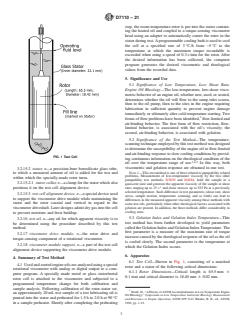
3.2.15 test cell, n—the combination of the rotor and stator. Critical elements of the test cell are sketched in Fig. 1.
3.2.15.1 rotor, n—a titanium rotor sized to give a compromise of sensitivity and range to the determination of viscosity and
gelation using this test method.
3.2.15.2 stator, n—a precision-bore borosilicate glass tube, to which a measured amount of oil is added for the test and within
which the specially-made rotor turns.
3.2.15.2.1 stator collar, n—a clamp for the stator which also positions it on the test cell alignment device.
3.2.15.3 test cell alignment device, n—a special device used to support the viscometer drive module while maintaining the stator
and the rotor coaxial and vertical in regard to the viscometer driveshaft. Later designs admit dry gas into the cell to prevent
moisture and frost buildup.
3.2.16 test oil, n—any oil for which apparent viscosity is to be determined using the procedure described by this test method.
3.2.17 viscometer drive module, n—the rotor drive and torque-sensing component of a rotational viscometer.
3.2.18 viscometer module support, n—a part of the test cell alignment device supporting the viscometer drive module.
4. Summary of Test Method
4.1 Used and sooted engine oils are analyzed using a special rotational viscometer with analog or digital output to a computer
program. A specially made metal or glass stator/metal rotor cell is attached to the viscometer and subjected to a programmed
temperature change for both calibration and sample analysis. Following calibration of the rotor-stator set, an approximately 20 mL
test sample of a test lubricating oil is poured into the stator and preheated for 1.5 h to 2.0 h at 90 °C in an oven or water bath. a
sample preheater. Shortly after completing the preheating step, the room-temperature rotor is put into the stator containing the
heated oil and coupled to a torque-sensing viscometer head using an adapter to automatically center the rotor in the stator during
test. A programmable low-temperaturecooling bath is used to cool the cell at a specified rate of 3 °C ⁄h from −5 °C to the
FIG. 1 Test Cell
D7110 − 21
temperature at which the maximum torque recordable is exceeded when using a speed of 0.3 r ⁄min for the rotor. After the desired
information has been collected, the computer program generates the desired viscometric and rheological values from the recorded
data.
5. Significance and Use
5.1 Significance of Low Temperature, Low Shear Rate, Engine Oil Rheology—The low-temperature, low-shear viscometric
behavior of an engine oil, whether new, used, or sooted, determines whether the oil will flow to the sump inlet screen, then to the
oil pump, then to the sites in the engine requiring lubrication in sufficient quantity to prevent engine damage immediately or
ultimately after cold temperature starting. Two forms of flow problems have been identified, flow-limited and air-binding
behavior. The first form of flow restriction, flow-limited behavior, is associated with the oil’s viscosity; the second, air-binding
behavior, is associated with gelation.
5.2 Significance of the Test Method—The temperature-scanning technique employed by this test method was designed to
determine the susceptibility of the engine oil to flow-limited and air-binding response to slow cooling conditions by providing
3,4,5
continuous information on the rheological condition of the oil over the temperature range of use. In this way, both viscometric
and gelation response are obtained in one test.
NOTE 1—This test method is one of three related to pumpability related problems. Measurement of low-temperature viscosity by the two other pumpability
test methods, D3829 and D4684, hold the sample in a quiescent state and generate the apparent viscosity of the sample at shear rates ranging up to 15
-1
s and shear stresses up to 525 Pa at a previously selected temperature. Such difference in test parameters (shear rate, shear stress, sample motion,
temperature scanning, and so forth) can lead to differences in the measured apparent viscosity among these methods with some test oils, particularly when
other rheological factors associated with gelation are present. In addition, the three methods differ considerably in cooling rates.
5.3 Gelation Index and Gelation Index Temperature—This test method has been further developed to yield parameters called the
Gelation Index and Gelation Index Temperature. The first parameter is a measure of the maximum rate of torque increase caused
by the rheological response of the oil as the oil is cooled slowly. The second parameter is the temperature at which the Gelation
Index occurs.
6. Apparatus
6.1 Test Cell—Shown in Fig. 1, consisting of a matched rotor and a stator of the following critical dimensions:
6.1.1 Rotor Dimensions—Critical length is 65.5 mm 6 0.1 mm and critical diameter is 18.40 mm 6 0.02 mm.
6.1.2 Stator Dimensions—Critical diameter is 22.05 mm (60.02 mm) at whatever length will satisfy the immersion depth when
the upper oil level is a minimum of 15 mm below the cooling liquid level over the entire temperature range.
6.2 Viscometer Drive Modules—Rotational viscometer drive modules capable of producing an analog signal to an analog-to-digital
converter or other analog signal data processor such as a strip-chart recorder.
6.2.1 With the rotor and stator described in 6.1.1 and 6.1.2, the viscometer drive module must be capable of measuring to at least
90 000 mPa·s (cP).
6.3 Test Cell Alignment Device—Simultaneously maintains a vertical axial alignment and reasonably consistent positioning of the
rotor in the stator to give repeatable torque readout from test to test when setting up the apparatus for analysis.
6.3.1 Viscometer Support—Supports the viscometer drive module and aligns it vertically.
6.3.2 Stator Collar—Clamps the stator and supports it when the stator collar is attached to the viscometer support.
6.4 A means of providing a dry gas atmosphere over the top of the test sample is necessary to prevent condensation and freezing
of water on the oil surface.
Shaub, H., “A History of ASTM Accomplishments in Low Temperature Engine Oil Rheology,” Symposium on Low Temperature Lubricant Rheology Measurement and
Relevance to Engine Operation, ASTM STP 1143, Rhodes, R. B., ed., ASTM, 1992, pp. 1-19.
D7110 − 21
6.5 Programmable Liquid Cooling or Scanning Brookfield Technique (SBT) Direct Cool Bath—Liquid bath capable Capable of
running either the calibration or the testing program with temperature control of 60.1 °C over the temperature range desired at
3 °C ⁄h.
6.5.1 Temperature Controller is set up to operate according to two programs, the calibration program and the test program. At any
temperature the controller modulates temperature within 0.1 °C of the desired value.
6.6 Computer, Analog-to-Digital Converter, and Analysis Program—Means of receiving data from the viscometer drive module
and converting this data into the desired information.
6.7 Sample Pre-treatment Water or Air Bath—Preheater—A programmable water or air bath for both bath, air bath or oven, or
dry bath (integrated or separate) for precise control of the test oils at 90 °C 6 2 °C andduring immersion time after the sample
reaches pre-treatment temperature. SBT Direct Cool bath can also perform the preheating portion of the test.
6.8 Calibrated Liquid-in-Glass or Digital Contact Thermometer, Thermometer—calibrated at 90 °C and reading to 60.2 °C.Ca-
librated liquid-in-glass or digital contact thermometer meeting the following requirements:
6.8.1 Calibrated Liquid-in-Glass Thermometer—One calibrated at 90 °C and reading to 60.2 °C and another calibrated at –20 °C
reading to 60.1 °C.
6.8.2 Digital Contact Thermometer—A DCT meeting the criteria of Table 1.
7. Materials
7.1 Calibration Oil—A Newtonian calibration oil of known dynamic viscosity over a temperature range of −5 °C to −35 °C.
7.2 Gelation Index Reference Oils, GIR-series, non-Newtonian Reference Oils, having gelation indices of established values as
well as related values for the gelation index temperatures.
TABLE 1 Digital Contact Thermometer Criteria for the Independent Temperature Indicator
Parameter Liquid Baths Dry Baths
A
Nominal temperature range –40 °C to 0 °C
Display resolution, minimum 0.1 °C
B
Accuracy, minimum –40 °C to 0 °C: ±100 mK (±0.1 °C)
Sensor type PRT
C
Immersion depth 114 mm (4.50 in.) minimum by Practice D7962 89 mm (3.50 in.) minimum by Practice D7962
D
Measurement drift less than 100 mK (0.1 °C) per year
E
Response time 12 s
F
Sensor sheath, max diameter 4.77 mm (0.188 in.) 3.18 mm (0.125 in.)
G
Sensor length, max 25 mm (1.0 in.)
H
Temperature calibration data When the ‘range-of-use’ is 30° or greater and less than 90° then at least 3 data points are required.
When the ‘range-of-use’ is 90° or greater, then at least 4 data points are required.
In all cases the calibration data is to be included in calibration report.
Temperature calibration report The DCT shall have a report of temperature calibration traceable to a national calibration or metrology stan-
dards body issued by a competent calibration laboratory with demonstrated competency in temperature cali-
bration. An ISO 17025 accredited laboratory with temperature calibration in its accreditation scope would
meet this requirement.
A
A device’s minimum and maximum temperature may be different than the values shown provided the calibration requirements are met.
B
Accuracy is the total combined accuracy of the DCT unit, which includes the display, electronics, and sensor probe with correction factors.
C
Minimum probe immersion depth as determined by Practice D7962, or an equivalent procedure, and is to be equal to or less than the value in the table. This is the
minimum immersion needed to obtain an accurate temperature measurement. Thus, the actual immersion will likely exceed this minimum.
D
Drift is the difference between the corrected DCT temperature and a reference.
E
Response Time—This applies to a Digital Contact Thermometer’s (DCT) combined display and sensor system. Conformance with this requirement is to be provided in
the manufacturer’s or supplier’s product documentation. Response time is defined as the time for a DCT to respond to a 63.2 % step change in temperature. The step
change begins with the DCT probe at an initial temperature of 20 °C ± 5 °C in air and the timing begins when it is transferred to water at 77 °C ± 5 °C which is flowing
at 0.9 m ⁄s ± 0.09 m ⁄s past the sensor, as described in Test Method E644 or an equivalent method. The DCT display refresh rate is to be at intervals of every 3 seconds
or less.
F
Sensor sheath is the tube that holds the sensing element. The value is the nominal outside diameter of the sheath segment containing the sensing element.
G
The physical length of the temperature sensing element. Contact the DCT supplier to determine whether this parameter is met, as it will not be accessible to the user.
H
Minimum number of calibration data points used to establish calibration.
D7110 − 21
7.3 Finger Cots, latex, used to close the top of the oil-filled stators when they are in the pre-treatment heating baths, sample
preheater, particularly if subject to water condensation inside the stator when heated in water baths.
7.4 Viscometer Heads, equipped with torque signal output and suitable sensitivity.
7.5 Temperature-programmable, Low-temperature Bath.
7.6 Torque Signal Recorder—Computer, analog-to-digital converter, and data analysis program.
7.7 Constant-temperature Oven or Water Bath, (programmable or non-programmable) for preheating samples.
7.8 Operator Calibrated, Temperature Measuring Devices, for 90 °C and −20 °C.
7.9 Newtonian Calibration Oil.
7.10 Source of Dry Air or Nitrogen Gas and means of gas introduction over top of stator.
8. Sampling
8.1 Approximately a 20 mL sample of test oil is necessary for the test. The sample must be thoroughly shaken so that the sample
is homogeneous (see 12.1).
NOTE 2—The submitter of samples should refer to Practice D4057 to be aware of how to properly acquire representative samples of petroleum products.
9. Preparation of Apparatus
9.1 Pre-treatment heating of Pretreat the samples using either a water bath or an oven.a preheater.
9.1.1 Water Baths—Using boiling distilled water and correcting for barometric pressure (if significant because of altitude of the
laboratory), check the calibration of liquid-in-glass or digital contact thermometer used in the pre-treatment water bath sample
preheater by appropriate methods.
9.1.1.1 Check the constant temperature of the pre-treatment water bath after ensuring that it is filled with distilled water to a level
20 mm above the oil level in the immersed stators. The temperature should be constant at 90 °C 6 2 °C. Complete this check upon
initial set-up or if test results indicate suspicious viscous behavior of the sample. Examples of such behavior might include
non-repeatable gelation indices or GI temperature for a given fluid, unexpectedly high or low gelation indices, gelation at an
unexpected temperature, or non-repeatable viscosity-temperature curves.
9.1.2 Ovens—Air Baths or Ovens and Separate Dry Block Heaters—Check the calibration of the temperature sensing device by
appropriate methods. The temperature should be constant at 90 °C 6 2 °C. Complete this check upon initial set-up or if test results
indicate suspicious viscous behavior of the sample. Examples of such behavior might include non-repeatable gelation indices or
GI temperature for a given fluid, unexpectedly high or low gelation indices, gelation at an unexpected temperature, or
non-repeatable viscosity-temperature curves.
9.1.2.1 Determine the length of time required to bring the sample up to 90 °C. Use this time interval to establish the length of time
the sample is held in the oven before being poured into the stator. preheater.
NOTE 3—Preheaters integral to the dry block bath and calibrated at –20 °C can reasonably be assumed to hold 90 °C 6 2 °C without additional checks.
9.2 Preparing Liquid Cold-bath—Programmable Cooling Bath—Check the liquid level in the programmable liquid cold bath. Fill
bath If using a liquid bath, fill to proper depth according to supplier’s instructions at −5 °C.
NOTE 4—To ensure adequate cooling fluid height above the sample, it is advisable to fill the liquid bath at −5 °C to the appropriate level indicated by
the manufacturer in the owners’ manual to avoid over-filling the bath and to always bring the bath back to this temperature when on stand-by. This keeps
D7110 − 21
down slows the evaporation rate. In addition, for many refrigeratingliquid baths, operation at some temperature moderately below room temperature
maintains best operational response. Coolant should Finally, it prevents overflow of the bath medium due to expansion of the cooling fluid. Cooling fluid
must not be added to the bath while at lower temperatures to avoid overflow at room temperature as well as disruption of the cooling cycle.during a sample
test or calibration to avoid temperature deviations.
9.2.1 Install or check the cooling programs for the programmable liquid cold bath. The programs to be implemented are shown
in Table 12 and Table 23.
9.3 Determine that the upper hook threaded (left hand thread) to the viscometer drive module’s driveshaft is firmly
finger-tightened. In the tightening process, gently and slightly lift the driveshaft.
NOTE 5—Do not pull down or push or pull laterally on the driveshaft as this may harm the internal jeweled bearing and perhaps bend the driveshaft as
well.
10. Preparation for Calibration of Cells and Testing of Samples
10.1 Programmable, Liquid-coolant, Cold Bath: Using the programmable cooling bath temperature controller and manufacturer’s
instructions, temporarily set bath temperature at –20 °C and allow to come to equilibrium for 1 h. For the dry block bath, fill the
test cells with 40 mL of methanol and place a rubber stopper on the cells. Check liquid bath temperature, or cell temperature for
the dry block bath, using an independent, accurate and sensitive temperature indicator such as a short-range, partial-immersion
thermometer or a digital contact thermometer (DCT) that meets the critera in Table 1. If using a DCT with the liquid bath, insert
the DCT so the tip of the probe is between 115 mm and 120 mm below the surface of the bath fluid. If using a DCT with the dry
block bath, insert the DCT so the tip of the probe is between 90 mm and 95 mm from the surface of the methanol in the test cell.
If the independent temperature indicator shows that the measured temperature is more than 60.2 °C from set point on the
programmable cooling
...