

ASTM F2781-15(2021)
(Practice)Standard Practice for Testing Forced Entry, Ballistic and Low Impact Resistance of Security Fence Systems
General Information
- Abstract
SIGNIFICANCE AND USE
5.1 The success or failure of any attempt to forcefully penetrate a fence system is dependent upon three primary factors that collectively define the threat—the tools and devices employed, the number of aggressors, and their level of sophistication.
5.2 Normally, a test procedure of this scope would be supported by years of laboratory testing intended to qualify and accurately reproduce the destructive effects of a variety of tools, implements, and devices. However, rapidly changing social conditions have created an immediate need for building components resistant to evolving forced entry techniques. Accordingly, the procedures presented herein are based more on field experience than laboratory analysis. They are more representative than inclusive, are intended to provide a basis for the comparative evaluation of different fence systems using forced penetration procedures, ballistic tests and impact testing, and are not primarily intended to be used to establish or confirm the absolute prevention of forced entries.
5.3 The test requirements specified herein have been established for use in evaluating the penetration resistance characteristics of standard fence systems to be used in commercial, government and military installations.
5.3.1 The success of any forced entry threat is dependent on the cumulative effect of the implements used, the elapsed time, and the sophistication and motivation of the personnel affecting the forced entry.
5.3.2 Absolute penetration resistance from forced entry by a determined and well-equipped attack group is impossible.
5.3.3 Aggressor groups range from unsophisticated criminals and vandals to organized criminals.
5.3.4 Attempts to force an entry may be thwarted by increasing the time necessary to affect such an entry and by early detection. Intrusion sensors positioned as far as possible from the protected environment in conjunction with optimal structural and component design will maximize the time available for ...
SCOPE
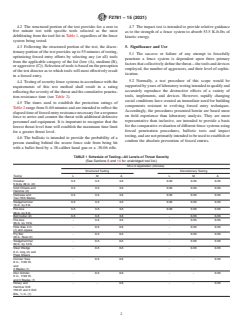
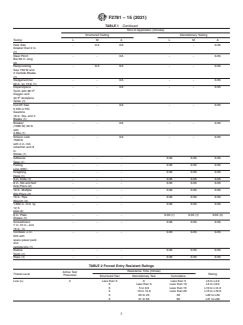
1.1 The forced entry resistance of fence systems is evaluated relative to three levels of forced entry threat using the limited hand tool inventory outlined in Table 1. It also establishes a system for rating the forced entry resistance of those systems (see Table 2). The tools specified to be used for testing at each threat level are those that are known to have a maximum destructive effect on structures and their sub-assemblies and are readily available to aggressors categorized as posing that level of threat.
1.1.1 Low Threat Level (L)—Specifically exempted from the inventory of available tools for the low (L) threat level category are power tools (gasoline, electric or hydraulic), and devices requiring more than one person to transport and operate.
1.1.2 Medium Threat Level (M)—Specifically exempted from the inventory of available tools for the medium (M) threat level category are power tools requiring an outside power source or self contained gasoline or battery driven tools and devices requiring more than two persons to transport and operate.
1.1.3 Aggressive Threat Level (A)—Specifically exempted from the inventory of available tools for the high (H) threat level category are devices requiring more than two persons to transport and operate.
1.2 The ability of a fence system to offer protection from bullets fired from a rifle or handgun would be beneficial particularly in Border Fence areas where security personnel can be targets during patrol activities. Accordingly, a limited test using a .38 Special handgun and a 7.62-mm rifle is performed to determine if any level of protection is provided by the fence system.
1.3 The ability of a fence system to provide impact resistance from a 4000 pound mass vehicle moving at a velocity of 20 MPH at a modest cost will provide relative guidance as to the strength of a security fence system in resisting low impact situations.
1.4 This international standard w...
- Status
- Published
- Publication Date
- 30-Sep-2021
- Technical Committee
- F14 - Fences
- Drafting Committee
- F14.50 - High Security Fences and Perimeter Barriers
Overview
ASTM F2781-15(2021): Standard Practice for Testing Forced Entry, Ballistic and Low Impact Resistance of Security Fence Systems provides a benchmark for evaluating the security performance of fence systems. Developed by ASTM International, this standard establishes testing procedures to assess the ability of fences to resist forced entry, ballistic threats, and vehicle impacts. The practice aims to offer reliable, comparable results for commercial, government, and military installations seeking enhanced perimeter security.
This standard is guided primarily by field experience due to evolving security threats and the immediate need for resilient barrier systems. It enables organizations to compare the performance of various security fence systems under representative attack scenarios without making absolute claims about impenetrability.
Key Topics
Threat Levels: The standard categorizes threats into three levels-Low, Medium, and Aggressive-based on the tools available to potential aggressors, their number, and their sophistication.
- Low Threat Level: Excludes power tools; intended for attacks by individuals with limited tools.
- Medium Threat Level: Allows some portable power tools but excludes those needing external power or more than two operators.
- Aggressive Threat Level: Permits powerful hand tools but excludes equipment requiring teams larger than two.
Testing Methodology: Fence systems undergo structured and discretionary attack tests:
- Structured Test: Involves a predefined set of tools and a limited timeframe to simulate practical breach attempts.
- Discretionary Test: Expands the range of tools and tactics within an allotted time, allowing the test director to focus on the most vulnerable points.
Ballistic Resistance: The standard includes testing with common handgun and rifle ammunition (.38 Special handgun and 7.62-mm rifle) to determine the likelihood of bullets penetrating the fence and potentially injuring personnel stationed behind it.
Impact Resistance: Fences are evaluated for their capacity to withstand a 4000-pound vehicle traveling at 20 MPH, giving insight into the system's resilience against vehicle ramming.
Comparative Ratings: The standard provides a system for rating penetration resistance by measuring elapsed time to create a breach, allowing objective comparison between different systems.
Applications
Commercial Facilities: Security fence testing ensures that businesses can select perimeter barriers that meet their risk management needs, deterring vandalism, theft, and intrusion.
Government/Military Installations: High-security environments rely on fences tested to ASTM F2781 to slow or prevent sophisticated intrusions, protect critical assets, and delay aggressors until a response team arrives.
Border Security: The ballistic resistance component is particularly vital for border fences, where personnel are at increased risk from armed threats.
Critical Infrastructure: Power stations, water treatment plants, and other vital facilities use these test results to inform security upgrades and compliance with vulnerability assessment recommendations.
Related Standards
- ASTM F1233: Test Method for Security Glazing Materials and Systems
- SAE J972: Moving Rigid Barrier Collision Tests (vehicle impact testing)
- MIL-STD-662F: Department of Defense Test Method Standard V50 Ballistic Test for Armor
- NIJ Standard 0108.01: National Institute of Justice Ballistic Resistant Protective Materials
Practical Value
Implementing ASTM F2781-15(2021) provides stakeholders with:
- Objective Security Benchmarking: Facilitates the selection of security fence systems based on tested, rated performance against credible intrusion scenarios.
- Risk Mitigation: Informs the integration of intrusion sensors and optimal design to maximize the delay of breaches and response times.
- Continual Improvement: As tools and attack methods evolve, the standard can be revised or resubmitted for updated testing procedures, ensuring ongoing relevance in changing threat environments.
By following ASTM F2781-15(2021), organizations significantly enhance their perimeter security and resilience to both physical and ballistic attacks. This standard is an essential tool for architects, security consultants, and facilities managers in designing and certifying robust security fence systems.
Relations
- Effective Date
- 01-May-2013
- Effective Date
- 01-Feb-2008
- Effective Date
- 01-Apr-2004
- Effective Date
- 10-Sep-1998
Get Certified
Connect with accredited certification bodies for this standard

CIS Institut d.o.o.
Personal Protective Equipment (PPE) certification body. Notified Body NB-2890 for EU Regulation 2016/425 PPE.

Kiwa BDA Testing
Building and construction product certification.
Kmetijski inštitut Slovenije
Agricultural Institute of Slovenia. Soil testing, plant health, agricultural product analysis.
Sponsored listings
Frequently Asked Questions
ASTM F2781-15(2021) is a standard published by ASTM International. Its full title is "Standard Practice for Testing Forced Entry, Ballistic and Low Impact Resistance of Security Fence Systems". This standard covers: SIGNIFICANCE AND USE 5.1 The success or failure of any attempt to forcefully penetrate a fence system is dependent upon three primary factors that collectively define the threat—the tools and devices employed, the number of aggressors, and their level of sophistication. 5.2 Normally, a test procedure of this scope would be supported by years of laboratory testing intended to qualify and accurately reproduce the destructive effects of a variety of tools, implements, and devices. However, rapidly changing social conditions have created an immediate need for building components resistant to evolving forced entry techniques. Accordingly, the procedures presented herein are based more on field experience than laboratory analysis. They are more representative than inclusive, are intended to provide a basis for the comparative evaluation of different fence systems using forced penetration procedures, ballistic tests and impact testing, and are not primarily intended to be used to establish or confirm the absolute prevention of forced entries. 5.3 The test requirements specified herein have been established for use in evaluating the penetration resistance characteristics of standard fence systems to be used in commercial, government and military installations. 5.3.1 The success of any forced entry threat is dependent on the cumulative effect of the implements used, the elapsed time, and the sophistication and motivation of the personnel affecting the forced entry. 5.3.2 Absolute penetration resistance from forced entry by a determined and well-equipped attack group is impossible. 5.3.3 Aggressor groups range from unsophisticated criminals and vandals to organized criminals. 5.3.4 Attempts to force an entry may be thwarted by increasing the time necessary to affect such an entry and by early detection. Intrusion sensors positioned as far as possible from the protected environment in conjunction with optimal structural and component design will maximize the time available for ... SCOPE 1.1 The forced entry resistance of fence systems is evaluated relative to three levels of forced entry threat using the limited hand tool inventory outlined in Table 1. It also establishes a system for rating the forced entry resistance of those systems (see Table 2). The tools specified to be used for testing at each threat level are those that are known to have a maximum destructive effect on structures and their sub-assemblies and are readily available to aggressors categorized as posing that level of threat. 1.1.1 Low Threat Level (L)—Specifically exempted from the inventory of available tools for the low (L) threat level category are power tools (gasoline, electric or hydraulic), and devices requiring more than one person to transport and operate. 1.1.2 Medium Threat Level (M)—Specifically exempted from the inventory of available tools for the medium (M) threat level category are power tools requiring an outside power source or self contained gasoline or battery driven tools and devices requiring more than two persons to transport and operate. 1.1.3 Aggressive Threat Level (A)—Specifically exempted from the inventory of available tools for the high (H) threat level category are devices requiring more than two persons to transport and operate. 1.2 The ability of a fence system to offer protection from bullets fired from a rifle or handgun would be beneficial particularly in Border Fence areas where security personnel can be targets during patrol activities. Accordingly, a limited test using a .38 Special handgun and a 7.62-mm rifle is performed to determine if any level of protection is provided by the fence system. 1.3 The ability of a fence system to provide impact resistance from a 4000 pound mass vehicle moving at a velocity of 20 MPH at a modest cost will provide relative guidance as to the strength of a security fence system in resisting low impact situations. 1.4 This international standard w...
SIGNIFICANCE AND USE 5.1 The success or failure of any attempt to forcefully penetrate a fence system is dependent upon three primary factors that collectively define the threat—the tools and devices employed, the number of aggressors, and their level of sophistication. 5.2 Normally, a test procedure of this scope would be supported by years of laboratory testing intended to qualify and accurately reproduce the destructive effects of a variety of tools, implements, and devices. However, rapidly changing social conditions have created an immediate need for building components resistant to evolving forced entry techniques. Accordingly, the procedures presented herein are based more on field experience than laboratory analysis. They are more representative than inclusive, are intended to provide a basis for the comparative evaluation of different fence systems using forced penetration procedures, ballistic tests and impact testing, and are not primarily intended to be used to establish or confirm the absolute prevention of forced entries. 5.3 The test requirements specified herein have been established for use in evaluating the penetration resistance characteristics of standard fence systems to be used in commercial, government and military installations. 5.3.1 The success of any forced entry threat is dependent on the cumulative effect of the implements used, the elapsed time, and the sophistication and motivation of the personnel affecting the forced entry. 5.3.2 Absolute penetration resistance from forced entry by a determined and well-equipped attack group is impossible. 5.3.3 Aggressor groups range from unsophisticated criminals and vandals to organized criminals. 5.3.4 Attempts to force an entry may be thwarted by increasing the time necessary to affect such an entry and by early detection. Intrusion sensors positioned as far as possible from the protected environment in conjunction with optimal structural and component design will maximize the time available for ... SCOPE 1.1 The forced entry resistance of fence systems is evaluated relative to three levels of forced entry threat using the limited hand tool inventory outlined in Table 1. It also establishes a system for rating the forced entry resistance of those systems (see Table 2). The tools specified to be used for testing at each threat level are those that are known to have a maximum destructive effect on structures and their sub-assemblies and are readily available to aggressors categorized as posing that level of threat. 1.1.1 Low Threat Level (L)—Specifically exempted from the inventory of available tools for the low (L) threat level category are power tools (gasoline, electric or hydraulic), and devices requiring more than one person to transport and operate. 1.1.2 Medium Threat Level (M)—Specifically exempted from the inventory of available tools for the medium (M) threat level category are power tools requiring an outside power source or self contained gasoline or battery driven tools and devices requiring more than two persons to transport and operate. 1.1.3 Aggressive Threat Level (A)—Specifically exempted from the inventory of available tools for the high (H) threat level category are devices requiring more than two persons to transport and operate. 1.2 The ability of a fence system to offer protection from bullets fired from a rifle or handgun would be beneficial particularly in Border Fence areas where security personnel can be targets during patrol activities. Accordingly, a limited test using a .38 Special handgun and a 7.62-mm rifle is performed to determine if any level of protection is provided by the fence system. 1.3 The ability of a fence system to provide impact resistance from a 4000 pound mass vehicle moving at a velocity of 20 MPH at a modest cost will provide relative guidance as to the strength of a security fence system in resisting low impact situations. 1.4 This international standard w...
ASTM F2781-15(2021) is classified under the following ICS (International Classification for Standards) categories: 13.310 - Protection against crime. The ICS classification helps identify the subject area and facilitates finding related standards.
ASTM F2781-15(2021) has the following relationships with other standards: It is inter standard links to ASTM F1233-08(2013), ASTM F1233-08, ASTM F1233-98(2004), ASTM F1233-98. Understanding these relationships helps ensure you are using the most current and applicable version of the standard.
ASTM F2781-15(2021) is available in PDF format for immediate download after purchase. The document can be added to your cart and obtained through the secure checkout process. Digital delivery ensures instant access to the complete standard document.
Standards Content (Sample)
This international standard was developed in accordance with internationally recognized principles on standardization established in the Decision on Principles for the
Development of International Standards, Guides and Recommendations issued by the World Trade Organization Technical Barriers to Trade (TBT) Committee.
Designation: F2781 − 15 (Reapproved 2021)
Standard Practice for
Testing Forced Entry, Ballistic and Low Impact Resistance
of Security Fence Systems
This standard is issued under the fixed designation F2781; the number immediately following the designation indicates the year of
original adoption or, in the case of revision, the year of last revision. A number in parentheses indicates the year of last reapproval. A
superscript epsilon (´) indicates an editorial change since the last revision or reapproval.
1. Scope 20 MPH at a modest cost will provide relative guidance as to
the strength of a security fence system in resisting low impact
1.1 The forced entry resistance of fence systems is evalu-
situations.
ated relative to three levels of forced entry threat using the
1.4 This international standard was developed in accor-
limited hand tool inventory outlined in Table 1. It also
dance with internationally recognized principles on standard-
establishes a system for rating the forced entry resistance of
ization established in the Decision on Principles for the
those systems (see Table 2). The tools specified to be used for
Development of International Standards, Guides and Recom-
testing at each threat level are those that are known to have a
mendations issued by the World Trade Organization Technical
maximum destructive effect on structures and their sub-
Barriers to Trade (TBT) Committee.
assemblies and are readily available to aggressors categorized
as posing that level of threat.
2. Referenced Documents
1.1.1 Low Threat Level (L)—Specificallyexemptedfromthe
2.1 ASTM Standards:
inventory of available tools for the low (L) threat level
F1233 Test Method for Security Glazing Materials And
category are power tools (gasoline, electric or hydraulic), and
Systems
devices requiring more than one person to transport and
2.2 SAE Standard:
operate.
SAE J972 Moving Rigid Barrier Collision Tests
1.1.2 Medium Threat Level (M)—Specifically exempted
2.3 U.S. Military Standards:
fromtheinventoryofavailabletoolsforthemedium(M)threat
MIL-STD-662F Department of Defense Test Method Stan-
level category are power tools requiring an outside power
dard V50 Ballistic Test for Armor
source or self contained gasoline or battery driven tools and
2.4 U.S. Dept. of Justice:
devices requiring more than two persons to transport and
NIJ Standard 0108.01 National Institute of Justice Ballistic
operate.
Resistant Protective Materials
1.1.3 Aggressive Threat Level (A)—Specifically exempted
from the inventory of available tools for the high (H) threat
3. Terminology
level category are devices requiring more than two persons to
3.1 Definitions of Terms Specific to This Standard:
transport and operate.
3.1.1 test director—the individual identified by the indepen-
1.2 The ability of a fence system to offer protection from
dent testing laboratory as being responsible to complete the
bullets fired from a rifle or handgun would be beneficial
specified tests and to document the results.
particularly in Border Fence areas where security personnel
3.1.2 forced entry—creating a four square feet opening.
can be targets during patrol activities. Accordingly, a limited
test using a .38 Special handgun and a 7.62-mm rifle is
4. Summary of Practice
performed to determine if any level of protection is provided
4.1 For each rating a structured portion and a discretionary
by the fence system.
portion as described in 4.2 and 4.3 is required.
1.3 The ability of a fence system to provide impact resis-
tance from a 4000 pound mass vehicle moving at a velocity of
For referenced ASTM standards, visit the ASTM website, www.astm.org, or
contact ASTM Customer Service at service@astm.org. For Annual Book of ASTM
Standards volume information, refer to the standard’s Document Summary page on
the ASTM website.
1 3
This practice is under the jurisdiction ofASTM Committee F14 on Fences and Available from SAE International (SAE), 400 Commonwealth Dr.,Warrendale,
is the direct responsibility of Subcommittee F14.50 on High Security Fences and PA 15096, http://www.sae.org.
Perimeter Barriers. Available from National Institute of Standards and Technology (NIST), 100
Current edition approved Oct. 1, 2021. Published November 2021. Originally Bureau Dr., Stop 1070, Gaithersburg, MD 20899-1070, http://www.nist.gov.
approved in 2009. Last previous edition approved in 2015 as F2781 – 15. AvailablefromNationalInstituteofJustice(NIJ),8107thSt.,NW,Washington,
DOI:10.1520/F2781-15R21. DC 20531, http://nij.gov.
Copyright © ASTM International, 100 Barr Harbor Drive, PO Box C700, West Conshohocken, PA 19428-2959. United States
F2781 − 15 (2021)
4.2 The structured portion of the test provides for a zero to 4.7 The impact test is intended to provide relative guidance
five minute test with specific tools selected as the most as to the strength of a fence system to absorb 53.5 K-ft-lbs of
debilitating from the tool list in Table 1, regardless of the fence
kinetic energy.
system being tested.
5. Significance and Use
4.3 Following the structured portion of the test, the discre-
tionary portion of the test provides up to 55 minutes of testing,
5.1 The success or failure of any attempt to forcefully
optimizing forced entry efforts by selecting any (or all) tools
penetrate a fence system is dependent upon three primary
from the applicable category of the list (low (A), medium (B),
factorsthatcollectivelydefinethethreat—thetoolsanddevices
oraggressive(C)).Selectionoftoolsisbasedontheperception
employed, the number of aggressors, and their level of sophis-
of the test director as to which tools will most effectively result
tication.
in a forced entry.
5.2 Normally, a test procedure of this scope would be
4.4 Testing of security fence systems in accordance with the
supportedbyyearsoflaboratorytestingintendedtoqualifyand
requirements of this test method shall result in a rating
accurately reproduce the destructive effects of a variety of
reflecting the severity of the threat and the cumulative penetra-
tools, implements, and devices. However, rapidly changing
tion resistance time (see Table 2).
social conditions have created an immediate need for building
4.5 The times used to establish the protection ratings of
components resistant to evolving forced entry techniques.
Table2rangefrom0–60minutesandareintendedtoreflectthe
Accordingly, the procedures presented herein are based more
elapsedtimeofforcedentryresistancenecessaryforaresponse
on field experience than laboratory analysis. They are more
force to arrive and counter the threat with additional defensive
representative than inclusive, are intended to provide a basis
personnel and equipment. It is important to recognize that the
for the comparative evaluation of different fence systems using
lowest threat level time will establish the maximum time limit
forced penetration procedures, ballistic tests and impact
for a greater threat level.
testing,andarenotprimarilyintendedtobeusedtoestablishor
4.6 The ballistic is intended to provide the probability of a
confirm the absolute prevention of forced entries.
person standing behind the secure fence side from being hit
with a bullet fired by a 38-caliber hand gun or a .30-06 rifle.
TABLE 1 Schedule of Testing—All Levels of Threat Severity
(See Sections 8 and 14 for unabridged tool list.)
Time of Application (minutes)
Structured Testing Discretionary Testing
Tool(s) L M A L M A
Crowbar 3-5 3-5 3-5 0-55 0-55 0-55
5lbby28in.(2)
Cold Chisels and 3-5 3-5 3-5 0-55 0-55 0-55
Hammer (2)
Hacksaw and 3-5 3-5 3-5 0-55 0-55 0-55
Two HSS Blades
Sledgehammer 3-5 3-5 3-5 0-55 0-55 0-55
16in.by6lb
Fire Axe 3-5 3-5 3-5 0-55 0-55 0-55
36in.by6lb
Bolt Cutter (2) 3-5 3-5 3-5 - 0-55 0-55
Fire Axe - 3-5 3-5 - 0-55 0-55
36in.by10lb
Hole Saw 2 in. - 0-5 0-5 - 0-55 0-55
(1) and Jigsaw
Pry Bar - 0-5 0-5 - 0-55 0-55
30 in. Steel (2)
Sledgehammer - 0-5 0-5 - 0-55 0-55
30in.by12lb
Steel Wedge - 0-5 0-5 - 0-55 0-55
6 in. long (2) and
Plate Shears
Circular Saw - 0-5 0-5 - - 0-55
8 in., 1100 W,
and
3 Blades (1)
Disc Grinder - 0-5 0-5 - - 0-55
5 in., 1100 W,
and 3 Blades (1)
Rotary and - - 0-5 - - 0-55
Hammer Drill
750 W and 5 Drill
Bits, ⁄2 in. (1)
F2781 − 15 (2021)
TABLE 1 Continued
Time of Application (minutes)
Structured Testing Discretionary Testing
Tool(s) L M A L M A
Hole Saw - 0-5 0-5 - - 0-55
Greater than 2 in.
(1)
Steel Pinch - - 0-5 - - 0-55
Bar 60 in. long
(2)
Reciprocating - 0-5 0-5 - - 0-55
Saw 750 W and
3 Carbide Blades
(1)
Sledgehammer - - 0-5 - - 0-55
30in.by15lb(1)
Oxyacetylene - - 0-5 - - 0-55
Torch with 80 ft
Oxygen and
40 ft Acetylene
Tanks (1)
Cut-Off Saw - - 0-5 - - 0-55
5KWorHD
Gasoline
18 in. Dia. and 3
Blades (1)
Breaker - - 0-5 - - 0-55
(1900 W) 30 lb
with
3 Bits (1)
Scissor Jack - - 0-5 - - 0-55
1500 lb
with 4 in. min
retraction and 8
in.
Stroke (1)
Adhesive - - - 0-55 0-55 0-55
Tape (1)
Fishing - - - 0-55 0-55 0-55
Line (250’)
Grappling - - - 0-55 0-55 0-55
Hook (1)
5-in. Knife (1) - - - 0-55 0-55 0-55
8 in. Std and Self - - - 0-55 0-55 0-55
Grip Pliers (2)
10 in. Multiple - - - 0-55 0-55 0-55
Slip Pliers (2)
10 in. Pipe - - - 0-55 0-55 0-55
Wrench (2)
1.660 in. O.D. by - - - 0-55 0-55 0-55
12 ft.
pipe (2)
8 in. Plate - - - 0-55 (1) 0-55 (1) 0-55 (2)
Shears (1)
Screwdrivers - - - 0-55 0-55 0-55
7 in.,10 in., and
16 in. (1)
Cordless ⁄2 in. - - - 0-55 0-55 0-55
Drill with
spare power pack
and
carbide bits (1)
Butane - - - 0-55 0-55 0-55
Torch (1)
Rope (1) - - - 0-55 0-55 0-55
TABLE 2 Forced Entry Resistant Ratings
Resistance Time (minute)
Active Test
Threat Level Rating
Personnel
Structured Test Discretionary Test Cumulative
Low (L) 2 Less than 5 0 Less than 5 L0 to L4.9
5 Less than 5 Less than 10 L5 to L9.9
5 5 to 9.9 Less than 15 L10 to L14.9
5 10 to 14.9 Less than 20 L15 to L19.9
5 20 to 25 30 L20 to L30
5 31 to 55 60 L31 to L60
F2781 − 15 (2021)
TABLE 2 Continued
Resistance Time (minute)
Active Test
Threat Level Rating
Personnel
Structured Test Discretionary Test Cumulative
Medium (M) 2 Less than 5 0 Less than 5 M0 to M4.9
5 Less than 5 Less than 10 M5 to M9.9
5 5 to 9.9 Less than 15 M10 to M14.9
5 10 to 14.9 Less than 20 M15 to M19.9
5 20 to 25 30 M20 to M30
5 31 to 55 60 M31 to M60
Aggressive (A) 4 Less than 5 0 Less than 5 A0 to A4.9
5 Less than 5 Less than 10 A5 to A9.9
5 5 to 9.9 Less than 15 A10 to A14.9
5 10 to 14.9 Less than 15 A15 to A19.9
5 20 to 25 30 A20 to A30
5 31 to 55 60 M31 to A60
5.3 The test requirements specified herein have been estab- 6.1.2.3 Construction instructions, including weldments,
lished for use in evaluating the penetration resistance charac- bolting, bonding materials, etc.
teristics of standard fence systems to be used in commercial, 6.1.3 Proprietary Information—Noneoftherequirementsof
government and military installations. 6.1.1 through 6.1.2.3 are intended to compromise or circum-
vent a manufacturer’s proprietary rights with respect to any
5.3.1 The success of any forced entry threat is dependent on
the cumulative effect of the implements used, the elapsed time, feature, configuration, material, or design. Those portions of
the design disclosure documentation considered proprietary
andthesophisticationandmotivationofthepersonnelaffecting
the forced entry. would be clearly marked or eliminated from the disclosure
documentation with an appropriate explanation. All submitted
5.3.2 Absolute penetration resistance from forced entry by a
documentation, however, would accurately represent the
determined and well-equipped attack group is impossible.
sample tested.
5.3.3 Aggressor groups range from unsophisticated crimi-
nals and vandals to organized criminals.
7. Sampling, Test Specimens, and Test Units
5.3.4 Attempts to force an entry may be thwarted by
7.1 Sample Size—In order to facilitate test standardization
increasing the time necessary to affect such an entry and by
all test samples will conform to the sizes specified in 7.1.1.
early detection. Intrusion sensors positioned as far as possible
7.1.1 A minimum lateral area of 96 in. high and 30 ft in
from the protected environment in conjunction with optimal
length. The requirements of this section and the procedures of
structural and component design will maximize the time
the test method are intended to minimize test costs by
available for a response force to intercept the intruders.
conducting as much testing on single test segments, if possible.
5.4 The procedures of this test method are intended to
Impact Tests shall target the impact location of the vehicle at
evaluate the time necessary for vandals and unsophisticated
themidpointofthe30ft.lengthtoavoidcontactingthevertical
criminals to forcefully penetrate security fence systems by
posts and performed after penetration tests have been com-
using manually operated tools—defined as a low, medium, or
pleted to minimize costs of material and repair labor.
aggressive forced entry threat.
7.1.2 Test Environment—The location of the test shall be in
a natural environment where the temperature minimum is not
6. Documentation of Test Materials
less than 40 °F and the maximum is 95 °F during the perfor-
6.1 Configuration Documentation—All materials and as-
mance of the test. All tested materials and tools will be
semblies to be tested shall conform to and be in compliance
temperature conditioned in this environment for a minimum of
with the latest revision of the appropriate publication or
24 h immediately prior to initiation of any test. The area
specification governing the fence system configuration. The
immediately adjacent to the test sample extending 6 ft to the
following documents shall apply: left and right of either vertical edge of the sample, 10 ft from
6.1.1 Standard Commercial Materials—Commercial mate- the assault face of the sample, and 10 ft above the horizontal
rials used in fabricating security fence systems will conform to surface supporting the test (attack) personnel, shall be free of
the configuration and performance standards established for any and all obstructions and appurtenances.
that material by ASTM International.
8. Preparation of Apparatus
6.1.2 Non-Standard Materials—All materials and sub-
assemblies used in the fabrication of forced entry barriers
8.1 Tools, Devices and Materials:
whose nature and configuration are not otherwise controlled by
8.1.1 Analysis of many of the aggressive actions against
recognized industrial, government, or manufacturer’s specifi-
installations that have resulted in forced entry has produced an
cations will be accompanied by full disclosure drawings and
extensive list of tools and implements that are readily acces-
specifications.
sible to aggressor groups. From this comprehensive listing,
6.1.2.1 Component Material Details—Specific industrial
tools and devices have been categorized as to the likelihood of
specifications, including size, thickness composition, etc.
theiruseandforcedentrythreatseverity.Whileinfiniteintype,
6.1.2.2 Make, model number, serial numbers, and date of size, and construction, all can be categorized with respect to
manufacture (as appropriate). their principal effect and function—prying, screwing, pulling,
F2781 − 15 (2021)
shearing, cutting, and impacting. Additionally, certain tools 8.3.15 Reciprocating Saw, cordless, 18 V with spare power
have been identified as those which are not actually tools, but pack, and three carbide blades.
which have a debilitating effect on protective barriers and are 8.3.16 Proof Test Grade 100 Alloy Chain,20ft, ⁄32in.,5400
readilyavailable(thatis,ropes,andsoforth).Whilenoattempt lb minimum.
will be made to completely list all the tools and implements
8.4 Aggressive Threat Severity Category Additional Tools:
which can be utilized to effect forced entry, Table 1 presents
8.4.1 Circular Saw, 1100 W, 8-in. diameter, and three
those tools and implements which have been determined to be
blades.
readily available and representative of the most effective of
8.4.2 Disc Grinder, 1100 W, 5-in. diameter and three discs.
forced entry tools for the very low, low, medium, and high
8.4.3 Rotary and Hammer Drill, 750W, five drill bits, ⁄2-in.
threat severity categories, respectively.
carbide.
8.1.2 All tools proposed for use in this test are to be clean
8.4.4 Hole Saw, greater than 2 in.
and verified for proper operation prior to commencement with
8.4.5 Steel Pinch Bar, 60-in. long.
the test.
8.4.6 Reciprocating Saw, 750 W and three carbide blades.
8.2 Low Threat Severity Category Tools: 8.4.7 Sledgehammer, 30 in., 15 lb.
3 3
8.4.8 Oxyacetylene Torch, with 80-ft oxygen tank, 40-ft
8.2.1 Adhesive Tape.
acetylene tank, and 20 ft of hose (119.0 lb).
8.2.2 Fishing Line.
8.4.9 Cut-Off Saw, 5 KW or HD Gasoline 18-in. diameter,
8.2.3 Grappling Hook.
with three blades.
8.2.4 Knife, 5 in.
8.4.10 Breaker, (1900 W), 30 lb with three bits.
8.2.5 Standard and Self-Gripping Pliers, 8 in.
8.4.11 One Scissor Jack, 1500 lb capacity with a minimum
8.2.6 Multiple Slip Pliers, 10 in.
retraction and an 8-in. stroke.
8.2.7 Pipe Wrench, 10 in.
8.2.8 Pipe, 1.660 in. O.D. by 12 ft.
9. Ballistic Equipment
8.2.9 Plate Shears, 8 in.
8.2.10 Screwdrivers, 7 in., 10 in., and 16 in. long.
9.1 Ballistic Firing Devicesin accordance with Test Method
8.2.11 Crowbar, 5 lb, 28 in. F1233—Firearms or test barrels suitable for use with the
8.2.12 Cold Chisels, 10 in. long by 1 in. wide.
following calibers of ammunition producing minimum veloci-
8.2.13 Drill, cordless, ⁄2 in., spare power pack, and carbide ties as required:
drill bits. 9.1.1 .38 Special—158 grain (10.2 g), lead.
8.2.14 Butane Torch. 9.1.2 .308 Winchester (7.62 mm, M80 Ball)—147 grain (9.5
8.2.15 Hacksaw, two HSS blades. g), full metal casing.
8.2.16 Sledgehammer, 16 in., 6 lb.
9.2 Ammunition/Standard Specification Ballistic Protection
8.2.17 Rope, 20-ft length of ⁄2-in. diameter manila rope,
Levels—All ammunition used in conducting tests within this
(4-lb).
test method shall be manufactured in compliance with current
8.2.18 Fireman’s Axe, 36 in., 6 lb.
configurations and standards established by the SportingArms
8.2.19 Pipe Cutter, 4 in. O.D.
and Ammunition Manufacturer’s Institute (SAAMI) or United
8.2.20 Bolt Cutter. 12 in.
States Military Specifications as applicable, except as may be
8.2.21 Fence Pliers, 10 in.
noted within this test method.This test method shall be defined
8.2.22 Cable Ratchet, 2000 lb capacity.
by the following ballistic threat levels:
9.2.1 Caliber .38 Special/Handgun—Ammunition conform-
8.3 Medium Threat Severity Category Additional Tools:
ing to SAAMI Specifications for caliber .38 Special, 158 grain,
8.3.1 Bolt Cutter, 20 in.
lead round nose producing, velocities of 875 ft/s (625 ft/s) at
8.3.2 Disc Grinder, 12 V with spare power pack and three
15 ft from the muzzle.
cutting discs.
9.2.2 Caliber 7.62 mm Steel Jacketed NATO/Rifle—
8.3.3 Drill Bits, 5.5 in., carbide.
Ammunition conforming to U.S. Military specifications for
8.3.4 Axe, 36 in., 10 lb.
caliber 7.62 mm NATO, M80 ball producing velocities of 2550
8.3.5 Hole Saw, 2 in.
ft/s and 2320 ft/s (650 ft/s) at 15 ft from the muzzle.
8.3.6 Steel Pry Bar.
9.3 Witness Material in accordance with NIJ Standard
8.3.7 Jigsaw, cordless, 12 V, and three carbide blades.
0108.01—The witness plate shall be 0.020 in. (0.51 mm) thick
8.3.8 Plate Shears, 12 in.
aluminum sheet. The minimum size of the witness plate shall
8.3.9 Sledgehammer, 30 in., 12 lb.
be 9 by 12 in. (229 by 305 mm) for half-scale testing or 18 by
8.3.10 Pipe, 1.660 in. O.D. by 20-ft long.
24 in. (457 by 610 mm) for full-scale testing.The witness plate
8.3.11 Steel Wedges, 6-in. long.
shall be made of 2024-T3, 2024-T4 or 5052 aluminum alloy
8.3.12 Circular Saw, cordless, 18 V, 8-in. diameter, and
sheet, and shall be located 5 ft (half scale) or 10 ft (full scale)
three blades.
behind and parallel to the test sample.
8.3.13 Disc Grinder, 18 V with spare power pack and three
cutting discs. 9.4 Instrumentation:
8.3.14 Jigsaw, cordless, 18 V with spare power pack, and 9.4.1 Photosensitive Triggering Screens (or similar)—
three carbide blades. Eitherhigh-velocitylumilinescreens,infraredballisticscreens,
F2781 − 15 (2021)
or electrical contact screens which either open or close an 9.5.4 Due to limitations in range space, the dimensions for
electrical circuit by passage of the projectile through the the chronographs and target holder in relation to the gun
detector shall be used. Contact screens may consist of metallic system are approximate. Alternate dimensions can be used
foils separated by a thin insulating layer, or may consist of a (with the exception of the witness plate location) as long as the
circuit printed on paper with the circuit spacing such that the intent of this test specification is met.
projectile passing through the screen will “break” the circuit.
10. Impact Test Equipment
9.4.2 Chronograph—The chronograph shall have a preci-
sion of 1 ms and an accuracy of 2 ms. Its triggering devices
10.1 Bogie Vehicle—A bogie vehicle is used for impact
shall be of either the photoelectric or conductive screen types
testing. The vehicle should be fabricated in accordance with
as described in 9.4.1. Chronograph or electronic timers used
SAE specification J972 and equipped with a 6-in. tall by 42-in.
shall be calibrated and certified for accuracy.
wide steel bumper. The sharp corners of the bumper should be
roundedoff.Theimpactbumpershouldbepositionedtoimpact
9.5 Test Frame and Stand in accordance with MIL-STD-
the fence system at 24 in. above grade. Fig. 1 illustrates a
662F and NIJ Standard 0108.01:
photograph of the bogie vehicle and of the bogie vehicle’s
9.5.1 The sample shall be mounted rigidly (bolted or
bumper height in relation to the fence system. The wheelbase
clamped) to the test fixture to produce a zero degree (for
of the bogie is to be 114 66 in. Four wheels of 7.00-15 size are
handgun testing) and five degree (for rifle testing) to the path
to be attached to two 3500 lb rated axles with a 4 inch inverted
of the bullet. The frame supports and clamps or mounting
drop. The center of gravity of the bogie should be along its
fixtures must be capable of retaining the sample and withstand-
central axis at 24 6 4 in. above the grade to minimize the
ing shock resulting from ballistic impact by the test projectiles.
potentialforrearwheelstobreakthecontactwiththepavement
The test sample mount shall be capable of adjustment for
during the impact. The bogie vehicle weight should be capable
moving the sample in the vertical or horizontal directions so
of being ballasted to the proximity weight of 4000 lb required
thatthepointofimpactcanbelocatedanywhereonthesample.
for the impact test. The bogie vehicle weight must be con-
Photosensitive triggering screens shall be positioned 5 and 15
firmed with four current calibrated platform scales (Detecto,
ft from the threat side of the sample which, in conjunction with
Model 954F 100P).
an elapsed time counter or direct reading chronograph, shall be
used to determine bullet velocities 10 ft from the strike face of
11. Instrumentation for All Threat Severity Categories
the sample. The test weapon shall be rigidly mounted at a
Including Ballistic and Impact Testing
distance of 25 ft from the muzzle to the target area of the test
11.1 In order to comply with the full range of test require-
assembly. The test weapon shall be aimed to produce a zero
ments of this test, the following support instrumentation,
degree obliquity trajectory to the target area within the toler-
materials, and equipment must be available to the test director.
ances of this test method.
11.1.1 Instrumentation—The following instrumentation is
9.5.2 The witness material shall be securely positioned
the minimum instrumentation required to meet the testing
parallel to, at 5 ft (half-scale) or 10 ft (full-scale) behind
requirements of this standard.
(protected side), the target area of the test assembly.The center
11.1.1.1 Video Camera—Digital recording media onto CD.
of the witness panel should be directly behind the desired point
11.1.1.2 Still Camera—Still photography camera utilizing
of impact.
digital recording media.
9.5.3 Should there be reason to suspect bullet flight stabili-
11.1.1.3 Timing Device—Stopwatch,60secondsweephand,
ties; the test director is obligated to implement a paper witness
stop-reset capable or equivalent.
panel, positioned 3 ft in front of the target area. This witness
panel shall be inspected following each test firing as to
...