


ASTM D7142-05(2016)
(Test Method)Standard Test Method for Holding Strength of Prong-Ring Attached Snap Fasteners
Standard Test Method for Holding Strength of Prong-Ring Attached Snap Fasteners
SIGNIFICANCE AND USE
5.1 Both test methods are considered satisfactory for acceptance testing of commercial shipments of garments with prong-ring type snap fasteners.
5.1.1 In case of dispute arising from differences in reported test results when using this test method for acceptance of commercial shipment, the purchaser and the supplier should conduct comparative tests to determine if there is a statistical bias between their laboratories. Competent statistical assistance is recommended for the investigation of bias. As a minimum, the two parties should take a group of test specimens that are as homogeneous as possible and that are from a lot of material of the type in question. The test specimens should then be randomly assigned in equal numbers to each laboratory for testing. The average results from the two laboratories should be compared using appropriate statistical analysis and an acceptable probability level chosen by the parties before testing is begun. If a bias is found, either the cause must be determined and corrected, or the purchaser and supplier must agree to interpret future test results with consideration to the known bias.
5.2 Comparison of results from test equipment operating on different principles is not recommended. In cases of conflict between the test results achieved with manual test equipment (Option 2) and motorized CRE (constant rate of extension) tensile testing machine (Option 1), the results from the motorized equipment shall take precedence.
5.3 This test method may be used to determine the compatibility of prong-ring type snap fasteners and fabrics for use in apparel. In which case, the fasteners are attached to the fabric in the manner in which they will be used and the combined units tested. See Annex A1.
SCOPE
1.1 This test method covers the determination of the holding strength of a prong-ring to the socket or stud of a snap fastener using a tensile testing machine (Option 1) or a manual test stand and force-measuring gage (Option 2).
1.2 This test method is applicable to prong-ring type snap fasteners in garments or to be attached to fabrics intended for use in apparel (see Annex A1).
1.3 The values stated in either SI units or inch-pound units are to be regarded separately as standard. Within the text, the inch-pound units are shown in parentheses. The values stated in each system are not exact equivalents; therefore, each system shall be used independently of the other. Combining values from the two systems may result in non-conformance with the specification.
1.4 This standard does not purport to address all of the safety concerns, if any, associated with its use. It is the responsibility of the user of this standard to establish appropriate safety and health practices and determine the applicability of regulatory limitations prior to use.
General Information
Buy Standard
Standards Content (Sample)
NOTICE: This standard has either been superseded and replaced by a new version or withdrawn.
Contact ASTM International (www.astm.org) for the latest information
Designation: D7142 − 05 (Reapproved 2016)
Standard Test Method for
Holding Strength of Prong-Ring Attached Snap Fasteners
This standard is issued under the fixed designation D7142; the number immediately following the designation indicates the year of
original adoption or, in the case of revision, the year of last revision. A number in parentheses indicates the year of last reapproval. A
superscript epsilon (´) indicates an editorial change since the last revision or reapproval.
1. Scope 3.1.1 force, n—a physical influence exerted by one body on
another which produces acceleration of bodies that are free to
1.1 Thistestmethodcoversthedeterminationoftheholding
move and deformation of bodies that are not free to move.
strength of a prong-ring to the socket or stud of a snap fastener
using a tensile testing machine (Option 1) or a manual test
3.1.2 holding strength, n—in snap fasteners, the force re-
stand and force-measuring gage (Option 2).
quired to separate the prong-ring from its attached mating part
(socket or stud).
1.2 This test method is applicable to prong-ring type snap
fasteners in garments or to be attached to fabrics intended for
3.1.2.1 Discussion—In this test method, a diametric force is
use in apparel (see Annex A1).
applied which simulates the diametric biting or pinching of a
child; however, in practice, the disengaging force used to
1.3 The values stated in either SI units or inch-pound units
unsnap a snap fastener is usually applied at the edge of the
are to be regarded separately as standard. Within the text, the
fastener.
inch-pound units are shown in parentheses. The values stated
in each system are not exact equivalents; therefore, each
3.1.3 prong-ring type fastener, n—generic name for snap
system shall be used independently of the other. Combining
fasteners which use a multi-pronged ring to penetrate through
values from the two systems may result in non-conformance
fabric to mechanically set a matching socket on one side of a
with the specification.
closure and to set a matching stud on the facing closure
1.4 This standard does not purport to address all of the
allowing the outer and inner closure facings to be snapped
safety concerns, if any, associated with its use. It is the
together. (See Fig. 1.)
responsibility of the user of this standard to establish appro-
3.1.4 socket, n—insnapfasteners,thefemalefunctionalpart
priate safety and health practices and determine the applica-
of the fastener which engages with the stud part of the fastener
bility of regulatory limitations prior to use.
to form the closure of two parts of the item on which the
fastener is used. (See Fig. 1.)
2. Referenced Documents
3.1.4.1 Discussion—Prong-ringattachedsocketorstudsnap
2.1 ASTM Standards:
fasteners are designed to be mechanically attached to garments
D76 Specification for Tensile Testing Machines for Textiles
or other items through the deformation interaction of the
D123 Terminology Relating to Textiles
prong-ring with the socket or stud. Other forms of snap
D1776 Practice for Conditioning and Testing Textiles
fasteners exist which may be attached to the foundation of the
2.2 Federal Document:
garment or other item by means of sewn threads or adhesive
16 CFR Parts 1500.48-1500.53 and 1501.4 Engineering Test
bonding.
Manual for Children’s Toys
3.1.5 strength, n—the property of a material that resists
3. Terminology
deformation induced by external forces.
3.1 Definitions:
3.1.5.1 Discussion—In this standard, the deformation is the
separation of the prong-ring from the socket or stud of a snap
fastener.
This test method is under the jurisdiction ofASTM Committee D13 on Textiles
and is the direct responsibility of Subcommittee D13.54 on Subassemblies.
3.1.6 stud, n—in snap fasteners, the male functional part of
Current edition approved Oct. 1, 2016. Published October 2016. Originally
asnapfastenerwhichengageswith,orsnapsinto,themouthof
approved in 2005. Last previous edition approved in 2011 as D7142 – 05 (2011).
DOI: 10.1520/D7142-05R16. thesockettoformaclosureoftwopartsoftheitem,orgarment
For referenced ASTM standards, visit the ASTM website, www.astm.org, or
on which the fastener is used. (See Fig. 1.)
contact ASTM Customer Service at service@astm.org. For Annual Book of ASTM
3.1.6.1 Discussion—See discussion for socket.
Standards volume information, refer to the standard’s Document Summary page on
the ASTM website.
3.1.7 For definitions of other textile terms used in this
Available from Federal Register, Vol 44, No. 117, June 1979, Consumer
Product Commission, 16 CFR Parts 1500 and 1501. standard, refer to Terminology D123.
Copyright © ASTM International, 100 Barr Harbor Drive, PO Box C700, West Conshohocken, PA 19428-2959. United States
D7142 − 05 (2016)
FIG. 1 Prong-ring Attached Fastener Parts
4. Summary of Test Method supplier must agree to interpret future test results with consid-
eration to the known bias.
4.1 Option 1—A specimen, consisting of a fastener socket
or stud attached to fabric by a prong-ring, is mounted in a
5.2 Comparison of results from test equipment operating on
special test fixture on a tensile testing machine. A force is
different principles is not recommended. In cases of conflict
applied diametrically until the prong-ring separates from the
between the test results achieved with manual test equipment
socket or stud, or the fabric is torn. The force at separation is
(Option 2) and motorized CRE (constant rate of extension)
reported as the holding strength. If the fabric tears, the force at
tensile testing machine (Option 1), the results from the motor-
fabric failure is recorded and the data is reported and it is
ized equipment shall take precedence.
consideredasadifferentcategoryandisreportedseparatefrom
5.3 This test method may be used to determine the compat-
the holding strength of the fasteners.
ibility of prong-ring type snap fasteners and fabrics for use in
4.2 Option 2—A specimen, consisting of a fastener socket
apparel. In which case, the fasteners are attached to the fabric
or stud attached to fabric by a prong-ring, is mounted in a
in the manner in which they will be used and the combined
special test fixture on a manual pull test stand which is fitted
units tested. See Annex A1.
with a portable force gage. A force is applied until the
prong-ring separates from the socket or stud, or the fabric is
6. Apparatus
torn.Theforceatseparationisreportedastheholdingstrength.
6.1 For Option 1:
If the fabric tears, the force at fabric failure is recorded and the
6.1.1 Tensile Testing Machine, CRE type, meeting Specifi-
data is reported and it is considered as a different category and
cation D76. (See Figs. 2 and 3.)
is reported separate from the holding strength of the fasteners.
6.1.2 Upper Snap FixtureAttachment 4, Fig. 4, designed to
5. Significance and Use
diametrically attach to the socket or stud of the snap fastener
which is attached to the fabric specimen or garment being
5.1 Both test methods are considered satisfactory for accep-
tested.
tance testing of commercial shipments of garments with
prong-ring type snap fasteners. 6.1.3 Lower Snap FixtureAttachment 4, Fig. 4, designed to
5.1.1 In case of dispute arising from differences in reported
secure the fabric and thereby the socket or stud attached to it in
test results when using this test method for acceptance of a horizontal plane.
commercial shipment, the purchaser and the supplier should
6.2 For Option 2:
conduct comparative tests to determine if there is a statistical
6.2.1 Force Measuring Gage 5, modified with an attachment
bias between their laboratories. Competent statistical assis-
tobefastenedontotheupperarmofateststandwiththeupper
tance is recommended for the investigation of bias. As a
test fixture suspended from it. (See Fig. 3.)
minimum, the two parties should take a group of test speci-
6.2.2 Upper Snap FixtureAttachment 4, Fig. 4, designed to
mens that are as homogeneous as possible and that are from a
diametrically attach to the socket or stud of the snap fastener
lot of material of the type in question. The test specimens
which is attached to the fabric specimen or garment being
should then be randomly assigned in equal numbers to each
tested.
laboratory for testing. The average results from the two
6.2.3 Lower Snap FixtureAttachment 4, Fig. 4, designed to
laboratories should be compared using appropriate statistical
secure the fabric and thereby the socket or stud attached to it in
analysis and an acceptable probability level chosen by the
a horizontal plane.
parties before testing is begun. If a bias is found, either the
cause must be determined and corrected, or the purchaser and 6.2.4 Test Stand, see Fig. 5.
D7142 − 05 (2016)
FIG. 2 CRE-Type Tensile Testing Machine setup With Test Fix- FIG. 3 Closeup of CRE-Type Tensile Testing Machine Fixture
tures For Option 1. Setup.
7. Sampling
clamping in the fixtures. Specimens need not be cut from the
7.1 Lot Sample:
garment provided that the garment does not interfere with the
7.1.1 For acceptance testing, randomly select the number of
test.
shipping cartons or other containers of
...
This document is not an ASTM standard and is intended only to provide the user of an ASTM standard an indication of what changes have been made to the previous version. Because
it may not be technically possible to adequately depict all changes accurately, ASTM recommends that users consult prior editions as appropriate. In all cases only the current version
of the standard as published by ASTM is to be considered the official document.
Designation: D7142 − 05 (Reapproved 2011) D7142 − 05 (Reapproved 2016)
Standard Test Method for
Holding Strength of Prong-Ring Attached Snap Fasteners
This standard is issued under the fixed designation D7142; the number immediately following the designation indicates the year of
original adoption or, in the case of revision, the year of last revision. A number in parentheses indicates the year of last reapproval. A
superscript epsilon (´) indicates an editorial change since the last revision or reapproval.
1. Scope
1.1 This test method covers the determination of the holding strength of a prong-ring to the socket or stud of a snap fastener
using a tensile testing machine (Option 1) or a manual test stand and force-measuring gage (Option 2).
1.2 This test method is applicable to prong-ring type snap fasteners in garments or to be attached to fabrics intended for use
in apparel (see Annex A1).
1.3 The values stated in either SI units or inch-pound units are to be regarded separately as standard. Within the text, the
inch-pound units are shown in parentheses. The values stated in each system are not exact equivalents; therefore, each system shall
be used independently of the other. Combining values from the two systems may result in non-conformance with the specification.
1.4 This standard does not purport to address all of the safety concerns, if any, associated with its use. It is the responsibility
of the user of this standard to establish appropriate safety and health practices and determine the applicability of regulatory
limitations prior to use.
2. Referenced Documents
2.1 ASTM Standards:
D76 Specification for Tensile Testing Machines for Textiles
D123 Terminology Relating to Textiles
D1776 Practice for Conditioning and Testing Textiles
2.2 Federal Document:
16 CFR Parts 1500.48-1500.53 and 1501.4 Engineering Test Manual for Children’s Toys
3. Terminology
3.1 Definitions:
3.1.1 force, n—a physical influence exerted by one body on another which produces acceleration of bodies that are free to move
and deformation of bodies that are not free to move.
3.1.2 holding strength, n—in snap fasteners, the force required to separate the prong-ring from its attached mating part (socket
or stud).
This test method is under the jurisdiction of ASTM Committee D13 on Textiles and is the direct responsibility of Subcommittee D13.54 on Subassemblies.
Current edition approved Jan. 1, 2011Oct. 1, 2016. Published March 2011October 2016. Originally approved in 2005. Last previous edition approved in 20052011 as
D7142D7142 – 05 (2011). - 05. DOI: 10.1520/D7142-05R11.10.1520/D7142-05R16.
For referenced ASTM standards, visit the ASTM website, www.astm.org, or contact ASTM Customer Service at service@astm.org. For Annual Book of ASTM Standards
volume information, refer to the standard’s Document Summary page on the ASTM website.
Available from Federal Register, Vol 44, No. 117, June 1979, Consumer Product Commission, 16 CFR Parts 1500 and 1501.
3.1.2.1 Discussion—
In this test method, a diametric force is applied which simulates the diametric biting or pinching of a child; however, in practice,
the disengaging force used to unsnap a snap fastener is usually applied at the edge of the fastener.
3.1.3 prong-ring type fastener, n—generic name for snap fasteners which use a multi-pronged ring to penetrate through fabric
to mechanically set a matching socket on one side of a closure and to set a matching stud on the facing closure allowing the outer
and inner closure facings to be snapped together. (See Fig. 1.)
3.1.4 socket, n—in snap fasteners, the female functional part of the fastener which engages with the stud part of the fastener
to form the closure of two parts of the item on which the fastener is used. (See Fig. 1.)
Copyright © ASTM International, 100 Barr Harbor Drive, PO Box C700, West Conshohocken, PA 19428-2959. United States
D7142 − 05 (2016)
FIG. 1 Prong-ring Attached Fastener Parts
3.1.4.1 Discussion—
Prong-ring attached socket or stud snap fasteners are designed to be mechanically attached to garments or other items through the
deformation interaction of the prong-ring with the socket or stud. Other forms of snap fasteners exist which may be attached to
the foundation of the garment or other item by means of sewn threads or adhesive bonding.
3.1.5 strength, n—the property of a material that resists deformation induced by external forces.
3.1.5.1 Discussion—
In this standard, the deformation is the separation of the prong-ring from the socket or stud of a snap fastener.
3.1.6 stud, n—in snap fasteners, the male functional part of a snap fastener which engages with, or snaps into, the mouth of the
socket to form a closure of two parts of the item, or garment on which the fastener is used. (See Fig. 1.)
3.1.6.1 Discussion—
See discussion for socket.
3.1.7 For definitions of other textile terms used in this standard, refer to Terminology D123.
4. Summary of Test Method
4.1 Option 1—A specimen, consisting of a fastener socket or stud attached to fabric by a prong-ring, is mounted in a special
test fixture on a tensile testing machine. A force is applied diametrically until the prong-ring separates from the socket or stud, or
the fabric is torn. The force at separation is reported as the holding strength. If the fabric tears, the force at fabric failure is recorded
and the data is reported and it is considered as a different category and is reported separate from the holding strength of the
fasteners.
4.2 Option 2—A specimen, consisting of a fastener socket or stud attached to fabric by a prong-ring, is mounted in a special
test fixture on a manual pull test stand which is fitted with a portable force gage. A force is applied until the prong-ring separates
from the socket or stud, or the fabric is torn. The force at separation is reported as the holding strength. If the fabric tears, the force
at fabric failure is recorded and the data is reported and it is considered as a different category and is reported separate from the
holding strength of the fasteners.
5. Significance and Use
5.1 Both test methods are considered satisfactory for acceptance testing of commercial shipments of garments with prong-ring
type snap fasteners.
5.1.1 In case of dispute arising from differences in reported test results when using this test method for acceptance of
commercial shipment, the purchaser and the supplier should conduct comparative tests to determine if there is a statistical bias
between their laboratories. Competent statistical assistance is recommended for the investigation of bias. As a minimum, the two
parties should take a group of test specimens that are as homogeneous as possible and that are from a lot of material of the type
in question. The test specimens should then be randomly assigned in equal numbers to each laboratory for testing. The average
D7142 − 05 (2016)
results from the two laboratories should be compared using appropriate statistical analysis and an acceptable probability level
chosen by the parties before testing is begun. If a bias is found, either the cause must be determined and corrected, or the purchaser
and supplier must agree to interpret future test results with consideration to the known bias.
5.2 Comparison of results from test equipment operating on different principles is not recommended. In cases of conflict
between the test results achieved with manual test equipment (Option 2) and motorized CRE (constant rate of extension) tensile
testing machine (Option 1), the results from the motorized equipment shall take precedence.
5.3 This test method may be used to determine the compatibility of prong-ring type snap fasteners and fabrics for use in apparel.
In which case, the fasteners are attached to the fabric in the manner in which they will be used and the combined units tested. See
Annex A1.
6. Apparatus
6.1 For Option 1:
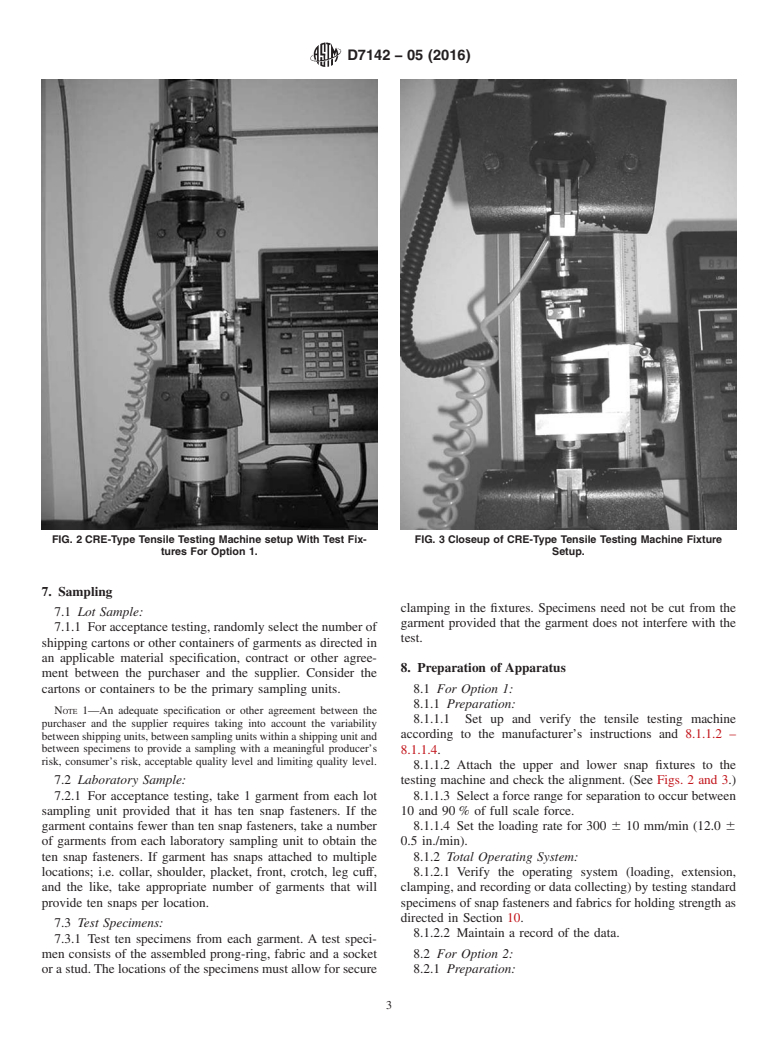
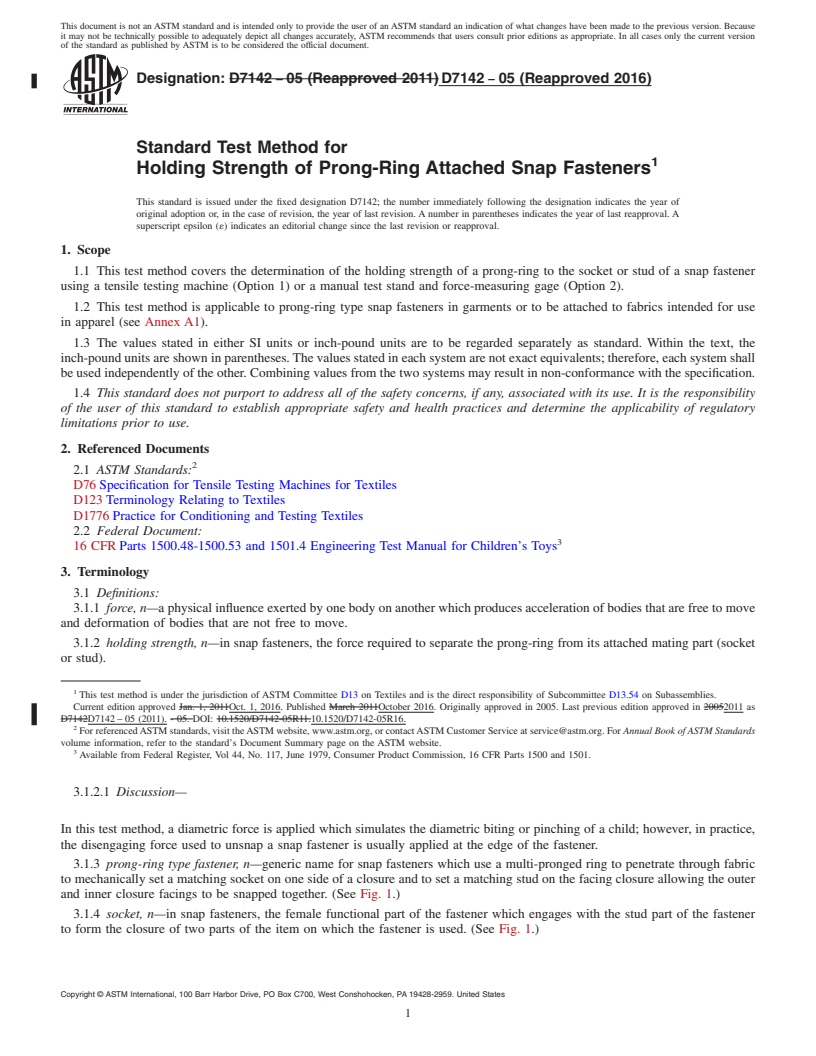
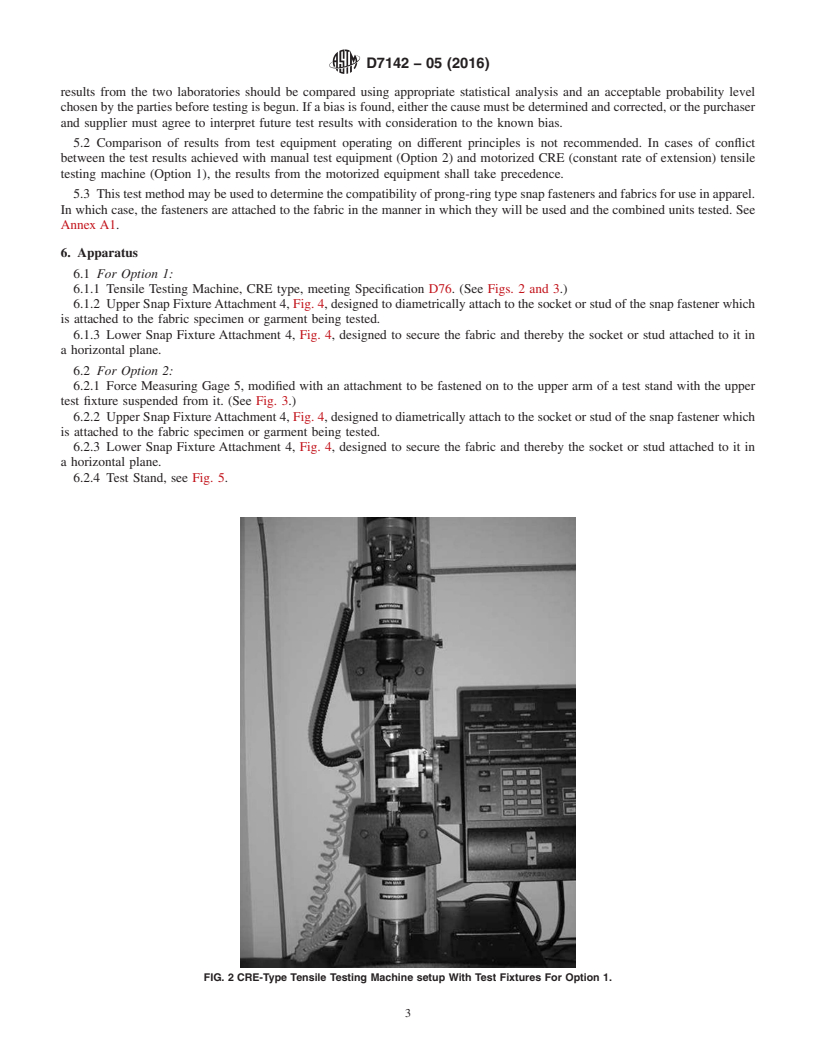
6.1.1 Tensile Testing Machine, CRE type, meeting Specification D76. (See Figs. 2 and 3.)
6.1.2 Upper Snap Fixture Attachment 4, Fig. 4, designed to diametrically attach to the socket or stud of the snap fastener which
is attached to the fabric specimen or garment being tested.
6.1.3 Lower Snap Fixture Attachment 4, Fig. 4, designed to secure the fabric and thereby the socket or stud attached to it in
a horizontal plane.
6.2 For Option 2:
6.2.1 Force Measuring Gage 5, modified with an attachment to be fastened on to the upper arm of a test stand with the upper
test fixture suspended from it. (See Fig. 3.)
6.2.2 Upper Snap Fixture Attachment 4, Fig. 4, designed to diametrically attach to the socket or stud of the snap fastener which
is attached to the fabric specimen or garment being tested.
6.2.3 Lower Snap Fixture Attachment 4, Fig. 4, designed to secure the fabric and thereby the socket or stud attached to it in
a horizontal plane.
6.2.4 Test Stand, see Fig. 5.
FIG. 2 CRE-Type Tensile Testing Machine setup With Test Fixtures For Option 1.
D7142 − 05 (2016)
FIG. 3 Closeup of CRE-Type Tensile Testing Machine Fixture Setup.
7. Sampling
7.1 Lot Sample:
7.1.1 For acceptance testing, randomly select the number of shipping car
...
Questions, Comments and Discussion
Ask us and Technical Secretary will try to provide an answer. You can facilitate discussion about the standard in here.