

ASTM D6077-16(2023)
(Test Method)Standard Test Method for Trapezoid Tearing Strength of Leather
General Information
- Abstract
SIGNIFICANCE AND USE
4.1 The trapezoid tearing load is a tension test in which the test strength is determined primarily by the interlocking structure of the fibers. It is useful for estimating relative ease of tearing of leather.
4.2 The procedure can also be used to determine if there is any appreciable difference in the relative strength of the leather in the parallel and the perpendicular directions to the backbone.
SCOPE
1.1 This test method covers the measurement of the tearing load of nonwoven fabrics by the trapezoid method for leather. This test method does not apply to wet blue.
1.2 The values stated in SI units are to be regarded as the standard. The values given in parentheses are for information only.
1.3 This standard does not purport to address all of the safety concerns, if any, associated with its use. It is the responsibility of the user of this standard to establish appropriate safety, health, and environmental practices and determine the applicability of regulatory limitations prior to use.
1.4 This international standard was developed in accordance with internationally recognized principles on standardization established in the Decision on Principles for the Development of International Standards, Guides and Recommendations issued by the World Trade Organization Technical Barriers to Trade (TBT) Committee.
- Status
- Published
- Publication Date
- 31-Dec-2022
- Technical Committee
- D31 - Leather
- Drafting Committee
- D31.05 - Upholstery


Overview
ASTM D6077-16(2023), Standard Test Method for Trapezoid Tearing Strength of Leather, is a crucial testing protocol developed by ASTM International for evaluating the tear strength of leather materials. Specifically, this standard provides a consistent and reliable method to determine the tearing load of leather using the trapezoid method, an established technique in the leather industry for quantifying how easily leather can be torn. This method is widely recognized and referenced in quality control, product development, and compliance assessments in the leather and footwear industries.
Key Topics
Purpose of the Trapezoid Tearing Test
The trapezoid tearing test is a tension-based evaluation where the specimen's tails are pulled apart. The resistance encountered is primarily influenced by the interlocking fiber structure found in leather, making it an effective measure for estimating the relative ease of tearing different leather materials.Directional Strength Assessment
This test method can assess the relative tear strength of leather specimens cut parallel and perpendicular to the backbone or cut edge. This is valuable for detecting anisotropy in strength, helping manufacturers optimize product design and raw material selection.Scope and Limitations
The standard applies strictly to nonwoven leather fabrics and excludes "wet blue" leathers (chrome-tanned but unfinished). It mandates the use of SI units for measurement. Users are responsible for maintaining proper safety and environmental procedures during test execution.Test Method Essentials
- Use of a constant-rate-of-traverse tensile testing machine equipped with an autographic recorder
- Specimen preparation according to referenced sampling and conditioning guidelines
- Clamping of the nonparallel sides of the trapezoid specimen in the testing machine
- Measurement and reporting of tearing load averages for sample sets
Applications
Quality Assurance and Product Development
By using ASTM D6077-16(2023), manufacturers and suppliers of leather goods, such as footwear, upholstery, and accessories, can ensure their materials meet required durability and tear resistance standards. The data derived from this method support decisions about suitable applications and expected performance of finished leather products.Compliance and Specification Testing
This standardized test method is widely accepted for compliance verification, helping organizations fulfill regulatory and buyer requirements for leather strength and integrity.Comparative Analysis
The results enable direct comparisons between leathers from different sources or production batches, aiding in supplier selection, process optimization, and troubleshooting of material failures.Research and Development
Material scientists and researchers utilize the standard to study the mechanical behavior of leather, facilitating innovations in tanning, finishing, and composite leather technologies.
Related Standards
To ensure comprehensive leather testing and quality control, ASTM D6077-16(2023) is often used in conjunction with the following ASTM standards:
- ASTM D1610 – Practice for Conditioning Leather and Leather Products for Testing
- ASTM D2813 – Practice for Sampling Leather for Physical and Chemical Tests
These standards provide guidance on sample conditioning and preparation, ensuring that results from the trapezoid tearing strength test are accurate and reproducible across different laboratories.
Keywords: ASTM D6077-16, leather tear strength, trapezoid tearing test, leather testing standards, leather durability, tear resistance, leather quality control, tension test, leather industry standards.
Relations
- Refers
ASTM D1610-01(2013) - Standard Practice for Conditioning Leather and Leather Products for Testing - Effective Date
- 01-May-2013
- Effective Date
- 01-Sep-2008
- Refers
ASTM D1610-01(2007) - Standard Practice for Conditioning Leather and Leather Products for Testing - Effective Date
- 01-Apr-2007
- Effective Date
- 01-Oct-2003
- Effective Date
- 10-May-2001
- Effective Date
- 10-May-2001
- Effective Date
- 10-Apr-1997
Get Certified
Connect with accredited certification bodies for this standard

Control Union Certifications
Global certification for agriculture and sustainability.

Hohenstein Institut
Textile testing and certification.

Bureau Veritas Bangladesh
Bureau Veritas certification services in Bangladesh.
Sponsored listings
Frequently Asked Questions
ASTM D6077-16(2023) is a standard published by ASTM International. Its full title is "Standard Test Method for Trapezoid Tearing Strength of Leather". This standard covers: SIGNIFICANCE AND USE 4.1 The trapezoid tearing load is a tension test in which the test strength is determined primarily by the interlocking structure of the fibers. It is useful for estimating relative ease of tearing of leather. 4.2 The procedure can also be used to determine if there is any appreciable difference in the relative strength of the leather in the parallel and the perpendicular directions to the backbone. SCOPE 1.1 This test method covers the measurement of the tearing load of nonwoven fabrics by the trapezoid method for leather. This test method does not apply to wet blue. 1.2 The values stated in SI units are to be regarded as the standard. The values given in parentheses are for information only. 1.3 This standard does not purport to address all of the safety concerns, if any, associated with its use. It is the responsibility of the user of this standard to establish appropriate safety, health, and environmental practices and determine the applicability of regulatory limitations prior to use. 1.4 This international standard was developed in accordance with internationally recognized principles on standardization established in the Decision on Principles for the Development of International Standards, Guides and Recommendations issued by the World Trade Organization Technical Barriers to Trade (TBT) Committee.
SIGNIFICANCE AND USE 4.1 The trapezoid tearing load is a tension test in which the test strength is determined primarily by the interlocking structure of the fibers. It is useful for estimating relative ease of tearing of leather. 4.2 The procedure can also be used to determine if there is any appreciable difference in the relative strength of the leather in the parallel and the perpendicular directions to the backbone. SCOPE 1.1 This test method covers the measurement of the tearing load of nonwoven fabrics by the trapezoid method for leather. This test method does not apply to wet blue. 1.2 The values stated in SI units are to be regarded as the standard. The values given in parentheses are for information only. 1.3 This standard does not purport to address all of the safety concerns, if any, associated with its use. It is the responsibility of the user of this standard to establish appropriate safety, health, and environmental practices and determine the applicability of regulatory limitations prior to use. 1.4 This international standard was developed in accordance with internationally recognized principles on standardization established in the Decision on Principles for the Development of International Standards, Guides and Recommendations issued by the World Trade Organization Technical Barriers to Trade (TBT) Committee.
ASTM D6077-16(2023) is classified under the following ICS (International Classification for Standards) categories: 59.140.30 - Leather and furs. The ICS classification helps identify the subject area and facilitates finding related standards.
ASTM D6077-16(2023) has the following relationships with other standards: It is inter standard links to ASTM D1610-01(2013), ASTM D2813-03(2008), ASTM D1610-01(2007), ASTM D2813-03, ASTM D1610-01, ASTM D1610-00, ASTM D2813-97. Understanding these relationships helps ensure you are using the most current and applicable version of the standard.
ASTM D6077-16(2023) is available in PDF format for immediate download after purchase. The document can be added to your cart and obtained through the secure checkout process. Digital delivery ensures instant access to the complete standard document.
Standards Content (Sample)
This international standard was developed in accordance with internationally recognized principles on standardization established in the Decision on Principles for the
Development of International Standards, Guides and Recommendations issued by the World Trade Organization Technical Barriers to Trade (TBT) Committee.
Designation: D6077 − 16 (Reapproved 2023)
Standard Test Method for
Trapezoid Tearing Strength of Leather
This standard is issued under the fixed designation D6077; the number immediately following the designation indicates the year of
original adoption or, in the case of revision, the year of last revision. A number in parentheses indicates the year of last reapproval. A
superscript epsilon (´) indicates an editorial change since the last revision or reapproval.
1. Scope the specimen is obtained from the load-elongation (stress-
strain) curve recorded autographically.
1.1 This test method covers the measurement of the tearing
load of nonwoven fabrics by the trapezoid method for leather.
4. Significance and Use
This test method does not apply to wet blue.
4.1 The trapezoid tearing load is a tension test in which the
1.2 The values stated in SI units are to be regarded as the
test strength is determined primarily by the interlocking
standard. The values given in parentheses are for information
structure of the fibers. It is useful for estimating relative ease of
only.
tearing of leather.
1.3 This standard does not purport to address all of the
4.2 The procedure can also be used to determine if there is
safety concerns, if any, associated with its use. It is the
any appreciable difference in the relative strength of the leather
responsibility of the user of this standard to establish appro-
intheparallelandtheperpendiculardirectionstothebackbone.
priate safety, health, and environmental practices and deter-
mine the applicability of regulatory limitations prior to use.
5. Apparatus
1.4 This international standard was developed in accor-
5.1 Tensile Testing Machine, constant-rate-of-traverse type,
dance with internationally recognized principles on standard-
equipped with an autographic recorder to register the applied
ization established in the Decision on Principles for the
load.
Development of International Standards, Guides and Recom-
mendations issued by the World Trade Organization Technical
5.2 Clamps, with faces measuring 25 mm by 75 mm (1 in.
Barriers to Trade (TBT) Committee.
by 3 in.) with the longer dimension perpendicular to the
direction of application of the load.
2. Referenced Documents
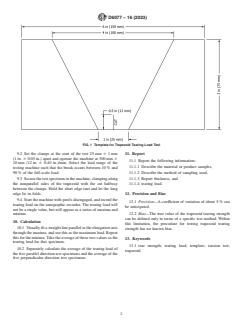
5.3 Template, optional, having the dimensions shown in Fig.
2.1 ASTM Standards:
1.
D1610 Practice for Conditioning Leather and Leather Prod-
5.4 Pawls, bolt on a machine to allow motion in only one
ucts for Testing
direction.
D2813 Practice for Sampling Leather for Physical and
Chemical Tests
6. Sampling
6.1 Unless otherwise specified, sample as directed, parallel
3. Summary of Test Method
and perpendicular to backbone or parallel and perpendicular to
3.1 An outline of a trapezoid (see Fig. 1) is marked on a
the cut part. Sampling per Practice D2813.
specimen cut for the determination of breaking load, and the
nonparallel sides of the specimen are clamped in the jaws of a
7. Test Specimens
tensile testing machine. A continuously increasing load is
7.1 Unless otherwise specified, test ten specimens.
applied to the specimen in such a way that the tear propagates
across the specimen width. The value of the breaking load of
7.2 Cut the test specimens parallel and perpendicular to
backbone or parallel and perpendicular to the cut part.
8. Conditioning
This test method is under the jurisdiction ofASTM Committee D31 on Leather
and is the direct responsibility of Subcommittee D31.05 on Upholstery.
8.1 Condition in accordance with Practice D1610. (The
Current edition approved Jan. 1, 2023. Published January 2023. Originally
customer may specify.)
approved in 1997. Last
...