

ASTM E1736-15(2022)
(Practice)Standard Practice for Acousto-Ultrasonic Assessment of Filament-Wound Pressure Vessels
General Information
- Abstract
SIGNIFICANCE AND USE
4.1 The AU method should be considered for vessels that are proven to be free of major flaws or discontinuities as determined by conventional techniques. The AU method may be used for detecting major flaws if other methods are deemed impractical. It is important to use methods such as immersion pulse-echo ultrasonics (Practice E1001) and acoustic emission (Practice E1067) to ascertain the presence of major flaws before proceeding with AU.
4.2 The AU method is intended almost exclusively for materials characterization by assessing the collective effects of dispersed defects and subcritical flaw populations. These are material aberrations that influence AU measurements and also underlie mechanical property variations, dynamic load response, and impact and fracture resistance.7
4.3 The AU method can be used to evaluate laminate quality using access to only one surface, the usual constraint imposed by closed pressure vessels. For best results, the AU probes must be fixtured to maintain the probe orientation at normal incidence to the curved surface of the vessel. Given these constraints, this practice describes a procedure for automated AU scanning using water squirters to assess the serviceability and reliability of filament-wound pressure vessels.8
SCOPE
1.1 This practice covers a procedure for acousto-ultrasonic (AU) assessment of filament-wound pressure vessels. Guidelines are given for the detection of defect states and flaw populations that arise during materials processing or manufacturing or upon exposure to aggressive service environments. Although this practice describes an automated scanning mode, similar results can be obtained with a manual scanning mode.
1.2 This procedure recommends technical details and rules for the reliable and reproducible AU detection of defect states and flaw populations. The AU procedure described herein can be a basis for assessing the serviceability of filament-wound pressure vessels.
1.3 The objective of the AU method is primarily the assessment of defect states and diffuse flaw populations that influence the mechanical strength and ultimate reliability of filament-wound pressure vessels. The AU approach and probe configuration are designed specifically to determine composite properties in lateral rather than through-the-thickness directions.2
1.4 The AU method is not for flaw detection in the conventional sense. The AU method is most useful for materials characterization, as explained in Guide E1495, which gives the rationale and basic technology for the AU method. Flaws and discontinuities such as large voids, disbonds, or extended lack of contact of interfaces can be found by other nondestructive examination (NDE) methods such as immersion pulse-echo ultrasonics.
1.5 Units—The values stated in SI units are to be regarded as standard. No other units of measurement are included in this practice.
1.6 This standard does not purport to address all of the safety concerns, if any, associated with its use. It is the responsibility of the user of this standard to establish appropriate safety, health, and environmental practices and determine the applicability of regulatory limitations prior to use.
1.7 This international standard was developed in accordance with internationally recognized principles on standardization established in the Decision on Principles for the Development of International Standards, Guides and Recommendations issued by the World Trade Organization Technical Barriers to Trade (TBT) Committee.
- Status
- Published
- Publication Date
- 30-Nov-2022
- Technical Committee
- E07 - Nondestructive Testing
- Drafting Committee
- E07.04 - Acoustic Emission Method
Overview
ASTM E1736-15(2022): Standard Practice for Acousto-Ultrasonic Assessment of Filament-Wound Pressure Vessels is an internationally recognized practice developed by ASTM International. This standard provides a comprehensive procedure for the acousto-ultrasonic (AU) assessment of filament-wound pressure vessels, focusing on materials characterization and the detection of defect states and flaw populations. Using this AU method, users can reliably evaluate the quality and serviceability of pressure vessels, especially where only single-sided access is feasible.
Purpose and Scope
- Offers guidelines for the assessment of laminated composite shells in filament-wound pressure vessels
- Outlines methods for identifying distributed defects and subcritical flaw populations arising from manufacturing, processing, or servicing environments
- Can be implemented in both automated and manual scanning modes
- Supports service life assessment by providing data relevant to mechanical strength, dynamic loading, and fracture resistance
Key Topics
Acousto-Ultrasonic (AU) Method
- Designed primarily for characterization of materials rather than conventional flaw detection
- Evaluates the integrity and quality of composite laminates using simulated stress waves
- Effective in measuring the collective impact of dispersed flaws or microstructural irregularities that influence mechanical properties
Applicability
- Especially suitable for filament-wound pressure vessels confirmed to be free of major flaws by pulse-echo ultrasonics (ASTM E1001) or acoustic emission testing (ASTM E1067)
- Useful when other nondestructive examination (NDE) methods are impractical
- Assessment focuses on distributed defects affecting strength and reliability, not on detecting large, isolated flaws like delaminations or disbonds
Process and Requirements
- Probes must be fixtured for proper alignment at normal incidence relative to the curved vessel surface
- Water jet ("squirter") coupling is used for efficient stress wave transmission and reception
- Both automated and manual scanning options are supported for comprehensive surface mapping
Applications
Industry and Safety
- Widely used in industries utilizing filament-wound pressure vessels such as aerospace, chemical processing, energy, and transportation
- Enables predictive maintenance by detecting early material degradation or distributed defects before catastrophic failure
- Supports compliance with safety and reliability requirements for high-pressure service environments
Manufacturing and Quality Control
- Facilitates quality assurance during manufacturing by benchmarking composite shell integrity and identifying process-related variabilities
- Provides feedback for process optimization regarding fiber impregnation, layer orientation, and winding quality
Limitations
- Not intended for acute flaw detection or imaging of large defects-best for assessing collective flaw populations and overall material quality
- Effectiveness may be influenced by vessel surface condition, couplant quality, probe alignment, and instrument calibration
Related Standards
For effective nondestructive evaluation (NDE) of filament-wound pressure vessels, ASTM E1736-15(2022) should be used in conjunction with other standards for comprehensive assessment:
- ASTM E1001 - Practice for Detection and Evaluation of Discontinuities by Immersed Pulse-Echo Ultrasonic Method
- ASTM E1067 - Practice for Acoustic Emission Examination of Fiber-Reinforced Plastic Resin (FRP) Tanks/Vessels
- ASTM E543 - Specification for Agencies Performing Nondestructive Testing
- ASTM E1495 - Guide for Acousto-Ultrasonic Assessment of Composites, Laminates, and Bonded Joints
- ASTM E1316 - Terminology for Nondestructive Examinations
- ISO 9712 - Non-destructive Testing-Qualification and Certification of NDT Personnel
- ANSI/ASNT CP-189 and ASNT SNT-TC-1A - Personnel Qualification and Certification in Nondestructive Testing
By adhering to ASTM E1736-15(2022) and its related standards, organizations can enhance the reliability, safety, and performance of filament-wound pressure vessels through advanced nondestructive testing practices.
Keywords: acousto-ultrasonic, filament-wound pressure vessel, nondestructive examination, composite shell assessment, materials characterization, ASTM E1736, pressure vessel quality, AU method.
Relations
- Effective Date
- 01-Feb-2024
- Effective Date
- 01-Dec-2019
- Effective Date
- 01-Mar-2019
- Effective Date
- 01-Jan-2018
- Effective Date
- 15-Jun-2017
- Effective Date
- 01-Feb-2017
- Effective Date
- 01-Aug-2016
- Effective Date
- 01-Feb-2016
- Effective Date
- 01-Dec-2015
- Effective Date
- 01-Sep-2015
- Effective Date
- 01-Jun-2014
- Effective Date
- 01-Jun-2014
- Effective Date
- 01-Dec-2013
- Effective Date
- 15-Jun-2013
- Effective Date
- 01-Jun-2013
Get Certified
Connect with accredited certification bodies for this standard

IMP NDT d.o.o.
Non-destructive testing services. Radiography, ultrasonic, magnetic particle, penetrant, visual inspection.
Inštitut za kovinske materiale in tehnologije
Institute of Metals and Technology. Materials testing, metallurgical analysis, NDT.
Q Techna d.o.o.
NDT and quality assurance specialist. 30+ years experience. NDT personnel certification per ISO 9712, nuclear and thermal power plant inspections, QA/
Sponsored listings
Frequently Asked Questions
ASTM E1736-15(2022) is a standard published by ASTM International. Its full title is "Standard Practice for Acousto-Ultrasonic Assessment of Filament-Wound Pressure Vessels". This standard covers: SIGNIFICANCE AND USE 4.1 The AU method should be considered for vessels that are proven to be free of major flaws or discontinuities as determined by conventional techniques. The AU method may be used for detecting major flaws if other methods are deemed impractical. It is important to use methods such as immersion pulse-echo ultrasonics (Practice E1001) and acoustic emission (Practice E1067) to ascertain the presence of major flaws before proceeding with AU. 4.2 The AU method is intended almost exclusively for materials characterization by assessing the collective effects of dispersed defects and subcritical flaw populations. These are material aberrations that influence AU measurements and also underlie mechanical property variations, dynamic load response, and impact and fracture resistance.7 4.3 The AU method can be used to evaluate laminate quality using access to only one surface, the usual constraint imposed by closed pressure vessels. For best results, the AU probes must be fixtured to maintain the probe orientation at normal incidence to the curved surface of the vessel. Given these constraints, this practice describes a procedure for automated AU scanning using water squirters to assess the serviceability and reliability of filament-wound pressure vessels.8 SCOPE 1.1 This practice covers a procedure for acousto-ultrasonic (AU) assessment of filament-wound pressure vessels. Guidelines are given for the detection of defect states and flaw populations that arise during materials processing or manufacturing or upon exposure to aggressive service environments. Although this practice describes an automated scanning mode, similar results can be obtained with a manual scanning mode. 1.2 This procedure recommends technical details and rules for the reliable and reproducible AU detection of defect states and flaw populations. The AU procedure described herein can be a basis for assessing the serviceability of filament-wound pressure vessels. 1.3 The objective of the AU method is primarily the assessment of defect states and diffuse flaw populations that influence the mechanical strength and ultimate reliability of filament-wound pressure vessels. The AU approach and probe configuration are designed specifically to determine composite properties in lateral rather than through-the-thickness directions.2 1.4 The AU method is not for flaw detection in the conventional sense. The AU method is most useful for materials characterization, as explained in Guide E1495, which gives the rationale and basic technology for the AU method. Flaws and discontinuities such as large voids, disbonds, or extended lack of contact of interfaces can be found by other nondestructive examination (NDE) methods such as immersion pulse-echo ultrasonics. 1.5 Units—The values stated in SI units are to be regarded as standard. No other units of measurement are included in this practice. 1.6 This standard does not purport to address all of the safety concerns, if any, associated with its use. It is the responsibility of the user of this standard to establish appropriate safety, health, and environmental practices and determine the applicability of regulatory limitations prior to use. 1.7 This international standard was developed in accordance with internationally recognized principles on standardization established in the Decision on Principles for the Development of International Standards, Guides and Recommendations issued by the World Trade Organization Technical Barriers to Trade (TBT) Committee.
SIGNIFICANCE AND USE 4.1 The AU method should be considered for vessels that are proven to be free of major flaws or discontinuities as determined by conventional techniques. The AU method may be used for detecting major flaws if other methods are deemed impractical. It is important to use methods such as immersion pulse-echo ultrasonics (Practice E1001) and acoustic emission (Practice E1067) to ascertain the presence of major flaws before proceeding with AU. 4.2 The AU method is intended almost exclusively for materials characterization by assessing the collective effects of dispersed defects and subcritical flaw populations. These are material aberrations that influence AU measurements and also underlie mechanical property variations, dynamic load response, and impact and fracture resistance.7 4.3 The AU method can be used to evaluate laminate quality using access to only one surface, the usual constraint imposed by closed pressure vessels. For best results, the AU probes must be fixtured to maintain the probe orientation at normal incidence to the curved surface of the vessel. Given these constraints, this practice describes a procedure for automated AU scanning using water squirters to assess the serviceability and reliability of filament-wound pressure vessels.8 SCOPE 1.1 This practice covers a procedure for acousto-ultrasonic (AU) assessment of filament-wound pressure vessels. Guidelines are given for the detection of defect states and flaw populations that arise during materials processing or manufacturing or upon exposure to aggressive service environments. Although this practice describes an automated scanning mode, similar results can be obtained with a manual scanning mode. 1.2 This procedure recommends technical details and rules for the reliable and reproducible AU detection of defect states and flaw populations. The AU procedure described herein can be a basis for assessing the serviceability of filament-wound pressure vessels. 1.3 The objective of the AU method is primarily the assessment of defect states and diffuse flaw populations that influence the mechanical strength and ultimate reliability of filament-wound pressure vessels. The AU approach and probe configuration are designed specifically to determine composite properties in lateral rather than through-the-thickness directions.2 1.4 The AU method is not for flaw detection in the conventional sense. The AU method is most useful for materials characterization, as explained in Guide E1495, which gives the rationale and basic technology for the AU method. Flaws and discontinuities such as large voids, disbonds, or extended lack of contact of interfaces can be found by other nondestructive examination (NDE) methods such as immersion pulse-echo ultrasonics. 1.5 Units—The values stated in SI units are to be regarded as standard. No other units of measurement are included in this practice. 1.6 This standard does not purport to address all of the safety concerns, if any, associated with its use. It is the responsibility of the user of this standard to establish appropriate safety, health, and environmental practices and determine the applicability of regulatory limitations prior to use. 1.7 This international standard was developed in accordance with internationally recognized principles on standardization established in the Decision on Principles for the Development of International Standards, Guides and Recommendations issued by the World Trade Organization Technical Barriers to Trade (TBT) Committee.
ASTM E1736-15(2022) is classified under the following ICS (International Classification for Standards) categories: 19.100 - Non-destructive testing. The ICS classification helps identify the subject area and facilitates finding related standards.
ASTM E1736-15(2022) has the following relationships with other standards: It is inter standard links to ASTM E1316-24, ASTM E1316-19b, ASTM E1316-19, ASTM E1316-18, ASTM E1316-17a, ASTM E1316-17, ASTM E1316-16a, ASTM E1316-16, ASTM E1316-15a, ASTM E1316-15, ASTM E1316-14, ASTM E1316-14e1, ASTM E1316-13d, ASTM E1316-13c, ASTM E1316-13b. Understanding these relationships helps ensure you are using the most current and applicable version of the standard.
ASTM E1736-15(2022) is available in PDF format for immediate download after purchase. The document can be added to your cart and obtained through the secure checkout process. Digital delivery ensures instant access to the complete standard document.
Standards Content (Sample)
This international standard was developed in accordance with internationally recognized principles on standardization established in the Decision on Principles for the
Development of International Standards, Guides and Recommendations issued by the World Trade Organization Technical Barriers to Trade (TBT) Committee.
Designation: E1736 − 15 (Reapproved 2022)
Standard Practice for
Acousto-Ultrasonic Assessment of Filament-Wound
Pressure Vessels
This standard is issued under the fixed designation E1736; the number immediately following the designation indicates the year of
original adoption or, in the case of revision, the year of last revision. A number in parentheses indicates the year of last reapproval. A
superscript epsilon (´) indicates an editorial change since the last revision or reapproval.
1. Scope 1.6 This standard does not purport to address all of the
safety concerns, if any, associated with its use. It is the
1.1 This practice covers a procedure for acousto-ultrasonic
responsibility of the user of this standard to establish appro-
(AU) assessment of filament-wound pressure vessels. Guide-
priate safety, health, and environmental practices and deter-
lines are given for the detection of defect states and flaw
mine the applicability of regulatory limitations prior to use.
populations that arise during materials processing or manufac-
1.7 This international standard was developed in accor-
turing or upon exposure to aggressive service environments.
dance with internationally recognized principles on standard-
Although this practice describes an automated scanning mode,
ization established in the Decision on Principles for the
similar results can be obtained with a manual scanning mode.
Development of International Standards, Guides and Recom-
1.2 This procedure recommends technical details and rules
mendations issued by the World Trade Organization Technical
for the reliable and reproducible AU detection of defect states
Barriers to Trade (TBT) Committee.
and flaw populations. The AU procedure described herein can
be a basis for assessing the serviceability of filament-wound
2. Referenced Documents
pressure vessels.
2.1 ASTM Standards:
1.3 The objective of the AU method is primarily the
E543 Specification for Agencies Performing Nondestructive
assessment of defect states and diffuse flaw populations that
Testing
influence the mechanical strength and ultimate reliability of
E1001 Practice for Detection and Evaluation of Discontinui-
filament-wound pressure vessels. The AU approach and probe
ties by the Immersed Pulse-Echo Ultrasonic Method
configuration are designed specifically to determine composite
Using Longitudinal Waves
properties in lateral rather than through-the-thickness direc-
E1067 PracticeforAcousticEmissionExaminationofFiber-
tions.
glass Reinforced Plastic Resin (FRP) Tanks/Vessels
1.4 TheAU method is not for flaw detection in the conven-
E1316 Terminology for Nondestructive Examinations
tional sense. The AU method is most useful for materials
E1495 Guide for Acousto-Ultrasonic Assessment of
characterization, as explained in Guide E1495, which gives the
Composites, Laminates, and Bonded Joints
rationale and basic technology for the AU method. Flaws and
2.2 ASNT Standards:
discontinuities such as large voids, disbonds, or extended lack
ANSI/ASNT CP-189 Personnel Qualification and Certifica-
of contact of interfaces can be found by other nondestructive
tion in Nondestructive Testing
examination (NDE) methods such as immersion pulse-echo
ASNT SNT-TC-1A Personnel Qualification and Certifica-
ultrasonics.
tion in Nondestructive Testing
1.5 Units—The values stated in SI units are to be regarded
2.3 AIA Standard:
as standard. No other units of measurement are included in this
NAS-410 Certification and Qualification of Nondestructive
practice.
Test Personnel
This practice is under the jurisdiction of ASTM Committee E07 on Nonde-
structive Testing and is the direct responsibility of Subcommittee E07.04 on For referenced ASTM standards, visit the ASTM website, www.astm.org, or
Acoustic Emission Method. contact ASTM Customer Service at service@astm.org. For Annual Book of ASTM
Current edition approved Dec. 1, 2022. Published December 2022. Originally Standards volume information, refer to the standard’s Document Summary page on
approved in 1995. Last previous edition approved in 2015 as E1736 – 15. DOI: the ASTM website.
10.1520/E1736-15R22. AvailablefromAmericanSocietyforNondestructiveTesting(ASNT),P.O.Box
Vary, A., “Acousto-Ultrasonics,” Nondestructive Testing of Fibre-Reinforced 28518, 1711 Arlingate Ln., Columbus, OH 43228-0518, http://www.asnt.org.
Plastics Composites, Vol 2, J. Summerscales, ed., Elsevier Science Publishers Ltd., Available fromAerospace IndustriesAssociation ofAmerica, Inc. (AIA), 1000
Barking, Essex, England, 1990, Chapter 1, pp. 1-54. WilsonBlvd.,Suite1700,Arlington,VA22209-3928,http://www.aia-aerospace.org.
Copyright © ASTM International, 100 Barr Harbor Drive, PO Box C700, West Conshohocken, PA 19428-2959. United States
E1736 − 15 (2022)
2.4 ISO Standard:
ISO 9712 Non-destructive Testing—Qualification and Cer-
tification of NDT Personnel
3. Terminology
3.1 Definitions—Relevant terminology and nomenclature
are defined in Terminology E1316 and Guide E1495.
3.2 Definitions of Terms Specific to This Standard:
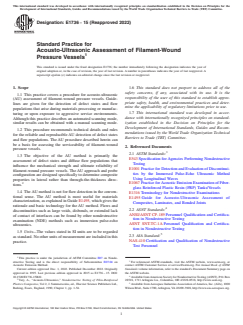
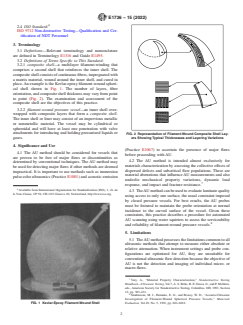
3.2.1 composite shell—a multilayer filament-winding that
comprises a second shell that reinforces the inner shell. The
compositeshellconsistsofcontinuousfibers,impregnatedwith
a matrix material, wound around the inner shell, and cured in
place.An example is the Kevlar-epoxy filament-wound spheri-
cal shell shown in Fig. 1. The number of layers, fiber
orientation, and composite shell thickness may vary from point
to point (Fig. 2). The examination and assessment of the
composite shell are the objectives of this practice.
3.2.2 filament-wound pressure vessel—an inner shell over-
wrapped with composite layers that form a composite shell.
The inner shell or liner may consist of an impervious metallic
or nonmetallic material. The vessel may be cylindrical or
spheroidal and will have at least one penetration with valve
attachments for introducing and holding pressurized liquids or
FIG. 2 Representation of Filament-Wound Composite Shell Lay-
ers Showing Typical Thicknesses and Layering Variations
gases.
4. Significance and Use
(Practice E1067) to ascertain the presence of major flaws
4.1 The AU method should be considered for vessels that
before proceeding with AU.
are proven to be free of major flaws or discontinuities as
4.2 The AU method is intended almost exclusively for
determined by conventional techniques. The AU method may
materials characterization by assessing the collective effects of
be used for detecting major flaws if other methods are deemed
dispersed defects and subcritical flaw populations. These are
impractical. It is important to use methods such as immersion
material aberrations that influence AU measurements and also
pulse-echo ultrasonics (Practice E1001) and acoustic emission
underlie mechanical property variations, dynamic load
response, and impact and fracture resistance.
Available from International Organization for Standardization (ISO), 1, ch. de
4.3 TheAUmethodcanbeusedtoevaluatelaminatequality
la Voie-Creuse, CP 56, CH-1211 Geneva 20, Switzerland, http://www.iso.org.
using access to only one surface, the usual constraint imposed
by closed pressure vessels. For best results, the AU probes
must be fixtured to maintain the probe orientation at normal
incidence to the curved surface of the vessel. Given these
constraints, this practice describes a procedure for automated
AU scanning using water squirters to assess the serviceability
and reliability of filament-wound pressure vessels.
5. Limitations
5.1 TheAU method possesses the limitations common to all
ultrasonic methods that attempt to measure either absolute or
relative attenuation. When instrument settings and probe con-
figurations are optimized for AU, they are unsuitable for
conventional ultrasonic flaw detection because the objective of
AU is not the detection and imaging of individual micro- or
macro-flaws.
Vary, A., “Material Property Characterization,” Nondestructive Testing
Handbook—Ultrasonic Testing, Vol 7,A. S. Birks, R. E. Green, Jr., and P. McIntire,
eds., American Society for Nondestructive Testing, Columbus, OH, 1991, Section
12, pp. 383–431.
Sundaresan, M. J., Henneke, E. G., and Brosey, W. D., “Acousto-Ultrasonic
Investigation of Filament-Wound Spherical Pressure Vessels,” Materials
FIG. 1 Kevlar-Epoxy Filament-Wound Shell Evaluation, Vol 49, No. 5, 1991, pp. 601–6012.
E1736 − 15 (2022)
5.2 The AU results may be affected adversely by the 6.7 Reexamination of Repaired/Reworked Items—
following factors: Reexamination of repaired/reworked items is not addressed in
(1) couplant (squirter or water jet) variations and bubbles, this standard and if required shall be specified in the contrac-
(2) vessel surface texture and roughness, tual agreement.
(3) improper selection of probe characteristics (center fre-
7. Apparatus
quency and bandwidth),
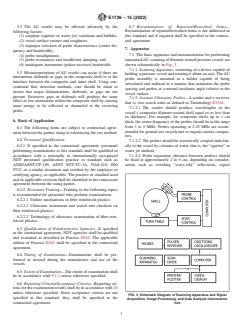
7.1 The basic apparatus and instrumentation for performing
(4) probe misalignment,
(5) probe resonances and insufficient damping, and automatedAUscanningoffilament-woundpressurevesselsare
shown schematically in Fig. 3.
(6) inadequate instrument (pulser-receiver) bandwidth.
7.1.1 Scanning Apparatus, consisting of a device capable of
5.3 Misinterpretations of AU results can occur if there are
holding a pressure vessel and rotating it about an axis. TheAU
intermittent disbonds or gaps in the composite shell or at the
probe assembly is mounted in a holder capable of being
interface between the composite and inner shell. Using con-
articulated and indexed in a manner that maintains the probe
ventional flaw detection methods, care should be taken to
spacing and probes at a normal incidence angle relative to the
ensure that major delaminations, disbonds, or gaps are not
vessel surface.
present. Extensive gaps or disbonds will produce the same
7.1.2 Acousto-Ultrasonic Probes—A sender and a receiver,
effect as low attenuation within the composite shell by causing
that is, two search units as defined in Terminology E1316.
more energy to be reflected or channeled to the receiving
7.1.2.1 The sender should produce wavelengths in the
probe.
vessel’s composite filament-wound shell equal to or less than
its thickness. For example, for composite shells up to 1 cm
6. Basis of Application
thick, the center frequency of the probes should be in the range
from 1 to 5 MHz. Probes operating at 2.25 MHz are recom-
6.1 The following items are subject to contractual agree-
mended for general use on polymer or organic matrix compos-
ment between the parties using or referencing the test method.
ites.
6.2 Personnel Qualification
7.1.2.2 The probes should be acoustically coupled individu-
6.2.1 If specified in the contractual agreement, personnel ally to the vessel by columns of water, that is, the “squirter” or
performing examinations to this standard shall be qualified in
water jet method.
accordance with a nationally or internationally recognized 7.1.2.3 Probe separation (distance between probes) should
NDT personnel qualification practice or standard such as be fixed at approximately 2 to 5 cm, depending on consider-
ANSI/ASNT-CP-189, ASNT SNT-TC-1A, NAS-410, ISO ations such as avoiding “cross-talk” reflections, signal
9712, or a similar document and certified by the employer or
certifying agency, as applicable. The practice or standard used
and its applicable revision shall be identified in the contractual
agreement between the using parties.
6.2.2 Personnel Training—Training in the following topics
is recommended for personnel who perform examinations.
6.2.2.1 Failure mechanisms in fiber reinforced plastics
6.2
...