

ASTM D8510/D8510M-23
(Test Method)Standard Test Method for Local Buckling and Crippling under Axial Compressive Loading
General Information
- Abstract
SIGNIFICANCE AND USE
5.1 This test method is designed to produce composite stiffener cross-section local buckling and crippling data for research and development, and for structural design and analysis. The standard generic configurations for this procedure provide data for two types of cross-section segments: one-edge-free and no-edge-free. This type of data is used in classical stiffener analysis methods. Compressive loading of composite column type specimens may exhibit one of four modes: (1) a compression material strength failure, (2) an overall column flexural, torsional, and or flexural-torsional instability, (3) a local instability followed by a continued post-buckled force carrying capability which eventually results in a material strength failure, or (4) a combination of local and overall instability followed by post-buckling failure. The first two modes are outside the scope of this test method. The latter two modes are categorized as crippling failure and is the purpose of this test method.
5.1.1 The desired failure mode is characterized by an initial linear elastic structural deformation. Continued loading eventually renders one of the cross-sectional segments unstable. Additional loading beyond this point of initial buckling exhibits a pattern of local lateral deflections or buckles. These deflections will grow, and possibly change modes, until catastrophic column failure occurs. This failure is considered the ultimate crippling stress for the buckled segments.
5.2 General factors that influence the mechanical response of composite laminates and should therefore be reported include the following: material, methods of material preparation and lay-up, specimen stacking sequence, specimen preparation, specimen conditioning, environment of testing, specimen alignment and gripping, speed of testing, time held at test temperature, void content, and volume percent reinforcement.
SCOPE
1.1 This test method covers the local buckling and crippling stresses for one-edge-free and no-edge-free cross section configurations using solid laminate composite material construction. Design of test specimens is covered in Guide D8511/D8511M. A number of test parameters may be varied within the scope of the standard, provided that the parameters are fully documented in the test report. The composite material forms are limited to continuous-fiber or discontinuous-fiber (tape, fabric, braids or hybrids of these forms) reinforced composites.
1.2 This test method requires careful specimen design, instrumentation, data measurement and data analysis. The use of this test method requires close coordination between the test requestor and the test lab personnel. Test requestors need to be familiar with Guide D8511/D8511M and CMH-17 Volume 3 Chapter 92 (1).
1.3 Units—The values stated in either SI units or inch-pound units are to be regarded separately as standard. The values stated in each system are not necessarily exact equivalents; therefore, to ensure conformance with the standard, each system shall be used independently of the other, and values from the two systems shall not be combined.
1.3.1 Within the text the inch-pound units are shown in brackets.
1.4 This standard does not purport to address all of the safety concerns, if any, associated with its use. It is the responsibility of the user of this standard to establish appropriate safety, health, and environmental practices and determine the applicability of regulatory limitations prior to use.
1.5 This international standard was developed in accordance with internationally recognized principles on standardization established in the Decision on Principles for the Development of International Standards, Guides and Recommendations issued by the World Trade Organization Technical Barriers to Trade (TBT) Committee.
- Status
- Published
- Publication Date
- 31-Aug-2023
- Technical Committee
- D30 - Composite Materials
- Drafting Committee
- D30.05 - Structural Test Methods
Overview
ASTM D8510/D8510M-23: Standard Test Method for Local Buckling and Crippling under Axial Compressive Loading is an internationally recognized ASTM standard designed for assessing the local buckling and crippling behavior of composite stiffener cross-sections under axial compressive loads. This test method supports research, development, and structural design by generating reliable data for various composite material forms, specifically continuous-fiber and discontinuous-fiber reinforced laminates, encompassing tapes, fabrics, braids, and hybrid forms.
Developed to align with World Trade Organization (WTO) principles for international standards, ASTM D8510/D8510M specifies procedures for producing buckling and crippling data for use in classical structural analysis and design of composite materials.
Key Topics
- Purpose and Scope: Focuses on local buckling and crippling stresses in composite column type specimens, evaluating one-edge-free and no-edge-free cross-section configurations using solid laminate construction.
- Failure Modes Addressed: Concentrates on local instability with post-buckled force-carrying capability, excluding overall column or material failure not resulting from local buckling.
- Test Specimens: Covers standard specimen configurations (one-edge-free, no-edge-free) of composite stiffeners, with geometry defined in ASTM D8511/D8511M.
- Measurement and Data Reporting: Stresses the necessity for accurate specimen design, alignment, instrumentation, and detailed reporting of testing conditions, material properties, and mechanical response factors.
- Environmental Considerations: Encourages thorough documentation of specimen conditioning, temperature, relative humidity, and test environment, all of which can influence composite behavior under compressive load.
- Units of Measurement: Recognizes both SI and inch-pound units, which are not interchangeable within a given test.
Applications
The application of ASTM D8510/D8510M-23 extends to:
- Research and Development: Enables material scientists and engineers to evaluate the buckling and crippling characteristics of new composite materials or structural designs.
- Structural Design and Analysis: Provides critical input data for analytical methods predicting the stability and failure of structural components, such as aircraft frames, automotive structures, and civil engineering elements.
- Quality Assurance and Manufacturing Validation: Used by manufacturers to validate materials' performance and ensure compliance with industry standards in production.
- Comparison of Composite Materials: Facilitates consistent comparison between different composite configurations by standardizing test parameters and reporting methods.
- Design Optimization: Assists engineers in selecting optimal stacking sequences, layups, and specimen geometries to achieve desired structural performance while minimizing weight.
Related Standards
For comprehensive composite testing and analysis, consider these ASTM and industry standards related to or referenced by ASTM D8510/D8510M-23:
- ASTM D8511/D8511M: Guide for designing test specimens for local buckling and crippling tests.
- ASTM D5687/D5687M: Guide for preparation of composite panels and specimen fabrication.
- ASTM D2584, D2734, D3171, D792: Assess material characteristics such as density, void content, and constituent content of composites.
- ASTM D5229/D5229M: Test method for moisture absorption properties of polymer matrix composites.
- ASTM D7137/D7137M: Test method for compressive residual strength properties of composite plates.
- ASTM E4, E83, E251, E1237: Standards for calibration, terminology, and strain gauge installation.
- Terminology D3878, D883, E6, E456: Standard terminologies for composites, plastics, mechanical testing, and statistics.
Practical Value
Implementing ASTM D8510/D8510M-23 in composite evaluation programs ensures:
- Reliable Characterization: Standardized procedures deliver consistent, comparable results across different laboratories and applications.
- Design Assurance: Designers and engineers can trust the mechanical data for making critical safety and performance decisions in industries such as aerospace, automotive, and civil engineering.
- Compliance with International Requirements: Following this standard supports adherence to global trade and technical barrier compliance.
Keywords: ASTM D8510, composite buckling, crippling, axial compressive loading, composite laminates, structural design, composite testing, international standard.
Relations
- Effective Date
- 01-Feb-2024
- Effective Date
- 01-Nov-2023
- Effective Date
- 01-Oct-2023
- Effective Date
- 01-Apr-2022
- Effective Date
- 15-Aug-2020
- Effective Date
- 01-Jun-2020
- Effective Date
- 01-May-2020
- Effective Date
- 01-Mar-2020
- Effective Date
- 01-Jan-2020
- Effective Date
- 15-Oct-2019
- Effective Date
- 01-Aug-2019
- Effective Date
- 15-Apr-2019
- Effective Date
- 15-Apr-2019
- Effective Date
- 01-Feb-2019
- Effective Date
- 01-Dec-2018
Frequently Asked Questions
ASTM D8510/D8510M-23 is a standard published by ASTM International. Its full title is "Standard Test Method for Local Buckling and Crippling under Axial Compressive Loading". This standard covers: SIGNIFICANCE AND USE 5.1 This test method is designed to produce composite stiffener cross-section local buckling and crippling data for research and development, and for structural design and analysis. The standard generic configurations for this procedure provide data for two types of cross-section segments: one-edge-free and no-edge-free. This type of data is used in classical stiffener analysis methods. Compressive loading of composite column type specimens may exhibit one of four modes: (1) a compression material strength failure, (2) an overall column flexural, torsional, and or flexural-torsional instability, (3) a local instability followed by a continued post-buckled force carrying capability which eventually results in a material strength failure, or (4) a combination of local and overall instability followed by post-buckling failure. The first two modes are outside the scope of this test method. The latter two modes are categorized as crippling failure and is the purpose of this test method. 5.1.1 The desired failure mode is characterized by an initial linear elastic structural deformation. Continued loading eventually renders one of the cross-sectional segments unstable. Additional loading beyond this point of initial buckling exhibits a pattern of local lateral deflections or buckles. These deflections will grow, and possibly change modes, until catastrophic column failure occurs. This failure is considered the ultimate crippling stress for the buckled segments. 5.2 General factors that influence the mechanical response of composite laminates and should therefore be reported include the following: material, methods of material preparation and lay-up, specimen stacking sequence, specimen preparation, specimen conditioning, environment of testing, specimen alignment and gripping, speed of testing, time held at test temperature, void content, and volume percent reinforcement. SCOPE 1.1 This test method covers the local buckling and crippling stresses for one-edge-free and no-edge-free cross section configurations using solid laminate composite material construction. Design of test specimens is covered in Guide D8511/D8511M. A number of test parameters may be varied within the scope of the standard, provided that the parameters are fully documented in the test report. The composite material forms are limited to continuous-fiber or discontinuous-fiber (tape, fabric, braids or hybrids of these forms) reinforced composites. 1.2 This test method requires careful specimen design, instrumentation, data measurement and data analysis. The use of this test method requires close coordination between the test requestor and the test lab personnel. Test requestors need to be familiar with Guide D8511/D8511M and CMH-17 Volume 3 Chapter 92 (1). 1.3 Units—The values stated in either SI units or inch-pound units are to be regarded separately as standard. The values stated in each system are not necessarily exact equivalents; therefore, to ensure conformance with the standard, each system shall be used independently of the other, and values from the two systems shall not be combined. 1.3.1 Within the text the inch-pound units are shown in brackets. 1.4 This standard does not purport to address all of the safety concerns, if any, associated with its use. It is the responsibility of the user of this standard to establish appropriate safety, health, and environmental practices and determine the applicability of regulatory limitations prior to use. 1.5 This international standard was developed in accordance with internationally recognized principles on standardization established in the Decision on Principles for the Development of International Standards, Guides and Recommendations issued by the World Trade Organization Technical Barriers to Trade (TBT) Committee.
SIGNIFICANCE AND USE 5.1 This test method is designed to produce composite stiffener cross-section local buckling and crippling data for research and development, and for structural design and analysis. The standard generic configurations for this procedure provide data for two types of cross-section segments: one-edge-free and no-edge-free. This type of data is used in classical stiffener analysis methods. Compressive loading of composite column type specimens may exhibit one of four modes: (1) a compression material strength failure, (2) an overall column flexural, torsional, and or flexural-torsional instability, (3) a local instability followed by a continued post-buckled force carrying capability which eventually results in a material strength failure, or (4) a combination of local and overall instability followed by post-buckling failure. The first two modes are outside the scope of this test method. The latter two modes are categorized as crippling failure and is the purpose of this test method. 5.1.1 The desired failure mode is characterized by an initial linear elastic structural deformation. Continued loading eventually renders one of the cross-sectional segments unstable. Additional loading beyond this point of initial buckling exhibits a pattern of local lateral deflections or buckles. These deflections will grow, and possibly change modes, until catastrophic column failure occurs. This failure is considered the ultimate crippling stress for the buckled segments. 5.2 General factors that influence the mechanical response of composite laminates and should therefore be reported include the following: material, methods of material preparation and lay-up, specimen stacking sequence, specimen preparation, specimen conditioning, environment of testing, specimen alignment and gripping, speed of testing, time held at test temperature, void content, and volume percent reinforcement. SCOPE 1.1 This test method covers the local buckling and crippling stresses for one-edge-free and no-edge-free cross section configurations using solid laminate composite material construction. Design of test specimens is covered in Guide D8511/D8511M. A number of test parameters may be varied within the scope of the standard, provided that the parameters are fully documented in the test report. The composite material forms are limited to continuous-fiber or discontinuous-fiber (tape, fabric, braids or hybrids of these forms) reinforced composites. 1.2 This test method requires careful specimen design, instrumentation, data measurement and data analysis. The use of this test method requires close coordination between the test requestor and the test lab personnel. Test requestors need to be familiar with Guide D8511/D8511M and CMH-17 Volume 3 Chapter 92 (1). 1.3 Units—The values stated in either SI units or inch-pound units are to be regarded separately as standard. The values stated in each system are not necessarily exact equivalents; therefore, to ensure conformance with the standard, each system shall be used independently of the other, and values from the two systems shall not be combined. 1.3.1 Within the text the inch-pound units are shown in brackets. 1.4 This standard does not purport to address all of the safety concerns, if any, associated with its use. It is the responsibility of the user of this standard to establish appropriate safety, health, and environmental practices and determine the applicability of regulatory limitations prior to use. 1.5 This international standard was developed in accordance with internationally recognized principles on standardization established in the Decision on Principles for the Development of International Standards, Guides and Recommendations issued by the World Trade Organization Technical Barriers to Trade (TBT) Committee.
ASTM D8510/D8510M-23 has the following relationships with other standards: It is inter standard links to ASTM D883-24, ASTM D883-23, ASTM D2734-23, ASTM E456-13a(2022)e1, ASTM E1237-20, ASTM E251-20a, ASTM E251-20, ASTM D5229/D5229M-20, ASTM D883-20, ASTM D3878-19a, ASTM D883-19c, ASTM D883-19a, ASTM D3878-19, ASTM D883-19, ASTM D883-18a. Understanding these relationships helps ensure you are using the most current and applicable version of the standard.
ASTM D8510/D8510M-23 is available in PDF format for immediate download after purchase. The document can be added to your cart and obtained through the secure checkout process. Digital delivery ensures instant access to the complete standard document.
Standards Content (Sample)
This international standard was developed in accordance with internationally recognized principles on standardization established in the Decision on Principles for the
Development of International Standards, Guides and Recommendations issued by the World Trade Organization Technical Barriers to Trade (TBT) Committee.
Designation: D8510/D8510M − 23
Standard Test Method for
Local Buckling and Crippling under Axial Compressive
Loading
This standard is issued under the fixed designation D8510/D8510M; the number immediately following the designation indicates the
year of original adoption or, in the case of revision, the year of last revision. A number in parentheses indicates the year of last
reapproval. A superscript epsilon (´) indicates an editorial change since the last revision or reapproval.
1. Scope mendations issued by the World Trade Organization Technical
Barriers to Trade (TBT) Committee.
1.1 This test method covers the local buckling and crippling
stresses for one-edge-free and no-edge-free cross section
2. Referenced Documents
configurations using solid laminate composite material con-
2.1 ASTM Standards:
struction. Design of test specimens is covered in Guide
D792 Test Methods for Density and Specific Gravity (Rela-
D8511/D8511M. A number of test parameters may be varied
tive Density) of Plastics by Displacement
within the scope of the standard, provided that the parameters
D883 Terminology Relating to Plastics
are fully documented in the test report. The composite material
D2584 Test Method for Ignition Loss of Cured Reinforced
forms are limited to continuous-fiber or discontinuous-fiber
Resins
(tape, fabric, braids or hybrids of these forms) reinforced
D2734 Test Methods for Void Content of Reinforced Plastics
composites.
D3171 Test Methods for Constituent Content of Composite
1.2 This test method requires careful specimen design,
Materials
instrumentation, data measurement and data analysis. The use
D3878 Terminology for Composite Materials
of this test method requires close coordination between the test
D5229/D5229M Test Method for Moisture Absorption Prop-
requestor and the test lab personnel. Test requestors need to be
erties and Equilibrium Conditioning of Polymer Matrix
familiar with Guide D8511/D8511M and CMH-17 Volume 3
Composite Materials
Chapter 9 (1).
D5687/D5687M Guide for Preparation of Flat Composite
1.3 Units—The values stated in either SI units or inch- Panels with Processing Guidelines for Specimen Prepara-
pound units are to be regarded separately as standard. The tion
values stated in each system are not necessarily exact equiva- D7137/D7137M Test Method for Compressive Residual
lents; therefore, to ensure conformance with the standard, each
Strength Properties of Damaged Polymer Matrix Compos-
system shall be used independently of the other, and values ite Plates
from the two systems shall not be combined.
D8511/D8511M
1.3.1 Within the text the inch-pound units are shown in E4 Practices for Force Calibration and Verification of Test-
brackets.
ing Machines
E6 Terminology Relating to Methods of Mechanical Testing
1.4 This standard does not purport to address all of the
E83 Practice for Verification and Classification of Exten-
safety concerns, if any, associated with its use. It is the
someter Systems
responsibility of the user of this standard to establish appro-
E177 Practice for Use of the Terms Precision and Bias in
priate safety, health, and environmental practices and deter-
ASTM Test Methods
mine the applicability of regulatory limitations prior to use.
E251 Test Methods for Performance Characteristics of Me-
1.5 This international standard was developed in accor-
tallic Bonded Resistance Strain Gages
dance with internationally recognized principles on standard-
E456 Terminology Relating to Quality and Statistics
ization established in the Decision on Principles for the
E1237 Guide for Installing Bonded Resistance Strain Gages
Development of International Standards, Guides and Recom-
3. Terminology
3.1 Definitions:
This test method is under the jurisdiction of ASTM Committee D30 on
Composite Materials and is the direct responsibility of Subcommittee D30.05 on
Structural Test Methods.
Current edition approved Sept. 1, 2023. Published September 2023. DOI: For referenced ASTM standards, visit the ASTM website, www.astm.org, or
10.1520/D8510_D8510M-23. contact ASTM Customer Service at service@astm.org. For Annual Book of ASTM
The boldface numbers in parentheses refer to a list of references at the end of Standards volume information, refer to the standard’s Document Summary page on
this standard. the ASTM website.
Copyright © ASTM International, 100 Barr Harbor Drive, PO Box C700, West Conshohocken, PA 19428-2959. United States
D8510/D8510M − 23
cc
3.1.1 Terminology D3878 defines terms relating to high- 3.3.4 F —crippling stress, MPa [psi].
modulus fibers and their composites. Terminology D883 de-
3.3.5 L1—specimen length between end potting or fixture
fines terms relating to plastics. Terminology E6 defines terms
inner surfaces, mm [in.].
relating to mechanical testing. Terminology E456 and Practice
3.3.6 L2—total specimen length, mm [in.].
E177 define terms relating to statistics. In the event of a
3.3.7 n—number of tested specimens.
conflict between terms, Terminology D3878 shall have prece-
dence over the other documents.
3.3.8 P—total compressive force applied to specimen, N
[lbf].
NOTE 1—If the term represents a physical quantity, its analytical
dimensions are stated immediately following the term (or letter symbol) in lcr
3.3.9 P —applied compressive force at which buckling
fundamental dimension form, using the following ASTM standard sym-
initiates, N [lbf].
bology for fundamental dimensions, shown within square brackets: [M]
cc
for mass, [L] for length, [T] for time, [θ] for thermodynamic temperature,
3.3.10 P —maximum applied compressive force, N [lbf].
and [nd] for non-dimensional quantities. Use of these symbols is restricted
3.3.11 t—specimen thickness (nominal or actual, as
to analytical dimensions when used with square brackets, as the symbols
may have other definitions when used without the brackets. specified), mm [in.].
3.2 Definitions of Terms Specific to This Standard:
3.3.12 w—overall width of buckling critical segment of
cc -2
3.2.1 crippling force, P [MLT ], n—the applied compres-
specimen cross-section, mm [in.].
sive force at or above the local buckling force at which
¯
3.3.13 X—sample mean (average).
specimen failure occurs.
3.3.14 S —sample standard deviation.
cc -1 -2
n-1
3.2.2 crippling stress, F [ML T ], n—the average stress
3.3.15 CV—sample coefficient of variation, %.
in the test specimen cross-section at failure (maximum force).
lcr -2
3.3.16 x —measured or derived property.
3.2.3 local buckling force, P [MLT ], n—the applied
i
compressive force at which buckling of a compression element
4. Summary of Test Method
within the cross-section initiates.
lcr -1 -2
3.2.4 local buckling stress, F [ML T ], n—the average 4.1 This test standard establishes the procedure for deter-
stress in the test specimen cross-section at which buckling of a
mining the local instability (buckling) force in one or more
compression element within the cross-section initiates. cross-section segments and the post-buckled force sustained by
a composite specimen. The test involves applying an axial
3.2.5 width to thickness ratio, b/t [nd], n—the ratio of the
compressive force to an unsupported specimen until local
width of the buckling critical section of the specimen cross-
buckling and subsequent catastrophic failure (“crippling”)
section to the specimen thickness.
occurs. The test frame head travel, force and cross-sectional
3.2.5.1 Discussion—The width to thickness ratio may be
strains are recorded during the test. Still or video images, or
either a nominal value determined from nominal thickness or
both, of the specimen deformations under force are recorded
an actual value determined from measured thickness.
and reported.
3.3 Symbols:
4.1.1 This test standard does not provide an explicit speci-
2 2
3.3.1 A—cross-sectional area, mm [in. ].
men geometry or data reduction methodology. The specimen
3.3.2 b—width of buckling critical segment of specimen
geometry is to be provided by the test requestor. Refer to Guide
cross-section, relative to laminate centerline, mm [in.].
D8511/D8511M for specimen design and analysis information.
lcr
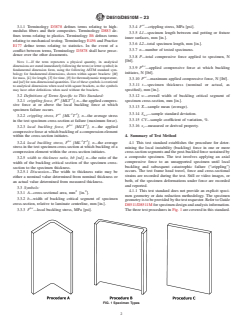
3.3.3 F —local buckling stress, MPa [psi]. The three test procedures in Fig. 1 are covered in this standard.
FIG. 1 Specimen Types
D8510/D8510M − 23
Other non-standard test specimen configurations may be tested 6. Interferences
using this method.
6.1 Refer to Guide D8511/D8511M for discussion of inter-
4.2 Procedure A – One Edge Free (OEF): ferences with specimens used in this test method.
4.2.1 The test specimen consists of a constant cross-section,
7. Apparatus
symmetric L-section with potted ends. Both segments of the
L-section are intended to buckle at the same applied force. This
7.1 Micrometers—A micrometer with a 4 mm to 8 mm
specimen configuration often exhibits a flexural-torsional
[0.16 in. to 0.32 in.] nominal diameter ball-interface or a flat
buckling mode which produces lower bound OEF results. This
anvil interface shall be used to measure the specimen thick-
is further discussed in Guide D8511/D8511M.
ness. A ball interface is recommended for thickness measure-
ments when at least one surface is irregular (for example, a
4.3 Procedure B – No Edge Free (NEF):
course peel ply surface which is neither smooth nor flat). A
4.3.1 The test specimen consists of a constant cross-section,
micrometer or caliper with a flat anvil interface shall be used
symmetric C-section with potted ends. The center “web”
for measuring length, width, and other machined surface
segment of the C-channel is intended to buckle while the edge
dimensions. The use of alternative measurement devices is
segments are intended to remain unbuckled up to the specimen
permitted if specified (or agreed to) by the test requestor and
failure force.
reported by the testing laboratory. The accuracy of the instru-
4.4 Procedure C – No Edge Free (NEF):
ment(s) shall be suitable for reading to within 1 % of the
4.4.1 The test specimen consists of a laminated plate speci-
specimen dimensions. For typical specimen geometries, an
men that is supported on the unloaded edges by V-groove
instrument with an accuracy of 60.0025 mm [60.0001 in.] is
fixture restraints and loaded with a clamping fixture on each
adequate for thickness measurements, while an instrument with
end.
an accuracy of 60.025 mm [60.001 in.] is adequate for
measurement of length, width, other machined surface dimen-
5. Significance and Use
sions.
5.1 This test method is designed to produce composite
7.2 Compression Loading Platens—The force shall be ap-
stiffener cross-section local buckling and crippling data for
plied to the specimen by a compression platen such that the
research and development, and for structural design and
mismatch between the specimen ends and the loading surfaces
analysis. The standard generic configurations for this proce-
does not exceed 0.025 mm [0.001 in.] over the contact area of
dure provide data for two types of cross-section segments:
the end of the specimen. Self-aligning (spherical seat) or screw
one-edge-free and no-edge-free. This type of data is used in
adjustable (tripod) compression platens may be used to meet
classical stiffener analysis methods. Compressive loading of
this requirement. The loading platen surfaces shall be, as a
composite column type specimens may exhibit one of four
minimum, as wide as the specimen and flat to within 0.10 mm
modes: (1) a compression material strength failure, (2) an
[0.004 in.].
overall column flexural, torsional, and or flexural-torsional
7.3 Testing Machine—The testing machine shall be in con-
instability, (3) a local instability followed by a continued
formance with Practices E4, and shall satisfy the following
post-buckled force carrying capability which eventually results
requirements:
in a material strength failure, or (4) a combination of local and
7.3.1 Testing Machine Configuration—The testing machine
overall instability followed by post-buckling failure. The first
shall have both an essentially stationary head and a movable
two modes are outside the scope of this test method. The latter
head.
two modes are categorized as crippling failure and is the
purpose of this test method. 7.3.2 Drive Mechanism—The testing machine drive mecha-
nism shall be capable of imparting to the movable head a
5.1.1 The desired failure mode is characterized by an initial
controlled velocity with respect to the stationary head. The
linear elastic structural deformation. Continued loading even-
velocity of the movable head shall be capable of being
tually renders one of the cross-sectional segments unstable.
regulated as specified in 11.3.10.
Additional loading beyond this point of initial buckling exhib-
its a pattern of local lateral deflections or buckles. These 7.3.3 Force Indicator—The testing machine force-sensing
deflections will grow, and possibly change modes, until cata- device shall be capable of indicating the total force being
strophic column failure occurs. This failure is considered the carried by the test specimen. This device shall be essentially
ultimate crippling stress for the buckled segments. free from inertia-lag at the specified rate of testing and shall
indicate the force with an accuracy over the force range(s) of
5.2 General factors that influence the mechanical response
interest of within 61 % of the indicated value.
of composite laminates and should therefore be reported
include the following: material, methods of material prepara- 7.4 Displacement—Displacement transducers such as
tion and lay-up, specimen stacking sequence, specimen LVDTs or DCDTs shall satisfy, at a minimum, Practice E83,
preparation, specimen conditioning, environment of testing, Class B2 requirements for the displacement range of interest,
specimen alignment and gripping, speed of testing, time held at and shall be calibrated over that range in accordance with
test temperature, void content, and volume percent reinforce- Practice E83. The transducers shall be essentially free of
ment. inertia-lag at the specified speed of testing.
D8510/D8510M − 23
7.5 Strain-Indicating Device—Strain data, when required, 7.5.1.3 Consideration of some form of temperature compen-
shall be determined by means of bonded resistance strain sation is recommended, even when testing at standard labora-
gauges. tory atmosphere. Temperature compensation may be required
7.5.1 Bonded Resistance Strain Gauge Selection—Strain when testing in non-ambient temperature environments.
gauge selection is based on the type of material to be tested. A
7.5.1.4 Consideration should be given to the transverse
minimum active gauge length of 3 mm [0.125 in.] is recom-
sensitivity of the selected strain gauge. The strain gauge
mended for composite laminates fabricated from unidirectional
manufacturer should be consulted for recommendations on
layers. Larger strain gauge sizes may be more suitable for some
transverse sensitivity corrections and effects on composites.
textile fabrics or braids. Gauge calibration certification shall
7.6 Buckle Shape Measurement—When required by the test
comply with Test Method E251. Strain gauges with a minimum
requestor, moiré fringe image methods or Digital Image
normal strain range of approximately 3 % are recommended.
Correlation (DIC) may be used to provide images of the
When testing textile fabric laminates, gauge selection should
specimen initial buckle shapes and changes with increasing
consider the use of an active gauge length that is at least as
applied force. An applied force readout visible in the recorded
great as the characteristic repeating unit of the fabric. Some
images or video is required.
guidelines on the use of strain gauges on composite materials
follow.
7.7 Conditioning Chamber—When conditioning materials
7.5.1.1 Surface preparation of fiber-reinforced composites
at non-laboratory environments, a temperature-/vapor-level
in accordance with Guide E1237 can penetrate the matrix
controlled environmental conditioning chamber is required that
material and cause damage to the reinforcing fibers, resulting
shall be capable of maintaining the required temperature to
in improper coupon failures. Reinforcing fibers should not be
within 63 °C [65 °F] and the required relative humidity level
exposed or damaged during the surface preparation process.
to within 63 %. Chamber conditions shall be monitored either
The strain gauge manufacturer should be consulted regarding
on an automated continuous basis or on a manual basis at
surface preparation guidelines and recommended bonding regular intervals.
agents for composites, pending the development of a set of
7.8 Environmental Test Chamber—An environmental test
standard practices for strain gauge installation surface prepa-
chamber is required for test environments other than ambient
ration of fiber-reinforced composite materials.
testing laboratory conditions. This chamber shall be capable of
7.5.1.2 Consideration should be given to the selection of
maintaining the test specimen and fixture at the required test
gages having larger resistances to reduce heating effects on low
environment during the mechanical test. The test temperature
conductivity materials. Resistances of 350 Ω or higher are
shall be maintained within 63 °C [65 °F] of the required
preferred. Additional consideration should be given to the use
temperature. The relative humidity level controlled within the
of the minimum possible gauge excitation voltage consistent
test chamber shall be specified by the test requestor.
with the desired accuracy (1 V to 2 V is recommended) to
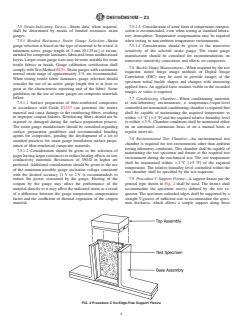
7.9 Procedure C Support Fixture—A support fixture per the
reduce the power consumed by the gauge. Heating of the
coupon by the gauge may affect the performance of the general type shown in Fig. 2 shall be used. The fixture shall
material directly or it may affect the indicated strain as a result accommodate the specimen size(s) defined by the test re-
of a difference between the gauge temperature compensation questor. The specimen unloaded edges shall be supported by a
factor and the coefficient of thermal expansion of the coupon straight V-groove of sufficient size to accommodate the speci-
material. men thickness, which allows a simple support along these
FIG. 2 Procedure C No-Edge-Free Support Fixture
D8510/D8510M − 23
edges. The specimen ends shall be clamped in the fixture to 8.2.1 Stacking Sequence—The standard laminate shall have
prevent end brooming failure modes. Details of a similar balanced and symmetric stacking sequences. Fabric laminates
fixture are provided in Test Method D7137/D7137M. containing satin-type weaves shall have symmetric warp
surfaces, unless otherwise specified and noted in the report.
8. Sampling and Test Specimens
Non-symmetric and non-balanced layups have extensional-
8.1 Sampling—The number of test replicates for each speci- bending stiffness coupling which leads to complicated buckling
patterns and non-linear post-buckling response.
men configuration shall be specified by the test requestor.
8.2.2 Configuration—The generic geometry of the speci-
NOTE 2—If specimens are to undergo environmental conditioning to
mens are shown in Fig. 3 and Fig. 4 (Procedure A), Fig. 5 and
equilibrium, and the end potting is installed prior to conditioning
Fig. 6 (Procedure B), and Fig. 7 and Fig. 8 (Procedure C). The
(recommended), then use a traveler specimen of the same nominal
thickness and appropriate size (but without potting) to determine when
corner radii for Procedure A and B specimens should be
equilibrium has been reached for the specimens being conditioned.
representative of intended part design configurations for which
8.2 Geometry: the crippling data will be used for stress analysis. A standard
FIG. 3 Procedure A Specimen Dimensions (SI Units)
D8510/D8510M − 23
FIG. 4 Procedure A Specimen Dimensions (Inch-Pound Units)
specimen configuration is not provided; refer to Guide D8511/ rough or uneven surfaces, or delaminations due to inappropri-
D8511M for the design of these test specimens. The potting ate machining methods. Obtain final dimensions by water-
retaining rings should be selected from standard tube sizes and lubricated precision sawing, milling, or grinding. The use of
shall be sufficient size to fit the specimen. diamond tooling has been found to be extremely effective for
many material systems. Edges should be flat and parallel
8.3 Specimen Preparation—Guide D5687/D5687M pro-
within the specified tolerances.
vides recommended specimen preparation practices and should
8.3.3 End Potting—The ends of Procedure A and B speci-
be followed where practical.
mens shall be potted to prevent end brooming failure. The
8.3.1 Specimen Fabrication—Control of fiber alignment is
effective length of the column should be considered as the
critical. Improper fiber alignment will influence the measured
length between the end potting inner surfaces. The following
properties. The specimen(s) cross section segments must be flat
procedure is recommended for potting the specimen ends:
and of uniform thickness, and the overall specimen must be
8.3.3.1 Machine the specimens prior to end potting.
straight to ensure even loading and avoid column bending.
8.3.2 Machining Methods—Specimen preparation is ex- 8.3.3.2 On each end use a retaining ring consisting of
tremely important for this specimen. Take precautions when aluminum or stainless steel tubing. Recommended tube wall
cutting specimens from plates to avoid notches, undercuts, thickness range is 0.9 mm to 3.2 mm [0.035 in. to 0.125 in.].
D8510/D8510M − 23
FIG. 5 Procedure B Specimen Dimensions (SI Units)
8.3.3.3 Use a room temperature curing epoxy potting com- 8.3.3.8 The final height of the end potting shall be a
pound. minimum of 12 mm [0.5 in.].
8.3.3.4 Place a retaining ring on a flat surface. Stand and
8.3.3.9 The specimen length between potting inner surfaces
support a specimen end inside the ring per below. Pour in
shall meet the test requestor requirements
...