

ASTM D4510-18
(Test Method)Standard Test Method for Counting Partial Cleavages in Wool and Other Animal Fibers
General Information
- Abstract
SIGNIFICANCE AND USE
5.1 Test Method D4510 for the counting of partial cleavages, may be used for the acceptance testing of commercial shipments of wool and other animal fibers, but caution is advised, since information on between-laboratory precision is limited. Comparative tests as directed in 5.1.1 may be advisable.
5.1.1 In case of a dispute arising from differences in reported test results when using this test method for acceptance testing of commercial shipments, the purchaser and the supplier should conduct comparative tests to determine if there is a statistical bias between their laboratories. Competent statistical assistance is recommended for the investigation of bias. As a minimum, the two parties should take a group of test specimens that are as homogeneous as possible and that are from a lot of material of the type in question. The test specimens should then be randomly assigned in equal numbers to each laboratory for testing. The average results from the two laboratories should be compared using Students t-test for unpaired data and an acceptable probability level chosen by the two parties before the testing is begun. If a bias is found, either its cause must be found and corrected or the purchaser and the supplier must agree to interpret future test results in the light of the known bias.
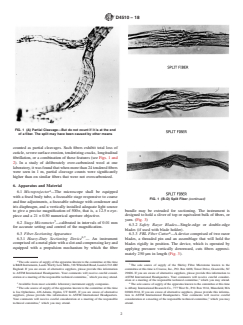
FIG. 1 (A) Partial Cleavage—But do not count if it is at the end of a fiber. The split may have been caused by other means
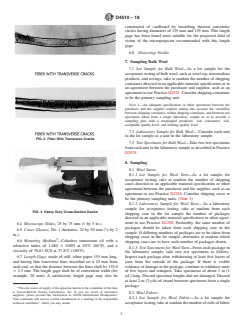
5.2 Chemically damaged or tendered fibers are recognizable microscopically by qualified operators and should not be counted as partial cleavages. Such fibers exhibit total loss of cuticle, severe surface erosion, tenderizing cracks, longitudinal fibrillation, or a combination of these features (see Figs. 1 and 2). In a study of deliberately over-carbonized wool at one laboratory, it was found that when more than 24 tendered fibers were seen in 1 m, partial cleavage counts were significantly higher than on similar fibers that were not overcarbonized.
FIG. ...
SCOPE
1.1 This test method covers a procedure, using the microprojector, for the counting of partial cleavages in wool and other animal fibers.
1.2 The values stated in SI units are to be regarded as standard. No other units of measurement are included in this standard.
1.3 This standard does not purport to address all of the safety concerns, if any, associated with its use. It is the responsibility of the user of this standard to establish appropriate safety, health, and environmental practices and determine the applicability of regulatory limitations prior to use.
1.4 This international standard was developed in accordance with internationally recognized principles on standardization established in the Decision on Principles for the Development of International Standards, Guides and Recommendations issued by the World Trade Organization Technical Barriers to Trade (TBT) Committee.
- Status
- Published
- Publication Date
- 30-Jun-2018
- Technical Committee
- D13 - Textiles
- Drafting Committee
- D13.13 - Wool and Felt
Overview
ASTM D4510-18: Standard Test Method for Counting Partial Cleavages in Wool and Other Animal Fibers provides a precise methodology for evaluating the quality and integrity of wool and other animal fibers. Developed by ASTM International, this test method specifies the use of a microprojector to visually count partial cleavages in fiber samples. Results are typically utilized in the acceptance testing of commercial shipments, ensuring consistency and reliability in the textile industry.
Counting partial cleavages is essential because they can indicate fiber damage, processing issues, or quality concerns that need to be addressed before further manufacturing or commercial exchange. This standard supports quality control, supplier-customer disputes resolution, and compliance with industry best practices.
Key Topics
- Test Methodology: Describes a detailed process for segmenting test specimens, projecting fiber sections at precise magnification (typically 500×), and systematically counting partial cleavages.
- Sampling Procedures: Outlines correct sampling techniques for bulk wool, yarns, and fabrics, including random selection and proper segregation of test specimens.
- Identification of Damage: Provides guidance for distinguishing between true partial cleavages and other forms of fiber damage, such as chemically tendered or over-carbonized fibers, which should not be counted as partial cleavages.
- Precision and Bias: Includes procedures for comparative testing between laboratories to determine statistical bias and ensure reliable results, particularly in cases of supplier-purchaser disputes.
- Statistical Evaluation: Recommends statistical methods for analyzing test results and resolving discrepancies, such as Student’s t-test, to support fair and accurate acceptance decisions.
Applications
ASTM D4510-18 is widely used in the textile industry for:
- Commercial Acceptance Testing: Verifying the quality of wool and other animal fibers in bulk shipments, yarns, and fabrics based on the prevalence of partial cleavages.
- Quality Control: Monitoring production processes and raw material quality, helping manufacturers ensure consistent product standards and avoid processing issues that lead to fiber damage.
- Supplier and Customer Disputes: Serving as a neutral, internationally recognized method for resolving differences in reported test results, supporting fair commercial transactions.
- Research and Product Development: Supporting studies related to fiber durability, processing effects, and the development of improved fiber preparation techniques.
- Regulatory and Compliance: Assisting with adherence to labeling and content requirements such as those defined by the Wool Products Labeling Act and other textile-related legislation.
Related Standards
For broader context and complementary methods, the following standards are often referenced alongside ASTM D4510-18:
- ASTM D123 – Terminology Relating to Textiles: Provides definitions of terms widely used in textile testing.
- ASTM D2258 – Practice for Sampling Yarn for Testing: Specifies collection methods for representative yarn samples.
- ASTM D2525 – Practice for Sampling Wool for Moisture: Details procedures for sampling wool to determine moisture content.
- ASTM D4845 – Terminology Relating to Wool: Focuses on wool-specific terminology and concepts.
- Wool Products Labeling Act of 1939 – Establishes legal requirements for fiber content labeling in wool products.
Conclusion
ASTM D4510-18 is an essential standard in the wool and animal fiber sector, providing a reliable protocol for counting partial cleavages as a measure of fiber quality. By following its guidelines, laboratories, manufacturers, and traders can ensure uniformity, resolve disputes efficiently, and maintain high standards in wool and animal fiber products.
Keywords: ASTM D4510-18, counting partial cleavages, wool fibers, animal fibers, textile testing, fiber damage, quality control, acceptance testing, microprojector, ASTM standards.
Relations
- Effective Date
- 01-Jul-2018
- Effective Date
- 01-Jul-2018
- Effective Date
- 01-Mar-2017
- Effective Date
- 15-Sep-2015
- Effective Date
- 01-Sep-2015
- Effective Date
- 01-Apr-2015
- Effective Date
- 15-Jun-2013
- Effective Date
- 15-Jun-2013
- Effective Date
- 15-May-2013
- Effective Date
- 01-Mar-2012
- Effective Date
- 01-Feb-2012
- Effective Date
- 01-Feb-2012
- Effective Date
- 01-Jun-2010
- Effective Date
- 01-Jun-2010
- Effective Date
- 01-Jun-2010
Get Certified
Connect with accredited certification bodies for this standard

Control Union Certifications
Global certification for agriculture and sustainability.

Hohenstein Institut
Textile testing and certification.

Bureau Veritas Bangladesh
Bureau Veritas certification services in Bangladesh.
Sponsored listings
Frequently Asked Questions
ASTM D4510-18 is a standard published by ASTM International. Its full title is "Standard Test Method for Counting Partial Cleavages in Wool and Other Animal Fibers". This standard covers: SIGNIFICANCE AND USE 5.1 Test Method D4510 for the counting of partial cleavages, may be used for the acceptance testing of commercial shipments of wool and other animal fibers, but caution is advised, since information on between-laboratory precision is limited. Comparative tests as directed in 5.1.1 may be advisable. 5.1.1 In case of a dispute arising from differences in reported test results when using this test method for acceptance testing of commercial shipments, the purchaser and the supplier should conduct comparative tests to determine if there is a statistical bias between their laboratories. Competent statistical assistance is recommended for the investigation of bias. As a minimum, the two parties should take a group of test specimens that are as homogeneous as possible and that are from a lot of material of the type in question. The test specimens should then be randomly assigned in equal numbers to each laboratory for testing. The average results from the two laboratories should be compared using Students t-test for unpaired data and an acceptable probability level chosen by the two parties before the testing is begun. If a bias is found, either its cause must be found and corrected or the purchaser and the supplier must agree to interpret future test results in the light of the known bias. FIG. 1 (A) Partial Cleavage—But do not count if it is at the end of a fiber. The split may have been caused by other means 5.2 Chemically damaged or tendered fibers are recognizable microscopically by qualified operators and should not be counted as partial cleavages. Such fibers exhibit total loss of cuticle, severe surface erosion, tenderizing cracks, longitudinal fibrillation, or a combination of these features (see Figs. 1 and 2). In a study of deliberately over-carbonized wool at one laboratory, it was found that when more than 24 tendered fibers were seen in 1 m, partial cleavage counts were significantly higher than on similar fibers that were not overcarbonized. FIG. ... SCOPE 1.1 This test method covers a procedure, using the microprojector, for the counting of partial cleavages in wool and other animal fibers. 1.2 The values stated in SI units are to be regarded as standard. No other units of measurement are included in this standard. 1.3 This standard does not purport to address all of the safety concerns, if any, associated with its use. It is the responsibility of the user of this standard to establish appropriate safety, health, and environmental practices and determine the applicability of regulatory limitations prior to use. 1.4 This international standard was developed in accordance with internationally recognized principles on standardization established in the Decision on Principles for the Development of International Standards, Guides and Recommendations issued by the World Trade Organization Technical Barriers to Trade (TBT) Committee.
SIGNIFICANCE AND USE 5.1 Test Method D4510 for the counting of partial cleavages, may be used for the acceptance testing of commercial shipments of wool and other animal fibers, but caution is advised, since information on between-laboratory precision is limited. Comparative tests as directed in 5.1.1 may be advisable. 5.1.1 In case of a dispute arising from differences in reported test results when using this test method for acceptance testing of commercial shipments, the purchaser and the supplier should conduct comparative tests to determine if there is a statistical bias between their laboratories. Competent statistical assistance is recommended for the investigation of bias. As a minimum, the two parties should take a group of test specimens that are as homogeneous as possible and that are from a lot of material of the type in question. The test specimens should then be randomly assigned in equal numbers to each laboratory for testing. The average results from the two laboratories should be compared using Students t-test for unpaired data and an acceptable probability level chosen by the two parties before the testing is begun. If a bias is found, either its cause must be found and corrected or the purchaser and the supplier must agree to interpret future test results in the light of the known bias. FIG. 1 (A) Partial Cleavage—But do not count if it is at the end of a fiber. The split may have been caused by other means 5.2 Chemically damaged or tendered fibers are recognizable microscopically by qualified operators and should not be counted as partial cleavages. Such fibers exhibit total loss of cuticle, severe surface erosion, tenderizing cracks, longitudinal fibrillation, or a combination of these features (see Figs. 1 and 2). In a study of deliberately over-carbonized wool at one laboratory, it was found that when more than 24 tendered fibers were seen in 1 m, partial cleavage counts were significantly higher than on similar fibers that were not overcarbonized. FIG. ... SCOPE 1.1 This test method covers a procedure, using the microprojector, for the counting of partial cleavages in wool and other animal fibers. 1.2 The values stated in SI units are to be regarded as standard. No other units of measurement are included in this standard. 1.3 This standard does not purport to address all of the safety concerns, if any, associated with its use. It is the responsibility of the user of this standard to establish appropriate safety, health, and environmental practices and determine the applicability of regulatory limitations prior to use. 1.4 This international standard was developed in accordance with internationally recognized principles on standardization established in the Decision on Principles for the Development of International Standards, Guides and Recommendations issued by the World Trade Organization Technical Barriers to Trade (TBT) Committee.
ASTM D4510-18 is classified under the following ICS (International Classification for Standards) categories: 59.060.10 - Natural fibres. The ICS classification helps identify the subject area and facilitates finding related standards.
ASTM D4510-18 has the following relationships with other standards: It is inter standard links to ASTM D4510-05(2009), ASTM D4845-10(2018), ASTM D123-17, ASTM D123-15b, ASTM D123-15a, ASTM D123-15, ASTM D123-13a, ASTM D123-13ae1, ASTM D123-13, ASTM D2258-99(2012), ASTM D123-12e1, ASTM D123-12, ASTM D4845-10e2, ASTM D4845-10, ASTM D4845-10e1. Understanding these relationships helps ensure you are using the most current and applicable version of the standard.
ASTM D4510-18 is available in PDF format for immediate download after purchase. The document can be added to your cart and obtained through the secure checkout process. Digital delivery ensures instant access to the complete standard document.
Standards Content (Sample)
This international standard was developed in accordance with internationally recognized principles on standardization established in the Decision on Principles for the
Development of International Standards, Guides and Recommendations issued by the World Trade Organization Technical Barriers to Trade (TBT) Committee.
Designation: D4510 − 18
Standard Test Method for
Counting Partial Cleavages in Wool and Other Animal
Fibers
This standard is issued under the fixed designation D4510; the number immediately following the designation indicates the year of
original adoption or, in the case of revision, the year of last revision.Anumber in parentheses indicates the year of last reapproval.A
superscript epsilon (´) indicates an editorial change since the last revision or reapproval.
1. Scope 3.1.1 The following terms are relevant to this standard:
cashmere, coarse hair, cashmere coarse hair content, cashmere
1.1 This test method covers a procedure, using the
down, cashmere hair.
microprojector, for the counting of partial cleavages in wool
and other animal fibers. 3.2 For all other terminology related to textiles, see Termi-
nology D123.
1.2 The values stated in SI units are to be regarded as
standard. No other units of measurement are included in this
4. Summary of Test Method
standard.
4.1 This test method describes a procedure:
1.3 This standard does not purport to address all of the
4.1.1 The segmenting of various test specimens in prepara-
safety concerns, if any, associated with its use. It is the
tion for testing,
responsibility of the user of this standard to establish appro-
4.1.2 The projection on a screen of magnified images of the
priate safety, health, and environmental practices and deter-
randomly sampled short segments of fiber from the small test
mine the applicability of regulatory limitations prior to use.
specimens, and
1.4 This international standard was developed in accor-
4.1.3 The measurement of the number of partially cleaved
dance with internationally recognized principles on standard-
fibers.
ization established in the Decision on Principles for the
Development of International Standards, Guides and Recom-
5. Significance and Use
mendations issued by the World Trade Organization Technical
5.1 Test Method D4510 for the counting of partial
Barriers to Trade (TBT) Committee.
cleavages, may be used for the acceptance testing of commer-
2. Referenced Documents cial shipments of wool and other animal fibers, but caution is
advised, since information on between-laboratory precision is
2.1 ASTM Standards:
limited. Comparative tests as directed in 5.1.1 may be advis-
D123Terminology Relating to Textiles
able.
D2258Practice for Sampling Yarn for Testing
5.1.1 In case of a dispute arising from differences in
D2525Practice for Sampling Wool for Moisture
reportedtestresultswhenusingthistestmethodforacceptance
D4845Terminology Relating to Wool
testing of commercial shipments, the purchaser and the sup-
2.2 Other Document:
3 plier should conduct comparative tests to determine if there is
Wool Products Labeling Act of 1939
a statistical bias between their laboratories. Competent statis-
tical assistance is recommended for the investigation of bias.
3. Terminology
As a minimum, the two parties should take a group of test
3.1 For all terminology relating to D13.13, Wool and Wool
specimens that are as homogeneous as possible and that are
Felt, refer to Terminology D4845.
from a lot of material of the type in question. The test
specimensshouldthenberandomlyassignedinequalnumbers
ThistestmethodisunderthejurisdictionofASTMCommitteeD13onTextiles
toeachlaboratoryfortesting.Theaverageresultsfromthetwo
and is the direct responsibility of Subcommittee D13.13 on Wool and Felt.
laboratories should be compared using Students t-test for
Current edition approved July 1, 2018. Published August 2018. Originally
unpaireddataandanacceptableprobabilitylevelchosenbythe
approved in 1991. Last previous edition approved in 2009 as D4510–05(2009)
which was withdrawn January 2018 and reinstated in July 2018. DOI: 10.1520/
twopartiesbeforethetestingisbegun.Ifabiasisfound,either
D4510-18.
its cause must be found and corrected or the purchaser and the
For referenced ASTM standards, visit the ASTM website, www.astm.org, or
suppliermustagreetointerpretfuturetestresultsinthelightof
contact ASTM Customer Service at service@astm.org. For Annual Book of ASTM
Standards volume information, refer to the standard’s Document Summary page on the known bias.
the ASTM website.
3 5.2 Chemicallydamagedortenderedfibersarerecognizable
Act of Congress, “Wool Products LabelingAct of 1939,” 76th Congress,Third
Session, approved October 14, 1939. microscopically by qualified operators and should not be
Copyright © ASTM International, 100 Barr Harbor Drive, PO Box C700, West Conshohocken, PA 19428-2959. United States
D4510 − 18
FIG. 1 (A) Partial Cleavage—But do not count if it is at the end
of a fiber. The split may have been caused by other means
counted as partial cleavages. Such fibers exhibit total loss of
cuticle,severesurfaceerosion,tenderizingcracks,longitudinal
fibrillation, or a combination of these features (see Figs. 1 and
2). In a study of deliberately over-carbonized wool at one
laboratory,itwasfoundthatwhenmorethan24tenderedfibers
were seen in 1 m, partial cleavage counts were significantly
higher than on similar fibers that were not overcarbonized.
6. Apparatus and Material
6.1 Microprojector —The microscope shall be equipped
with a fixed body tube, a focusable stage responsive to coarse
FIG. 1 (B–D) Split Fiber (continued)
and fine adjustments, a focusable substage with condenser and
iris diaphragm, and a vertically installed adequate light source
bundle may be extruded for sectioning. The instrument is
to give a precise magnification of 500×, that is, a 12.5×eye-
designed to hold a sliver of top or equivalent bulk of fibers, or
piece and a 21×0.50 numerical aperture objective.
yarn. (Fig. 3)
6.2 Stage Micrometer —calibrated in intervals of 0.01 mm
6.3.2 Safety Razor Blades—Single-edge or double-edge
for accurate setting and control of the magnification.
blades (if used with blade holder).
6.3 Fiber-Sectioning Apparatus:
6.3.3 FRL Fiber Cutter —Adevice comprised of two razor
6,7
6.3.1 Heavy-Duty Sectioning Device — An instrument
blades, a threaded pin and an assemblage that will hold the
comprisedofametalplatewithaslotandcompressingkeyand
blades rigidly in position. The device, which is operated by
equipped with a propulsion mechanism by which the fiber
applying pressure vertically downward, cuts fibers approxi-
mately 250 µm in length (Fig. 3).
The sole source of supply of the apparatus known to the committee at this time
isR&BInstruments,LeedsWortlyLowMills,318WhitehallRoad,LeedsL5124RJ The sole source of supply of the Shirley Fibre Microtome known to the
England. If you are aware of alternative suppliers, please provide this information committeeatthistimeisCrosroe,Inc.,P.O.Box6408,TowerDrive,Greenville,SC
to ASTM International Headquarters. Your comments will receive careful consid- 29606. If you are aware of alternative suppliers, please provide this information to
erationatameetingoftheresponsibletechnicalcommittee, whichyoumayattend. ASTM International Headquarters. Your comments will receive careful consider-
ation at a meeting of the responsible technical committee, which you may attend.
5 8
Available from most scientific laboratory instrument supply companies. The sole source of supply of the apparatus known to the committee at this time
The sole source of supply of the apparatus known to the committee at this time isAlbany International Research Co., 777 West St., P.O. Box 9114, Mansfield, MA
is Joe Opherkens, 426 Adams, Ogden, UT 84403. If you are aware of alternative 02048-9114. If you are aware of alternative suppliers, please provide this informa-
suppliers, please provide this information to ASTM International Headquarters. tion to ASTM International Headquarters. Your comments will receive careful
Your comments will receive careful consideration at a meeting of the responsible consideration at a meeting of the responsible technical committee, which you may
technical committee, which you may attend. attend.
D4510 − 18
constructed of cardboard by inscribing thereon concentric
circles having diameters of 135 mm and 155 mm. This length
gage has been found most suitable for the projected field of
vision of the microprojector recommended with this length
gage.
6.8 Dissecting Needle.
7. Sampling Bulk Wool
7.1 Lot Sample for Bulk Wool—As a lot sample for the
acceptancetestingofbulkwool,suchaswooltop,intermediate
products, and rovings, take at random the number of shipping
containers directed in an applicable material specification or in
an agreement between the purchaser and supplier, such as an
agreementtousePracticeD2525.Considershippingcontainers
to be the primary sampling unit.
NOTE 1—An adequate specification or other agreement between the
purchaser and the supplier requires taking into account the variability
betweenshippingcontainers,withinshippingcontainers,andbetweentest
specimens taken from a single laboratory sample so as to provide a
sampling plan with a meaningful producers’ risk, consumers’ risk,
acceptable quality level, and limiting quality level.
7.2 Laboratory Sample for Bulk Wool— Consider each unit
in the lot sample as a unit in the laboratory sample.
FIG. 2 Fiber With Transverse Cracks
7.3 Test Specimens for Bulk Wool—Take two test specimens
fromeachunitinthelaboratorysampleasdescribedinPractice
D2525.
8. Sampling
8.1 Wool Yarns:
8.1.1 Lot Sample for Wool Yarn—As a lot sample for
acceptance testing, take at random the number of shipping
cases directed in an applicable material specification or other
agreement between the purchaser and the supplier, such as an
agreement to use Practice D2258. Consider shipping cases to
be the primary sampling units. (Note 1)
8.1.2 Laboratory Sample for Wool Yarn— As a laboratory
sample for acceptance testing, take at random from each
FIG. 3 Heavy Duty Cross-Section Device
shipping case in the lot sample the number of packages
directed in an applicable material specification or other agree-
6.4 Microscope Slides, 25 by 75 mm (1 by 3 in.). ment to use Practice D2258. Preferably, the same number of
packages should be taken from each shipping case in the
6.5 Cover Glasses, No. 1 thickness, 22 by 50 mm ( ⁄8 by 2
sample. If differing numbers of packages are to be taken from
in.).
shipping cases in the lot sample, determine at random which
6.6 Mounting Medium —Colorless immersion oil with a
shipping cases are to have each number of packages drawn.
refractive index of 1.480 6 0.005 at 20°C (68°F), and a
8.1.3 Test Specimens for Wool Yarn—From each package in
viscosity of 78.81 SUS at 37.8°C (100°F).
the laboratory sample, take two test specimens as follows.
6.7 Length Gage, made of stiff, white paper 155 mm long, Inspect each package after withdrawing at least five layers of
and having thin transverse lines inscribed on it 10 mm from yarn from the outside of the package. If there is visible
each end, so that the distance between the lines shall be 135.0 evidenceofdamagetothepackage,continuetowithdrawunits
6 2.5 mm. The length gage shall be of convenient width (for of five layers and reinspect. Take specimens of about 1 m (1
example, 30 mm). A satisfactory length gage may also be yd.) long. Discard specimen lengths that are damaged. Discard
at least 2 m (2 yds) of strand between specimens from a single
package.
The sole source of supply of the apparatus known to the c
...