

ASTM E1404-94(2019)
(Specification)Standard Specification for Laboratory Glass Conical Flasks
General Information
- Abstract
ABSTRACT
This specification provides standard dimensional requirements for glass conical flasks suitable for general laboratory use. Conical flasks (Erlenmeyer) shall be classified into four types which are divided into classes. Type I is for general purpose with graduated scale and shall be designated into two classes: Class 1 with narrow mouth and heavy duty beaded top and Class 2 with wide mouth and heavy duty beaded top. Type II flasks have tapered ground joint with graduated scale. This type shall be divided into three classes: Class 1 with outer conical, joint without stopper, Class 2 with stopper and Class 3 is used for iodine determination. Flasks of Type III have screw thread finish, with graduated scale. Lastly, Type IV flasks are used for culture and they are differentiated into three classes: Class 1 flask has long neck, plain top, Class 2 has wide base (Fernbach), and Class 3 has also wide base and low form. The flasks shall be made of borosilicate glass.
SCOPE
1.1 This specification provides standard dimensional requirements for glass conical flasks suitable for general laboratory use.
Note 1: For packaging standards, choose the following standards; E920, E921, and E1133.
1.2 The values stated in SI units are to be regarded as standard. No other units of measurement are included in this standard.
1.3 This international standard was developed in accordance with internationally recognized principles on standardization established in the Decision on Principles for the Development of International Standards, Guides and Recommendations issued by the World Trade Organization Technical Barriers to Trade (TBT) Committee.
- Status
- Published
- Publication Date
- 30-Jun-2019
- Technical Committee
- E41 - Laboratory Apparatus
- Drafting Committee
- E41.01 - Laboratory Ware and Supplies


Overview
ASTM E1404-94(2019) is the internationally recognized standard specification for laboratory glass conical flasks, commonly referred to as Erlenmeyer flasks. Developed by ASTM International, this standard details the dimensional, material, and manufacturing requirements for glass conical flasks used in general laboratory applications. The specification categorizes flasks into four types, each further divided into classes based on features such as mouth width, neck finish, and intended use. All flasks under this standard are required to be made of high-quality borosilicate glass, ensuring resistance to thermal and chemical stresses.
Key Topics
Classification of Conical Flasks
ASTM E1404-94(2019) defines four major types of glass conical flasks:- Type I: General purpose, with graduated scales; available in narrow or wide mouth with heavy-duty beaded tops.
- Type II: Tapered ground joint with graduated scale; with or without stopper and a specific class for iodine determination.
- Type III: Screw thread finish with graduated scale; meets Glass Packaging Institute (G.P.I.) thread standards.
- Type IV: Designed for culture work, including options with long neck, wide base (Fernbach), or low form designs.
Dimensional Requirements
- Precise dimensions specified for various flask capacities (ranging from 25 mL to 6000 mL), including body diameter, neck size, wall thickness, and height.
- Flat bottoms required for stability; concavity is permitted, provided the flask stands vertically without rocking.
Material Specifications
- All flasks must be manufactured from borosilicate glass that conforms to Type I, Class A of ASTM E438.
- Limits on permissible thermal residual stress are set to ensure durability and safety.
Markings and Graduation
- Permanent manufacturer’s name or trademark and nominal capacity must appear on each flask.
- Graduated markings with specified limits for error and side-area for additional identification.
Applications
The requirements set forth in ASTM E1404-94(2019) make it an essential reference for laboratories and manufacturers worldwide. Conical flasks covered by this standard are utilized in:
- Chemical analysis: For mixing, heating, or titrating solutions reliably.
- Microbiology and cell culture: Especially with Type IV culture flasks.
- Sample preparation: Ensuring consistent and reproducible results across research and quality control labs.
- Pharmaceutical, environmental, or food testing: Where accuracy and chemical resistance are critical.
The standard ensures that glass conical flasks possess the required dimensional stability, resistance to stress, and ease of handling to meet rigorous laboratory workflows.
Related Standards
For comprehensive laboratory glassware compliance and packaging, consider these associated ASTM standards:
- ASTM E438: Specification for Glasses in Laboratory Apparatus - defines the material classification for borosilicate glass.
- ASTM E671: Permissible Thermal Residual Stress in Annealed Glass Laboratory Apparatus.
- ASTM E675 & E676: Specifications for taper-ground stoppers and joints.
- ASTM E920, E921: Specifications for commercially and export packaged laboratory apparatus.
- ASTM E1133: Practice for performance testing of packaged laboratory apparatus.
- ASTM E1157: Procedures for sampling and testing of reusable laboratory glassware.
Practical Value
Complying with ASTM E1404-94(2019) provides laboratories and suppliers with a framework for selecting and manufacturing quality laboratory glass conical flasks. Adherence ensures uniform performance, reduces the risk of sample contamination, and facilitates international trade through standardized design and labeling. For any laboratory aiming for reliable results and global compatibility, referencing this specification is critical.
Relations
- Effective Date
- 01-Feb-2024
- Effective Date
- 01-Jul-2019
- Refers
ASTM E675-02(2019) - Standard Specification for Interchangeable Taper-Ground Stopcocks And Stoppers - Effective Date
- 01-Jan-2019
- Effective Date
- 01-Jan-2019
- Effective Date
- 01-Jan-2018
- Effective Date
- 01-Nov-2013
- Effective Date
- 01-Nov-2012
- Refers
ASTM E675-02(2012) - Standard Specification for Interchangeable Taper-Ground Stopcocks And Stoppers - Effective Date
- 01-Nov-2012
- Effective Date
- 01-Dec-2011
- Effective Date
- 01-Dec-2011
- Effective Date
- 01-Dec-2011
- Effective Date
- 01-Sep-2010
- Effective Date
- 15-May-2010
- Effective Date
- 01-Apr-2010
- Effective Date
- 01-Nov-2008
Get Certified
Connect with accredited certification bodies for this standard

ECOCERT
Organic and sustainability certification.

Eurofins Food Testing Global
Global leader in food, environment, and pharmaceutical product testing.

Intertek Bangladesh
Intertek certification and testing services in Bangladesh.
Sponsored listings
Frequently Asked Questions
ASTM E1404-94(2019) is a technical specification published by ASTM International. Its full title is "Standard Specification for Laboratory Glass Conical Flasks". This standard covers: ABSTRACT This specification provides standard dimensional requirements for glass conical flasks suitable for general laboratory use. Conical flasks (Erlenmeyer) shall be classified into four types which are divided into classes. Type I is for general purpose with graduated scale and shall be designated into two classes: Class 1 with narrow mouth and heavy duty beaded top and Class 2 with wide mouth and heavy duty beaded top. Type II flasks have tapered ground joint with graduated scale. This type shall be divided into three classes: Class 1 with outer conical, joint without stopper, Class 2 with stopper and Class 3 is used for iodine determination. Flasks of Type III have screw thread finish, with graduated scale. Lastly, Type IV flasks are used for culture and they are differentiated into three classes: Class 1 flask has long neck, plain top, Class 2 has wide base (Fernbach), and Class 3 has also wide base and low form. The flasks shall be made of borosilicate glass. SCOPE 1.1 This specification provides standard dimensional requirements for glass conical flasks suitable for general laboratory use. Note 1: For packaging standards, choose the following standards; E920, E921, and E1133. 1.2 The values stated in SI units are to be regarded as standard. No other units of measurement are included in this standard. 1.3 This international standard was developed in accordance with internationally recognized principles on standardization established in the Decision on Principles for the Development of International Standards, Guides and Recommendations issued by the World Trade Organization Technical Barriers to Trade (TBT) Committee.
ABSTRACT This specification provides standard dimensional requirements for glass conical flasks suitable for general laboratory use. Conical flasks (Erlenmeyer) shall be classified into four types which are divided into classes. Type I is for general purpose with graduated scale and shall be designated into two classes: Class 1 with narrow mouth and heavy duty beaded top and Class 2 with wide mouth and heavy duty beaded top. Type II flasks have tapered ground joint with graduated scale. This type shall be divided into three classes: Class 1 with outer conical, joint without stopper, Class 2 with stopper and Class 3 is used for iodine determination. Flasks of Type III have screw thread finish, with graduated scale. Lastly, Type IV flasks are used for culture and they are differentiated into three classes: Class 1 flask has long neck, plain top, Class 2 has wide base (Fernbach), and Class 3 has also wide base and low form. The flasks shall be made of borosilicate glass. SCOPE 1.1 This specification provides standard dimensional requirements for glass conical flasks suitable for general laboratory use. Note 1: For packaging standards, choose the following standards; E920, E921, and E1133. 1.2 The values stated in SI units are to be regarded as standard. No other units of measurement are included in this standard. 1.3 This international standard was developed in accordance with internationally recognized principles on standardization established in the Decision on Principles for the Development of International Standards, Guides and Recommendations issued by the World Trade Organization Technical Barriers to Trade (TBT) Committee.
ASTM E1404-94(2019) is classified under the following ICS (International Classification for Standards) categories: 71.040.20 - Laboratory ware and related apparatus. The ICS classification helps identify the subject area and facilitates finding related standards.
ASTM E1404-94(2019) has the following relationships with other standards: It is inter standard links to ASTM E438-92(2024), ASTM E920-97(2019), ASTM E675-02(2019), ASTM E676-02(2019), ASTM E438-92(2018), ASTM E920-97(2013), ASTM E676-02(2012), ASTM E675-02(2012), ASTM E1157-87(2011), ASTM E438-92(2011), ASTM E1157-87(2018)e1, ASTM E1133-86(2010), ASTM E921-97(2010), ASTM E671-98(2010), ASTM E920-97(2008). Understanding these relationships helps ensure you are using the most current and applicable version of the standard.
ASTM E1404-94(2019) is available in PDF format for immediate download after purchase. The document can be added to your cart and obtained through the secure checkout process. Digital delivery ensures instant access to the complete standard document.
Standards Content (Sample)
This international standard was developed in accordance with internationally recognized principles on standardization established in the Decision on Principles for the
Development of International Standards, Guides and Recommendations issued by the World Trade Organization Technical Barriers to Trade (TBT) Committee.
Designation:E1404 −94 (Reapproved 2019)
Standard Specification for
Laboratory Glass Conical Flasks
This standard is issued under the fixed designation E1404; the number immediately following the designation indicates the year of
original adoption or, in the case of revision, the year of last revision. A number in parentheses indicates the year of last reapproval. A
superscript epsilon (´) indicates an editorial change since the last revision or reapproval.
1. Scope 3. Classification
1.1 This specification provides standard dimensional re- 3.1 Conical flasks (Erlenmeyer) shall be in in the following
quirements for glass conical flasks suitable for general labora- types and capacities.
tory use.
3.1.1 Type I—general purpose, with graduated scale.
3.1.1.1 Class 1—Narrow mouth with heavy duty beaded
NOTE 1—For packaging standards, choose the following standards;
top, in capacities of 25 mL, 50 mL, 125 mL, 250 mL, 300 mL,
E920, E921, and E1133.
500 mL, 1000 mL, 1500 mL, 2000 mL, 4000 mL, and 6000
1.2 The values stated in SI units are to be regarded as
mL.
standard. No other units of measurement are included in this
3.1.1.2 Class 2—Wide mouth with heavy duty beaded top,
standard.
in capacities of 125 mL, 250 mL, 500 mL, 1000 mL, and
1.3 This international standard was developed in accor-
2000 mL.
dance with internationally recognized principles on standard-
3.1.2 Type II—Tapered ground joint, with graduated scale.
ization established in the Decision on Principles for the
3.1.2.1 Class 1—Outer Conical, joint without stopper, in
Development of International Standards, Guides and Recom-
capacities of 50 mL, 125 mL, 250 mL, 500 mL, 1000 mL, and
mendations issued by the World Trade Organization Technical
2000 mL.
Barriers to Trade (TBT) Committee.
3.1.2.2 Class 2—with stopper, in capacities of 25 mL,
50 mL, 125 mL, 250 mL, 500 mL, and 1000 mL.
2. Referenced Documents
3.1.2.3 Class 3—For iodine determination, in capacities of
2.1 ASTM Standards:
125 mL, 250 mL, and 500 mL.
E438 Specification for Glasses in Laboratory Apparatus
3.1.3 Type III—Screw thread finish, with graduated scale, in
E671 Specification for Maximum Permissible Thermal Re-
capacities of 50 mL, 125 mL, 250 mL, 500 mL, 1000 mL, and
sidual Stress in Annealed Glass Laboratory Apparatus
2000 mL.
E675 Specification for Interchangeable Taper-Ground Stop-
3.1.4 Type IV—Culture;
cocks And Stoppers
3.1.4.1 Class 1—Long neck, plain top, in capacities of
E676 Specification for Interchangeable Taper-Ground Joints
50 mL, 125 mL, 250 mL, 500 mL, 1000 mL, and 2000 mL.
E920 Specification for Commercially Packaged Laboratory
3.1.4.2 Class 2—Wide base (Fernbach), in capacity of
Apparatus
2800 mL.
E921 Specification for Export Packaged Laboratory Appa-
3.1.4.3 Class 3—Wide base, low form, in a capacity of
ratus
2500 mL.
E1133 Practice for Performance Testing of Packaged Labo-
ratory Apparatus for United States Government Procure-
NOTE 2—The term milliliter (mL) is commonly used as a special name
for the cubic centimeter (cm ) and similarly the liter (L) for 1000 cubic
ments
centimeters, in accordance with the International System of Units (SI).
E1157 Specification for Sampling and Testing of Reusable
Laboratory Glassware
4. Material and Manufacturing
4.1 Flasks shall be made of borosilicate glass conforming to
This specification is under the jurisdiction of ASTM Committee E41 on
the requirements of Type I, Class A of Specification E438.
Laboratory Apparatus and is the direct responsibility of Subcommittee E41.01 on
Laboratory Ware and Supplies.
4.2 Maximum residual thermal stress shall be such as to
Current edition approved July 1, 2019. Published August 2019. Originally
conform to Specification E671.
approved in 1991. Last previous edition approved in 2013 as E1404– 94(2013).
DOI: 10.1520/E1404-94R19.
For referenced ASTM standards, visit the ASTM website, www.astm.org, or 5. Appearance
contact ASTM Customer Service at service@astm.org. For Annual Book of ASTM
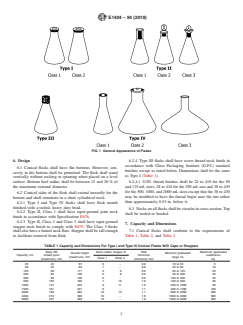
5.1 The general appearance of the flasks shall be as illus-
Standards volume information, refer to the standard’s Document Summary page on
the ASTM website. trated in Fig. 1.
Copyright © ASTM International, 100 Barr Harbor Drive, PO Box C700, West Conshohocken, PA 19428-2959. United States
E1404−94 (2019)
FIG. 1 General Appearance of Flasks
6. Design 6.2.4 Type III flasks shall have screw thread neck finish in
accordance with Glass Packaging Institute (G.P.I.) standard
6.1 Conical flasks shall have flat bottoms. However, con-
finishes except as noted below. Dimensions shall be the same
cavity in the bottom shall be permitted. The flask shall stand
as Type I (Table 1).
vertically without rocking or spinning when placed on a leve
...