

ASTM D6210-17
(Specification)Standard Specification for Fully-Formulated Glycol Base Engine Coolant for Heavy-Duty Engines
General Information
- Abstract
ABSTRACT
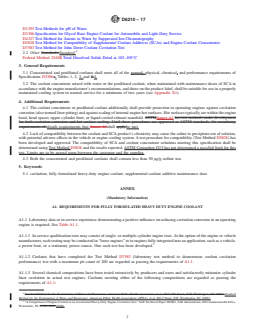
This specification covers the requirements for fully-formulated glycol base coolants for cooling systems of heavy-duty engines. When concentrates are used at 40 to 60 % glycol concentration by volume in water of suitable quality, or when prediluted glycol base engine coolants (50 volume % minimum) are used without further dilution, they will function effectively during both winter and summer to provide protection against corrosion, cavitation, freezing, and boiling. The coolant concentrate mixed with water or the prediluted coolant, when maintained with maintenance doses of supplemental coolant additives (SCA), shall be suitable for use in a properly maintained cooling system in normal service for a minimum of two years. In addition, the coolant concentrate or prediluted coolant shall provide protection in operating engines against cavitation corrosion (also termed liner pitting) and against scaling of internal engine hot surfaces. Hot surfaces typically are within the engine head, head spacer, upper cylinder liner, or liquid cooled exhaust manifold.
SCOPE
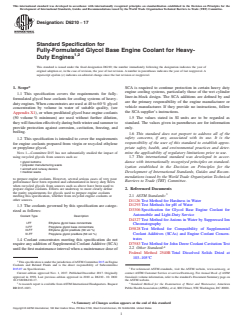
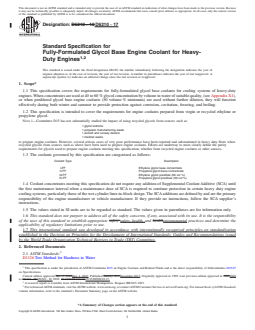
1.1 This specification covers the requirements for fully-formulated glycol base coolants for cooling systems of heavy-duty engines. When concentrates are used at 40 to 60 % glycol concentration by volume in water of suitable quality, (see Appendix X1), or when prediluted glycol base engine coolants (50 volume % minimum) are used without further dilution, they will function effectively during both winter and summer to provide protection against corrosion, cavitation, freezing, and boiling.
1.2 This specification is intended to cover the requirements for engine coolants prepared from virgin or recycled ethylene or propylene glycol.
Note 1: Committee D15 has not substantially studied the impact of using recycled glycols from sources such as:
• glycol bottoms
• polyester manufacturing waste
• aircraft and runway deicers
• medical waste to prepare engine coolants. However, several serious cases of very poor performance have been reported and substantiated in heavy duty fleets when recycled glycols from sources such as above have been used to prepare engine coolants. Efforts are underway to more clearly define the purity requirements for glycols used to prepare engine coolants meeting this specification, whether from recycled engine coolants or other sources.
1.3 The coolants governed by this specification are categorized as follows:
Coolant Type
Description
I-FF
Ethylene glycol base concentrate
II-FF
Propylene glycol base concentrate
III-FF
Ethylene glycol predilute (50 vol %)
IV-FF
Propylene glycol predilute (50 vol %)
1.4 Coolant concentrates meeting this specification do not require any addition of Supplemental Coolant Additive (SCA) until the first maintenance interval when a maintenance dose of SCA is required to continue protection in certain heavy duty engine cooling systems, particularly those of the wet cylinder liner-in-block design. The SCA additions are defined by and are the primary responsibility of the engine manufacturer or vehicle manufacturer. If they provide no instructions, follow the SCA supplier's instructions.
1.5 The values stated in SI units are to be regarded as standard. The values given in parentheses are for information only.
1.6 This standard does not purport to address all of the safety concerns, if any, associated with its use. It is the responsibility of the user of this standard to establish appropriate safety, health, and environmental practices and determine the applicability of regulatory limitations prior to use.
1.7 This international standard was developed in accordance with internationally recognized principles on standardization established in the Decision on Principles for the Development of International Standards, Guides and Recommendations issued by the World Trade Organization Technical Barriers to Trade (TBT) Committee.
- Status
- Published
- Publication Date
- 31-Oct-2017
- Technical Committee
- D15 - Engine Coolants and Related Fluids
- Drafting Committee
- D15.07 - Specifications
Buy Documents

ASTM D6210-17 - Standard Specification for Fully-Formulated Glycol Base Engine Coolant for Heavy-Duty Engines<rangeref></rangeref >
REDLINE ASTM D6210-17 - Standard Specification for Fully-Formulated Glycol Base Engine Coolant for Heavy-Duty Engines<rangeref></rangeref >
Overview
ASTM D6210-17 is a standard specification developed by ASTM International for fully-formulated glycol base engine coolants used in heavy-duty engines. This specification covers the requirements for both glycol concentrate and prediluted formulations designed for effective performance in cooling systems of heavy-duty engines in a wide range of operating environments. The aim is to provide year-round protection against corrosion, cavitation, freezing, and boiling when used with water of suitable quality and proper supplemental coolant additives (SCAs).
These coolants, whether prepared from virgin or recycled ethylene or propylene glycol, are engineered to ensure long service life, minimize maintenance, and protect critical engine components from damage due to extreme temperatures and internal corrosion.
Key Topics
Coolant Types: The standard classifies coolants as follows:
- I-FF: Ethylene glycol base concentrate
- II-FF: Propylene glycol base concentrate
- III-FF: Ethylene glycol predilute (minimum 50% glycol)
- IV-FF: Propylene glycol predilute (minimum 50% glycol)
Performance Criteria:
- Protection against corrosion, cavitation (liner pitting), freezing, and boiling.
- Effective performance maintained for a minimum of two years in properly maintained cooling systems.
- Additives required to prevent hot surface scaling and cavitation corrosion.
- Sulfate levels in both concentrated and prediluted coolants must be under 50 μg/g.
Use of Recycled Glycol:
- The specification covers both virgin and recycled glycol, but cautions about the use of recycled glycols from certain sources due to documented poor performance in heavy-duty fleets.
Supplemental Coolant Additives (SCAs):
- Fully-formulated coolants under this specification do not require SCA addition until the first maintenance interval.
- SCA addition and dosing should follow the cooling system or SCA supplier's recommendations.
Water Quality:
- For optimal performance, water used must meet specific quality standards regarding solids, hardness, chloride, sulfate, and pH.
Applications
ASTM D6210-17 is essential for manufacturers, fleet operators, and service providers dealing with heavy-duty engines in trucks, buses, construction equipment, agricultural machinery, and stationary engines. Its application ensures:
- Enhanced Engine Protection: Prevents common issues like liner pitting, overheating, and deposit formation.
- Year-round Operation: Glycol-based coolants provide freeze protection in winter and prevent boiling in summer.
- Maintenance Efficiency: Defined intervals for SCA maintenance and guidelines for coolant concentration promote longer service intervals.
- Compatibility Testing: Ensures coolant and SCA compatibility to prevent precipitation and maintain coolant efficiency.
By following ASTM D6210-17, organizations can reduce downtime, extend engine life, and maintain compliance with industry standards for coolant quality and engine protection.
Related Standards
Several other ASTM and industry standards support or complement ASTM D6210-17 and are referenced within its scope:
- ASTM D1126: Test Method for Hardness in Water
- ASTM D1293: Test Methods for pH of Water
- ASTM D3306: Specification for Glycol Base Engine Coolant for Automobile and Light-Duty Service
- ASTM D4327: Test Method for Anions in Water by Suppressed Ion Chromatography
- ASTM D5828: Test Method for Compatibility of Supplemental Coolant Additives and Engine Coolant Concentrates
- ASTM D7583: Test Method for John Deere Coolant Cavitation Test
These referenced standards help define testing procedures, water quality criteria, and compatibility assessments crucial for ensuring that fully-formulated glycol base engine coolants deliver the intended performance in heavy-duty applications. For further information or to obtain the most current version, visit the ASTM International website.
Relations
- Effective Date
- 01-Apr-2019
- Effective Date
- 01-Mar-2012
- Effective Date
- 01-Jan-2012
- Effective Date
- 01-Mar-2011
- Effective Date
- 01-Jan-2011
- Effective Date
- 01-Apr-2010
- Effective Date
- 01-Nov-2009
- Effective Date
- 01-Sep-2009
- Effective Date
- 15-May-2008
- Effective Date
- 15-Jan-2008
- Effective Date
- 01-Aug-2007
- Effective Date
- 01-Oct-2005
- Effective Date
- 01-Jan-2005
- Effective Date
- 10-Sep-2003
- Effective Date
- 10-May-2002
Buy Documents
ASTM D6210-17 - Standard Specification for Fully-Formulated Glycol Base Engine Coolant for Heavy-Duty Engines<rangeref></rangeref >
REDLINE ASTM D6210-17 - Standard Specification for Fully-Formulated Glycol Base Engine Coolant for Heavy-Duty Engines<rangeref></rangeref >
Get Certified
Connect with accredited certification bodies for this standard

ECOCERT
Organic and sustainability certification.

Eurofins Food Testing Global
Global leader in food, environment, and pharmaceutical product testing.

Intertek Bangladesh
Intertek certification and testing services in Bangladesh.
Sponsored listings
Frequently Asked Questions
ASTM D6210-17 is a technical specification published by ASTM International. Its full title is "Standard Specification for Fully-Formulated Glycol Base Engine Coolant for Heavy-Duty Engines<rangeref></rangeref >". This standard covers: ABSTRACT This specification covers the requirements for fully-formulated glycol base coolants for cooling systems of heavy-duty engines. When concentrates are used at 40 to 60 % glycol concentration by volume in water of suitable quality, or when prediluted glycol base engine coolants (50 volume % minimum) are used without further dilution, they will function effectively during both winter and summer to provide protection against corrosion, cavitation, freezing, and boiling. The coolant concentrate mixed with water or the prediluted coolant, when maintained with maintenance doses of supplemental coolant additives (SCA), shall be suitable for use in a properly maintained cooling system in normal service for a minimum of two years. In addition, the coolant concentrate or prediluted coolant shall provide protection in operating engines against cavitation corrosion (also termed liner pitting) and against scaling of internal engine hot surfaces. Hot surfaces typically are within the engine head, head spacer, upper cylinder liner, or liquid cooled exhaust manifold. SCOPE 1.1 This specification covers the requirements for fully-formulated glycol base coolants for cooling systems of heavy-duty engines. When concentrates are used at 40 to 60 % glycol concentration by volume in water of suitable quality, (see Appendix X1), or when prediluted glycol base engine coolants (50 volume % minimum) are used without further dilution, they will function effectively during both winter and summer to provide protection against corrosion, cavitation, freezing, and boiling. 1.2 This specification is intended to cover the requirements for engine coolants prepared from virgin or recycled ethylene or propylene glycol. Note 1: Committee D15 has not substantially studied the impact of using recycled glycols from sources such as: • glycol bottoms • polyester manufacturing waste • aircraft and runway deicers • medical waste to prepare engine coolants. However, several serious cases of very poor performance have been reported and substantiated in heavy duty fleets when recycled glycols from sources such as above have been used to prepare engine coolants. Efforts are underway to more clearly define the purity requirements for glycols used to prepare engine coolants meeting this specification, whether from recycled engine coolants or other sources. 1.3 The coolants governed by this specification are categorized as follows: Coolant Type Description I-FF Ethylene glycol base concentrate II-FF Propylene glycol base concentrate III-FF Ethylene glycol predilute (50 vol %) IV-FF Propylene glycol predilute (50 vol %) 1.4 Coolant concentrates meeting this specification do not require any addition of Supplemental Coolant Additive (SCA) until the first maintenance interval when a maintenance dose of SCA is required to continue protection in certain heavy duty engine cooling systems, particularly those of the wet cylinder liner-in-block design. The SCA additions are defined by and are the primary responsibility of the engine manufacturer or vehicle manufacturer. If they provide no instructions, follow the SCA supplier's instructions. 1.5 The values stated in SI units are to be regarded as standard. The values given in parentheses are for information only. 1.6 This standard does not purport to address all of the safety concerns, if any, associated with its use. It is the responsibility of the user of this standard to establish appropriate safety, health, and environmental practices and determine the applicability of regulatory limitations prior to use. 1.7 This international standard was developed in accordance with internationally recognized principles on standardization established in the Decision on Principles for the Development of International Standards, Guides and Recommendations issued by the World Trade Organization Technical Barriers to Trade (TBT) Committee.
ABSTRACT This specification covers the requirements for fully-formulated glycol base coolants for cooling systems of heavy-duty engines. When concentrates are used at 40 to 60 % glycol concentration by volume in water of suitable quality, or when prediluted glycol base engine coolants (50 volume % minimum) are used without further dilution, they will function effectively during both winter and summer to provide protection against corrosion, cavitation, freezing, and boiling. The coolant concentrate mixed with water or the prediluted coolant, when maintained with maintenance doses of supplemental coolant additives (SCA), shall be suitable for use in a properly maintained cooling system in normal service for a minimum of two years. In addition, the coolant concentrate or prediluted coolant shall provide protection in operating engines against cavitation corrosion (also termed liner pitting) and against scaling of internal engine hot surfaces. Hot surfaces typically are within the engine head, head spacer, upper cylinder liner, or liquid cooled exhaust manifold. SCOPE 1.1 This specification covers the requirements for fully-formulated glycol base coolants for cooling systems of heavy-duty engines. When concentrates are used at 40 to 60 % glycol concentration by volume in water of suitable quality, (see Appendix X1), or when prediluted glycol base engine coolants (50 volume % minimum) are used without further dilution, they will function effectively during both winter and summer to provide protection against corrosion, cavitation, freezing, and boiling. 1.2 This specification is intended to cover the requirements for engine coolants prepared from virgin or recycled ethylene or propylene glycol. Note 1: Committee D15 has not substantially studied the impact of using recycled glycols from sources such as: • glycol bottoms • polyester manufacturing waste • aircraft and runway deicers • medical waste to prepare engine coolants. However, several serious cases of very poor performance have been reported and substantiated in heavy duty fleets when recycled glycols from sources such as above have been used to prepare engine coolants. Efforts are underway to more clearly define the purity requirements for glycols used to prepare engine coolants meeting this specification, whether from recycled engine coolants or other sources. 1.3 The coolants governed by this specification are categorized as follows: Coolant Type Description I-FF Ethylene glycol base concentrate II-FF Propylene glycol base concentrate III-FF Ethylene glycol predilute (50 vol %) IV-FF Propylene glycol predilute (50 vol %) 1.4 Coolant concentrates meeting this specification do not require any addition of Supplemental Coolant Additive (SCA) until the first maintenance interval when a maintenance dose of SCA is required to continue protection in certain heavy duty engine cooling systems, particularly those of the wet cylinder liner-in-block design. The SCA additions are defined by and are the primary responsibility of the engine manufacturer or vehicle manufacturer. If they provide no instructions, follow the SCA supplier's instructions. 1.5 The values stated in SI units are to be regarded as standard. The values given in parentheses are for information only. 1.6 This standard does not purport to address all of the safety concerns, if any, associated with its use. It is the responsibility of the user of this standard to establish appropriate safety, health, and environmental practices and determine the applicability of regulatory limitations prior to use. 1.7 This international standard was developed in accordance with internationally recognized principles on standardization established in the Decision on Principles for the Development of International Standards, Guides and Recommendations issued by the World Trade Organization Technical Barriers to Trade (TBT) Committee.
ASTM D6210-17 is classified under the following ICS (International Classification for Standards) categories: 71.100.45 - Refrigerants and antifreezes. The ICS classification helps identify the subject area and facilitates finding related standards.
ASTM D6210-17 has the following relationships with other standards: It is inter standard links to ASTM D3306-19, ASTM D1126-12, ASTM D1293-12, ASTM D4327-11, ASTM D5828-97(2011)e1, ASTM D3306-10, ASTM D7583-09, ASTM D3306-09, ASTM D3306-08a, ASTM D3306-08, ASTM D1126-02(2007)e1, ASTM D3306-05, ASTM D1293-99(2005), ASTM D3306-03, ASTM D1126-02. Understanding these relationships helps ensure you are using the most current and applicable version of the standard.
ASTM D6210-17 is available in PDF format for immediate download after purchase. The document can be added to your cart and obtained through the secure checkout process. Digital delivery ensures instant access to the complete standard document.
Standards Content (Sample)
This international standard was developed in accordance with internationally recognized principles on standardization established in the Decision on Principles for the
Development of International Standards, Guides and Recommendations issued by the World Trade Organization Technical Barriers to Trade (TBT) Committee.
Designation:D6210 −17
Standard Specification for
Fully-Formulated Glycol Base Engine Coolant for Heavy-
1,2
Duty Engines
This standard is issued under the fixed designation D6210; the number immediately following the designation indicates the year of
original adoption or, in the case of revision, the year of last revision.Anumber in parentheses indicates the year of last reapproval.A
superscript epsilon (´) indicates an editorial change since the last revision or reapproval.
1. Scope* SCA is required to continue protection in certain heavy duty
engine cooling systems, particularly those of the wet cylinder
1.1 This specification covers the requirements for fully-
liner-in-block design. The SCA additions are defined by and
formulated glycol base coolants for cooling systems of heavy-
are the primary responsibility of the engine manufacturer or
duty engines.When concentrates are used at 40 to 60% glycol
vehicle manufacturer. If they provide no instructions, follow
concentration by volume in water of suitable quality, (see
the SCA supplier’s instructions.
Appendix X1), or when prediluted glycol base engine coolants
(50 volume% minimum) are used without further dilution, 1.5 The values stated in SI units are to be regarded as
theywillfunctioneffectivelyduringbothwinterandsummerto standard. The values given in parentheses are for information
provide protection against corrosion, cavitation, freezing, and only.
boiling.
1.6 This standard does not purport to address all of the
safety concerns, if any, associated with its use. It is the
1.2 This specification is intended to cover the requirements
responsibility of the user of this standard to establish appro-
for engine coolants prepared from virgin or recycled ethylene
priate safety, health, and environmental practices and deter-
or propylene glycol.
NOTE 1—Committee D15 has not substantially studied the impact of mine the applicability of regulatory limitations prior to use.
using recycled glycols from sources such as:
1.7 This international standard was developed in accor-
glycol bottoms
dance with internationally recognized principles on standard-
polyester manufacturing waste
ization established in the Decision on Principles for the
aircraft and runway deicers
Development of International Standards, Guides and Recom-
medical waste
mendations issued by the World Trade Organization Technical
to prepare engine coolants. However, several serious cases of very poor
Barriers to Trade (TBT) Committee.
performance have been reported and substantiated in heavy duty fleets
when recycled glycols from sources such as above have been used to
prepare engine coolants. Efforts are underway to more clearly define 2. Referenced Documents
the purity requirements for glycols used to prepare engine coolants
2.1 ASTM Standards:
meeting this specification, whether from recycled engine coolants or
other sources.
D1126Test Method for Hardness in Water
D1293Test Methods for pH of Water
1.3 The coolants governed by this specification are catego-
D3306Specification for Glycol Base Engine Coolant for
rized as follows:
Automobile and Light-Duty Service
Coolant Type Description
D4327Test Method forAnions in Water by Suppressed Ion
I-FF Ethylene glycol base concentrate
Chromatography
II-FF Propylene glycol base concentrate
D5828Test Method for Compatibility of Supplemental
III-FF Ethylene glycol predilute (50 vol %)
IV-FF Propylene glycol predilute (50 vol %) Coolant Additives (SCAs) and Engine Coolant Concen-
trates
1.4 Coolant concentrates meeting this specification do not
D7583Test Method for John Deere Coolant Cavitation Test
require any addition of Supplemental CoolantAdditive (SCA)
2.2 Other Standard:
untilthefirstmaintenanceintervalwhenamaintenancedoseof
Federal Method 2540BTotal Dissolved Solids Dried at
103–105°C
ThisspecificationisunderthejurisdictionofASTMCommitteeD15onEngine
Coolants and Related Fluids and is the direct responsibility of Subcommittee
D15.07 on Specifications. For referenced ASTM standards, visit the ASTM website, www.astm.org, or
Current edition approved Nov. 1, 2017. PublishedDecember 2017. Originally contact ASTM Customer Service at service@astm.org. For Annual Book of ASTM
approved in 1998. Last previous edition approved in 2010 as D6210-10. DOI: Standards volume information, refer to the standard’s Document Summary page on
10.1520/D6210-17. the ASTM website.
2 4
Aresearch report is available fromASTM International Headquarters. Request Standard Method for the Examination of Water and Wastewater, American
RR:D15-1023. PublicHealthAssociation(APHA),etal,800IStreet,NW,Washington,DC20001.
*A Summary of Changes section appears at the end of this standard
Copyright © ASTM International, 100 Barr Harbor Drive, PO Box C700, West Conshohocken, PA 19428-2959. United States
D6210−17
3. General Requirements 4.2 Lack of compatibility between the coolant and SCA
product’s chemistry may cause the solute to precipitate out of
3.1 Concentrated and prediluted coolants shall meet all of
solution, with potential adverse effects in the vehicle or engine
the general, physical, chemical, and performance requirements
cooling system. A test procedure for compatibility (Test
of Specification D3306, Tables 1, 2, 3, and 4.
Method D5828) has been developed and approved. The com-
3.2 The coolant concentrate mixed with water or the predi-
patibility of SCA and coolant concentrate solutions meeting
luted coolant, when maintained with maintenance doses of
this specification shall be determined using Test Method
SCA in accordance with the engine manufacturer’s
D5828andtheresultsreported.ASTMCommitteeD15hasnot
recommendations, and those on the product label, shall be
determinedapass/faillimitforthistest.Limitsaretobeagreed
suitable for use in a properly maintained cooling system in
upon between the customer and the supplier.
normalserviceforaminimumoftwoyears(seeAppendixX1).
4.3 Both the concentrated and prediluted coolants shall
4. Additional Requirements
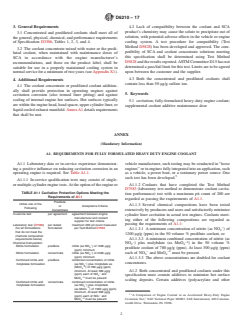
contain less than 50 µg/g sulfate ion.
4.1 The coolant concentrate or prediluted coolant addition-
ally shall provide protection in operating engines against
5. Keywords
cavitation corrosion (also termed liner pitting) and against
scaling of internal engine hot surfaces. Hot surfaces typically
5.1 cavitation; fully-formulated heavy-duty engine coolant;
arewithintheenginehead,headspacer,uppercylinderliner,or
supplemental coolant additive maintenance dose
liquidcooledexhaustmanifold.AnnexA1detailsrequirements
that shall be met.
ANNEX
(Mandatory Information)
A1. REQUIREMENTS FOR FULLY FORMULATED HEAVY DUTY ENGINE COOLANT
A1.1 Laboratory data or in-service experience demonstrat- vehicle manufacturer, such testing may be conducted in “loose
ing a positive influence on reducing cavitation corrosion in an engines”orinenginesfullyintegratedintoanapplication,such
operating engine is required. See Table A1.1. as a vehicle, a power boat, or a stationary power source. One
such test has been developed.
A1.1.1 In-service qualification tests may consist of single-
ormultiple-cylinderenginetests.Attheoptionoftheengineor A1.1.2 Coolants that have completed the Test Method
D7583 (laboratory test method to demonstrate coolant cavita-
TABLE A1.1 Cavitation Protection Options Meeting the
tion performance) test with a maximum pit count of 200 are
Requirements of A1.1
regarded as passing the requirements of A1.1.
Predilute
Utilize one of the
A1.1.3 Several chemical compositions have been tested
or Acceptance Criteria
Following
Concentrate
extensively by producers and users and satisfactorily minimize
In-service test per agreement agreement between engine
cylinder liner cavitation in actual test engines. Coolants meet-
manufacturer and coolant
ing either of the following compositions are regarded as
supplier for test criteria
passing the requirements of A1.1:
Laboratory test (D7583) per tested maximum 200 pit count measured
−
(for all formulations formulation per Test Method D7583
A1.1.3.1 A minimum concentration of nitrite (as NO )of
that do not meet the
1200 µg/g (ppm) in the 50 volume % predilute coolant, or
chemical composition
A1.1.3.2 A minimum combined concentration of nitrite (as
requirements below)
− −2
Chemical Composition
NO ) plus molybdate (as MoO ) in the 50 volume %
2 4
−
Nitrite formulation predilute nitrite (as NO ) of 1200 µg/g
predilute coolant of 780 µg/g (ppm). At least 300 µg/g (ppm)
(ppm) minimum
− −2
−
each of NO and MoO must be present.
Nitrite formulation concentrat
...
This document is not an ASTM standard and is intended only to provide the user of an ASTM standard an indication of what changes have been made to the previous version. Because
it may not be technically possible to adequately depict all changes accurately, ASTM recommends that users consult prior editions as appropriate. In all cases only the current version
of the standard as published by ASTM is to be considered the official document.
Designation: D6210 − 10 D6210 − 17
Standard Specification for
Fully-Formulated Glycol Base Engine Coolant for Heavy-
1,2
Duty Engines
This standard is issued under the fixed designation D6210; the number immediately following the designation indicates the year of
original adoption or, in the case of revision, the year of last revision. A number in parentheses indicates the year of last reapproval. A
superscript epsilon (´) indicates an editorial change since the last revision or reapproval.
1. Scope*
1.1 This specification covers the requirements for fully-formulated glycol base coolants for cooling systems of heavy-duty
engines. When concentrates are used at 40 to 60 % glycol concentration by volume in water of suitable quality, (see Appendix X1),
or when prediluted glycol base engine coolants (50 volume % minimum) are used without further dilution, they will function
effectively during both winter and summer to provide protection against corrosion, cavitation, freezing, and boiling.
1.2 This specification is intended to cover the requirements for engine coolants prepared from virgin or recycled ethylene or
propylene glycol.
NOTE 1—Committee D15 has not substantially studied the impact of using recycled glycols from sources such as:
• glycol bottoms
• polyester manufacturing waste
• aircraft and runway deicers
• medical waste
to prepare engine coolants. However, several serious cases of very poor performance have been reported and substantiated in heavy duty fleets when
recycled glycols from sources such as above have been used to prepare engine coolants. Efforts are underway to more clearly define the purity
requirements for glycols used to prepare engine coolants meeting this specification, whether from recycled engine coolants or other sources.
1.3 The coolants governed by this specification are categorized as follows:
Coolant Type Description
I-FF Ethylene glycol base concentrate
II-FF Propylene glycol base concentrate
III-FF Ethylene glycol predilute (50 vol %)
IV-FF Propylene glycol predilute (50 vol %)
1.4 Coolant concentrates meeting this specification do not require any addition of Supplemental Coolant Additive (SCA) until
the first maintenance interval when a maintenance dose of SCA is required to continue protection in certain heavy duty engine
cooling systems, particularly those of the wet cylinder liner-in-block design. The SCA additions are defined by and are the primary
responsibility of the engine manufacturer or vehicle manufacturer. If they provide no instructions, follow the SCA supplier’s
instructions.
1.5 The values stated in SI units are to be regarded as standard. The values given in parentheses are for information only.
1.6 This standard does not purport to address all of the safety concerns, if any, associated with its use. It is the responsibility
of the user of this standard to establish appropriate safety safety, health, and healthenvironmental practices and determine the
applicability of regulatory limitations prior to use.
1.7 This international standard was developed in accordance with internationally recognized principles on standardization
established in the Decision on Principles for the Development of International Standards, Guides and Recommendations issued
by the World Trade Organization Technical Barriers to Trade (TBT) Committee.
2. Referenced Documents
2.1 ASTM Standards:
D1126 Test Method for Hardness in Water
This specification is under the jurisdiction of ASTM Committee D15 on Engine Coolants and Related Fluids and is the direct responsibility of Subcommittee D15.07
on Specifications.
Current edition approved Dec. 1, 2010Nov. 1, 2017. Published January 2011December 2017. Originally approved in 1998. Last previous edition approved in 20082010
as D6210 - 08.D6210 - 10. DOI: 10.1520/D6210-10.10.1520/D6210-17.
A research report is available from ASTM International Headquarters. Request RR:D15-1023.
For referenced ASTM standards, visit the ASTM website, www.astm.org, or contact ASTM Customer Service at service@astm.org. For Annual Book of ASTM Standards
volume information, refer to the standard’s Document Summary page on the ASTM website.
*A Summary of Changes section appears at the end of this standard
Copyright © ASTM International, 100 Barr Harbor Drive, PO Box C700, West Conshohocken, PA 19428-2959. United States
D6210 − 17
D1293 Test Methods for pH of Water
D3306 Specification for Glycol Base Engine Coolant for Automobile and Light-Duty Service
D4327 Test Method for Anions in Water by Suppressed Ion Chromatography
D5828 Test Method for Compatibility of Supplemental Coolant Additives (SCAs) and Engine Coolant Concentrates
D7583 Test Method for John Deere Coolant Cavitation Test
2.2 Other Standards:Standard:
Federal Method 2540B Total Dissolved Solids Dried at 103–105°C
3. General Requirements
3.1 Concentrated and prediluted coolants shall meet all of the general, physical, chemical, and performance requirements of
Specification D3306.,, Tables 1, 2, 3, and 3.4.
3.2 The coolant concentrate mixed with water or the prediluted coolant, when maintained with maintenance doses of SCA in
accordance with the engine manufacturer’s recommendations, and those on the product label, shall be suitable for use in a properly
maintained cooling system in normal service for a minimum of two years (see Appendix X1).
4. Additional Requirements
4.1 The coolant concentrate or prediluted coolant additionally shall provide protection in operating engines against cavitation
corrosion (also termed liner pitting) and against scaling of internal engine hot surfaces. Hot surfaces typically are within the engine
head, head spacer, upper cylinder liner, or liquid cooled exhaust manifold. ASTMAnnex A1 has test methods under development
for both cavitation corrosion and hot surface scaling. Until these procedures are approved as ASTM standards, the mandatory
requirements of details requirements that Annex A1shall apply.be met.
4.2 Lack of compatibility between the coolant and SCA product’s chemistry may cause the solute to precipitate out of solution,
with potential adverse effects in the vehicle or engine cooling system. A test procedure for compatibility (Test Method D5828) has
been developed and approved. The compatibility of SCA and coolant concentrate solutions meeting this specification shall be
determined using Test Method D5828 and the results reported. ASTM Committee D15 has not determined a pass/fail limit for this
test. Limits are to be agreed upon between the customer and the supplier.
4.3 Both the concentrated and prediluted coolants shall contain less than 50 μg/g sulfate ion.
5. Keywords
5.1 cavitation; fully-formulated heavy-duty engine coolant; supplemental coolant additive maintenance dose
ANNEX
(Mandatory Information)
A1. REQUIREMENTS FOR FULLY FORMULATED HEAVY DUTY ENGINE COOLANT
A1.1 Laboratory data or in-service experience demonstrating a positive influence on reducing cavitation corrosion in an operating
engine is required. See Table A1.1.
A1.1.1 In-service qualification tests may consist of single- or multiple-cylinder engine tests. At the option of the engine or vehicle
manufacturer, such testing may be conducted in “loose engines” or in engines fully integrated into an application, such as a vehicle,
a power boat, or a stationary power source. One such test has been developed.
A1.1.2 Coolants that have completed the Test Method D7583 (laboratory test method to demonstrate coolant cavitation
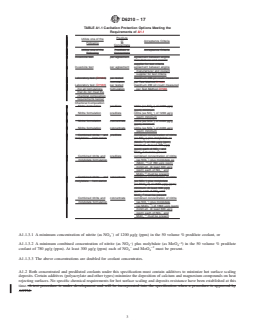
performance) test with a maximum pit count of 200 are regarded as passing the requirements of A1.1.
A1.1.3 Several chemical compositions have been tested extensively by producers and users and satisfactorily minimize cylinder
liner cavitation in actual test engines. Coolants meeting either of the following compositions are regarded as passing the
requirements of A1.1:
Standard Method for the Examination of Water and Wastewater, American Public Health Association, et al, 1015 15th Street, N.W. Washington, DC 20005 Standard
Method for the Examination of Water and Wastewater, American Public Health Association (APHA), et al, 800 I Street, NW, Washington, DC 20001.
“A Comparison of Engine Coolant in an Accelerated Heavy-Duty Engine Cavitation Test,” SAE Technical Paper 960883, SAE International, 400 Commonwealth Drive,
Warrendale, PA 15096–0001.15096.
D6210 − 17
TABLE A1.1 Cavitation Protection Options Meeting the
Requirements of A1.1
Predilute
Utilize one of the
or Acceptance Criteria
Following
Concentrate
Utilize one of the Predilute or Acceptance Criteria
Following Concentrate
In-service test per agreement agreement between engine
manufacturer and coolant
supplier for test criteria
In-service test per agreement agreement between engine
manufacturer and coolant
supplier for test criteria
Laboratory test (D7583) per tested maximum 200 pit count measured
formulation per Test Method D7583
Laboratory test (D7583) per tested maximum 200 pit count measured
(for all formulations formulation per Test Method D7583
that do not meet the
chemical composition
requirements below)
Chemical Composition
−
Nitrite formulation predilute nitrite (as NO ) of 1200 μg/g
(ppm) minimum
−
Nitrite formulation predilute nitrite (as NO ) of 1200 μg/g
(ppm) minimum
−
Nitrite formulation concentrate nitrite (as NO ) of 2400 μg/g
(ppm) minimum
−
Nitrite formulation concentrate nitrite (as NO ) of 2400 μg/g
(ppm) minimum
Combined nitrite and predilute combined concentration of nitrite
−
molybdate formulation (as NO ) plus molybdate as
–2
(MoO ) of 780 μg/g (ppm)
minimum. At least 300 μg/g
−
(ppm) each of NO and
–2
MoO must be present
Combined nitrite and predilute combined concentration of nitrite
−
molybdate formulation (as NO ) plus molybdate as
–2
(MoO ) of 780 μg/g (ppm)
minimum. At least 300 μg/g
−
(p
...