

ASTM B939-21
(Test Method)Standard Test Method for Radial Crushing Strength, K, of Powder Metallurgy (PM) Bearings and Structural Materials
General Information
- Abstract
SIGNIFICANCE AND USE
5.1 The radial crushing strength test is a destructive procedure used to determine a material strength characteristic of PM bearings and hollow cylindrical test specimens. These data can be used to grade, classify, and evaluate the materials.
5.2 The PM bearing Specifications B438 and B439 require the use of this test method as an acceptance test for the strength of oil-impregnated sintered bearings.
5.3 This test method may be used by powder producers and parts manufacturers as a lot acceptance test for metal powders and lubricated powder mixtures intended for the production of porous parts.
5.4 Companies in the PM industry use this test as a manufacturing control test because it is appropriate for production practices.
5.5 Radial crushing strength is a property of the PM material but is not a design value. However, experience has shown that the radial crushing strength of a material is approximately twice the ultimate tensile strength.
SCOPE
1.1 This test method covers the equipment and laboratory procedure for the determination of the radial crushing strength of materials using either a plain powder metallurgy (PM) bearing or a thin-walled hollow cylindrical test specimen. This is a destructive test that produces quantitative results.
1.2 Limitations:
1.2.1 The principle of this procedure is based on the material being tested having minimal ductility. The permanent deflection of the cylinder during the test should not exceed 10 % of the outside diameter.
1.2.2 The radial crushing strength test results should be used only as a guide if the test specimen has a wall thickness that is greater than one-third of the outside diameter. These test results should then only be used for comparison with data from the test specimens of like materials and similar dimensions.
1.3 Units—With the exception of the values for density and the mass used to determine density, for which the use of the gram per cubic centimetre (g/cm3) and gram (g) units are the industry standard, the values stated in inch-pound units are to be regarded as standard. The values given in parentheses are mathematical conversions to SI units that are provided for information only and are not considered standard.
1.4 This standard does not purport to address all of the safety concerns, if any, associated with its use. It is the responsibility of the user of this standard to establish appropriate safety, health, and environmental practices and determine the applicability of regulatory limitations prior to use.
1.5 This international standard was developed in accordance with internationally recognized principles on standardization established in the Decision on Principles for the Development of International Standards, Guides and Recommendations issued by the World Trade Organization Technical Barriers to Trade (TBT) Committee.
- Status
- Published
- Publication Date
- 31-Mar-2021
- Technical Committee
- B09 - Metal Powders and Metal Powder Products
- Drafting Committee
- B09.04 - Bearings
Buy Documents

ASTM B939-21 - Standard Test Method for Radial Crushing Strength, <emph type="bdit">K</emph>, of Powder Metallurgy (PM) Bearings and Structural Materials
REDLINE ASTM B939-21 - Standard Test Method for Radial Crushing Strength, <emph type="bdit">K</emph>, of Powder Metallurgy (PM) Bearings and Structural Materials
Overview
ASTM B939-21: Standard Test Method for Radial Crushing Strength, K, of Powder Metallurgy (PM) Bearings and Structural Materials specifies the procedure for measuring the radial crushing strength of powder metallurgy bearings and hollow cylindrical specimens. This test is essential for evaluating the quality and classification of PM materials, specifically for oil-impregnated sintered bearings. The standard outlines methods for preparing specimens, performing destructive testing, and reporting precise, quantitative results, serving as a critical quality and manufacturing control for the powder metallurgy industry.
Key Topics
Test Scope and Significance
- The procedure applies to plain PM bearings and thin-walled cylindrical specimens, ensuring a consistent method for determining material strength characteristics.
- Radial crushing strength is a critical measure but not a direct design value; typically, it is about twice the ultimate tensile strength.
- The test is destructive, providing quantitative data for grading and classification purposes.
Specimen Requirements
- Suitable for materials exhibiting minimal ductility.
- Specimens must be thin-walled (wall thickness less than one-third, ideally less than 30%, of the outside diameter).
- The cylinder’s permanent deflection during testing should not exceed 10% of the outer diameter.
- Acceptance limited to comparisons among similar materials and sizes when wall thickness exceeds recommended proportions.
Precision and Measurement
- Measurements are taken using precise micrometers, calipers, and plug gauges.
- Testing machines must be capable of finely controlled compressive force application.
- Repeatability and reproducibility are documented, supporting confidence in test results.
Reporting and Safety
- Clear guidance on reporting average values from multiple measurements.
- Recommendation to report specimen origin, processing, and deviations from test methods.
- Users must ensure compliance with local safety, health, and environmental regulations.
Applications
Acceptance Testing for PM Bearings
- Mandated by ASTM standards B438 and B439 for verifying the strength of oil-impregnated bronze-base and iron-base PM bearings.
- Used during lot acceptance by powder producers and manufacturers to ensure quality of metal powders and lubricated powder blends.
Manufacturing Control
- Employed as an in-process control test in PM component manufacturing environments to maintain consistent product quality.
Material Evaluation and Classification
- Facilitates accurate grading, classification, and comparison of powder metallurgy materials.
Research and Quality Assurance
- Offers a standardized approach for laboratories and research institutions to assess strength characteristics and conduct interlaboratory comparisons.
Related Standards
- ASTM B243 – Terminology of Powder Metallurgy: Defines relevant PM terms used in testing and reporting.
- ASTM B438 – Specification for Bronze-Base PM Bearings (Oil-Impregnated): Calls for the use of the radial crushing strength test for acceptance.
- ASTM B439 – Specification for Iron-Base PM Bearings (Oil-Impregnated): Requires this test method for compliance.
- ASTM B925 – Practices for Production and Preparation of PM Test Specimens: Describes procedures for specimen preparation.
- ASTM E456 – Terminology Relating to Quality and Statistics: Provides statistical definitions for interpreting test results.
- ASTM E691 – Practice for Conducting Interlaboratory Studies: Standard for assessing test precision.
- MPIF Standard 55 – Determination of Radial Crush Strength (K) of PM Test Specimens: An MPIF method directly related to the procedures specified in ASTM B939-21.
By adhering to the procedures outlined in ASTM B939-21, manufacturers, laboratories, and researchers can reliably assess the radial crushing strength of powder metallurgy bearings and structural materials, ensuring quality control, material certification, and standardized reporting across the industry. This standard is essential for maintaining consistency, product reliability, and facilitating regulatory compliance within the powder metallurgy sector.
Relations
- Effective Date
- 01-Apr-2022
- Effective Date
- 01-Oct-2018
- Effective Date
- 01-Oct-2017
- Effective Date
- 01-Oct-2017
- Effective Date
- 01-Jul-2016
- Effective Date
- 15-Nov-2013
- Effective Date
- 15-Nov-2013
- Effective Date
- 15-Nov-2013
- Effective Date
- 15-Nov-2013
- Effective Date
- 01-Nov-2013
- Effective Date
- 15-Aug-2013
- Effective Date
- 01-May-2013
- Effective Date
- 01-Apr-2013
- Effective Date
- 15-Jul-2012
- Effective Date
- 01-May-2012
Buy Documents
ASTM B939-21 - Standard Test Method for Radial Crushing Strength, <emph type="bdit">K</emph>, of Powder Metallurgy (PM) Bearings and Structural Materials
REDLINE ASTM B939-21 - Standard Test Method for Radial Crushing Strength, <emph type="bdit">K</emph>, of Powder Metallurgy (PM) Bearings and Structural Materials
Get Certified
Connect with accredited certification bodies for this standard

Element Materials Technology
Materials testing and product certification.

Inštitut za kovinske materiale in tehnologije
Institute of Metals and Technology. Materials testing, metallurgical analysis, NDT.
Sponsored listings
Frequently Asked Questions
ASTM B939-21 is a standard published by ASTM International. Its full title is "Standard Test Method for Radial Crushing Strength, <emph type="bdit">K</emph>, of Powder Metallurgy (PM) Bearings and Structural Materials". This standard covers: SIGNIFICANCE AND USE 5.1 The radial crushing strength test is a destructive procedure used to determine a material strength characteristic of PM bearings and hollow cylindrical test specimens. These data can be used to grade, classify, and evaluate the materials. 5.2 The PM bearing Specifications B438 and B439 require the use of this test method as an acceptance test for the strength of oil-impregnated sintered bearings. 5.3 This test method may be used by powder producers and parts manufacturers as a lot acceptance test for metal powders and lubricated powder mixtures intended for the production of porous parts. 5.4 Companies in the PM industry use this test as a manufacturing control test because it is appropriate for production practices. 5.5 Radial crushing strength is a property of the PM material but is not a design value. However, experience has shown that the radial crushing strength of a material is approximately twice the ultimate tensile strength. SCOPE 1.1 This test method covers the equipment and laboratory procedure for the determination of the radial crushing strength of materials using either a plain powder metallurgy (PM) bearing or a thin-walled hollow cylindrical test specimen. This is a destructive test that produces quantitative results. 1.2 Limitations: 1.2.1 The principle of this procedure is based on the material being tested having minimal ductility. The permanent deflection of the cylinder during the test should not exceed 10 % of the outside diameter. 1.2.2 The radial crushing strength test results should be used only as a guide if the test specimen has a wall thickness that is greater than one-third of the outside diameter. These test results should then only be used for comparison with data from the test specimens of like materials and similar dimensions. 1.3 Units—With the exception of the values for density and the mass used to determine density, for which the use of the gram per cubic centimetre (g/cm3) and gram (g) units are the industry standard, the values stated in inch-pound units are to be regarded as standard. The values given in parentheses are mathematical conversions to SI units that are provided for information only and are not considered standard. 1.4 This standard does not purport to address all of the safety concerns, if any, associated with its use. It is the responsibility of the user of this standard to establish appropriate safety, health, and environmental practices and determine the applicability of regulatory limitations prior to use. 1.5 This international standard was developed in accordance with internationally recognized principles on standardization established in the Decision on Principles for the Development of International Standards, Guides and Recommendations issued by the World Trade Organization Technical Barriers to Trade (TBT) Committee.
SIGNIFICANCE AND USE 5.1 The radial crushing strength test is a destructive procedure used to determine a material strength characteristic of PM bearings and hollow cylindrical test specimens. These data can be used to grade, classify, and evaluate the materials. 5.2 The PM bearing Specifications B438 and B439 require the use of this test method as an acceptance test for the strength of oil-impregnated sintered bearings. 5.3 This test method may be used by powder producers and parts manufacturers as a lot acceptance test for metal powders and lubricated powder mixtures intended for the production of porous parts. 5.4 Companies in the PM industry use this test as a manufacturing control test because it is appropriate for production practices. 5.5 Radial crushing strength is a property of the PM material but is not a design value. However, experience has shown that the radial crushing strength of a material is approximately twice the ultimate tensile strength. SCOPE 1.1 This test method covers the equipment and laboratory procedure for the determination of the radial crushing strength of materials using either a plain powder metallurgy (PM) bearing or a thin-walled hollow cylindrical test specimen. This is a destructive test that produces quantitative results. 1.2 Limitations: 1.2.1 The principle of this procedure is based on the material being tested having minimal ductility. The permanent deflection of the cylinder during the test should not exceed 10 % of the outside diameter. 1.2.2 The radial crushing strength test results should be used only as a guide if the test specimen has a wall thickness that is greater than one-third of the outside diameter. These test results should then only be used for comparison with data from the test specimens of like materials and similar dimensions. 1.3 Units—With the exception of the values for density and the mass used to determine density, for which the use of the gram per cubic centimetre (g/cm3) and gram (g) units are the industry standard, the values stated in inch-pound units are to be regarded as standard. The values given in parentheses are mathematical conversions to SI units that are provided for information only and are not considered standard. 1.4 This standard does not purport to address all of the safety concerns, if any, associated with its use. It is the responsibility of the user of this standard to establish appropriate safety, health, and environmental practices and determine the applicability of regulatory limitations prior to use. 1.5 This international standard was developed in accordance with internationally recognized principles on standardization established in the Decision on Principles for the Development of International Standards, Guides and Recommendations issued by the World Trade Organization Technical Barriers to Trade (TBT) Committee.
ASTM B939-21 is classified under the following ICS (International Classification for Standards) categories: 77.160 - Powder metallurgy. The ICS classification helps identify the subject area and facilitates finding related standards.
ASTM B939-21 has the following relationships with other standards: It is inter standard links to ASTM E456-13a(2022)e1, ASTM B243-18, ASTM E456-13A(2017)e1, ASTM E456-13A(2017)e3, ASTM B243-16, ASTM E456-13ae1, ASTM E456-13a, ASTM E456-13ae2, ASTM E456-13ae3, ASTM B243-13, ASTM E456-13, ASTM E691-13, ASTM B438-13, ASTM B243-12, ASTM E456-12e1. Understanding these relationships helps ensure you are using the most current and applicable version of the standard.
ASTM B939-21 is available in PDF format for immediate download after purchase. The document can be added to your cart and obtained through the secure checkout process. Digital delivery ensures instant access to the complete standard document.
Standards Content (Sample)
This international standard was developed in accordance with internationally recognized principles on standardization established in the Decision on Principles for the
Development of International Standards, Guides and Recommendations issued by the World Trade Organization Technical Barriers to Trade (TBT) Committee.
Designation: B939 − 21
Standard Test Method for
Radial Crushing Strength,K, of Powder Metallurgy (PM)
Bearings and Structural Materials
This standard is issued under the fixed designation B939; the number immediately following the designation indicates the year of
original adoption or, in the case of revision, the year of last revision.Anumber in parentheses indicates the year of last reapproval.A
superscript epsilon (´) indicates an editorial change since the last revision or reapproval.
1. Scope* 2. Referenced Documents
2.1 ASTM Standards:
1.1 This test method covers the equipment and laboratory
procedure for the determination of the radial crushing strength B243Terminology of Powder Metallurgy
B438Specification for Bronze-Base Powder Metallurgy
of materials using either a plain powder metallurgy (PM)
bearing or a thin-walled hollow cylindrical test specimen.This (PM) Bearings (Oil-Impregnated)
B439Specification for Iron-Base Powder Metallurgy (PM)
is a destructive test that produces quantitative results.
Bearings (Oil-Impregnated)
1.2 Limitations:
B925Practices for Production and Preparation of Powder
1.2.1 The principle of this procedure is based on the
Metallurgy (PM) Test Specimens
material being tested having minimal ductility. The permanent
E456Terminology Relating to Quality and Statistics
deflection of the cylinder during the test should not exceed
E691Practice for Conducting an Interlaboratory Study to
10% of the outside diameter.
Determine the Precision of a Test Method
1.2.2 Theradialcrushingstrengthtestresultsshouldbeused
2.2 MPIF Standard:
only as a guide if the test specimen has a wall thickness that is
MPIF Standard 55Determination of Radial Crush Strength
greaterthanone-thirdoftheoutsidediameter.Thesetestresults
(K) of Powder Metallurgy (PM) Test Specimens
shouldthenonlybeusedforcomparisonwithdatafromthetest
specimens of like materials and similar dimensions.
3. Terminology
1.3 Units—With the exception of the values for density and
3.1 Definitions—Definitions of powder metallurgy (PM)
the mass used to determine density, for which the use of the
terms can be found in Terminology B243. Additional descrip-
gram per cubic centimetre (g/cm ) and gram (g) units are the
tive information is available under “General Information on
industry standard, the values stated in inch-pound units are to
PM” on the ASTM B09 web page.
be regarded as standard. The values given in parentheses are
mathematical conversions to SI units that are provided for
4. Summary of Test Method
information only and are not considered standard.
4.1 Radial crushing strength is determined by subjecting a
1.4 This standard does not purport to address all of the
plain sleeve bearing or a thin-walled cylindrical test specimen
safety concerns, if any, associated with its use. It is the
to a controlled compressive force applied perpendicular to its
responsibility of the user of this standard to establish appro-
central axis under uniformly increasing load until fracture
priate safety, health, and environmental practices and deter-
occurs.
mine the applicability of regulatory limitations prior to use.
4.2 The term “radial crushing strength,” as used in this test
1.5 This international standard was developed in accor-
method is the stress at fracture calculated from the breaking
dance with internationally recognized principles on standard-
load and the dimensions of the test specimen.
ization established in the Decision on Principles for the
Development of International Standards, Guides and Recom-
5. Significance and Use
mendations issued by the World Trade Organization Technical
5.1 The radial crushing strength test is a destructive proce-
Barriers to Trade (TBT) Committee.
dureusedtodetermineamaterialstrengthcharacteristicofPM
1 2
This test method is under the jurisdiction of ASTM Committee B09 on Metal For referenced ASTM standards, visit the ASTM website, www.astm.org, or
Powders and Metal Powder Products and is the direct responsibility of Subcom- contact ASTM Customer Service at service@astm.org. For Annual Book of ASTM
mittee B09.04 on Bearings. Standards volume information, refer to the standard’s Document Summary page on
Current edition approved April 1, 2021. Published April 2021. Originally the ASTM website.
approved in 2005. Last previous edition approved in 2015 as B939–15. DOI: Available from Metal Powder Industries Federation (MPIF), 105 College Rd.
10.1520/B0939-21. East, Princeton, NJ 08540, http://www.mpif.org.
*A Summary of Changes section appears at the end of this standard
Copyright © ASTM International, 100 Barr Harbor Drive, PO Box C700, West Conshohocken, PA 19428-2959. United States
B939 − 21
bearings and hollow cylindrical test specimens.These data can
be used to grade, classify, and evaluate the materials.
5.2 The PM bearing Specifications B438 and B439 require
theuseofthistestmethodasanacceptancetestforthestrength
of oil-impregnated sintered bearings.
5.3 This test method may be used by powder producers and
parts manufacturers as a lot acceptance test for metal powders
and lubricated powder mixtures intended for the production of
porous parts.
5.4 Companies in the PM industry use this test as a
manufacturing control test because it is appropriate for pro-
duction practices.
5.5 Radial crushing strength is a property of the PM
material but is not a design value. However, experience has
shown that the radial crushing strength of a material is
approximately twice the ultimate tensile strength.
6. Apparatus
6.1 Measuring Equipment—Micrometers,calipers,andplug
gages capable of measuring the inside and outside diameters
and length of the test specimen to the nearest 0.001 in.
(0.03mm).
6.2 Compression Testing Machine—Acompressionmachine
readable to 0.1% of the full scale reading, and capable of
applying a controlled breaking force to the test specimen. Use
the lowest range that can produce a measurable result.
6.3 Loading Plates—Two loading plates—ground, flat,
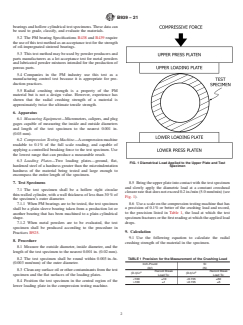
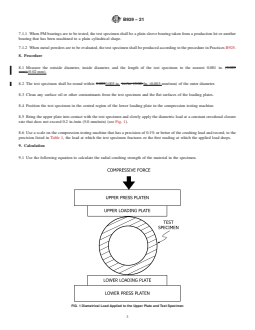
FIG. 1 Diametrical Load Applied to the Upper Plate and Test
hardened steel of a hardness greater than the microindentation
Specimen
hardness of the material being tested and large enoug
...
This document is not an ASTM standard and is intended only to provide the user of an ASTM standard an indication of what changes have been made to the previous version. Because
it may not be technically possible to adequately depict all changes accurately, ASTM recommends that users consult prior editions as appropriate. In all cases only the current version
of the standard as published by ASTM is to be considered the official document.
Designation: B939 − 15 B939 − 21
Standard Test Method for
Radial Crushing Strength, K, of Powder Metallurgy (PM)
Bearings and Structural Materials
This standard is issued under the fixed designation B939; the number immediately following the designation indicates the year of
original adoption or, in the case of revision, the year of last revision. A number in parentheses indicates the year of last reapproval. A
superscript epsilon (´) indicates an editorial change since the last revision or reapproval.
1. Scope*
1.1 This test method covers the equipment and laboratory procedure for the determination of the radial crushing strength of
materials using either a plain powder metallurgy (PM) bearing or a thin-walled hollow cylindrical test specimen. This is a
destructive test that produces quantitative results.
1.2 Limitations:
1.2.1 The principle of this procedure is based on the material being tested having minimal ductility. The permanent deflection of
the cylinder during the test should not exceed 10 % of the outside diameter.
1.2.2 The radial crushing strength test results should be used only as a guide if the test specimen has a wall thickness that is greater
than one-third of the outside diameter. These test results should then only be used for comparison with data from the test specimens
of like materials and similar dimensions.
1.3 Units—With the exception of the values for density and the mass used to determine density, for which the use of the gram per
cubic centimetre (g/cm ) and gram (g) units are the industry standard, the values stated in inch-pound units are to be regarded as
standard. The values given in parentheses are mathematical conversions to SI units that are provided for information only and are
not considered standard.
1.4 This standard does not purport to address all of the safety concerns, if any, associated with its use. It is the responsibility
of the user of this standard to establish appropriate safety safety, health, and healthenvironmental practices and determine the
applicability of regulatory limitations prior to use.
1.5 This international standard was developed in accordance with internationally recognized principles on standardization
established in the Decision on Principles for the Development of International Standards, Guides and Recommendations issued
by the World Trade Organization Technical Barriers to Trade (TBT) Committee.
2. Referenced Documents
2.1 ASTM Standards:
B243 Terminology of Powder Metallurgy
B438 Specification for Bronze-Base Powder Metallurgy (PM) Bearings (Oil-Impregnated)
This test method is under the jurisdiction of ASTM Committee B09 on Metal Powders and Metal Powder Products and is the direct responsibility of Subcommittee B09.04
on Bearings.
Current edition approved April 1, 2015April 1, 2021. Published April 2015April 2021. Originally approved in 2005. Last previous edition approved in 20092015 as
B939 – 09.B939 – 15. DOI: 10.1520/B0939-15.10.1520/B0939-21.
For referenced ASTM standards, visit the ASTM website, www.astm.org, or contact ASTM Customer Service at service@astm.org. For Annual Book of ASTM Standards
volume information, refer to the standard’s Document Summary page on the ASTM website.
*A Summary of Changes section appears at the end of this standard
Copyright © ASTM International, 100 Barr Harbor Drive, PO Box C700, West Conshohocken, PA 19428-2959. United States
B939 − 21
B439 Specification for Iron-Base Powder Metallurgy (PM) Bearings (Oil-Impregnated)
B925 Practices for Production and Preparation of Powder Metallurgy (PM) Test Specimens
E456 Terminology Relating to Quality and Statistics
E691 Practice for Conducting an Interlaboratory Study to Determine the Precision of a Test Method
2.2 MPIF Standard:
MPIF Standard 55 Determination of Radial Crush Strength (K) of Powder Metallurgy (PM) Test Specimens
3. Terminology
3.1 Definitions—Definitions of powder metallurgy (PM) terms can be found in Terminology B243. Additional descriptive
information is available in the related material section of Vol 02.05 of the under “General Information on PM” on the Annual Book
of ASTM Standards.ASTM B09 web page.
4. Summary of Test Method
4.1 Radial crushing strength is determined by subjecting a plain sleeve bearing or a thin-walled cylindrical test specimen to a
controlled compressive force applied perpendicular to its central axis under uniformly increasing load until fracture occurs.
4.2 The term “radial crushing strength,” as used in this test method is the stress at fracture calculated from the breaking load and
the dimensions of the test specimen.
5. Significance and Use
5.1 The radial crushing strength test is a destructive procedure used to determine a material strength characteristic of PM bearings
and hollow cylindrical test specimens. These data can be used to grade, classify, and evaluate the materials.
5.2 The PM bearing Specifications B438 and B439 require the use of this test method as an acceptance test for the strength of
oil-impregnated sintered bearings.
5.3 This test method may be used by powder producers and parts manufacturers as a lot acceptance test for metal powders and
lubricated powder mixtures intended for the production of porous parts.
5.4 Companies in the PM industry use this test as a manufacturing control test because it is appropriate for production practices.
5.5 Radial crushing strength is a property of the PM material but is not a design value. However, experience has shown that the
radial crushing strength of a material is approximately twice the ultimate tensile strength.
6. Apparatus
6.1 Measuring Equipment—Micrometers, calipers, and plug gages capable of measuring the inside and outside diameters and
length of the test specimen to the nearest 0.001 in. (0.03 mm).
6.2 Compression Testing Machine—A compression machine readable to 0.1% of the full scale reading, and capable of applying
a controlled breaking force to the test specimen. Use the lowest range that can produce a measurable result.
6.3 Loading Plates—Two loading plates—ground, flat, hardened steel of a hardness greater than the microindentation hardness of
the material being tested and large enough to encompass the entire length of the specimen.
7. Test Specimens
7.1 The test specimen shall be a hollow right circular thin-walled cylinder.cylinder, with a wall thickness of less than 30 % of the
specimen’s outer diameter.
Available from Metal Powder Industries Federation (MPIF), 105 College Rd. East, Princeton, NJ 08540, http://www.mpif.org.
B939 − 21
7.1.1 When PM bearings are to be tested, the test specimen shall be a
...