

ASTM D5845-21
(Test Method)Standard Test Method for Determination of MTBE, ETBE, TAME, DIPE, Methanol, Ethanol and tert-Butanol in Gasoline by Infrared Spectroscopy
General Information
- Abstract
SIGNIFICANCE AND USE
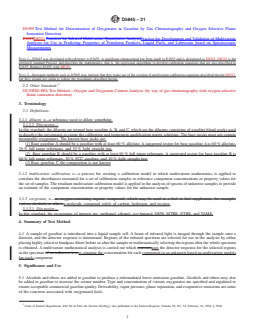
5.1 Alcohols and ethers are added to gasoline to produce a reformulated lower emissions gasoline. Alcohols and ethers may also be added to gasoline to increase the octane number. Type and concentration of various oxygenates are specified and regulated to ensure acceptable commercial gasoline quality. Driveability, vapor pressure, phase separation, and evaporative emissions are some of the concerns associated with oxygenated fuels.
5.2 This test method is faster, simpler, less expensive and more portable than current methods.
5.3 This test method may be applicable for quality control in the production of gasoline.
5.4 This test method is not suitable for testing for compliance with federal regulations.3
5.5 False positive readings for some of the samples tested in the round robin were sometimes observed. As only extreme base gasolines were tested in the round robin, no definitive statement can be made as to the expected frequency or magnitude of false positives expected in a wider range of base gasolines.
SCOPE
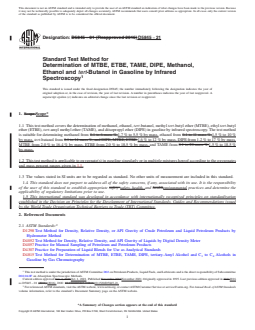
1.1 This test method covers the determination of methanol, ethanol, tert-butanol, methyl tert-butyl ether (MTBE), ethyl tert-butyl ether (ETBE), tert-amyl methyl ether (TAME), and diisopropyl ether (DIPE) in gasoline by infrared spectroscopy. The test method is suitable for determining methanol from 1.7 % to 5.5 % by mass, ethanol from 1.5 % to 10 % by mass, tert-butanol from 1.6 % to 12 % by mass, DIPE from 1.2 % to 17 % by mass, MTBE from 2.0 % to 16.4 % by mass, ETBE from 2.0 % to 18.5 % by mass, and TAME from 1.5 % to 18.5 % by mass.
1.2 This test method is applicable to oxygenate(s) in gasoline singularly or in multiple mixtures hereof according to the oxygenates and mass percent ranges given in 1.1.
1.3 The values stated in SI units are to be regarded as standard. No other units of measurement are included in this standard.
1.4 This standard does not purport to address all of the safety concerns, if any, associated with its use. It is the responsibility of the user of this standard to establish appropriate safety, health, and environmental practices and determine the applicability of regulatory limitations prior to use.
1.5 This international standard was developed in accordance with internationally recognized principles on standardization established in the Decision on Principles for the Development of International Standards, Guides and Recommendations issued by the World Trade Organization Technical Barriers to Trade (TBT) Committee.
- Status
- Published
- Publication Date
- 30-Sep-2021
- Technical Committee
- D02 - Petroleum Products, Liquid Fuels, and Lubricants
- Drafting Committee
- D02.04.0F - Absorption Spectroscopic Methods
Buy Documents
ASTM D5845-21 - Standard Test Method for Determination of MTBE, ETBE, TAME, DIPE, Methanol, Ethanol and <emph type="ital">tert</emph>-Butanol in Gasoline by Infrared Spectroscopy
REDLINE ASTM D5845-21 - Standard Test Method for Determination of MTBE, ETBE, TAME, DIPE, Methanol, Ethanol and <emph type="ital">tert</emph>-Butanol in Gasoline by Infrared Spectroscopy
Overview
ASTM D5845-21 is the standard test method for the determination of MTBE (methyl tert-butyl ether), ETBE (ethyl tert-butyl ether), TAME (tert-amyl methyl ether), DIPE (diisopropyl ether), methanol, ethanol, and tert-butanol in gasoline by infrared spectroscopy. Developed by ASTM International, this standard method is widely used in fuel quality assurance where rapid, reliable analysis of oxygenates is essential. With increasing emphasis on lower emissions and improved fuel performance, the standard provides a practical tool for refineries and testing laboratories.
Key Topics
Oxygenated Compounds in Gasoline: Alcohols and ethers, such as methanol, ethanol, MTBE, ETBE, TAME, and DIPE, are commonly blended into gasoline to enhance octane ratings and meet regulatory requirements for reduced emissions.
Infrared Spectroscopy: The method measures characteristic absorbances in the infrared spectrum for each oxygenate, enabling simultaneous quantification without requiring extensive sample preparation.
Applicable Concentration Ranges:
- Methanol: 1.7% to 5.5% by mass
- Ethanol: 1.5% to 10% by mass
- Tert-butanol: 1.6% to 12% by mass
- DIPE: 1.2% to 17% by mass
- MTBE: 2.0% to 16.4% by mass
- ETBE: 2.0% to 18.5% by mass
- TAME: 1.5% to 18.5% by mass
Calibration and Quality Control: Uses multivariate calibration models (as per ASTM D8321), with daily checks using quality control standards to ensure instrument performance and analytical accuracy.
Precision and Limitations: The method offers good repeatability and reproducibility for its intended range. However, it is not suitable for regulatory compliance testing and may show false positives with certain base gasolines.
Applications
Fuel Quality Control: ASTM D5845-21 enables gasoline producers and laboratories to monitor and control the concentration of oxygenated compounds rapidly. This is crucial in optimizing blending processes, adjusting formulations, and maintaining commercial fuel specifications.
Operational Efficiency: Compared to traditional gas chromatography, the infrared spectroscopy approach is faster, more portable, and less expensive, making it ideal for in-plant or field analysis where timely decisions are required.
Environmental Compliance and Performance: While the standard is not intended for direct federal regulatory compliance, it supports internal monitoring for reformulated gasoline programs, assisting in the production of cleaner-burning fuels and ensuring consistent product performance.
Research and Development: The method’s straightforward analysis lends itself well to process development, bench testing, and evaluating new gasoline formulations containing various oxygenate blends.
Related Standards
Several ASTM standards and international methods are referenced or used alongside ASTM D5845-21, including:
- ASTM D4052: Density, Relative Density, and API Gravity of Liquids by Digital Density Meter
- ASTM D4057: Manual Sampling of Petroleum and Petroleum Products
- ASTM D4307: Preparation of Liquid Blends for Use as Analytical Standards
- ASTM D4815: Determination of MTBE, ETBE, TAME, DIPE, tert-Amyl Alcohol, and C1 to C4 Alcohols in Gasoline by Gas Chromatography
- ASTM D8321: Development and Validation of Multivariate Analyses for Use in Predicting Properties of Petroleum Products based on Spectroscopic Measurements
- ASTM D5599: Determination of Oxygenates in Gasoline by Gas Chromatography and Oxygen Selective Flame Ionization Detection
These related standards help ensure the accuracy, reliability, and consistency of oxygenate determinations in fuel quality control processes.
Keywords: ASTM D5845-21, oxygenates, MTBE, ETBE, TAME, DIPE, methanol, ethanol, tert-butanol, gasoline, infrared spectroscopy, fuel analysis, oxygenated fuels, petroleum, fuel quality control, ASTM standards.
Relations
- Effective Date
- 01-May-2017
- Effective Date
- 01-Oct-2015
- Effective Date
- 01-Jun-2015
- Effective Date
- 15-May-2012
- Effective Date
- 01-Apr-2012
- Refers
ASTM D4057-06(2011) - Standard Practice for Manual Sampling of Petroleum and Petroleum Products - Effective Date
- 01-Jun-2011
- Effective Date
- 01-Oct-2010
- Effective Date
- 01-May-2010
- Effective Date
- 01-Oct-2009
- Effective Date
- 01-Nov-2005
- Effective Date
- 01-Nov-2005
- Effective Date
- 01-May-2004
- Effective Date
- 10-May-2003
- Effective Date
- 10-Nov-2000
- Refers
ASTM D4057-95(2000) - Standard Practice for Manual Sampling of Petroleum and Petroleum Products - Effective Date
- 10-Apr-2000
Buy Documents
ASTM D5845-21 - Standard Test Method for Determination of MTBE, ETBE, TAME, DIPE, Methanol, Ethanol and <emph type="ital">tert</emph>-Butanol in Gasoline by Infrared Spectroscopy
REDLINE ASTM D5845-21 - Standard Test Method for Determination of MTBE, ETBE, TAME, DIPE, Methanol, Ethanol and <emph type="ital">tert</emph>-Butanol in Gasoline by Infrared Spectroscopy
Get Certified
Connect with accredited certification bodies for this standard

Element Materials Technology
Materials testing and product certification.

ABS Group Brazil
ABS Group certification services in Brazil.

ABS Quality Evaluations Inc.
American Bureau of Shipping quality certification.
Sponsored listings
Frequently Asked Questions
ASTM D5845-21 is a standard published by ASTM International. Its full title is "Standard Test Method for Determination of MTBE, ETBE, TAME, DIPE, Methanol, Ethanol and <emph type="ital">tert</emph>-Butanol in Gasoline by Infrared Spectroscopy". This standard covers: SIGNIFICANCE AND USE 5.1 Alcohols and ethers are added to gasoline to produce a reformulated lower emissions gasoline. Alcohols and ethers may also be added to gasoline to increase the octane number. Type and concentration of various oxygenates are specified and regulated to ensure acceptable commercial gasoline quality. Driveability, vapor pressure, phase separation, and evaporative emissions are some of the concerns associated with oxygenated fuels. 5.2 This test method is faster, simpler, less expensive and more portable than current methods. 5.3 This test method may be applicable for quality control in the production of gasoline. 5.4 This test method is not suitable for testing for compliance with federal regulations.3 5.5 False positive readings for some of the samples tested in the round robin were sometimes observed. As only extreme base gasolines were tested in the round robin, no definitive statement can be made as to the expected frequency or magnitude of false positives expected in a wider range of base gasolines. SCOPE 1.1 This test method covers the determination of methanol, ethanol, tert-butanol, methyl tert-butyl ether (MTBE), ethyl tert-butyl ether (ETBE), tert-amyl methyl ether (TAME), and diisopropyl ether (DIPE) in gasoline by infrared spectroscopy. The test method is suitable for determining methanol from 1.7 % to 5.5 % by mass, ethanol from 1.5 % to 10 % by mass, tert-butanol from 1.6 % to 12 % by mass, DIPE from 1.2 % to 17 % by mass, MTBE from 2.0 % to 16.4 % by mass, ETBE from 2.0 % to 18.5 % by mass, and TAME from 1.5 % to 18.5 % by mass. 1.2 This test method is applicable to oxygenate(s) in gasoline singularly or in multiple mixtures hereof according to the oxygenates and mass percent ranges given in 1.1. 1.3 The values stated in SI units are to be regarded as standard. No other units of measurement are included in this standard. 1.4 This standard does not purport to address all of the safety concerns, if any, associated with its use. It is the responsibility of the user of this standard to establish appropriate safety, health, and environmental practices and determine the applicability of regulatory limitations prior to use. 1.5 This international standard was developed in accordance with internationally recognized principles on standardization established in the Decision on Principles for the Development of International Standards, Guides and Recommendations issued by the World Trade Organization Technical Barriers to Trade (TBT) Committee.
SIGNIFICANCE AND USE 5.1 Alcohols and ethers are added to gasoline to produce a reformulated lower emissions gasoline. Alcohols and ethers may also be added to gasoline to increase the octane number. Type and concentration of various oxygenates are specified and regulated to ensure acceptable commercial gasoline quality. Driveability, vapor pressure, phase separation, and evaporative emissions are some of the concerns associated with oxygenated fuels. 5.2 This test method is faster, simpler, less expensive and more portable than current methods. 5.3 This test method may be applicable for quality control in the production of gasoline. 5.4 This test method is not suitable for testing for compliance with federal regulations.3 5.5 False positive readings for some of the samples tested in the round robin were sometimes observed. As only extreme base gasolines were tested in the round robin, no definitive statement can be made as to the expected frequency or magnitude of false positives expected in a wider range of base gasolines. SCOPE 1.1 This test method covers the determination of methanol, ethanol, tert-butanol, methyl tert-butyl ether (MTBE), ethyl tert-butyl ether (ETBE), tert-amyl methyl ether (TAME), and diisopropyl ether (DIPE) in gasoline by infrared spectroscopy. The test method is suitable for determining methanol from 1.7 % to 5.5 % by mass, ethanol from 1.5 % to 10 % by mass, tert-butanol from 1.6 % to 12 % by mass, DIPE from 1.2 % to 17 % by mass, MTBE from 2.0 % to 16.4 % by mass, ETBE from 2.0 % to 18.5 % by mass, and TAME from 1.5 % to 18.5 % by mass. 1.2 This test method is applicable to oxygenate(s) in gasoline singularly or in multiple mixtures hereof according to the oxygenates and mass percent ranges given in 1.1. 1.3 The values stated in SI units are to be regarded as standard. No other units of measurement are included in this standard. 1.4 This standard does not purport to address all of the safety concerns, if any, associated with its use. It is the responsibility of the user of this standard to establish appropriate safety, health, and environmental practices and determine the applicability of regulatory limitations prior to use. 1.5 This international standard was developed in accordance with internationally recognized principles on standardization established in the Decision on Principles for the Development of International Standards, Guides and Recommendations issued by the World Trade Organization Technical Barriers to Trade (TBT) Committee.
ASTM D5845-21 is classified under the following ICS (International Classification for Standards) categories: 75.160.20 - Liquid fuels. The ICS classification helps identify the subject area and facilitates finding related standards.
ASTM D5845-21 has the following relationships with other standards: It is inter standard links to ASTM D5599-17, ASTM D4307-99(2015), ASTM D5599-15, ASTM D1298-12a, ASTM D1298-12, ASTM D4057-06(2011), ASTM D5599-00(2010), ASTM D4307-99(2010), ASTM D4815-09, ASTM D5599-00(2005), ASTM D1298-99(2005), ASTM D4307-99(2004), ASTM D4815-03, ASTM D5599-00, ASTM D4057-95(2000). Understanding these relationships helps ensure you are using the most current and applicable version of the standard.
ASTM D5845-21 is available in PDF format for immediate download after purchase. The document can be added to your cart and obtained through the secure checkout process. Digital delivery ensures instant access to the complete standard document.
Standards Content (Sample)
This international standard was developed in accordance with internationally recognized principles on standardization established in the Decision on Principles for the
Development of International Standards, Guides and Recommendations issued by the World Trade Organization Technical Barriers to Trade (TBT) Committee.
Designation: D5845 − 21
Standard Test Method for
Determination of MTBE, ETBE, TAME, DIPE, Methanol,
Ethanol and tert-Butanol in Gasoline by Infrared
Spectroscopy
This standard is issued under the fixed designation D5845; the number immediately following the designation indicates the year of
original adoption or, in the case of revision, the year of last revision. A number in parentheses indicates the year of last reapproval. A
superscript epsilon (´) indicates an editorial change since the last revision or reapproval.
1. Scope* 2. Referenced Documents
2.1 ASTM Standards:
1.1 This test method covers the determination of methanol,
D1298 Test Method for Density, Relative Density, or API
ethanol, tert-butanol, methyl tert-butyl ether (MTBE), ethyl
Gravity of Crude Petroleum and Liquid Petroleum Prod-
tert-butyl ether (ETBE), tert-amyl methyl ether (TAME), and
ucts by Hydrometer Method
diisopropyl ether (DIPE) in gasoline by infrared spectroscopy.
D4052 Test Method for Density, Relative Density, and API
The test method is suitable for determining methanol from
Gravity of Liquids by Digital Density Meter
1.7 % to 5.5 % by mass, ethanol from 1.5 % to 10 % by mass,
D4057 Practice for Manual Sampling of Petroleum and
tert-butanol from 1.6 % to 12 % by mass, DIPE from 1.2 % to
Petroleum Products
17 % by mass, MTBE from 2.0 % to 16.4 % by mass, ETBE
D4307 Practice for Preparation of Liquid Blends for Use as
from 2.0 % to 18.5 % by mass, and TAME from 1.5 % to
Analytical Standards
18.5 % by mass.
D4815 Test Method for Determination of MTBE, ETBE,
TAME, DIPE, tertiary-Amyl Alcohol and C to C Alco-
1.2 This test method is applicable to oxygenate(s) in gaso-
1 4
line singularly or in multiple mixtures hereof according to the hols in Gasoline by Gas Chromatography
D5599 Test Method for Determination of Oxygenates in
oxygenates and mass percent ranges given in 1.1.
Gasoline by Gas Chromatography and Oxygen Selective
1.3 The values stated in SI units are to be regarded as
Flame Ionization Detection
standard. No other units of measurement are included in this
D8321 Practice for Development and Validation of Multi-
standard.
variate Analyses for Use in Predicting Properties of
Petroleum Products, Liquid Fuels, and Lubricants based
1.4 This standard does not purport to address all of the
on Spectroscopic Measurements
safety concerns, if any, associated with its use. It is the
responsibility of the user of this standard to establish appro-
NOTE 1—D5845 was developed with reference to E1655. A significant
priate safety, health, and environmental practices and deter-
enhancement has been made to E1655 and is designated as D8321. D8321
is the preferred standard Practice and describes the mathematics, that is,
mine the applicability of regulatory limitations prior to use.
the regression algorithms to develop calibration equations that are also
1.5 This international standard was developed in accor-
described in E1655. Replace E1655 with D8321.
dance with internationally recognized principles on standard-
NOTE 2—Surrogate methods such as D5845 may indicate that they
make use of the creation of multivariate calibration equations described
ization established in the Decision on Principles for the
therein D8321, but they should not claim to follow the procedures
Development of International Standards, Guides and Recom-
described herein.
mendations issued by the World Trade Organization Technical
Barriers to Trade (TBT) Committee. 2.2 Other Standard:
GC/OFID EPATest Method—Oxygen and Oxygenate Con-
tent Analysis (by way of gas chromatography with
oxygen-selective flame ionization detection)
1 2
This test method is under the jurisdiction of ASTM Committee D02 on For referenced ASTM standards, visit the ASTM website, www.astm.org, or
Petroleum Products, Liquid Fuels, and Lubricants and is the direct responsibility of contact ASTM Customer Service at service@astm.org. For Annual Book of ASTM
Subcommittee D02.04.0F on Absorption Spectroscopic Methods. Standards volume information, refer to the standard’s Document Summary page on
Current edition approved Oct. 1, 2021. Published November 2021. Originally the ASTM website.
approved in 1995. Last previous edition approved in 2016 as D5845 – 01 (2016). Code of Federal Regulations, Part 80 of Title 40, Section 80.46(g); also
DOI: 10.1520/D5845-21. published in the Federal Register, Volume 59, No. 32, February 16, 1994, p 7828.
*A Summary of Changes section appears at the end of this standard
Copyright © ASTM International, 100 Barr Harbor Drive, PO Box C700, West Conshohocken, PA 19428-2959. United States
D5845 − 21
3. Terminology 5.4 This test method is not suitable for testing for compli-
ance with federal regulations.
3.1 Definitions:
3.1.1 diluent, n—a substance used to dilute something. 5.5 False positive readings for some of the samples tested in
3.1.1.1 Discussion—Inthisstandard,thediluentsaretermed the round robin were sometimes observed. As only extreme
base gasolineA, B, and C, which are the diluents consisting of base gasolines were tested in the round robin, no definitive
gasoline blend stocks used to dissolve the oxygenates to create statement can be made as to the expected frequency or
the calibration and instrument qualification matrix solutions. magnitude of false positives expected in a wider range of base
The base stocks must not contain measurable oxygenates. The gasolines.
known base socks are:
6. Apparatus
(1) Base gasolineAshould be a gasoline with at least 60 %
alkylate. A suggested recipe for base gasoline A is 60 %
6.1 Mid-IR Spectrometric Analyzer, of one of the following
alkylate,30 %fullrangereformate,and10 %lightstraightrun. types:
(2) BasegasolineBshouldbeagasolinewithatleast60 %
6.1.1 Filter-based Mid-IR Test Apparatus—The type of
full range reformate.Asuggested recipe for base gasoline B is apparatus suitable for use in this test method minimally
60 % full range reformate, 30 % FCC gasoline, and 10 % light employs an IR source, an infrared transmission cell or a liquid
straight run.
attenuated total internal reflection cell, wavelength discrimi-
(3) Base gasoline C the composition is not known nating filters, a chopper wheel, a detector, anA-D converter, a
microprocessor, and a sample introduction system.
3.1.2 multivariate calibration, n—a process for creating a
6.1.2 Fourier Transform Mid-IR Test Apparatus—The type
calibration model in which multivariate mathematics is applied
of apparatus suitable for use in this test method employs an IR
to correlate the absorbances measured for a set of calibration
source, an infrared transmission cell or a liquid attenuated total
samples to reference component concentrations or property
internal reflection cell, a scanning interferometer, a detector, an
values for the set of samples. The resultant multivariate
A-D converter, a microprocessor and a sample introduction
calibration model is applied to the analysis of spectra of
system.
unknown samples to provide an estimate of the component
6.1.3 Dispersive Mid-IR Test Apparatus—The type of appa-
concentration or property values for the unknown sample.
ratus suitable for use in this test method minimally employs an
3.1.3 oxygenate, n—a molecule composed solely of carbon,
IR source, an infrared transmission cell or a liquid attenuated
hydrogen, and oxygen.
total internal reflection cell, a wavelength dispersive element
3.1.3.1 Discussion—In this standard, the oxygenates of
such as a grating or prism, a chopper wheel, a detector, anA-D
interest are: methanol, ethanol, tert-butanol, DIPE, MTBE,
converter, a microprocessor and a sample introduction system.
ETBE, and TAME.
7. Reagents and Materials
4. Summary of Test Method
7.1 Samples for Calibration and Quality Control Check
4.1 A sample of gasoline is introduced into a liquid sample
Solutions—Use of chemicals of at least 99 % purity is highly
cell. A beam of infrared light is imaged through the sample
recommended when preparing calibration and quality control
onto a detector, and the detector response is determined.
check samples. If reagents of high purity are not available, an
Regions of the infrared spectrum are selected for use in the
accurate assay of the reagent must be performed using a
analysis by either placing highly selective bandpass filters
properly calibrated GC or other techniques (for example, water
before or after the sample or mathematically selecting the
determination).
regions after the whole spectrum is obtained. A multivariate
7.1.1 Base gasolines containing no oxygenates,
mathematical analysis is carried out which uses the detector
7.1.2 Methanol,
response for the selected regions in the spectrum to compute
7.1.3 Ethanol,
the concentration for each component in an unknown based on
7.1.4 tert-Butanol,
multivariate models for each component.
7.1.5 Methyl tert-butyl ether, MTBE,
7.1.6 Ethyl tert-butyl ether, ETBE,
5. Significance and Use
7.1.7 tert-Amyl methyl ether, TAME, and
5.1 Alcohols and ethers are added to gasoline to produce a
7.1.8 Diisopropyl ether, DIPE.
reformulated lower emissions gasoline. Alcohols and ethers
7.2 Warning—These materials are flammable and may be
may also be added to gasoline to increase the octane number.
harmful if ingested or inhaled.
Typeandconcentrationofvariousoxygenatesarespecifiedand
regulated to ensure acceptable commercial gasoline quality.
8. Sampling and Sample Handling
Driveability, vapor pressure, phase separation, and evaporative
8.1 General Requirements:
emissionsaresomeoftheconcernsassociatedwithoxygenated
8.1.1 Gasoline samples must be handled with meticulous
fuels.
care to prevent evaporative loss and composition changes.
5.2 This test method is faster, simpler, less expensive and
8.1.2 Gasoline samples to be analyzed by the test method
more portable than current methods.
shall be obtained using method(s) specified by governmental
5.3 Thistestmethodmaybeapplicableforqualitycontrolin regulatory agencies or by the procedures outlined in Practice
the production of gasoline. D4057 (or equivalent). Do not use the “Sampling by Water
D5845 − 21
Displacement” method as some alcohols or ethers might be of known oxygenate content for each oxygenate to be deter-
extracted into the water phase. mined. These standards should be made up by mass according
8.1.3 Protect samples from excessive temperatures prior to
to Practice D4307 and should be at the expected concentration
testing. This can be accomplished by storage in an appropriate level for that oxygenate. The recommended quality control
ice bath or refrigerator at 0 °C to 5 °C.
standard concentrations are found in Table 1.
8.1.4 Donottestsamplesstoredinleakycontainers.Discard
10.2 The individual oxygenate values obtained must agree
and obtain a new sample if leaks are detected.
within 65 % relative of the values in the prepared quality
8.1.5 Performtheoxygenatedeterminationonfreshsamples
control standard (for example, MTBE 14.0 % 6 0.7 % by
from containers that are at least 80 % full. If sample containers
mass) or to within 60.3 % by mass absolute, whichever is
are less than 80 % full or have been opened and sampled
greater (for example, methanol 4.0 % 6 0.3 % by mass). If the
multiple times, a new sample shall be obtained.
individualvaluesareoutsidethespecifiedrange,recalibratethe
8.2 Sample Handling During Analysis:
instrument according to the procedures in 9.2. The quality
8.2.1 Prior to the analysis of samples by infrared
control standards should not be used for the calibration or
spectroscopy, the samples should be allowed to equilibrate to
recalibration of the instrument. Do not analyze samples
the temperature at which they should be analyzed (15 °C to
without meeting the quality control specifications.
38 °C).
8.2.2 After withdrawing the sample, reseal the container,
11. Procedure
and store the sample in an ice bath or a refrigerator at 0 °C to
5 °C. 11.1 Equilibrate the samples to between 15 °C and 38 °C
before analysis.
9. Preparation, Calibration, and Qualification of the
11.2 Follow the manufacturer’s instructions for establishing
Infrared Test Apparatus
a baseline for the instrument, introducing a sample into the
9.1 Preparation—Prepare the instrument for operation in
sample cell and operating the instrument. If the instructions
accordance with the manufacturer’s instructions.
call for a non-oxygenated gasoline to be used in establishing
9.2 Calibration—Each instrument must be calibrated by the
the baseline, use a non-oxygenated gasoline that is different
manufacturer or user in accordance with Practice D8321. This
from the non-oxygenated gasolines used in the preparation of
practice serves as a guide for the multivariate calibration of
eithercalibrationstandards,validationofqualificationsamples,
infrared spectrometers used in determining the physical char-
or quality control standards.
acteristics of petroleum and petrochemical products. The
11.3 Thoroughly clean the sample cell by introducing
procedures describe treatment of the data, development of the
enough sample to the cell to ensure the cell is washed a
calibration, and qualification of the instrument. Note that bias
minimum of three times with the test solution.
and slope adjustments are specifically not recommended to
improve calibration or prediction statistics for IR multivariate
11.4 Establish that the equipment is running properly by
models.
running the quality control standards prior to the analysis of
9.3 Qualification of Instrument—The instrument must be unknown test samples (see Section 10).
qualifiedaccordingtotheprocedureinAnnexA1toensurethat
11.5 In
...
This document is not an ASTM standard and is intended only to provide the user of an ASTM standard an indication of what changes have been made to the previous version. Because
it may not be technically possible to adequately depict all changes accurately, ASTM recommends that users consult prior editions as appropriate. In all cases only the current version
of the standard as published by ASTM is to be considered the official document.
Designation: D5845 − 01 (Reapproved 2016) D5845 − 21
Standard Test Method for
Determination of MTBE, ETBE, TAME, DIPE, Methanol,
Ethanol and tert-Butanol in Gasoline by Infrared
Spectroscopy
This standard is issued under the fixed designation D5845; the number immediately following the designation indicates the year of
original adoption or, in the case of revision, the year of last revision. A number in parentheses indicates the year of last reapproval. A
superscript epsilon (´) indicates an editorial change since the last revision or reapproval.
1. Scope Scope*
1.1 This test method covers the determination of methanol, ethanol, tert-butanol, methyl tert-butyl ether (MTBE), ethyl tert-butyl
ether (ETBE), tert-amyl methyl ether (TAME), and diisopropyl ether (DIPE) in gasoline by infrared spectroscopy. The test method
is suitable for determining methanol from 0.1 to 6 mass %,1.7 % to 5.5 % by mass, ethanol from 0.1 to 11 mass %,1.5 % to 10 %
by mass, tert-butanol from 0.1 to 14 mass %, and DIPE, MTBE, ETBE 1.6 % to 12 % by mass, DIPE from 1.2 % to 17 % by mass,
MTBE from 2.0 % to 16.4 % by mass, ETBE from 2.0 % to 18.5 % by mass, and TAME from 0.1 to 20 mass %.1.5 % to 18.5 %
by mass.
1.2 This test method is applicable to oxygenate(s) in gasoline singularly or in multiple mixtures hereof according to the oxygenates
and mass percent ranges given in 1.1.
1.3 The values stated in SI units are to be regarded as standard. No other units of measurement are included in this standard.
1.4 This standard does not purport to address all of the safety concerns, if any, associated with its use. It is the responsibility
of the user of this standard to establish appropriate safety safety, health, and healthenvironmental practices and determine the
applicability of regulatory limitations prior to use.
1.5 This international standard was developed in accordance with internationally recognized principles on standardization
established in the Decision on Principles for the Development of International Standards, Guides and Recommendations issued
by the World Trade Organization Technical Barriers to Trade (TBT) Committee.
2. Referenced Documents
2.1 ASTM Standards:
D1298 Test Method for Density, Relative Density, or API Gravity of Crude Petroleum and Liquid Petroleum Products by
Hydrometer Method
D4052 Test Method for Density, Relative Density, and API Gravity of Liquids by Digital Density Meter
D4057 Practice for Manual Sampling of Petroleum and Petroleum Products
D4307 Practice for Preparation of Liquid Blends for Use as Analytical Standards
D4815 Test Method for Determination of MTBE, ETBE, TAME, DIPE, tertiary-Amyl Alcohol and C to C Alcohols in
1 4
Gasoline by Gas Chromatography
This test method is under the jurisdiction of ASTM Committee D02 on Petroleum Products, Liquid Fuels, and Lubricants and is the direct responsibility of Subcommittee
D02.04.0F on Absorption Spectroscopic Methods.
Current edition approved Oct. 1, 2016Oct. 1, 2021. Published November 2016November 2021. Originally approved in 1995. Last previous edition approved in 20112016
as D5845 – 01 (2011).(2016). DOI: 10.1520/D5845-01R16.10.1520/D5845-21.
For referenced ASTM standards, visit the ASTM website, www.astm.org, or contact ASTM Customer Service at service@astm.org. For Annual Book of ASTM Standards
volume information, refer to the standard’s Document Summary page on the ASTM website.
*A Summary of Changes section appears at the end of this standard
Copyright © ASTM International, 100 Barr Harbor Drive, PO Box C700, West Conshohocken, PA 19428-2959. United States
D5845 − 21
D5599 Test Method for Determination of Oxygenates in Gasoline by Gas Chromatography and Oxygen Selective Flame
Ionization Detection
E1655D8321 Practices for Infrared Multivariate Quantitative AnalysisPractice for Development and Validation of Multivariate
Analyses for Use in Predicting Properties of Petroleum Products, Liquid Fuels, and Lubricants based on Spectroscopic
Measurements
NOTE 1—D5845 was developed with reference to E1655. A significant enhancement has been made to E1655 and is designated as D8321. D8321 is the
preferred standard Practice and describes the mathematics, that is, the regression algorithms to develop calibration equations that are also described in
E1655. Replace E1655 with D8321.
NOTE 2—Surrogate methods such as D5845 may indicate that they make use of the creation of multivariate calibration equations described therein D8321,
but they should not claim to follow the procedures described herein.
2.2 Other Standard:
GC/OFID EPA Test Method—Oxygen and Oxygenate Content Analysis (by way of gas chromatography with oxygen-selective
flame ionization detection)
3. Terminology
3.1 Definitions:
3.1.1 diluent, n—a substance used to dilute something.
3.1.1.1 Discussion—
In this standard, the diluents are termed base gasoline A, B, and C, which are the diluents consisting of gasoline blend stocks used
to dissolve the oxygenates to create the calibration and instrument qualification matrix solutions. The base stocks must not contain
measurable oxygenates. The known base socks are:
(1) Base gasoline A should be a gasoline with at least 60 % alkylate. A suggested recipe for base gasoline A is 60 % alkylate,
30 % full range reformate, and 10 % light straight run.
(2) Base gasoline B should be a gasoline with at least 60 % full range reformate. A suggested recipe for base gasoline B is
60 % full range reformate, 30 % FCC gasoline, and 10 % light straight run.
(3) Base gasoline C the composition is not known
3.1.2 multivariate calibration, n—a process for creating a calibration model in which multivariate mathematics is applied to
correlate the absorbances measured for a set of calibration samples to reference component concentrations or property values for
the set of samples. The resultant multivariate calibration model is applied to the analysis of spectra of unknown samples to provide
an estimate of the component concentration or property values for the unknown sample.
3.1.3 oxygenate, n—an oxygen-containing organic compound, which may be used as a fuel or fuel supplement, for example,
various alcohols or ethers.a molecule composed solely of carbon, hydrogen, and oxygen.
3.1.3.1 Discussion—
In this standard, the oxygenates of interest are: methanol, ethanol, tert-butanol, DIPE, MTBE, ETBE, and TAME.
4. Summary of Test Method
4.1 A sample of gasoline is introduced into a liquid sample cell. A beam of infrared light is imaged through the sample onto a
detector, and the detector response is determined. Regions of the infrared spectrum are selected for use in the analysis by either
placing highly selective bandpass filters before or after the sample or mathematically selecting the regions after the whole spectrum
is obtained. A multivariate mathematical analysis is carried out which convertsuses the detector response for the selected regions
in the spectrum of an unknown to a to compute the concentration for each component in an unknown based on multivariate models
for each component.
5. Significance and Use
5.1 Alcohols and ethers are added to gasoline to produce a reformulated lower emissions gasoline. Alcohols and ethers may also
be added to gasoline to increase the octane number. Type and concentration of various oxygenates are specified and regulated to
ensure acceptable commercial gasoline quality. Driveability, vapor pressure, phase separation, and evaporative emissions are some
of the concerns associated with oxygenated fuels.
Code of Federal Regulations, Part 80 of Title 40, Section 80.46(g); also published in the Federal Register, Volume 59, No. 32, February 16, 1994, p 7828.
D5845 − 21
5.2 This test method is faster, simpler, less expensive and more portable than current methods.
5.3 This test method may be applicable for quality control in the production of gasoline.
5.4 This test method is not suitable for testing for compliance with federal regulations.
5.5 False positive readings for some of the samples tested in the round robin were sometimes observed. As only extreme base
gasolines were tested in the round robin, no definitive statement can be made as to the expected frequency or magnitude of false
positives expected in a wider range of base gasolines.
6. Apparatus
6.1 Mid-IR Spectrometric Analyzer, of one of the following types:
6.1.1 Filter-based Mid-IR Test Apparatus—The type of apparatus suitable for use in this test method minimally employs an IR
source, an infrared transmission cell or a liquid attenuated total internal reflection cell, wavelength discriminating filters, a chopper
wheel, a detector, an A-D converter, a microprocessor, and a sample introduction system.
6.1.2 Fourier Transform Mid-IR Test Apparatus—The type of apparatus suitable for use in this test method employs an IR source,
an infrared transmission cell or a liquid attenuated total internal reflection cell, a scanning interferometer, a detector, an A-D
converter, a microprocessor and a sample introduction system.
6.1.3 Dispersive Mid-IR Test Apparatus—The type of apparatus suitable for use in this test method minimally employs an IR
source, an infrared transmission cell or a liquid attenuated total internal reflection cell, a wavelength dispersive element such as
a grating or prism, a chopper wheel, a detector, an A-D converter, a microprocessor and a sample introduction system.
7. Reagents and Materials
7.1 Samples for Calibration and Quality Control Check Solutions—Use of chemicals of at least 99 % purity is highly
recommended when preparing calibration and quality control check samples. If reagents of high purity are not available, an
accurate assay of the reagent must be performed using a properly calibrated GC or other techniques (for example, water
determination).
7.1.1 Base gasolines containing no oxygenates,
7.1.2 Methanol,
7.1.3 Ethanol,
7.1.4 tert-Butanol,
7.1.5 Methyl tert-butyl ether, MTBE,
7.1.6 Ethyl tert-butyl ether, ETBE,
7.1.7 tert-Amyl methyl ether, TAME, and
7.1.8 Diisopropyl ether, DIPE.
7.2 Warning—These materials are flammable and may be harmful if ingested or inhaled.
8. Sampling and Sample Handling
8.1 General Requirements:
8.1.1 Gasoline samples must be handled with meticulous care to prevent evaporative loss and composition changes.
D5845 − 21
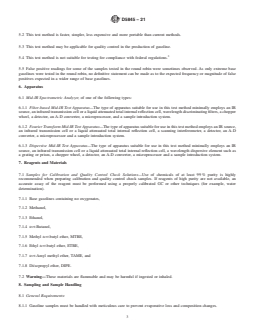
8.1.2 Gasoline samples to be analyzed by the test method shall be obtained using method(s) specified by governmental regulatory
agencies or by the procedures outlined in Practice D4057 (or equivalent). Do not use the “Sampling by Water Displacement”
method as some alcohols or ethers might be extracted into the water phase.
8.1.3 Protect samples from excessive temperatures prior to testing. This can be accomplished by storage in an appropriate ice bath
or refrigerator at 0 °C to 5 °C.
8.1.4 Do not test samples stored in leaky containers. Discard and obtain a new sample if leaks are detected.
8.1.5 Perform the oxygenate determination on fresh samples from containers that are at least 80 % full. If sample containers are
less than 80 % full or have been opened and sampled multiple times, a new sample shall be obtained.
8.2 Sample Handling During Analysis:
8.2.1 Prior to the analysis of samples by infrared spectroscopy, the samples should be allowed to equilibrate to the temperature
at which they should be analyzed (15 °C to 38 °C).
8.2.2 After withdrawing the sample, reseal the container, and store the sample in an ice bath or a refrigerator at 0 °C to 5 °C.
9. Preparation, Calibration, and Qualification of the Infrared Test Apparatus
9.1 Preparation—Prepare the instrument for operation in accordance with the manufacturer’s instructions.
9.2 Calibration—Each instrument must be calibrated by the manufacturer or user in accordance with Practice E1655D8321. This
practice serves as a guide for the multivariate calibration of infrared spectrometers used in determining the physical characteristics
of petroleum and petrochemical products. The procedures describe treatment of the data, development of the calibration, and
qualification of the instrument. Note that bias and slope adjustments are specifically not recommended to improve calibration or
prediction statistics for IR multivariate models.
9.3 Qualification of Instrument—The instrument must be qualified according to the procedure in Annex A1 to ensure that the
instrument accurately and precisely measures each oxygenate in the presence of typical gasoline compounds or other oxygenates
that, in typical concentrations, present spectral interferences. General classes of compounds that will cause interferences include
aromatics, branched aliphatic hydrocarbons, and other oxygenates.
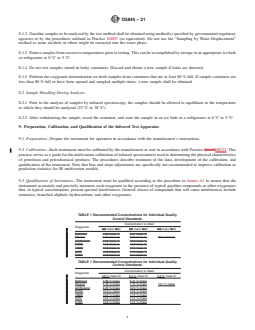
TABLE 1 Recommended Concentrations for Individual Quality
Control Standards
Concentration to Attain
Oxygenate
2.0 mass % O 2.7 mass % O 3.5 mass % O
Methanol 4.00 mass % 5.41 mass %
Ethanol 5.76 mass % 7.77 mass % 10.1 mass %
tert-Butanol 9.26 mass % 12.5 mass %
MTBE 11.0 mass % 14.9 mass %
TAME 12.8 mass % 17.2 mass %
DIPE 12.8 mass % 17.2 mass %
ETBE 12.8 mass % 17.2 mass %
TABLE 1 Recommended Concentrations for Individual Quality
Control Standards
Concentration to Attain
Oxygenate
2.0 % mass O 2.7 % mass O 3.5 % mass O
Methanol 4.00 % mass 5.41 % mass
Ethanol 5.76 % mass 7.77 % mass 10.1 % mass
tert-Butanol 9.26 % mass 12.5 % mass
MTBE 11.0 % mass 14.9 % mass
TAME 12.8 % mass 17.2 % mass
DIPE 12.8 % mass 17.2 % mass
ETBE 12.8 % mass 17.2 % mass
D5845 − 21
10. Quality Control Standards
10.1 Confirm the proper operation of the instrument each day it is used by analyzing at least one quality control standard of known
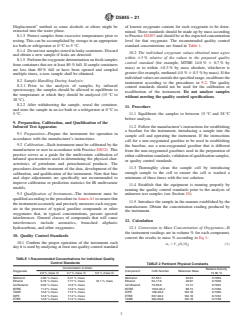
oxygenate content for each oxygenate to be determined. These standards should be made up by mass according to Practice D4307
and should be at the expected concentration level for that oxygenate. The recommended quality control standard concentrations
are found in Table 1.
10.2 The individual oxygenate values obtained must agree within 65 % relative of the values in the prepared quality control
standard (for example, MTBE
...