

ASTM D7864/D7864M-15(2023)
(Test Method)Standard Test Method for Determining the Aperture Stability Modulus of Geogrids
General Information
- Abstract
SIGNIFICANCE AND USE
5.1 The aperture stability modulus is a measure of the in-plane shear modulus, which is a function of other geogrid characteristics, most notably junction stability, flexural rib stiffness, and rib tensile modulus.
5.2 The test data can be used in conjunction with interpretive methods to evaluate the geogrid aperture stability at various traffic loads and base/subgrade conditions.
Note 1: Aperture stability modulus is referenced in the FHWA Geosynthetics Design and Construction Guidelines (2008) as an input parameter for the design of geogrid-reinforced unpaved roads using punched and drawn biaxial geogrids. Geogrids of different manufacturing process and material composition may use this property in calibration and validation of their material within the associated design.
5.3 This test method is not intended for routine acceptance testing of geogrid. This test method should be used to characterize geogrid intended for use in applications in which aperture stability is considered relevant.
SCOPE
1.1 This test method covers the procedure for measuring the Aperture Stability Modulus of a geogrid. (The terms “Secant Aperture Stability Modulus,” “Torsional Rigidity Modulus,” “In-plane Shear Modulus,” and “Torsional Stiffness Modulus” have been used in the literature to describe this same property.)
1.2 This test method is intended to determine the in-plane stability of a geogrid by clamping a center node and measuring the stiffness over an area of the geogrid. This test method is applicable for various types of geogrid.
1.3 This test method is intended to provide characteristic properties for design. The test method was developed for pavement and subgrade improvement calibrated design methods requiring input of aperture stability modulus.
1.4 The values stated in either SI units or inch-pound units are to be regarded separately as standard. The values stated in each system are not necessarily exact equivalents; therefore, to ensure conformance with the standard, each system shall be used independently of the other, and values from the two systems shall not be combined.
1.5 This standard does not purport to address all of the safety concerns, if any, associated with its use. It is the responsibility of the user of this standard to establish appropriate safety, health, and environmental practices and determine the applicability of regulatory limitations prior to use.
1.6 This international standard was developed in accordance with internationally recognized principles on standardization established in the Decision on Principles for the Development of International Standards, Guides and Recommendations issued by the World Trade Organization Technical Barriers to Trade (TBT) Committee.
- Status
- Published
- Publication Date
- 31-May-2023
- Technical Committee
- D35 - Geosynthetics
- Drafting Committee
- D35.01 - Mechanical Properties
Overview
ASTM D7864/D7864M-15(2023) is the standard test method developed by ASTM International for determining the aperture stability modulus of geogrids. This test method provides a standardized procedure for measuring the in-plane shear modulus of geogrids, often referred to in literature by multiple terms such as secant aperture stability modulus, torsional rigidity modulus, in-plane shear modulus, and torsional stiffness modulus. The aperture stability modulus is a key property that describes the geogrid’s resistance to deformation under applied torque, which is critical for soil reinforcement and stabilization applications. This standard supports the consistent evaluation and comparison of geogrid materials for civil engineering, road construction, and geotechnical projects.
Key Topics
- Aperture Stability Modulus: Measures the in-plane torsional stiffness of a geogrid, providing an important parameter for understanding its mechanical behavior under applied loads.
- Test Procedure: Involves clamping a central node of a geogrid sample and applying torque to measure stiffness. Calculations are based on recorded torque and rotation.
- Applicable to Various Geogrid Types: The test method can be applied to a range of geogrid products irrespective of their manufacturing process or material composition.
- Characteristic Property for Design: Results of this test are typically used in the design and verification of geogrids in contexts where aperture stability is crucial, such as in pavement and subgrade improvement.
- Not for Routine Acceptance: This method is intended for characterization, not routine acceptance testing, emphasizing its value in research, development, and design input.
- Dual Units: Test results may be reported in either SI or inch-pound units, according to the requirements of the project or region, but units should not be mixed.
Applications
- Geogrid-Reinforced Road Design: The aperture stability modulus is referenced in the US Federal Highway Administration (FHWA) Geosynthetics Design and Construction Guidelines as an input parameter for designing geogrid-reinforced unpaved roads, particularly when using punched and drawn biaxial geogrids.
- Base and Subgrade Improvement: Civil and geotechnical engineers use this test data to evaluate geogrid performance under various traffic loads and site conditions, aiding in calibrated design for soil reinforcement.
- Material Selection and Validation: Results from this test are instrumental when comparing geogrids of different materials or construction methods to ensure suitability for project demands.
- Calibration of Design Methods: The test supports the calibration and validation of geogrid models and design input parameters, ensuring that designs reflect realistic material performance characteristics.
- Research and Development: Enables product development and quality control for geogrid manufacturers by providing a reproducible measure of aperture stability.
Related Standards
- ASTM D4354: Practice for sampling of geosynthetics for testing, referenced for specimen preparation.
- ASTM D4439: Terminology for geosynthetics, providing consistent definitions used in this standard.
- FHWA Geosynthetic Design and Construction Guidelines (2008): Federal document referencing aperture stability modulus as an input parameter in road design.
- Other ASTM Geogrid and Geosynthetic Index Tests: D7864/D7864M fits within the broader context of geosynthetic material property evaluation standards.
Keywords: ASTM D7864, aperture stability modulus, geogrid test method, geogrid reinforcement, in-plane shear modulus, geosynthetics, soil stabilization, civil engineering standards, geogrid design, FHWA guidelines
Relations
- Effective Date
- 01-Feb-2024
- Effective Date
- 01-May-2020
- Effective Date
- 15-Apr-2018
- Effective Date
- 01-Aug-2017
- Effective Date
- 01-Sep-2015
- Effective Date
- 01-Jul-2015
- Effective Date
- 01-Mar-2014
- Effective Date
- 01-Jul-2012
- Effective Date
- 01-Oct-2011
- Effective Date
- 15-Jan-2009
- Effective Date
- 01-Nov-2004
- Effective Date
- 01-Jun-2004
- Effective Date
- 10-Aug-2002
- Effective Date
- 10-Sep-2001
- Effective Date
- 10-Sep-2001
Get Certified
Connect with accredited certification bodies for this standard

Control Union Certifications
Global certification for agriculture and sustainability.

Hohenstein Institut
Textile testing and certification.

Bureau Veritas Bangladesh
Bureau Veritas certification services in Bangladesh.
Sponsored listings
Frequently Asked Questions
ASTM D7864/D7864M-15(2023) is a standard published by ASTM International. Its full title is "Standard Test Method for Determining the Aperture Stability Modulus of Geogrids". This standard covers: SIGNIFICANCE AND USE 5.1 The aperture stability modulus is a measure of the in-plane shear modulus, which is a function of other geogrid characteristics, most notably junction stability, flexural rib stiffness, and rib tensile modulus. 5.2 The test data can be used in conjunction with interpretive methods to evaluate the geogrid aperture stability at various traffic loads and base/subgrade conditions. Note 1: Aperture stability modulus is referenced in the FHWA Geosynthetics Design and Construction Guidelines (2008) as an input parameter for the design of geogrid-reinforced unpaved roads using punched and drawn biaxial geogrids. Geogrids of different manufacturing process and material composition may use this property in calibration and validation of their material within the associated design. 5.3 This test method is not intended for routine acceptance testing of geogrid. This test method should be used to characterize geogrid intended for use in applications in which aperture stability is considered relevant. SCOPE 1.1 This test method covers the procedure for measuring the Aperture Stability Modulus of a geogrid. (The terms “Secant Aperture Stability Modulus,” “Torsional Rigidity Modulus,” “In-plane Shear Modulus,” and “Torsional Stiffness Modulus” have been used in the literature to describe this same property.) 1.2 This test method is intended to determine the in-plane stability of a geogrid by clamping a center node and measuring the stiffness over an area of the geogrid. This test method is applicable for various types of geogrid. 1.3 This test method is intended to provide characteristic properties for design. The test method was developed for pavement and subgrade improvement calibrated design methods requiring input of aperture stability modulus. 1.4 The values stated in either SI units or inch-pound units are to be regarded separately as standard. The values stated in each system are not necessarily exact equivalents; therefore, to ensure conformance with the standard, each system shall be used independently of the other, and values from the two systems shall not be combined. 1.5 This standard does not purport to address all of the safety concerns, if any, associated with its use. It is the responsibility of the user of this standard to establish appropriate safety, health, and environmental practices and determine the applicability of regulatory limitations prior to use. 1.6 This international standard was developed in accordance with internationally recognized principles on standardization established in the Decision on Principles for the Development of International Standards, Guides and Recommendations issued by the World Trade Organization Technical Barriers to Trade (TBT) Committee.
SIGNIFICANCE AND USE 5.1 The aperture stability modulus is a measure of the in-plane shear modulus, which is a function of other geogrid characteristics, most notably junction stability, flexural rib stiffness, and rib tensile modulus. 5.2 The test data can be used in conjunction with interpretive methods to evaluate the geogrid aperture stability at various traffic loads and base/subgrade conditions. Note 1: Aperture stability modulus is referenced in the FHWA Geosynthetics Design and Construction Guidelines (2008) as an input parameter for the design of geogrid-reinforced unpaved roads using punched and drawn biaxial geogrids. Geogrids of different manufacturing process and material composition may use this property in calibration and validation of their material within the associated design. 5.3 This test method is not intended for routine acceptance testing of geogrid. This test method should be used to characterize geogrid intended for use in applications in which aperture stability is considered relevant. SCOPE 1.1 This test method covers the procedure for measuring the Aperture Stability Modulus of a geogrid. (The terms “Secant Aperture Stability Modulus,” “Torsional Rigidity Modulus,” “In-plane Shear Modulus,” and “Torsional Stiffness Modulus” have been used in the literature to describe this same property.) 1.2 This test method is intended to determine the in-plane stability of a geogrid by clamping a center node and measuring the stiffness over an area of the geogrid. This test method is applicable for various types of geogrid. 1.3 This test method is intended to provide characteristic properties for design. The test method was developed for pavement and subgrade improvement calibrated design methods requiring input of aperture stability modulus. 1.4 The values stated in either SI units or inch-pound units are to be regarded separately as standard. The values stated in each system are not necessarily exact equivalents; therefore, to ensure conformance with the standard, each system shall be used independently of the other, and values from the two systems shall not be combined. 1.5 This standard does not purport to address all of the safety concerns, if any, associated with its use. It is the responsibility of the user of this standard to establish appropriate safety, health, and environmental practices and determine the applicability of regulatory limitations prior to use. 1.6 This international standard was developed in accordance with internationally recognized principles on standardization established in the Decision on Principles for the Development of International Standards, Guides and Recommendations issued by the World Trade Organization Technical Barriers to Trade (TBT) Committee.
ASTM D7864/D7864M-15(2023) is classified under the following ICS (International Classification for Standards) categories: 59.080.70 - Geotextiles. The ICS classification helps identify the subject area and facilitates finding related standards.
ASTM D7864/D7864M-15(2023) has the following relationships with other standards: It is inter standard links to ASTM D4439-24, ASTM D4354-12(2020), ASTM D4439-18, ASTM D4439-17, ASTM D4439-15a, ASTM D4439-15, ASTM D4439-14, ASTM D4354-12, ASTM D4439-11, ASTM D4354-99(2009), ASTM D4354-99(2004), ASTM D4439-04, ASTM D4439-02, ASTM D4439-00, ASTM D4439-01. Understanding these relationships helps ensure you are using the most current and applicable version of the standard.
ASTM D7864/D7864M-15(2023) is available in PDF format for immediate download after purchase. The document can be added to your cart and obtained through the secure checkout process. Digital delivery ensures instant access to the complete standard document.
Standards Content (Sample)
This international standard was developed in accordance with internationally recognized principles on standardization established in the Decision on Principles for the
Development of International Standards, Guides and Recommendations issued by the World Trade Organization Technical Barriers to Trade (TBT) Committee.
Designation: D7864/D7864M − 15 (Reapproved 2023)
Standard Test Method for
Determining the Aperture Stability Modulus of Geogrids
This standard is issued under the fixed designation D7864/D7864M; the number immediately following the designation indicates the
year of original adoption or, in the case of revision, the year of last revision. A number in parentheses indicates the year of last
reapproval. A superscript epsilon (´) indicates an editorial change since the last revision or reapproval.
1. Scope 2. Referenced Documents
1.1 This test method covers the procedure for measuring the 2.1 ASTM Standards:
Aperture Stability Modulus of a geogrid. (The terms “Secant D4354 Practice for Sampling of Geosynthetics and Rolled
Aperture Stability Modulus,” “Torsional Rigidity Modulus,” Erosion Control Products (RECPs) for Testing
“In-plane Shear Modulus,” and “Torsional Stiffness Modulus” D4439 Terminology for Geosynthetics
have been used in the literature to describe this same property.) 2.2 FHWA Document:
FHWA Geosynthetic Design and Construction Guidelines
1.2 This test method is intended to determine the in-plane
(2008)
stability of a geogrid by clamping a center node and measuring
the stiffness over an area of the geogrid. This test method is
3. Terminology
applicable for various types of geogrid.
3.1 Definitions:
1.3 This test method is intended to provide characteristic
3.1.1 For definitions of general terms used in this test
properties for design. The test method was developed for
method, refer to Terminology D4439.
pavement and subgrade improvement calibrated design meth-
3.1.2 geogrid, n—a geosynthetic formed by a regular net-
ods requiring input of aperture stability modulus.
work of integrally connected elements with apertures greater
1.4 The values stated in either SI units or inch-pound units than 6.35 mm [ ⁄4 in.] to allow interlocking with surrounding
are to be regarded separately as standard. The values stated in soil, rock, earth, and other surrounding materials to primarily
each system are not necessarily exact equivalents; therefore, to function as reinforcement.
ensure conformance with the standard, each system shall be
3.1.3 index test, n—a test procedure which may contain a
used independently of the other, and values from the two
known bias but which may be used to establish an order for a
systems shall not be combined.
set of specimens with respect to property of interest.
1.5 This standard does not purport to address all of the
3.2 Definitions of Terms Specific to This Standard:
safety concerns, if any, associated with its use. It is the
3.2.1 aperture—the openings between adjacent ribs forming
responsibility of the user of this standard to establish appro-
an angle which enable soil interlocking to occur.
priate safety, health, and environmental practices and deter-
3.2.2 aperture stability modulus—a measure of the in-plane
mine the applicability of regulatory limitations prior to use.
torsional stiffness of a geogrid. This is defined as torque
1.6 This international standard was developed in accor-
divided by the rotation at that torque.
dance with internationally recognized principles on standard-
3.2.3 geosynthetic, n—a product manufactured from poly-
ization established in the Decision on Principles for the
meric material used with soil, rock, earth, or other geotechnical
Development of International Standards, Guides and Recom-
engineering material as integral part of a man-made project,
mendations issued by the World Trade Organization Technical
structure, or system.
Barriers to Trade (TBT) Committee.
For referenced ASTM standards, visit the ASTM website, www.astm.org, or
This test method is under the jurisdiction of ASTM Committee D35 on contact ASTM Customer Service at service@astm.org. For Annual Book of ASTM
Geosynthetics and is the direct responsibility of Subcommittee D35.01 on Mechani- Standards volume information, refer to the standard’s Document Summary page on
cal Properties. the ASTM website.
Current edition approved June 1, 2023. Published June 2023. Originally Available from U.S. Department of Transportation, Federal Highway
approved in 2015. Last previous edition approved in 2015 as D7864/D7864M – 15. Administration, 1200 New Jersey Ave., SE, Washington, DC 20590, http://
DOI: 10.1520/D7864_D7864M-15R23. www.fhwa.dot.gov.
Copyright © ASTM International, 100 Barr Harbor Drive, PO Box C700, West Conshohocken, PA 19428-2959. United States
D7864/D7864M − 15 (2023)
3.2.4 initial aperture stability modulus, n—the change in 5. Significance and Use
moment at 0.5 and 1.0 N-m [4.4 and 8.8 lbf-in.], respectively,
5.1 The aperture stability modulus is a measure of the
divided by the change in angular rotation at these two moment
in-plane shear modulus, which is a function of other geogrid
values.
characteristics, most notably junction stability, flexural rib
3.2.5 junction, n—the point where geogrid ribs are intercon- stiffness, and rib tensile modulus.
nected to provide structure and dimensional stability.
5.2 The test data can be used in conjunction with interpre-
3.2.6 offset aperture stability modulus—the change in mo- tive methods to evaluate the geogrid aperture stability at
ment at 2.0 and 2.5 N-m [17.7 and 22.1 lbf-in.], respectively,
various traffic loads and base/subgrade conditions.
divided by the change in angular rotation at these two moment
NOTE 1—Aperture stability modulus is referenced in the FHWA
values.
Geosynthetics Design and Construction Guidelines (2008) as an input
parameter for the design of geogrid-reinforced unpaved roads using
3.2.7 rib, n—for geogrids, the continuous oriented elements
punched and drawn biaxial geogrids. Geogrids of different manufacturing
of a geogrid which are interconnected to a node or junction.
process and material composition may use this property in calibration and
validation of their material within the associated design.
4. Summary of Test Method
5.3 This test method is not intended for routine acceptance
4.1 A geogrid sample is placed over a square, horizontal testing of geogrid. This test method should be used to charac-
opening and the edges are anchored just outside the opening. A
terize geogrid intended for use in applications in which
rod is clamped vertically on the single center node or junction. aperture stability is considered relevant.
A torque is applied to the rod, which twists the clamped node
6. Apparatus
or junction and the geogrid rib matrix, thereby applying a
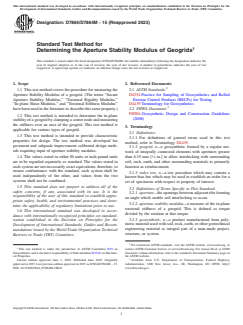
moment causing bending to each of the ribs that intersects the 6.1 The apparatus consists of a table, table clamps for the
single clamped center node or junction. The torque divided by edges of the geogrid, a rod with a center clamp that attaches to
the angle of rotation is termed the Aperture Stability Modulus the ribs around a node or junction, a loading mechanism, and
expressed in units of N-m/degree [lbf-in./degree]. a method of measuring the moment and the angle of rotation of
FIG. 1 Test Apparatus During Test (loading plates and weights not shown)
D7864/D7864M − 15 (2023)
the rod. A cross section of the apparatus used originally to [0.5 in.] outside the hole then the rib must be clamped between
develop the test method is shown in Figs. 1-4. Other methods the node or junction and the edge of the hole. If the node or
of clamping, applying a moment, loading, and measuring have junction is within 12.7 mm [0.5 in.] of the edge of the hole, the
been used by others and are acceptable, subject to the con- node or junction must be clamped. Each rib must be held so
straints discussed in the following subsections. Details of each that it does not move laterally more than 0.1 mm [0.004 in.]
part follow. during the test. The tension in some ribs may be very high,
6.1.1 Table—The table shall be constructed so that the perhaps on the order of several thousand N [several hundred
geogrid can be laid over a 229 mm [9 in.] square hole and lbf] for geogrids with high modulus values and large aperture
anchored in place. The geogrid must be placed as it would be sizes. The higher the aperture stability modulus, the more
in the field, flat but not stretched. This requires a supporting important it is that the clamps do not allow lateral movement.
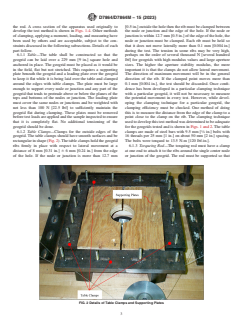
plate beneath the geogrid and a loading plate over the geogrid The direction of maximum movement will be in the general
to keep it flat while it is being laid over the table and clamped direction of the rib. If the clamped point moves more than
around the edges with table clamps. The plate must be large 0.1 mm [0.004 in.], the test should be discarded. Once confi-
enough to support every node or junction and any part of the dence has been developed in a particular clamping technique
geogrid that tends to protrude above or below the planes of the with a particular geogrid, it will not be necessary to measure
tops and bottoms of the nodes or junction. The loading plate the potential movement in every test. However, while devel-
must cover the same nodes or junctions and be weighted with oping the clamping technique for a particular geogrid, the
not less than 100 N [22.5 lbf] to sufficiently maintain the clamping efficiency must be checked. One method of doing
geogrid flat during clamping. These plates must be removed this is to measure the distance from the edge of the clamp to a
before test loads are applied and the sample inspected to ensure point close to the clamp on the rib. The clamping technique
that it is completely flat. No additional tensioning of the used to develop this test method was determined to be adequate
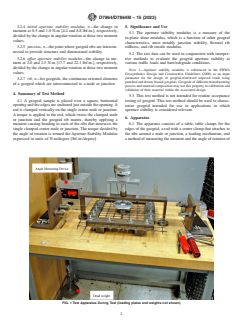
geogrid should be done. for the geogrids tested and is shown in Figs. 1 and 2. The table
6.1.2 Table Clamps—Clamps for the outside edges of the clamps are made of steel bars with 9.5 mm [ ⁄8 in.] bolts with
geogrid. The table clamps should have smooth surfaces and be 16 threads per 25 mm [1 in.] on about 50 mm [2 in.] spacing.
rectangular in shape (Fig. 2). The table clamps hold the geogrid The bolts were torqued to 13.5 N-m [120 lbf-in.].
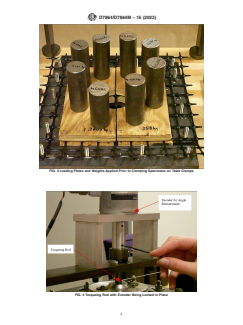
ribs firmly in place with respect to lateral movement at a 6.1.3 Torqueing Rod—The torquing rod must have a clamp
distance of 8 mm [0.31 in.] 6 6 mm [0.24 in.] from the edge at one end to attach it to the ribs around the single center node
of the hole. If the node or junction is more than 12.7 mm or junction of the geogrid. The rod must be supported so that
FIG. 2 Details of Table Clamps and Supporting Plates
D7864/D7864M − 15 (2023)
FIG. 3 Loading Plates and Weights Applied Prior to Clamping Specimens on Table Clamps
FIG. 4 Torqueing Rod with Encoder Being Locked in Place
D7864/D7864M − 15 (2023)
it does not apply a vertical force on the geogrid. In addition, the measurement of the rotation of the rod. If there is significant
rod must be held in a vertical orientation to avoid applying an deformation between the points where the measurement is
out-of-plane torque to the geogrid structure. The same dis- taken and the rotation
...