

ASTM D8002-24
(Test Method)Standard Test Method for Modified Fouling Index (MFI-0.45) of Water
General Information
- Abstract
SIGNIFICANCE AND USE
5.1 This test method is an alternative for the silt density index (SDI) method (Test Method D4189) with the aim to overcome inaccuracies related to a nonlinear relation with the fouling potential due to particulate matter concentration, absence of temperature correction, support pad, and time.
5.2 The MFI-0.45 can serve as a useful indication of the quantity of particulate matter.
5.3 The MFI-0.45 can be used to determine effectiveness of various processes such as filtration or clarification used to remove particulate matter.
5.4 The MFI-0.45 has empirically been correlated with fouling tendency of some water treatment equipment such as reverse osmosis (RO) devices.
SCOPE
1.1 This test method covers the determination of the modified fouling index (MFI) of water measured at constant pressure. This test can be used to indicate the fouling potential of reverse osmosis/nanofiltration (RO/NF) feed water due particulate matter and is applicable to low and high turbidity waters. Since the size, shape, and nature of particulate matter in water may vary, this test method is not an absolute measurement of the quantity of particulate matter.
1.2 This test method is not applicable for reagent-grade water Types I, II, and III of Specification D1193 or effluents from most reverse osmosis and ultra-filtration systems.
1.3 The values stated in SI units are to be regarded as standard. No other units of measurement are included in this standard.
1.4 This standard does not purport to address all of the safety concerns, if any, associated with its use. It is the responsibility of the user of this standard to establish appropriate safety, health, and environmental practices and determine the applicability of regulatory limitations prior to use.
1.5 This international standard was developed in accordance with internationally recognized principles on standardization established in the Decision on Principles for the Development of International Standards, Guides and Recommendations issued by the World Trade Organization Technical Barriers to Trade (TBT) Committee.
- Status
- Published
- Publication Date
- 31-Mar-2024
- Technical Committee
- D19 - Water
- Drafting Committee
- D19.08 - Membranes and Ion Exchange Materials
Overview
ASTM D8002-24: Standard Test Method for Modified Fouling Index (MFI-0.45) of Water sets forth a reliable procedure for determining the fouling potential of water, particularly in feedwaters for reverse osmosis (RO) and nanofiltration (NF) membrane systems. This method measures the Modified Fouling Index (MFI-0.45) at constant pressure using a 0.45 μm membrane filter, enabling assessment across low and high turbidity waters. MFI-0.45 serves as a robust alternative to traditional silt density index (SDI) testing, helping overcome common inaccuracies and offering a valuable indication of particulate matter quantity and process efficacy.
Key Topics
- Modified Fouling Index (MFI-0.45): A metric that quantifies fouling potential due to particulate matter in water, based on filtration velocity through a 0.45 μm membrane at constant pressure.
- Particulate Matter Assessment: MFI-0.45 indicates the amount and fouling risk associated with suspended solids in water samples.
- Comparison to SDI: This test method addresses and reduces errors linked to the nonlinear relationship between particulate concentration and fouling potential, as well as temperature influence, support pad effects, and timing inaccuracies present in the SDI method.
- Applicability: Suitable for a wide range of water samples, including those with low or high turbidity, but not intended for reagent-grade water or most RO/ultrafiltration process effluents.
- Standardization: Developed according to WTO principles, enhancing international consistency in water quality and membrane fouling measurements.
Applications
- Water Treatment Evaluation: MFI-0.45 is a critical tool for assessing the performance of filtration, clarification, and other water treatment processes. By quantifying the fouling potential of feed waters, operators can optimize process control and select appropriate pretreatment steps for RO/NF membranes.
- Membrane System Monitoring: The method allows predictive maintenance and performance tracking for reverse osmosis and nanofiltration equipment, supporting improved operational efficiency, longer membrane life, and reduced unplanned downtime.
- Process Optimization: Helps in comparing the effectiveness of different filtration or clarification technologies by providing a standardized metric for particulate fouling risk.
- Regulatory Compliance and Quality Assurance: Supports water quality management programs by providing standardized, repeatable measurements essential for reporting, compliance, and audits.
- Research and Development: Facilitates innovation in water treatment by offering a consistent way to benchmark new membrane technologies or pretreatment methods.
Related Standards
- ASTM D4189: Standard Test Method for Silt Density Index (SDI) of Water - the traditional method for measuring membrane fouling potential, which the MFI-0.45 aims to improve upon.
- ASTM D1193: Specification for Reagent Water - outlines grades of water not suitable for MFI-0.45 testing.
- ASTM D3370: Practices for Sampling Water from Flowing Process Streams - guidelines for water sampling in conjunction with MFI-0.45 testing.
- ASTM D6161: Terminology Used for Microfiltration, Ultrafiltration, Nanofiltration, and Reverse Osmosis Membrane Processes.
- ASTM D7726: Guide for Use of Various Turbidimeter Technologies for Measurement of Turbidity in Water.
Practical Value
Implementing ASTM D8002-24 improves the reliability of water quality assessment in membrane-based systems. It enables plant managers, engineers, and laboratory technicians to:
- Quantitatively assess particulate fouling risk in real time,
- Make informed decisions on water treatment and system maintenance,
- Demonstrate compliance with industry and regulatory benchmarks,
- Achieve cost savings through optimized membrane performance.
Keywords: Modified Fouling Index, MFI-0.45, membrane fouling, water quality, particulate matter, reverse osmosis, ASTM D8002, nanofiltration, water treatment, water testing standard.
Relations
- Effective Date
- 01-Apr-2024
Frequently Asked Questions
ASTM D8002-24 is a standard published by ASTM International. Its full title is "Standard Test Method for Modified Fouling Index (MFI-0.45) of Water". This standard covers: SIGNIFICANCE AND USE 5.1 This test method is an alternative for the silt density index (SDI) method (Test Method D4189) with the aim to overcome inaccuracies related to a nonlinear relation with the fouling potential due to particulate matter concentration, absence of temperature correction, support pad, and time. 5.2 The MFI-0.45 can serve as a useful indication of the quantity of particulate matter. 5.3 The MFI-0.45 can be used to determine effectiveness of various processes such as filtration or clarification used to remove particulate matter. 5.4 The MFI-0.45 has empirically been correlated with fouling tendency of some water treatment equipment such as reverse osmosis (RO) devices. SCOPE 1.1 This test method covers the determination of the modified fouling index (MFI) of water measured at constant pressure. This test can be used to indicate the fouling potential of reverse osmosis/nanofiltration (RO/NF) feed water due particulate matter and is applicable to low and high turbidity waters. Since the size, shape, and nature of particulate matter in water may vary, this test method is not an absolute measurement of the quantity of particulate matter. 1.2 This test method is not applicable for reagent-grade water Types I, II, and III of Specification D1193 or effluents from most reverse osmosis and ultra-filtration systems. 1.3 The values stated in SI units are to be regarded as standard. No other units of measurement are included in this standard. 1.4 This standard does not purport to address all of the safety concerns, if any, associated with its use. It is the responsibility of the user of this standard to establish appropriate safety, health, and environmental practices and determine the applicability of regulatory limitations prior to use. 1.5 This international standard was developed in accordance with internationally recognized principles on standardization established in the Decision on Principles for the Development of International Standards, Guides and Recommendations issued by the World Trade Organization Technical Barriers to Trade (TBT) Committee.
SIGNIFICANCE AND USE 5.1 This test method is an alternative for the silt density index (SDI) method (Test Method D4189) with the aim to overcome inaccuracies related to a nonlinear relation with the fouling potential due to particulate matter concentration, absence of temperature correction, support pad, and time. 5.2 The MFI-0.45 can serve as a useful indication of the quantity of particulate matter. 5.3 The MFI-0.45 can be used to determine effectiveness of various processes such as filtration or clarification used to remove particulate matter. 5.4 The MFI-0.45 has empirically been correlated with fouling tendency of some water treatment equipment such as reverse osmosis (RO) devices. SCOPE 1.1 This test method covers the determination of the modified fouling index (MFI) of water measured at constant pressure. This test can be used to indicate the fouling potential of reverse osmosis/nanofiltration (RO/NF) feed water due particulate matter and is applicable to low and high turbidity waters. Since the size, shape, and nature of particulate matter in water may vary, this test method is not an absolute measurement of the quantity of particulate matter. 1.2 This test method is not applicable for reagent-grade water Types I, II, and III of Specification D1193 or effluents from most reverse osmosis and ultra-filtration systems. 1.3 The values stated in SI units are to be regarded as standard. No other units of measurement are included in this standard. 1.4 This standard does not purport to address all of the safety concerns, if any, associated with its use. It is the responsibility of the user of this standard to establish appropriate safety, health, and environmental practices and determine the applicability of regulatory limitations prior to use. 1.5 This international standard was developed in accordance with internationally recognized principles on standardization established in the Decision on Principles for the Development of International Standards, Guides and Recommendations issued by the World Trade Organization Technical Barriers to Trade (TBT) Committee.
ASTM D8002-24 has the following relationships with other standards: It is inter standard links to ASTM D8002-15e1. Understanding these relationships helps ensure you are using the most current and applicable version of the standard.
ASTM D8002-24 is available in PDF format for immediate download after purchase. The document can be added to your cart and obtained through the secure checkout process. Digital delivery ensures instant access to the complete standard document.
Standards Content (Sample)
This international standard was developed in accordance with internationally recognized principles on standardization established in the Decision on Principles for the
Development of International Standards, Guides and Recommendations issued by the World Trade Organization Technical Barriers to Trade (TBT) Committee.
Designation: D8002 − 24
Standard Test Method for
Modified Fouling Index (MFI-0.45) of Water
This standard is issued under the fixed designation D8002; the number immediately following the designation indicates the year of
original adoption or, in the case of revision, the year of last revision. A number in parentheses indicates the year of last reapproval. A
superscript epsilon (´) indicates an editorial change since the last revision or reapproval.
1. Scope Applicable Test Methods of Committee D19 on Water
D3370 Practices for Sampling Water from Flowing Process
1.1 This test method covers the determination of the modi-
Streams
fied fouling index (MFI) of water measured at constant
D4189 Test Method for Silt Density Index (SDI) of Water
pressure. This test can be used to indicate the fouling potential
D6161 Terminology Used for Microfiltration, Ultrafiltration,
of reverse osmosis/nanofiltration (RO/NF) feed water due
Nanofiltration, and Reverse Osmosis Membrane Processes
particulate matter and is applicable to low and high turbidity
D7726 Guide for The Use of Various Turbidimeter Tech-
waters. Since the size, shape, and nature of particulate matter in
nologies for Measurement of Turbidity in Water
water may vary, this test method is not an absolute measure-
ment of the quantity of particulate matter.
3. Terminology
1.2 This test method is not applicable for reagent-grade
3.1 Definitions:
water Types I, II, and III of Specification D1193 or effluents
3.1.1 For definitions of terms used in this standard, refer to
from most reverse osmosis and ultra-filtration systems.
Terminologies D1129 and D6161.
3.2 Definitions of Terms Specific to This Standard:
1.3 The values stated in SI units are to be regarded as
standard. No other units of measurement are included in this 3.2.1 modified fouling index, MFI-0.45, n—index calculated
from the development of filtration velocity through a 0.45 μm
standard.
membrane filter. D2777
1.4 This standard does not purport to address all of the
safety concerns, if any, associated with its use. It is the
4. Summary of Test Method
responsibility of the user of this standard to establish appro-
4.1 Water is passed through a 0.45 μm membrane filter at
priate safety, health, and environmental practices and deter-
constant pressure of 200 kPa and the development of the rate
mine the applicability of regulatory limitations prior to use.
of filtration is measured continuously.
1.5 This international standard was developed in accor-
dance with internationally recognized principles on standard- 4.2 The MFI is calculated from the obtained data of flow
ization established in the Decision on Principles for the
versus time at constant pressure and temperature.
Development of International Standards, Guides and Recom-
5. Significance and Use
mendations issued by the World Trade Organization Technical
Barriers to Trade (TBT) Committee. 5.1 This test method is an alternative for the silt density
index (SDI) method (Test Method D4189) with the aim to
2. Referenced Documents
overcome inaccuracies related to a nonlinear relation with the
fouling potential due to particulate matter concentration, ab-
2.1 ASTM Standards:
sence of temperature correction, support pad, and time.
D1129 Terminology Relating to Water
D1193 Specification for Reagent Water
5.2 The MFI-0.45 can serve as a useful indication of the
D2777 Practice for Determination of Precision and Bias of
quantity of particulate matter.
5.3 The MFI-0.45 can be used to determine effectiveness of
various processes such as filtration or clarification used to
This test method is under the jurisdiction of ASTM Committee D19 on Water
remove particulate matter.
and is the direct responsibility of Subcommittee D19.08 on Membranes and Ion
Exchange Materials.
5.4 The MFI-0.45 has empirically been correlated with
Current edition approved April 1, 2024. Published April 2024. Originally
ɛ1 fouling tendency of some water treatment equipment such as
approved in 2015. Last previous edition was approved in 2015 as D8002 – 15
which was withdrawn January 2024 and reinstated in April 2024. DOI: 10.1520/ reverse osmosis (RO) devices.
D8002-24.
For referenced ASTM standards, visit the ASTM website, www.astm.org, or 6. Apparatus
contact ASTM Customer Service at service@astm.org. For Annual Book of ASTM
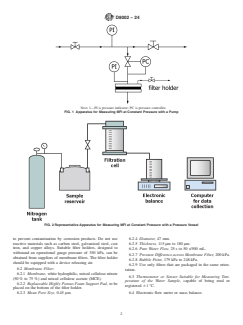
6.1 MFI Assembly—As described in Fig. 1 and Fig. 2,
Standards volume information, refer to the standard’s Document Summary page on
the ASTM website. wetted parts should be made of high-quality stainless or plastic
Copyright © ASTM International, 100 Barr Harbor Drive, PO Box C700, West Conshohocken, PA 19428-2959. United States
D8002 − 24
NOTE 1—PI is pressure indicator; PC is pressure controller.
FIG. 1 Apparatus for Measuring MFI at Constant Pressure with a Pump
FIG. 2 Representative Apparatus for Measuring MFI at Constant Pressure with a Pressure Vessel
to prevent contamination by corrosion products. Do not use 6.2.4 Diameter, 47 mm.
reactive materials such as carbon steel, galvanized steel, cast
6.2.5 Thickness, 115 μm to 180 μm.
iron, and copper alloys. Suitable filter holders, designed to
6.2.6 Pure Water Flow, 25 s to 50 s/500 mL.
withstand an operational gauge pressure of 350 kPa, can be
6.2.7 Pressure Difference across Membrane Filter, 200 kPa.
obtained from suppliers of membrane filters. The filter holder
6.2.8 Bubble Point, 179 kPa to 248 kPa.
should be equipped with a device releasing air.
6.2.9 Use only filters that are packaged in the same orien-
6.2 Membrane Filter:
tation.
6.2.1 Membrane, white hydrophilic, mixed cellulose nitrate
6.3 Thermometer or Sensor Suitable for Measuring Tem-
(50 % to 75 %) and mixed cellulose acetate (MCE).
perature of the Water Sample, capable of being read or
6.2.2 Replaceable Highly Porous Foam Support Pad, to be
registered 61 °C.
placed on the bottom of the filter holder.
6.2.3 Mean Pore Size, 0.45 μm. 6.4 Electronic flow meter or mass balance.
D8002 − 24
6.5 Computer or data-collecting and processing device. 8.2 During the gel filtration period, there exists a linear
relation between resistance (here expressed as reciprocal flow
rate at standard conditions) and cumulative filtered water
7. Procedure
volume (V), for which the slope (b) describes the fouling
7.1 Assemble apparatus as shown in Fig. 1 and Fig. 2
tendency of a given water (Eq 1 and Eq 2).
including flow-measuring devices (electronic flow meter or
t 1 ηR ηI
mass balance) and set the pressure regulator at 200 kPa.
m
5 5 1 V (1)
V Q ∆PA 2∆PA
avg
7.2 Before installing the membrane filter, flush the water to
dt
be tested through the apparatus to remove contaminants. For
η·I dV
sampling, follow the procedure given in Practices D3370.
b 5 5 (2)
2·∆P·A dV
Discrete samples can be used with appropriate pressurizing
apparatus such as a pump or an air/nitrogen pressurized vessel.
where:
NOTE 1—The pump should be of such a design that grinding flocs will t = filtration time, s,
not occur or be minimal.
V = cumulative filtrate volume, L,
NOTE 2—Ensure that the sample to be tested is not super saturated with
Q = average flow rate, t/V,
avg
air or nitrogen.
η = water viscosity, Ns/m ,
I = fouling index, l/m ,
7.3 Measure the temperature of the water.
R = membrane resistance, l/m,
m
7.4 Open the membrane filter holder and place a 0.45 μm
ΔP = applied transmembrane pressure, N/m , and
membrane filter (47 mm in diameter) on the support plate of 2
A = membrane surface area, m .
the holder. A replaceable foam support pad needs to be placed
8.3 The gradient of the line (b) has been defined as the MFI,
on the support plate of the holder. Handle the membrane filter
as an index of the fouling potential of a feed water containing
only with dull tweezers to avoid puncturing. Avoid touching
particles for the fixed reference values of ∆P (200 kPa), η
the membrane filter with fingers.
-4 2
(η ), and A (13.8 × 10 m equivalent to 47-mm diameter
20 °C 0
NOTE 3—Record the manufacturer of the membrane filter and manu-
membrane filter). The term, I, represents the fouling index for
facturer’s identification for the membrane filter.
the propensity of particles in water to form a layer with
7.5 Make sure the O-ring is in good condition and properly
hydraulic resistance:
placed.
η ·I
20°C
MFI 5 (3)
7.6 Replace the top of the half of the filter holder and close
2·∆P ·A
0 0
loosely.
NOTE 9—MFI is expressed in units of s/L . By doing this, the results
will be in the same order of magnitude of SDI in the range 2 to 3.
7.7 Bleed out air by opening the pressure relieve valve and
open the small air relieve valve on top of the filter holder.
8.4 In conducting the MFI test, the MFI can be determined
dt
NOTE 4—Apparatus making use of membranes of smaller diameters
dV
might use a disposable membrane incorporated i
...