

ASTM F1162/F1162M-18
(Specification)Standard Specification for Pole Vault Landing Systems
General Information
- Abstract
SIGNIFICANCE AND USE
6.1 The dynamic data obtained with the procedures given in this specification measure the cushioning properties of the pole vault landing systems tested.
6.2 The size of the pole vault landing system is specified with respect to the kinematics of body movement.
SCOPE
1.1 This specification covers minimum requirements of size, physical characteristics of materials, standard testing procedures, labeling and identification of pole vault landing systems.
1.2 Units—The values stated in either SI units or inch-pound units are to be regarded separately as standard. The values stated in each system may not be exact equivalents; therefore, each system shall be used independently of the other. Combining values from the two systems may result in non-conformance with the standard.
1.3 This standard does not purport to address all of the safety concerns, if any, associated with its use. It is the responsibility of the user of this standard to establish appropriate safety, health, and environmental practices and determine the applicability of regulatory limitations prior to use.
1.4 This international standard was developed in accordance with internationally recognized principles on standardization established in the Decision on Principles for the Development of International Standards, Guides and Recommendations issued by the World Trade Organization Technical Barriers to Trade (TBT) Committee.
- Status
- Published
- Publication Date
- 31-Mar-2018
- Technical Committee
- F08 - Sports Equipment, Playing Surfaces, and Facilities
- Drafting Committee
- F08.67 - Pole Vault

Overview
ASTM F1162/F1162M-18: Standard Specification for Pole Vault Landing Systems establishes the minimum requirements for size, physical characteristics, testing procedures, and labeling of pole vault landing systems. This international standard, developed by ASTM Committee F08 on Sports Equipment, ensures consistency and safety in the design and construction of landing mats used in pole vaulting activities. By outlining dynamic performance criteria and dimensional standards, it supports the protection of athletes while accommodating the kinematics of the sport.
Key Topics
- Minimum Requirements: The standard defines minimum overall dimensions for the landing system, including the width, length, and height of primary sections such as base units, front bun sections, and standard base pads.
- Material and Construction: Physical characteristics of the materials used for padding and covers are specified to ensure reliable cushioning properties.
- Impact Testing: ASTM F1162/F1162M-18 details procedures for dynamic impact testing using specified equipment and protocols. Components are tested both in situ and isolated, with performance evaluated based on peak acceleration (g-max) values.
- Preferred Landing Zone: The document describes the identification and location of a preferred landing area, marked for vaulter and coach reference.
- Labeling and Identification: Requirements include permanent labels for manufacturer, model designation, and specific safety warnings to inform users of proper assembly, installation, and intended use.
- Reporting: Comprehensive reporting is required for conformity, including documentation of test methods, results, site description, and system condition.
Applications
Pole vault landing systems designed and constructed according to ASTM F1162/F1162M-18 are widely used in:
- Athletics Facilities: Ensures that schools, universities, and professional sports venues offer standard-compliant safety equipment for pole vaulters.
- Sports Equipment Manufacturing: Guides manufacturers in designing and producing pole vault mats that meet international safety and performance requirements.
- Testing and Certification: Used by third-party testing organizations to verify compliance of products prior to installation or market release.
- Facility Planning and Upgrades: Facility managers reference the standard when specifying new installations or upgrading existing pole vault areas to maintain modern safety standards.
- Event Compliance: Competition organizers use the specification to ensure that landing systems at meets and events conform to recognized safety benchmarks.
By meeting this standard, organizations can significantly reduce the risk of injury to athletes, demonstrate regulatory compliance, and align with industry best practices.
Related Standards
Organizations and professionals working with pole vault landing systems should also consider the following related standards:
- ASTM F1292: Specification for Impact Attenuation of Surfacing Materials Within the Use Zone of Playground Equipment - Provides methods for measuring impact performance and forms the basis of the dynamic impact procedures referenced in ASTM F1162/F1162M-18.
- International Athletics Federation Regulations: May include dimensional and performance requirements for pole vault equipment and facilities.
Keywords: pole vault landing system, ASTM F1162, pole vault mat, landing pad, impact testing, athletics safety standard, sports equipment compliance, pole vaulting equipment
By referencing ASTM F1162/F1162M-18, facilities, manufacturers, and testing agencies can ensure pole vault landing systems achieve the highest standards for safety, performance, and regulatory compliance.
Relations
- Effective Date
- 01-Apr-2018
- Effective Date
- 01-Dec-2018
- Effective Date
- 01-Oct-2017
- Effective Date
- 01-May-2017
- Effective Date
- 01-Nov-2013
- Effective Date
- 01-Dec-2009
- Effective Date
- 01-Jan-2004
- Effective Date
- 10-Aug-1999
Frequently Asked Questions
ASTM F1162/F1162M-18 is a technical specification published by ASTM International. Its full title is "Standard Specification for Pole Vault Landing Systems". This standard covers: SIGNIFICANCE AND USE 6.1 The dynamic data obtained with the procedures given in this specification measure the cushioning properties of the pole vault landing systems tested. 6.2 The size of the pole vault landing system is specified with respect to the kinematics of body movement. SCOPE 1.1 This specification covers minimum requirements of size, physical characteristics of materials, standard testing procedures, labeling and identification of pole vault landing systems. 1.2 Units—The values stated in either SI units or inch-pound units are to be regarded separately as standard. The values stated in each system may not be exact equivalents; therefore, each system shall be used independently of the other. Combining values from the two systems may result in non-conformance with the standard. 1.3 This standard does not purport to address all of the safety concerns, if any, associated with its use. It is the responsibility of the user of this standard to establish appropriate safety, health, and environmental practices and determine the applicability of regulatory limitations prior to use. 1.4 This international standard was developed in accordance with internationally recognized principles on standardization established in the Decision on Principles for the Development of International Standards, Guides and Recommendations issued by the World Trade Organization Technical Barriers to Trade (TBT) Committee.
SIGNIFICANCE AND USE 6.1 The dynamic data obtained with the procedures given in this specification measure the cushioning properties of the pole vault landing systems tested. 6.2 The size of the pole vault landing system is specified with respect to the kinematics of body movement. SCOPE 1.1 This specification covers minimum requirements of size, physical characteristics of materials, standard testing procedures, labeling and identification of pole vault landing systems. 1.2 Units—The values stated in either SI units or inch-pound units are to be regarded separately as standard. The values stated in each system may not be exact equivalents; therefore, each system shall be used independently of the other. Combining values from the two systems may result in non-conformance with the standard. 1.3 This standard does not purport to address all of the safety concerns, if any, associated with its use. It is the responsibility of the user of this standard to establish appropriate safety, health, and environmental practices and determine the applicability of regulatory limitations prior to use. 1.4 This international standard was developed in accordance with internationally recognized principles on standardization established in the Decision on Principles for the Development of International Standards, Guides and Recommendations issued by the World Trade Organization Technical Barriers to Trade (TBT) Committee.
ASTM F1162/F1162M-18 is classified under the following ICS (International Classification for Standards) categories: 97.220.10 - Sports facilities. The ICS classification helps identify the subject area and facilitates finding related standards.
ASTM F1162/F1162M-18 has the following relationships with other standards: It is inter standard links to ASTM F1162/F1162M-12, ASTM F1292-18, ASTM F1292-17a, ASTM F1292-17, ASTM F1292-13, ASTM F1292-09, ASTM F1292-04, ASTM F1292-99. Understanding these relationships helps ensure you are using the most current and applicable version of the standard.
ASTM F1162/F1162M-18 is available in PDF format for immediate download after purchase. The document can be added to your cart and obtained through the secure checkout process. Digital delivery ensures instant access to the complete standard document.
Standards Content (Sample)
This international standard was developed in accordance with internationally recognized principles on standardization established in the Decision on Principles for the
Development of International Standards, Guides and Recommendations issued by the World Trade Organization Technical Barriers to Trade (TBT) Committee.
Designation: F1162/F1162M −18 An American National Standard
Standard Specification for
Pole Vault Landing Systems
This standard is issued under the fixed designation F1162/F1162M; the number immediately following the designation indicates the year
of original adoption or, in the case of revision, the year of last revision. A number in parentheses indicates the year of last reapproval.
A superscript epsilon (´) indicates an editorial change since the last revision or reapproval.
1. Scope jority of the padding behind the planting box. In most pole
vault landing systems, they are several large rectangular
1.1 This specification covers minimum requirements of
sections that compose the majority of this portion of the
size, physical characteristics of materials, standard testing
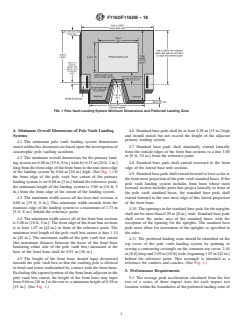
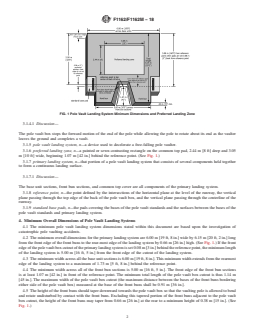
landing system. (See Fig. 1.)
procedures, labeling and identification of pole vault landing
systems.
3.1.2 common top cover, n—the continuous covering over
1.2 Units—The values stated in either SI units or inch- the top surfaces of all parts of the primary landing system.
pound units are to be regarded separately as standard. The
3.1.2.1 Discussion—It may function both as padding and as
values stated in each system may not be exact equivalents;
a binder to help hold the base units and front bun sections in
therefore, each system shall be used independently of the other.
place during use. (See Fig. 1.)
Combining values from the two systems may result in non-
3.1.3 front bun sections, n—those components of the pri-
conformance with the standard.
mary landing system that pad the areas between the standard
1.3 This standard does not purport to address all of the
bases and around the pole vault box. (See Fig. 1.)
safety concerns, if any, associated with its use. It is the
responsibility of the user of this standard to establish appro-
3.1.4 pole vault box, n—a trough at the end of the pole vault
priate safety, health, and environmental practices and deter- runway. A vaulter slides the end of the pole into the pole vault
mine the applicability of regulatory limitations prior to use.
box.
1.4 This international standard was developed in accor-
3.1.4.1 Discussion—The pole vault box stops the forward
dance with internationally recognized principles on standard-
motion of the end of the pole while allowing the pole to rotate
ization established in the Decision on Principles for the
about its end as the vaulter leaves the ground and completes a
Development of International Standards, Guides and Recom-
vault.
mendations issued by the World Trade Organization Technical
3.1.5 pole vault landing system, n—a device used to decel-
Barriers to Trade (TBT) Committee.
erate a free-falling pole vaulter.
2. Referenced Documents
3.1.6 preferred landing zone, n—a painted or sewn contrast-
2.1 ASTM Standards:
ing rectangle on the common top pad, 2.44 m [8 ft] deep and
F1292 Specification for Impact Attenuation of Surfacing
3.05 m [10 ft] wide, beginning 1.07 m [42 in.] behind the
Materials Within the Use Zone of Playground Equipment
reference point. (See Fig. 1.)
3.1.7 primary landing system, n—thatportionofapolevault
3. Terminology
landing system that consists of several components held
3.1 Definitions:
together to form a continuous landing surface.
3.1.1 base unit sections, n—those components of a pole
3.1.7.1 Discussion—The base unit sections, front bun
vault landing system where the pole vaulter intends to land.
sections, and common top cover are all components of the
3.1.1.1 Discussion—The base unit sections provide the ma-
primary landing system.
3.1.8 reference point, n—the point defined by the intersec-
This specification is under the jurisdiction ofASTM Committee F08 on Sports
tions of the horizontal plane at the level of the runway, the
Equipment, Playing Surfaces, and Facilities and is the direct responsibility of
vertical plane passing through the top edge of the back of the
Subcommittee F08.67 on Pole Vault.
Current edition approved April 1, 2018. Published April 2018. Originally
pole vault box, and the vertical plane passing through the
approved in 1988. Last previous edition approved in 2012 as F1162/F1162M – 12.
centerline of the runway.
DOI: 10.1520/F1162_F1162M-18.
For referenced ASTM standards, visit the ASTM website, www.astm.org, or
3.1.9 standard base pads, n—the pads covering the bases of
contact ASTM Customer Service at service@astm.org. For Annual Book of ASTM
the pole vault standards and the surfaces between the bases of
Standards volume information, refer to the standard’s Document Summary page on
the ASTM website. the pole vault standards and primary landing system.
Copyright © ASTM International, 100 Barr Harbor Drive, PO Box C700, West Conshohocken, PA 19428-2959. United States
F1162/F1162M − 18
FIG. 1 Pole Vault Landing System Minimum Dimensions and Preferred Landing Zone
4. Minimum Overall Dimensions of Pole Vault Landing 4.6 Standard base pads shall be at least 0.38 m [15 in.] high
Systems and should match but not exceed the height of the adjacent
primary landing system.
4.1 The minimum pole vault landing system dimensions
stated within this document are based upon the investigation of 4.7 Standard base pads shall minimally extend laterally
catastrophic pole vaulting accidents. from the outside edges of the front bun sections to a line 3.00
m [9 ft, 10 in.] from the reference point.
4.2 The minimum overall dimensions for the primary land-
ing system are 6.00 m [19 ft, 8 in.] wide by 6.15 m [20 ft, 2 in.] 4.8 Standard base pads shall extend rearward to the front
long from the front edge of the front buns to the rear-most edge edge of the lateral base unit sections.
of the landing system by 0.66 m [26 in.] high. (See Fig. 1.) If
4.9 Standard base pads shall extend forward at least as far as
the front edge of the pole vault box cutout of the primary
the front most projection of the pole vault standard bases. If the
landing system is set 0.08 m [3 in.] behind the reference point,
pole vault landing system includes front buns whose most
the minimum length of the landing system is 5.00 m [16 ft, 5
forward section includes parts that project laterally in front of
in.] from the front edge of the cutout of the landing system.
the pole vault standard bases, the standard base pads shall
4.3 The minimum width across all the base unit sections is extend forward to the rear most edge of this lateral projection
6.00 m [19 ft, 8 in.]. This minimum width extends from the of the front buns.
rearmost edge of the landing system to a maximum of 1.73 m
4.10 The openings in the standard base pads for the uprights
[5 ft, 8 in.] behind the reference point.
shall not be more than 0.20 m [8 in.] wide. Standard base pads
4.4 The minimum width across all of the front bun sections shall cover the entire area of the standard bases with the
is 5.00 m [16 ft, 5 in.]. The front edge of the front bun sections exception of the opening for the uprights. The standard base
is at least 1.07 m [42 in.] in front of the reference point. The pads must allow for movement of the uprights as specified in
minimum total length of the pole vault box cutout is thus 1.14 the rules.
m [45 in.]. The maximum width of the pole vault box cutout
4.11 The preferred landing zone should be identified on the
(the maximum distance between the bases of the front buns
top cover of the pole vault landing system by painting or
bordering either side of the pole vault box) measured at the
sewing a contrasting rectangle on the common top cover, 2.44
base of the front buns shall be 0.91 m [36 in.].
m[8ft]deepand3.05m[10ft]wide,beginning1.07m[42in.]
4.5 The height of the front buns should taper downward behind the reference point. This rectangle is intended as a
towards the pole vault box so that the vaulting pole is allowed reference for vaulters and coaches. (See Fig. 1.)
to bend and rotate undisturbed by contact with the front buns.
5. Performance Requirements
Excluding this tapered portion of the front buns adjacent to the
pole vaul
...
This document is not an ASTM standard and is intended only to provide the user of an ASTM standard an indication of what changes have been made to the previous version. Because
it may not be technically possible to adequately depict all changes accurately, ASTM recommends that users consult prior editions as appropriate. In all cases only the current version
of the standard as published by ASTM is to be considered the official document.
Designation: F1162/F1162M − 12 F1162/F1162M − 18 An American National Standard
Standard Specification for
Pole Vault Landing Systems
This standard is issued under the fixed designation F1162/F1162M; the number immediately following the designation indicates the year
of original adoption or, in the case of revision, the year of last revision. A number in parentheses indicates the year of last reapproval.
A superscript epsilon (´) indicates an editorial change since the last revision or reapproval.
1. Scope
1.1 This specification covers minimum requirements of size, physical characteristics of materials, standard testing procedures,
labeling and identification of pole vault landing systems.
1.2 Units—The values stated in either SI units or inch-pound units are to be regarded separately as standard. The values stated
in each system may not be exact equivalents; therefore, each system shall be used independently of the other. Combining values
from the two systems may result in non-conformance with the standard.
1.3 This standard does not purport to address all of the safety concerns, if any, associated with its use. It is the responsibility
of the user of this standard to establish appropriate safety safety, health, and healthenvironmental practices and determine the
applicability of regulatory limitations prior to use.
1.4 This international standard was developed in accordance with internationally recognized principles on standardization
established in the Decision on Principles for the Development of International Standards, Guides and Recommendations issued
by the World Trade Organization Technical Barriers to Trade (TBT) Committee.
2. Referenced Documents
2.1 ASTM Standards:
F1292 Specification for Impact Attenuation of Surfacing Materials Within the Use Zone of Playground Equipment
3. Terminology
3.1 Definitions:
3.1.1 base unit sections, n—those components of a pole vault landing system where the pole vaulter intends to land.
3.1.1.1 Discussion—
The base unit sections provide the majority of the padding behind the planting box. In most pole vault landing systems, they are
several large rectangular sections that compose the majority of this portion of the landing system. (See Fig. 1.)
3.1.2 common top cover, n—the continuous covering over the top surfaces of all parts of the primary landing system.
3.1.2.1 Discussion—
It may function both as padding and as a binder to help hold the base units and front bun sections in place during use. (See Fig.
1.)
3.1.3 front bun sections, n—those components of the primary landing system that pad the areas between the standard bases and
around the pole vault box. (See Fig. 1.)
3.1.4 pole vault box, n—a trough at the end of the pole vault runway. A vaulter slides the end of the pole into the pole vault
box.
This specification is under the jurisdiction of ASTM Committee F08 on Sports Equipment Equipment, Playing Surfaces, and Facilities and is the direct responsibility
of Subcommittee F08.67 on Pole Vault.
Current edition approved May 1, 2012April 1, 2018. Published June 2012April 2018. Originally approved in 1988. Last previous edition approved in 20022012 as
E1162 – 02F1162/F1162M – 12. which was withdrawn April 2011 and reinstated in May 2012. DOI: 10.1520/F1162_F1162M-12. DOI: 10.1520/F1162_F1162M-18.
For referenced ASTM standards, visit the ASTM website, www.astm.org, or contact ASTM Customer Service at service@astm.org. For Annual Book of ASTM Standards
volume information, refer to the standard’s Document Summary page on the ASTM website.
Copyright © ASTM International, 100 Barr Harbor Drive, PO Box C700, West Conshohocken, PA 19428-2959. United States
F1162/F1162M − 18
FIG. 1 Pole Vault Landing System Minimum Dimensions and Preferred Landing Zone
3.1.4.1 Discussion—
The pole vault box stops the forward motion of the end of the pole while allowing the pole to rotate about its end as the vaulter
leaves the ground and completes a vault.
3.1.5 pole vault landing system, n—a device used to decelerate a free-falling pole vaulter.
3.1.6 preferred landing zone, n—a painted or sewn contrasting rectangle on the common top pad, 2.44 m [8 ft] deep and 3.05
m [10 ft] wide, beginning 1.07 m [42 in.] behind the reference point. (See Fig. 1.)
3.1.7 primary landing system, n—that portion of a pole vault landing system that consists of several components held together
to form a continuous landing surface.
3.1.7.1 Discussion—
The base unit sections, front bun sections, and common top cover are all components of the primary landing system.
3.1.8 reference point, n—the point defined by the intersections of the horizontal plane at the level of the runway, the vertical
plane passing through the top edge of the back of the pole vault box, and the vertical plane passing through the centerline of the
runway.
3.1.9 standard base pads, n—the pads covering the bases of the pole vault standards and the surfaces between the bases of the
pole vault standards and primary landing system.
4. Minimum Overall Dimensions of Pole Vault Landing Systems
4.1 The minimum pole vault landing system dimensions stated within this document are based upon the investigation of
catastrophic pole vaulting accidents.
4.2 The minimum overall dimensions for the primary landing system are 6.00 m [19 ft, 8 in.] wide by 6.15 m [20 ft, 2 in.] long
from the front edge of the front buns to the rear-most edge of the landing system by 0.66 m [26 in.] high. (See Fig. 1.) If the front
edge of the pole vault box cutout of the primary landing system is set 0.08 m [3 in.] behind the reference point, the minimum length
of the landing system is 5.00 m [16 ft, 5 in.] from the front edge of the cutout of the landing system.
4.3 The minimum width across all the base unit sections is 6.00 m [19 ft, 8 in.]. This minimum width extends from the rearmost
edge of the landing system to a maximum of 1.73 m [5 ft, 8 in.] behind the reference point.
4.4 The minimum width across all of the front bun sections is 5.00 m [16 ft, 5 in.]. The front edge of the front bun sections
is at least 1.07 m [42 in.] in front of the reference point. The minimum total length of the pole vault box cutout is thus 1.14 m
[45 in.]. The maximum width of the pole vault box cutout (the maximum distance between the bases of the front buns bordering
either side of the pole vault box) measured at the base of the front buns shall be 0.91 m [36 in.].
4.5 The height of the front buns should taper downward towards the pole vault box so that the vaulting pole is allowed to bend
and rotate undisturbed by contact with the front buns. Excluding this tapered portion of the front buns adjacent to the pole vault
box cutout, the height of the front buns may taper from 0.66 m [26 in.] at the rear to a minimum height of 0.38 m [15 in.]. (See
Fig. 1.)
F1162/F1162M − 18
4.6 Standard base pads shall be at least 0.38 m [15 in.] high and should match but not exceed the height of the adjacent primary
landing system.
4.7 Standard base pads shall minimally extend laterally from the outside edges of the front bun sections to a line 3.00 m [9 ft,
10 in.] from the reference point.
4.8 Standard base pads shall extend rearward to the front edge of the lateral base unit sections.
4.9 Standard base pads shall extend forward at least as far as the front most projection of the pole vault standard bases. If the
pole vault landing system includes front buns whose most forward section includes parts that project laterally in front of the pole
vault standard bases, the standard base pads shall extend forward to the rear most edge of this lateral projection of the front buns.
4.10 The openings in the standard base pads for the uprights shall not be more than 0.20 m [8 in.] wide. Standard base pads
shall cover the entire area of the standard bases with the exception of the opening for the uprights. The standard base pads must
allow for movement of the uprights as specified in the rules.
4.11 The preferred landing zone should be identified on the top cover of the pole vault landing system by painting or
...