

ASTM C702/C702M-18
(Practice)Standard Practice for Reducing Samples of Aggregate to Testing Size
General Information
- Abstract
SIGNIFICANCE AND USE
4.1 Specifications for aggregates require obtaining representative portions of the supply material for testing. Other factors being equal, larger samples will tend to be more representative of the total supply. This practice provides procedures for reducing the large sample obtained in the field, or produced in the laboratory, to a convenient size for conducting a number of descriptive and quality tests. Failure to carefully follow the procedures in this practice could result in providing a non-representative sample to be used in subsequent testing. The individual test methods provide for minimum amount of material to be tested.
4.2 Under certain circumstances, reduction in size of the large sample prior to testing is not recommended. Substantial differences between the selected test samples sometimes cannot be avoided, for example, in the case of an aggregate having relatively few large size particles in the sample. The laws of chance dictate that these few particles may be unequally distributed among the reduced size test samples. Similarly, if the test sample is being examined for certain contaminants occurring in only small percentages, caution should be used in interpreting results from the reduced size test sample. Chance inclusion or exclusion of only one or two particles in the selected test sample may importantly influence interpretation of the characteristics of the original sample. In these cases, the entire original sample should be tested.
SCOPE
1.1 This practice covers three methods for the reduction of large samples of aggregate to the appropriate size for testing. These techniques are intended to minimize variations in measured characteristics between the test samples selected and the large sample.
1.2 The values stated in either SI units or inch-pound units are to be regarded separately as standard. The values stated in each system may not be exact equivalents; therefore, each system shall be used independently of the other. Combining values from the two systems may result in non-conformance with the standard.
Note 1: Sieve size is identified by its standard designation in Specification E11. The alternative designation given in parentheses is for information only and does not represent a different standard sieve size.
1.3 This standard does not purport to address all of the safety concerns, if any, associated with its use. It is the responsibility of the user of this standard to establish appropriate safety, health, and environmental practices and determine the applicability of regulatory limitations prior to use.
1.4 This international standard was developed in accordance with internationally recognized principles on standardization established in the Decision on Principles for the Development of International Standards, Guides and Recommendations issued by the World Trade Organization Technical Barriers to Trade (TBT) Committee.
- Status
- Published
- Publication Date
- 31-Jan-2018
- Technical Committee
- C09 - Concrete and Concrete Aggregates
- Drafting Committee
- C09.20 - Aggregates
Overview
ASTM C702/C702M-18, Standard Practice for Reducing Samples of Aggregate to Testing Size, is an internationally recognized ASTM standard that specifies procedures for reducing large aggregate samples to testing size. Ensuring representative test samples is critical for accurate aggregate quality assessment in the construction, transportation, and materials testing industries. This practice is designed to minimize variation between the portion tested and the overall sample, ensuring valid and reliable test results.
Key Topics
Representative Sampling: The standard emphasizes obtaining portions of aggregates that accurately reflect the properties of the overall supply. Larger initial samples are generally more representative, but must be reduced properly to a size suitable for laboratory testing.
Sample Reduction Methods: ASTM C702/C702M-18 covers three main techniques for aggregate sample reduction:
- Method A: Mechanical Splitter – Preferred for both fine and coarse aggregates, especially when the sample is dry or in a saturated-surface-dry condition.
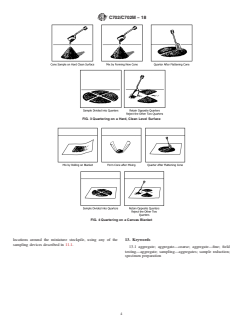
- Method B: Quartering – Applied manually with a scoop/shovel and canvas blanket; suitable when mechanical splitters are not available or for aggregates with free surface moisture.
- Method C: Miniature Stockpile Sampling – Specifically for damp fine aggregates, this method involves thorough mixing and obtaining several increments from a stockpile.
Avoiding Sampling Errors: The standard outlines when not to reduce the aggregate sample size, such as when there are few large particles or rare contaminants present. In these instances, the entire original sample may need to be examined to prevent skewed results due to random distribution.
Testing Units: Provides guidance for using either SI or inch-pound units independently to maintain consistency and conformity with the standard.
Applications
ASTM C702/C702M-18 is widely used for:
- Quality Control in Construction Materials: Ensuring that concrete and asphalt aggregates meet specifications for pavements, structures, and foundations.
- Laboratory Analysis: Preparing aggregate samples for a range of tests such as particle size distribution, specific gravity, moisture content, and contaminant levels.
- Field Testing and Compliance: Used by transportation agencies, contractors, and material suppliers to comply with industry and regulatory requirements.
- Research and Development: Facilitates accurate, repeatable results in materials research, especially when comparing material properties or developing new aggregate sources.
Related Standards
ASTM C702/C702M-18 is frequently used alongside other key aggregate and material testing standards, such as:
- ASTM C125: Terminology Relating to Concrete and Concrete Aggregates
- ASTM C128: Test Method for Relative Density (Specific Gravity) and Absorption of Fine Aggregate
- ASTM D75: Practice for Sampling Aggregates
- ASTM E11: Specification for Woven Wire Test Sieve Cloth and Test Sieves
- AASHTO T 248: Harmonized practice for reducing samples of aggregate
Understanding and implementing ASTM C702/C702M-18 is essential for accurate aggregate test results and maintaining quality assurance in concrete and asphalt production. Adhering to this standard helps ensure the integrity of construction materials and supports compliance with widely adopted engineering practices.
Relations
- Effective Date
- 15-Dec-2019
- Effective Date
- 01-Jan-2019
- Effective Date
- 01-Oct-2018
- Effective Date
- 01-Jul-2018
- Effective Date
- 01-Jan-2018
- Effective Date
- 15-Dec-2016
- Effective Date
- 15-Dec-2015
- Effective Date
- 01-Jul-2015
- Effective Date
- 01-Feb-2015
- Effective Date
- 01-Aug-2014
- Effective Date
- 15-Dec-2013
- Effective Date
- 01-Oct-2013
- Effective Date
- 01-Aug-2013
- Effective Date
- 01-Feb-2013
- Effective Date
- 01-Dec-2012
Get Certified
Connect with accredited certification bodies for this standard

DIBt (Deutsches Institut für Bautechnik)
German Institute for Building Technology.
DIN CERTCO
DIN Group product certification.

Aboma Certification B.V.
Specialized in construction, metal, and transport sectors.
Sponsored listings
Frequently Asked Questions
ASTM C702/C702M-18 is a standard published by ASTM International. Its full title is "Standard Practice for Reducing Samples of Aggregate to Testing Size". This standard covers: SIGNIFICANCE AND USE 4.1 Specifications for aggregates require obtaining representative portions of the supply material for testing. Other factors being equal, larger samples will tend to be more representative of the total supply. This practice provides procedures for reducing the large sample obtained in the field, or produced in the laboratory, to a convenient size for conducting a number of descriptive and quality tests. Failure to carefully follow the procedures in this practice could result in providing a non-representative sample to be used in subsequent testing. The individual test methods provide for minimum amount of material to be tested. 4.2 Under certain circumstances, reduction in size of the large sample prior to testing is not recommended. Substantial differences between the selected test samples sometimes cannot be avoided, for example, in the case of an aggregate having relatively few large size particles in the sample. The laws of chance dictate that these few particles may be unequally distributed among the reduced size test samples. Similarly, if the test sample is being examined for certain contaminants occurring in only small percentages, caution should be used in interpreting results from the reduced size test sample. Chance inclusion or exclusion of only one or two particles in the selected test sample may importantly influence interpretation of the characteristics of the original sample. In these cases, the entire original sample should be tested. SCOPE 1.1 This practice covers three methods for the reduction of large samples of aggregate to the appropriate size for testing. These techniques are intended to minimize variations in measured characteristics between the test samples selected and the large sample. 1.2 The values stated in either SI units or inch-pound units are to be regarded separately as standard. The values stated in each system may not be exact equivalents; therefore, each system shall be used independently of the other. Combining values from the two systems may result in non-conformance with the standard. Note 1: Sieve size is identified by its standard designation in Specification E11. The alternative designation given in parentheses is for information only and does not represent a different standard sieve size. 1.3 This standard does not purport to address all of the safety concerns, if any, associated with its use. It is the responsibility of the user of this standard to establish appropriate safety, health, and environmental practices and determine the applicability of regulatory limitations prior to use. 1.4 This international standard was developed in accordance with internationally recognized principles on standardization established in the Decision on Principles for the Development of International Standards, Guides and Recommendations issued by the World Trade Organization Technical Barriers to Trade (TBT) Committee.
SIGNIFICANCE AND USE 4.1 Specifications for aggregates require obtaining representative portions of the supply material for testing. Other factors being equal, larger samples will tend to be more representative of the total supply. This practice provides procedures for reducing the large sample obtained in the field, or produced in the laboratory, to a convenient size for conducting a number of descriptive and quality tests. Failure to carefully follow the procedures in this practice could result in providing a non-representative sample to be used in subsequent testing. The individual test methods provide for minimum amount of material to be tested. 4.2 Under certain circumstances, reduction in size of the large sample prior to testing is not recommended. Substantial differences between the selected test samples sometimes cannot be avoided, for example, in the case of an aggregate having relatively few large size particles in the sample. The laws of chance dictate that these few particles may be unequally distributed among the reduced size test samples. Similarly, if the test sample is being examined for certain contaminants occurring in only small percentages, caution should be used in interpreting results from the reduced size test sample. Chance inclusion or exclusion of only one or two particles in the selected test sample may importantly influence interpretation of the characteristics of the original sample. In these cases, the entire original sample should be tested. SCOPE 1.1 This practice covers three methods for the reduction of large samples of aggregate to the appropriate size for testing. These techniques are intended to minimize variations in measured characteristics between the test samples selected and the large sample. 1.2 The values stated in either SI units or inch-pound units are to be regarded separately as standard. The values stated in each system may not be exact equivalents; therefore, each system shall be used independently of the other. Combining values from the two systems may result in non-conformance with the standard. Note 1: Sieve size is identified by its standard designation in Specification E11. The alternative designation given in parentheses is for information only and does not represent a different standard sieve size. 1.3 This standard does not purport to address all of the safety concerns, if any, associated with its use. It is the responsibility of the user of this standard to establish appropriate safety, health, and environmental practices and determine the applicability of regulatory limitations prior to use. 1.4 This international standard was developed in accordance with internationally recognized principles on standardization established in the Decision on Principles for the Development of International Standards, Guides and Recommendations issued by the World Trade Organization Technical Barriers to Trade (TBT) Committee.
ASTM C702/C702M-18 is classified under the following ICS (International Classification for Standards) categories: 91.100.30 - Concrete and concrete products. The ICS classification helps identify the subject area and facilitates finding related standards.
ASTM C702/C702M-18 has the following relationships with other standards: It is inter standard links to ASTM C125-19a, ASTM C125-19, ASTM C125-18b, ASTM C125-18a, ASTM C125-18, ASTM C125-16, ASTM C125-15b, ASTM C125-15a, ASTM C125-15, ASTM C125-14, ASTM C125-13b, ASTM E11-13, ASTM C125-13a, ASTM C125-13, ASTM C125-12a. Understanding these relationships helps ensure you are using the most current and applicable version of the standard.
ASTM C702/C702M-18 is available in PDF format for immediate download after purchase. The document can be added to your cart and obtained through the secure checkout process. Digital delivery ensures instant access to the complete standard document.
Standards Content (Sample)
This international standard was developed in accordance with internationally recognized principles on standardization established in the Decision on Principles for the
Development of International Standards, Guides and Recommendations issued by the World Trade Organization Technical Barriers to Trade (TBT) Committee.
Designation: C702/C702M − 18 American Association State
Highway and Transportation
Officials Standard: T 248
Standard Practice for
Reducing Samples of Aggregate to Testing Size
This standard is issued under the fixed designation C702/C702M; the number immediately following the designation indicates the year
of original adoption or, in the case of revision, the year of last revision. A number in parentheses indicates the year of last reapproval.
A superscript epsilon (´) indicates an editorial change since the last revision or reapproval.
This standard has been approved for use by agencies of the U.S. Department of Defense.
1. Scope C128 Test Method for Relative Density (Specific Gravity)
and Absorption of Fine Aggregate
1.1 This practice covers three methods for the reduction of
D75 Practice for Sampling Aggregates
large samples of aggregate to the appropriate size for testing.
E11 Specification for Woven Wire Test Sieve Cloth and Test
These techniques are intended to minimize variations in
Sieves
measured characteristics between the test samples selected and
the large sample.
3. Terminology
1.2 The values stated in either SI units or inch-pound units
3.1 Definitions—The terms used in this practice are defined
are to be regarded separately as standard. The values stated in
in Terminology C125.
each system may not be exact equivalents; therefore, each
system shall be used independently of the other. Combining
4. Significance and Use
values from the two systems may result in non-conformance
4.1 Specificationsforaggregatesrequireobtainingrepresen-
with the standard.
tative portions of the supply material for testing. Other factors
NOTE 1—Sieve size is identified by its standard designation in Speci-
being equal, larger samples will tend to be more representative
fication E11. The alternative designation given in parentheses is for
of the total supply. This practice provides procedures for
information only and does not represent a different standard sieve size.
reducing the large sample obtained in the field, or produced in
1.3 This standard does not purport to address all of the
the laboratory, to a convenient size for conducting a number of
safety concerns, if any, associated with its use. It is the
descriptive and quality tests. Failure to carefully follow the
responsibility of the user of this standard to establish appro-
procedures in this practice could result in providing a non-
priate safety, health, and environmental practices and deter-
representative sample to be used in subsequent testing. The
mine the applicability of regulatory limitations prior to use.
individual test methods provide for minimum amount of
1.4 This international standard was developed in accor-
material to be tested.
dance with internationally recognized principles on standard-
ization established in the Decision on Principles for the
4.2 Under certain circumstances, reduction in size of the
Development of International Standards, Guides and Recom-
large sample prior to testing is not recommended. Substantial
mendations issued by the World Trade Organization Technical
differences between the selected test samples sometimes can-
Barriers to Trade (TBT) Committee.
not be avoided, for example, in the case of an aggregate having
relatively few large size particles in the sample. The laws of
2. Referenced Documents
chance dictate that these few particles may be unequally
distributed among the reduced size test samples. Similarly, if
2.1 ASTM Standards:
the test sample is being examined for certain contaminants
C125 Terminology Relating to Concrete and Concrete Ag-
occurring in only small percentages, caution should be used in
gregates
interpreting results from the reduced size test sample. Chance
inclusion or exclusion of only one or two particles in the
selected test sample may importantly influence interpretation
This practice is under the jurisdiction of ASTM Committee C09 on Concrete
andConcreteAggregatesandisthedirectresponsibilityofSubcommitteeC09.20on
of the characteristics of the original sample. In these cases, the
Aggregates.
entire original sample should be tested.
Current edition approved Feb. 1, 2018. Published March 2018. Originally
approved in 1971. Last previous edition approved in 2011 as C702/C702M–11.
5. Selection of Method
DOI: 10.1520/C0702_C0702M-18.
For referenced ASTM standards, visit the ASTM website, www.astm.org, or
5.1 Fine Aggregate—Reduce the size of samples of fine
contact ASTM Customer Service at service@astm.org. For Annual Book of ASTM
aggregate that are drier than the saturated-surface-dry condi-
Standards volume information, refer to the standard’s Document Summary page on
the ASTM website. tion (Note 2) using a mechanical splitter according to Method
Copyright © ASTM International, 100 Barr Harbor Drive, PO Box C700, West Conshohocken, PA 19428-2959. United States
C702/C702M − 18
A. Reduce the size of samples having free moisture on the accomplish all intended tests. Use similar procedures for
particle surfaces by quartering according to Method B, or by aggregate produced in the laboratory.
treating as a miniature stockpile as described in Method C.
METHOD A—MECHANICAL SPLITTER
5.1.1 If the use of Method B or Method C is desired, and the
sample does not have free moisture on the particle surfaces,
7. Apparatus
moisten the sample to obtain free moisture on the particle
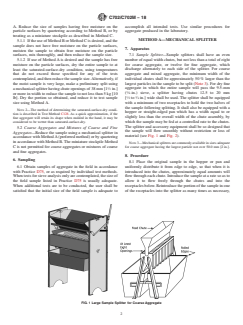
7.1 Sample Splitter—Sample splitters shall have an even
surfaces, mix thoroughly, and then reduce the sample size.
number of equal width chutes, but not less than a total of eight
5.1.2 If use of Method A is desired and the sample has free
for coarse aggregate, or twelve for fine aggregate, which
moisture on the particle surfaces, dry the entire sample to at
discharge alternately to each side of the splitter. For coarse
least the saturated-surface-dry condition, using temperatures
aggregate and mixed aggregate, the minimum width of the
that do not exceed those specified for any of the tests
individual chutes shall be approximately 50 % larger than the
contemplated,andthenreducethesamplesize.Alternatively,if
largest particles in the sample to be split (Note 3). For dry fine
the moist sample is very large, make a preliminary split using
aggregate in which the entire sample will pass the 9.5-mm
a mechanical splitter having chute openings of 38 mm [1 ⁄2 in.]
( ⁄8-in.) sieve, a splitter having chutes 12.5 to 20 mm
or more in width to reduce the sample to not less than 5 kg [10
1 3
lb]. Dry the portion so obtained, and reduce it to test sample [ ⁄2 to ⁄4 in.] wide shall be used. The splitter shall be equipped
with a minimum of two receptacles to hold the two halves of
size using Method A.
the sample following splitting. It shall also be equipped with a
NOTE 2—The method of determining the saturated-surface-dry condi-
hopper or straight-edged pan which has a width equal to or
tion is described in Test Method C128. As a quick approximation, if the
slightly less than the overall width of the chute a
...
This document is not an ASTM standard and is intended only to provide the user of an ASTM standard an indication of what changes have been made to the previous version. Because
it may not be technically possible to adequately depict all changes accurately, ASTM recommends that users consult prior editions as appropriate. In all cases only the current version
of the standard as published by ASTM is to be considered the official document.
Designation: C702/C702M − 11 C702/C702M − 18 American Association State
Highway and Transportation
Officials Standard: T 248
Standard Practice for
Reducing Samples of Aggregate to Testing Size
This standard is issued under the fixed designation C702/C702M; the number immediately following the designation indicates the year
of original adoption or, in the case of revision, the year of last revision. A number in parentheses indicates the year of last reapproval.
A superscript epsilon (´) indicates an editorial change since the last revision or reapproval.
This standard has been approved for use by agencies of the U.S. Department of Defense.
1. Scope
1.1 This practice covers three methods for the reduction of large samples of aggregate to the appropriate size for testing
employingtesting. These techniques that are intended to minimize variations in measured characteristics between the test samples
so selected and the large sample.
1.2 The values stated in either SI units or inch-pound units are to be regarded separately as standard. The values stated in each
system may not be exact equivalents; therefore, each system shall be used independently of the other. Combining values from the
two systems may result in non-conformance with the standard.
NOTE 1—Sieve size is identified by its standard designation in Specification E11. The alternative designation given in parentheses is for information
only and does not represent a different standard sieve size.
1.3 This standard does not purport to address all of the safety concerns, if any, associated with its use. It is the responsibility
of the user of this standard to establish appropriate safety safety, health, and healthenvironmental practices and determine the
applicability of regulatory limitations prior to use.
1.4 This international standard was developed in accordance with internationally recognized principles on standardization
established in the Decision on Principles for the Development of International Standards, Guides and Recommendations issued
by the World Trade Organization Technical Barriers to Trade (TBT) Committee.
2. Referenced Documents
2.1 ASTM Standards:
C125 Terminology Relating to Concrete and Concrete Aggregates
C128 Test Method for Relative Density (Specific Gravity) and Absorption of Fine Aggregate
D75 Practice for Sampling Aggregates
E11 Specification for Woven Wire Test Sieve Cloth and Test Sieves
3. Terminology
3.1 Definitions—The terms used in this practice are defined in Terminology C125.
4. Significance and Use
4.1 Specifications for aggregates require sampling obtaining representative portions of the supply material for testing. Other
factors being equal, larger samples will tend to be more representative of the total supply. This practice provides procedures for
reducing the large sample obtained in the field, or produced in the laboratory, to a convenient size for conducting a number of tests
to describe the material and measure its quality in a manner that the smaller test sample portion is most likely to be a representation
of the larger sample, and thus of the total supply. descriptive and quality tests. Failure to carefully follow the procedures in this
practice could result in providing a nonrepresentativenon-representative sample to be used in subsequent testing. The individual
test methods provide for minimum amount of material to be tested.
This practice is under the jurisdiction of ASTM Committee C09 on Concrete and Concrete Aggregates and is the direct responsibility of Subcommittee C09.20 on Normal
Weight Aggregates.
Current edition approved Aug. 1, 2011Feb. 1, 2018. Published September 2011March 2018. Originally approved in 1971. Last previous edition approved in 20032011 as
C702–98(2003).C702/C702M–11. DOI: 10.1520/C0702_C0702M-11.10.1520/C0702_C0702M-18.
For referenced ASTM standards, visit the ASTM website, www.astm.org, or contact ASTM Customer Service at service@astm.org. For Annual Book of ASTM Standards
volume information, refer to the standard’s Document Summary page on the ASTM website.
Copyright © ASTM International, 100 Barr Harbor Drive, PO Box C700, West Conshohocken, PA 19428-2959. United States
C702/C702M − 18
4.2 Under certain circumstances, reduction in size of the large sample prior to testing is not recommended. Substantial
differences between the selected test samples sometimes cannot be avoided, as for example, in the case of an aggregate having
relatively few large size particles in the sample. The laws of chance dictate that these few particles may be unequally distributed
among the reduced size test samples. Similarly, if the test sample is being examined for certain contaminants occurring as a few
discrete fragments in only small percentages, caution should be used in interpreting results from the reduced size test sample.
Chance inclusion or exclusion of only one or two particles in the selected test sample may importantly influence interpretation of
the characteristics of the original sample. In these cases, the entire original sample should be tested.
5. Selection of Method
5.1 Fine Aggregate—Reduce the size of samples of fine aggregate that are drier than the saturated-surface-dry condition (Note
2) using a mechanical splitter according to Method A. Reduce the size of samples having free moisture on the particle surfaces
by quartering according to Method B, or by treating as a miniature stockpile as described in Method C.
5.1.1 If the use of Method B or Method C is desired, and the sample does not have free moisture on the particle surfaces,
moisten the sample to obtain free moisture on the particle surfaces, mix thoroughly, and then reduce the sample size.
5.1.2 If use of Method A is desired and the sample has free moisture on the particle surfaces, dry the entire sample to at least
the saturated-surface-dry condition, using temperatures that do not exceed those specified for any of the tests contemplated, and
then reduce the sample size. Alternatively, if the moist sample is very large, make a preliminary split using a mechanical splitter
having chute openings of 38 mm [1 ⁄2 in.] or more in width to reduce the sample to not less than 5 kg [10 lb]. Dry the portion so
obtained, and reduce it to test sample size using Method A.
NOTE 2—The method of determining the saturated-surface-dry condition is described in Test Method C128. As a quick approximation, if the fine
aggregate will retain its shape when molded in the hand, it may be considered to be wetter than saturated-surface-dry.
5.2 Coarse Aggregates and Mixtures of Coarse and Fine Aggregates—Reduce the sample using a mechanical splitter in
accordance with Method A (preferred method) or by quartering in accordance with Method B. The miniature stockpile Method C
is not permitted for coarse aggregates or mixtures of coarse and fine aggregates.
6. Sampling
6.1 Obtain samples of aggregate in the field in accordance with Practice D75, or as required by individual test methods. When
tests for sieve analysis only are contemplated, the size of the field sample listed in Practice D75 is usually adequate. When
additional tests are to be conducted, the user shall be satisfied that the initial size of the field sample is adequate to accomplish
all intended tests. Use similar
...