

ASTM D7514-14(2022)
(Test Method)Standard Test Method for Evaluating Ink Stainblocking of Architectural Paint Systems by Visual Assessment
General Information
- Abstract
SIGNIFICANCE AND USE
5.1 This standard may be used by paint companies and raw material suppliers to assess effectiveness of interior architectural primers for blocking stains from bleeding through to a topcoat.
5.2 In practice, different ink-stained substrates may give various results for stainblocking performance for a primer and topcoat system. As such, this test method may be used for a number of different ink-stained surfaces.
SCOPE
1.1 This standard provides a method for evaluating the ability of an architectural paint system to block ink stains from markers and writing instruments from bleeding through a primer into a topcoat.
1.2 The values stated in SI units are to be regarded as standard. No other units of measurement are included in this standard.
1.3 This standard does not purport to address all of the safety concerns, if any, associated with its use. It is the responsibility of the user of this standard to establish appropriate safety, health, and environmental practices and determine the applicability of regulatory limitations prior to use.
1.4 This international standard was developed in accordance with internationally recognized principles on standardization established in the Decision on Principles for the Development of International Standards, Guides and Recommendations issued by the World Trade Organization Technical Barriers to Trade (TBT) Committee.
- Status
- Published
- Publication Date
- 30-Nov-2022
- Technical Committee
- D01 - Paint and Related Coatings, Materials, and Applications
- Drafting Committee
- D01.42 - Architectural Coatings

Overview
ASTM D7514-14(2022) - Standard Test Method for Evaluating Ink Stainblocking of Architectural Paint Systems by Visual Assessment - provides a consistent method for measuring how well architectural paint systems prevent ink stains from markers or pens from bleeding through primer and topcoat layers. This international standard is essential for manufacturers, suppliers, and laboratories seeking to ensure the quality and performance of interior architectural primers and coatings. The standard utilizes visual assessment methods, enabling users to rate and compare stainblocking performance across different stain types and substrate conditions.
Key Topics
- Test Methodology: The standard outlines procedures for applying ink stains on substrates, coating the stained substrates with test paints, applying topcoats, and evaluating the final appearance for evidence of stain bleed-through.
- Stainblocking Definition: Stainblocking is defined as the ability of a paint or coating to prevent stains from migrating into the top finish.
- Substrate and Ink Variability: The test can be applied to various substrates and uses multiple types of ink (including permanent and washable markers, dry erase markers, ink pens, and highlighters), reflecting real-world scenarios.
- Visual Assessment: Results are rated visually on a numerical scale, allowing direct comparison of stainblocking effectiveness among different products.
- Repeatability and Reproducibility: Guidance is provided on ensuring test results are consistent within and between laboratories.
Applications
ASTM D7514-14(2022) is widely used in the architectural coatings industry for:
- Product Development and QA: Paint manufacturers use this standard method to develop and quality-test primers and topcoats, ensuring their ability to block common household and commercial ink stains.
- Raw Material Selection: Suppliers utilize the results to evaluate how different raw materials affect the stainblocking capability of finished paint systems.
- Specification Compliance: Architects, contractors, and regulatory bodies reference this test method to ensure that interior paint systems meet specified stain resistance requirements.
- Benchmarking and Product Comparison: The standardized visual ratings allow objective comparison among various paint and primer products, aiding in marketing and purchasing decisions.
The method also helps identify the limitations of stainblocking performance on different surface materials and with various stain types, ensuring more realistic expectations in real-world applications.
Related Standards
When implementing or referencing ASTM D7514-14(2022), the following related ASTM standards may be relevant:
- ASTM D823 - Practices for Producing Films of Uniform Thickness of Paint, Coatings, and Related Products on Test Panels: Details application techniques for preparing test samples.
- ASTM D1640 - Test Methods for Drying, Curing, or Film Formation of Organic Coatings: Outlines procedures for measuring drying times.
- ASTM E177 - Practice for Use of the Terms Precision and Bias in ASTM Test Methods: Provides guidance on the repeatability and reproducibility of test results.
- ASTM E691 - Practice for Conducting an Interlaboratory Study to Determine the Precision of a Test Method: Supports validation of test methods through multi-laboratory studies.
Practical Value
Using ASTM D7514-14(2022) helps organizations:
- Improve stain resistance in interior wall coatings, enhancing product value and end-user satisfaction.
- Achieve consistent product performance across production batches.
- Support marketing claims and compliance with architectural specifications for interior surfaces prone to ink stains.
- Facilitate benchmarking and third-party verification of claims related to ink stainblocking effectiveness.
In summary, this ASTM standard enables reliable evaluation and comparison of ink stainblocking in architectural paint systems, offering critical support to the coatings industry's commitment to product quality and performance.
Relations
- Effective Date
- 01-Dec-2017
- Effective Date
- 01-May-2014
- Effective Date
- 01-May-2013
- Effective Date
- 01-May-2013
- Effective Date
- 01-Nov-2012
- Effective Date
- 01-Nov-2011
- Effective Date
- 01-Oct-2010
- Effective Date
- 01-Aug-2009
- Effective Date
- 01-Oct-2008
- Effective Date
- 01-Oct-2008
- Effective Date
- 01-Jun-2007
- Refers
ASTM E177-06b - Standard Practice for Use of the Terms Precision and Bias in ASTM Test Methods - Effective Date
- 15-Nov-2006
- Refers
ASTM E177-06a - Standard Practice for Use of the Terms Precision and Bias in ASTM Test Methods - Effective Date
- 01-Nov-2006
- Effective Date
- 01-Nov-2005
- Refers
ASTM E177-04e1 - Standard Practice for Use of the Terms Precision and Bias in ASTM Test Methods - Effective Date
- 01-Nov-2004
Frequently Asked Questions
ASTM D7514-14(2022) is a standard published by ASTM International. Its full title is "Standard Test Method for Evaluating Ink Stainblocking of Architectural Paint Systems by Visual Assessment". This standard covers: SIGNIFICANCE AND USE 5.1 This standard may be used by paint companies and raw material suppliers to assess effectiveness of interior architectural primers for blocking stains from bleeding through to a topcoat. 5.2 In practice, different ink-stained substrates may give various results for stainblocking performance for a primer and topcoat system. As such, this test method may be used for a number of different ink-stained surfaces. SCOPE 1.1 This standard provides a method for evaluating the ability of an architectural paint system to block ink stains from markers and writing instruments from bleeding through a primer into a topcoat. 1.2 The values stated in SI units are to be regarded as standard. No other units of measurement are included in this standard. 1.3 This standard does not purport to address all of the safety concerns, if any, associated with its use. It is the responsibility of the user of this standard to establish appropriate safety, health, and environmental practices and determine the applicability of regulatory limitations prior to use. 1.4 This international standard was developed in accordance with internationally recognized principles on standardization established in the Decision on Principles for the Development of International Standards, Guides and Recommendations issued by the World Trade Organization Technical Barriers to Trade (TBT) Committee.
SIGNIFICANCE AND USE 5.1 This standard may be used by paint companies and raw material suppliers to assess effectiveness of interior architectural primers for blocking stains from bleeding through to a topcoat. 5.2 In practice, different ink-stained substrates may give various results for stainblocking performance for a primer and topcoat system. As such, this test method may be used for a number of different ink-stained surfaces. SCOPE 1.1 This standard provides a method for evaluating the ability of an architectural paint system to block ink stains from markers and writing instruments from bleeding through a primer into a topcoat. 1.2 The values stated in SI units are to be regarded as standard. No other units of measurement are included in this standard. 1.3 This standard does not purport to address all of the safety concerns, if any, associated with its use. It is the responsibility of the user of this standard to establish appropriate safety, health, and environmental practices and determine the applicability of regulatory limitations prior to use. 1.4 This international standard was developed in accordance with internationally recognized principles on standardization established in the Decision on Principles for the Development of International Standards, Guides and Recommendations issued by the World Trade Organization Technical Barriers to Trade (TBT) Committee.
ASTM D7514-14(2022) is classified under the following ICS (International Classification for Standards) categories: 87.080 - Inks. Printing inks. The ICS classification helps identify the subject area and facilitates finding related standards.
ASTM D7514-14(2022) has the following relationships with other standards: It is inter standard links to ASTM D823-17, ASTM E177-14, ASTM E177-13, ASTM E691-13, ASTM D823-95(2012), ASTM E691-11, ASTM E177-10, ASTM D1640-03(2009), ASTM E691-08, ASTM E177-08, ASTM D823-95(2007), ASTM E177-06b, ASTM E177-06a, ASTM E691-05, ASTM E177-04e1. Understanding these relationships helps ensure you are using the most current and applicable version of the standard.
ASTM D7514-14(2022) is available in PDF format for immediate download after purchase. The document can be added to your cart and obtained through the secure checkout process. Digital delivery ensures instant access to the complete standard document.
Standards Content (Sample)
This international standard was developed in accordance with internationally recognized principles on standardization established in the Decision on Principles for the
Development of International Standards, Guides and Recommendations issued by the World Trade Organization Technical Barriers to Trade (TBT) Committee.
Designation: D7514 − 14 (Reapproved 2022)
Standard Test Method for
Evaluating Ink Stainblocking of Architectural Paint Systems
by Visual Assessment
This standard is issued under the fixed designation D7514; the number immediately following the designation indicates the year of
original adoption or, in the case of revision, the year of last revision. A number in parentheses indicates the year of last reapproval. A
superscript epsilon (´) indicates an editorial change since the last revision or reapproval.
1. Scope 3.1.1 stainblocking, n—the ability of a paint or coating to
prevent stains from bleeding through into the top finish.
1.1 This standard provides a method for evaluating the
ability of an architectural paint system to block ink stains from
4. Summary of Test Method
markers and writing instruments from bleeding through a
4.1 A substrate, typically a painted surface or an uncoated
primer into a topcoat.
building material, is stained using a series of ink writing
1.2 The values stated in SI units are to be regarded as
implements.
standard. No other units of measurement are included in this
4.2 The stained substrate is coated with the test paints and
standard.
allowed to dry for a specified interval.
1.3 This standard does not purport to address all of the
4.3 The test paints are top-coated with a wall paint and the
safety concerns, if any, associated with its use. It is the
test paint/topcoat system is evaluated for stainblocking effec-
responsibility of the user of this standard to establish appro-
tiveness.
priate safety, health, and environmental practices and deter-
mine the applicability of regulatory limitations prior to use.
5. Significance and Use
1.4 This international standard was developed in accor-
5.1 This standard may be used by paint companies and raw
dance with internationally recognized principles on standard-
material suppliers to assess effectiveness of interior architec-
ization established in the Decision on Principles for the
tural primers for blocking stains from bleeding through to a
Development of International Standards, Guides and Recom-
topcoat.
mendations issued by the World Trade Organization Technical
Barriers to Trade (TBT) Committee.
5.2 In practice, different ink-stained substrates may give
various results for stainblocking performance for a primer and
2. Referenced Documents
topcoat system. As such, this test method may be used for a
2.1 ASTM Standards:
number of different ink-stained surfaces.
D823 Practices for Producing Films of Uniform Thickness
of Paint, Coatings and Related Products on Test Panels 6. Apparatus
D1640 Test Methods for Drying, Curing, or Film Formation
6.1 Film applicator, such as a drawdown bar, capable of
of Organic Coatings
applying 0.075 mm to 0.100 mm (3 mil to 4 mil) wet film
E177 Practice for Use of the Terms Precision and Bias in
thickness with a minimum film width as needed to cover the
ASTM Test Methods
test area defined in 9.2.
E691 Practice for Conducting an Interlaboratory Study to
6.2 Ruler or suitable straight edge instrument.
Determine the Precision of a Test Method
7. Reagents and Materials
3. Terminology
7.1 Substrate desired for testing. The substrate must be able
3.1 Definitions:
to accept a variety of ink marks and must have a uniform flat
surfacetoenablepaintfilmstobeappliedwithadrawdownbar
This test method is under the jurisdiction of ASTM Committee D01 on Paint
applicator.Asealed drawdown chart coated with a base paint is
and Related Coatings, Materials, andApplications and is the direct responsibility of
Subcommittee D01.42 on Architectural Coatings.
commonly used.
Current edition approved Dec. 1, 2022. Published December 2022. Originally
7.2 Staining media selected from among the following
approved in 2009. Last previous edition approved in 2014 as D7514 – 14. DOI:
10.1520/D7514-14R22.
materials:
For referenced ASTM standards, visit the ASTM website, www.astm.org, or
7.2.1 Permanent marker.
contact ASTM Customer Service at service@astm.org. For Annual Book of ASTM
7.2.2 Washable marker.
Standards volume information, refer to the standard’s Document Summary page on
the ASTM website. 7.2.3 Dry erase marker.
Copyright ©ASTM International, 100 Barr Harbor Drive, PO Box C700, West Conshohocken, PA19428-2959. United States
D7514 − 14 (2022)
7.2.4 Ink pen. 9.1.2.1 Select a paint to use as a basecoat. Any commer-
7.2.5 Highlighter. cially available white flat wall paint may be used for this
7.2.6 Other suitable writing implements as agreed upon purpose.
between purchaser and seller.
NOTE2—Becausedifferentbasecoatpaintswillvaryinhowtheyaccept
NOTE 1—Parties involved in comparing ink stainblocking results
the ink stains, performance can only be compared for tests using the same
between laboratories must ensure the selected writing implements are
substrate system.
from a common supply. This is important as inks may produce different
staining effects depending on their age, storage conditions, or manufac-
9.1.2.2 Apply the selected basecoat paint to an all-white
tured lot. Additionally, it may be useful when replacing ink pens or
sealed drawdown chart to achieve a wet-film thickness of
markers with a new supply to conduct a comparison of old and new to
approximately 0.075 mm (3.0 mils). The application shall be
validate if new ink stainblocking results will correlate to historical
conducted in accordance with any appropriate practice de-
findings.
scribed in Practices D823.
8. Hazards
9.1.2.3 The basecoat paint must cover enough of the width
of the drawdown chart to enable smooth passage of the
8.1 The user of this standard should refer to appropriate
drawdown bar for subsequent coats of test paint. The progres-
MSDSforhazardsassociatedwithhandlingofpaintsamplesor
sion of paint applications for this standard beginning with the
other laboratory items used as specified in this standard.
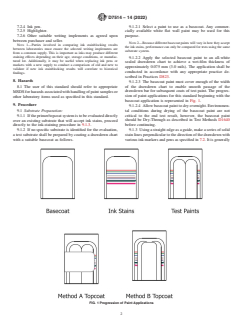
basecoat application is represented in Fig. 1.
9. Procedure
9.1.2.4 Allow basecoat paint to dry overnight. Environmen-
tal conditions during drying of the basecoat paint are not
9.1 Substrate Preparation:
critical to the end test result, however, the basecoat paint
9.1.1 If the primer/topcoat system is to be evaluated directly
should be Dry-Through as described in Test Methods D1640
over an existing substrate that will accept ink stains, proceed
before continuing.
directly to the ink-staining procedure in 9.1.3.
9.1.2 If no specific substrate is identified for the evaluation, 9.1.3 Usingastraightedgeasaguide,makeaseriesofsolid
a test substrate shall be prepared by coating a drawdown chart stain lines perpendicular to the direction of the drawdown with
with a suitable basecoat as follows. various ink markers and pens as specified in 7.2. It is generally
FIG. 1 Progression of Paint Applications
D7514 − 14 (2022)
suggested to select inks of varying chemical composition such 9.2.4 If the test paint system is designed for use without an
as those having different carrier solvents. additional topcoat, proceed directly to final evaluation de-
9.1.4 A minimum of 2 colors of each marker and pen is scribed in Section 10.
recommended. Leave a minimum of 3 mm unstained area 9.2.5 Select a paint to use as a topcoat. The topcoat paint
between each stain line. should represent a paint that would be applied over the test
paints in practice. If evaluating a self-priming system, the test
NOTE 3—Selecting a variety of colors for each stain is recommended as
paint itself may be used as the topcoat.
this gives an indication of a coating system’s stainblocking ability using a
9.2.6 Complete the panel by applying the selected topcoat
commoninkcompositionbutwithvaryingpigmentation.Inpractice,three
or more colors are often selected to represent each ink.
using a film applicator to achieve a 0.075 mm to 0.100 mm
(3 mil to 4 mil) wet film.
9.1.5 If the test will be run using Method A as described in
9.2.6.1 Method A—The topcoat drawdown is cast so that it
9.2.6.1, the distance between the top and bottom stain lines on
is parallel to the applied direction of the ink stains on the
the test chart should not exceed the practical application width
substrate.
...