

ASTM C201-93(2019)e1
(Test Method)Standard Test Method for Thermal Conductivity of Refractories
General Information
- Abstract
SIGNIFICANCE AND USE
3.1 The thermal conductivity of refractories is a property required for selecting their thermal transmission characteristics. Users select refractories to provide specified conditions of heat loss and cold face temperature, without exceeding the temperature limitation of the refractory. This test method establishes the testing for thermal conductivity of refractories using the calorimeter.
3.2 This procedure requires a large thermal gradient and steady-state conditions. The results are based upon a mean temperature.
3.3 The data from this test method are suitable for specification acceptance and design of multi-layer refractory construction.
3.4 The use of these data requires consideration of the actual application environment and conditions.
SCOPE
1.1 This test method covers the determination of the comparative thermal conductivity of refractories under standardized conditions of testing. This test method is designed for refractories having a conductivity factor of not more than 200 Btu·in./h·ft2·°F (28.8 W/m·K), for a thickness of 1 in. (25 mm).
1.2 Detailed ASTM test methods to be used in conjunction with this procedure in testing specific types of refractory materials are as follows: Test Method C182, Test Method C202, Test Method C417, and Test Method C767.
1.3 The values stated in inch-pound units are to be regarded as standard. The values given in parentheses are mathematical conversions to SI units that are provided for information only and are not considered standard.
1.4 This standard does not purport to address all of the safety concerns, if any, associated with its use. It is the responsibility of the user of this standard to establish appropriate safety, health, and environmental practices and determine the applicability of regulatory limitations prior to use.
1.5 This international standard was developed in accordance with internationally recognized principles on standardization established in the Decision on Principles for the Development of International Standards, Guides and Recommendations issued by the World Trade Organization Technical Barriers to Trade (TBT) Committee.
- Status
- Published
- Publication Date
- 31-Dec-2018
- Technical Committee
- C08 - Refractories
- Drafting Committee
- C08.02 - Thermal Properties
Overview
ASTM C201-93(2019)e1: Standard Test Method for Thermal Conductivity of Refractories is a widely respected international standard published by ASTM International. This standard outlines a reliable method for determining the comparative thermal conductivity of refractory materials under controlled and specified conditions. The procedure is essential for users and designers who must select appropriate refractories based on their thermal transmission properties, ensuring optimal performance in high-temperature industrial applications. Utilizing a calorimeter, ASTM C201-93 establishes a steady-state testing protocol to produce accurate thermal conductivity values, aiding material specification, acceptance, and multi-layer refractory design.
Key Topics
- Thermal Conductivity Measurement: Defines how to measure the rate at which heat passes through refractory materials using a calorimetric method, ensuring data reflects real-world conditions and application environments.
- Standardized Conditions: Test methods are designed for refractories with a maximum conductivity factor of 200 Btu·in./h·ft²·°F (28.8 W/m·K) at a thickness of 1 inch (25 mm), ensuring comparability and repeatability of results.
- Sample and Apparatus Specifications: Detailed requirements for specimen sizing, preparation, and equipment-including the heating chamber, calorimeter assembly, and water circulating system-are described to maintain test accuracy.
- Data Use and Interpretation: Emphasizes the need for considering actual operating conditions when applying test results to material selection and engineering design.
- Precision and Bias: Documents inter-laboratory precision and sets expectations for repeatability and variability, supporting reliable quality assurance.
Applications
The ASTM C201-93(2019)e1 standard is fundamental in industries where thermal management and insulation are critical, including:
- Metallurgical and Petrochemical Industries: Selecting refractories for furnaces, kilns, and reactors to control heat loss and maintain process efficiency without exceeding material temperature limits.
- Ceramics and Glass Manufacturing: Choosing appropriate refractory linings to optimize heating processes and protect equipment.
- Power Generation: Assisting in the design and maintenance of boilers and incinerators where heat containment is necessary for operational safety and efficiency.
- Construction of Multi-Layer Refractory Walls: Data supports the engineering of composite structures by informing choices for insulative and structural layers based on measured thermal properties.
This test method also provides data suitable for specification acceptance, product quality control, and research and development into new refractory formulations or installation techniques.
Related Standards
ASTM C201-93(2019)e1 references several complementary ASTM standards to address a range of refractory material types and necessary test measurements, including:
- ASTM C155 – Classification of Insulating Firebrick
- ASTM C182 – Test Method for Thermal Conductivity of Insulating Firebrick
- ASTM C202 – Test Method for Thermal Conductivity of Refractory Brick
- ASTM C417 – Test Method for Thermal Conductivity of Unfired Monolithic Refractories
- ASTM C767 – Test Method for Thermal Conductivity of Carbon Refractories
- ASTM C134 – Test Methods for Size, Dimensional Measurements, and Bulk Density of Refractory Bricks
- ASTM E220 – Test Method for Calibration of Thermocouples by Comparison Techniques
Practical Value
Adherence to ASTM C201-93(2019)e1 assures consistent, reproducible, and internationally recognized measurement of thermal conductivity in refractory materials. This supports industries in achieving energy efficiency, regulatory compliance, and optimal refractory selection for demanding high-temperature environments. By reliably characterizing material performance, stakeholders can make informed decisions that enhance both equipment longevity and process safety.
Keywords: ASTM C201, thermal conductivity, refractories, calorimeter test method, insulation, refractory materials, industrial heating, ASTM standards, material selection, test procedure, thermal properties.
Relations
- Effective Date
- 01-Apr-2020
- Effective Date
- 01-Apr-2019
- Effective Date
- 01-Apr-2019
- Effective Date
- 01-Nov-2013
- Effective Date
- 01-Sep-2013
- Effective Date
- 01-Sep-2013
- Effective Date
- 01-Sep-2013
- Effective Date
- 01-Sep-2013
- Effective Date
- 01-Apr-2010
- Effective Date
- 01-Apr-2010
- Effective Date
- 01-Mar-2009
- Effective Date
- 01-Mar-2009
- Effective Date
- 01-Mar-2009
- Refers
ASTM E220-07a - Standard Test Method for Calibration of Thermocouples By Comparison Techniques - Effective Date
- 01-Nov-2007
- Refers
ASTM E220-07e1 - Standard Test Method for Calibration of Thermocouples By Comparison Techniques - Effective Date
- 01-May-2007
Frequently Asked Questions
ASTM C201-93(2019)e1 is a standard published by ASTM International. Its full title is "Standard Test Method for Thermal Conductivity of Refractories". This standard covers: SIGNIFICANCE AND USE 3.1 The thermal conductivity of refractories is a property required for selecting their thermal transmission characteristics. Users select refractories to provide specified conditions of heat loss and cold face temperature, without exceeding the temperature limitation of the refractory. This test method establishes the testing for thermal conductivity of refractories using the calorimeter. 3.2 This procedure requires a large thermal gradient and steady-state conditions. The results are based upon a mean temperature. 3.3 The data from this test method are suitable for specification acceptance and design of multi-layer refractory construction. 3.4 The use of these data requires consideration of the actual application environment and conditions. SCOPE 1.1 This test method covers the determination of the comparative thermal conductivity of refractories under standardized conditions of testing. This test method is designed for refractories having a conductivity factor of not more than 200 Btu·in./h·ft2·°F (28.8 W/m·K), for a thickness of 1 in. (25 mm). 1.2 Detailed ASTM test methods to be used in conjunction with this procedure in testing specific types of refractory materials are as follows: Test Method C182, Test Method C202, Test Method C417, and Test Method C767. 1.3 The values stated in inch-pound units are to be regarded as standard. The values given in parentheses are mathematical conversions to SI units that are provided for information only and are not considered standard. 1.4 This standard does not purport to address all of the safety concerns, if any, associated with its use. It is the responsibility of the user of this standard to establish appropriate safety, health, and environmental practices and determine the applicability of regulatory limitations prior to use. 1.5 This international standard was developed in accordance with internationally recognized principles on standardization established in the Decision on Principles for the Development of International Standards, Guides and Recommendations issued by the World Trade Organization Technical Barriers to Trade (TBT) Committee.
SIGNIFICANCE AND USE 3.1 The thermal conductivity of refractories is a property required for selecting their thermal transmission characteristics. Users select refractories to provide specified conditions of heat loss and cold face temperature, without exceeding the temperature limitation of the refractory. This test method establishes the testing for thermal conductivity of refractories using the calorimeter. 3.2 This procedure requires a large thermal gradient and steady-state conditions. The results are based upon a mean temperature. 3.3 The data from this test method are suitable for specification acceptance and design of multi-layer refractory construction. 3.4 The use of these data requires consideration of the actual application environment and conditions. SCOPE 1.1 This test method covers the determination of the comparative thermal conductivity of refractories under standardized conditions of testing. This test method is designed for refractories having a conductivity factor of not more than 200 Btu·in./h·ft2·°F (28.8 W/m·K), for a thickness of 1 in. (25 mm). 1.2 Detailed ASTM test methods to be used in conjunction with this procedure in testing specific types of refractory materials are as follows: Test Method C182, Test Method C202, Test Method C417, and Test Method C767. 1.3 The values stated in inch-pound units are to be regarded as standard. The values given in parentheses are mathematical conversions to SI units that are provided for information only and are not considered standard. 1.4 This standard does not purport to address all of the safety concerns, if any, associated with its use. It is the responsibility of the user of this standard to establish appropriate safety, health, and environmental practices and determine the applicability of regulatory limitations prior to use. 1.5 This international standard was developed in accordance with internationally recognized principles on standardization established in the Decision on Principles for the Development of International Standards, Guides and Recommendations issued by the World Trade Organization Technical Barriers to Trade (TBT) Committee.
ASTM C201-93(2019)e1 is classified under the following ICS (International Classification for Standards) categories: 81.080 - Refractories. The ICS classification helps identify the subject area and facilitates finding related standards.
ASTM C201-93(2019)e1 has the following relationships with other standards: It is inter standard links to ASTM C767-20, ASTM C182-19, ASTM C202-19, ASTM E220-13, ASTM C155-97(2013), ASTM C767-93(2013), ASTM C182-88(2013), ASTM C202-93(2013), ASTM C417-05(2010)e1, ASTM C134-95(2010), ASTM C202-93(2009)e1, ASTM C182-88(2009), ASTM C767-93(2009), ASTM E220-07a, ASTM E220-07e1. Understanding these relationships helps ensure you are using the most current and applicable version of the standard.
ASTM C201-93(2019)e1 is available in PDF format for immediate download after purchase. The document can be added to your cart and obtained through the secure checkout process. Digital delivery ensures instant access to the complete standard document.
Standards Content (Sample)
This international standard was developed in accordance with internationally recognized principles on standardization established in the Decision on Principles for the
Development of International Standards, Guides and Recommendations issued by the World Trade Organization Technical Barriers to Trade (TBT) Committee.
´1
Designation: C201 − 93 (Reapproved 2019)
Standard Test Method for
Thermal Conductivity of Refractories
This standard is issued under the fixed designation C201; the number immediately following the designation indicates the year of
original adoption or, in the case of revision, the year of last revision.Anumber in parentheses indicates the year of last reapproval.A
superscript epsilon (´) indicates an editorial change since the last revision or reapproval.
ε NOTE—The conductivity factor in parentheses in 1.1 was corrected editorially from 2818 W/m·K to 28.8 W/m·K in
October 2022.
1. Scope C155Classification of Insulating Firebrick
C182Test Method for Thermal Conductivity of Insulating
1.1 This test method covers the determination of the com-
Firebrick
parative thermal conductivity of refractories under standard-
C202Test Method for Thermal Conductivity of Refractory
ized conditions of testing. This test method is designed for
Brick
refractories having a conductivity factor of not more than 200
2 C417Test Method for Thermal Conductivity of Unfired
Btu·in./h·ft ·°F(28.8W/m·K),forathicknessof1in.(25mm).
Monolithic Refractories
1.2 Detailed ASTM test methods to be used in conjunction
C767Test Method for Thermal Conductivity of Carbon
with this procedure in testing specific types of refractory
Refractories
materials are as follows: Test Method C182, Test Method
E220Test Method for Calibration of Thermocouples By
C202, Test Method C417, and Test Method C767.
Comparison Techniques
1.3 The values stated in inch-pound units are to be regarded
3. Significance and Use
as standard. The values given in parentheses are mathematical
conversions to SI units that are provided for information only
3.1 The thermal conductivity of refractories is a property
and are not considered standard.
required for selecting their thermal transmission characteris-
1.4 This standard does not purport to address all of the tics.Usersselectrefractoriestoprovidespecifiedconditionsof
safety concerns, if any, associated with its use. It is the heat loss and cold face temperature, without exceeding the
responsibility of the user of this standard to establish appro- temperature limitation of the refractory. This test method
priate safety, health, and environmental practices and deter- establishes the testing for thermal conductivity of refractories
mine the applicability of regulatory limitations prior to use.
using the calorimeter.
1.5 This international standard was developed in accor-
3.2 This procedure requires a large thermal gradient and
dance with internationally recognized principles on standard-
steady-state conditions. The results are based upon a mean
ization established in the Decision on Principles for the
temperature.
Development of International Standards, Guides and Recom-
3.3 The data from this test method are suitable for specifi-
mendations issued by the World Trade Organization Technical
cation acceptance and design of multi-layer refractory con-
Barriers to Trade (TBT) Committee.
struction.
2. Referenced Documents
3.4 Theuseofthesedatarequiresconsiderationoftheactual
2.1 ASTM Standards: application environment and conditions.
C134Test Methods for Size, Dimensional Measurements,
and Bulk Density of Refractory Brick and Insulating 4. Apparatus
Firebrick
4.1 The apparatus shall conform in close detail with that
shown in the approved drawings. The equipment is shown in
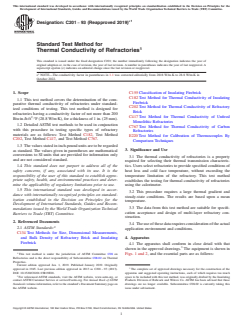
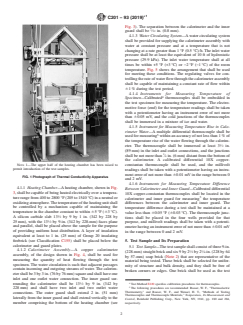
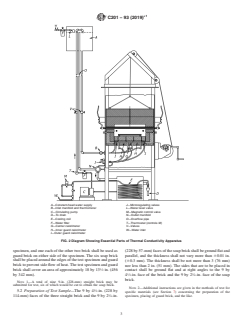
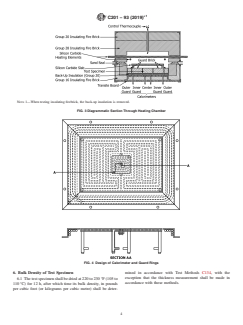
Figs. 1 and 2, and the essential parts are as follows:
This test method is under the jurisdiction of ASTM Committee C08 on
Refractories and is the direct responsibility of Subcommittee C08.02 on Thermal
Properties.
Current edition approved Jan. 1, 2019. Published January 2019. Originally
approved in 1945. Last previous edition approved in 2013 as C201–93 (2013). The complete set of approved drawings necessary for the construction of the
DOI: 10.1520/C0201-93R19E01. apparatus and suggested operating instructions, each of which requires too much
For referenced ASTM standards, visit the ASTM website, www.astm.org, or space to be included with this test method, was originally drafted by the Insulating
contact ASTM Customer Service at service@astm.org. For Annual Book of ASTM Products Division of Babcock and Wilcox Co. ASTM has been advised that these
Standards volume information, refer to the standard’s Document Summary page on drawings are no longer available. Subcommittee C08.02 is currently taking this
the ASTM website. issue under advisement.
Copyright © ASTM International, 100 Barr Harbor Drive, PO Box C700, West Conshohocken, PA 19428-2959. United States
´1
C201 − 93 (2019)
Fig. 3). The separation between the calorimeter and the inner
guard shall be ⁄32 in. (0.8 mm).
4.1.3 WaterCirculatingSystem—Awatercirculatingsystem
shall be provided for supplying the calorimeter assembly with
water at constant pressure and at a temperature that is not
changing at a rate greater than 1°F (0.5°C)⁄h. The inlet water
pressure shall be at least the equivalent of 10 ft of hydrostatic
pressure (29.9 kPa). The inlet water temperature shall at all
times be within +5°F (+3°C) or −2°F (−1°C) of the room
temperature. Fig. 5 shows the arrangement that shall be used
for meeting these conditions. The regulating valves for con-
trollingtherateofwaterflowthroughthecalorimeterassembly
shall be capable of maintaining a constant rate of flow within
61% during the test period.
4.1.4 Instruments for Measuring Temperature of
Specimen—Calibrated thermocouples shall be embedded in
the test specimen for measuring the temperature. The electro-
motive force (emf) for the temperature readings shall be taken
with a potentiometer having an instrument error of not more
than 60.05 mV, and the cold junctions of the thermocouples
shall be immersed in a mixture of ice and water.
4.1.5 Instrument for Measuring Temperature Rise in Calo-
rimeter Water—A multiple differential thermocouple shall be
used for measuring within an accuracy of not less than 1% of
the temperature rise of the water flowing through the calorim-
eter. The thermocouple shall be immersed at least 3 ⁄2 in.
(89mm) in the inlet and outlet connections, and the junctions
shallbenotmorethan ⁄4in.(6mm)distantfromthebottomof
the calorimeter. A calibrated differential 10X copper-
NOTE 1—The upper half of the heating chamber has been raised to
constantan thermocouple shall be used, and the millivolt
permit introduction of the test samples.
readings shall be taken with a potentiometer having an instru-
ment error of not more than 60.01 mVin the range between 0
FIG. 1 Photograph of Thermal Conductivity Apparatus
and2mV.
4.1.6 Instruments for Measuring Temperature Difference
4.1.1 Heating Chamber—Aheating chamber, shown in Fig.
BetweenCalorimeterandInnerGuard—Calibrateddifferential
3, shall be capable of being heated electrically over a tempera-
10X copper-constantan thermocouples shall be located in the
turerangefrom400to2800°F(205to1540°C)inaneutralor
calorimeter and inner guard for measuring the temperature
oxidizingatmosphere.Thetemperatureoftheheatingunitshall
differences between the calorimeter and inner guard. The
be controlled by a mechanism capable of maintaining the
temperature difference during a test shall be maintained at a
temperature in the chamber constant to within 65°F(63°C).
value less than 60.05°F (60.03°C). The thermocouple junc-
A silicon carbide slab 13 ⁄2 by 9 by 1 in. (342 by 228 by
tions shall be placed in the four wells provided for that
25mm), with the 13 ⁄2 by 9-in. (342 by 228-mm) faces plane
purpose, and millivolt readings shall be taken with a potenti-
and parallel, shall be placed above the sample for the purpose
ometerhavinganinstrumenterrorofnotmorethan 60.01mV
of providing uniform heat distribution. A layer of insulation
in the range between 0 and 2 mV.
equivalent at least to 1 in. (25 mm) of Group 20 insulating
firebrick (see Classification C155) shall be placed below the 5. Test Sample and Its Preparation
calorimeter and guard plates.
5.1 TestSample—Thetestsampleshallconsistofthree9-in.
4.1.2 Calorimeter Assembly—A copper calorimeter
1 1
(228-mm)straightbrickandsix9by2 ⁄2by2 ⁄4-in.(228by64
assembly, of the design shown in Fig. 4, shall be used for
by 57-mm) soap brick (Note 2) that are representative of the
measuring the quantity of heat flowing through the test
material being tested. These brick shall be selected for unifor-
specimen. The water circulation is such that adjacent passages
mity of structure and bulk density, and they shall be free of
contain incoming and outgoing streams of water. T
...