

ASTM D1151-00(2022)
(Practice)Standard Practice for Effect of Moisture and Temperature on Adhesive Bonds
General Information
- Abstract
SIGNIFICANCE AND USE
4.1 This practice may be used to determine the performance, for suitable materials, in terms of any desired strength property of adhesive bonds. Test conditions of temperature and moisture only are here specified. The duration of exposure is dependent upon the nature of the adhesive and the type of specimens and will, therefore, be covered by material specifications.
SCOPE
1.1 This practice defines conditions for determining the performance of adhesive bonds when subjected to continuous exposure at specified conditions of moisture and temperature. The performance is expressed as a percentage based on the ratio of strength retained after exposure to the original strength.
1.2 The values stated in SI units are to be regarded as the standard. The values given in parentheses are provided for information purposes only.
1.3 This standard does not purport to address all of the safety concerns, if any, associated with its use. It is the responsibility of the user of this standard to establish appropriate safety, health, and environmental practices and determine the applicability of regulatory limitations prior to use.
1.4 This international standard was developed in accordance with internationally recognized principles on standardization established in the Decision on Principles for the Development of International Standards, Guides and Recommendations issued by the World Trade Organization Technical Barriers to Trade (TBT) Committee.
- Status
- Published
- Publication Date
- 31-Dec-2021
- Technical Committee
- D14 - Adhesives
- Drafting Committee
- D14.80 - Metal Bonding Adhesives


Overview
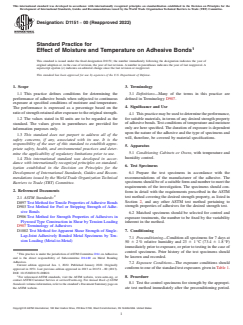
ASTM D1151-00(2022), Standard Practice for Effect of Moisture and Temperature on Adhesive Bonds, is an internationally recognized standard developed by ASTM International under the jurisdiction of ASTM Committee D14 on Adhesives. This standard establishes conditions for evaluating the performance of adhesive bonds subjected to continuous exposure to specified temperature and moisture conditions. The goal is to facilitate the comparison of strength retention in adhesive joints under various environmental stresses.
Key Topics
- Performance Evaluation: ASTM D1151 outlines methods to assess how adhesive bonds retain strength after exposure to controlled moisture and temperature environments compared to their original condition.
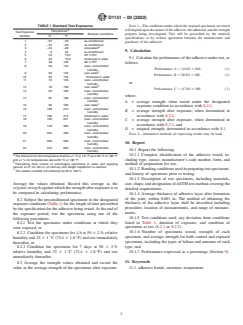
- Exposure Conditions: The standard provides a comprehensive table of standard test exposures, covering a wide range of temperatures (from -57 °C to 316 °C) and moisture conditions (such as relative humidity, water immersion, and oven exposure).
- Test Specimen Preparation: Test specimens should be prepared according to the adhesive manufacturer's recommendations and specific ASTM test methods for accurate, reproducible results.
- Conditioning and Testing: The procedure involves preconditioning specimens, exposing them to defined environments for a specified duration, then testing their residual strength.
- Performance Calculation: The retained strength after exposure is compared to the original strength, and the performance is expressed as a percentage.
- Reporting Requirements: Detailed reporting is essential, including adhesive identification, bonding conditions, specimen description, test methods, and test results.
Applications
ASTM D1151 is widely used across industries where adhesive bonds are subject to fluctuating moisture and temperature conditions. Typical applications include:
- Aerospace: Evaluating the durability of structural bonds in aircraft components exposed to extreme temperatures and humidity.
- Automotive: Testing adhesive joints in parts subject to weather cycles and thermal loads.
- Construction: Ensuring the reliability of adhesive bonds used in building materials exposed to varying outdoor environments.
- Marine and Defense: Assessing performance of adhesives in settings subject to high humidity, water immersion, and temperature extremes.
- Product Development and Quality Control: Comparing different adhesive formulations and verifying compliance with material specifications in manufacturing.
By following ASTM D1151, manufacturers, engineers, and quality assurance professionals can select and qualify adhesives that meet the performance needs of their end-use environments, minimize failures, and improve product durability.
Related Standards
The practice extensively references other ASTM standards commonly used in adhesive testing, including:
- ASTM D897: Test Method for Tensile Properties of Adhesive Bonds
- ASTM D903: Test Method for Peel or Stripping Strength of Adhesive Bonds
- ASTM D906: Test Method for Strength Properties of Adhesives in Plywood-Type Construction in Shear by Tension Loading
- ASTM D907: Terminology of Adhesives
- ASTM D1002: Test Method for Apparent Shear Strength of Single-Lap-Joint Metal Specimens by Tension Loading
Each of these standards provides specific test methods or definitions that complement the evaluation procedures outlined in ASTM D1151.
Keywords: ASTM D1151, adhesive bonds, moisture effect, temperature effect, strength retention, adhesive testing, environmental exposure, adhesive performance, quality control, durability testing
Relations
- Effective Date
- 01-Apr-2020
- Effective Date
- 01-Apr-2019
- Effective Date
- 01-Nov-2017
- Effective Date
- 01-Aug-2017
- Effective Date
- 01-May-2016
- Effective Date
- 01-Jul-2012
- Effective Date
- 01-May-2012
- Effective Date
- 01-Dec-2011
- Effective Date
- 01-Apr-2011
- Effective Date
- 01-Jan-2011
- Effective Date
- 01-Oct-2010
- Effective Date
- 01-Oct-2008
- Effective Date
- 01-Oct-2008
- Effective Date
- 15-Aug-2008
- Effective Date
- 01-Mar-2008
Get Certified
Connect with accredited certification bodies for this standard

DIN CERTCO
DIN Group product certification.

Smithers Quality Assessments
US management systems and product certification.
Sponsored listings
Frequently Asked Questions
ASTM D1151-00(2022) is a standard published by ASTM International. Its full title is "Standard Practice for Effect of Moisture and Temperature on Adhesive Bonds". This standard covers: SIGNIFICANCE AND USE 4.1 This practice may be used to determine the performance, for suitable materials, in terms of any desired strength property of adhesive bonds. Test conditions of temperature and moisture only are here specified. The duration of exposure is dependent upon the nature of the adhesive and the type of specimens and will, therefore, be covered by material specifications. SCOPE 1.1 This practice defines conditions for determining the performance of adhesive bonds when subjected to continuous exposure at specified conditions of moisture and temperature. The performance is expressed as a percentage based on the ratio of strength retained after exposure to the original strength. 1.2 The values stated in SI units are to be regarded as the standard. The values given in parentheses are provided for information purposes only. 1.3 This standard does not purport to address all of the safety concerns, if any, associated with its use. It is the responsibility of the user of this standard to establish appropriate safety, health, and environmental practices and determine the applicability of regulatory limitations prior to use. 1.4 This international standard was developed in accordance with internationally recognized principles on standardization established in the Decision on Principles for the Development of International Standards, Guides and Recommendations issued by the World Trade Organization Technical Barriers to Trade (TBT) Committee.
SIGNIFICANCE AND USE 4.1 This practice may be used to determine the performance, for suitable materials, in terms of any desired strength property of adhesive bonds. Test conditions of temperature and moisture only are here specified. The duration of exposure is dependent upon the nature of the adhesive and the type of specimens and will, therefore, be covered by material specifications. SCOPE 1.1 This practice defines conditions for determining the performance of adhesive bonds when subjected to continuous exposure at specified conditions of moisture and temperature. The performance is expressed as a percentage based on the ratio of strength retained after exposure to the original strength. 1.2 The values stated in SI units are to be regarded as the standard. The values given in parentheses are provided for information purposes only. 1.3 This standard does not purport to address all of the safety concerns, if any, associated with its use. It is the responsibility of the user of this standard to establish appropriate safety, health, and environmental practices and determine the applicability of regulatory limitations prior to use. 1.4 This international standard was developed in accordance with internationally recognized principles on standardization established in the Decision on Principles for the Development of International Standards, Guides and Recommendations issued by the World Trade Organization Technical Barriers to Trade (TBT) Committee.
ASTM D1151-00(2022) is classified under the following ICS (International Classification for Standards) categories: 83.180 - Adhesives. The ICS classification helps identify the subject area and facilitates finding related standards.
ASTM D1151-00(2022) has the following relationships with other standards: It is inter standard links to ASTM D906-20, ASTM D1002-10(2019), ASTM D903-98(2017), ASTM D906-98(2017), ASTM D897-08(2016), ASTM D907-12a, ASTM D907-12, ASTM D907-11a, ASTM D906-98(2011), ASTM D907-11, ASTM D903-98(2010), ASTM D897-08, ASTM D907-08b, ASTM D907-08a, ASTM D907-08. Understanding these relationships helps ensure you are using the most current and applicable version of the standard.
ASTM D1151-00(2022) is available in PDF format for immediate download after purchase. The document can be added to your cart and obtained through the secure checkout process. Digital delivery ensures instant access to the complete standard document.
Standards Content (Sample)
This international standard was developed in accordance with internationally recognized principles on standardization established in the Decision on Principles for the
Development of International Standards, Guides and Recommendations issued by the World Trade Organization Technical Barriers to Trade (TBT) Committee.
Designation: D1151 − 00 (Reapproved 2022)
Standard Practice for
Effect of Moisture and Temperature on Adhesive Bonds
This standard is issued under the fixed designation D1151; the number immediately following the designation indicates the year of
original adoption or, in the case of revision, the year of last revision. A number in parentheses indicates the year of last reapproval. A
superscript epsilon (´) indicates an editorial change since the last revision or reapproval.
This standard has been approved for use by agencies of the U.S. Department of Defense.
1. Scope 3. Terminology
1.1 This practice defines conditions for determining the 3.1 Definitions—Many of the terms in this practice are
performance of adhesive bonds when subjected to continuous defined in Terminology D907.
exposure at specified conditions of moisture and temperature.
4. Significance and Use
The performance is expressed as a percentage based on the
ratio of strength retained after exposure to the original strength.
4.1 Thispracticemaybeusedtodeterminetheperformance,
for suitable materials, in terms of any desired strength property
1.2 The values stated in SI units are to be regarded as the
of adhesive bonds.Test conditions of temperature and moisture
standard. The values given in parentheses are provided for
only are here specified. The duration of exposure is dependent
information purposes only.
upon the nature of the adhesive and the type of specimens and
1.3 This standard does not purport to address all of the
will, therefore, be covered by material specifications.
safety concerns, if any, associated with its use. It is the
responsibility of the user of this standard to establish appro-
5. Apparatus
priate safety, health, and environmental practices and deter-
5.1 Conditioning Cabinets or Ovens, with temperature and
mine the applicability of regulatory limitations prior to use.
humidity control.
1.4 This international standard was developed in accor-
dance with internationally recognized principles on standard-
6. Test Specimens
ization established in the Decision on Principles for the
Development of International Standards, Guides and Recom- 6.1 Prepare the test specimens in accordance with the
recommendations of the manufacturer of the adhesive. The
mendations issued by the World Trade Organization Technical
Barriers to Trade (TBT) Committee. specimens should be of a suitable form and number to meet the
requirements of the investigation. The specimens should con-
2. Referenced Documents
form in detail with the requirements prescribed in the ASTM
test method covering the desired strength property, as listed in
2.1 ASTM Standards:
Section 2, and any other ASTM test method pertaining to
D897 Test Method for Tensile Properties ofAdhesive Bonds
strength properties of adhesives for the desired strength test.
D903 Test Method for Peel or Stripping Strength of Adhe-
sive Bonds
6.2 Matched specimens should be selected for control and
D906 Test Method for Strength Properties of Adhesives in
exposure treatments, the number to be fixed by the variability
Plywood Type Construction in Shear by Tension Loading
inherent in the method.
D907 Terminology of Adhesives
D1002 Test Method for Apparent Shear Strength of Single- 7. Conditioning
Lap-Joint Adhesively Bonded Metal Specimens by Ten-
7.1 Preconditioning—Condition all specimens for 7 days at
sion Loading (Metal-to-Metal)
50 6 2 % relative humidity and 23 6 1 °C (73.4 6 1.8 °F)
immediately prior to exposure, or prior to testing in the case of
control specimens. Prior history of the test specimens should
This practice is under the jurisdiction of ASTM Committee D14 on Adhesives
be known and recorded.
and is the direct responsibility of Subcommittee D14.80 on Metal Bonding
Adhesives.
7.2 Exposure Conditions—The exposure conditions should
Current edition approved Jan. 1, 2022. Published January 2022. Originally
conform to one of the standard test exposures given in Table 1.
approved in 1951. Last previous edition approved in 2013 as D1151 – 00 (2013).
DOI: 10.1520/D1151-00R22.
For referenced ASTM standards, visit the ASTM website, www.astm.org, or 8. Procedure
contact ASTM Customer Service at service@astm.org. For Annual Book of ASTM
8.1 Test the control specimens for strength by the appropri-
Standards volume information, refer to the standard’s Document Summary page on
the ASTM website. ate test method immediately after the preconditioning period.
Copyright © ASTM International, 100 Barr Harbor Drive, PO Box C700, West Conshohocken, PA 19428-2959. United States
D1151 − 00 (2022)
TABLE 1 Standard Test Exposures NOTE 1—The conditions under which the exposed specimens are tested
A willdependuponthenatureoftheadhesive,theadherend,andthestrength
Temperature
Test Exposure
Moisture Conditions property being investigated. This will be prescribed by the material
Number
°C °F
specifications or by written agreeme
...