

ASTM A722/A722M-18
(Specification)Standard Specification for High-Strength Steel Bars for Prestressed Concrete
General Information
- Abstract
ABSTRACT
This specification covers uncoated high-strength steel bars intended for use in pretensioned and post-tensioned prestressed concrete construction or in prestressed ground anchors. Two types of bars are considered: Type I bar, which has a plain surface and Type II bar, which has surface deformations. The bars shall be rolled from properly identified heats of ingot cast or strand cast steel. The bars shall be subjected to cold-stressing and then shall be stress-relieved to produce the prescribed mechanical properties. Yield strength, elongation, and tension tests shall be performed.
SCOPE
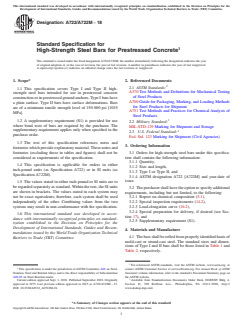
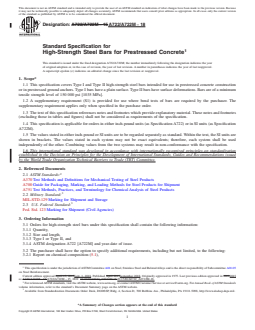
1.1 This specification covers Type I and Type II high-strength steel bars intended for use in prestressed concrete construction or in prestressed ground anchors. Type I bars have a plain surface. Type II bars have surface deformations. Bars are of a minimum tensile strength level of 150 000 psi [1035 MPa].
1.2 A supplementary requirement (S1) is provided for use where bend tests of bars are required by the purchaser. The supplementary requirement applies only when specified in the purchase order.
1.3 The text of this specification references notes and footnotes which provide explanatory material. These notes and footnotes (excluding those in tables and figures) shall not be considered as requirements of the specification.
1.4 This specification is applicable for orders in either inch-pound units (as Specification A722) or in SI units (as Specification A722M).
1.5 The values stated in either inch-pound or SI units are to be regarded separately as standard. Within the text, the SI units are shown in brackets. The values stated in each system may not be exact equivalents; therefore, each system shall be used independently of the other. Combining values from the two systems may result in non-conformance with the specification.
1.6 This international standard was developed in accordance with internationally recognized principles on standardization established in the Decision on Principles for the Development of International Standards, Guides and Recommendations issued by the World Trade Organization Technical Barriers to Trade (TBT) Committee.
- Status
- Published
- Publication Date
- 31-Aug-2018
- Technical Committee
- A01 - Steel, Stainless Steel and Related Alloys
- Drafting Committee
- A01.05 - Steel Reinforcement
Buy Documents
ASTM A722/A722M-18 - Standard Specification for High-Strength Steel Bars for Prestressed Concrete
REDLINE ASTM A722/A722M-18 - Standard Specification for High-Strength Steel Bars for Prestressed Concrete
Overview
ASTM A722/A722M-18: Standard Specification for High-Strength Steel Bars for Prestressed Concrete defines requirements for uncoated high-strength steel bars intended for use in both pretensioned and post-tensioned prestressed concrete construction as well as prestressed ground anchors. This standard, published by ASTM International, builds confidence in structural applications by specifying material characteristics, mechanical properties, testing protocols, and packaging details for these critical construction steel bars.
ASTM A722/A722M-18 covers two types of steel bars:
- Type I: Plain surface bars
- Type II: Bars with surface deformations
These bars must meet a minimum tensile strength of 150,000 psi [1035 MPa] and are available under both inch-pound (A722) and SI (A722M) units. The specification ensures reliable performance and quality, supporting the safety and longevity of prestressed concrete structures worldwide.
Key Topics
Key requirements and features addressed by ASTM A722/A722M-18 include:
Bar Types and Identification
- Type I (plain surface) and Type II (deformed surface) bars
- Clearly defined dimensions and weight ranges for each type
Mechanical Properties
- Minimum tensile strength: 150,000 psi [1035 MPa]
- Yield strength defined as a percentage of minimum tensile strength (85% for Type I, 80% for Type II)
- Minimum elongation and reduction of area
- Supplementary bend test requirements when specified
Manufacturing and Testing
- Rolled from properly identified heats of steel
- Cold-stressing and stress-relieving processes to achieve required properties
- Comprehensive tension testing and dimensional checks
- Supplementary chemical composition analysis and special inspection options as ordered
Product Marking and Packaging
- Bundling by size, labeling with heat number and bar size
- Clear identification for shipment, including requirements for military and government procurement
International Compatibility
- Compliant with international standardization principles and dual-unit measurement formatting for global use
Applications
High-strength steel bars produced to ASTM A722/A722M-18 are widely used for:
Prestressed Concrete Construction
- Essential for bridges, parking structures, industrial buildings, and transportation infrastructure requiring prestressed reinforcement
- Suitable for both pretensioned and post-tensioned systems, improving load capacity and span capabilities
Prestressed Ground Anchors
- Utilized in civil engineering and geotechnical projects, including retaining walls, slope stabilization, and anchoring of foundations
Infrastructure Projects
- Applied in highway, railway, and utilities construction where reliable, high-strength materials are critical
The use of ASTM A722/A722M-18 bars contributes to:
- Improved structural integrity and durability
- Enhanced resistance to tensile stresses and dynamic loading
- Greater design flexibility for engineers and architects
Related Standards
Several ASTM and industry standards are referenced within or commonly used alongside ASTM A722/A722M-18, including:
- ASTM A370: Test Methods and Definitions for Mechanical Testing of Steel Products
- ASTM A700: Guide for Packaging, Marking, and Loading Methods for Steel Products for Shipment
- ASTM A751: Test Methods, Practices, and Terminology for Chemical Analysis of Steel Products
- MIL-STD-129: Marking for Shipment and Storage for military applications
- Federal Standard 123: Marking for Shipment (Civil Agencies)
For best results in prestressed concrete construction or ground anchor projects, consult these related standards to ensure full compliance in testing, chemical analysis, and shipment requirements.
Keywords: high-strength steel bars, prestressed concrete, ASTM A722, Type I bars, Type II bars, deformed steel bars, plain steel bars, prestressed ground anchors, concrete reinforcement standards, mechanical testing of steel, steel bar specifications
Relations
- Effective Date
- 01-Mar-2024
- Effective Date
- 01-Nov-2019
- Effective Date
- 01-Jul-2019
- Refers
ASTM A370-17a - Standard Test Methods and Definitions for Mechanical Testing of Steel Products - Effective Date
- 15-Nov-2017
- Effective Date
- 01-Jan-2017
- Effective Date
- 01-Nov-2015
- Effective Date
- 01-Nov-2014
- Effective Date
- 15-May-2014
- Effective Date
- 01-Mar-2014
- Effective Date
- 15-Nov-2013
- Refers
ASTM A370-12a - Standard Test Methods and Definitions for Mechanical Testing of Steel Products - Effective Date
- 15-Oct-2012
- Effective Date
- 15-Mar-2012
- Refers
ASTM A370-11a - Standard Test Methods and Definitions for Mechanical Testing of Steel Products - Effective Date
- 15-Nov-2011
- Effective Date
- 15-Jun-2010
- Refers
ASTM A370-09a - Standard Test Methods and Definitions for Mechanical Testing of Steel Products - Effective Date
- 01-Jun-2009
Buy Documents
ASTM A722/A722M-18 - Standard Specification for High-Strength Steel Bars for Prestressed Concrete
REDLINE ASTM A722/A722M-18 - Standard Specification for High-Strength Steel Bars for Prestressed Concrete
Get Certified
Connect with accredited certification bodies for this standard

Element Materials Technology
Materials testing and product certification.

Inštitut za kovinske materiale in tehnologije
Institute of Metals and Technology. Materials testing, metallurgical analysis, NDT.
Sponsored listings
Frequently Asked Questions
ASTM A722/A722M-18 is a technical specification published by ASTM International. Its full title is "Standard Specification for High-Strength Steel Bars for Prestressed Concrete". This standard covers: ABSTRACT This specification covers uncoated high-strength steel bars intended for use in pretensioned and post-tensioned prestressed concrete construction or in prestressed ground anchors. Two types of bars are considered: Type I bar, which has a plain surface and Type II bar, which has surface deformations. The bars shall be rolled from properly identified heats of ingot cast or strand cast steel. The bars shall be subjected to cold-stressing and then shall be stress-relieved to produce the prescribed mechanical properties. Yield strength, elongation, and tension tests shall be performed. SCOPE 1.1 This specification covers Type I and Type II high-strength steel bars intended for use in prestressed concrete construction or in prestressed ground anchors. Type I bars have a plain surface. Type II bars have surface deformations. Bars are of a minimum tensile strength level of 150 000 psi [1035 MPa]. 1.2 A supplementary requirement (S1) is provided for use where bend tests of bars are required by the purchaser. The supplementary requirement applies only when specified in the purchase order. 1.3 The text of this specification references notes and footnotes which provide explanatory material. These notes and footnotes (excluding those in tables and figures) shall not be considered as requirements of the specification. 1.4 This specification is applicable for orders in either inch-pound units (as Specification A722) or in SI units (as Specification A722M). 1.5 The values stated in either inch-pound or SI units are to be regarded separately as standard. Within the text, the SI units are shown in brackets. The values stated in each system may not be exact equivalents; therefore, each system shall be used independently of the other. Combining values from the two systems may result in non-conformance with the specification. 1.6 This international standard was developed in accordance with internationally recognized principles on standardization established in the Decision on Principles for the Development of International Standards, Guides and Recommendations issued by the World Trade Organization Technical Barriers to Trade (TBT) Committee.
ABSTRACT This specification covers uncoated high-strength steel bars intended for use in pretensioned and post-tensioned prestressed concrete construction or in prestressed ground anchors. Two types of bars are considered: Type I bar, which has a plain surface and Type II bar, which has surface deformations. The bars shall be rolled from properly identified heats of ingot cast or strand cast steel. The bars shall be subjected to cold-stressing and then shall be stress-relieved to produce the prescribed mechanical properties. Yield strength, elongation, and tension tests shall be performed. SCOPE 1.1 This specification covers Type I and Type II high-strength steel bars intended for use in prestressed concrete construction or in prestressed ground anchors. Type I bars have a plain surface. Type II bars have surface deformations. Bars are of a minimum tensile strength level of 150 000 psi [1035 MPa]. 1.2 A supplementary requirement (S1) is provided for use where bend tests of bars are required by the purchaser. The supplementary requirement applies only when specified in the purchase order. 1.3 The text of this specification references notes and footnotes which provide explanatory material. These notes and footnotes (excluding those in tables and figures) shall not be considered as requirements of the specification. 1.4 This specification is applicable for orders in either inch-pound units (as Specification A722) or in SI units (as Specification A722M). 1.5 The values stated in either inch-pound or SI units are to be regarded separately as standard. Within the text, the SI units are shown in brackets. The values stated in each system may not be exact equivalents; therefore, each system shall be used independently of the other. Combining values from the two systems may result in non-conformance with the specification. 1.6 This international standard was developed in accordance with internationally recognized principles on standardization established in the Decision on Principles for the Development of International Standards, Guides and Recommendations issued by the World Trade Organization Technical Barriers to Trade (TBT) Committee.
ASTM A722/A722M-18 is classified under the following ICS (International Classification for Standards) categories: 77.140.15 - Steels for reinforcement of concrete. The ICS classification helps identify the subject area and facilitates finding related standards.
ASTM A722/A722M-18 has the following relationships with other standards: It is inter standard links to ASTM A370-24, ASTM A700-14(2019), ASTM A370-19, ASTM A370-17a, ASTM A370-17, ASTM A370-15, ASTM A700-14, ASTM A370-14, ASTM A751-14, ASTM A370-13, ASTM A370-12a, ASTM A370-12, ASTM A370-11a, ASTM A370-10, ASTM A370-09a. Understanding these relationships helps ensure you are using the most current and applicable version of the standard.
ASTM A722/A722M-18 is available in PDF format for immediate download after purchase. The document can be added to your cart and obtained through the secure checkout process. Digital delivery ensures instant access to the complete standard document.
Standards Content (Sample)
This international standard was developed in accordance with internationally recognized principles on standardization established in the Decision on Principles for the
Development of International Standards, Guides and Recommendations issued by the World Trade Organization Technical Barriers to Trade (TBT) Committee.
Designation: A722/A722M −18
Standard Specification for
High-Strength Steel Bars for Prestressed Concrete
This standard is issued under the fixed designationA722/A722M; the number immediately following the designation indicates the year
of original adoption or, in the case of revision, the year of last revision.Anumber in parentheses indicates the year of last reapproval.
A superscript epsilon (´) indicates an editorial change since the last revision or reapproval.
1. Scope* 2. Referenced Documents
2.1 ASTM Standards:
1.1 This specification covers Type I and Type II high-
A370Test Methods and Definitions for Mechanical Testing
strength steel bars intended for use in prestressed concrete
of Steel Products
constructionorinprestressedgroundanchors.TypeIbarshave
A700Guide for Packaging, Marking, and Loading Methods
a plain surface. Type II bars have surface deformations. Bars
for Steel Products for Shipment
are of a minimum tensile strength level of 150 000 psi [1035
A751Test Methods and Practices for Chemical Analysis of
MPa].
Steel Products
1.2 A supplementary requirement (S1) is provided for use
2.2 Military Standard:
where bend tests of bars are required by the purchaser. The
MIL-STD-129Marking for Shipment and Storage
supplementary requirement applies only when specified in the 3
2.3 U.S. Federal Standard:
purchase order.
Fed. Std. 123Marking for Shipment (Civil Agencies)
1.3 The text of this specification references notes and
3. Ordering Information
footnotes which provide explanatory material.These notes and
footnotes (excluding those in tables and figures) shall not be 3.1 Orders for high-strength steel bars under this specifica-
considered as requirements of the specification. tion shall contain the following information:
3.1.1 Quantity,
1.4 This specification is applicable for orders in either
3.1.2 Size and length,
inch-pound units (as Specification A722) or in SI units (as
3.1.3 Type I or Type II, and
Specification A722M).
3.1.4 ASTM designation A722 [A722M] and year-date of
issue.
1.5 The values stated in either inch-pound or SI units are to
beregardedseparatelyasstandard.Withinthetext,theSIunits
3.2 Thepurchasershallhavetheoptiontospecifyadditional
are shown in brackets. The values stated in each system may
requirements, including but not limited, to the following:
not be exact equivalents; therefore, each system shall be used
3.2.1 Report on chemical composition (5.1),
independently of the other. Combining values from the two
3.2.2 Special inspection requirements (14.2),
systems may result in non-conformance with the specification.
3.2.3 Load-elongation curve (16.2),
3.2.4 Special preparation for delivery, if desired (see Sec-
1.6 This international standard was developed in accor-
tion 17), and
dance with internationally recognized principles on standard-
3.2.5 Supplementary requirement (S1).
ization established in the Decision on Principles for the
Development of International Standards, Guides and Recom-
4. Materials and Manufacture
mendations issued by the World Trade Organization Technical
4.1 Thebarsshallberolledfromproperlyidentifiedheatsof
Barriers to Trade (TBT) Committee.
mold-cast or strand-cast steel. The standard sizes and dimen-
sions of Type I and II bars shall be those listed in Table 1 and
Table 2, respectively.
For referenced ASTM standards, visit the ASTM website, www.astm.org, or
This specification is under the jurisdiction ofASTM Committee A01 on Steel, contact ASTM Customer Service at service@astm.org. For Annual Book of ASTM
Stainless Steel and RelatedAlloys and is the direct responsibility of Subcommittee Standards volume information, refer to the standard’s Document Summary page on
A01.05 on Steel Reinforcement. the ASTM website.
Current edition approved Sept. 1, 2018. Published September 2018. Originally Available from Standardization Documents Order Desk, DODSSP, Bldg. 4,
approved in 1975. Last previous edition approved in 2015 as A722/A722M–15. Section D, 700 Robbins Ave., Philadelphia, PA 19111-5098, http://
DOI: 10.1520/A0722_A0722M-18. www.dodssp.daps.mil.
*A Summary of Changes section appears at the end of this standard
Copyright © ASTM International, 100 Barr Harbor Drive, PO Box C700, West Conshohocken, PA 19428-2959. United States
A722/A722M − 18
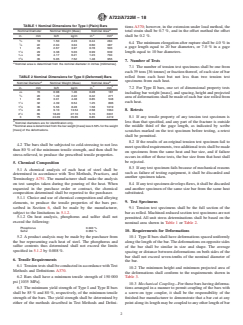
TABLE 1 Nominal Dimensions for Type I (Plain) Bars
tions A370; however, in the extension under load method, the
A
Nominal Diameter Nominal Weight (Mass) Nominal Area total strain shall be 0.7 %, and in the offset method the offset
2 2
in. mm lb/ft kg/m in. mm shall be 0.2 %.
⁄4 19 1.50 2.23 0.44 284
6.4 The minimum elongation after rupture shall be 4.0 % in
⁄8 22 2.04 3.04 0.60 387
a gage length equal to 20 bar diameters, or 7.0 % in a gage
1 25 2.67 3.97 0.78 503
1 ⁄8 29 3.38 5.03 0.99 639
length equal to 10 bar diameters.
1 ⁄4 32 4.17 6.21 1.23 794
1 ⁄8 35 5.05 7.52 1.48 955
7. Number of Tests
A
Nominal area is determined from the nominal diameter in inches [millimetres].
7.1 The number of tension test specimens shall be one from
each39tons[36tonnes]orfractionthereof,ofeachsizeofbar
rolled from each heat but not less than two tension test
TABLE 2 Nominal Dimensions for Type II (Deformed) Bars
A B specimens from each heat.
Nominal Diameter Nominal Weight (Mass) Nominal Area
2 2
in. mm lb/ft kg/m in. mm 7.2 For Type II bars, one set of dimensional property tests
⁄8 15 0.98 1.46 0.28 181
including bar weight [mass], and spacing, height and projected
⁄4 20 1.49 2.22 0.42 271
areaofdeformationsshallbemadeofeachbarsizerolledfrom
1 26 3.01 4.48 0.85 548
1 each heat.
1 ⁄4 32 4.39 6.54 1.25 806
1 ⁄8 36 5.56 8.28 1.58 1019
1 ⁄4 46 9.10 13.54 2.58 1664
8. Retests
2 ⁄2 65 18.20 27.10 5.16 3331
8.1 If any tensile property of any tension test specimen is
3 75 24.09 35.85 6.85 4419
A
less than that specified, and any part of the fracture is outside
Nominal diameters are for identification only.
B
Nominal area is determined from the bar weight [mass] less 3.50% for the weight
the middle third of the gage length, as indicated by scribe
[mass] of the deformations.
scratches marked on the test specimen before testing, a retest
shall be permitted.
8.2 If the results of an original tension test specimen fail to
4.2 The bars shall be subjected to cold-stressing to not less
meetspecifiedrequirements,twoadditionaltestsshallbemade
than 80 % of the minimum tensile strength, and then shall be
on specimens from the same heat and bar size, and if failure
stress-relieved, to produce the prescribed tensile properties.
occurs in either of these tests, the bar size from that heat shall
be rejected.
5. Chemical Composition
8.3 Ifanytestspecimenfailsbecauseofmechanicalreasons
5.1 A chemical analysis of each heat of steel shall be
such as failure of testing equipment, it shall be discarded and
determined in accordance with Test Methods, Practices, and
another specimen taken.
Terminology A751. The manufacturer shall make the analysis
on test samples taken during the pouring of the heat. When 8.4 Ifanytestspecimendevelopsflaws,itshallbediscarded
requested in the purchase order or contract, the chemical and another specimen of the same size bar from the same heat
composition determined shall be reported to the purchaser. substituted.
5.1.1 Choice and use of chemical composition and alloying
9. Test Specimens
elements, to produce the tensile properties of the bars pre-
scribed in Section 6, shall be made by the manufacturer,
9.1 Tension test specimens shall be the full section of the
subject to the limitations in 5.1.2.
bar as rolled. Machined-reduced section test specimens are not
5.1.2 On heat analysis, phosphorus and sulfur shall not
permitted. All unit stress determinations shall be based on the
exceed the following:
nominal area shown in Table 1 or Table 2.
Phosphorus 0.040 %
10. Requirements for Deformations
Sulfur 0.050 %
5.2 Aproduct analysis may be made by the purchaser from
10.1 Type II bars shall have deformations spaced uniformly
the bar representing each heat of steel. The phosphorus and
alongthelengthofthebar.Thedeformationsonoppositesides
sulfur contents thus determined shall not exceed the limits
of the bar shall be similar in size and shape. The average
specified in 5.1.2 by 0.008%.
spacing or distance between deformations on both sides of the
bar shall not exceed seven-tenths of the nominal diameter of
6. Tensile Requirements
the bar.
6.1 TensiontestsshallbeconductedinaccordancewithTest
10.2 The minimum height and minimum projected area of
Methods and Definitions A370.
the deformations shall conform to the requirements shown in
6.2 Bars shall have a minimum tensile strength of 150 000 Table 3.
psi [1035 MPa].
10.3 MechanicalCoupling—Forthosebarshavingdeforma-
6.3 The minimum yield strength of Type I and Type II bars tions arranged in a manner to permit coupling of the bars with
shall be 85 % and 80 %, respectively, of the minimum tensile a screw-on type coupler, it shall be the responsibility of the
strength of the bars. The yield strength shall be determined by finished-bar manufacturer to demonstrate that a bar cut at any
either of the methods described in Test Methods and Defini- pointalongitslengthmaybecoupledtoanyotherlengthofbar
A722/A722M − 18
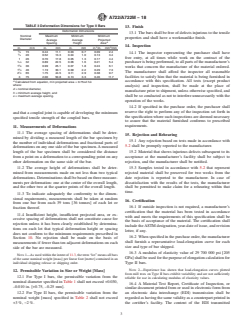
TABLE 3 Deformation Dimensions for Type II Bars
13. Finish
Deformation Dimensions
13.1 Thebarsshallbefreeofdefectsinjurioustothetensile
Nominal
Maximum Minimum Minimum
properties and shall have a workmanlike finish.
Diameter
Average Average Projected
A
Spacing Height Area
14. Inspection
2 2
in. mm in. mm in. mm in. /in. mm /mm
⁄8 15 0.44 11.1 0.03 0.7 0.09 2.4
14.1 The inspector representing the purchaser shall have
⁄4 20 0.52 13.3 0.04 1.0 0.13 3.4
free entry, at all times while work on the contract of the
1 26 0.70 17.8 0.05 1.3 0.17 4.4
1 ⁄4 32 0.89 22.5 0.06 1.6 0.21 5.4 purchaserisbeingperformed,toallpartsofthemanufacturer’s
1 ⁄8 36 0.99 25.1 0.07 1.8 0.24 6.1
works that concern the manufacture of the material ordered.
1 ⁄4 46 1.19 30.1 0.09 2.2 0.29 7.3
The manufactur
...
This document is not an ASTM standard and is intended only to provide the user of an ASTM standard an indication of what changes have been made to the previous version. Because
it may not be technically possible to adequately depict all changes accurately, ASTM recommends that users consult prior editions as appropriate. In all cases only the current version
of the standard as published by ASTM is to be considered the official document.
Designation: A722/A722M − 15 A722/A722M − 18
Standard Specification for
High-Strength Steel Bars for Prestressed Concrete
This standard is issued under the fixed designation A722/A722M; the number immediately following the designation indicates the year
of original adoption or, in the case of revision, the year of last revision. A number in parentheses indicates the year of last reapproval.
A superscript epsilon (´) indicates an editorial change since the last revision or reapproval.
1. Scope*
1.1 This specification covers Type I and Type II high-strength steel bars intended for use in prestressed concrete construction
or in prestressed ground anchors. Type I bars have a plain surface. Type II bars have surface deformations. Bars are of a minimum
tensile strength level of 150 000 psi [1035 MPa].
1.2 A supplementary requirement (S1) is provided for use where bend tests of bars are required by the purchaser. The
supplementary requirement applies only when specified in the purchase order.
1.3 The text of this specification references notes and footnotes which provide explanatory material. These notes and footnotes
(excluding those in tables and figures) shall not be considered as requirements of the specification.
1.4 This specification is applicable for orders in either inch-pound units (as Specification A722) or in SI units (as Specification
A722M).
1.5 The values stated in either inch-pound or SI units are to be regarded separately as standard. Within the text, the SI units are
shown in brackets. The values stated in each system may not be exact equivalents; therefore, each system shall be used
independently of the other. Combining values from the two systems may result in non-conformance with the specification.
1.6 This international standard was developed in accordance with internationally recognized principles on standardization
established in the Decision on Principles for the Development of International Standards, Guides and Recommendations issued
by the World Trade Organization Technical Barriers to Trade (TBT) Committee.
2. Referenced Documents
2.1 ASTM Standards:
A370 Test Methods and Definitions for Mechanical Testing of Steel Products
A700 Guide for Packaging, Marking, and Loading Methods for Steel Products for Shipment
A751 Test Methods, Practices, and Terminology for Chemical Analysis of Steel Products
2.2 Military Standard:
MIL-STD-129 Marking for Shipment and Storage
2.3 U.S. Federal Standard:
Fed. Std. 123 Marking for Shipment (Civil Agencies)
3. Ordering Information
3.1 Orders for high-strength steel bars under this specification shall contain the following information:
3.1.1 Quantity,
3.1.2 Size and length,
3.1.3 Type I or Type II, and
3.1.4 ASTM designation A722 [A722M] and year-date of issue.
3.2 The purchaser shall have the option to specify additional requirements, including but not limited, to the following:
3.2.1 Report on chemical composition (5.1),
This specification is under the jurisdiction of ASTM Committee A01 on Steel, Stainless Steel and Related Alloys and is the direct responsibility of Subcommittee A01.05
on Steel Reinforcement.
Current edition approved April 15, 2015Sept. 1, 2018. Published April 2015September 2018. Originally approved in 1975. Last previous edition approved in 20122015
as A722/A722M – 12.A722/A722M – 15. DOI: 10.1520/A0722_A0722M-15.10.1520/A0722_A0722M-18.
For referenced ASTM standards, visit the ASTM website, www.astm.org, or contact ASTM Customer Service at service@astm.org. For Annual Book of ASTM Standards
volume information, refer to the standard’s Document Summary page on the ASTM website.
Available from Standardization Documents Order Desk, DODSSP, Bldg. 4, Section D, 700 Robbins Ave., Philadelphia, PA 19111-5098, http://www.dodssp.daps.mil.
*A Summary of Changes section appears at the end of this standard
Copyright © ASTM International, 100 Barr Harbor Drive, PO Box C700, West Conshohocken, PA 19428-2959. United States
A722/A722M − 18
3.2.2 Special inspection requirements (14.2),
3.2.3 Load-elongation curve (16.2),
3.2.4 Special preparation for delivery, if desired (see Section 17), and
3.2.5 Supplementary requirement (S1).
4. Materials and Manufacture
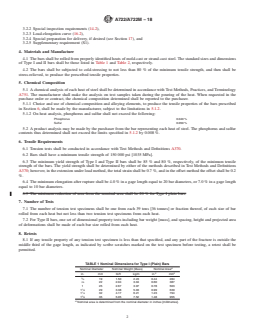
4.1 The bars shall be rolled from properly identified heats of mold-cast or strand-cast steel. The standard sizes and dimensions
of Type I and II bars shall be those listed in Table 1 and Table 2, respectively.
4.2 The bars shall be subjected to cold-stressing to not less than 80 % of the minimum tensile strength, and then shall be
stress-relieved, to produce the prescribed tensile properties.
5. Chemical Composition
5.1 A chemical analysis of each heat of steel shall be determined in accordance with Test Methods, Practices, and Terminology
A751. The manufacturer shall make the analysis on test samples taken during the pouring of the heat. When requested in the
purchase order or contract, the chemical composition determined shall be reported to the purchaser.
5.1.1 Choice and use of chemical composition and alloying elements, to produce the tensile properties of the bars prescribed
in Section 6, shall be made by the manufacturer, subject to the limitations in 5.1.2.
5.1.2 On heat analysis, phosphorus and sulfur shall not exceed the following:
Phosphorus 0.040 %
Sulfur 0.050 %
5.2 A product analysis may be made by the purchaser from the bar representing each heat of steel. The phosphorus and sulfur
contents thus determined shall not exceed the limits specified in 5.1.2 by 0.008 %.
6. Tensile Requirements
6.1 Tension tests shall be conducted in accordance with Test Methods and Definitions A370.
6.2 Bars shall have a minimum tensile strength of 150 000 psi [1035 MPa].
6.3 The minimum yield strength of Type I and Type II bars shall be 85 % and 80 %, respectively, of the minimum tensile
strength of the bars. The yield strength shall be determined by either of the methods described in Test Methods and Definitions
A370; however, in the extension under load method, the total strain shall be 0.7 %, and in the offset method the offset shall be 0.2
%.
6.4 The minimum elongation after rupture shall be 4.0 % in a gage length equal to 20 bar diameters, or 7.0 % in a gage length
equal to 10 bar diameters.
6.5 The minimum reduction of area from the nominal area shall be 20 % for Type I plain bars.
7. Number of Tests
7.1 The number of tension test specimens shall be one from each 39 tons [36 tonnes] or fraction thereof, of each size of bar
rolled from each heat but not less than two tension test specimens from each heat.
7.2 For Type II bars, one set of dimensional property tests including bar weight [mass], and spacing, height and projected area
of deformations shall be made of each bar size rolled from each heat.
8. Retests
8.1 If any tensile property of any tension test specimen is less than that specified, and any part of the fracture is outside the
middle third of the gage length, as indicated by scribe scratches marked on the test specimen before testing, a retest shall be
permitted.
TABLE 1 Nominal Dimensions for Type I (Plain) Bars
A
Nominal Diameter Nominal Weight (Mass) Nominal Area
2 2
in. mm lb/ft kg/m in. mm
⁄4 19 1.50 2.23 0.44 284
⁄8 22 2.04 3.04 0.60 387
1 25 2.67 3.97 0.78 503
1 ⁄8 29 3.38 5.03 0.99 639
1 ⁄4 32 4.17 6.21 1.23 794
1 ⁄8 35 5.05 7.52 1.48 955
A
Nominal area is determined from the nominal diameter in inches [millimetres].
A722/A722M − 18
TABLE 2 Nominal Dimensions for Type II (Deformed) Bars
A B
Nominal Diameter Nominal Weight (Mass) Nominal Area
2 2
in. mm lb/ft kg/m in. mm
⁄8 15 0.98 1.46 0.28 181
⁄4 20 1.49 2.22 0.42 271
1 26 3.01 4.48 0.85 548
1 ⁄4 32 4.39 6.54 1.25 806
1 ⁄8 36 5.56 8.28 1.58 1019
1 ⁄4 46 9.10 13.54 2.58 1664
2 ⁄2 65 18.20 27.10 5.16 3331
3 75 24.09 35.85 6.85 4419
A
Nominal diameters are for identification only.
B
Nominal area is determined from the bar weight [mass] less 3.50% for the weight
[mass] of the deformations.
8.2 If the results of an original tension test specimen fail to meet specified requirements, two additional tests shall be made on
specimens from the same heat and bar size, and if failure occurs in either of these tests, the bar size from that heat shall be rejected.
8.3 If any test specimen fails because of mechanical reasons such as failure of testing equipment, it shall be discarded and
another specimen taken.
8.4 If any test specimen develops flaws, it shall be discarded and another specimen of the same size bar from the same heat
substituted.
9. Test Specimens
9.1 Tension test specimens shall be the full section of the bar as rolled. Machined-reduced section test specimens are not
permitted. All unit stress determinations shall be based on the nominal area shown in Table 1 or Table 2.
10. Requirements for Deformations
10.1 Type II bars shall have deformations spaced uniformly along the length of the bar. The deformations on opposite sides of
the bar shall be similar in size and shape. The average spacing or distance between deformations on both sides of the bar shall not
exceed seven-tenths of the nominal diameter of the bar.
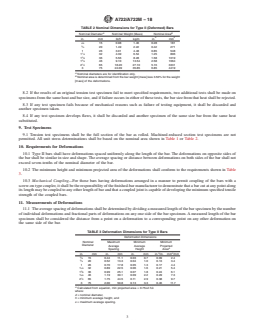
10.2 The minimum height and minimum projected area of the deformations shall conform to the requirements shown in Table
3.
10.3 Mechanical Coupling—For those bars having deformations arranged in a manner to permit coupling of the bars with a
screw-on type coupler, it shall be the responsibility of the finished-bar manufacturer to demonstrate that a bar cut at any point along
its length may be coupled to any other length of bar and that a coupled joint is capable of developing the minimum specified tensile
strength of the coupled bars.
11. Measurements of Deformations
11.1 The average spacing of deformations shall be determined by dividing a measured length of the bar specimen by the number
of individual deformations and fractional parts of deformations on any one side of the bar specimen. A measured length of the bar
specimen shall be considered the distance from a point on a deformation to a corresponding point on any other deformation on
the same side of the bar.
TABLE 3 Deformation Dimensions for Type II Bars
Deformation Dimensions
Nominal
Maximum Minimum Minimum
Diameter
Average Average Projected
A
Spacing Height Area
2 2
in. mm in. mm in. mm in. /in. mm /mm
⁄8 15 0.44 11.1 0.03 0.7 0.09 2.4
⁄4 20 0.52 13.3 0.04 1.0 0.13 3.4
...