

ASTM A485-17(2022)
(Specification)Standard Specification for High Hardenability Antifriction Bearing Steel
General Information
- Abstract
ABSTRACT
This specification covers high hardenability modifications of high-carbon bearing quality steel to be used in the manufacture of antifriction bearings. The grades of steels covered here are: Grade 1, Grade 2, Grade 3, Grade 4, Grade B2, Grade B3, Grade B4, Grade B5, Grade B6, Grade B7, and Grade B8. Heat and product analyses shall be performed wherein specimens shall conform to required chemical composition of carbon, manganese, phosphorus, sulfur, silicon, chromium, nickel, titanium, copper, molybdenum, oxygen, and aluminum. The steels shall undergo normalizing followed by spheroidize annealing before heating for end quenching. Test for hardenability shall be performed wherein specimens shall conform to required Brinell and Rockwell hardness.
SCOPE
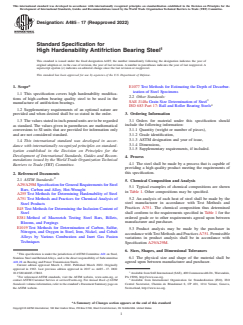
1.1 This specification covers high hardenability modifications of high-carbon bearing quality steel to be used in the manufacture of antifriction bearings.
1.2 Supplementary requirements of an optional nature are provided and when desired shall be so stated in the order.
1.3 The values stated in inch-pound units are to be regarded as standard. The values given in parentheses are mathematical conversions to SI units that are provided for information only and are not considered standard.
1.4 This international standard was developed in accordance with internationally recognized principles on standardization established in the Decision on Principles for the Development of International Standards, Guides and Recommendations issued by the World Trade Organization Technical Barriers to Trade (TBT) Committee.
- Status
- Published
- Publication Date
- 28-Feb-2022
- Technical Committee
- A01 - Steel, Stainless Steel and Related Alloys
- Drafting Committee
- A01.28 - Bearing and Power Transmission Steels

Overview
ASTM A485-17(2022) is the internationally recognized standard specification for high hardenability antifriction bearing steel, established by ASTM International. This specification addresses high hardenability, high-carbon bearing quality steels tailored for the manufacture of antifriction bearings. It encompasses a range of steel grades (such as Grade 1, Grade 2, Grade 3, Grade 4, and B-series grades) which are characterized by tight controls on chemical composition, microstructure, and mechanical properties to ensure performance in demanding bearing applications.
The standard outlines requirements for chemical composition, heat treatment, microstructural integrity, hardenability, cleanliness, and dimensional tolerances - essential factors for achieving the reliability and lifespan of antifriction bearings used in mechanical assemblies. The specification was developed in line with international standardization principles recognized by the World Trade Organization (WTO) Technical Barriers to Trade (TBT) Committee.
Key Topics
- Steel Grades Covered: Multiple grades (Grade 1-4 and B2-B8) are specified, each with defined chemical compositions and tailored hardenability profiles.
- Chemical Composition: The standard sets maximum and minimum concentrations for elements such as carbon, manganese, phosphorus, sulfur, silicon, chromium, nickel, molybdenum, titanium, copper, oxygen, and aluminum.
- Heat Treatment Requirements: Mandatory normalizing and spheroidize annealing before end-quenching to optimize microstructure for bearing use.
- Hardenability Testing: End-quench tests using Rockwell and Brinell hardness scales to ensure each steel heat meets required hardenability standards.
- Cleanliness and Inclusion Rating: Quality assessment includes macro- and micro-inclusion ratings based on established test methods to guarantee low inclusion content.
- Dimensional Tolerances and Surface Quality: Specifications for hot-rolled, cold-finished, and annealed products to ensure tight control over size, shape, and surface integrity.
- Supplementary Requirements: Optional provisions for specific quality measures, such as enhanced machinability, alternative inclusion rating systems, or macroetch testing, can be specified in purchase orders.
Applications
- Antifriction Bearings: The primary application is the production of high-performance antifriction bearings, including ball bearings and roller bearings, which require high hardness, toughness, and resistance to wear.
- Precision Machinery: Used in automotive, aerospace, and industrial equipment that rely on reliable bearing components for critical rotary and linear movements.
- Heavy-duty Equipment: Ideal for applications where bearings are exposed to high loads, cyclic stresses, and challenging environments, as the steel's hardenability and cleanliness promote superior fatigue life and dimensional stability.
- Custom Bearing Production: Flexibility in supplementary requirements allows producers and purchasers to tailor steel properties for specialized bearings or advanced engineering applications.
Related Standards
For best results and regulatory compliance, ASTM A485-17(2022) should be considered in conjunction with these related standards:
- ASTM A29/A29M: General requirements for hot-wrought carbon and alloy steel bars.
- ASTM A255: Test methods for determining steel hardenability.
- ASTM A751: Test methods and practices for chemical analysis of steel products.
- ASTM E45: Methods for determining the inclusion content of steel.
- ASTM E381: Macroetch testing for steel bars, billets, blooms, and forgings.
- ASTM E1077: Test for estimating the depth of decarburization in steel specimens.
- ASTM E1019: Determination of carbon, sulfur, nitrogen, and oxygen content.
- SAE J148a: Grain size determination of steel.
- ISO 683 Part 17: International standard for ball and roller bearing steels.
Adhering to ASTM A485-17(2022) ensures the delivery of high hardenability, performance-optimized antifriction bearing steels tailored for the exacting requirements of modern industry.
Relations
- Effective Date
- 01-Nov-2023
- Effective Date
- 01-Sep-2018
- Effective Date
- 01-Nov-2015
- Effective Date
- 01-Oct-2014
- Effective Date
- 01-Mar-2014
- Effective Date
- 01-May-2012
- Effective Date
- 01-May-2012
- Effective Date
- 01-Oct-2011
- Effective Date
- 01-Oct-2011
- Effective Date
- 01-Jun-2011
- Effective Date
- 01-Apr-2011
- Effective Date
- 15-Mar-2011
- Effective Date
- 01-Nov-2010
- Effective Date
- 01-May-2010
- Effective Date
- 01-Nov-2008
Get Certified
Connect with accredited certification bodies for this standard

Element Materials Technology
Materials testing and product certification.

Inštitut za kovinske materiale in tehnologije
Institute of Metals and Technology. Materials testing, metallurgical analysis, NDT.
Sponsored listings
Frequently Asked Questions
ASTM A485-17(2022) is a technical specification published by ASTM International. Its full title is "Standard Specification for High Hardenability Antifriction Bearing Steel". This standard covers: ABSTRACT This specification covers high hardenability modifications of high-carbon bearing quality steel to be used in the manufacture of antifriction bearings. The grades of steels covered here are: Grade 1, Grade 2, Grade 3, Grade 4, Grade B2, Grade B3, Grade B4, Grade B5, Grade B6, Grade B7, and Grade B8. Heat and product analyses shall be performed wherein specimens shall conform to required chemical composition of carbon, manganese, phosphorus, sulfur, silicon, chromium, nickel, titanium, copper, molybdenum, oxygen, and aluminum. The steels shall undergo normalizing followed by spheroidize annealing before heating for end quenching. Test for hardenability shall be performed wherein specimens shall conform to required Brinell and Rockwell hardness. SCOPE 1.1 This specification covers high hardenability modifications of high-carbon bearing quality steel to be used in the manufacture of antifriction bearings. 1.2 Supplementary requirements of an optional nature are provided and when desired shall be so stated in the order. 1.3 The values stated in inch-pound units are to be regarded as standard. The values given in parentheses are mathematical conversions to SI units that are provided for information only and are not considered standard. 1.4 This international standard was developed in accordance with internationally recognized principles on standardization established in the Decision on Principles for the Development of International Standards, Guides and Recommendations issued by the World Trade Organization Technical Barriers to Trade (TBT) Committee.
ABSTRACT This specification covers high hardenability modifications of high-carbon bearing quality steel to be used in the manufacture of antifriction bearings. The grades of steels covered here are: Grade 1, Grade 2, Grade 3, Grade 4, Grade B2, Grade B3, Grade B4, Grade B5, Grade B6, Grade B7, and Grade B8. Heat and product analyses shall be performed wherein specimens shall conform to required chemical composition of carbon, manganese, phosphorus, sulfur, silicon, chromium, nickel, titanium, copper, molybdenum, oxygen, and aluminum. The steels shall undergo normalizing followed by spheroidize annealing before heating for end quenching. Test for hardenability shall be performed wherein specimens shall conform to required Brinell and Rockwell hardness. SCOPE 1.1 This specification covers high hardenability modifications of high-carbon bearing quality steel to be used in the manufacture of antifriction bearings. 1.2 Supplementary requirements of an optional nature are provided and when desired shall be so stated in the order. 1.3 The values stated in inch-pound units are to be regarded as standard. The values given in parentheses are mathematical conversions to SI units that are provided for information only and are not considered standard. 1.4 This international standard was developed in accordance with internationally recognized principles on standardization established in the Decision on Principles for the Development of International Standards, Guides and Recommendations issued by the World Trade Organization Technical Barriers to Trade (TBT) Committee.
ASTM A485-17(2022) is classified under the following ICS (International Classification for Standards) categories: 77.140.20 - Stainless steels. The ICS classification helps identify the subject area and facilitates finding related standards.
ASTM A485-17(2022) has the following relationships with other standards: It is inter standard links to ASTM E45-18a(2023), ASTM A255-10(2018), ASTM A29/A29M-15, ASTM A255-10(2014), ASTM A751-14, ASTM A29/A29M-12, ASTM A29/A29M-12e1, ASTM E45-11a, ASTM A29/A29M-11a, ASTM E45-11, ASTM A29/A29M-11, ASTM E1019-11, ASTM E45-10, ASTM A255-10, ASTM E1019-08. Understanding these relationships helps ensure you are using the most current and applicable version of the standard.
ASTM A485-17(2022) is available in PDF format for immediate download after purchase. The document can be added to your cart and obtained through the secure checkout process. Digital delivery ensures instant access to the complete standard document.
Standards Content (Sample)
This international standard was developed in accordance with internationally recognized principles on standardization established in the Decision on Principles for the
Development of International Standards, Guides and Recommendations issued by the World Trade Organization Technical Barriers to Trade (TBT) Committee.
Designation:A485 −17 (Reapproved 2022)
Standard Specification for
High Hardenability Antifriction Bearing Steel
This standard is issued under the fixed designation A485; the number immediately following the designation indicates the year of
original adoption or, in the case of revision, the year of last revision. A number in parentheses indicates the year of last reapproval. A
superscript epsilon (´) indicates an editorial change since the last revision or reapproval.
This standard has been approved for use by agencies of the U.S. Department of Defense.
1. Scope* E1077 Test Methods for Estimating the Depth of Decarbur-
ization of Steel Specimens
1.1 This specification covers high hardenability modifica-
2.2 Other Standards:
tions of high-carbon bearing quality steel to be used in the
SAE J148a Grain Size Determination of Steel
manufacture of antifriction bearings.
ISO 683 Part 17: Ball and Roller Bearing Steels
1.2 Supplementary requirements of an optional nature are
provided and when desired shall be so stated in the order. 3. Ordering Information
3.1 Orders for material under this specification should
1.3 The values stated in inch-pound units are to be regarded
as standard. The values given in parentheses are mathematical include the following information:
3.1.1 Quantity (weight or number of pieces),
conversions to SI units that are provided for information only
and are not considered standard. 3.1.2 Grade identification,
3.1.3 ASTM designation and year of issue,
1.4 This international standard was developed in accor-
3.1.4 Dimensions,
dance with internationally recognized principles on standard-
3.1.5 Supplementary requirements, if included.
ization established in the Decision on Principles for the
Development of International Standards, Guides and Recom-
4. Process
mendations issued by the World Trade Organization Technical
4.1 The steel shall be made by a process that is capable of
Barriers to Trade (TBT) Committee.
providing a high quality product meeting the requirements of
this specification.
2. Referenced Documents
2.1 ASTM Standards:
5. Chemical Composition and Analysis
A29/A29M SpecificationforGeneralRequirementsforSteel
5.1 Typical examples of chemical compositions are shown
Bars, Carbon and Alloy, Hot-Wrought
in Table 1. Other compositions may be specified.
A255 Test Methods for Determining Hardenability of Steel
5.2 An analysis of each heat of steel shall be made by the
A751 Test Methods and Practices for Chemical Analysis of
steel manufacturer in accordance with Test Methods and
Steel Products
Practices A751. The chemical composition thus determined
E45 Test Methods for Determining the Inclusion Content of
shall conform to the requirements specified in Table 1 for the
Steel
ordered grade or to other requirements agreed upon between
E381 Method of Macroetch Testing Steel Bars, Billets,
manufacturer and purchaser.
Blooms, and Forgings
E1019 Test Methods for Determination of Carbon, Sulfur,
5.3 Product analysis may be made by the purchaser in
Nitrogen, and Oxygen in Steel, Iron, Nickel, and Cobalt
accordancewithTestMethodsandPracticesA751.Permissible
Alloys by Various Combustion and Inert Gas Fusion
variations in product analysis shall be in accordance with
Techniques
Specification A29/A29M.
6. Sizes, Shapes, and Dimensional Tolerances
This specification is under the jurisdiction of ASTM Committee A01 on Steel,
6.1 The physical size and shape of the material shall be
Stainless Steel and RelatedAlloys, and is the direct responsibility of Subcommittee
A01.28 on Bearing and Power Transmission Steels.
agreed upon between manufacturer and purchaser.
Current edition approved March 1, 2022. Published March 2022. Originally
approved in 1963. Last previous edition approved in 2017 as A485 – 17. DOI:
10.1520/A0485-17R22. Available from SAE International (SAE), 400 Commonwealth Dr.,Warrendale,
For referenced ASTM standards, visit the ASTM website, www.astm.org, or PA 15096, http://www.sae.org.
contact ASTM Customer Service at service@astm.org. For Annual Book of ASTM Available from International Organization for Standardization (ISO), ISO
Standards volume information, refer to the standard’s Document Summary page on Central Secretariat, Chemin de Blandonnet 8, CP 401, 1214 Vernier, Geneva,
the ASTM website. Switzerland, http://www.iso.org.
*A Summary of Changes section appears at the end of this standard
Copyright © ASTM International, 100 Barr Harbor Drive, PO Box C700, West Conshohocken, PA 19428-2959. United States
A485−17 (2022)
A, B
TABLE 1 Chemical Composition
C D
ISO Name C Mn P (max) S (max) Si Cr Ni (max) Ti (max) Cu (max) Mo O (max) Al (max)
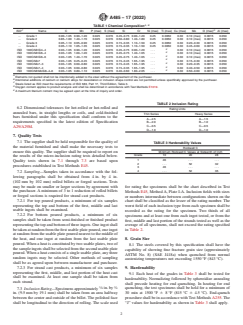
... Grade 1 0.90–1.05 0.90–1.20 0.025 0.015 0.45–0.75 0.90–1.20 0.25 0.0050 0.30 0.10 (max) 0.0015 0.050
... Grade 2 0.85–1.00 1.40–1.70 0.025 0.015 0.50–0.80 1.40–1.80 0.25 0.0050 0.30 0.10 (max) 0.0015 0.050
... Grade 3 0.95–1.10 0.65–0.90 0.025 0.015 0.15–0.35 1.10–1.50 0.25 0.0050 0.30 0.20–0.30 0.0015 0.050
... Grade 4 0.95–1.10 1.05–1.35 0.025 0.015 0.15–0.35 1.10–1.50 0.25 0.0050 0.30 0.45–0.60 0.0015 0.050
E
ISO 100CrMnSi4–4 0.93–1.05 0.90–1.20 0.025 0.015 0.45–0.75 0.90–1.20 . . . 0.30 0.10 (max) 0.0015 0.050
E
ISO 100CrMnSi6–4 0.93–1.05 1.00–1.20 0.025 0.015 0.45–0.75 1.40–1.65 . . . 0.30 0.10 (max) 0.0015 0.050
E
ISO 100CrMnSi6–6 0.93–1.05 1.40–1.70 0.025 0.015 0.45–0.75 1.40–1.65 . . . 0.30 0.10 (max) 0.0015 0.050
E
ISO 100CrMo7 0.93–1.05 0.25–0.45 0.025 0.015 0.15–0.45 1.65–1.95 . . . 0.30 0.15–0.30 0.0015 0.050
E
ISO 100CrMo7–3 0.93–1.05 0.60–0.80 0.025 0.015 0.15–0.45 1.65–1.95 . . . 0.30 0.20–0.35 0.0015 0.050
E
ISO 100CrMo7–4 0.93–1.05 0.60–0.80 0.025 0.015 0.15–0.35 1.65–1.95 . . . 0.30 0.40–0.50 0.0015 0.050
E
ISO 100CrMnMoSi8–4–6 0.93–1.05 0.80–1.10 0.025 0.015 0.40–0.60 1.80–2.05 . . . 0.30 0.50–0.60 0.0015 0.050
A
Elements not quoted shall not be intentionally added to the steel without the agreement of the purchaser.
B
Intentional additions of calcium or calcium alloys for deoxidation or inclusion shape control are not permitted unless specifically approved by the purchaser.
C
Steels listed as ISO meet the requirements of ISO 683, Part 17, Third Edition, Table 3.
D
Oxygen content applies to product analysis and shall be determined in accordance with Test Methods E1019.
E
A maximum titanium content may be agreed upon at the time of inquiry and order.
TABLE 2 Inclusion Rating
6.2 Dimensional tolerances for hot-rolled or hot-rolled and
Rating Units
annealed bars, in straight lengths or coils, and cold-finished
Thin Series Heavy Series
bars furnished under this specification shall conform to the
A—2.5 A—1.5
requirements specified in the latest edition of Specification B—2.0 B—1.0
C—0.5 C—0.5
A29/A29M.
D—1.0 D—1.0
7. Quality Tests
7.1 The supplier shall be held responsible for the quality of
TABLE 3 Hardenability Values
the material furnished and shall make the necessary tests to
Rockwell C
ensure this quality. The supplier shall be required to report on
Minimum Rockwell C Values at Sixteenth of Inch
Grade 10 20 28
the results of the micro-inclusion rating tests detailed below.
1 46 . .
Quality tests shown in 7.1 through 7.3 are based upon
2 . . . 52 32
procedures established in Test Methods E45.
3 46 . .
4 . . . 52 35
7.2 Sampling—Samples taken in accordance with the fol-
lowing paragraphs shall be obtained from 4 in. by 4 in.
(102 mm by 102 mm) rolled billets or forged sections. Tests
may be made on smaller or larger sections by agreement with
for rating the specimens shall be the chart described in Test
the purchaser. A minimum of 3 to 1 reduction of rolled billets
Methods E45, MethodA, Plate I-A. Inclusion fields with sizes
or forged sections is required for strand cast products.
or numbers intermediate between configurations shown on the
7.2.1 For top poured products, a minimum of six samples
chart shall be classified as the lesser of the rating number. The
representing the top and bottom of the first, middle and last
worst field of each inclusion type from each specimen shall be
usable ingots shall be examined.
recorded as the rating for the specimen. Two thirds of all
7.2.2 For bottom poured products, a minimum of six
specimens and at least one from each ingot tested, or from the
samples shall be taken from semi-finished or finished product
first, middle and last portion of the strands tested as well as the
representingthetopandbottomofthreeingots.Oneingotshall
average of all specimens, shall not exceed the rating specified
betakenatrandomfromthefirstusableplatepoured,oneingot
in Table 2.
atrandomfromtheusableplatepourednearesttothemiddleof
8. Grain Size
the heat, and one ingot at random from the last usable plate
poured.Wh
...