

ASTM D7379/D7379M-08(2021)
(Test Method)Standard Test Methods for Strength of Modified Bitumen Sheet Material Laps Using Cold Process Adhesive
General Information
- Abstract
SIGNIFICANCE AND USE
3.1 These tests are useful in sampling and testing combinations of modified bitumen sheet materials used with cold-applied adhesives.
SCOPE
1.1 These test methods cover the procedure for sampling and testing the strength of laps formed with adhesive used with polymer-modified bituminous sheet materials.
1.2 The values stated in either SI units or inch-pound units are to be regarded separately as standard. The values stated in each system may not be exact equivalents; therefore, each system shall be used independently of the other. Combining values from the two systems may result in nonconformance with the standard.
1.3 This standard does not purport to address all of the safety concerns, if any, associated with its use. It is the responsibility of the user of this standard to establish appropriate safety, health, and environmental practices and determine the applicability of regulatory limitations prior to use.
1.4 This international standard was developed in accordance with internationally recognized principles on standardization established in the Decision on Principles for the Development of International Standards, Guides and Recommendations issued by the World Trade Organization Technical Barriers to Trade (TBT) Committee.
- Status
- Published
- Publication Date
- 30-Jun-2021
- Technical Committee
- D08 - Roofing and Waterproofing
- Drafting Committee
- D08.04 - Felts, Fabrics and Bituminous Sheet Materials

Overview
ASTM D7379/D7379M-08(2021) – Standard Test Methods for Strength of Modified Bitumen Sheet Material Laps Using Cold Process Adhesive outlines procedures for sampling and testing the strength of laps formed with adhesives used in polymer-modified bituminous sheet materials. Developed by ASTM, this international standard supports the evaluation of both T-peel and shear strength in adhesive-bonded laps, helping ensure the reliable use of modified bitumen products in construction and waterproofing applications.
This standard is significant for manufacturers, quality control personnel, and specifiers, offering a consistent approach to measure the performance of cold-applied adhesives in roofing and waterproofing systems.
Key Topics
Scope and Purpose
- Focuses on test methods for assessing the strength of laps created with cold process adhesives in polymer-modified bitumen sheet materials.
- Applies to both SI and inch-pound units, but each unit system must be used independently to maintain conformance.
Sampling and Conditioning
- Describes the selection of bitumen rolls and adhesive containers from each shipment.
- Specifies preconditioning materials at controlled temperature and humidity prior to testing.
T-Peel Strength Testing
- Details preparation and configuration of test specimens that mimic field seams.
- Instructs on T-peel bond testing using defined separation rates and precise measurement intervals.
Shear Strength Testing
- Outlines procedures for specimen preparation and testing to determine adhesive shear strength.
- Ensures specimens represent actual construction lap configurations.
Data Reporting
- Requires reporting of peak and average peel and shear strength values for each adhesive and membrane tested.
Precision and Reproducibility
- Provides guidelines for evaluating repeatability and reproducibility of test outcomes, supporting reliability in quality assessment.
Safety and Compliance
- Notes the importance of adhering to appropriate safety, health, and environmental practices.
- Aligns with WTO Technical Barriers to Trade (TBT) Committee principles for international standards development.
Applications
These test methods are valuable throughout the roofing, waterproofing, and construction industries, offering practical benefits such as:
- Quality Control: Manufacturers use these procedures to qualify new adhesives and bitumen membrane products, ensuring consistent performance.
- Material Comparison: Enables objective evaluation of different cold-applied adhesive systems, aiding in material selection and specification.
- Field Validation: Simulates real-world lap formation to ensure test results accurately represent in-situ conditions.
- Project Specification: Specifiers and consultants can reference this standard to mandate lap strength criteria in project documents.
Common scenarios include:
- Testing laps in roofing membranes bonded with cold process adhesives.
- Verifying the performance of repair materials used in bitumen-based waterproofing systems.
- Comparing new adhesive formulations against industry benchmarks.
Related Standards
Several ASTM standards are referenced or used in conjunction with ASTM D7379/D7379M-08(2021):
- ASTM D140/D140M – Practice for Sampling Asphalt Materials
- ASTM D146/D146M – Test Methods for Sampling and Testing Bitumen-Saturated Felts and Woven Fabrics for Roofing and Waterproofing
- ASTM D5147/D5147M – Test Methods for Sampling and Testing Modified Bituminous Sheet Material
These related standards provide further guidance on sampling, conditioning, and testing procedures for asphalt and bituminous materials, supporting a comprehensive approach to roofing and waterproofing product evaluation.
Keywords: modified bitumen sheet material, cold process adhesive, lap strength, T-peel strength, shear strength, roofing materials, ASTM D7379/D7379M-08(2021), bituminous waterproofing, adhesive testing, construction material standards.
Relations
- Effective Date
- 01-Dec-2023
- Effective Date
- 01-Jul-2018
- Effective Date
- 01-Jun-2016
- Effective Date
- 01-Jun-2015
- Effective Date
- 01-Jun-2014
- Effective Date
- 01-Jan-2014
- Effective Date
- 01-May-2011
- Effective Date
- 01-Jan-2011
- Effective Date
- 01-Jun-2009
Get Certified
Connect with accredited certification bodies for this standard

DIBt (Deutsches Institut für Bautechnik)
German Institute for Building Technology.
DIN CERTCO
DIN Group product certification.

Aboma Certification B.V.
Specialized in construction, metal, and transport sectors.
Sponsored listings
Frequently Asked Questions
ASTM D7379/D7379M-08(2021) is a standard published by ASTM International. Its full title is "Standard Test Methods for Strength of Modified Bitumen Sheet Material Laps Using Cold Process Adhesive". This standard covers: SIGNIFICANCE AND USE 3.1 These tests are useful in sampling and testing combinations of modified bitumen sheet materials used with cold-applied adhesives. SCOPE 1.1 These test methods cover the procedure for sampling and testing the strength of laps formed with adhesive used with polymer-modified bituminous sheet materials. 1.2 The values stated in either SI units or inch-pound units are to be regarded separately as standard. The values stated in each system may not be exact equivalents; therefore, each system shall be used independently of the other. Combining values from the two systems may result in nonconformance with the standard. 1.3 This standard does not purport to address all of the safety concerns, if any, associated with its use. It is the responsibility of the user of this standard to establish appropriate safety, health, and environmental practices and determine the applicability of regulatory limitations prior to use. 1.4 This international standard was developed in accordance with internationally recognized principles on standardization established in the Decision on Principles for the Development of International Standards, Guides and Recommendations issued by the World Trade Organization Technical Barriers to Trade (TBT) Committee.
SIGNIFICANCE AND USE 3.1 These tests are useful in sampling and testing combinations of modified bitumen sheet materials used with cold-applied adhesives. SCOPE 1.1 These test methods cover the procedure for sampling and testing the strength of laps formed with adhesive used with polymer-modified bituminous sheet materials. 1.2 The values stated in either SI units or inch-pound units are to be regarded separately as standard. The values stated in each system may not be exact equivalents; therefore, each system shall be used independently of the other. Combining values from the two systems may result in nonconformance with the standard. 1.3 This standard does not purport to address all of the safety concerns, if any, associated with its use. It is the responsibility of the user of this standard to establish appropriate safety, health, and environmental practices and determine the applicability of regulatory limitations prior to use. 1.4 This international standard was developed in accordance with internationally recognized principles on standardization established in the Decision on Principles for the Development of International Standards, Guides and Recommendations issued by the World Trade Organization Technical Barriers to Trade (TBT) Committee.
ASTM D7379/D7379M-08(2021) is classified under the following ICS (International Classification for Standards) categories: 91.100.50 - Binders. Sealing materials. The ICS classification helps identify the subject area and facilitates finding related standards.
ASTM D7379/D7379M-08(2021) has the following relationships with other standards: It is inter standard links to ASTM D140/D140M-16(2023), ASTM D5147/D5147M-18, ASTM D140/D140M-16, ASTM D140/D140M-15, ASTM D140/D140M-14, ASTM D5147/D5147M-14, ASTM D5147/D5147M-11a, ASTM D5147/D5147M-11, ASTM D140/D140M-09. Understanding these relationships helps ensure you are using the most current and applicable version of the standard.
ASTM D7379/D7379M-08(2021) is available in PDF format for immediate download after purchase. The document can be added to your cart and obtained through the secure checkout process. Digital delivery ensures instant access to the complete standard document.
Standards Content (Sample)
This international standard was developed in accordance with internationally recognized principles on standardization established in the Decision on Principles for the
Development of International Standards, Guides and Recommendations issued by the World Trade Organization Technical Barriers to Trade (TBT) Committee.
Designation: D7379/D7379M −08 (Reapproved 2021)
Standard Test Methods for
Strength of Modified Bitumen Sheet Material Laps Using
Cold Process Adhesive
This standard is issued under the fixed designation D7379/D7379M; the number immediately following the designation indicates the
year of original adoption or, in the case of revision, the year of last revision. A number in parentheses indicates the year of last
reapproval. A superscript epsilon (´) indicates an editorial change since the last revision or reapproval.
1. Scope 3. Significance and Use
3.1 These tests are useful in sampling and testing combina-
1.1 These test methods cover the procedure for sampling
tions of modified bitumen sheet materials used with cold-
and testing the strength of laps formed with adhesive used with
applied adhesives.
polymer-modified bituminous sheet materials.
1.2 The values stated in either SI units or inch-pound units
4. Sampling
are to be regarded separately as standard. The values stated in
4.1 Fromeachshipmentorfractionthereof,selectatrandom
each system may not be exact equivalents; therefore, each
a number of modified bitumen rolls and containers of adhesive
system shall be used independently of the other. Combining
in accordance with the following. Determine the number of
values from the two systems may result in nonconformance
adhesive containers to be sampled in accordance with Practice
with the standard.
D140/D140M. Determine the number of rolls to be selected in
1.3 This standard does not purport to address all of the
accordance with Section 3, Sampling, of Test Methods D146/
safety concerns, if any, associated with its use. It is the D146M.
responsibility of the user of this standard to establish appro-
5. Conditioning
priate safety, health, and environmental practices and deter-
mine the applicability of regulatory limitations prior to use.
5.1 Condition test materials for a minimum of4hat23 6
1.4 This international standard was developed in accor-
2 °C [73.4 6 3.6 °F] and 50 6 5 % relative humidity before
dance with internationally recognized principles on standard-
preparing specimens for testing.
ization established in the Decision on Principles for the
Development of International Standards, Guides and Recom- 6. Lap T-Peel Strength
mendations issued by the World Trade Organization Technical
6.1 This test method covers the determination of the T-peel
Barriers to Trade (TBT) Committee.
strength of polymer-modified bituminous sheet material and
cold-applied adhesive combinations.
2. Referenced Documents
6.1.1 Modified Bitumen Samples for Testing—Samples for
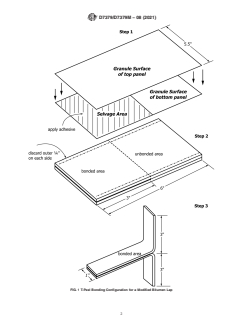
testing shall consist of two 140 by 152-mm [5.5 by 6-in.] test
2.1 ASTM Standards:
panels of modified bitumen, bonded with the adhesive to be
D140/D140M Practice for Sampling Asphalt Materials
tested, and cut into 25-mm [1-in.] specimens as shown in Fig.
D146/D146M Test Methods for Sampling and Testing
1. Cut the modified bitumen sheet materials and mate the sides
Bitumen-Saturated Felts and Woven Fabrics for Roofing
to be bonded facing each other.
and Waterproofing
6.1.2 Sides to be bonded shall be prepared in the same
D5147/D5147M Test Methods for Sampling and Testing
fashion as a field seam is constructed with the bottom side of
Modified Bituminous Sheet Material
a top panel bonded to the top side (selvage) of the bottom panel
using the adhesive to be tested.
6.2 Stir the adhesive to be tested until it is uniform. Spread
These test methods are under the jurisdiction of ASTM Committee D08 on
5.0 6 0.3 g of the adhesive evenly over the selvage portion of
Roofing and Waterproofing and are the direct responsibility of Subcommittee
D08.04 on Felts, Fabrics and Bituminous Sheet Materials.
a bottom panel. Place the top panel over the adhesive-coated
Current edition approved July 1, 2021. Published July 2021. Originally approved
area of the bottom panel (as shown in Fig. 1) in the same
ɛ1
in 2008. Last previous edition approved in 2015 as D7379/D7379M – 08 (2015) .
manner, as a field lap would be made.
DOI: 10.1520/D7379_D7379M-08R21.
For referenced ASTM standards, visit the ASTM website, www.astm.org, or
6.3 Roll the freshly prepared panel combination three times
contact ASTM Customer Service at service@astm.org. For Annual Book of ASTM
with a back-and-forth motion, taking care not to move the
Standards volume information, refer to the standard’s Document Summary page on
the ASTM website. panels during the rolling process. No downward pressure shall
Copyright © ASTM International, 100 Barr Harbor Drive, PO Box C700, West Conshohocken, PA 19428-2959. United States
D7379/D7379M − 08 (2021)
FIG. 1 T-Peel Bonding Configuration for a Modified Bitumen Lap
D7379/D7379M − 08 (2021)
be exerted on the roller by the operator. The roller shall be 7. Lap Shear Strength
placed in direct contact with the 3-in. wide cemented lap
7.1 This test method covers the determination of the shear
portion. The roller shall be 127 mm [5 in.] 6 5 % wide,
strength of adhesives used with polymer-modified bituminous
127 mm [5 in.] 6 5 % in diameter, and shall weigh 11.8 kg
sheet materials.
[26 lb] 65%.
7.1.1 Panels for Test—Prepare pre-cut test panels, as shown
in Fig. 2, by mating the sides to be bonded facing each other.
6.4 Conditioning—Heat condition completed modified bitu-
Sides to be bonded shall be prepared in the same fashion as a
men panels prior to peel testing in a ventilated, forced-air
field seam is constructed; tha
...