

ASTM E1249-15(2021)
(Practice)Standard Practice for Minimizing Dosimetry Errors in Radiation Hardness Testing of Silicon Electronic Devices Using Co-60 Sources
General Information
- Abstract
SIGNIFICANCE AND USE
4.1 Division of the Co-60 Hardness Testing into Five Parts:
4.1.1 The equilibrium absorbed dose shall be measured with a dosimeter, such as a TLD, located adjacent to the device under test. Alternatively, a dosimeter may be irradiated in the position of the device before or after irradiation of the device.
4.1.2 This absorbed dose measured by the dosimeter shall be converted to the equilibrium absorbed dose in the material of interest within the critical region within the device under test, for example the SiO2 gate oxide of an MOS device.
4.1.3 A correction for absorbed-dose enhancement effects shall be considered. This correction is dependent upon the photon energy that strikes the device under test.
4.1.4 A correlation should be made between the absorbed dose in the critical region (for example, the gate oxide mentioned in 4.1.2) and some electrically important effect (such as charge trapped at the Si/SiO2 interface as manifested by a shift in threshold voltage).
4.1.5 An extrapolation should then be made from the results of the test to the results that would be expected for the device under test under actual operating conditions.
Note 5: The parts of a test discussed in 4.1.2 and 4.1.3 are the subject of this practice. The subject of 4.1.1 is covered and referenced in other standards such as Practice E668 and ICRU Report 14. The parts of a test discussed in 4.1.4 and 4.1.5 are outside the scope of this practice.
4.2 Low-Energy Components in the Spectrum—Some of the primary Co-60 gamma rays (1.17 and 1.33 MeV) produce lower energy photons by Compton scattering within the Co-60 source structure, within materials that lie between the source and the device under test, and within materials that lie beyond the device but contribute to backscattering. As a result of the complexity of these effects, the photon energy spectrum striking the device usually is not well known. This point is further discussed in Section 5 and Appendix X1. The presence of ...
SCOPE
1.1 This practice covers recommended procedures for the use of dosimeters, such as thermoluminescent dosimeters (TLD's), to determine the absorbed dose in a region of interest within an electronic device irradiated using a Co-60 source. Co-60 sources are commonly used for the absorbed dose testing of silicon electronic devices.
Note 1: This absorbed-dose testing is sometimes called “total dose testing” to distinguish it from “dose rate testing.”
Note 2: The effects of ionizing radiation on some types of electronic devices may depend on both the absorbed dose and the absorbed dose rate; that is, the effects may be different if the device is irradiated to the same absorbed-dose level at different absorbed-dose rates. Absorbed-dose rate effects are not covered in this practice but should be considered in radiation hardness testing.
1.2 The principal potential error for the measurement of absorbed dose in electronic devices arises from non-equilibrium energy deposition effects in the vicinity of material interfaces.
1.3 Information is given about absorbed-dose enhancement effects in the vicinity of material interfaces. The sensitivity of such effects to low energy components in the Co-60 photon energy spectrum is emphasized.
1.4 A brief description is given of typical Co-60 sources with special emphasis on the presence of low energy components in the photon energy spectrum output from such sources.
1.5 Procedures are given for minimizing the low energy components of the photon energy spectrum from Co-60 sources, using filtration. The use of a filter box to achieve such filtration is recommended.
1.6 Information is given on absorbed-dose enhancement effects that are dependent on the device orientation with respect to the Co-60 source.
1.7 The use of spectrum filtration and appropriate device orientation provides a radiation environment whereby the absorbed dose in the sensitive region of an elect...
- Status
- Published
- Publication Date
- 31-Jan-2021
- Technical Committee
- E10 - Nuclear Technology and Applications
Overview
ASTM E1249-15(2021), Standard Practice for Minimizing Dosimetry Errors in Radiation Hardness Testing of Silicon Electronic Devices Using Co-60 Sources, provides guidance on reducing errors in the measurement of absorbed dose during radiation hardness testing of silicon electronic devices exposed to Cobalt-60 (Co-60) gamma radiation. This standard establishes recommended procedures for using dosimeters, including thermoluminescent dosimeters (TLDs), to accurately determine absorbed dose within regions of interest in electronic devices.
Minimizing dosimetry errors is essential for validating the radiation tolerance and reliability of silicon devices, particularly for applications in aerospace, defense, nuclear, and high-reliability commercial sectors where exposure to gamma radiation can impact device performance.
Key Topics
- Dosimetry Procedures: Recommends standardized procedures for the placement and use of TLDs and other dosimeters to measure absorbed dose adjacent to or within the device under test.
- Absorbed-Dose Enhancement: Addresses potential errors arising from nonequilibrium energy deposition near material interfaces, especially where layers of differing atomic numbers are present.
- Photon Energy Spectrum: Emphasizes the significance of low energy photon components produced by Compton scattering and the importance of spectrum hardening to minimize dosimetry errors.
- Spectrum Filtration: Provides guidance on using filter boxes (typically layered Pb and Al) to remove low-energy components from the Co-60 gamma spectrum, thus reducing absorbed-dose enhancement effects.
- Device Orientation: Recommends optimal device orientations relative to the Co-60 source to further minimize dosimetry errors due to high atomic number materials and directional effects.
- Conversion and Reporting: Includes methods for converting dosimeter readings to equilibrium absorbed dose values in critical regions of the device (e.g., SiO₂ gate oxides in MOS devices) and outlines minimal information required for comprehensive test reporting.
Applications
The practical value of ASTM E1249-15(2021) is substantial for organizations performing radiation hardness assurance (RHA) testing of silicon devices. Typical applications include:
- Aerospace and Defense Electronics: Ensuring flight electronics, satellites, and military systems can withstand total ionizing dose (TID) from gamma sources.
- Semiconductor Device Manufacturers: Validating silicon-based device reliability under radiation for sectors with stringent quality requirements.
- Component Qualification: Supporting the qualification and procurement of radiation-tolerant parts for critical infrastructure, medical devices, and research equipment.
- Dosimetry Laboratories: Establishing consistent, repeatable methods for absorbed dose measurement in electronic device testing.
By following the recommended practice, organizations can achieve more accurate, reproducible, and internationally comparable results, decreasing the risk of dosimetry-related errors in device qualification.
Related Standards
To ensure comprehensive radiation hardness testing and dosimetry, users should consult the following related standards and references:
- ASTM E666 – Practice for Calculating Absorbed Dose from Gamma or X Radiation
- ASTM E668 – Practice for Application of Thermoluminescence-Dosimetry (TLD) Systems for Determining Absorbed Dose in Radiation-Hardness Testing
- ASTM E1250 – Test Method for Application of Ionization Chambers to Assess the Low Energy Gamma Component
- ASTM E170 – Terminology Relating to Radiation Measurements and Dosimetry
- ICRU Report 14 – Radiation Dosimetry: X-Rays and Gamma Rays With Maximum Photon Energies Between 0.6 and 50 MeV
- ICRU Report 18 – Specification of High Activity Gamma-Ray Sources
Summary
ASTM E1249-15(2021) is a key standard for minimizing measurement errors in Co-60 irradiation of silicon electronic devices, enabling accurate assessment of absorbed dose in critical regions prone to radiation-induced effects. Through recommended dosimetry procedures, spectrum filtration, consideration of absorbed-dose enhancement, and required test reporting, this standard underpins reliable radiation hardness testing vital to high-reliability electronics industries.
Keywords: radiation hardness testing, Co-60 irradiation, absorbed dose, dosimetry errors, spectrum hardening, silicon electronic devices, TLD, total ionizing dose, ASTM E1249.
Relations
- Effective Date
- 01-Jul-2020
- Effective Date
- 01-Jul-2020
- Effective Date
- 01-Jun-2017
- Effective Date
- 01-Oct-2016
- Effective Date
- 15-Feb-2016
- Effective Date
- 01-Sep-2015
- Effective Date
- 01-Jun-2015
- Effective Date
- 15-Mar-2015
- Effective Date
- 15-Oct-2014
- Effective Date
- 01-Sep-2014
- Effective Date
- 01-Jan-2013
- Effective Date
- 01-Dec-2010
- Effective Date
- 01-Jun-2010
- Effective Date
- 01-Jun-2010
- Effective Date
- 15-Aug-2009
Get Certified
Connect with accredited certification bodies for this standard

BSMI (Bureau of Standards, Metrology and Inspection)
Taiwan's standards and inspection authority.
Sponsored listings
Frequently Asked Questions
ASTM E1249-15(2021) is a standard published by ASTM International. Its full title is "Standard Practice for Minimizing Dosimetry Errors in Radiation Hardness Testing of Silicon Electronic Devices Using Co-60 Sources". This standard covers: SIGNIFICANCE AND USE 4.1 Division of the Co-60 Hardness Testing into Five Parts: 4.1.1 The equilibrium absorbed dose shall be measured with a dosimeter, such as a TLD, located adjacent to the device under test. Alternatively, a dosimeter may be irradiated in the position of the device before or after irradiation of the device. 4.1.2 This absorbed dose measured by the dosimeter shall be converted to the equilibrium absorbed dose in the material of interest within the critical region within the device under test, for example the SiO2 gate oxide of an MOS device. 4.1.3 A correction for absorbed-dose enhancement effects shall be considered. This correction is dependent upon the photon energy that strikes the device under test. 4.1.4 A correlation should be made between the absorbed dose in the critical region (for example, the gate oxide mentioned in 4.1.2) and some electrically important effect (such as charge trapped at the Si/SiO2 interface as manifested by a shift in threshold voltage). 4.1.5 An extrapolation should then be made from the results of the test to the results that would be expected for the device under test under actual operating conditions. Note 5: The parts of a test discussed in 4.1.2 and 4.1.3 are the subject of this practice. The subject of 4.1.1 is covered and referenced in other standards such as Practice E668 and ICRU Report 14. The parts of a test discussed in 4.1.4 and 4.1.5 are outside the scope of this practice. 4.2 Low-Energy Components in the Spectrum—Some of the primary Co-60 gamma rays (1.17 and 1.33 MeV) produce lower energy photons by Compton scattering within the Co-60 source structure, within materials that lie between the source and the device under test, and within materials that lie beyond the device but contribute to backscattering. As a result of the complexity of these effects, the photon energy spectrum striking the device usually is not well known. This point is further discussed in Section 5 and Appendix X1. The presence of ... SCOPE 1.1 This practice covers recommended procedures for the use of dosimeters, such as thermoluminescent dosimeters (TLD's), to determine the absorbed dose in a region of interest within an electronic device irradiated using a Co-60 source. Co-60 sources are commonly used for the absorbed dose testing of silicon electronic devices. Note 1: This absorbed-dose testing is sometimes called “total dose testing” to distinguish it from “dose rate testing.” Note 2: The effects of ionizing radiation on some types of electronic devices may depend on both the absorbed dose and the absorbed dose rate; that is, the effects may be different if the device is irradiated to the same absorbed-dose level at different absorbed-dose rates. Absorbed-dose rate effects are not covered in this practice but should be considered in radiation hardness testing. 1.2 The principal potential error for the measurement of absorbed dose in electronic devices arises from non-equilibrium energy deposition effects in the vicinity of material interfaces. 1.3 Information is given about absorbed-dose enhancement effects in the vicinity of material interfaces. The sensitivity of such effects to low energy components in the Co-60 photon energy spectrum is emphasized. 1.4 A brief description is given of typical Co-60 sources with special emphasis on the presence of low energy components in the photon energy spectrum output from such sources. 1.5 Procedures are given for minimizing the low energy components of the photon energy spectrum from Co-60 sources, using filtration. The use of a filter box to achieve such filtration is recommended. 1.6 Information is given on absorbed-dose enhancement effects that are dependent on the device orientation with respect to the Co-60 source. 1.7 The use of spectrum filtration and appropriate device orientation provides a radiation environment whereby the absorbed dose in the sensitive region of an elect...
SIGNIFICANCE AND USE 4.1 Division of the Co-60 Hardness Testing into Five Parts: 4.1.1 The equilibrium absorbed dose shall be measured with a dosimeter, such as a TLD, located adjacent to the device under test. Alternatively, a dosimeter may be irradiated in the position of the device before or after irradiation of the device. 4.1.2 This absorbed dose measured by the dosimeter shall be converted to the equilibrium absorbed dose in the material of interest within the critical region within the device under test, for example the SiO2 gate oxide of an MOS device. 4.1.3 A correction for absorbed-dose enhancement effects shall be considered. This correction is dependent upon the photon energy that strikes the device under test. 4.1.4 A correlation should be made between the absorbed dose in the critical region (for example, the gate oxide mentioned in 4.1.2) and some electrically important effect (such as charge trapped at the Si/SiO2 interface as manifested by a shift in threshold voltage). 4.1.5 An extrapolation should then be made from the results of the test to the results that would be expected for the device under test under actual operating conditions. Note 5: The parts of a test discussed in 4.1.2 and 4.1.3 are the subject of this practice. The subject of 4.1.1 is covered and referenced in other standards such as Practice E668 and ICRU Report 14. The parts of a test discussed in 4.1.4 and 4.1.5 are outside the scope of this practice. 4.2 Low-Energy Components in the Spectrum—Some of the primary Co-60 gamma rays (1.17 and 1.33 MeV) produce lower energy photons by Compton scattering within the Co-60 source structure, within materials that lie between the source and the device under test, and within materials that lie beyond the device but contribute to backscattering. As a result of the complexity of these effects, the photon energy spectrum striking the device usually is not well known. This point is further discussed in Section 5 and Appendix X1. The presence of ... SCOPE 1.1 This practice covers recommended procedures for the use of dosimeters, such as thermoluminescent dosimeters (TLD's), to determine the absorbed dose in a region of interest within an electronic device irradiated using a Co-60 source. Co-60 sources are commonly used for the absorbed dose testing of silicon electronic devices. Note 1: This absorbed-dose testing is sometimes called “total dose testing” to distinguish it from “dose rate testing.” Note 2: The effects of ionizing radiation on some types of electronic devices may depend on both the absorbed dose and the absorbed dose rate; that is, the effects may be different if the device is irradiated to the same absorbed-dose level at different absorbed-dose rates. Absorbed-dose rate effects are not covered in this practice but should be considered in radiation hardness testing. 1.2 The principal potential error for the measurement of absorbed dose in electronic devices arises from non-equilibrium energy deposition effects in the vicinity of material interfaces. 1.3 Information is given about absorbed-dose enhancement effects in the vicinity of material interfaces. The sensitivity of such effects to low energy components in the Co-60 photon energy spectrum is emphasized. 1.4 A brief description is given of typical Co-60 sources with special emphasis on the presence of low energy components in the photon energy spectrum output from such sources. 1.5 Procedures are given for minimizing the low energy components of the photon energy spectrum from Co-60 sources, using filtration. The use of a filter box to achieve such filtration is recommended. 1.6 Information is given on absorbed-dose enhancement effects that are dependent on the device orientation with respect to the Co-60 source. 1.7 The use of spectrum filtration and appropriate device orientation provides a radiation environment whereby the absorbed dose in the sensitive region of an elect...
ASTM E1249-15(2021) is classified under the following ICS (International Classification for Standards) categories: 17.240 - Radiation measurements. The ICS classification helps identify the subject area and facilitates finding related standards.
ASTM E1249-15(2021) has the following relationships with other standards: It is inter standard links to ASTM E1250-15(2020), ASTM E668-20, ASTM E170-17, ASTM E170-16a, ASTM E170-16, ASTM E170-15a, ASTM E1250-15, ASTM E170-15, ASTM E170-14a, ASTM E170-14, ASTM E668-13, ASTM E1250-10, ASTM E170-10, ASTM E668-10, ASTM E170-09a. Understanding these relationships helps ensure you are using the most current and applicable version of the standard.
ASTM E1249-15(2021) is available in PDF format for immediate download after purchase. The document can be added to your cart and obtained through the secure checkout process. Digital delivery ensures instant access to the complete standard document.
Standards Content (Sample)
This international standard was developed in accordance with internationally recognized principles on standardization established in the Decision on Principles for the
Development of International Standards, Guides and Recommendations issued by the World Trade Organization Technical Barriers to Trade (TBT) Committee.
Designation: E1249 − 15 (Reapproved 2021)
Standard Practice for
Minimizing Dosimetry Errors in Radiation Hardness Testing
of Silicon Electronic Devices Using Co-60 Sources
This standard is issued under the fixed designation E1249; the number immediately following the designation indicates the year of
original adoption or, in the case of revision, the year of last revision.Anumber in parentheses indicates the year of last reapproval.A
superscript epsilon (´) indicates an editorial change since the last revision or reapproval.
This standard has been approved for use by agencies of the U.S. Department of Defense.
1. Scope 1.7 The use of spectrum filtration and appropriate device
orientation provides a radiation environment whereby the
1.1 This practice covers recommended procedures for the
absorbed dose in the sensitive region of an electronic device
use of dosimeters, such as thermoluminescent dosimeters
can be calculated within defined error limits without detailed
(TLD’s),todetermine the absorbed dose in a regionofinterest
knowledge of either the device structure or of the photon
within an electronic device irradiated using a Co-60 source.
energyspectrumofthesource,andhence,withoutknowingthe
Co-60 sources are commonly used for the absorbed dose
details of the absorbed-dose enhancement effects.
testing of silicon electronic devices.
1.8 The recommendations of this practice are primarily
NOTE 1—This absorbed-dose testing is sometimes called “total dose
applicable to piece-part testing of electronic devices. Elec-
testing” to distinguish it from “dose rate testing.”
tronic circuit board and electronic system testing may intro-
NOTE 2—The effects of ionizing radiation on some types of electronic
devicesmaydependonboththeabsorbeddoseandtheabsorbeddoserate;
duce problems that are not adequately treated by the methods
that is, the effects may be different if the device is irradiated to the same
recommended here.
absorbed-dose level at different absorbed-dose rates. Absorbed-dose rate
1.9 This standard does not purport to address all of the
effects are not covered in this practice but should be considered in
radiation hardness testing. safety concerns, if any, associated with its use. It is the
responsibility of the user of this standard to establish appro-
1.2 The principal potential error for the measurement of
priate safety, health, and environmental practices and deter-
absorbed dose in electronic devices arises from non-
mine the applicability of regulatory limitations prior to use.
equilibriumenergydepositioneffectsinthevicinityofmaterial
1.10 This international standard was developed in accor-
interfaces.
dance with internationally recognized principles on standard-
1.3 Information is given about absorbed-dose enhancement
ization established in the Decision on Principles for the
effects in the vicinity of material interfaces. The sensitivity of
Development of International Standards, Guides and Recom-
such effects to low energy components in the Co-60 photon
mendations issued by the World Trade Organization Technical
energy spectrum is emphasized.
Barriers to Trade (TBT) Committee.
1.4 A brief description is given of typical Co-60 sources
with special emphasis on the presence of low energy compo-
2. Referenced Documents
nentsinthephotonenergy spectrum output from suchsources. 2
2.1 ASTM Standards:
1.5 Procedures are given for minimizing the low energy E170Terminology Relating to Radiation Measurements and
components of the photon energy spectrum from Co-60 Dosimetry
sources, using filtration.The use of a filter box to achieve such E666Practice for CalculatingAbsorbed Dose From Gamma
filtration is recommended. or X Radiation
E668Practice for Application of Thermoluminescence-
1.6 Information is given on absorbed-dose enhancement
Dosimetry (TLD) Systems for Determining Absorbed
effectsthataredependentonthedeviceorientationwithrespect
DoseinRadiation-HardnessTestingofElectronicDevices
to the Co-60 source.
E1250Test Method forApplication of Ionization Chambers
to Assess the Low Energy Gamma Component of
This practice is under the jurisdiction of ASTM Committee E10 on Nuclear
Technology and Applicationsand is the direct responsibility of Subcommittee
E10.07 on Radiation Dosimetry for Radiation Effects on Materials and Devices. For referenced ASTM standards, visit the ASTM website, www.astm.org, or
Current edition approved Feb. 1, 2021. Published February 2021. Originally contact ASTM Customer Service at service@astm.org. For Annual Book of ASTM
approved in 1988. Last previous edition approved in 2015 as E1249–15. DOI: Standards volume information, refer to the standard’s Document Summary page on
10.1520/E1249-15R21. the ASTM website.
Copyright © ASTM International, 100 Barr Harbor Drive, PO Box C700, West Conshohocken, PA 19428-2959. United States
E1249 − 15 (2021)
Cobalt-60 Irradiators Used in Radiation-Hardness Testing dosimeter, or both, for the purpose of minimizing low energy
of Silicon Electronic Devices components of the incident photon energy spectrum.
2.2 International Commission on Radiation Units and Mea- 3.10 spectrum filter—material layer intercepting photons on
surements Reports: their path between the Co-60 source and the device under test.
ICRUReport14 Radiation Dosimetry: X-Rays andGamma Thepurposeofthefilteristoreducelowenergycomponentsof
Rays With Maximum Photon Energies Between 0.6 and
the photon energy spectrum.
50 MeV
3.11 spectrum hardening—process by which the fraction of
ICRUReport18SpecificationofHighActivityGamma-Ray
low energy components of the photon energy spectrum is
Sources
reduced.
3.12 spectrum softening—process by which the fraction of
3. Terminology
low energy components of the photon energy spectrum is
3.1 absorber—material that reduces the photon fluence rate
increased.
from a Co-60 source by any interaction mechanism.
4. Significance and Use
3.2 absorbed-dose enhancement—increase (or decrease) in
the absorbed dose (as compared to the equilibrium absorbed
4.1 Division of the Co-60 Hardness Testing into Five Parts:
dose) at a point in a material of interest. This can be expected
4.1.1 Theequilibriumabsorbeddoseshallbemeasuredwith
to occur near an interface with a material of higher or lower
a dosimeter, such as a TLD, located adjacent to the device
atomic number.
under test. Alternatively, a dosimeter may be irradiated in the
position of the device before or after irradiation of the device.
3.3 absorbed-dose enhancement factor— ratio of the ab-
sorbed dose at a point in a material of interest to the 4.1.2 This absorbed dose measured by the dosimeter shall
be converted to the equilibrium absorbed dose in the material
equilibrium absorbed dose in that same material.
of interest within the critical region within the device under
3.4 average absorbed dose—mass weighted mean of the
test, for example the SiO gate oxide of an MOS device.
absorbed dose over a region of interest.
4.1.3 A correction for absorbed-dose enhancement effects
3.5 average absorbed-dose enhancement factor—ratio of
shall be considered. This correction is dependent upon the
the average absorbed dose in a region of interest to the
photon energy that strikes the device under test.
equilibrium absorbed dose (1).
4.1.4 A correlation should be made between the absorbed
dose in the critical region (for example, the gate oxide
NOTE 3—For a description of the necessary conditions for measuring
equilibrium absorbed dose, see 6.3.1 and the term charged particle mentioned in 4.1.2) and some electrically important effect
equilibriuminTerminologyE170,whichprovidesdefinitionsanddescrip-
(such as charge trapped at the Si/SiO interface as manifested
tions of other applicable terms of this practice.
by a shift in threshold voltage).
3.6 beam trap—absorber that is designed to remove the 4.1.5 Anextrapolationshouldthenbemadefromtheresults
beam that has been transmitted through the device under test.
of the test to the results that would be expected for the device
Its purpose is to eliminate the scattering of the transmitted under test under actual operating conditions.
beam back into the device under test.
NOTE 5—The parts of a test discussed in 4.1.2 and 4.1.3 are the subject
3.7 clean spectrum—onethatisrelativelyfreeoflowenergy of this practice. The subject of 4.1.1 is covered and referenced in other
standards such as Practice E668 and ICRU Report 14. The parts of a test
componentsinthephotonenergyspectrum.Forexample,fora
discussed in 4.1.4 and 4.1.5 are outside the scope of this practice.
Co-60sourceanideallycleanspectrumwouldcontainonlythe
4.2 Low-Energy Components in the Spectrum—Some of the
primary 1.17 and 1.33 MeV photons of Co-60 decay.
primary Co-60 gamma rays (1.17 and 1.33 MeV) produce
3.8 equilibrium absorbed dose—absorbed dose at some
lower energy photons by Compton scattering within the Co-60
incremental volume within the material in which the condition
source structure, within materials that lie between the source
of charged particle equilibrium (the energies, number, and
and the device under test, and within materials that lie beyond
direction of charged particles induced by the radiation are
the device but contribute to backscattering. As a result of the
constant throughout the volume) exists (see Terminology
complexity of these effects, the photon energy spectrum
E170).
striking the device usually is not well known. This point is
NOTE 4—For practical purposes the equilibrium absorbed dose is the
further discussed in Section 5 and Appendix X1.The presence
absorbed dose value that exists in a material at a distance from any
of low-energy photons in the incident spectrum can result in
interface with another material, greater than the range of the maximum
dosimetry errors. This practice defines test procedures that
energy secondary electrons generated by the incident photons.
shouldminimizedosimetryerrorswithouttheneedtoknowthe
3.9 filter box—container, made of one or more layers of
spectrum. These recommended procedures are discussed in
different materials, surrounding a device under test or a
4.5, 4.6, Section 7, and Appendix X5.
4.3 Conversion to Equilibrium Absorbed Dose in the Device
Material—Theconversionfromthemeasuredabsorbeddosein
AvailablefromInternationalCommissiononRadiationUnits,7910Woodmont
thematerialofthedosimeter(suchastheCaF ofaTLD)tothe
Ave., Washington, DC 20014.
equivalentabsorbeddoseinthematerialofinterest(suchasthe
The boldface numbers in parentheses refer to the list of references appended to
this practice. SiO ofthegateoxideofadevice)isdependentontheincident
E1249 − 15 (2021)
photon energy spectrum. However, if the simplifying assump- Finally,shieldingmaterialsoftungsten,lead,concrete,orwater
tion is made that all incident photons have the energies of the are often present. Therefore, a significant fraction of the
primaryCo-60gammarays,thentheconversionfromabsorbed photons incident on the device under test are the result of
dose in the dosimeter to that in the device under test can be Compton scattering that produces low energy components in
made using tabulated values for the energy absorption coeffi- the source output photon energy spectrum (see ICRU Report
cients for the dosimeter and device materials. Where this 18 for additional discussion of gamma-ray sources).
simplification is appropriate, the error incurred by its use to
NOTE 6—As an example, the energy spectrum from even a relatively
determine equilibrium absorbed dose is usually less than 5%
clean Co-60 source has about 35% of its total number of photons with
(see 6.3).
energies of less than 1 MeV (see Ref (2) and Appendix X1).
4.4 Absorbed-Dose Enhancement Effects— If a higher
5.2 Evenforagivensource,aconsiderablevariabilityexists
atomicnumbermaterialliesadjacenttoaloweratomicnumber
in the output energy spectrum depending on the geometry and
material, the energy deposition in the region adjacent to the
positionofirradiation.Thespectrumatanypositionisaffected
interface is a complex function of the incident photon energy
by scattering from walls, floor, and ceiling and by scattering
spectrum, the material composition, and the spatial arrange-
from material located nearby.
mentofthesourceandabsorbers.Theabsorbeddosenearsuch
NOTE 7—A qualitative estimate of the spectrum hardness for a given
an interface cannot be adequately determined using the proce-
source can be obtained using Method E1250.
dure outlined in 4.3. Errors incurred by failure to account for
5.3 The following Co-60 source types are described briefly
these effects may, in unusual cases, exceed a factor of five.
andlistedintheorderofdecreasingrelativespectrumhardness
Becausemicroelectronicdevicescharacteristicallycontainlay-
under the most favorable conditions of irradiation.
ers of dissimilar materials with thicknesses of tens of
nanometres, absorbed-dose enhancement effects are a charac-
NOTE 8—Diagrams of typical sources, a nominal photon energy
teristic problem for irradiation of such devices (see 6.1 and
spectrum for each, and references are given in Appendix X1.
Appendix X2).
5.3.1 A teletherapy source is a completely shielded source
4.5 Minimizing Absorbed-Dose Enhancement Effects—
from which the photon output is confined to a beam that is
Under some circumstances, absorbed-dose enhancement ef-
usually collimated.The source output is typically directed into
fects can be minimized by hardening the spectrum. Hardening
a shielded room, but a shielded container, or box, is used in
isaccomplishedbytheuseofhighatomicnumberabsorbersto
some cases.
remove low energy components of the spectrum, and by
5.3.2 A room sourceisasourcecontainedinashieldedwell
minimizing the amount and proximity of low atomic number
fromwhichitismovedintoashieldedroombyremotecontrol.
material to reduce softening of the spectrum by Compton
Its position in the room relative to walls, floor, and ceiling and
scattering (see Sections 6 and 7).
otherscatteringmaterialdeterminestherelativehardnessofits
4.6 Limits of the Dosimetry Errors— To correct for effective photon energy spectrum. As a result, the photon
absorbed-dose enhancement by calculational methods would energy spectrum obtained in a room source can be relatively
require a knowledge of the incident photon energy spectrum hard or relatively soft as compared with other Co-60 sources.
and the detailed structure of the device under test. To measure
5.3.3 A water well sourceisacompletelyshieldedsourceat
absorbed-dose enhancement would require methods for simu-
a certain depth in a pool of water to which access for
lating the irradiation conditions and device geometry. Such
irradiations is by means of a water-tight container, or can. A
corrections are impractical for routine hardness testing.
cylindrical array of sealed stainless-steel pencils containing
However, if the methods specified in Section 7 are used to
Co-60 pellets is the normal source geometry. The photon
minimizeabsorbed-doseenhancementeffects,errorsduetothe
energy spectrum depends on whether irradiations are made
absence of a correction for these effects can be kept within
insideoroutsidethearray,withtheformerarrangementhaving
bounds that may be acceptable for many users.An estimate of
the hardest spectrum.
these error bounds for representative cases is given in Section
5.3.4 A shielded-cavity irradiator is a self-contained
7 and Appendix X5.
shielded source that is usually contained in steel and lead
surrounding a cavity in which irradiations can be carried out.
4.7 Application to Non-Silicon Devices— The material of
Self-absorption and scattering affect the photon energy spec-
this practice is primarily directed toward silicon based solid
trum.
state electronic devices. The application of the material and
recommendations presented here should be applied to gallium
6. Factors Affecting Absorbed Dose Measurement
arsenide and other types of devices only with caution.
6.1 Absorbed-dose Enhancement Near Material Interfaces:
5. Description of Co-60 Sources
6.1.1 For illustration, most semiconductor devices can be
5.1 Cobalt-60principallydecaysbyemittinggammaraysof represented as one-dimensional planar layers of active and
1.17 and 1.33 MeV. In most sources, Co-60 is doubly encap- structural materials. The energy deposition by secondary elec-
sulated in stainless steel; the sources are supported on trons produced by photons near the interface between layers
structures, usually of aluminum alloys or stainless steel. For depends,inacomplexway,on(a)theeffectiveatomicnumber
somesources,theoutputiscollimatedusingiron,lead,orother of the layers, (b) the photon energy, (c) the photon direction,
high-density metals or combinations of these absorbers. and (d) the layer thickness.
E1249 − 15 (2021)
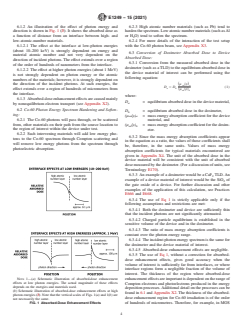
6.1.2 An illustration of the effect of photon energy and 6.2.3 High atomic number materials (such as Pb) tend to
direction is shown in Fig. 1 (3). It shows the absorbed dose as hardenthespectrum.Lowatomicnumbermaterials(suchasAl
a function of distance from an interface between high- and or H O) tend to soften the spectrum.
low-atomic-number materials.
6.2.4 For more details of the interaction of the test setup
6.1.2.1 The effect at the interface at low-photon energies with the Co-60 photon beam, see Appendix X3.
(about 10–200 keV) is strongly dependent on energy and
6.3 Conversion of Dosimeter Absorbed Dose to Device
material atomic number and not very dependent on the
Absorbed Dose:
direction of incident photons. The effect extends over a region
6.3.1 Conversion from the measured absorbed dose in the
of the order of hundreds of nanometers from the interface.
dosimeter (such as aTLD) to the equilibrium absorbed dose in
6.1.2.2 The effect at higher photon energies (about 1 MeV)
the device material of interest can be performed using the
is not strongly dependent on photon energy or the atomic
following equation:
numbers of the materials; however, it is strongly dependent on
µ /ρ
the direction of the incident photons. At such energies, the ~ !
en
a
D 5 D (1)
a b
effect extends over a region of hundreds of micrometers from µ /ρ
~ !
en b
the interface.
where:
6.1.3 Absorbed-doseenhancementeffectsarecausedmainly
D = equilibriumabsorbeddoseinthedevicematerial,
a
by nonequilibrium electron transport (see Appendix X2).
6.2 Co-60 Photon Energy Spectrum Hardening and Soften-
D = equilibrium absorbed dose in the dosimeter,
b
ing:
(µ /ρ) = mass energy absorption coefficient for the device
en a
6.2.1 The Co-60 photons will pass through, or be scattered
material, and
from, other materials on their path from the source location to (µ /ρ) = massenergyabsorptioncoefficientforthedosim-
en b
the region of interest within the device under test.
eter.
6.2.2 Such intervening materials will add low energy pho-
6.3.2 Since the mass energy absorption coefficients appear
tons to the Co-60 spectrum through Compton scattering and
in the equation as a ratio, the values of those coefficients shall
will remove low energy photons from the spectrum through
be, therefore, in the same units. Values of mass energy
photoelectric absorption.
absorption coefficients for typical materials encountered are
given in Appendix X4. The unit of the absorbed dose in the
device material will be consistent with the unit of absorbed
dosemeasuredbythedosimeter.(Foradiscussionofunits,see
Terminology E170).
6.3.3 An example of a dosimeter would be a CaF TLD.An
example of a device material of interest would be the SiO of
the gate oxide of a device. For further discussion and other
examples of the application of this calculation, see Practices
E666 and E668.
6.3.4 The use of Eq 1 is strictly applicable only if the
following assumptions and restrictions are met:
6.3.4.1 Both the dosimeter and device are sufficiently thin
that the incident photons are not significantly attenuated.
6.3.4.2 Charged particle equilibrium is established in the
sensitive volume of the device and in the dosimeter.
6.3.4.3 The ratio of mass energy absorption coefficients is
constant over the photon energy range.
6.3.4.4 Theincidentphotonenergyspectrumisthesamefor
the dosimeter and the device material of interest.
6.3.4.5 Absorbed-dose enhancement effects are negligible.
6.3.5 The use of Eq 1, without a correction for absorbed-
dose enhancement effects, gives good accuracy when the
volume of interest is sufficiently far from interfaces, or where
interface regions form a negligible fraction of the volume of
interest. The thickness of the region where absorbed-dose
NOTE 1—(a) Schematic illustration of absorbed-dose enhancement
enhancementeffectsareimportantisdependentontherangeof
effects at low photon energies. The actual magnitude of these effects
Compton electrons and photoelectrons produced in the energy
depends on the energies and materials used.
deposition processes.Additional detail on the processes can be
(b) Schematic illustration of absorbed-dose enhancement effects at high
found in 6.1 and Appendix X2.The thickness of the absorbed-
photonenergies (3).NotethattheverticalscalesofFigs.1(a)and1(b)are
dose enhancement region for Co-60 irradiation is of the order
not necessarily the same.
FIG. 1 Absorbed-Dose Enhancement Effects of hundreds of micrometres. Therefore, for example, in MOS
E1249 − 15 (2021)
This aluminum layer should be thick enough to produce an approximate
devices where the critical gate oxide is 10–200 nm thick, the
chargedparticleequilibriumwiththelargelylowatomicnumbermaterials
volume of interest will generally lie within the enhancement
usually present in devices. It can be seen from Fig. X5.1 that the
region.
absorbed-dose enhancement effects of a high atomic number material are
6.3.6 Since mass energy absorption coefficients are a func-
largely eliminated after about 0.8 mm (about 0.03 in.) of aluminum.
tion of photon energy, the use of Eq 1 requires knowledge of
7.2.3 For the teletherapy and room type sources, other
the incident photon spectrum. However, for photon energies
proceduresshouldbeusedinadditiontotheuseofafilterbox.
greater than 250 keV, ratios of mass energy absorption coeffi-
Potential scatterers within the vicinity of the irradiation posi-
cients are slowly varying functions of photon energy (see Fig.
tion or near the direct path of the radiation beam should be
X4.1). As a result it is often adequate to use the values of
removed. Those potential scatterers that cannot be removed,
(µ /ρ) and (µ /ρ) tabulated for 1 MeV (see
en dosimeter en device
Appendix X4). For photon energies greater than 250 keV the including the walls, floor, and ceiling, should be covered with
errors introduced by this approximation are usually less than Pb, when practical (see X3.2.2).
about 5%. The advantage of this approximation is that it
7.2.4 In the case of room type sources, when the Co-60 is
requires no knowledge of the Co-60 source photon energy
contained within an individual capsule, the effect of scattering
spectrum. Such spectrum information frequently is unavail-
from the walls, floor and ceiling can be estimated by exposing
able.
an appropriate dosimeter at different radial distances, r, from
the source. If the dosimeter response shows no significant
NOTE9—Anotherconsiderationinabsorbed-doseconversionisthatthe
photons will generally have passed through somewhat different layers of
deviation from an inverse square law (l/r ), corrected if
material in going from the source to the dosimeter as compared to going
necessary for the calculated effects of infinite source and
from the source to the device under test. Therefore, the photon energy
detector size, it may be concluded that, at the positions tested,
spectrum incident on the dosimeter will be different from that incident on
no effects are present from scatterers, other than those associ-
the device. For Co-60 irradiations of electronic devices, these differences
can be neglected if care is taken to make the irradiation geometry of the
ated with the support structures of the source and detector.An
dosimeters and devices essentially the same. The resulting dosimetry
appropriate dosimeter in this context must be one capable of
errors are generally less than 10%.
responding to low energy photons.
6.4 Examples of Conditions That May Lead to Large
7.2.5 For a teletherapy source, proper collimators should be
Absorbed-Dose Enhancement Effects:
used and a beam trap can often be used effectively to reduce
6.4.1 A soft spectrum is typically caused by Compton
backscattering.
scattering from low atomic number materials. It is particularly
important in water well sources, if long water paths are used,
7.3 Minimizing Errors Due to High Energy Photons:
and in room sources, if there is significant photon backscatter-
7.3.1 Aformofabsorbed-doseenhancementispresenteven
ing from walls and floors.
for relatively high energy Co-60 photons. This form of
6.4.2 High Atomic Number Materials in devices or device
absorbed-dose enhancement cannot be reduced by the use of
packagingcanleadtolargeeffects.Acommonexampleofsuch
spectrum hardening, but can be minimized by proper device
a structure is the device packaged with a gold layer on the
orientation (see X2.3).
inside of a Kovar lid.
7.3.2 Theorientationoftheplaneofthesemiconductorchip
7. Procedures for Minimizing Dosimetry Errors Due to in the device under test shall be perpendicular to the incident
Absorbed-Dose Enhancement radiation to the extent possible. The device shall be oriented
withhigheratomicnumberlayerstowardtheincidentradiation
7.1 The principal errors in dosimetry in Co-60 irradiation
in order to minimize absorbed-dose enhancement effects.
hardness testing of electronic devices are caused by absorbed-
These requirements do not apply for irradiations in source
dose enhancement effects resulting from non-equilibrium elec-
geometries in which the photons are incident nearly isotropi-
trontransport.Sucherrorscanbereducedbyusingappropriate
cally on the device under test; for example, in a self-shielded
procedures assuming that the dosimetry measurements are
cavity source or in the center of a cylindrical array of a water
made correctly (See Practice E668 for the use of TLDs). The
well or room source.
dosimeter shall be irradiated under the same conditions as the
device under test (see 4.1.1).
NOTE 11—An orientation to be avoided is that of a unidirectional beam
7.2 Minimizing Errors Due to Low Energy Photons: directed so that it passes from a low-atomic-number material to a
high
...