

ASTM B934-21
(Test Method)Standard Test Method for Effective Case Depth of Ferrous Powder Metallurgy (PM) Parts Using Microindentation Hardness Measurements
General Information
- Abstract
SIGNIFICANCE AND USE
5.1 The engineering function of many PM parts may require an exterior portion of the part to have a specified case depth and microindentation hardness. Measurement of effective case depth is used to determine the depth to which the microindentation hardness of the exterior portion of a part has been increased over that of the interior of the part.
SCOPE
1.1 This test method covers a procedure for determination of the effective case depth of powder metallurgy (PM) parts.
1.2 A microindentation hardness traverse procedure is described to determine effective case depth. This test method may be used to determine the effective case depth for all types of hardened cases.
1.3 The procedure for determining the microindentation hardness of powder metallurgy materials, as described in Test Method B933, shall be followed.
1.4 Units—With the exception of the unit for density, for which the grams per cubic centimeter unit is the long-standing industry practice, the values in SI units are to be regarded as standard.
1.5 This standard does not purport to address all of the safety concerns, if any, associated with its use. It is the responsibility of the user of this standard to establish appropriate safety, health, and environmental practices and determine the applicability of regulatory limitations prior to use.
1.6 This international standard was developed in accordance with internationally recognized principles on standardization established in the Decision on Principles for the Development of International Standards, Guides and Recommendations issued by the World Trade Organization Technical Barriers to Trade (TBT) Committee.
- Status
- Published
- Publication Date
- 31-Mar-2021
- Technical Committee
- B09 - Metal Powders and Metal Powder Products
- Drafting Committee
- B09.05 - Structural Parts
Buy Documents

ASTM B934-21 - Standard Test Method for Effective Case Depth of Ferrous Powder Metallurgy (PM) Parts Using Microindentation Hardness Measurements
REDLINE ASTM B934-21 - Standard Test Method for Effective Case Depth of Ferrous Powder Metallurgy (PM) Parts Using Microindentation Hardness Measurements
Overview
ASTM B934-21, titled Standard Test Method for Effective Case Depth of Ferrous Powder Metallurgy (PM) Parts Using Microindentation Hardness Measurements, is a key international standard developed by ASTM International. It provides a reliable test procedure for determining the effective case depth of ferrous powder metallurgy parts. The method described relies on a microindentation hardness traverse, which is critical for assessing the performance characteristics of case-hardened PM components. This standard is widely referenced in engineering, quality control, and manufacturing environments that utilize PM technology for producing ferrous parts requiring case hardening.
Key Topics
- Effective Case Depth Measurement: Standardizes the method for measuring the depth from the surface to the point where the PM part hardness falls below a specified value, typically corresponding to 50 HRC unless otherwise agreed.
- Microindentation Hardness Traverse: Describes the process of taking hardness measurements at sequential depths from the surface inward, using Knoop or Vickers microhardness indenters with specified loads.
- Test Specimen Preparation:
- Detailed guidelines for sectioning, mounting, grinding, and polishing samples to ensure accurate and repeatable hardness readings.
- Importance of avoiding processes that might alter the original hardness profile.
- Recommendations for etching procedures suitable for ferrous PM materials.
- Reporting Requirements: Specifies the required documentation for test results, including material type, measurement location, type of indenter, applied load, and effective case depth values.
- Precision and Repeatability: Offers data on repeatability and reproducibility, supporting interlaboratory consistency and confidence in test outcomes.
- Safety and Compliance: Notes the user’s responsibility for ensuring proper safety, health, and environmental practices as well as compliance with regulatory limits.
Applications
ASTM B934-21 finds broad practical application in industries utilizing powder metallurgy to manufacture precision ferrous components that require surface hardening. Common uses include:
- Automotive Components: Assessing gear, sprocket, and camshaft performance where surface wear resistance is critical.
- Industrial Machinery: Validating the service life and durability of case-hardened PM parts in heavy equipment and tools.
- Aerospace Hardware: Ensuring reliability of PM parts subjected to high-stress environments.
- Quality Assurance: Providing an objective basis for acceptance or rejection of case-hardened batches, supporting both manufacturer and customer specifications.
- Research and Development: Supporting the development of new PM materials or heat-treatment processes by offering a quantifiable method of case depth characterization.
By standardizing the measurement of effective case depth with microindentation hardness, ASTM B934-21 enables producers and users of ferrous PM parts to consistently verify critical mechanical properties, ensuring optimal component performance and reliability in service.
Related Standards
The following are closely referenced standards and industry resources associated with ASTM B934-21:
- ASTM B243: Terminology of Powder Metallurgy - defines key PM terms used within ASTM standards.
- ASTM B933: Standard Test Method for Microindentation Hardness of PM Materials - provides detailed procedures for hardness testing.
- ASTM E384: Standard Test Method for Microindentation Hardness of Materials - outlines general requirements for microhardness testing.
- ASTM E691: Practice for Conducting an Interlaboratory Study to Determine Test Method Precision.
- MPIF Standard 70: Guide to Sample Preparation of Ferrous PM Materials for Cross-Sectional Metallographic Evaluation - offers guidelines for preparing samples for microindentation and metallographic analysis.
Adherence to these related standards, in combination with ASTM B934-21, ensures consistency, accuracy, and global recognition for users and producers of powder metallurgy components.
Keywords: ASTM B934-21, effective case depth, powder metallurgy, PM parts, microindentation hardness, case hardening, ferrous materials, quality control, standard test method, Knoop, Vickers, hardness traverse
Relations
- Effective Date
- 01-Oct-2018
- Effective Date
- 01-Jul-2016
- Effective Date
- 01-Apr-2014
- Effective Date
- 01-Nov-2013
- Effective Date
- 01-May-2013
- Effective Date
- 15-Jul-2012
- Effective Date
- 15-Nov-2011
- Effective Date
- 01-Nov-2011
- Effective Date
- 01-Feb-2010
- Effective Date
- 01-Feb-2010
- Effective Date
- 15-Jan-2010
- Effective Date
- 15-Dec-2009
- Effective Date
- 01-May-2009
- Effective Date
- 01-Apr-2009
- Effective Date
- 01-Jan-2009
Buy Documents
ASTM B934-21 - Standard Test Method for Effective Case Depth of Ferrous Powder Metallurgy (PM) Parts Using Microindentation Hardness Measurements
REDLINE ASTM B934-21 - Standard Test Method for Effective Case Depth of Ferrous Powder Metallurgy (PM) Parts Using Microindentation Hardness Measurements
Get Certified
Connect with accredited certification bodies for this standard

Element Materials Technology
Materials testing and product certification.

Inštitut za kovinske materiale in tehnologije
Institute of Metals and Technology. Materials testing, metallurgical analysis, NDT.
Sponsored listings
Frequently Asked Questions
ASTM B934-21 is a standard published by ASTM International. Its full title is "Standard Test Method for Effective Case Depth of Ferrous Powder Metallurgy (PM) Parts Using Microindentation Hardness Measurements". This standard covers: SIGNIFICANCE AND USE 5.1 The engineering function of many PM parts may require an exterior portion of the part to have a specified case depth and microindentation hardness. Measurement of effective case depth is used to determine the depth to which the microindentation hardness of the exterior portion of a part has been increased over that of the interior of the part. SCOPE 1.1 This test method covers a procedure for determination of the effective case depth of powder metallurgy (PM) parts. 1.2 A microindentation hardness traverse procedure is described to determine effective case depth. This test method may be used to determine the effective case depth for all types of hardened cases. 1.3 The procedure for determining the microindentation hardness of powder metallurgy materials, as described in Test Method B933, shall be followed. 1.4 Units—With the exception of the unit for density, for which the grams per cubic centimeter unit is the long-standing industry practice, the values in SI units are to be regarded as standard. 1.5 This standard does not purport to address all of the safety concerns, if any, associated with its use. It is the responsibility of the user of this standard to establish appropriate safety, health, and environmental practices and determine the applicability of regulatory limitations prior to use. 1.6 This international standard was developed in accordance with internationally recognized principles on standardization established in the Decision on Principles for the Development of International Standards, Guides and Recommendations issued by the World Trade Organization Technical Barriers to Trade (TBT) Committee.
SIGNIFICANCE AND USE 5.1 The engineering function of many PM parts may require an exterior portion of the part to have a specified case depth and microindentation hardness. Measurement of effective case depth is used to determine the depth to which the microindentation hardness of the exterior portion of a part has been increased over that of the interior of the part. SCOPE 1.1 This test method covers a procedure for determination of the effective case depth of powder metallurgy (PM) parts. 1.2 A microindentation hardness traverse procedure is described to determine effective case depth. This test method may be used to determine the effective case depth for all types of hardened cases. 1.3 The procedure for determining the microindentation hardness of powder metallurgy materials, as described in Test Method B933, shall be followed. 1.4 Units—With the exception of the unit for density, for which the grams per cubic centimeter unit is the long-standing industry practice, the values in SI units are to be regarded as standard. 1.5 This standard does not purport to address all of the safety concerns, if any, associated with its use. It is the responsibility of the user of this standard to establish appropriate safety, health, and environmental practices and determine the applicability of regulatory limitations prior to use. 1.6 This international standard was developed in accordance with internationally recognized principles on standardization established in the Decision on Principles for the Development of International Standards, Guides and Recommendations issued by the World Trade Organization Technical Barriers to Trade (TBT) Committee.
ASTM B934-21 is classified under the following ICS (International Classification for Standards) categories: 77.160 - Powder metallurgy. The ICS classification helps identify the subject area and facilitates finding related standards.
ASTM B934-21 has the following relationships with other standards: It is inter standard links to ASTM B243-18, ASTM B243-16, ASTM B933-14, ASTM B243-13, ASTM E691-13, ASTM B243-12, ASTM B243-11, ASTM E691-11, ASTM E384-10e1, ASTM E384-10, ASTM B243-10, ASTM B243-09a, ASTM E384-09, ASTM B933-09, ASTM B243-09. Understanding these relationships helps ensure you are using the most current and applicable version of the standard.
ASTM B934-21 is available in PDF format for immediate download after purchase. The document can be added to your cart and obtained through the secure checkout process. Digital delivery ensures instant access to the complete standard document.
Standards Content (Sample)
This international standard was developed in accordance with internationally recognized principles on standardization established in the Decision on Principles for the
Development of International Standards, Guides and Recommendations issued by the World Trade Organization Technical Barriers to Trade (TBT) Committee.
Designation: B934 − 21
Standard Test Method for
Effective Case Depth of Ferrous Powder Metallurgy (PM)
Parts Using Microindentation Hardness Measurements
This standard is issued under the fixed designation B934; the number immediately following the designation indicates the year of
original adoption or, in the case of revision, the year of last revision. A number in parentheses indicates the year of last reapproval. A
superscript epsilon (´) indicates an editorial change since the last revision or reapproval.
1. Scope* E384 Test Method for Microindentation Hardness of Mate-
rials
1.1 This test method covers a procedure for determination
E691 Practice for Conducting an Interlaboratory Study to
of the effective case depth of powder metallurgy (PM) parts.
Determine the Precision of a Test Method
1.2 A microindentation hardness traverse procedure is de-
2.2 MPIF Standard:
scribedtodetermineeffectivecasedepth.Thistestmethodmay
Standard70 GuidetoSamplePreparationofFerrousPowder
be used to determine the effective case depth for all types of
Metallurgy (PM) Materials for Cross-Sectional Metallo-
hardened cases.
graphic Evaluation
1.3 The procedure for determining the microindentation
3. Terminology
hardness of powder metallurgy materials, as described in Test
Method B933, shall be followed.
3.1 Definitions of powder metallurgy (PM) terms can be
found in Terminology B243. Additional descriptive informa-
1.4 Units—With the exception of the unit for density, for
which the grams per cubic centimeter unit is the long-standing tion is available under “General Information on PM” on the
ASTM B09 web page.
industry practice, the values in SI units are to be regarded as
standard.
3.2 Definitions of Terms Specific to This Standard:
1.5 This standard does not purport to address all of the 3.2.1 case, n—that portion of a part, extending inward from
safety concerns, if any, associated with its use. It is the the surface that has a microindentation hardness, after
responsibility of the user of this standard to establish appro- hardening, equal to or greater than a specified hardness.
priate safety, health, and environmental practices and deter-
3.2.2 effective case depth, n—perpendicular distance from
mine the applicability of regulatory limitations prior to use.
the surface of the hardened case to the furthest point where a
1.6 This international standard was developed in accor-
microindentation hardness value equivalent to 50 HRC is
dance with internationally recognized principles on standard-
maintained, unless otherwise specified.
ization established in the Decision on Principles for the
Development of International Standards, Guides and Recom-
4. Summary of Test Method
mendations issued by the World Trade Organization Technical
4.1 The powder metallurgy part is sectioned and the surface
Barriers to Trade (TBT) Committee.
prepared for examination. Microindentation hardness measure-
ments are taken at various depths below the part surface. The
2. Referenced Documents
distance where the microindentation hardness falls below the
2.1 ASTM Standards:
equivalent of 50 HRC is defined as the effective case depth,
B243 Terminology of Powder Metallurgy
unless otherwise specified.
B933 TestMethodforMicroindentationHardnessofPowder
Metallurgy (PM) Materials
5. Significance and Use
5.1 TheengineeringfunctionofmanyPMpartsmayrequire
an exterior portion of the part to have a specified case depth
This test method is under the jurisdiction of ASTM Committee B09 on Metal
and microindentation hardness. Measurement of effective case
Powders and Metal Powder Products and is the direct responsibility of Subcom-
depth is used to determine the depth to which the microinden-
mittee B09.05 on Structural Parts.
Current edition approved April 1, 2021. Published July 2021. Originally
tation hardness of the exterior portion of a part has been
approved in 2004. Last previous edition approved in 2015 as B934 – 15. DOI:
increased over that of the interior of the part.
10.1520/B0934-21.
For referenced ASTM standards, visit the ASTM website, www.astm.org, or
contact ASTM Customer Service at service@astm.org. For Annual Book of ASTM
Standards volume information, refer to the standard’s Document Summary page on Available from Metal Powder Industries Federation (MPIF), 105 College Rd.
the ASTM website. East, Princeton, NJ 08540, http://www.mpif.org.
*A Summary of Changes section appears at the end of this standard
Copyright © ASTM International, 100 Barr Harbor Drive, PO Box C700, West Conshohocken, PA 19428-2959. United States
B934 − 21
6. Apparatus 8. Procedure
6.1 Knoop or Vickers Hardness Indenters, using 100 gf
8.1 Measure microindentation hardness at a series of known
(0.9807 N) loads are recommended following Test Method
intervals from the surface of the test specimen toward the
E384. The type of hardness indenter and load used shall be
interior. Take a minimum of three acceptable microindentation
agreed upon between customer and producer.
hardness measurements at each depth. Space the indentations
so that adjacent tests do not interfere with each other. The
6.2 Calibrated Optical Instrument, Micrometer Stage, or
minimum spacing between tests is illustrated in Fig. 1. Use a
other suitable means to measure the distance from the surface
calibrated optical instrument, micrometer stage, or other suit-
of the part to the center of the impression with a precision of
able means to measure the distance from the surface of the part
0.025 mm.
to the center of the impression.
7. Test Specimen
8.2 Microindentation impressions should not be placed in
7.1 Cut a test specimen from the PM part, perpendicular to
soft regions such as copper or the center of nickel-rich regions.
the hardened surface at a specified location, being careful to
Randomly encountered upper bainite or fine pearlite in the
avoid any cutting or grinding procedure that would affect the
martensite should not be excluded as a measurement location.
original microindentation hardness.
8.3 Plot microindentation hardness versus distance from the
7.2 Mounting of the test specimen is recommended for
part surface (see Fig. 2). The effective case depth shall be the
convenience in surface preparation, edge retention, and micro-
distanceatwhichthemicroindentationhardnessfallsbelowthe
indentation hardness measurement. Edge retention is important
equivalent of 50 HRC unless a different value is specified (see
for proper depth measurement of the case.
Note 1). Plot definition will dictate the required number of
readings, particularly in the critical region of effective case
7.3 Guidelines for grinding and polishing specimens are
depth. The procedure described in Appendix X1 of Test
provided in MPIF Standard Guide 70. The area to be traversed
Method B933 shall be used for conversion to HRC.
should be polished so the microindentation hardness impres-
sions are unaffected, that is, the lighter the indenter load, the NOTE 1—No compositional change occurs in induction hardened
materials. The hardness of martensite is affected by the carbon content of
finer the finish necessary. Care should be
...
This document is not an ASTM standard and is intended only to provide the user of an ASTM standard an indication of what changes have been made to the previous version. Because
it may not be technically possible to adequately depict all changes accurately, ASTM recommends that users consult prior editions as appropriate. In all cases only the current version
of the standard as published by ASTM is to be considered the official document.
Designation: B934 − 15 B934 − 21
Standard Test Method for
Effective Case Depth of Ferrous Powder Metallurgy (PM)
Parts Using Microindentation Hardness Measurements
This standard is issued under the fixed designation B934; the number immediately following the designation indicates the year of
original adoption or, in the case of revision, the year of last revision. A number in parentheses indicates the year of last reapproval. A
superscript epsilon (´) indicates an editorial change since the last revision or reapproval.
1. Scope*
1.1 This test method covers a procedure for determination of the effective case depth of powder metallurgy (PM) parts.
1.2 A microindentation hardness traverse procedure is described to determine effective case depth. This test method may be used
to determine the effective case depth for all types of hardened cases.
1.3 The procedure for determining the microindentation hardness of powder metallurgy materials, as described in Test Method
B933, shall be followed.
1.4 Units—With the exception of the unit for density, for which the grams per cubic centimeter unit is the long-standing industry
practice, the values in SI units are to be regarded as standard.
1.5 This standard does not purport to address all of the safety concerns, if any, associated with its use. It is the responsibility
of the user of this standard to establish appropriate safety safety, health, and healthenvironmental practices and determine the
applicability of regulatory limitations prior to use.
1.6 This international standard was developed in accordance with internationally recognized principles on standardization
established in the Decision on Principles for the Development of International Standards, Guides and Recommendations issued
by the World Trade Organization Technical Barriers to Trade (TBT) Committee.
2. Referenced Documents
2.1 ASTM Standards:
B243 Terminology of Powder Metallurgy
B933 Test Method for Microindentation Hardness of Powder Metallurgy (PM) Materials
E384 Test Method for Microindentation Hardness of Materials
E691 Practice for Conducting an Interlaboratory Study to Determine the Precision of a Test Method
2.2 MPIF Standard:
Standard 70 Guide to Sample Preparation of Ferrous Powder Metallurgy (PM) Materials for Cross-Sectional Metallographic
Evaluation
This test method is under the jurisdiction of ASTM Committee B09 on Metal Powders and Metal Powder Products and is the direct responsibility of Subcommittee B09.05
on Structural Parts.
Current edition approved Oct. 1, 2015April 1, 2021. Published November 2015July 2021. Originally approved in 2004. Last previous edition approved in 20102015 as
B934 – 10.B934 – 15. DOI: 10.1520/B0934-15.10.1520/B0934-21.
For referenced ASTM standards, visit the ASTM website, www.astm.org, or contact ASTM Customer Service at service@astm.org. For Annual Book of ASTM Standards
volume information, refer to the standard’s Document Summary page on the ASTM website.
Available from Metal Powder Industries Federation (MPIF), 105 College Rd. East, Princeton, NJ 08540, http://www.mpif.org.
*A Summary of Changes section appears at the end of this standard
Copyright © ASTM International, 100 Barr Harbor Drive, PO Box C700, West Conshohocken, PA 19428-2959. United States
B934 − 21
3. Terminology
3.1 Definitions of powder metallurgy (PM) terms can be found in Terminology B243. Additional descriptive information is
available in the Related Material section of Volume 02.05 of the under “General Information on PM” on the Annual Book of ASTM
Standards.ASTM B09 web page.
3.2 Definitions of Terms Specific to This Standard:
3.2.1 case, —n—that portion of a part, extending inward from the surface that has a microindentation hardness, after hardening,
equal to or greater than a specified hardness.
3.2.2 effective case depth—depth, n—perpendicular distance from the surface of the hardened case to the furthest point where a
microindentation hardness value equivalent to 50 HRC is maintained, unless otherwise specified.
4. Summary of Test Method
4.1 The powder metallurgy part is sectioned and the surface prepared for examination. Microindentation hardness measurements
are taken at various depths below the part surface. The distance where the microindentation hardness falls below the equivalent
of 50 HRC is defined as the effective case depth, unless otherwise specified.
5. Significance and Use
5.1 The engineering function of many PM parts may require an exterior portion of the part to have a specified case depth and
microindentation hardness. Measurement of effective case depth is used to determine the depth to which the microindentation
hardness of the exterior portion of a part has been increased over that of the interior of the part.
6. Apparatus
6.1 Knoop or Vickers Hardness Indenters, using 100 gf (0.9807 N) loads are recommended following Test Method E384. The type
of hardness indenter and load used shall be agreed upon between customer and producer.
6.2 Calibrated Optical Instrument, Micrometer Stage, or other suitable means to measure the distance from the surface of the part
to the center of the impression with a precision of 0.025 mm.
7. Test Specimen
7.1 Cut a test specimen from the PM part, perpendicular to the hardened surface at a specified location, being careful to avoid any
cutting or grinding procedure that would affect the original microindentation hardness.
7.2 Mounting of the test specimen is recommended for convenience in surface preparation, edge retention, and microindentation
hardness measurement. Edge retention is important for proper depth measurement of the case.
7.3 Grind and polish the test specimen using methods recommended in Appendix X2 of Test Method Guidelines for grinding and
polishing specimens are provided in MPIF Standard Guide 70. B933. The area to be traversed should be polished so the
microindentation hardness impressions are unaffected, that is, the lighter the indenter load, the finer the finish necessary. Care
should be taken to ensure that the true area fraction of porosity is revealed throughout the entire cross-section of the specimen.
It is essential in surface preparation to remove all smeared metal and to identify pores clearly so that they may be avoided during
testing.
7.4 The specimen should be lightly etched prior to microindentation hardness testing. Careful etching is necessary as heavy
etching obscures features and interferes with the measurement of the diagonals of the indentation.
7.5 For heat treated steels, swabbing with or immersion in 2 % nital for 4 to 7 s gives an appropriate structure.
8. Procedure
8.1 Measure microindentation hardness at a series of known intervals from the surface of the test specimen toward the interior.
B934 − 21
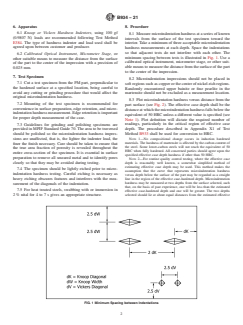
Take a minimum of three acceptable microindentation hardness measurements at each depth. Space the indentations so that
adjacent tests do not interfere with each other. The minimum spacing between tests is illustrated in Fig. 1. Use a calibrated optical
instrument, micrometer stage, or other suitable means to measure the distance from the surface of the part to the center of the
impression.
8.2 Microindentation impressions should not be placed in soft regions such as copper or the center of nickel-rich regions.
Randomly encountered upper bainite or fine pearlite in the martensite should not be excluded as a measurement location.
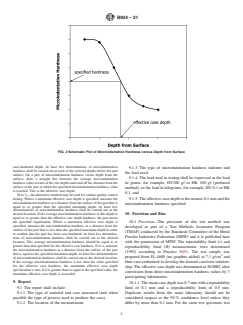
8.3 Plot microindentation hardness versus distance from the part surface (se
...