

ASTM D8182-18
(Test Method)Standard Test Method for Alloy Classification of Wear Debris using Laser-Induced Breakdown Spectroscopy (LIBS)
General Information
- Abstract
SIGNIFICANCE AND USE
5.1 In many cases, equipment failure modes are identified by wear debris that is not captured in used lubricating oil samples but captured on chip detectors, filters or by other means. Users of this technique include, but are not limited to, original equipment manufacturers (OEMs), commercial airlines, civil aerospace operators, maintenance repair and overhaul (MRO) facilities, and military maintenance personnel.
SCOPE
1.1 This test method describes a means for quantitative determination of wear debris found in in-service lubricants by laser-induced breakdown spectroscopy (LIBS). LIBS is an analytical technology that uses short laser pulses to create micro hot-plasma ablation of a material and then employs spectroscopic tools for analysis.2
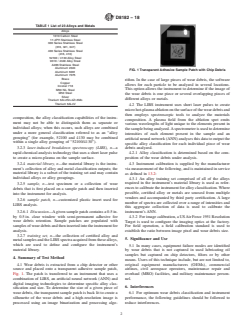
1.2 This method covers the means for alloy classification and sizing of wear debris. Wear debris sources can include, but are not limited to: (1) chip collector and chip detector devices, (2) filters, (3) ferrograms, and (4) loose particles. The 23 tested alloys and metals included in the default material library of the instrument are listed in Table 1.
1.3 The method for alloy classification and sizing of wear debris is not limited to the list of alloys in Table 1. The instrument has the capability of including additional alloys and metals as required.
1.4 The values stated in SI units are to be regarded as standard. No other units of measurement are included in this standard.
1.5 This standard does not purport to address all of the safety concerns, if any, associated with its use. It is the responsibility of the user of this standard to establish appropriate safety, health, and environmental practices and determine the applicability of regulatory limitations prior to use.
1.6 This international standard was developed in accordance with internationally recognized principles on standardization established in the Decision on Principles for the Development of International Standards, Guides and Recommendations issued by the World Trade Organization Technical Barriers to Trade (TBT) Committee.
- Status
- Published
- Publication Date
- 31-May-2018
- Technical Committee
- D02 - Petroleum Products, Liquid Fuels, and Lubricants
Overview
ASTM D8182-18 establishes the Standard Test Method for Alloy Classification of Wear Debris using Laser-Induced Breakdown Spectroscopy (LIBS). This method is designed to provide a quantitative approach to identifying and classifying alloy wear debris found in in-service lubricants, a critical task for equipment health monitoring in various industries. The standard outlines procedures for analyzing debris collected from sources such as chip detectors, filters, and ferrograms, enabling more accurate diagnostics of equipment wear and potential failure modes. The application of LIBS technology allows for rapid, precise elemental and alloy analysis, supporting effective maintenance and operational decisions.
Key Topics
- Wear Debris Detection: The method focuses on the analysis of wear debris not typically captured in routine oil samples but collected on chip detectors, filters, or related devices, which are crucial indicators of abnormal wear or impending equipment failure.
- LIBS Technology: LIBS utilizes short laser pulses to generate micro-plasma on the debris surface. Spectroscopic analysis of the emitted light identifies elemental composition, enabling alloy classification through the instrument's material library and artificial neural network (ANN).
- Sample Preparation: Proper cleaning (commonly with isopropyl alcohol), handling, and placement of wear debris onto transparent adhesive sample patches are detailed to ensure the accuracy of measurement and classification.
- Calibration and Standardization: The standard emphasizes daily standardization using manufacturer-provided materials and outlines procedures for maintaining calibration, crucial for reliable results.
- Results Interpretation: Automated data output includes alloy classification, debris area in microns squared, and visual imaging-enabling trend analysis for maintenance optimization.
Applications
ASTM D8182-18 serves a wide range of stakeholders, including:
- Original Equipment Manufacturers (OEMs): To monitor and validate component wear during design and field operation.
- Commercial Airlines and Civil Aerospace Operators: For timely detection of wear in aircraft engines and systems, improving safety and reducing unplanned downtime.
- Maintenance, Repair, and Overhaul (MRO) Facilities: For accurate identification of worn components, guiding repair strategies.
- Military Maintenance Personnel: In mission-critical systems, real-time alloy classification assists in preventive maintenance to avoid costly failures.
Typical sources of wear debris for LIBS analysis include chip collector and detector devices, filters, ferrograms, and loose particles. The method provides actionable data supporting predictive maintenance programs, ensuring equipment reliability and reducing life-cycle costs.
Related Standards
This test method references and complements several other ASTM standards relevant to lubricant condition monitoring and equipment maintenance:
- ASTM D7669 - Guide for Practical Lubricant Condition Data Trend Analysis
- ASTM D7720 - Guide for Statistically Evaluating Measurand Alarm Limits when Using Oil Analysis
- ASTM E177 - Practice for Use of the Terms Precision and Bias in ASTM Test Methods
Practical Value
- Enhanced Failure Detection: Enables early recognition of wear-related issues by precisely classifying metallic debris, thus supporting proactive maintenance decisions.
- Accurate Alloy Identification: Assists in tracing wear debris to specific source components, facilitating targeted troubleshooting and root cause analysis.
- Supporting Condition Monitoring: Integrates seamlessly with broader oil analysis and machinery health monitoring programs.
- Compliance and Best Practice: Following ASTM D8182-18 ensures that alloy classification and wear debris analysis are performed in line with internationally accepted standards.
Keywords: ASTM D8182-18, wear debris analysis, alloy classification, laser-induced breakdown spectroscopy (LIBS), equipment maintenance, oil analysis, preventative maintenance, asset reliability.
Relations
- Effective Date
- 01-May-2014
- Effective Date
- 01-May-2013
- Effective Date
- 01-Jun-2011
- Effective Date
- 15-Feb-2011
- Effective Date
- 01-Oct-2010
- Effective Date
- 01-Oct-2008
- Refers
ASTM E177-06b - Standard Practice for Use of the Terms Precision and Bias in ASTM Test Methods - Effective Date
- 15-Nov-2006
- Refers
ASTM E177-06a - Standard Practice for Use of the Terms Precision and Bias in ASTM Test Methods - Effective Date
- 01-Nov-2006
- Effective Date
- 01-Nov-2004
- Refers
ASTM E177-04e1 - Standard Practice for Use of the Terms Precision and Bias in ASTM Test Methods - Effective Date
- 01-Nov-2004
- Effective Date
- 01-Nov-2004
- Refers
ASTM E177-90a(2002) - Standard Practice for Use of the Terms Precision and Bias in ASTM Test Methods - Effective Date
- 10-Jan-2002
Get Certified
Connect with accredited certification bodies for this standard

Element Materials Technology
Materials testing and product certification.

ABS Group Brazil
ABS Group certification services in Brazil.

ABS Quality Evaluations Inc.
American Bureau of Shipping quality certification.
Sponsored listings
Frequently Asked Questions
ASTM D8182-18 is a standard published by ASTM International. Its full title is "Standard Test Method for Alloy Classification of Wear Debris using Laser-Induced Breakdown Spectroscopy (LIBS)". This standard covers: SIGNIFICANCE AND USE 5.1 In many cases, equipment failure modes are identified by wear debris that is not captured in used lubricating oil samples but captured on chip detectors, filters or by other means. Users of this technique include, but are not limited to, original equipment manufacturers (OEMs), commercial airlines, civil aerospace operators, maintenance repair and overhaul (MRO) facilities, and military maintenance personnel. SCOPE 1.1 This test method describes a means for quantitative determination of wear debris found in in-service lubricants by laser-induced breakdown spectroscopy (LIBS). LIBS is an analytical technology that uses short laser pulses to create micro hot-plasma ablation of a material and then employs spectroscopic tools for analysis.2 1.2 This method covers the means for alloy classification and sizing of wear debris. Wear debris sources can include, but are not limited to: (1) chip collector and chip detector devices, (2) filters, (3) ferrograms, and (4) loose particles. The 23 tested alloys and metals included in the default material library of the instrument are listed in Table 1. 1.3 The method for alloy classification and sizing of wear debris is not limited to the list of alloys in Table 1. The instrument has the capability of including additional alloys and metals as required. 1.4 The values stated in SI units are to be regarded as standard. No other units of measurement are included in this standard. 1.5 This standard does not purport to address all of the safety concerns, if any, associated with its use. It is the responsibility of the user of this standard to establish appropriate safety, health, and environmental practices and determine the applicability of regulatory limitations prior to use. 1.6 This international standard was developed in accordance with internationally recognized principles on standardization established in the Decision on Principles for the Development of International Standards, Guides and Recommendations issued by the World Trade Organization Technical Barriers to Trade (TBT) Committee.
SIGNIFICANCE AND USE 5.1 In many cases, equipment failure modes are identified by wear debris that is not captured in used lubricating oil samples but captured on chip detectors, filters or by other means. Users of this technique include, but are not limited to, original equipment manufacturers (OEMs), commercial airlines, civil aerospace operators, maintenance repair and overhaul (MRO) facilities, and military maintenance personnel. SCOPE 1.1 This test method describes a means for quantitative determination of wear debris found in in-service lubricants by laser-induced breakdown spectroscopy (LIBS). LIBS is an analytical technology that uses short laser pulses to create micro hot-plasma ablation of a material and then employs spectroscopic tools for analysis.2 1.2 This method covers the means for alloy classification and sizing of wear debris. Wear debris sources can include, but are not limited to: (1) chip collector and chip detector devices, (2) filters, (3) ferrograms, and (4) loose particles. The 23 tested alloys and metals included in the default material library of the instrument are listed in Table 1. 1.3 The method for alloy classification and sizing of wear debris is not limited to the list of alloys in Table 1. The instrument has the capability of including additional alloys and metals as required. 1.4 The values stated in SI units are to be regarded as standard. No other units of measurement are included in this standard. 1.5 This standard does not purport to address all of the safety concerns, if any, associated with its use. It is the responsibility of the user of this standard to establish appropriate safety, health, and environmental practices and determine the applicability of regulatory limitations prior to use. 1.6 This international standard was developed in accordance with internationally recognized principles on standardization established in the Decision on Principles for the Development of International Standards, Guides and Recommendations issued by the World Trade Organization Technical Barriers to Trade (TBT) Committee.
ASTM D8182-18 is classified under the following ICS (International Classification for Standards) categories: 75.100 - Lubricants, industrial oils and related products. The ICS classification helps identify the subject area and facilitates finding related standards.
ASTM D8182-18 has the following relationships with other standards: It is inter standard links to ASTM E177-14, ASTM E177-13, ASTM D7720-11, ASTM D7669-11, ASTM E177-10, ASTM E177-08, ASTM E177-06b, ASTM E177-06a, ASTM E177-04, ASTM E177-04e1, ASTM E177-06, ASTM E177-90a(2002). Understanding these relationships helps ensure you are using the most current and applicable version of the standard.
ASTM D8182-18 is available in PDF format for immediate download after purchase. The document can be added to your cart and obtained through the secure checkout process. Digital delivery ensures instant access to the complete standard document.
Standards Content (Sample)
This international standard was developed in accordance with internationally recognized principles on standardization established in the Decision on Principles for the
Development of International Standards, Guides and Recommendations issued by the World Trade Organization Technical Barriers to Trade (TBT) Committee.
Designation:D8182 −18
Standard Test Method for
Alloy Classification of Wear Debris using Laser-Induced
Breakdown Spectroscopy (LIBS)
This standard is issued under the fixed designation D8182; the number immediately following the designation indicates the year of
original adoption or, in the case of revision, the year of last revision. A number in parentheses indicates the year of last reapproval. A
superscript epsilon (´) indicates an editorial change since the last revision or reapproval.
1. Scope 2. Referenced Documents
2.1 ASTM Standards:
1.1 This test method describes a means for quantitative
D7669 Guide for Practical Lubricant Condition Data Trend
determination of wear debris found in in-service lubricants by
Analysis
laser-induced breakdown spectroscopy (LIBS). LIBS is an
D7720 Guide for Statistically Evaluating Measurand Alarm
analytical technology that uses short laser pulses to create
Limits when Using Oil Analysis to Monitor Equipment
micro hot-plasma ablation of a material and then employs
and Oil for Fitness and Contamination
spectroscopic tools for analysis.
E177 Practice for Use of the Terms Precision and Bias in
1.2 This method covers the means for alloy classification
ASTM Test Methods
and sizing of wear debris.Wear debris sources can include, but
3. Terminology
are not limited to: (1) chip collector and chip detector devices,
(2) filters, (3) ferrograms, and (4) loose particles.The 23 tested
3.1 Definitions:
alloys and metals included in the default material library of the
3.1.1 alloy, n—unique composition of two or more metals
instrument are listed in Table 1.
that has one or more of the metals treated or processed in a
special way to confer enhanced performance characteristics on
1.3 The method for alloy classification and sizing of wear
the resulting material.
debris is not limited to the list of alloys in Table 1. The
3.1.2 debris, n—solid particulate matter introduced to lubri-
instrument has the capability of including additional alloys and
cant (or machinery/equipment fluid) through contamination or
metals as required.
detached from a surface due to wear, corrosion, or erosion
1.4 The values stated in SI units are to be regarded as
process.
standard. No other units of measurement are included in this
3.1.3 in-service oil, n—lubricating oil that is present in a
standard.
machine that has been at operating temperature for at least one
1.5 This standard does not purport to address all of the
hour.
safety concerns, if any, associated with its use. It is the
3.1.4 wear, n—damage to a solid surface, usually involving
responsibility of the user of this standard to establish appro-
progressive loss or displacement of material, due to relative
priate safety, health, and environmental practices and deter-
motion between that surface and a contacting substance or
mine the applicability of regulatory limitations prior to use.
substances.
1.6 This international standard was developed in accor-
3.1.5 wear debris, n—particles that have become detached
dance with internationally recognized principles on standard-
in wear or erosion processes.
ization established in the Decision on Principles for the
3.2 Definitions of Terms Specific to This Standard:
Development of International Standards, Guides and Recom-
3.2.1 alloy classification, n—the automated process that
mendations issued by the World Trade Organization Technical
uses the LIBS technology in conjunction with an artificial
Barriers to Trade (TBT) Committee.
neural network (ANN) to determine the specific alloy or alloy
grouping for a given sample.
3.2.2 alloy grouping, n—within a given LIBS training set,
This test method is under the jurisdiction of ASTM Committee D02 on
when two or more alloys are significantly similar in elemental
Petroleum Products, Liquid Fuels, and Lubricants and is the direct responsibility of
Subcommittee D02.96.06 on Practices and Techniques for Prediction and Determi-
nation of Microscopic Wear and Wear-related Properties.
Current edition approved June 1, 2018. Published July 2018. DOI: 10.1520/ For referenced ASTM standards, visit the ASTM website, www.astm.org, or
D8182-18. contact ASTM Customer Service at service@astm.org. For Annual Book of ASTM
Hill, R., Lawrence, R., Toms, A.; “A New Approach to Elemental and Wear Standards volume information, refer to the standard’s Document Summary page on
Debris Analysis,” STLE, Las Vegas, NV, 2016. the ASTM website.
Copyright © ASTM International, 100 Barr Harbor Drive, PO Box C700, West Conshohocken, PA 19428-2959. United States
D8182−18
TABLE 1 List of 23 Alloys and Metals
Alloys
1010 Carbon Steel
17-4PH Stainless Steel
300 Series Stainless Steel
(316, 321, 347)
400 Series Stainless Steel
(416, 410)
52100 / 4130 Alloy Steel
9310 / 4340 Alloy Steel
A286 Stainless Steel
Aluminum 2024
FIG. 1Transparent Adhesive Sample Patch with Chip Debris
Aluminum 6061
Aluminum 7075
Brass
rithm. In the case of large pieces of wear debris, the software
Copper
allows for each particle to be analyzed in several locations.
Inconel 718
This option allows the instrument to determine if the image of
M50 NiL Steel
M50 Steel
the wear debris is one piece or several overlapping pieces of
Silver
different alloys or metals.
Titanium 6Al-2Sn-4Zr-6Mo
Titanium 6Al-4V
4.2 The LIBS instrument uses short laser pulses to create
microhot-plasmaablationonthesurfaceoftheweardebrisand
then employs spectroscopic tools to analyze the materials
composition, the alloy classification capabilities of the instru-
composition. A plasma field from the ablation spot emits
ment may not be able to distinguish them as separate or
various wavelengths of light unique to the elements present in
individual alloys; when this occurs, such alloys are combined
thesamplebeinganalyzed.Aspectrometerisusedtodetermine
under a more general classification referred to as an “alloy
intensities of each element present in the sample and an
grouping” (for example, 52100 and 4130 may be combined
artificial neural network (ANN) analyses this data to output the
within a single alloy grouping of “52100/4130”).
specific alloy classification for each individual piece of wear
3.2.3 laser-induced breakdown spectroscopy (LIBS), n—a debris analyzed.
rapid chemical analysis technology that uses a short laser pulse 4.2.1 Alloy classification is determined based on the com-
to create a micro-plasma on the sample surface. position of the wear debris under analysis.
3.2.4 material library, n—the material library is the instru-
4.3 Instrument calibration is supplied by the manufacturer
ment’s collection of alloy and metal classification outputs; the
via measurement of the following, and is maintained in service
material library is a subset of the training set and may contain
as defined in 13.2:
individual alloys or alloy groupings.
4.3.1 An alloy training set comprised of all of the alloys
required in the instrument’s material library is used as refer-
3.2.5 sample, n—test specimen or a collection of wear
ences to calibrate the instrument for alloy classification.Where
debris that is first placed on a sample patch and then inserted
possible, certified alloy or metals are sourced from multiple
into the instrument for analysis.
vendors and accompanied by third party certification. A large
3.2.6 sample patch, n—customized plastic insert used for
number of spectra are collected over a range of intensities and
LIBS analysis.
this aggregate collection of data is used to calibrate the
3.2.6.1 Discussion—Agiven sample patch contains a 0.5 in.
instrument’s ANN.
by 0.5 in. clear window with semi-permanent adhesive for 4.3.2 Forimagecalibration,aUSAirForce1951Resolution
wear debris retention. Sample patches are populated with
Target is used to configure the imaging optics at the factory.
samplesofweardebrisandtheninsertedintotheinstrumentfor For field operation, a field calibration standard is used to
analysis.
establish the ratio between image pixel and wear debris size.
3.2.7 training set, n—the collection of certified alloy and
5. Significance and Use
metalsamplesandtheLIBSspectraacquiredfromthesealloys,
which are used to define and configure the instrument’s 5.1 In many cases, equipment failure modes are identified
material library.
by wear debris that is not captured in used lubricating oil
samples but captured on chip detectors, filters or by other
4. Summary of Test Method
means. Users of this technique include, but are not limited to,
4.1 Wear debris is extracted from a chip detector or other original equipment manufacturers (OEMs), commercial
source and placed onto a transparent adhesive sample patch, airlines, civil aerospace operators, maintenance repair and
Fig. 1. The patch is transferred to an instrument that uses a overhaul (MRO) facilities, and military maintenance person-
combination of LIBS, an artificial neural network (ANN) and nel.
digital imaging technologies to determine specific alloy clas-
6. Interferences
sification and size. To determine the size of a given piece of
wear debris, the transparent sample patch is back lit to create a 6.1 For optimum wear debris classification and instrument
silhouette of the wear debris and a high-resolution image is performance, the following guidelines should be followed to
processed using an image binarization and processing algo- reduce interferences.
D8182−18
6.1.1 Residual oil on the wear debris may weaken the signal 10. Sampling, Test Specimens, and Test Units
intensity. An isopropyl alcohol rinse of the debris is recom-
10.1 For alloy classification, wear debris particles with a
mended prior to applying the wear debris to the sample patch.
minimum dimension larger than 70 µm are classified. Particles
Applying a drop or two of isopropyl alcohol to the sample
smaller than these dimensions are not classified.
patch, after the wear debris is applied, is allowed.
10.2 Test specimens and wear debris samples should be no
6.1.2 When preparing the sample patch for analysis, con-
thicker than 0.5 mm. Any sample that is thicker than 0.5 mm
centrated ’clumps’ of wear debris should be avoided. Overlap-
should be broken into smaller pieces.
ping debris may hinder proper identification of some particles.
If needed, excessive debris all from one source can be placed 10.3 Residual oil on the wear debris should be removed
on multiple patches. prior to applying the wear debris to the sample patch. An
6.1.3 When preparing the sample patch for analysis, wear isopropyl alcohol rinse of the debris is recommended.
debris should lay as flat as possible on the sample patch for
10.4 For proper identification, test specimens and wear
proper identification.
debris samples must be alloys or metals included in the
6.1.4 Avoid placing wear debris thicker than 0.5 mm on a
material library and training set.
sample patch. Wear debris thicker than 0.5 mm should be
10.5 Test specimens and wear debris samples should be flat
broken into smaller pieces for proper identification.
for proper identification.
6.1.5 Alloys not in the material library will be classified as
“unclassified” or if their elemental composition is similar to an
11. Preparation of Apparatus
alloy in the library, they may be incorrectly classified.
11.1 Refer to the manufacturer’s manual for the mechanical
6.1.6 The operation, maintenance, service and all related
setup and power up procedures.
activities regarding the instrument shall be performed in
11.2 Ensure that no alerts, which indicate a fault with the
accordance with the manufacturer’s manual and technical
measurement hardware or software, are generated during
specification.
powerup.
7. Apparatus
12. Conditioning
7.1 LIBS Instrument.
12.1 The instrument self-conditions upon start-up. The in-
7.2 Sample Tray, to hold the transparent adhesive sample
strument will initiate and automatically notify the operator
patch containing the wear debris sample during analysis.
when ready.
13. Calibration and Standardization
8. Reagents and Materials
13.1 Standardization—In-service standardization is com-
8.1 Transparent adhesive sample patches.
pleted by the operator in order to verify the status of the
8.2 Optional patch preparation tools and materials
instrument. Standardization is completed through the use of an
(tweezers, probe set, wash bottle, isopropyl alcohol).
automated standardization process using manufacturer pro-
vided standardization standard. The standardization procedure
8.3 Standardization standard that allows for the standardiza-
should be completed once each day prior to use of the
tion procedure to be completed verifying the instrument is
instrument. Refer to the manufacturer’s manual for the stan-
standardized.
dardization procedure.
8.4 Calibration standard that allows for the calibration
13.2 Calibration—The instrument is factory-calibrated
procedure to be completed ensuring instrument calibration.
upon receipt. In-service calibration, if required, is completed
by the operator through the use of an automated calibration
9. Hazards
process using manufacturer provided calibration standard.
9.1 Potential hazards arising from the use of a laser have
Refer to the manufacturer’s manual for the calibration proce-
been mitigated by the design and manufacturing process. The
dure.
instrument is designated as a Class 1 laser product and
complies with US FDA performance standards for laser prod-
14. Analysis Procedures
ucts except for deviations pursuant to Laser Notice No. 50,
14.1 The instrument shall be used, operated and maintained
datedJune24,2007.Onlymanufacturerauthorizedtechnicians
in accordance with the instrument’s manufacturer’s
can complete laser service on the instrument. Manufacturer
requirements, manual and technical specifications. The follow-
recommended safety procedures must be followed during
ing is a high-level summary of the most critical procedures
instrument service.
required to ensure optimal performance from the instrument.
Refer to the manufacturer’s manual for all other procedures
including transportation, maintenance and service.
The sole source of supply of the apparatus known to the committee at this time
14.1.1 Sample Patch Preparation—There are several poten-
is GasTOPS, Ltd., Polytek St., Ottawa, Ontario K1J 9J3, Canada. If you are aware
tial sources of wear debris. The process of transferring wear
of alternative suppliers, please provide this information to ASTM International
debris from the collection source to the sample patch largely
Headquarters.Your comments will receive careful consideration at a meeting of the
responsible technical committee, which you may attend. depends on how the debris was collected from the equipment.
D8182−18
The following procedure defines the recommended process of 14.1.3.3 The instrument may be preset to analyze each wear
transferring wear debris while considering the cautions out- debris in several locations/sections.
lined in Section 6.
15. Calculation or Interpretation of Results
14.1.1.1 Cleaning We
...