

ASTM B703-21
(Test Method)Standard Test Method for Apparent Density of Metal Powders and Related Compounds Using the Arnold Meter
General Information
- Abstract
SIGNIFICANCE AND USE
5.1 The apparent density is an important measure of a material characteristic of the powder that is useful to the powder producers and powder users in determining quality and lot to lot consistency.
5.2 This test method is applicable to free-flowing and non-free-flowing metal powders, lubricated powder mixtures and metal compounds.
5.3 The apparent density of a lubricated metal powder mixture may be different when a quantity settles after falling into the die cavity during automated compacting compared with the value obtained from a measurement taken in the laboratory under controlled test conditions.
5.4 This test method simulates the action of the feed shoe on a powder compacting press and gives an apparent density value that closely approximates the apparent density of the powder in the die cavity after the production filling operation.
5.5 Knowledge of this apparent density value for the final lubricated production powder mixture is very helpful to the powder metallurgy (PM) parts fabricator to set the compression ratios for fixed fill die cavity tooling.
5.6 The values of apparent density obtained on metal powders with this test method are approximately 0.2 g/cm3 higher than those obtained using the Hall Funnel, Test Method B212, the Carney Funnel, Test Method B417; or the Scott Volumeter, Test Method B329.
5.7 This test method may be part of a purchase agreement between the powder producer and PM parts producer, or it may be an internal quality control test for either party.
SCOPE
1.1 This test method covers a quantitative laboratory procedure for determining the apparent density of both free-flowing and non-free-flowing metal powders, lubricated metal powder mixtures, and powder compounds.
1.2 Units—With the exception of the values for mass, volume, and density, for which the use of the gram and the cubic centimetre units is the long-standing industry practice, the values stated in inch-pound units are to be regarded as standard. The values given in parentheses are mathematical conversions to SI units that are provided for information only and are not considered standard.
1.3 This standard does not purport to address all of the safety concerns, if any, associated with its use. It is the responsibility of the user of this standard to establish appropriate safety, health, and environmental practices and determine the applicability of regulatory limitations prior to use.
1.4 This international standard was developed in accordance with internationally recognized principles on standardization established in the Decision on Principles for the Development of International Standards, Guides and Recommendations issued by the World Trade Organization Technical Barriers to Trade (TBT) Committee.
- Status
- Published
- Publication Date
- 31-Aug-2021
- Technical Committee
- B09 - Metal Powders and Metal Powder Products
- Drafting Committee
- B09.02 - Base Metal Powders
Buy Documents
ASTM B703-21 - Standard Test Method for Apparent Density of Metal Powders and Related Compounds Using the Arnold Meter
REDLINE ASTM B703-21 - Standard Test Method for Apparent Density of Metal Powders and Related Compounds Using the Arnold Meter
Overview
ASTM B703-21, Standard Test Method for Apparent Density of Metal Powders and Related Compounds Using the Arnold Meter, provides a quantitative laboratory procedure for determining the apparent density of both free-flowing and non-free-flowing metal powders, lubricated metal powder mixtures, and metal powder compounds. Developed by ASTM Committee B09, this test method is essential for powder producers and powder metallurgy (PM) parts fabricators interested in ensuring quality, consistency, and optimal processing of metal powders. The Arnold Meter technique yields an apparent density value that simulates conditions found during production filling operations, supporting accurate quality control and reliable product performance.
Key Topics
- Apparent Density Measurement: The standard defines “Arnold Apparent Density” as the mass per unit volume of a powder (typically in g/cm³) determined using the Arnold Meter.
- Applicability: The method applies to both free-flowing and non-free-flowing powders, as well as lubricated powder mixtures and metal compounds.
- Quality Control: Understanding apparent density aids producers and users in assessing material quality and lot-to-lot consistency.
- Production Simulation: The procedure closely replicates the action of the feed shoe in a powder compacting press, offering values that approximate those found in die cavities after production filling.
- Instrument Requirements: The Arnold Meter consists of a precise steel die block and a powder delivery cylinder, facilitating repeatable and accurate density determinations.
Applications
ASTM B703-21 is widely used in the following practical contexts:
- Quality Assurance for Powder Producers: Regular apparent density testing verifies that metal powders meet specified criteria, supporting consistent supply to customers and adherence to contract requirements.
- Process Optimization: Manufacturers use Arnold Apparent Density results to set compression ratios for fixed-fill die cavity tooling in powder metallurgy part fabrication.
- Purchase Agreements: This method is commonly specified in purchasing contracts between powder suppliers and PM part manufacturers, ensuring both parties have a common understanding of material characteristics.
- Internal Quality Control: Both suppliers and users incorporate regular density testing for batch comparison and process monitoring, leading to enhanced product reliability.
- Mixture Evaluation: Determining the apparent density of production powder mixtures, especially those containing lubricants, assists in predicting and controlling compacted part properties.
Note: The Arnold Meter method generally yields apparent density results approximately 0.2 g/cm³ higher than other common methods, such as Hall Flowmeter (ASTM B212), Carney Funnel (ASTM B417), or Scott Volumeter (ASTM B329). This difference should be considered when comparing data across different standards.
Related Standards
The following standards are related to ASTM B703-21 and are useful for complementary testing and terminology:
- ASTM B212: Test Method for Apparent Density of Free-Flowing Metal Powders Using the Hall Flowmeter Funnel
- ASTM B215: Practices for Sampling Metal Powders
- ASTM B243: Terminology of Powder Metallurgy
- ASTM B329: Test Method for Apparent Density of Metal Powders and Compounds Using the Scott Volumeter
- ASTM B417: Test Method for Apparent Density of Non-Free-Flowing Metal Powders Using the Carney Funnel
- MPIF 48: Determination of Apparent Density of Metal Powders Using the Arnold Meter
- ASTM E177 and E456: Practices and Terminology Relating to Precision and Statistics in Test Methods
Conclusion
Implementing the ASTM B703-21 standard for the determination of apparent density using the Arnold Meter is crucial for achieving consistent product quality in metal powder production and powder metallurgy part manufacturing. By providing a realistic simulation of production conditions, this test method is an invaluable tool for process control, product specification, and quality assurance within the metal powder industry.
Relations
- Effective Date
- 01-May-2020
- Effective Date
- 01-Oct-2018
- Effective Date
- 01-Oct-2018
- Effective Date
- 01-Jul-2016
- Effective Date
- 01-Dec-2014
- Effective Date
- 01-May-2014
- Effective Date
- 01-Nov-2013
- Effective Date
- 01-Oct-2013
- Effective Date
- 01-May-2013
- Effective Date
- 01-May-2013
- Effective Date
- 01-Apr-2013
- Effective Date
- 01-Oct-2012
- Effective Date
- 15-Jul-2012
- Effective Date
- 01-Apr-2012
- Effective Date
- 15-Nov-2011
Buy Documents
ASTM B703-21 - Standard Test Method for Apparent Density of Metal Powders and Related Compounds Using the Arnold Meter
REDLINE ASTM B703-21 - Standard Test Method for Apparent Density of Metal Powders and Related Compounds Using the Arnold Meter
Get Certified
Connect with accredited certification bodies for this standard

Element Materials Technology
Materials testing and product certification.

Inštitut za kovinske materiale in tehnologije
Institute of Metals and Technology. Materials testing, metallurgical analysis, NDT.
Sponsored listings
Frequently Asked Questions
ASTM B703-21 is a standard published by ASTM International. Its full title is "Standard Test Method for Apparent Density of Metal Powders and Related Compounds Using the Arnold Meter". This standard covers: SIGNIFICANCE AND USE 5.1 The apparent density is an important measure of a material characteristic of the powder that is useful to the powder producers and powder users in determining quality and lot to lot consistency. 5.2 This test method is applicable to free-flowing and non-free-flowing metal powders, lubricated powder mixtures and metal compounds. 5.3 The apparent density of a lubricated metal powder mixture may be different when a quantity settles after falling into the die cavity during automated compacting compared with the value obtained from a measurement taken in the laboratory under controlled test conditions. 5.4 This test method simulates the action of the feed shoe on a powder compacting press and gives an apparent density value that closely approximates the apparent density of the powder in the die cavity after the production filling operation. 5.5 Knowledge of this apparent density value for the final lubricated production powder mixture is very helpful to the powder metallurgy (PM) parts fabricator to set the compression ratios for fixed fill die cavity tooling. 5.6 The values of apparent density obtained on metal powders with this test method are approximately 0.2 g/cm3 higher than those obtained using the Hall Funnel, Test Method B212, the Carney Funnel, Test Method B417; or the Scott Volumeter, Test Method B329. 5.7 This test method may be part of a purchase agreement between the powder producer and PM parts producer, or it may be an internal quality control test for either party. SCOPE 1.1 This test method covers a quantitative laboratory procedure for determining the apparent density of both free-flowing and non-free-flowing metal powders, lubricated metal powder mixtures, and powder compounds. 1.2 Units—With the exception of the values for mass, volume, and density, for which the use of the gram and the cubic centimetre units is the long-standing industry practice, the values stated in inch-pound units are to be regarded as standard. The values given in parentheses are mathematical conversions to SI units that are provided for information only and are not considered standard. 1.3 This standard does not purport to address all of the safety concerns, if any, associated with its use. It is the responsibility of the user of this standard to establish appropriate safety, health, and environmental practices and determine the applicability of regulatory limitations prior to use. 1.4 This international standard was developed in accordance with internationally recognized principles on standardization established in the Decision on Principles for the Development of International Standards, Guides and Recommendations issued by the World Trade Organization Technical Barriers to Trade (TBT) Committee.
SIGNIFICANCE AND USE 5.1 The apparent density is an important measure of a material characteristic of the powder that is useful to the powder producers and powder users in determining quality and lot to lot consistency. 5.2 This test method is applicable to free-flowing and non-free-flowing metal powders, lubricated powder mixtures and metal compounds. 5.3 The apparent density of a lubricated metal powder mixture may be different when a quantity settles after falling into the die cavity during automated compacting compared with the value obtained from a measurement taken in the laboratory under controlled test conditions. 5.4 This test method simulates the action of the feed shoe on a powder compacting press and gives an apparent density value that closely approximates the apparent density of the powder in the die cavity after the production filling operation. 5.5 Knowledge of this apparent density value for the final lubricated production powder mixture is very helpful to the powder metallurgy (PM) parts fabricator to set the compression ratios for fixed fill die cavity tooling. 5.6 The values of apparent density obtained on metal powders with this test method are approximately 0.2 g/cm3 higher than those obtained using the Hall Funnel, Test Method B212, the Carney Funnel, Test Method B417; or the Scott Volumeter, Test Method B329. 5.7 This test method may be part of a purchase agreement between the powder producer and PM parts producer, or it may be an internal quality control test for either party. SCOPE 1.1 This test method covers a quantitative laboratory procedure for determining the apparent density of both free-flowing and non-free-flowing metal powders, lubricated metal powder mixtures, and powder compounds. 1.2 Units—With the exception of the values for mass, volume, and density, for which the use of the gram and the cubic centimetre units is the long-standing industry practice, the values stated in inch-pound units are to be regarded as standard. The values given in parentheses are mathematical conversions to SI units that are provided for information only and are not considered standard. 1.3 This standard does not purport to address all of the safety concerns, if any, associated with its use. It is the responsibility of the user of this standard to establish appropriate safety, health, and environmental practices and determine the applicability of regulatory limitations prior to use. 1.4 This international standard was developed in accordance with internationally recognized principles on standardization established in the Decision on Principles for the Development of International Standards, Guides and Recommendations issued by the World Trade Organization Technical Barriers to Trade (TBT) Committee.
ASTM B703-21 is classified under the following ICS (International Classification for Standards) categories: 77.160 - Powder metallurgy. The ICS classification helps identify the subject area and facilitates finding related standards.
ASTM B703-21 has the following relationships with other standards: It is inter standard links to ASTM B329-20, ASTM B243-18, ASTM B329-18, ASTM B243-16, ASTM B329-14, ASTM E177-14, ASTM B243-13, ASTM B417-13, ASTM E691-13, ASTM E177-13, ASTM B212-13, ASTM B329-06(2012), ASTM B243-12, ASTM B212-12, ASTM B243-11. Understanding these relationships helps ensure you are using the most current and applicable version of the standard.
ASTM B703-21 is available in PDF format for immediate download after purchase. The document can be added to your cart and obtained through the secure checkout process. Digital delivery ensures instant access to the complete standard document.
Standards Content (Sample)
This international standard was developed in accordance with internationally recognized principles on standardization established in the Decision on Principles for the
Development of International Standards, Guides and Recommendations issued by the World Trade Organization Technical Barriers to Trade (TBT) Committee.
Designation: B703 − 21
Standard Test Method for
Apparent Density of Metal Powders and Related
Compounds Using the Arnold Meter
This standard is issued under the fixed designation B703; the number immediately following the designation indicates the year of
original adoption or, in the case of revision, the year of last revision. A number in parentheses indicates the year of last reapproval. A
superscript epsilon (´) indicates an editorial change since the last revision or reapproval.
1. Scope* B417 Test Method for Apparent Density of Non-Free-
Flowing Metal Powders Using the Carney Funnel
1.1 This test method covers a quantitative laboratory proce-
E177 Practice for Use of the Terms Precision and Bias in
dure for determining the apparent density of both free-flowing
ASTM Test Methods
and non-free-flowing metal powders, lubricated metal powder
E691 Practice for Conducting an Interlaboratory Study to
mixtures, and powder compounds.
Determine the Precision of a Test Method
1.2 Units—With the exception of the values for mass,
2.2 MPIF Standard:
volume, and density, for which the use of the gram and the
MPIF 48 Determination of Apparent Density of Metal Pow-
cubic centimetre units is the long-standing industry practice,
ders Using the Arnold Meter
the values stated in inch-pound units are to be regarded as
standard. The values given in parentheses are mathematical
3. Terminology
conversions to SI units that are provided for information only
and are not considered standard.
3.1 Definitions—Useful definitions of terms for metal pow-
1.3 This standard does not purport to address all of the
ders and powder metallurgy (PM) are found in Terminology
safety concerns, if any, associated with its use. It is the
B243. Additional descriptive PM information is available at
responsibility of the user of this standard to establish appro-
www.astm.org on the B09 web page, under the Committee
priate safety, health, and environmental practices and deter-
Documents section, following the link for “General Informa-
mine the applicability of regulatory limitations prior to use.
tion on PM.”
1.4 This international standard was developed in accor-
3.2 Definitions of Terms Specific to This Standard:
dance with internationally recognized principles on standard-
3.2.1 Arnold Apparent Density (AD ), n—the mass per unit
ization established in the Decision on Principles for the
A
Development of International Standards, Guides and Recom- volume of a powder, expressed in gram per cubic centimetre
mendations issued by the World Trade Organization Technical units, determined in accordance with the procedure in this test
Barriers to Trade (TBT) Committee. method.
3.2.2 Arnold Meter, n—the laboratory instrumentation pic-
2. Referenced Documents
tured in Fig. 1, consisting of a steel die block with a precise
2.1 ASTM Standards:
cavityandapowderdeliverycylinder,thatisusedtodetermine
B212 Test Method for Apparent Density of Free-Flowing
a quantitative value for Arnold Apparent Density, (AD ).
A
Metal Powders Using the Hall Flowmeter Funnel
B215 Practices for Sampling Metal Powders
4. Summary of Test Method
B243 Terminology of Powder Metallurgy
B329 Test Method for Apparent Density of Metal Powders 4.1 The test method consists of first collecting a 20 cm
and Compounds Using the Scott Volumeter volume of the test powder by slowly sliding a cylindrical
sleeve containing the test powder over a precise cavity in a die
block.
This test method is under the jurisdiction of ASTM Committee B09 on Metal
Powders and Metal Powder Products and is the direct responsibility of Subcom-
4.2 The mass of the volume of powder thus collected is
mittee B09.02 on Base Metal Powders.
determined and the Arnold Apparent Density (AD ), is calcu-
A
Current edition approved Sept. 1, 2021. Published September 2021. Originally
lated as mass divided by volume and expressed in g/cm units.
approved in 1983. Last previous edition approved in 2017 as B703 – 17. DOI:
10.1520/B0703-21.
For referenced ASTM standards, visit the ASTM website, www.astm.org, or
contact ASTM Customer Service at service@astm.org. For Annual Book of ASTM
Standards volume information, refer to the standard’s Document Summary page on This standard is available from Metal Powder Industries Federation (MPIF),
the ASTM website. 105 College Rd. East, Princeton, NJ 08540, http://www.mpif.org.
*A Summary of Changes section appears at the end of this standard
Copyright © ASTM International, 100 Barr Harbor Drive, PO Box C700, West Conshohocken, PA 19428-2959. United States
B703 − 21
FIG. 1 Arnold Meter
5. Significance and Use 6. Apparatus
5.1 The apparent density is an important measure of a 6.1 Steel Die Block —A hardened, tempered (60 HRC
material characteristic of the powder that is useful to the min.),groundanddemagnetizedtoolsteelblockapproximately
powder producers and powder users in determining quality and 6.50 by 2.50 in. (165 by 64 mm) and 1.0000 6 0.0001 in.
lot to lot consistency. (25.400 6 0.003 mm) in thickness, having a precise centrally
located through-hole 1.2466 6 0.0001 in. (31.664 6 0.003
5.2 This test method is applicable to free-flowing and
mm) in diameter with a volume of 20.0 cm (see Fig. 2). The
non-free-flowing metal powders, lubricated powder mixtures
surfaces of the sides of the die block shall be given a
and metal compounds.
rougheningtreatmenttoaidinhandlingduringuse(seeFig.1).
5.3 The apparent density of a lubricated metal powder
6.2 Powder Delivery Cylinder —A nonferrous cylindrical
mixture may be different when a quantity settles after falling
sleeve, preferably brass or bronze, approximately 1.75 in. (44
into the die cavity during automated compacting compared
mm) outside diameter and 1.50 in. (38 mm) inside diameter
with the value obtained from a measurement taken in the
with a height of about 1.50 in. (38 mm), (see Fig. 2). The
laboratory under controlled test conditions.
cylinder should be inscribed on the ID with a ring at approxi-
5.4 Thistestmethodsimulatestheactionofthefeedshoeon 3
mately three quarters of its height to indicate 50 cm .
apowdercompactingpressandgivesanapparentdensityvalue
6.3 Weighing Paper—A sheet of coated or waxed paper
thatcloselyapproximatestheapparentdensityofthepowderin
approximately 6 in. (150 mm) square.
the die cavity after the production filling operation.
6.4 Balance—Alaboratory balance readable to 0.001 g, and
5.5 Knowledge of this apparent density value for the final
with a capacity of at least 200 g.
lubricated production powder mixture is very helpful to the
powdermetallurgy(PM)partsfabricatortosetthecompression
7. Test Portion
ratios for fixed fill die cavity tooling.
7.1 The test portion shall be approximately 50 cm of
5.6 The values of apparent density obtained on metal
powder, obtained in accordance with Practices B215, that will
powders with this test method are approximately 0.2 g/cm
fill the delivery cylinder to about three quarters of its height.
higher than those obtained using the Hall Funnel, Test Method
B212, the Carney Funnel, Test Method B417; or the Scott
Volumeter, Test Method B329. 4
An apparatus may be produced according to the drawings, Fig. 2, in this
standard. If you are aware of suppliers for this apparatus, please provide this
5.7 This test method may be part of a purchase agreement
information to ASTM International Headquarters. Your comments will receive
between the powder producer and PM parts producer, or it may
careful consideration at a meeting of the responsible technical committee, which
be an internal quality control test for either party. you may attend.
B703 − 2
...
This document is not an ASTM standard and is intended only to provide the user of an ASTM standard an indication of what changes have been made to the previous version. Because
it may not be technically possible to adequately depict all changes accurately, ASTM recommends that users consult prior editions as appropriate. In all cases only the current version
of the standard as published by ASTM is to be considered the official document.
Designation: B703 − 17 B703 − 21
Standard Test Method for
Apparent Density of Metal Powders and Related
Compounds Using the Arnold Meter
This standard is issued under the fixed designation B703; the number immediately following the designation indicates the year of
original adoption or, in the case of revision, the year of last revision. A number in parentheses indicates the year of last reapproval. A
superscript epsilon (´) indicates an editorial change since the last revision or reapproval.
1. Scope*
1.1 This test method covers a quantitative laboratory procedure for determining the apparent density of both free-flowing and
non-free-flowing metal powders, lubricated metal powder mixtures, and powder compounds.
1.2 Units—With the exception of the values for mass, volume, and density, for which the use of the gram and the cubic centimetre
units is the long-standing industry practice, the values stated in inch-pound units are to be regarded as standard. The values given
in parentheses are mathematical conversions to SI units that are provided for information only and are not considered standard.
1.3 This standard does not purport to address all of the safety concerns, if any, associated with its use. It is the responsibility
of the user of this standard to establish appropriate safety safety, health, and healthenvironmental practices and determine the
applicability of regulatory limitations prior to use.
1.4 This international standard was developed in accordance with internationally recognized principles on standardization
established in the Decision on Principles for the Development of International Standards, Guides and Recommendations issued
by the World Trade Organization Technical Barriers to Trade (TBT) Committee.
2. Referenced Documents
2.1 ASTM Standards:
B212 Test Method for Apparent Density of Free-Flowing Metal Powders Using the Hall Flowmeter Funnel
B215 Practices for Sampling Metal Powders
B243 Terminology of Powder Metallurgy
B329 Test Method for Apparent Density of Metal Powders and Compounds Using the Scott Volumeter
B417 Test Method for Apparent Density of Non-Free-Flowing Metal Powders Using the Carney Funnel
E177 Practice for Use of the Terms Precision and Bias in ASTM Test Methods
E456 Terminology Relating to Quality and Statistics
E691 Practice for Conducting an Interlaboratory Study to Determine the Precision of a Test Method
2.2 MPIF Standard:
MPIF 48 Determination of Apparent Density of Metal Powders Using the Arnold Meter
This test method is under the jurisdiction of ASTM Committee B09 on Metal Powders and Metal Powder Products and is the direct responsibility of Subcommittee B09.02
on Base Metal Powders.
Current edition approved Sept. 1, 2017Sept. 1, 2021. Published September 2017September 2021. Originally approved in 1983. Last previous edition approved in 20102017
as B703B703 – 17. –10. DOI: 10.1520/B0703-17.10.1520/B0703-21.
For referenced ASTM standards, visit the ASTM website, www.astm.org, or contact ASTM Customer Service at service@astm.org. For Annual Book of ASTM Standards
volume information, refer to the standard’s Document Summary page on the ASTM website.
This reportstandard is available from Metal Powder Industries Federation, Federation (MPIF), 105 College RoadRd. East, Princeton, NJ 0854008540, http://
www.mpif.org.
*A Summary of Changes section appears at the end of this standard
Copyright © ASTM International, 100 Barr Harbor Drive, PO Box C700, West Conshohocken, PA 19428-2959. United States
B703 − 21
3. Terminology
3.1 Definitions—Useful definitions of terms for metal powders and powder metallurgy (PM) are found in Terminology B243.
Additional descriptive PM information is available at www.astm.org on the B09 web page, under the Committee Documents
section, following the link for “General Information on PM.”
3.2 Definitions of Terms Specific to This Standard:
3.2.1 Arnold Apparent Density (AD )—), n—the mass per unit volume of a powder, expressed in gram per cubic centimetre units,
A
determined in accordance with the procedure in this test method.
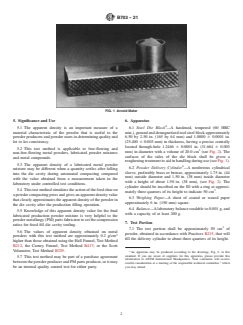
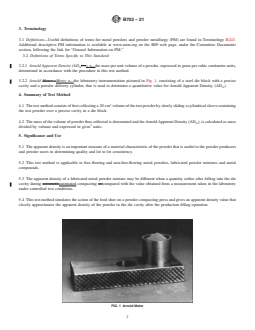
3.2.2 Arnold Meter—Meter, n—the laboratory instrumentation pictured in Fig. 1, consisting of a steel die block with a precise
cavity and a powder delivery cylinder, that is used to determine a quantitative value for Arnold Apparent Density, (AD ).
A
4. Summary of Test Method
4.1 The test method consists of first collecting a 20 cm volume of the test powder by slowly sliding a cylindrical sleeve containing
the test powder over a precise cavity in a die block.
4.2 The mass of the volume of powder thus collected is determined and the Arnold Apparent Density (AD ), is calculated as mass
A
divided by volume and expressed in g/cm units.
5. Significance and Use
5.1 The apparent density is an important measure of a material characteristic of the powder that is useful to the powder producers
and powder users in determining quality and lot to lot consistency.
5.2 This test method is applicable to free-flowing and non-free-flowing metal powders, lubricated powder mixtures and metal
compounds.
5.3 The apparent density of a lubricated metal powder mixture may be different when a quantity settles after falling into the die
cavity during automaticautomated compacting as compared with the value obtained from a measurement taken in the laboratory
under controlled test conditions.
5.4 This test method simulates the action of the feed shoe on a powder compacting press and gives an apparent density value that
closely approximates the apparent density of the powder in the die cavity after the production filling operation.
FIG. 1 Arnold Meter
B703 − 21
5.5 Knowledge of this apparent density value for the final lubricated production powder mixture is very helpful to the powder
metallurgy (PM) parts fabricator to set the compression ratios for fixed fill die cavity tooling.
5.6 The values of apparent density obtained on metal powders with this test method are approximately 0.2 g/cm higher than those
obtained using the Hall Funnel, Test Method B212, the Carney Funnel, Test Method B417; or the Scott Volumeter, Test Method
B329.
5.7 This test method may be part of a purchase agreement between the powder supplierproducer and PM parts producer, or it may
be an internal quality control test for either party.
6. Apparatus
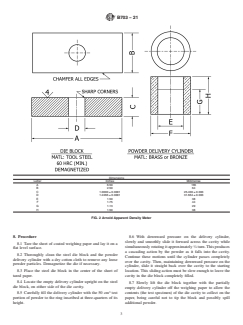
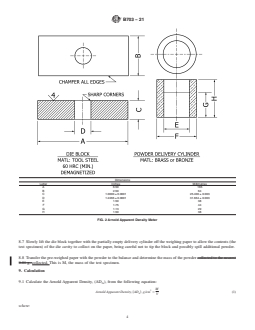
6.1 Steel Die Block —A hardened, tempered (60 HRC min.), ground and demagnetized tool steel block approximately 6.50 by
2.50 in. (165 by 64 mm) and 1.0000 6 0.0001 in. (25.400 6 0.003 mm) in thickness, having a precise centrally located
through-hole 1.2466 6 0.0001 in. (31.664 6 0.003 mm) in diameter with a volume of 20.0 cm (see Fig. 2). The surfaces of the
sides of the die block shall be given a roughening treatment to aid in handling during use (see Fig. 1).
6.2 Powder Delivery Cylinder —A nonferrous cylindrical sleeve, preferably brass or bronze, approximately 1.75 in. (44 mm)
outside diameter and 1.50 in. (38 mm) inside diameter with a height of about 1.50 in. (38 mm), (see Fig. 2). The cylinder should
be inscribed on the ID with a ring at approximately three quarters of its height to indicate 50 cm .
6.3 Weighing Paper—A sheet of coated or waxed paper approximately 6.06 in. (150 mm) square.
6.4 Balance—A laboratory balance readable to 0.001 g, and with a capacity of at least 200 g, to be used for determining the mass
of the test specimen to the nearest 0.01 g.
7. Test Portion
7.1 The test portion shall be approximately 50 cm of powder, obtained in accordance with Practices B215, that will fill the
delivery cylinder to about three quarters of its height.
8. Procedure
8.1 Tare the sheet of coated weighing paper and lay it on a flat level surface.
8.2 Thoroughly clean the steel die block and the powder delivery cylinder with a dry cotton cloth to remove any loose powder
particles. Demagnetize the die if necessary.
8.3 Place the steel die block in the center of the sheet of tared paper.
8.4 Locate the empty delivery cylinder upright on the steel die block, on either side of the die cavity.
8.5 Carefully fill the delivery cylinder with the 50 cm test portion of powder to the ring inscribed at three-quarters of its height.
8.6 With downward pressure on the delivery cylinder, slowly and smoothly slide it forward across the cavity while simultaneously
rotating i
...