

ASTM C1547-02(2022)
(Classification)Standard Classification for Fusion-Cast Refractory Blocks and Shapes
General Information
- Abstract
SIGNIFICANCE AND USE
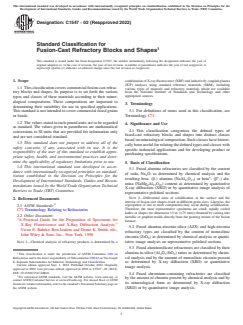
4.1 This classification categorizes the defined types of fused-cast refractory blocks and shapes into distinct classes based on mineralogical composition. Such classes have historically been useful for relating the defined types and classes with specific industrial applications and for developing product or purchasing specifications.
SCOPE
1.1 This classification covers commercial fusion-cast refractory blocks and shapes. Its purpose is to set forth the various types and classes of these materials according to their mineralogical compositions. These compositions are important to determining their suitability for use in specified applications. This standard is not intended to cover commercial fused grains or beads.
1.2 The values stated in inch-pound units are to be regarded as standard. The values given in parentheses are mathematical conversions to SI units that are provided for information only and are not considered standard.
1.3 This standard does not purport to address all of the safety concerns, if any, associated with its use. It is the responsibility of the user of this standard to establish appropriate safety, health, and environmental practices and determine the applicability of regulatory limitations prior to use.
1.4 This international standard was developed in accordance with internationally recognized principles on standardization established in the Decision on Principles for the Development of International Standards, Guides and Recommendations issued by the World Trade Organization Technical Barriers to Trade (TBT) Committee.
- Status
- Published
- Publication Date
- 31-Aug-2022
- Technical Committee
- C08 - Refractories


Overview
ASTM C1547-02(2022) is the internationally recognized standard for the classification of fusion-cast refractory blocks and shapes. Developed by ASTM International, this standard provides a systematic classification based on the mineralogical composition of commercial fusion-cast refractories, which are essential materials in high-temperature industrial applications. The classification aids manufacturers, purchasers, and end-users in selecting the right fusion-cast refractory products tailored to specific process and operational requirements.
Key Topics
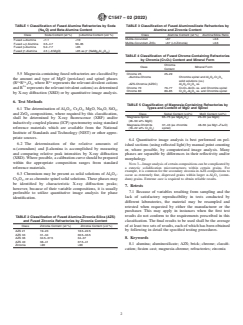
- Mineralogical Classification: Fusion-cast refractory blocks and shapes are categorized into classes based on their mineralogical makeup. Key groups include fused alumina, alumina-zirconia-silica (AZS), aluminosilicate, magnesia-containing, and chromium-containing refractories.
- Testing and Analysis: The standard prescribes recognized test methods such as X-ray fluorescence (XRF), inductively coupled plasma (ICP) spectrometry, and X-ray diffraction (XRD) for determining the mineral content and phase distribution in refractory materials.
- Specification Development: By providing clear definitions and classes, ASTM C1547 is instrumental in drafting precise material specifications and purchasing requirements.
- Industrial Relevance: The standard's classification system reflects industry best practices, providing direct links between material composition, product classes, and intended industrial uses.
Applications
The classification system outlined in ASTM C1547 is used widely across industries requiring high-performance refractory solutions, including:
- Glass Manufacturing: Selection of AZS and high-zirconia blocks for furnace linings, where resistance to corrosion by molten glass and slag is critical.
- Steel and Metallurgical Processes: Use of magnesia-spinel or chrome-containing materials for equipment exposed to extreme thermal and chemical conditions.
- Ceramics and Petrochemical: Deployment of tailored fusion-cast blocks in kilns, gasifiers, and reactors, ensuring optimal performance and durability.
- Purchasing and Quality Assurance: The standard supports procurement professionals and quality engineers in specifying, purchasing, and verifying suitable refractories for specific applications.
Related Standards
To ensure comprehensive coverage of fusion-cast refractory properties and terminology, ASTM C1547 should be referenced alongside other relevant ASTM International standards, including:
- ASTM C71: Terminology Relating to Refractories, which defines key terms used in classification and product specification.
- Test Methods: Procedures outlined for chemical and structural analysis, such as XRF and XRD, ensure reliable material characterization.
- International Standards: The standard is aligned with World Trade Organization (WTO) principles on the development of international standards, supporting global trade and regulatory compliance.
Practical Value
Adopting ASTM C1547 delivers critical benefits in the selection and use of fusion-cast refractories:
- Consistency in Specification: Clear classes and types support standardized procurement and reduce ambiguity in material selection.
- Quality and Performance Assurance: Material composition is directly linked to in-service performance, ensuring safety and reliability in high-temperature operations.
- Industry Confidence: Stakeholders gain assurance from internationally recognized classification and analysis methods.
- Efficient Communication: Shared terminology and reference points streamline collaboration across engineering, procurement, and manufacturing teams.
By adhering to ASTM C1547-02(2022), organizations enhance their ability to select, specify, and apply fusion-cast refractory blocks and shapes with confidence and precision.
Relations
- Effective Date
- 01-Oct-2018
- Effective Date
- 01-Apr-2012
- Effective Date
- 01-Apr-2008
- Effective Date
- 15-Dec-2007
- Effective Date
- 10-Dec-2001
- Effective Date
- 10-Dec-2001
- Effective Date
- 10-Dec-2001
- Effective Date
- 10-Dec-2001
Frequently Asked Questions
ASTM C1547-02(2022) is a standard published by ASTM International. Its full title is "Standard Classification for Fusion-Cast Refractory Blocks and Shapes". This standard covers: SIGNIFICANCE AND USE 4.1 This classification categorizes the defined types of fused-cast refractory blocks and shapes into distinct classes based on mineralogical composition. Such classes have historically been useful for relating the defined types and classes with specific industrial applications and for developing product or purchasing specifications. SCOPE 1.1 This classification covers commercial fusion-cast refractory blocks and shapes. Its purpose is to set forth the various types and classes of these materials according to their mineralogical compositions. These compositions are important to determining their suitability for use in specified applications. This standard is not intended to cover commercial fused grains or beads. 1.2 The values stated in inch-pound units are to be regarded as standard. The values given in parentheses are mathematical conversions to SI units that are provided for information only and are not considered standard. 1.3 This standard does not purport to address all of the safety concerns, if any, associated with its use. It is the responsibility of the user of this standard to establish appropriate safety, health, and environmental practices and determine the applicability of regulatory limitations prior to use. 1.4 This international standard was developed in accordance with internationally recognized principles on standardization established in the Decision on Principles for the Development of International Standards, Guides and Recommendations issued by the World Trade Organization Technical Barriers to Trade (TBT) Committee.
SIGNIFICANCE AND USE 4.1 This classification categorizes the defined types of fused-cast refractory blocks and shapes into distinct classes based on mineralogical composition. Such classes have historically been useful for relating the defined types and classes with specific industrial applications and for developing product or purchasing specifications. SCOPE 1.1 This classification covers commercial fusion-cast refractory blocks and shapes. Its purpose is to set forth the various types and classes of these materials according to their mineralogical compositions. These compositions are important to determining their suitability for use in specified applications. This standard is not intended to cover commercial fused grains or beads. 1.2 The values stated in inch-pound units are to be regarded as standard. The values given in parentheses are mathematical conversions to SI units that are provided for information only and are not considered standard. 1.3 This standard does not purport to address all of the safety concerns, if any, associated with its use. It is the responsibility of the user of this standard to establish appropriate safety, health, and environmental practices and determine the applicability of regulatory limitations prior to use. 1.4 This international standard was developed in accordance with internationally recognized principles on standardization established in the Decision on Principles for the Development of International Standards, Guides and Recommendations issued by the World Trade Organization Technical Barriers to Trade (TBT) Committee.
ASTM C1547-02(2022) is classified under the following ICS (International Classification for Standards) categories: 81.080 - Refractories. The ICS classification helps identify the subject area and facilitates finding related standards.
ASTM C1547-02(2022) has the following relationships with other standards: It is inter standard links to ASTM C71-12(2018), ASTM C71-12, ASTM C71-08, ASTM C71-07, ASTM C71-00, ASTM C71-00a, ASTM C71-01, ASTM C71-01a. Understanding these relationships helps ensure you are using the most current and applicable version of the standard.
ASTM C1547-02(2022) is available in PDF format for immediate download after purchase. The document can be added to your cart and obtained through the secure checkout process. Digital delivery ensures instant access to the complete standard document.
Standards Content (Sample)
This international standard was developed in accordance with internationally recognized principles on standardization established in the Decision on Principles for the
Development of International Standards, Guides and Recommendations issued by the World Trade Organization Technical Barriers to Trade (TBT) Committee.
Designation:C1547 −02 (Reapproved 2022)
Standard Classification for
Fusion-Cast Refractory Blocks and Shapes
This standard is issued under the fixed designation C1547; the number immediately following the designation indicates the year of
original adoption or, in the case of revision, the year of last revision. A number in parentheses indicates the year of last reapproval. A
superscript epsilon (´) indicates an editorial change since the last revision or reapproval.
combination of X-ray fluorescence (XRF) and inductively coupled plasma
1. Scope
(ICP) analyses using standard reference materials (SRM), including
1.1 Thisclassificationcoverscommercialfusion-castrefrac-
various types of minerals and refractory materials which are available
tory blocks and shapes. Its purpose is to set forth the various from the National Institute of Standards and Technology and other
appropriate sources.
types and classes of these materials according to their miner-
alogical compositions. These compositions are important to
3. Terminology
determining their suitability for use in specified applications.
3.1 For definitions of terms used in this classification, see
This standard is not intended to cover commercial fused grains
Terminology C71.
or beads.
1.2 The values stated in inch-pound units are to be regarded
4. Significance and Use
as standard. The values given in parentheses are mathematical
4.1 This classification categorizes the defined types of
conversions to SI units that are provided for information only
fused-cast refractory blocks and shapes into distinct classes
and are not considered standard.
basedonmineralogicalcomposition.Suchclasseshavehistori-
1.3 This standard does not purport to address all of the
cally been useful for relating the defined types and classes with
safety concerns, if any, associated with its use. It is the
specific industrial applications and for developing product or
responsibility of the user of this standard to establish appro-
purchasing specifications.
priate safety, health, and environmental practices and deter-
mine the applicability of regulatory limitations prior to use.
5. Basis of Classification
1.4 This international standard was developed in accor-
5.1 Fused alumina refractories are classified by the content
dance with internationally recognized principles on standard-
of soda, Na O, as determined by chemical analysis and the
ization established in the Decision on Principles for the
resulting beta- (β-) alumina (NaAl O ) or beta"-(β"-) alu-
11 17
Development of International Standards, Guides and Recom-
mina (NaMg Al O ) content as determined by quantitative
2 15 25
mendations issued by the World Trade Organization Technical
X-ray diffraction (XRD) or by quantitative image analysis of
Barriers to Trade (TBT) Committee.
representative polished sections.
NOTE 2—Differential rates of solidification at the surface and the
2. Referenced Documents
interior of fusion-cast shapes result in different grain sizes. Likewise, the
2.1 ASTM Standards: segregation of one or more components may occur during solidification.
Therefore, the most representative specimens are small, rapidly cooled
C71 Terminology Relating to Refractories
ladles or shapes (no dimension >3 in. (>75 mm)) obtained by casting into
2.2 Other Document:
metallic or graphite molds directly from the pouring stream of the fusion
“A Practical Guide for the Preparation of Specimens for
furnace.
X-Ray Fluorescence and X-Ray Diffraction Analysis,”
5.2 Fused alumina-zirconia-silica (AZS) and high-zirconia
Victor E. Buhrke, Ron Jenkins and Deane K. Smith, eds.,
refractory types are classified by the content of monoclinic
John Wiley & Sons, Inc., New York, 1998
zirconia (ZrO ) as determined by chemical analysis or quanti-
NOTE 1—Chemical analysis of refractory products is determined by a tative image analysis on representative polished sections.
5.3 Fused aluminosilicate refractories are classified by their
alumina-to-silica (Al O :SiO ) ratios as determined by chemi-
2 3 2
This classification is under the jurisdiction of ASTM Committee C08 on
cal analysis and by the amount of monoclinic zirconia present
Refractories and is the direct responsibility of Subcommittee C08.92 on The Joseph
E. Kopanda Subcommittee for Editorial, Terminology and Classification.
as determined by X-ray diffraction (XRD) or quantitative
Current edition approved Sept. 1, 2022. Published October 2022. Originally
image analysis.
approved in 2002. Last previous edition approved in 2018 as C1547 – 02 (2018).
DOI: 10.1520/C1547-02R22.
5.4 Fused chromium-containing refractories are classified
For referenced ASTM standards, visit the ASTM website, www.astm.org, or
by the amount of chromia present by chemical analysis and by
contact ASTM Customer Service at service@astm.org. For Annual Book of ASTM
its mineralogical form as determined by X-ray diffraction
Standards volume information, refer to the standard’s Document Summary page on
the ASTM website. (XRD) or by quantitative image analysis.
Copyright © ASTM International, 100 Barr Harbor Drive, PO Box C700, West Conshohocken, PA 19428-2959. United States
C1547−02 (2022)
TABLE 1 Classification of Fused Alumina Refractories by Soda TABLE 3 Classification of Fused Aluminosi
...