

ASTM B593-21
(Test Method)Standard Test Method for Bending Fatigue Testing for Copper-Alloy Spring Materials
General Information
- Abstract
SIGNIFICANCE AND USE
5.1 The bending fatigue test described in this test method provides information on the ability of a copper alloy flat sheet and strip of spring material to resist the development of cracks or general mechanical deterioration as a result of a relatively large number of cycles (generally in the range 105 to 108) under conditions of constant displacement.
5.2 This test method is primarily a research and development tool which may be used to determine the effect of variations in materials on fatigue strength and also to provide data for use in selecting copper alloy spring materials for service under conditions of repeated strain cycling.
5.3 The results are suitable for direct application in design only when all design factors such as loading, geometry of part, frequency of straining, and environmental conditions are known. The test method is generally unsuitable for an inspection test or a quality control test due to the amount of time and effort required to collect the data.
SCOPE
1.1 This test method establishes the requirements for the determination of the reversed or repeated bending fatigue properties of copper alloy flat sheet or strip of spring materials by fixed cantilever, constant deflection (that is, constant amplitude of displacement)-type testing machines. This method is limited to flat sheet or strip ranging in thickness from 0.005 in. to 0.062 in. (0.13 mm to 1.57 mm), to a fatigue life range of 105 to 108 cycles, and to conditions where no significant change in stress-strain relations occurs during the test.
Note 1: This implies that the load-deflection characteristics of the material do not change as a function of the number of cycles within the precision of measurement. There is no significant cyclic hardening or softening.
1.2 Units—The values stated in inch-pound units are to be regarded as standard. The values given in parentheses are mathematical conversions to SI units that are provided for information only and are not considered standard.
1.3 The following safety hazard caveat pertains only to the test methods(s) described in this test method.
1.3.1 This standard does not purport to address all of the safety concerns, if any, associated with its use. It is the responsibility of the user of this standard to establish appropriate safety, health, and environmental practices and determine the applicability of regulatory limitations prior to use.
1.4 This international standard was developed in accordance with internationally recognized principles on standardization established in the Decision on Principles for the Development of International Standards, Guides and Recommendations issued by the World Trade Organization Technical Barriers to Trade (TBT) Committee.
- Status
- Published
- Publication Date
- 31-Dec-2020
- Technical Committee
- B05 - Copper and Copper Alloys
- Drafting Committee
- B05.06 - Methods of Test
Buy Documents
ASTM B593-21 - Standard Test Method for Bending Fatigue Testing for Copper-Alloy Spring Materials
REDLINE ASTM B593-21 - Standard Test Method for Bending Fatigue Testing for Copper-Alloy Spring Materials
Overview
ASTM B593-21: Standard Test Method for Bending Fatigue Testing for Copper-Alloy Spring Materials provides a comprehensive methodology for evaluating the bending fatigue properties of copper alloy flat sheet and strip materials used in spring applications. Developed by ASTM International, this standard defines requirements for determining the reversed or repeated bending fatigue characteristics through fixed cantilever, constant deflection-type testing. The method is crucial for research and development, allowing manufacturers and engineers to assess a material’s resistance to crack formation or mechanical deterioration over extended cycles - typically ranging from 100,000 to 100 million cycles.
Key Topics
- Bending Fatigue Testing: Specifies procedures for subjecting copper alloy specimens to repeated cyclic bending until failure, simulating real-world service conditions with constant amplitude of displacement.
- Sample Preparation: Includes guidelines for preparing test specimens using conventional machining or photochemical machining, with attention to avoid work hardening or introducing surface defects.
- Material Thickness Range: Applicable to flat sheet or strip thicknesses from 0.005 in. to 0.062 in. (0.13 mm to 1.57 mm), ensuring precise results within specified dimensions.
- Fatigue Life Measurement: Focuses on generating data about the number of cycles to failure under controlled displacement, underlining the importance of material selection for applications requiring cyclic durability.
- Calculation and Calibration: Offers direction for calculating maximum bending stress using established beam equations or finite element modeling, alongside instructions for machine calibration and strain measurement.
Applications
- Material Research and Development: Primarily used to assess how variations in copper alloy composition or processing methods affect fatigue strength, providing vital data for innovation and optimization.
- Design and Material Selection: Supports engineers in choosing appropriate copper-alloy spring materials for applications involving repeated strain cycling, such as electrical connectors, switches, or precision instrument components.
- Service Life Prediction: Generates data that may inform design decisions when all related factors-such as loading, geometry, strain frequency, and environment-are known, aiding in the accurate prediction of in-service durability.
- Not Intended for QC or Inspection: Due to the extensive effort and time required for fatigue data collection, this standard is generally unsuitable for routine inspection or quality control.
Related Standards
- ASTM B846: Terminology for Copper and Copper Alloys-provides vital definitions to support understanding and consistency in testing.
- ASTM B950: Guide for Editorial Procedures and Form of Product Specifications for Copper and Copper Alloys-ensures uniform documentation.
- ASTM E468: Practice for Presentation of Constant Amplitude Fatigue Test Results for Metallic Materials-aids in standardized reporting of fatigue data.
- ASTM E1823: Terminology Relating to Fatigue and Fracture Testing-offers critical definitions for interpreting fatigue and fracture results.
- ASTM STP 91A: Guide for Fatigue Testing and the Statistical Analysis of Fatigue Data-supplements statistical assessment and procedural guidance.
By following ASTM B593-21, material scientists, engineers, and designers have a reliable method to evaluate the durability of copper-alloy spring materials under cyclical loading. The data generated helps enhance material performance, inform product development, and ensure confidence in the selection of materials for high-cycle fatigue environments. For those involved in material science, metallurgy, or component design, understanding and applying this standard is essential for achieving optimal fatigue performance in copper-alloy springs.
Relations
- Effective Date
- 15-Feb-2024
- Effective Date
- 01-Feb-2024
- Effective Date
- 01-Feb-2020
- Effective Date
- 01-Aug-2019
- Effective Date
- 01-Jan-2019
- Effective Date
- 15-Dec-2012
- Effective Date
- 15-Nov-2012
- Effective Date
- 01-Sep-2012
- Effective Date
- 01-Aug-2012
- Effective Date
- 15-May-2012
- Effective Date
- 15-Mar-2012
- Effective Date
- 01-Oct-2011
- Effective Date
- 01-Jun-2011
- Effective Date
- 01-Jun-2011
- Effective Date
- 01-Jan-2011
Buy Documents
ASTM B593-21 - Standard Test Method for Bending Fatigue Testing for Copper-Alloy Spring Materials
REDLINE ASTM B593-21 - Standard Test Method for Bending Fatigue Testing for Copper-Alloy Spring Materials
Get Certified
Connect with accredited certification bodies for this standard

Element Materials Technology
Materials testing and product certification.

Inštitut za kovinske materiale in tehnologije
Institute of Metals and Technology. Materials testing, metallurgical analysis, NDT.
Sponsored listings
Frequently Asked Questions
ASTM B593-21 is a standard published by ASTM International. Its full title is "Standard Test Method for Bending Fatigue Testing for Copper-Alloy Spring Materials". This standard covers: SIGNIFICANCE AND USE 5.1 The bending fatigue test described in this test method provides information on the ability of a copper alloy flat sheet and strip of spring material to resist the development of cracks or general mechanical deterioration as a result of a relatively large number of cycles (generally in the range 105 to 108) under conditions of constant displacement. 5.2 This test method is primarily a research and development tool which may be used to determine the effect of variations in materials on fatigue strength and also to provide data for use in selecting copper alloy spring materials for service under conditions of repeated strain cycling. 5.3 The results are suitable for direct application in design only when all design factors such as loading, geometry of part, frequency of straining, and environmental conditions are known. The test method is generally unsuitable for an inspection test or a quality control test due to the amount of time and effort required to collect the data. SCOPE 1.1 This test method establishes the requirements for the determination of the reversed or repeated bending fatigue properties of copper alloy flat sheet or strip of spring materials by fixed cantilever, constant deflection (that is, constant amplitude of displacement)-type testing machines. This method is limited to flat sheet or strip ranging in thickness from 0.005 in. to 0.062 in. (0.13 mm to 1.57 mm), to a fatigue life range of 105 to 108 cycles, and to conditions where no significant change in stress-strain relations occurs during the test. Note 1: This implies that the load-deflection characteristics of the material do not change as a function of the number of cycles within the precision of measurement. There is no significant cyclic hardening or softening. 1.2 Units—The values stated in inch-pound units are to be regarded as standard. The values given in parentheses are mathematical conversions to SI units that are provided for information only and are not considered standard. 1.3 The following safety hazard caveat pertains only to the test methods(s) described in this test method. 1.3.1 This standard does not purport to address all of the safety concerns, if any, associated with its use. It is the responsibility of the user of this standard to establish appropriate safety, health, and environmental practices and determine the applicability of regulatory limitations prior to use. 1.4 This international standard was developed in accordance with internationally recognized principles on standardization established in the Decision on Principles for the Development of International Standards, Guides and Recommendations issued by the World Trade Organization Technical Barriers to Trade (TBT) Committee.
SIGNIFICANCE AND USE 5.1 The bending fatigue test described in this test method provides information on the ability of a copper alloy flat sheet and strip of spring material to resist the development of cracks or general mechanical deterioration as a result of a relatively large number of cycles (generally in the range 105 to 108) under conditions of constant displacement. 5.2 This test method is primarily a research and development tool which may be used to determine the effect of variations in materials on fatigue strength and also to provide data for use in selecting copper alloy spring materials for service under conditions of repeated strain cycling. 5.3 The results are suitable for direct application in design only when all design factors such as loading, geometry of part, frequency of straining, and environmental conditions are known. The test method is generally unsuitable for an inspection test or a quality control test due to the amount of time and effort required to collect the data. SCOPE 1.1 This test method establishes the requirements for the determination of the reversed or repeated bending fatigue properties of copper alloy flat sheet or strip of spring materials by fixed cantilever, constant deflection (that is, constant amplitude of displacement)-type testing machines. This method is limited to flat sheet or strip ranging in thickness from 0.005 in. to 0.062 in. (0.13 mm to 1.57 mm), to a fatigue life range of 105 to 108 cycles, and to conditions where no significant change in stress-strain relations occurs during the test. Note 1: This implies that the load-deflection characteristics of the material do not change as a function of the number of cycles within the precision of measurement. There is no significant cyclic hardening or softening. 1.2 Units—The values stated in inch-pound units are to be regarded as standard. The values given in parentheses are mathematical conversions to SI units that are provided for information only and are not considered standard. 1.3 The following safety hazard caveat pertains only to the test methods(s) described in this test method. 1.3.1 This standard does not purport to address all of the safety concerns, if any, associated with its use. It is the responsibility of the user of this standard to establish appropriate safety, health, and environmental practices and determine the applicability of regulatory limitations prior to use. 1.4 This international standard was developed in accordance with internationally recognized principles on standardization established in the Decision on Principles for the Development of International Standards, Guides and Recommendations issued by the World Trade Organization Technical Barriers to Trade (TBT) Committee.
ASTM B593-21 is classified under the following ICS (International Classification for Standards) categories: 77.150.30 - Copper products. The ICS classification helps identify the subject area and facilitates finding related standards.
ASTM B593-21 has the following relationships with other standards: It is inter standard links to ASTM E1823-24a, ASTM E1823-24, ASTM E1823-20, ASTM B846-19a, ASTM B846-19, ASTM E1823-12e, ASTM E1823-12d, ASTM E1823-12c, ASTM E1823-12b, ASTM E1823-12a, ASTM E1823-12, ASTM E468-11, ASTM E1823-11, ASTM B846-11a, ASTM B846-11. Understanding these relationships helps ensure you are using the most current and applicable version of the standard.
ASTM B593-21 is available in PDF format for immediate download after purchase. The document can be added to your cart and obtained through the secure checkout process. Digital delivery ensures instant access to the complete standard document.
Standards Content (Sample)
This international standard was developed in accordance with internationally recognized principles on standardization established in the Decision on Principles for the
Development of International Standards, Guides and Recommendations issued by the World Trade Organization Technical Barriers to Trade (TBT) Committee.
Designation: B593 − 21
Standard Test Method for
Bending Fatigue Testing for Copper-Alloy Spring Materials
This standard is issued under the fixed designation B593; the number immediately following the designation indicates the year of
original adoption or, in the case of revision, the year of last revision.Anumber in parentheses indicates the year of last reapproval.A
superscript epsilon (´) indicates an editorial change since the last revision or reapproval.
This standard has been approved for use by agencies of the U.S. Department of Defense.
1. Scope* 2. Referenced Documents
1.1 This test method establishes the requirements for the 2.1 ASTM Standards:
determination of the reversed or repeated bending fatigue B846Terminology for Copper and Copper Alloys
properties of copper alloy flat sheet or strip of spring materials E468Practice for Presentation of Constant Amplitude Fa-
by fixed cantilever, constant deflection (that is, constant am- tigue Test Results for Metallic Materials
plitudeofdisplacement)-typetestingmachines.Thismethodis E1823TerminologyRelatingtoFatigueandFractureTesting
limited to flat sheet or strip ranging in thickness from 0.005 in. 2.2 Other ASTM Document:
to0.062in.(0.13mmto1.57mm),toafatigueliferangeof10 ASTM STP 91AA Guide for Fatigue Testing and the
to 10 cycles, and to conditions where no significant change in Statistical Analysis of Fatigue Data
stress-strain relations occurs during the test.
3. Terminology
NOTE 1—This implies that the load-deflection characteristics of the
3.1 For definition of terms relating to this test method, refer
material do not change as a function of the number of cycles within the
to Terminology E1823 and Practice E468.
precision of measurement. There is no significant cyclic hardening or
softening.
3.2 For definitions of terms related to copper and copper
1.2 Units—The values stated in inch-pound units are to be
alloys, refer to Terminology B846.
regarded as standard. The values given in parentheses are
4. Summary of Test Method
mathematical conversions to SI units that are provided for
information only and are not considered standard.
4.1 A prepared test specimen of a specific wrought copper
alloy flat sheet or strip of spring material is mounted into a
1.3 The following safety hazard caveat pertains only to the
fixed cantilever, constant-deflection type fatigue testing ma-
test methods(s) described in this test method.
chine. The specimen is held at one end, acting as a cantilever
1.3.1 This standard does not purport to address all of the
beam, and cycled by flexure followed by reverse flexure until
safety concerns, if any, associated with its use. It is the
completefailure.Thenumberofcyclestofailureisrecordedas
responsibility of the user of this standard to establish appro-
a measure of fatigue life.
priate safety, health, and environmental practices and deter-
mine the applicability of regulatory limitations prior to use.
5. Significance and Use
1.4 This international standard was developed in accor-
5.1 The bending fatigue test described in this test method
dance with internationally recognized principles on standard-
provides information on the ability of a copper alloy flat sheet
ization established in the Decision on Principles for the
and strip of spring material to resist the development of cracks
Development of International Standards, Guides and Recom-
or general mechanical deterioration as a result of a relatively
mendations issued by the World Trade Organization Technical
5 8
largenumberofcycles(generallyintherange10 to10 )under
Barriers to Trade (TBT) Committee.
conditions of constant displacement.
1 2
This test method is under the jurisdiction ofASTM Committee B05 on Copper For referenced ASTM standards, visit the ASTM website, www.astm.org, or
and Copper Alloys and is the direct responsibility of Subcommittee B05.06 on contact ASTM Customer Service at service@astm.org. For Annual Book of ASTM
Methods of Test. Standards volume information, refer to the standard’s Document Summary page on
Current edition approved Jan. 1, 2021. Published January 2021. Originally the ASTM website.
approved in 1973. Last previous edition approved in 2020 as B593–20. DOI: For referenced ASTM documents, visit the ASTM website, www.astm.org, or
10.1520/B0593-21. contact ASTM Customer Service at service@astm.org.
*A Summary of Changes section appears at the end of this standard
Copyright © ASTM International, 100 Barr Harbor Drive, PO Box C700, West Conshohocken, PA 19428-2959. United States
B593 − 21
5.2 This test method is primarily a research and develop- 7. Test Specimen
ment tool which may be used to determine the effect of
7.1 The test specimen shall be of the fixed-cantilever type.
variations in materials on fatigue strength and also to provide
Examples of specimens that are typically used are shown in
data for use in selecting copper alloy spring materials for
Fig. 2.
service under conditions of repeated strain cycling.
7.2 It is important, therefore, that care be exercised in the
preparation of test specimens, particularly in minimizing ef-
5.3 The results are suitable for direct application in design
fects such as work hardening or induced stress. Conventional
onlywhenalldesignfactorssuchasloading,geometryofpart,
milling, blanking, or photochemical machining can be used to
frequency of straining, and environmental conditions are
ensuregoodworkmanship.Improperlypreparedtestspecimens
known. The test method is generally unsuitable for an inspec-
cause unsatisfactory test results.
tion test or a quality control test due to the amount of time and
7.2.1 Milled specimens are best machined by cross milling
effort required to collect the data.
a stack, approximately 0.75 in. (19.05 mm) thick, including
back-up plates, for which 0.12 in. (3.05 mm) thick brass sheet
6. Apparatus
stock may be used.
6.1 Testing Machine—The fatigue testing machine is a
7.2.1.1 It is necessary to ensure that any cutting or machin-
fixed-cantilever, constant-deflection type machine. In this ma-
ing operation required to either rough cut the test specimen
chine (Fig. 1) the test specimen shall be held as a cantilever
from the blank, or to machine it to size does not appreciably
beam in a clamp at one end and deflected by a concentrated alter the metallurgical structure or properties of the material.
load applied near the other end of the apex of the tapered
All cuts taken in machining should be such as to minimize
section (Fig. 2). Either the clamp or the loading member may work hardening of the test specimen.
be adjusted so that the deflection of the free end of the 7.2.1.2 Inselectingcuttingspeedsandfeedrates,dueregard
cantilever is either completely reversed (mean displacement should be paid to the test specimen material, and for finishing
equal to zero) or greater in one direction of bending (mean cuts, to the quality of the surface finish required.
displacement not equal to zero).
NOTE 2—It is not practicable to recommend a single procedure for
feeds, speeds, and depth of cut, since this will vary with the material
6.2 Asuitable counter and monitoring circuit is required to
tested. The procedure used, however, should be noted in reporting test
provide a direct readout of the number of cycles to complete
results, since differences in procedure may produce variability in test
failure (that is, separation into two pieces). results among different laboratories.
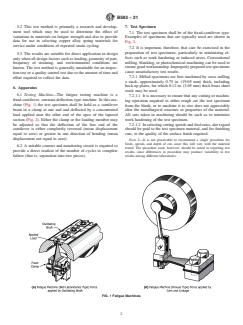
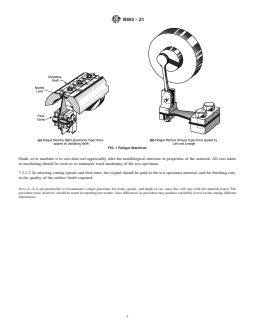
FIG. 1 Fatigue Machines
B593 − 21
NOTE 1—All dimensions are in inches: in.×25.4=mm.
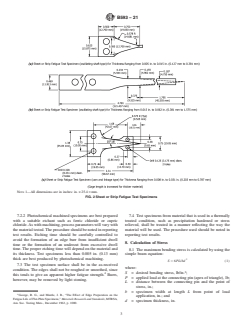
FIG. 2 Sheet or Strip Fatigue Test Sp
...
This document is not an ASTM standard and is intended only to provide the user of an ASTM standard an indication of what changes have been made to the previous version. Because
it may not be technically possible to adequately depict all changes accurately, ASTM recommends that users consult prior editions as appropriate. In all cases only the current version
of the standard as published by ASTM is to be considered the official document.
Designation: B593 − 20 B593 − 21
Standard Test Method for
Bending Fatigue Testing for Copper-Alloy Spring Materials
This standard is issued under the fixed designation B593; the number immediately following the designation indicates the year of
original adoption or, in the case of revision, the year of last revision. A number in parentheses indicates the year of last reapproval. A
superscript epsilon (´) indicates an editorial change since the last revision or reapproval.
This standard has been approved for use by agencies of the U.S. Department of Defense.
1. Scope*
1.1 This test method establishes the requirements for the determination of the reversed or repeated bending fatigue properties of
copper alloy flat sheet,sheet or strip of spring materials by fixed cantilever, constant deflection (that is, constant amplitude of
displacement)-type testing machines. This method is limited to flat sheet or strip ranging in thickness from 0.005 in. to 0.062 in.
5 8
(0.13 mm to 1.57 mm), to a fatigue life range of 10 to 10 cycles, and to conditions where no significant change in stress-strain
relations occurs during the test.
NOTE 1—This implies that the load-deflection characteristics of the material do not change as a function of the number of cycles within the precision of
measurement. There is no significant cyclic hardening or softening.
1.2 Units—The values stated in inch-pound units are to be regarded as standard. The values given in parentheses are mathematical
conversions to SI units that are provided for information only and are not considered standard.
1.3 The following safety hazard caveat pertains only to the test methods(s) described in this test method.
1.3.1 This standard does not purport to address all of the safety concerns, if any, associated with its use. It is the responsibility
of the user of this standard to establish appropriate safety, health, and environmental practices and determine the applicability of
regulatory limitations prior to use.
1.4 This international standard was developed in accordance with internationally recognized principles on standardization
established in the Decision on Principles for the Development of International Standards, Guides and Recommendations issued
by the World Trade Organization Technical Barriers to Trade (TBT) Committee.
2. Referenced Documents
2.1 ASTM Standards:
B846 Terminology for Copper and Copper Alloys
B950 Guide for Editorial Procedures and Form of Product Specifications for Copper and Copper Alloys
E468 Practice for Presentation of Constant Amplitude Fatigue Test Results for Metallic Materials
E1823 Terminology Relating to Fatigue and Fracture Testing
This test method is under the jurisdiction of ASTM Committee B05 on Copper and Copper Alloys and is the direct responsibility of Subcommittee B05.06 on Methods
of Test.
Current edition approved April 1, 2020Jan. 1, 2021. Published April 2020January 2021. Originally approved in 1973. Last previous edition approved in 20142020 as
ε1
B593–96 (2014)–20. . DOI: 10.1520/B0593–20.10.1520/B0593-21.
For referenced ASTM standards, visit the ASTM website, www.astm.org, or contact ASTM Customer Service at service@astm.org. For Annual Book of ASTM Standards
volume information, refer to the standard’s Document Summary page on the ASTM website.
*A Summary of Changes section appears at the end of this standard
Copyright © ASTM International, 100 Barr Harbor Drive, PO Box C700, West Conshohocken, PA 19428-2959. United States
B593 − 21
2.2 Other ASTM Document:
ASTM STP 91-A91A A Guide for Fatigue Testing and the Statistical Analysis of Fatigue Data
3. Terminology
3.1 For definition of terms relating to this test method, refer to Terminology E1823 and Practice E468.
3.2 For definitions of terms related to copper and copper alloys, refer to Terminology B846.
4. Summary of Test Method
4.1 A prepared test specimen of a specific wrought copper alloy flat sheet or strip of spring material is mounted into a fixed
cantilever, constant-deflection type fatigue testing machine. The specimen is held at one end, acting as a cantilever beam, and
cycled by flexure followed by reverse flexure until complete failure. The number of cycles to failure is recorded as a measure of
fatigue life.
5. Significance and Use
5.1 The bending fatigue test described in this test method provides information on the ability of a copper alloy flat sheet and strip
of spring material to resist the development of cracks or general mechanical deterioration as a result of a relatively large number
5 8
of cycles (generally in the range 10 to 10 ) under conditions of constant displacement.
5.2 This test method is primarily a research and development tool which may be used to determine the effect of variations in
materials on fatigue strength and also to provide data for use in selecting copper alloy spring materials for service under conditions
of repeated strain cycling.
5.3 The results are suitable for direct application in design only when all design factors such as loading, geometry of part,
frequency of straining, and environmental conditions are known. The test method is generally unsuitable for an inspection test or
a quality control test due to the amount of time and effort required to collect the data.
6. Apparatus
6.1 Testing Machine—The fatigue testing machine is a fixed-cantilever, constant-deflection type machine. In this machine (Fig. 1)
the test specimen shall be held as a cantilever beam in a clamp at one end and deflected by a concentrated load applied near the
other end of the apex of the tapered section (Fig. 2). Either the clamp or the loading member may be adjusted so that the deflection
of the free end of the cantilever is either completely reversed (mean displacement equal to zero) or greater in one direction of
bending (mean displacement not equal to zero).
6.2 A suitable counter and monitoring circuit is required to provide a direct readout of the number of cycles to complete failure;
thatfailure (that is, separation into two pieces.pieces).
7. Test Specimen
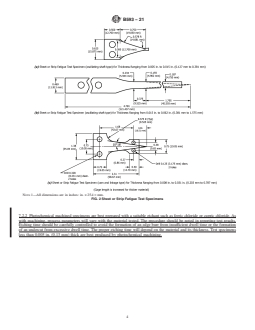
7.1 The test specimen shall be of the fixed-cantilever type. Examples of specimens that are typically used are shown in Fig. 2.
7.2 It is important, therefore, that care be exercised in the preparation of test specimens, particularly in machining, to
assureminimizing effects such as work hardening or induced stress. Conventional milling, blanking, or photochemical machining
can be used to ensure good workmanship. Improperly prepared test specimens cause unsatisfactory test results.
7.2.1 TheMilled specimens are best preparedmachined by cross milling a stack, approximately 0.75 in. (19.05 mm) thick,
including back-up plates, for which 0.12 in. (3.05 mm) thick brass sheet stock may be used.
7.2.1.1 It is necessary to ensure that any cutting or machining operation required to either rough cut the test specimen from the
For referenced ASTM documents, visit the ASTM website, www.astm.org, or contact ASTM Customer Service at service@astm.org.
B593 − 21
FIG. 1 Fatigue Machines
blank, or to machine it to size does not appreciably alter the metallurgical structure or properties of the material. All cuts taken
in machining should be such as to minimize work hardening of the test specimen.
7.2.1.2 In selecting cutting speeds and feed rates, due regard should be paid to the test specimen material, and for finishing cuts,
to the quality of the surface finish required.
NOTE 2—It is not practicable to recommend a single procedure for feeds, speeds, and depth of cut, since this will vary with the material tested. The
procedure used, however, should be noted in reporting test results, since differences in procedure may produce variability in test results among different
laboratories.
B593 − 21
NOTE 1—All dimensions are in inches: in. × 25.4 = mm.
FIG. 2 Sheet or Strip Fatigue Test Specimens
7.2.2 Ph
...