

ASTM B944-22
(Specification)Standard Specification for Copper-Beryllium Welded Heat Exchanger and Condenser Tube (UNS No. C17510)
General Information
- Abstract
SCOPE
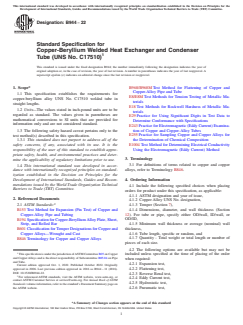
1.1 This specification establishes the requirements for copper-beryllium alloy UNS No. C17510 welded tube in straight lengths.
1.2 Units—The values stated in inch-pound units are to be regarded as standard. The values given in parentheses are mathematical conversions to SI units that are provided for information only and are not considered standard.
1.3 The following safety hazard caveat pertains only to the test method(s) described in this specification.
1.3.1 This standard does not purport to address all of the safety concerns, if any, associated with its use. It is the responsibility of the user of this standard to establish appropriate safety, health, and environmental practices and determine the applicability of regulatory limitations prior to use.
1.4 This international standard was developed in accordance with internationally recognized principles on standardization established in the Decision on Principles for the Development of International Standards, Guides and Recommendations issued by the World Trade Organization Technical Barriers to Trade (TBT) Committee.
- Status
- Published
- Publication Date
- 30-Sep-2022
- Technical Committee
- B05 - Copper and Copper Alloys
- Drafting Committee
- B05.04 - Pipe and Tube
Buy Documents
ASTM B944-22 - Standard Specification for Copper-Beryllium Welded Heat Exchanger and Condenser Tube (UNS No. C17510)
REDLINE ASTM B944-22 - Standard Specification for Copper-Beryllium Welded Heat Exchanger and Condenser Tube (UNS No. C17510)
Overview
ASTM B944-22 is the established international standard that specifies requirements for copper-beryllium alloy welded tube (UNS C17510) used in heat exchanger and condenser applications. Developed and maintained by ASTM International, this specification covers the material, manufacturing, mechanical properties, dimensions, testing procedures, and quality assurance needed to ensure reliable performance of welded copper-beryllium tubes in demanding industrial settings.
These tubes are supplied in straight lengths, offering enhanced strength, thermal conductivity, and corrosion resistance. ASTM B944-22 is critical for manufacturers, engineers, and procurement specialists involved in the design, fabrication, and maintenance of heat exchangers and condensers, especially in sectors like HVAC, power generation, chemical processing, and marine environments.
Key Topics
- Material Requirements: Tubes must be made from cold-rolled strip of copper-beryllium alloy UNS C17510, ensuring high purity and quality suitable for welding and forming.
- Mechanical and Physical Properties: The standard prescribes minimum tensile strength, yield strength, elongation, Rockwell hardness, and electrical conductivity requirements after precipitation heat treatment.
- Dimensional Tolerances: Precise tolerances are set for wall thickness, outside diameter, length, and straightness to ensure compatibility with demanding engineering applications.
- Testing and Inspection: Comprehensive performance tests are required, including expansion, flattening, reverse bend, eddy current, hydrostatic, and pneumatic tests to confirm tube integrity, weld quality, and leak tightness.
- Chemical Composition: Defines the acceptable ranges for key alloying elements such as beryllium, nickel, cobalt, iron, aluminum, silicon, and copper content.
- Certification and Traceability: Provides guidance on certification, mill test reports, and marking for complete traceability and compliance.
Applications
ASTM B944-22 copper-beryllium welded tubes are primarily used in:
- Heat Exchangers: Highly suitable for industrial and commercial heat exchangers where efficient thermal conductivity and mechanical strength are required.
- Condensers: Used in power plants, HVAC systems, and refrigeration units due to their corrosion resistance and durability in fluid contact applications.
- Evaporators: Applied in energy and chemical processing systems where robust tube performance is essential for reliability and safety.
- Marine and Chemical Processing: Valuable in harsh environments such as shipboard installations or corrosive processing plants due to their resistance to pitting and stress corrosion cracking.
- Boiler and Pressure Vessels: Frequently specified when compliance with the ASME Boiler and Pressure Vessel Code is required.
These applications benefit from the precise mechanical properties, high electrical conductivity, and robust testing protocols set out in the ASTM B944-22 standard.
Related Standards
ASTM B944-22 references and aligns with several other ASTM and federal standards to ensure comprehensive coverage, quality control, and interoperability, including:
- ASTM B153: Expansion (Pin Test) for copper and copper-alloy tubing
- ASTM B194: Specification for copper-beryllium alloy plate, sheet, strip, and rolled bar
- ASTM B601: Classification for temper designations for copper and copper alloys
- ASTM B968/B968M: Flattening test for copper and copper-alloy pipe and tube
- ASTM E8/E8M: Test methods for tension testing of metallic materials
- ASTM E18: Test methods for Rockwell hardness of metallic materials
- ASTM E243: Practice for electromagnetic (eddy current) examination of copper and copper-alloy tubes
- ASTM E1004: Determining electrical conductivity by the electromagnetic (eddy current) method
For packaging and marking, federal standards such as Fed. Std. No. 185 and MIL-STD-129 may also apply, especially for government and military contracts.
Summary
By adhering to ASTM B944-22, producers and end-users of copper-beryllium welded heat exchanger and condenser tubes can be confident in consistent product quality, performance, and safety. This standard offers practical guidance, promotes industry best practices, and streamlines procurement for critical heat transfer components across a variety of industries.
Relations
- Effective Date
- 01-Jan-2024
- Effective Date
- 01-Dec-2023
- Effective Date
- 01-Aug-2019
- Effective Date
- 01-Jan-2019
- Effective Date
- 01-Oct-2018
- Effective Date
- 01-Jul-2018
- Effective Date
- 01-Jun-2018
- Effective Date
- 01-Mar-2018
- Effective Date
- 01-Jul-2017
- Effective Date
- 01-Jun-2017
- Effective Date
- 01-Oct-2016
- Effective Date
- 15-Jul-2016
- Effective Date
- 01-Feb-2015
- Effective Date
- 01-Dec-2013
- Effective Date
- 01-Jun-2013
Buy Documents
ASTM B944-22 - Standard Specification for Copper-Beryllium Welded Heat Exchanger and Condenser Tube (UNS No. C17510)
REDLINE ASTM B944-22 - Standard Specification for Copper-Beryllium Welded Heat Exchanger and Condenser Tube (UNS No. C17510)
Get Certified
Connect with accredited certification bodies for this standard

Element Materials Technology
Materials testing and product certification.

Inštitut za kovinske materiale in tehnologije
Institute of Metals and Technology. Materials testing, metallurgical analysis, NDT.
Sponsored listings
Frequently Asked Questions
ASTM B944-22 is a technical specification published by ASTM International. Its full title is "Standard Specification for Copper-Beryllium Welded Heat Exchanger and Condenser Tube (UNS No. C17510)". This standard covers: SCOPE 1.1 This specification establishes the requirements for copper-beryllium alloy UNS No. C17510 welded tube in straight lengths. 1.2 Units—The values stated in inch-pound units are to be regarded as standard. The values given in parentheses are mathematical conversions to SI units that are provided for information only and are not considered standard. 1.3 The following safety hazard caveat pertains only to the test method(s) described in this specification. 1.3.1 This standard does not purport to address all of the safety concerns, if any, associated with its use. It is the responsibility of the user of this standard to establish appropriate safety, health, and environmental practices and determine the applicability of regulatory limitations prior to use. 1.4 This international standard was developed in accordance with internationally recognized principles on standardization established in the Decision on Principles for the Development of International Standards, Guides and Recommendations issued by the World Trade Organization Technical Barriers to Trade (TBT) Committee.
SCOPE 1.1 This specification establishes the requirements for copper-beryllium alloy UNS No. C17510 welded tube in straight lengths. 1.2 Units—The values stated in inch-pound units are to be regarded as standard. The values given in parentheses are mathematical conversions to SI units that are provided for information only and are not considered standard. 1.3 The following safety hazard caveat pertains only to the test method(s) described in this specification. 1.3.1 This standard does not purport to address all of the safety concerns, if any, associated with its use. It is the responsibility of the user of this standard to establish appropriate safety, health, and environmental practices and determine the applicability of regulatory limitations prior to use. 1.4 This international standard was developed in accordance with internationally recognized principles on standardization established in the Decision on Principles for the Development of International Standards, Guides and Recommendations issued by the World Trade Organization Technical Barriers to Trade (TBT) Committee.
ASTM B944-22 is classified under the following ICS (International Classification for Standards) categories: 77.150.30 - Copper products. The ICS classification helps identify the subject area and facilitates finding related standards.
ASTM B944-22 has the following relationships with other standards: It is inter standard links to ASTM E8/E8M-24, ASTM E1004-23, ASTM B846-19a, ASTM B846-19, ASTM B601-18a, ASTM E18-18, ASTM E243-18, ASTM B601-18, ASTM E18-17, ASTM E1004-17, ASTM B601-16, ASTM E8/E8M-16, ASTM E8/E8M-15, ASTM E243-13, ASTM E8/E8M-13. Understanding these relationships helps ensure you are using the most current and applicable version of the standard.
ASTM B944-22 is available in PDF format for immediate download after purchase. The document can be added to your cart and obtained through the secure checkout process. Digital delivery ensures instant access to the complete standard document.
Standards Content (Sample)
This international standard was developed in accordance with internationally recognized principles on standardization established in the Decision on Principles for the
Development of International Standards, Guides and Recommendations issued by the World Trade Organization Technical Barriers to Trade (TBT) Committee.
Designation:B944 −22
Standard Specification for
Copper-Beryllium Welded Heat Exchanger and Condenser
Tube (UNS No. C17510)
This standard is issued under the fixed designation B944; the number immediately following the designation indicates the year of
original adoption or, in the case of revision, the year of last revision. A number in parentheses indicates the year of last reapproval. A
superscript epsilon (´) indicates an editorial change since the last revision or reapproval.
1. Scope* B968/B968M Test Method for Flattening of Copper and
Copper-Alloy Pipe and Tube
1.1 This specification establishes the requirements for
E8/E8M Test Methods for Tension Testing of Metallic Ma-
copper-beryllium alloy UNS No. C17510 welded tube in
terials
straight lengths.
E18 Test Methods for Rockwell Hardness of Metallic Ma-
1.2 Units—The values stated in inch-pound units are to be
terials
regarded as standard. The values given in parentheses are
E29 Practice for Using Significant Digits in Test Data to
mathematical conversions to SI units that are provided for
Determine Conformance with Specifications
information only and are not considered standard.
E243 Practice for Electromagnetic (Eddy Current) Examina-
tion of Copper and Copper-Alloy Tubes
1.3 The following safety hazard caveat pertains only to the
test method(s) described in this specification. E255 Practice for Sampling Copper and Copper Alloys for
the Determination of Chemical Composition
1.3.1 This standard does not purport to address all of the
safety concerns, if any, associated with its use. It is the E1004 Test Method for Determining Electrical Conductivity
Using the Electromagnetic (Eddy Current) Method
responsibility of the user of this standard to establish appro-
priate safety, health, and environmental practices and deter-
3. Terminology
mine the applicability of regulatory limitations prior to use.
1.4 This international standard was developed in accor- 3.1 For definitions of terms related to copper and copper
alloys, refer to Terminology B846.
dance with internationally recognized principles on standard-
ization established in the Decision on Principles for the
4. Ordering Information
Development of International Standards, Guides and Recom-
mendations issued by the World Trade Organization Technical
4.1 Include the following specified choices when placing
Barriers to Trade (TBT) Committee.
orders for product under this specification, as applicable:
4.1.1 ASTM designation and year of issue,
2. Referenced Documents
4.1.2 Copper Alloy UNS No. designation,
4.1.3 Temper (Section 7),
2.1 ASTM Standards:
B153 Test Method for Expansion (Pin Test) of Copper and 4.1.4 Dimensions, diameter, and wall thickness (Section
12). For tube or pipe, specify either OD/wall, ID/wall, or
Copper-Alloy Pipe and Tubing
OD/ID,
B194 Specification for Copper-BerylliumAlloy Plate, Sheet,
4.1.5 Minimum wall thickness or average (nominal) wall
Strip, and Rolled Bar
thickness,
B601 Classification forTemper Designations for Copper and
4.1.6 Tube length, specific or random, and
Copper Alloys—Wrought and Cast
4.1.7 Quantity - Total weight or total length or number of
B846 Terminology for Copper and Copper Alloys
pieces of each size.
4.2 The following options are available but may not be
ThisspecificationisunderthejurisdictionofASTMCommitteeB05onCopper
included unless specified at the time of placing of the order
and CopperAlloys and is the direct responsibility of Subcommittee B05.04 on Pipe
when required:
and Tube.
4.2.1 Expansion test,
Current edition approved Oct. 1, 2022. Published October 2022. Originally
4.2.2 Flattening test,
approved in 2006. Last previous edition approved in 2016 as B944 – 11 (2016).
DOI: 10.1520/B0944-22.
4.2.3 Reverse Bend test,
For referenced ASTM standards, visit the ASTM website, www.astm.org, or
4.2.4 Eddy Current test,
contact ASTM Customer Service at service@astm.org. For Annual Book of ASTM
4.2.5 Hydrostatic test,
Standards volume information, refer to the standard’s Document Summary page on
the ASTM website. 4.2.6 Pneumatic test,
*A Summary of Changes section appears at the end of this standard
Copyright © ASTM International, 100 Barr Harbor Drive, PO Box C700, West Conshohocken, PA 19428-2959. United States
B944−22
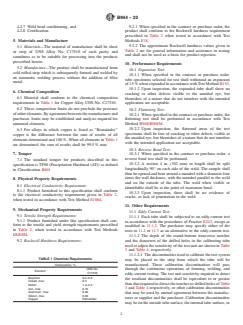
4.2.7 Weld bead conditioning, and 9.2.1 When specified in the contract or purchase order, the
4.2.8 Certification. product shall conform to the Rockwell hardness requirement
prescribed in Table 2 when tested in accordance with Test
5. Materials and Manufacture
Methods E18.
9.2.2 The approximate Rockwell hardness values given in
5.1 Materials—The material of manufacture shall be sheet
Table 2 are for general information and assistance in testing
or strip of UNS Alloy No. C17510 of such purity and
and shall not be used as a basis for product rejection.
soundness as to be suitable for processing into the products
prescribed herein.
10. Performance Requirements
5.2 Manufacture—The product shall be manufactured from
10.1 Expansion Test:
cold rolled strip which is subsequently formed and welded by
10.1.1 When specified in the contract or purchase order,
an automatic welding process without the addition of filler
tube specimens selected for test shall withstand an expansion
metal.
of15 %whenexpandedinaccordancewithTestMethodB153.
10.1.2 Upon inspection, the expanded tube shall show no
6. Chemical Composition
cracking or other defects visible to the unaided eye, but
6.1 Material shall conform to the chemical composition
blemishes of a nature that do not interfere with the intended
requirements in Table 1 for Copper Alloy UNS No. C17510.
application are acceptable.
6.2 These composition limits do not preclude the presence
10.2 Flattening Test:
ofotherelements.Byagreementbetweenthemanufacturerand
10.2.1 When specified in the contract or purchase order, the
purchaser, limits may be established and analysis required for
flattening test shall be performed in accordance with Test
unnamed elements.
Method B968/B968M.
10.2.2 Upon inspection, the flattened areas of the test
6.3 For alloys in which copper is listed as “Remainder,”
specimens shall be free of cracking or other defects visible to
copper is the difference between the sum of results of all
the unaided eye, but blemishes of a nature that do not interfere
elements determined and 100 %. When all elements in Table 1
with the intended application are acceptable.
are determined, the sum of results shall be 99.5 % min.
10.3 Reverse Bend Test:
7. Temper
10.3.1 When specified in the contract or purchase order, a
reverse bend test shall be performed.
7.1 The standard temper for products described in this
10.3.2 A section 4 in. (102 mm) in length shall be split
specification is TF00 (Precipitation Hardened (AT)) as defined
longitudinally 90° on each side of the weld. The sample shall
in Classification B601.
thenbeopenedandbentaroundamandrelwithadiameterfour
times the wall thickness, with the mandrel parallel to the weld
8. Physical Property Requirements
and on the outside of the tube. The weld when visible or
8.1 Electrical Conductivity Requirement:
identifiable shall be at the point of maximum bend.
8.1.1 Product furnished to this specification shall conform
10.3.3 Upon inspection, there shall be no evidence of
to the electrical conductivity requirement given in Table 2,
cracks, or lack of penetration in the weld.
when tested in accordance with Test Method E1004.
11. Other Requirements
9. Mechanical Property Requirements
11.1 Eddy Current Test:
9.1 Tensile Strength Requirements:
11.1.1 Each tube shall be subjected to an eddy-current test
9.1.1 Product furnished under this specification shall con-
in accordance with the procedures of Practice E243, except as
form to the tensile and yield strength requirements prescribed
modified in 11.1.2. The purchaser may specify either of the
in Table 2, when tested in accordance with Test Methods
tests in 11.2 or 11.3 as an alternative to the eddy-current test.
E8/E8M.
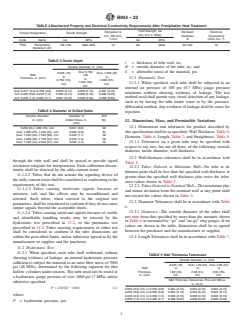
11.1.2 The depth of the round-bottom transverse notches
and the diameters of the drilled holes in the calibrating tube
9.2 Rockwell Hardness Requirements:
used to adjust the sensitivity of the test unit are shown in Table
3 and Table 4, respectively.
11.1.2.1 The discontinuities used to calibrate the test system
TABLE 1 Chemical Requirements
may be placed in the strip from which the tube will be
Composition, % manufactured. These calibration discontinuities will pass
UNS No. through the continuous operations of forming, welding, and
Element
C17510
eddy-current testing. The test unit sensitivity required to detect
Beryllium 0.2–0.6
the resultant discontinuities shall be equivalent to or greater
Cobalt, max 0.3
than that required to detect the notches or drilled holes ofTable
Nickel 1.4–2.2
Iron, max 0.10 3 and Table 4 respectively, or other calibration discontinuities
Aluminum, max 0.20
that may be used by mutual agreement between the manufac-
Silicon, max 0.20
turer or supplier and the purchaser. Calibration discontinuities
Copper Remainder
maybeontheoutsidetubesurface,theinternaltubesurface,or
B944−22
TABLE 2 Mechanical Property and Electrical Conductivity Requirements After Precipitation Heat Treatment
Yield Strength, ksi
Elongation in Rockwell Electrical
Temper Designation Tensile Strength
min, 0.2 % Offset
2 in. (50 mm), Hardness Conductivity
%min B IACS min, %
Code Name ksi MPa ksi MPa
TF00 Precipitation 100–130 (690–895) 10 80 (550) 92–100 45
Hardened (AT)
TABLE 3 Notch Depth
t = thickness of tube wall, in.;
Outside Diameter, in. (mm)
D = outside diameter of the tube, in.; and
Over 0.750
S = allowable stress of the material, psi.
0.625 (16) Over 1.250 (32)
Wall
(19)
to to
Thickness, in. (mm) 11.3 Pneumatic Test:
to
0.750 (19), 2.000 (51),
1.250 (32),
11.3.1 When specified, each tube shall be subjected to an
incl. incl.
incl.
internal air pressure of 100 psi (0.7 MPa) gauge pressure
Over 0.017 (0.4)–0.032 (0.8) 0.005 (0.13) 0.006 (0.15) 0.007 (0.18)
minimum without showing evidence of leakage. The test
Incl. 0.032 (0.8)–0.049 (1.3) 0.006 (0.15) 0.006 (0.15) 0.008 (0.20)
method used shall permit easy visual detection of any leakage,
Incl. 0.049 (1.3)–0.083 (2.1) 0.007 (0.18) 0.008 (0.20) 0.008 (0.20)
such as by having the tube under water or by the pressure-
differential method.Any evidence of leakage shall be cause for
TABLE 4 Diameter of Drilled Holes
rejection.
Outside Diameter, Diameter of Drill
in. (mm) Drilled Holes, in. No.
12. Dimensions, Mass, and Permissible Variations
(mm)
12.1 Dimensions and tolerances for product described by
0.250 (6)–1.000 (25), incl. 0.031 (0.8) 68
Over 1.000 (25)–1.250 (32), incl. 0.036 (0.9) 64
thisspecificationshallbeasspecified:WallThickness,Table5;
Over 1.250 (32)–1.500 (38), incl. 0.042 (1.1) 58
Diameter, Table 6; Length, Table 7; and Straightness, Table 8.
Over 1.500 (38)–1.750 (44), incl. 0.046 (1.2) 56
12.1.1 Tolerances on a given tube may be specified with
Over 1.750 (44)–2.000 (51), incl. 0.052 (1.3) 55
respect to any two, but not all three, of the following: outside
diameter, inside diameter, wall thickness.
12.2 Wall-thickness tolerances shall be in accordance with
through the tube wall and shall be spaced to provide signal
Table 5.
resolution adequate for interpretation. Each calibration discon-
12.2.1 Tubes Ordered to Minimum Wall—No tube at its
tinuity shall be detected by the eddy-current tester.
thinnest point shall be less than the specified wall thickness or
11.1.2.2 Tubes that do not actuate the signaling device of
greater than the specified wall thickness plus twice the toler-
theeddy-currenttestershallbeconsideredasconformingtothe
ance values shown in Table 5.
requirements of this test.
12.2.2 TubesOrderedtoNominalWall—Themaximumplus
11.1.2.3 Tubes causing irrelevant signals because of
and minus deviation from the nominal wall at any point shall
moisture, soil, and like effects may be reconditioned and
not exceed the values shown in Table 5.
retested. Such tubes, when retested to the original test
12.3 Diameter Tolerances shall be in accordance with Table
parameters, shall be considered to conform if they do not cause
6.
output signals beyond the acceptable limits.
12.3.1 Diameter—The outside diameter of the tubes shall
11.1.2.4 Tubes causing irrelevant signals because of visible
not vary from that specified by more than the amounts shown
and identifiable handling marks may be retested by the
in Table 6 as measured by “go” and “no-go” ring gauges. If no
hydrostatic test prescribed in 11.2, or the pneumatic test
values are shown in the table, dimensions shall be as agreed
prescribed in 11.3. Tubes meeting requirements of either test
between the purchaser and the manufacturer or supplier.
shall be considered to conform if the tube dimensions are
within the prescribed limits, unless otherwise agreed to by the
12.4 LengthTolerances shall be in accordance with Table 7.
manufacturer or supplier and the purchaser.
11.2 Hydrostatic Test:
11.2.1 When specified, each tube shall withstand, without
TABLE 5 Wall Thickness Tolerances
showing evidence of leakage, an internal hydrostatic pressure
Outside Diameter, in. (mm)
sufficient to subject the material to an outer fiber stress of 7000
0.625 (16) Over 1.00 (25) Over 2.00 (51)
psi (48 MPa), determined by the following equation for thin
Wall to to to
hollow cylinders under tension. The tube need not be tested at Thickness, 1.00 (25), 2.00 (51), 3.00 (76),
in. (mm) incl. incl. incl.
a hydrostatic gauge pressure of over 1000 psi (7 MPa) unless
Wall Thickness Tolerances, Plus and Minus,
otherwise specified.
in. (mm)
P 5 2St/~D 2 0.8t! (1)
0.020 (0.5) incl. to 0.032 (0.8) 0.004 (0.10) 0.004 (0.10) 0.004 (0.10)
0.032 (0.8) incl. to 0.035 (0.9) 0.004 (0.10) 0.004 (0.10) 0.005 (0.13)
where:
0.035 (0.9) incl. to 0.058 (1.5) 0.006 (0.16) 0.006 (0.16) 0.006 (0.16)
0.058 (1.5) incl. to 0.083 (2.1) 0.008 (0.20) 0.008 (0.20) 0.008 (0.20)
P = hydrostatic pressure, psi;
B944−22
TABLE 6 Diameter Tolerances
Wall Thickness, in. (mm)
Outside
0.020 (0.05) 0.032 (0.8) 0.035 (0.9) 0.058 (1.5)
Diameter,
to 0.032 (0.8), incl. to 0.035 (0.9), incl. to 0.058 (1.5), incl. to 0.083 (2.1), incl.
in. (mm)
Diameter Tolerance, Plus and M
...
This document is not an ASTM standard and is intended only to provide the user of an ASTM standard an indication of what changes have been made to the previous version. Because
it may not be technically possible to adequately depict all changes accurately, ASTM recommends that users consult prior editions as appropriate. In all cases only the current version
of the standard as published by ASTM is to be considered the official document.
Designation: B944 − 11 (Reapproved 2016) B944 − 22
Standard Specification for
Copper-Beryllium Welded Heat Exchanger and Condenser
Tube (UNS No. C17510)
This standard is issued under the fixed designation B944; the number immediately following the designation indicates the year of
original adoption or, in the case of revision, the year of last revision. A number in parentheses indicates the year of last reapproval. A
superscript epsilon (´) indicates an editorial change since the last revision or reapproval.
1. Scope Scope*
1.1 This specification establishes the requirements for copper-beryllium alloy UNS No. C17510 welded tube in straight lengths.
1.2 Units—The values stated in inch-pound units are to be regarded as standard. The values given in parentheses are mathematical
conversions to SI units, whichunits that are provided for information only and are not considered standard.
1.3 This standard does not purport to address all of the safety concerns, if any, associated with its use. It is the responsibility
of the user of this standard to establish appropriate safety and health practices and determine the applicability of regulatory
limitations prior to use.
1.3 The following safety hazard caveat pertains only to the test method(s) described in this specification.
1.3.1 This standard does not purport to address all of the safety concerns, if any, associated with its use. It is the responsibility
of the user of this standard to establish appropriate safety, health, and environmental practices and determine the applicability of
regulatory limitations prior to use.
1.4 This international standard was developed in accordance with internationally recognized principles on standardization
established in the Decision on Principles for the Development of International Standards, Guides and Recommendations issued
by the World Trade Organization Technical Barriers to Trade (TBT) Committee.
2. Referenced Documents
2.1 ASTM Standards:
B153 Test Method for Expansion (Pin Test) of Copper and Copper-Alloy Pipe and Tubing
B194 Specification for Copper-Beryllium Alloy Plate, Sheet, Strip, and Rolled Bar
B601 Classification for Temper Designations for Copper and Copper Alloys—Wrought and Cast
B846 Terminology for Copper and Copper Alloys
B968/B968M Test Method for Flattening of Copper and Copper-Alloy Pipe and Tube
E8/E8M Test Methods for Tension Testing of Metallic Materials
E18 Test Methods for Rockwell Hardness of Metallic Materials
E29 Practice for Using Significant Digits in Test Data to Determine Conformance with Specifications
E243 Practice for Electromagnetic (Eddy Current) Examination of Copper and Copper-Alloy Tubes
This specification is under the jurisdiction of ASTM Committee B05 on Copper and Copper Alloys and is the direct responsibility of Subcommittee B05.04 on Pipe and
Tube.
Current edition approved Oct. 1, 2016Oct. 1, 2022. Published October 2016October 2022. Originally approved in 2006. Last previous edition approved in 20112016 as
B944 – 11.B944 – 11 (2016). DOI: 10.1520/B0944-11R16.10.1520/B0944-22.
For referenced ASTM standards, visit the ASTM website, www.astm.org, or contact ASTM Customer Service at service@astm.org. For Annual Book of ASTM Standards
volume information, refer to the standard’sstandard’s Document Summary page on the ASTM website.
*A Summary of Changes section appears at the end of this standard
Copyright © ASTM International, 100 Barr Harbor Drive, PO Box C700, West Conshohocken, PA 19428-2959. United States
B944 − 22
E255 Practice for Sampling Copper and Copper Alloys for the Determination of Chemical Composition
E1004 Test Method for Determining Electrical Conductivity Using the Electromagnetic (Eddy Current) Method
3. Terminology
3.1 For definitions of terms related to copper and copper alloys, refer to Terminology B846.
4. Ordering Information
4.1 Include the following information specified choices when placing orders for product under this specification, as applicable:
4.1.1 ASTM designation and year of issue,
4.1.2 Copper Alloy UNS No. designation,
4.1.3 Temper (Section 7),
4.1.4 Dimensions, diameter, and wall thickness (Section 12). For tube or pipe, specify either OD/wall, ID/wall, or OD/ID,
4.1.5 Minimum wall thickness or average (nominal) wall thickness,
4.1.6 Tube length, specific or random, and
4.1.7 Quantity—Quantity - Total weight or total length or number of pieces of each size.
4.2 The following options are available and should be but may not be included unless specified at the time of placing of the order
when required:
4.2.1 Expansion test,
4.2.2 Flattening test,
4.2.3 Reverse Bend test,
4.2.4 Eddy Current test,
4.2.5 Hydrostatic test,
4.2.6 Pneumatic test,
4.2.7 Weld bead conditioning, and
4.2.8 Certification.
5. Materials and Manufacture
5.1 Materials—The material of manufacture shall be sheet or strip of UNS Alloy No. C17510 of such purity and soundness as to
be suitable for processing into the products prescribed herein.
5.2 Manufacture—The product shall be manufactured from cold rolled strip which is subsequently formed and welded by an
automatic welding process without the addition of filler metal.
6. Chemical Composition
6.1 Material shall conform to the chemical composition requirements in Table 1 for Copper Alloy UNS No. C17510.
6.2 These composition limits do not preclude the presence of other elements. By agreement between the manufacturer and
purchaser, limits may be established and analysis required for unnamed elements.
B944 − 22
TABLE 1 Chemical Requirements
Composition, %
UNS No.
Element
C17510
Beryllium 0.2–0.6
Cobalt, max 0.3
Nickel 1.4–2.2
Iron, max 0.10
Aluminum, max 0.20
Silicon, max 0.20
Copper Remainder
6.3 For alloys in which copper is listed as “Remainder,” copper is the difference between the sum of results of all elements
determined and 100 %. When all elements in Table 1 are determined, the sum of results shall be 99.5 % min.
7. Temper
7.1 The standard temper for products described in this specification is TF00 (precipitation hardened) (Precipitation Hardened
(AT)) as defined in Classification B601.
8. Physical Property Requirements
8.1 Electrical Conductivity—Conductivity Requirement:
8.1.1 Product furnished to this specification shall conform to the electrical conductivity requirement given in Table 2, when tested
in accordance with Test Method E1004.
9. Mechanical Property Requirements
9.1 Tensile Strength Requirements:
9.1.1 Product furnished under this specification shall conform to the tensile and yield strength requirements prescribed in Table
2, when tested in accordance with Test Methods E8/E8M.
9.2 When specified in the contract or purchase order, the product shall conform to the Rockwell hardness requirement prescribed
in Table 2 when tested in accordance with Test Methods E18.Rockwell Hardness Requirements:
9.2.1 When specified in the contract or purchase order, the product shall conform to the Rockwell hardness requirement prescribed
in Table 2 when tested in accordance with Test Methods E18.
9.2.2 The approximate Rockwell hardness values given in Table 2 are for general information and assistance in testing,testing and
shall not be used as a basis for product rejection.
TABLE 2 Mechanical Property and Electrical Conductivity Requirements After Precipitation Heat Treatment
Yield Strength, ksi
Elongation in Rockwell Electrical
Temper Designation Tensile Strength
min, 0.2 % Offset
2 in. (50 mm), Hardness Conductivity
% min B IACS min, %
Standard Former ksi MPa ksi MPa
TF00 AT 100–130 (690–895) 10 80 (550) 92–100 45
TABLE 2 Mechanical Property and Electrical Conductivity Requirements After Precipitation Heat Treatment
Yield Strength, ksi
Elongation in Rockwell Electrical
Temper Designation Tensile Strength
min, 0.2 % Offset
2 in. (50 mm), Hardness Conductivity
% min B IACS min, %
Code Name ksi MPa ksi MPa
TF00 Precipitation 100–130 (690–895) 10 80 (550) 92–100 45
Hardened (AT)
B944 − 22
10. Performance Requirements
10.1 Expansion Test Requirements—Test: Tube specimens selected for test shall withstand an expansion of 15 % when expanded
in accordance with Test Method B153. This is defined as expansion of tube outside diameter in percent of original outside diameter.
The expanded tube shall show no cracking or rupture visible to the unaided eye.
10.1.1 When specified in the contract or purchase order, tube specimens selected for test shall withstand an expansion of 15 %
when expanded in accordance with Test Method B153.
10.1.2 Upon inspection, the expanded tube shall show no cracking or other defects visible to the unaided eye, but blemishes of
a nature that do not interfere with the intended application are acceptable.
10.2 Flattening Test Requirements—Test: Test specimens at least 4 ft in length shall be flattened on different elements throughout
the length remaining after specimens for the expansion and metallographic tests have been taken. Each element shall be slowly
flattened by one stroke of a press. The term “flattened” shall be interpreted as follows: A micrometer caliper set at three times the
wall thickness shall pass over the tube freely throughout the flattened part except at the points where the change in element of
flattening takes place. The flattened elements shall not show cracking or rupture visible to the unaided eye. The weld when visible
or identifiable shall be placed in the position of maximum bend on one half of the flattened elements.
10.2.1 When specified in the contract or purchase order, the flattening test shall be performed in accordance with Test Method
B968/B968M.
10.2.2 Upon inspection, the flattened areas of the test specimens shall be free of cracking or other defects visible to the unaided
eye, but blemishes of a nature that do not interfere with the intended application are acceptable.
10.3 Reverse Bend Test Requirements—Test: A section 4 in. in length shall be split longitudinally 90° on each side of the weld.
The sample shall then be opened and bent around a mandrel with a diameter four times the wall thickness, with the mandrel parallel
to the weld and on the outside of the tube. The weld when visible or identifiable shall be at the point of maximum bend. There
shall be no evidence of cracks, or lack of penetration in the weld.
10.3.1 When specified in the contract or purchase order, a reverse bend test shall be performed.
10.3.2 A section 4 in. (102 mm) in length shall be split longitudinally 90° on each side of the weld. The sample shall then be
opened and bent around a mandrel with a diameter four times the wall thickness, with the mandrel parallel to the weld and on the
outside of the tube. The weld when visible or identifiable shall be at the point of maximum bend.
10.3.3 Upon inspection, there shall be no evidence of cracks, or lack of penetration in the weld.
11. Other Requirements
11.1 Each tube shall be subjected to an eddy-current test. The purchaser may specify either of the tests in 11.2 or 11.3 as an
alternative to the eddy-current test.Eddy Current Test:
11.1.1 Each tube shall be subjected to an eddy-current test in accordance with the procedures of Practice E243, except as modified
in 11.1.2. The purchaser may specify either of the tests in 11.2 or 11.3 as an alternative to the eddy-current test.
11.1.2 Eddy Current Test—Each tube shall be passed through an eddy-current testing unit adjusted to provide information on the
suitability of the tube for the intended application. Testing shall follow the procedures of PracticeThe depth of the round-bottom
transverse notches and the diameters of the drilled holes in the calibrating tube used to adjust the sensitivity of the test unit are
E243, except as modified shown in 11.1.1.2Table 3. and Table 4, respectively.
11.1.1.1 The depth of the round-bottom transverse notches and the diameters of the drilled holes in the calibrating tube used to
adjust the sensitivity of the test unit are shown in Table 3 and Table 4 respectively.
11.1.2.1 The discontinuities used to calibrate the test system may be placed in the strip from which the tube will be manufactured.
These calibration discontinuities will pass through the continuous operations of forming, welding, and eddy-current testing. The
test unit sensitivity required to detect the resultant discontinuities shall be equivalent to or greater than that required to detect the
B944 − 22
TABLE 3 Notch Depth
Outside Diameter, in.
0.625 Over 0.750 Over 1.250
Specified Wall
to to to
Thickness, in.
0.750, 1.250, 2.000,
incl. incl. incl.
Over 0.017–0.032 0.005 0.006 0.007
Incl. 0.032–0.049 0.006 0.006 0.008
Incl. 0.049–0.083 0.007 0.008 0.008
TABLE 3 Notch Depth
Outside Diameter, in. (mm)
Over 0.750
0.625 (16) Over 1.250 (32)
Wall
(19)
to to
Thickness, in. (mm)
to
0.750 (19), 2.000 (51),
1.250 (32),
incl. incl.
incl.
Over 0.017 (0.4)–0.032 (0.8) 0.005 (0.13) 0.006 (0.15) 0.007 (0.18)
Incl. 0.032 (0.8)–0.049 (1.3) 0.006 (0.15) 0.006 (0.15) 0.008 (0.20)
Incl. 0.049 (1.3)–0.083 (2.1) 0.007 (0.18) 0.008 (0.20) 0.008 (0.20)
TABLE 4 Diameter of Drilled Holes
Outside Diameter, Diameter of Drill
in. Drilled Holes, in. No.
0.250–1.000, incl. 0.031 68
Over 1.000–1.025, incl. 0.036 64
Over 1.250–1.500, incl. 0.042 58
Over 1.500–1.750, incl. 0.046 56
Over 1.750–2.000, incl. 0.052 55
TABLE 4 Diameter of Drilled Holes
Outside Diameter, Diameter of Drill
in. (mm) Drilled Holes, in. No.
(mm)
0.250 (6)–1.000 (25), incl. 0.031 (0.8) 68
Over 1.000 (25)–1.250 (32), incl. 0.036 (0.9) 64
Over 1.250 (32)–1.500 (38), incl. 0.042 (1.1) 58
Over 1.500 (38)–1.750 (44), incl. 0.046 (1.2) 56
Over 1.750 (44)–2.000 (51), incl. 0.052 (1.3) 55
notches or drilled holes of Table 3 and Table 4 respectively, or other calibration discontinuities that may be used by mutual
agreement between the manufacturer or supplier and the purchaser. Calibration discontinuities may be on the outside tube surface,
the internal tube surface, or through the tube wall and shall be spaced to provide signal resolution adequate for interpretation. Each
calibration discontinuity shall be detected by the eddy-current tester.
11.1.2.2 Tubes that do not actuate the signaling device of the eddy-current tester shall be considered as conforming to the
requirements of this test.
11.1.2.3 Tubes causing irrelevant signals because of moisture, soil, and like effects may be reconditioned and retested. Such tubes,
when retested to the original test parameters, shall be considered to conform if they do not cause output signals beyond the
acceptable limits.
11.1.2.4 Tubes that do not actuate the signaling device of the eddy-current tester shall be considered as conforming to the
requirements of this test. Tubes causing irrelevant signals because of moisture, soil, and like effects may be reconditioned and
retested. Such tubes, when retested to the original test parameters, shall be considered to conform if they do not cause output
signals beyond the acceptable limits. Tubes causing irrelevant signals because of visible and identifiable handling marks may be
retested by the hydrostatic test prescribed in 11.2, or the pneumatic test prescribed in 11.3. Tubes meeting requirements of either
test shall be considered to conform if the tube dimensions are within the prescribed limits, unless otherwise agreed to by the
manufacturer or supplier and the purchaser.
11.2 Hydrostatic Test—Test: When specified, each tube shall withstand, without showing evidence of leakage, an internal
hydrostatic pressure sufficient to subject the material to a fiber stress of 7000 psi, determined by the following equation for thin
hollow cylinders under tension. The tube need not be tested at a hydrostatic pressure of over 1000 psig unless so specified.
B944 − 22
11.2.1 When specified, each tube shall withstand, without showing evidence of leakage, an internal hydrostatic pressure sufficient
to subject the material to an outer fiber stress of 7000 psi (48 MPa), determined by the following equation for thin hollow cylinders
under tension. The tube need not be tested at a hydrostatic gauge pressure of over 1000 psi (7 MPa) unless otherwise specified.
P 5 2St/ D 2 0.8t (1)
~ !
where:
P = hydrostatic pressure, psi;
t = thickness of tube wall, in.;
D = outside diameter of the tube, in.; and
S = allowable stress of the material, psi.
P 5 2St/~D 2 0.8t! (1)
where:
P = hydrostatic pressure, psig,
t = thickness of tube wall, in.,
D = outside diameter of the tube, in., and
S = allowable stress of the material, psi.
11.3 Pneumatic Test—Test: When specified, each tube shall be subjected to an internal air pressure of 100 psig minimum without
showing evidence of leakage. The test method used shall permit easy visual detection of any leakage, such as by having the tube
under water or by the pressure-differential method. Any evidence of leakage shall be cause for rejection.
11.3.1 When specified, each tube shall be subjected to an internal air pressure of 100 psi (0.7 MPa) gauge pressure minimum
without showing evidence of leakage. The test method used shall permit easy visual detection of any leakage, such as by having
the tube under water or by the pressure-differential method. Any evidence of leakage shall be cause for rejection.
12. Dimensions, Mass, and Permissible Variations
12.1 Dimensions and tolerances for product described by this specification shall be as specified: Wall Thickness, Table 35;
Diameter, Table 46; Length, Table 57; and Straightness, Table
...