

ASTM D2821-19
(Test Method)Standard Test Method for Measuring the Relative Stiffness of Leather by Means of a Torsional Wire Apparatus
General Information
- Abstract
SIGNIFICANCE AND USE
3.1 This test method is designed to measure the apparent torsional modulus3 of a leather specimen. Experience has shown that the torsion modulus of leather is directly related to the characteristic known as stiffness when felt in a glove.4
SCOPE
1.1 This test method describes the use of a torsional apparatus for measuring the relative stiffness of gloving leathers. This test method does not apply to wet blue.
1.2 The values stated in SI units are to be regarded as the standard. The values shown in parentheses are provided for information only.
1.3 This standard does not purport to address all of the safety concerns, if any, associated with its use. It is the responsibility of the user of this standard to establish appropriate safety, health, and environmental practices and determine the applicability of regulatory limitations prior to use.
1.4 This international standard was developed in accordance with internationally recognized principles on standardization established in the Decision on Principles for the Development of International Standards, Guides and Recommendations issued by the World Trade Organization Technical Barriers to Trade (TBT) Committee.
- Status
- Published
- Publication Date
- 31-Mar-2019
- Technical Committee
- D31 - Leather
- Drafting Committee
- D31.04 - Apparel
Buy Documents

ASTM D2821-19 - Standard Test Method for Measuring the Relative Stiffness of Leather by Means of a Torsional Wire Apparatus
REDLINE ASTM D2821-19 - Standard Test Method for Measuring the Relative Stiffness of Leather by Means of a Torsional Wire Apparatus
Overview
ASTM D2821-19: Standard Test Method for Measuring the Relative Stiffness of Leather by Means of a Torsional Wire Apparatus details a precise procedure for evaluating the stiffness of leather, especially gloving leathers. This ASTM standard outlines the use of a torsional wire apparatus to determine the apparent torsional modulus of leather samples, which directly relates to their perceived stiffness - a critical parameter in applications such as work gloves and other leather apparel.
Developed by ASTM Committee D31 on Leather, this internationally recognized test method is widely adopted in quality control and product development within the leather industry.
Key Topics
- Torsional Stiffness Measurement: Utilizes a specialized torsional wire apparatus to apply a controlled angular twist to leather specimens, measuring the resistance (modulus) as an indicator of stiffness.
- Sample Preparation: Outlines precise sample dimensions and orientation, as stiffness can vary depending on the cut and alignment relative to the leather’s backbone.
- Conditioning Requirements: Refers to ASTM D1610 for standardized conditioning of specimens prior to testing, ensuring consistency and reliability of results.
- Reporting Standards: Specifies detailed reporting criteria, including leather identification, specimen orientation, dimensions, conditioning, and measured values.
- Precision and Bias: Addresses repeatability of results, emphasizing the need for careful sample handling due to natural variability in leather.
- Applicability: Specifically targets gloving leathers and does not apply to wet blue (unfinished) leathers.
Applications
The ASTM D2821-19 test method is essential for:
- Leather Glove Manufacturers: Assessing and ranking glove leathers for optimal stiffness and hand feel, improving fit and performance.
- Quality Control Labs: Verifying product consistency between batches, ensuring materials meet customer and regulatory requirements.
- Leather Goods Designers: Selecting suitable materials for applications where flexibility and stiffness directly affect functionality, such as in protective gear, work gloves, and fashion accessories.
- Research and Development: Comparing new tanning processes, treatments, or leather types for their impact on final material stiffness.
By providing quantifiable data on leather stiffness, the standard helps manufacturers deliver products that match intended usability and comfort profiles.
Related Standards
For comprehensive leather and material testing, the following ASTM standards are frequently referenced alongside ASTM D2821-19:
- ASTM D1053 - Test Methods for Rubber Property-Stiffening at Low Temperatures: Flexible Polymers and Coated Fabrics. Offers related methodologies for non-leather flexible materials.
- ASTM D1610 - Practice for Conditioning Leather and Leather Products for Testing. Details crucial procedures for specimen preparation to ensure accurate, reproducible tests.
Practical Value
Implementing ASTM D2821-19 provides significant benefits for stakeholders across the leather supply chain:
- Reliable Quality Assurance: Consistent methods for measuring leather stiffness help maintain high product standards.
- Customer Satisfaction: End-users receive leather products-especially gloves-that meet expectations for comfort, flexibility, and performance.
- Streamlined Product Development: Designers and engineers can rapidly compare materials and make informed decisions.
- International Compliance: Conformance with recognized ASTM and WTO principles assures global market access and acceptance.
Utilization of ASTM D2821-19 streamlines testing, standardizes reporting, and supports the overall integrity of leather product manufacturing and specification.
Relations
- Effective Date
- 01-Apr-2019
- Refers
ASTM D1610-01(2013) - Standard Practice for Conditioning Leather and Leather Products for Testing - Effective Date
- 01-May-2013
- Refers
ASTM D1610-01(2007) - Standard Practice for Conditioning Leather and Leather Products for Testing - Effective Date
- 01-Apr-2007
- Effective Date
- 10-May-2001
- Effective Date
- 10-May-2001
Buy Documents
ASTM D2821-19 - Standard Test Method for Measuring the Relative Stiffness of Leather by Means of a Torsional Wire Apparatus
REDLINE ASTM D2821-19 - Standard Test Method for Measuring the Relative Stiffness of Leather by Means of a Torsional Wire Apparatus
Get Certified
Connect with accredited certification bodies for this standard

Control Union Certifications
Global certification for agriculture and sustainability.

Hohenstein Institut
Textile testing and certification.

Bureau Veritas Bangladesh
Bureau Veritas certification services in Bangladesh.
Sponsored listings
Frequently Asked Questions
ASTM D2821-19 is a standard published by ASTM International. Its full title is "Standard Test Method for Measuring the Relative Stiffness of Leather by Means of a Torsional Wire Apparatus". This standard covers: SIGNIFICANCE AND USE 3.1 This test method is designed to measure the apparent torsional modulus3 of a leather specimen. Experience has shown that the torsion modulus of leather is directly related to the characteristic known as stiffness when felt in a glove.4 SCOPE 1.1 This test method describes the use of a torsional apparatus for measuring the relative stiffness of gloving leathers. This test method does not apply to wet blue. 1.2 The values stated in SI units are to be regarded as the standard. The values shown in parentheses are provided for information only. 1.3 This standard does not purport to address all of the safety concerns, if any, associated with its use. It is the responsibility of the user of this standard to establish appropriate safety, health, and environmental practices and determine the applicability of regulatory limitations prior to use. 1.4 This international standard was developed in accordance with internationally recognized principles on standardization established in the Decision on Principles for the Development of International Standards, Guides and Recommendations issued by the World Trade Organization Technical Barriers to Trade (TBT) Committee.
SIGNIFICANCE AND USE 3.1 This test method is designed to measure the apparent torsional modulus3 of a leather specimen. Experience has shown that the torsion modulus of leather is directly related to the characteristic known as stiffness when felt in a glove.4 SCOPE 1.1 This test method describes the use of a torsional apparatus for measuring the relative stiffness of gloving leathers. This test method does not apply to wet blue. 1.2 The values stated in SI units are to be regarded as the standard. The values shown in parentheses are provided for information only. 1.3 This standard does not purport to address all of the safety concerns, if any, associated with its use. It is the responsibility of the user of this standard to establish appropriate safety, health, and environmental practices and determine the applicability of regulatory limitations prior to use. 1.4 This international standard was developed in accordance with internationally recognized principles on standardization established in the Decision on Principles for the Development of International Standards, Guides and Recommendations issued by the World Trade Organization Technical Barriers to Trade (TBT) Committee.
ASTM D2821-19 is classified under the following ICS (International Classification for Standards) categories: 59.140.30 - Leather and furs. The ICS classification helps identify the subject area and facilitates finding related standards.
ASTM D2821-19 has the following relationships with other standards: It is inter standard links to ASTM D2821-14, ASTM D1610-01(2013), ASTM D1610-01(2007), ASTM D1610-01, ASTM D1610-00. Understanding these relationships helps ensure you are using the most current and applicable version of the standard.
ASTM D2821-19 is available in PDF format for immediate download after purchase. The document can be added to your cart and obtained through the secure checkout process. Digital delivery ensures instant access to the complete standard document.
Standards Content (Sample)
This international standard was developed in accordance with internationally recognized principles on standardization established in the Decision on Principles for the
Development of International Standards, Guides and Recommendations issued by the World Trade Organization Technical Barriers to Trade (TBT) Committee.
Designation: D2821 − 19
Standard Test Method for
Measuring the Relative Stiffness of Leather by Means of a
Torsional Wire Apparatus
This standard is issued under the fixed designation D2821; the number immediately following the designation indicates the year of
original adoption or, in the case of revision, the year of last revision. A number in parentheses indicates the year of last reapproval. A
superscript epsilon (´) indicates an editorial change since the last revision or reapproval.
This standard has been approved for use by agencies of the U.S. Department of Defense.
1. Scope 3. Significance and Use
3.1 This test method is designed to measure the apparent
1.1 This test method describes the use of a torsional
torsional modulus of a leather specimen. Experience has
apparatus for measuring the relative stiffness of gloving leath-
shown that the torsion modulus of leather is directly related to
ers. This test method does not apply to wet blue.
the characteristic known as stiffness when felt in a glove.
1.2 The values stated in SI units are to be regarded as the
standard. The values shown in parentheses are provided for 4. Apparatus
information only.
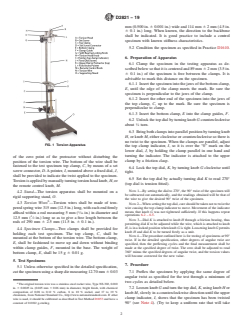
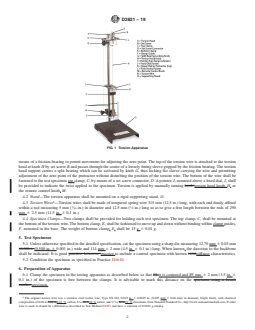
4.1 Torsion Apparatus — The torsional apparatus, Fig. 1,
shall consist of a torsion head, A, capable of being turned
1.3 This standard does not purport to address all of the
through a complete circle in a plane normal to the torsion wire,
safety concerns, if any, associated with its use. It is the
N. The torsion head is equipped with an upper dial or
responsibility of the user of this standard to establish appro-
protractor, K, graduated from 0 to 360° in increments not
priate safety, health, and environmental practices and deter-
greater than 5°, and a fixed index pointer, L. The protractor is
mine the applicability of regulatory limitations prior to use.
attached to the torsion head by means of a friction bearing to
1.4 This international standard was developed in accor-
permit movement for adjusting the zero point. The top of the
dance with internationally recognized principles on standard-
torsion wire is attached to the torsion head at knob H by set
ization established in the Decision on Principles for the
screwBandpassesthroughthecenterofalooselyfittingsleeve
Development of International Standards, Guides and Recom-
gripped by the friction bearing. The torsion head support
mendations issued by the World Trade Organization Technical
carries a split bearing which can be activated by knob G, thus
Barriers to Trade (TBT) Committee.
locking the sleeve carrying the wire and permitting adjustment
2. Referenced Documents
This test method is similar to Test Method D1053. The original apparatus was
2.1 ASTM Standards:
described by Williamson, I., British Plastics, Vol 23, 1950, pp 87-90, 102; and
D1053 Test Methods for Rubber Property—Stiffening at
typical examples of the results of its use on leather were given in a paper by
LowTemperatures: Flexible Polymers and Coated Fabrics Witnauer, L. PA, and Palm, W.E., Journal, American Leather Chemist’s Assn.,
JALCA, Vol 59, 1964, pp. 246-258.
D1610 Practice for Conditioning Leather and Leather Prod-
Gloves were made from the neck and butt areas of cattlehide work-glove
ucts for Testing
leather selected for 3° of softness varying from soft to firm.These were ranked from
softest to firmest by 20 individuals. Since there was some overlapping of rank as
assigned by individual observers, the final rank was assigned according to highest
numberofselections.Specimensofleathercutfromthesidesintheareafromwhich
This test method is under the jurisdiction ofASTM Committee D31 on Leather each glove was cut were tested for stiffness according to this test method.At 90° of
and is the direct responsibility of Subcommittee D31.04 on Apparel. This test twist, the stiffness values gave a ranking similar to that obtained by feel. Specimens
method was developed in cooperation with the American Leather Chemists Assn. cut parallel to the backbone gave more consistent ranking than specimens cut
Current edition approved April 1, 2019. Published May 2019. Originally perpendicular to the backbone. This undoubtedly reflects the fact that work gloves
approved in 1969 as D2821 – 69T. Last previous edition approved in 2014 as are cut from a side with the fingers parallel to the backbone.
D2821 – 14. DOI: 10.1520/D2821-19. The sole source of supply of the apparatus known to the committee at this time
For referenced ASTM standards, visit the ASTM website, www.astm.org, or is Taber Industries, 455 Bryant Street, North Tonawanda, NY, 14120. If you are
contact ASTM Customer Service at service@astm.org. For Annual Book of ASTM aware of alternative suppliers, please provide this information to ASTM Interna-
Standards volume information, refer to the standard’s Document Summary page on tional Headquarters.Your comments will receive careful consideration at a meeting
the ASTM website. of the responsible technical committee, which you may attend.
Copyright © ASTM International, 100 Barr Harbor Drive, PO Box C700, West Conshohocken, PA 19428-2959. United States
D2821 − 19
mm (0.500 in. 6 0.001 in.) wide and 114 mm 6 2 mm (4.5 in.
6 0.1 in.) long. When known, the direction to the backbone
shall be indicated. It is good practice to include a control
specimen with known stiffness characteristics.
5.2 Condition the specimen as specified in Practice D1610.
6. Preparation of Apparatus
6.1 Clamp the specimen in the testing apparatus as de-
scribed below so that it is centered and 89 mm 6 2 mm (3.5 in.
6 0.1 in.) of the specimen is free between the clamps. It is
advisable to mark this distance on the specimen.
6.1.1 Insert the specimen into the jaws of the bottom clamp,
E, until the edge of the clamp meets the mark. Be sure the
specimen is perpendicular to the jaws of the clamp.
6.1.2 Insert the other end of the specimen into the jaws of
the top clamp, C, up to the mark. Be sure the specimen is
perpendicular to clamp.
6.1.3 Insert the bottom clamp, E into the clamp guides, F.
6.2 Unlock the top dial by turning knobG counterclockwise
about ⁄4 turn.
6.3 Bring both clamps into parallel position by turning knob
H, or knob M, either clockwise or counterclockwise so there is
no twist to the specimen. When the clamps are parallel, adjust
FIG. 1 Torsion Apparatus
the top clamp indicator, I, so it is over the “0” mark on the
lower dial, J, by holding the clamp parallel in one hand and
turning the indicator. The indicator is attached to the upper
of the zero point of the protractor without disturbing the
clamp by a friction clasp.
position of the torsion wire. The bottom of the wire shall be
fastened to the test specimen top clamp, C, by means of a set
6.4 Lock the top dial, K, by turning knob G clockwise until
screw connector,D.Apointer,I, mounted above a fixed dial,J,
tight.
shall be provided to indicate the twist applied to the specimen.
6.5 Set the top dial by actually turning dial K to read 270°
Torsionisappliedbymanuallyturningtorsionheadknob,H,or
(top dial is tension fitted).
the remote control knob, M.
NOTE 1—By setting the dial to 270°, the 90° twist of the specimen will
4.2 Stand—The torsion apparatus shall be mounted on a
be subtracted out automatically, and the readings obtained will be that o
...
This document is not an ASTM standard and is intended only to provide the user of an ASTM standard an indication of what changes have been made to the previous version. Because
it may not be technically possible to adequately depict all changes accurately, ASTM recommends that users consult prior editions as appropriate. In all cases only the current version
of the standard as published by ASTM is to be considered the official document.
Designation: D2821 − 14 D2821 − 19
Standard Test Method for
Measuring the Relative Stiffness of Leather by Means of a
Torsional Wire Apparatus
This standard is issued under the fixed designation D2821; the number immediately following the designation indicates the year of
original adoption or, in the case of revision, the year of last revision. A number in parentheses indicates the year of last reapproval. A
superscript epsilon (´) indicates an editorial change since the last revision or reapproval.
This standard has been approved for use by agencies of the U.S. Department of Defense.
1. Scope
1.1 This test method describes the use of a torsional apparatus for measuring the relative stiffness of gloving leathers. This test
method does not apply to wet blue.
1.2 The values stated in SI units are to be regarded as the standard. The values shown in parentheses are provided for
information only.
1.3 This standard does not purport to address all of the safety concerns, if any, associated with its use. It is the responsibility
of the user of this standard to establish appropriate safety safety, health, and healthenvironmental practices and determine the
applicability of regulatory limitations prior to use.
1.4 This international standard was developed in accordance with internationally recognized principles on standardization
established in the Decision on Principles for the Development of International Standards, Guides and Recommendations issued
by the World Trade Organization Technical Barriers to Trade (TBT) Committee.
2. Referenced Documents
2.1 ASTM Standards:
D1053 Test Methods for Rubber Property—Stiffening at Low Temperatures: Flexible Polymers and Coated Fabrics
D1610 Practice for Conditioning Leather and Leather Products for Testing
3. Significance and Use
3.1 This test method is designed to measure the apparent torsional modulus of a leather specimen. Experience has shown that
the torsion modulus of leather is directly related to the characteristic known as stiffness when felt in a glove.
4. Apparatus
4.1 Torsion Apparatus — The torsional apparatus, Fig. 1, shall consist of a torsion head, A, capable of being turned through a
complete circle in a plane normal to the torsion wire, N. The torsion head is equipped with an upper dial or protractor, K, graduated
from 0 to 360° in increments not greater than 5°, and a fixed index pointer, L. The protractor is attached to the torsion head by
This test method is under the jurisdiction of ASTM Committee D31 on Leather and is the direct responsibility of Subcommittee D31.04 on Apparel. This test method
was developed in cooperation with the American Leather Chemists Assn.
Current edition approved April 1, 2014April 1, 2019. Published May 2014May 2019. Originally approved in 1969 as D2821 – 69T. Last previous edition approved in
20092014 as D2821 – 09.D2821 – 14. DOI: 10.1520/D2821-14.10.1520/D2821-19.
For referenced ASTM standards, visit the ASTM website, www.astm.org, or contact ASTM Customer Service at service@astm.org. For Annual Book of ASTM Standards
volume information, refer to the standard’s Document Summary page on the ASTM website.
This test method is similar to Test Method D1053. The original apparatus was described by Williamson, I., British Plastics, Vol 23, 1950, pp 87-90, 102; and typical
examples of the results of its use on leather were given in a paper by Witnauer, L. PA, and Palm, W.E., Journal, American Leather Chemist’s Assn., JALCA, Vol 59, 1964,
pp. 246-258.
Gloves were made from the neck and butt areas of cattlehide work-glove leather selected for 3° of softness varying from soft to firm. These were ranked from softest
to firmest by 20 individuals. Since there was some overlapping of rank as assigned by individual observers, the final rank was assigned according to highest number of
selections. Specimens of leather cut from the sides in the area from which each glove was cut were tested for stiffness according to this test method. At 90° of twist, the stiffness
values gave a ranking similar to that obtained by feel. Specimens cut parallel to the backbone gave more consistent ranking than specimens cut perpendicular to the backbone.
This undoubtedly reflects the fact that work gloves are cut from a side with the fingers parallel to the backbone. A report of these experiments and data used for calculation
of precision and accuracy are on file at ASTM Headquarters.
The sole source of supply of the apparatus known to the committee at this time is Taber Industries, 455 Bryant Street, North Tonawanda, NY, 14120. If you are aware
of alternative suppliers, please provide this information to ASTM International Headquarters. Your comments will receive careful consideration at a meeting of the responsible
technical committee, which you may attend.
Copyright © ASTM International, 100 Barr Harbor Drive, PO Box C700, West Conshohocken, PA 19428-2959. United States
D2821 − 19
FIG. 1 Torsion Apparatus
means of a friction bearing to permit movement for adjusting the zero point. The top of the torsion wire is attached to the torsion
head at knob H by set screw B and passes through the center of a loosely fitting sleeve gripped by the friction bearing. The torsion
head support carries a split bearing which can be activated by knob G, thus locking the sleeve carrying the wire and permitting
adjustment of the zero point of the protractor without disturbing the position of the torsion wire. The bottom of the wire shall be
fastened to the test specimen top clamp, C, by means of a set screw connector, D. A pointer, I, mounted above a fixed dial, J, shall
be provided to indicate the twist applied to the specimen. Torsion is applied by manually turning knob torsion head knob, H, or
the remote control knob, M.
4.2 Stand—The torsion apparatus shall be mounted on a rigid supporting stand, O.
4.3 Torsion Wires —Torsion wires shall be made of tempered spring wire 315 mm (12.5 in.) long, with each end firmly affixed
3 1
within a rod measuring 5 mm ( ⁄16 in.) in diameter and 12.5 mm ( ⁄2 in.) long so as to give a free length between the rods of 290
mm 6 2.5 mm (11.5 in. 6 0.1 in.).
4.4 Specimen Clamps—Two clamps shall be provided for holding each test specimen. The top clamp, C, shall be mounted at
the bottom of the torsion wire. The bottom clamp, E, shall be fashioned to move up and down without binding within clamp guides,
F, mounted in the base. The weight of bottom clamp, E, shall be 15 g 6 0.01 g.
5. Test Specimens
5.1 Unless otherwise specified in the detailed specification, cut the specimen using a sharp die measuring 12.70 mm 6 0.03 mm
(0.5006 (0.500 in. 6 0.001 in.) wide and 114 mm 6 2 mm (4.5 in. 6 0.1 in.) long. When known, the direction to the backbone
shall be indicated. It is good practice, however, practice to include a control specimen with known twiststiffness characteristics.
5.2 Condition the specimen as specified in Practice D1610.
6. Preparation of Apparatus
6.1 Clamp the specimen in the testing apparatus as described below so that 89 it is centered and 89 mm 6 2 mm (3.5 in. 6
0.1 in.) of the specimen is free between the clamps. It is advisable to mark this distance on the specimen using a bench
marker.specimen.
The original torsion wire was a stainless steel rocket wire, Type NS-302, 0.010 in. 6 0.0025 in. (0.025 mm 6 0.06 mm) in diameter, bright finish, with chemical
composition of 0.08 to 0.12 %0.12 % carbon, 8 to 10 %10 % nickel, and 17 to 19 %19 % chromium, from National Standard Co., http://www.nationalstandard.com. If other
wire is used, it should be calibrated as described in Test Method D1053 and have a constant of 0.0182 g·cm/deg.
--------------------
...