

ASTM D2683-20
(Specification)Standard Specification for Socket-Type Polyethylene Fittings for Outside Diameter-Controlled Polyethylene Pipe and Tubing
General Information
- Abstract
ABSTRACT
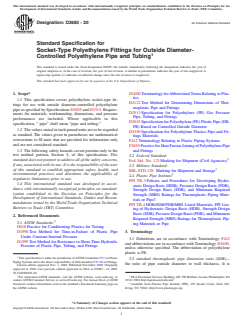
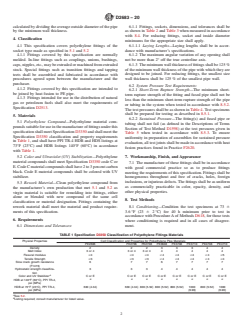
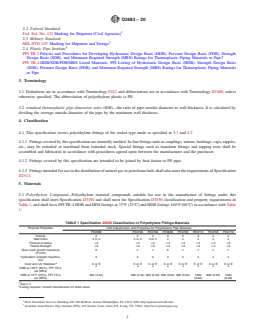
This specification covers polyethylene socket-type fittings for use with outside diameter-controlled polyethylene pipe and tubing. Fittings covered by this specification are normally molded. In-line fittings such as couplings, unions, bushings, caps, nipples, etc., may be extruded or machined from extruded stock. Special fittings such as transition fittings and tapping teets shall be assembled and fabricated. Conditioning, dimensions, short-term rupture test, and sustained pressure test shall be performed to conform with the requirements specified.
SCOPE
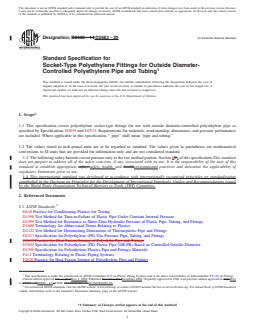
1.1 This specification covers polyethylene socket-type fittings for use with outside diameter-controlled polyethylene pipe as specified by Specifications D3035 and D2513. Requirements for materials, workmanship, dimensions, and pressure performance are included. Where applicable in this specification, “ pipe” shall mean “pipe and tubing.”
1.2 The values stated in inch-pound units are to be regarded as standard. The values given in parentheses are mathematical conversions to SI units that are provided for information only and are not considered standard.
1.3 The following safety hazards caveat pertains only to the test method portion, Section 8, of this specification: This standard does not purport to address all of the safety concerns, if any, associated with its use. It is the responsibility of the user of this standard to establish appropriate safety, health, and environmental practices and determine the applicability of regulatory limitations prior to use.
1.4 This international standard was developed in accordance with internationally recognized principles on standardization established in the Decision on Principles for the Development of International Standards, Guides and Recommendations issued by the World Trade Organization Technical Barriers to Trade (TBT) Committee.
- Status
- Published
- Publication Date
- 31-Oct-2020
- Technical Committee
- F17 - Plastic Piping Systems
- Drafting Committee
- F17.10 - Fittings
Buy Documents
ASTM D2683-20 - Standard Specification for Socket-Type Polyethylene Fittings for Outside Diameter-Controlled Polyethylene Pipe and Tubing
REDLINE ASTM D2683-20 - Standard Specification for Socket-Type Polyethylene Fittings for Outside Diameter-Controlled Polyethylene Pipe and Tubing
Overview
ASTM D2683-20 is the leading international standard titled "Standard Specification for Socket-Type Polyethylene Fittings for Outside Diameter-Controlled Polyethylene Pipe and Tubing." Published by ASTM International, this specification establishes requirements for polyethylene (PE) socket-type fittings used in conjunction with outside diameter-controlled PE pipe and tubing as specified by ASTM D3035 and D2513. It covers standards for material properties, manufacturing tolerances, workmanship, dimensional requirements, and pressure performance to ensure reliable, safe performance in a wide range of piping applications.
Key Topics
Material Requirements
- Fittings must be manufactured from polyethylene materials conforming to ASTM D3350, including specifications for cell classification, density, and stress ratings.
- Rework materials from the manufacturer's own production are allowed, provided they meet all virgin material requirements.
Fitting Types and Manufacturing
- Includes molded, extruded, or machined in-line fittings such as couplings, unions, bushings, caps, and nipples.
- Special assemblies (e.g., transition fittings and tapping tees) must be manufactured under procedures agreed upon between manufacturer and purchaser.
Performance Testing
- Includes short-term rupture tests and sustained pressure tests to validate the durability and pressure capacity of both fittings and their joints with compatible pipes or tubing.
- Dimensional and out-of-round tolerances are enforced to ensure compatibility and consistent assembly.
Marking and Traceability
- Fittings must be clearly marked with the manufacturer’s identification, material designation, size, and the ASTM D2683 designation.
- Markings must remain legible under normal handling and installation to ensure product traceability.
Applications
ASTM D2683-20 is widely used in industries requiring reliable plastic piping infrastructure. Key application areas include:
Water Distribution and Plumbing Systems
Ensures compatibility and leak-free performance in potable cold water distribution, provided fittings meet additional NSF/ANSI 61 or NSF 14 certification when required by authorities.Natural Gas and Petroleum Fuel Distribution
Specifies additional requirements where PE fittings are used in gas and fuel pipelines, supporting long-term durability and regulatory compliance.Irrigation and Industrial Piping
Used in agricultural, landscaping, and various industrial fluid transport systems where reliable, corrosion-resistant PE piping solutions are necessary.Municipal Infrastructure
Applied in infrastructure upgrades, trenchless installations, and other public utility projects requiring durable and easy-to-install pipe connections.
Related Standards
ASTM D2683-20 references several related documents and standards, enhancing its relevance in industry:
- ASTM D3035: Specification for Polyethylene (PE) Plastic Pipe (DR-PR) Based on Controlled Outside Diameter.
- ASTM D2513: Specification for Polyethylene (PE) Gas Pressure Pipe, Tubing, and Fittings.
- ASTM D3350: Specification for Polyethylene Plastics Pipe and Fittings Materials.
- ASTM D1598 / D1599: Test Methods for Failure Time and Hydrostatic Strength of Thermoplastic Pipe.
- ASTM D618: Practice for Conditioning Plastics for Testing.
- ASTM D2122: Test Method for Determining Dimensions of Thermoplastic Pipe and Fittings.
- F2620 / D2657: Practices for Heat Fusion Joining of Polyolefin Pipe and Fittings.
These standards form an essential framework for manufacturing, testing, and applying PE socket fittings in compliance with industry best practices.
ASTM D2683-20 remains a critical standard for manufacturers, engineers, and practitioners dealing with polyethylene pipe systems, supporting safe, reliable, and consistent installations in numerous applications. Adhering to this standard ensures both regulatory compliance and long-term performance of polyethylene piping networks.
Relations
- Effective Date
- 01-Apr-2020
- Effective Date
- 01-Jan-2019
- Effective Date
- 01-Sep-2018
- Refers
ASTM D2513-18 - Standard Specification for Polyethylene (PE) Gas Pressure Pipe, Tubing, and Fittings - Effective Date
- 15-Apr-2018
- Refers
ASTM D1600-18 - Standard Terminology for Abbreviated Terms Relating to Plastics (Withdrawn 2024) - Effective Date
- 01-Jan-2018
- Effective Date
- 01-Aug-2017
- Effective Date
- 01-Feb-2017
- Effective Date
- 15-Dec-2016
- Refers
ASTM D2513-16 - Standard Specification for Polyethylene (PE) Gas Pressure Pipe, Tubing, and Fittings - Effective Date
- 01-Dec-2016
- Effective Date
- 15-Nov-2016
- Effective Date
- 01-Aug-2016
- Effective Date
- 01-Nov-2015
- Effective Date
- 01-Jun-2015
- Refers
ASTM D2122-15 - Standard Test Method for Determining Dimensions of Thermoplastic Pipe and Fittings - Effective Date
- 15-Mar-2015
- Effective Date
- 01-Aug-2014
Buy Documents
ASTM D2683-20 - Standard Specification for Socket-Type Polyethylene Fittings for Outside Diameter-Controlled Polyethylene Pipe and Tubing
REDLINE ASTM D2683-20 - Standard Specification for Socket-Type Polyethylene Fittings for Outside Diameter-Controlled Polyethylene Pipe and Tubing
Get Certified
Connect with accredited certification bodies for this standard

Institut za varilstvo d.o.o. (Welding Institute)
Slovenia's leading welding institute since 1952. ISO 3834, EN 1090, pressure equipment certification, NDT personnel, welder qualification. Only IIW Au
Sponsored listings
Frequently Asked Questions
ASTM D2683-20 is a technical specification published by ASTM International. Its full title is "Standard Specification for Socket-Type Polyethylene Fittings for Outside Diameter-Controlled Polyethylene Pipe and Tubing". This standard covers: ABSTRACT This specification covers polyethylene socket-type fittings for use with outside diameter-controlled polyethylene pipe and tubing. Fittings covered by this specification are normally molded. In-line fittings such as couplings, unions, bushings, caps, nipples, etc., may be extruded or machined from extruded stock. Special fittings such as transition fittings and tapping teets shall be assembled and fabricated. Conditioning, dimensions, short-term rupture test, and sustained pressure test shall be performed to conform with the requirements specified. SCOPE 1.1 This specification covers polyethylene socket-type fittings for use with outside diameter-controlled polyethylene pipe as specified by Specifications D3035 and D2513. Requirements for materials, workmanship, dimensions, and pressure performance are included. Where applicable in this specification, “ pipe” shall mean “pipe and tubing.” 1.2 The values stated in inch-pound units are to be regarded as standard. The values given in parentheses are mathematical conversions to SI units that are provided for information only and are not considered standard. 1.3 The following safety hazards caveat pertains only to the test method portion, Section 8, of this specification: This standard does not purport to address all of the safety concerns, if any, associated with its use. It is the responsibility of the user of this standard to establish appropriate safety, health, and environmental practices and determine the applicability of regulatory limitations prior to use. 1.4 This international standard was developed in accordance with internationally recognized principles on standardization established in the Decision on Principles for the Development of International Standards, Guides and Recommendations issued by the World Trade Organization Technical Barriers to Trade (TBT) Committee.
ABSTRACT This specification covers polyethylene socket-type fittings for use with outside diameter-controlled polyethylene pipe and tubing. Fittings covered by this specification are normally molded. In-line fittings such as couplings, unions, bushings, caps, nipples, etc., may be extruded or machined from extruded stock. Special fittings such as transition fittings and tapping teets shall be assembled and fabricated. Conditioning, dimensions, short-term rupture test, and sustained pressure test shall be performed to conform with the requirements specified. SCOPE 1.1 This specification covers polyethylene socket-type fittings for use with outside diameter-controlled polyethylene pipe as specified by Specifications D3035 and D2513. Requirements for materials, workmanship, dimensions, and pressure performance are included. Where applicable in this specification, “ pipe” shall mean “pipe and tubing.” 1.2 The values stated in inch-pound units are to be regarded as standard. The values given in parentheses are mathematical conversions to SI units that are provided for information only and are not considered standard. 1.3 The following safety hazards caveat pertains only to the test method portion, Section 8, of this specification: This standard does not purport to address all of the safety concerns, if any, associated with its use. It is the responsibility of the user of this standard to establish appropriate safety, health, and environmental practices and determine the applicability of regulatory limitations prior to use. 1.4 This international standard was developed in accordance with internationally recognized principles on standardization established in the Decision on Principles for the Development of International Standards, Guides and Recommendations issued by the World Trade Organization Technical Barriers to Trade (TBT) Committee.
ASTM D2683-20 is classified under the following ICS (International Classification for Standards) categories: 23.040.45 - Plastics fittings. The ICS classification helps identify the subject area and facilitates finding related standards.
ASTM D2683-20 has the following relationships with other standards: It is inter standard links to ASTM F412-20, ASTM F412-19, ASTM D1599-18, ASTM D2513-18, ASTM D1600-18, ASTM F412-17a, ASTM F412-17, ASTM D2513-16a, ASTM D2513-16, ASTM F412-16a, ASTM F412-16, ASTM D1598-15, ASTM F412-15, ASTM D2122-15, ASTM D3035-14a. Understanding these relationships helps ensure you are using the most current and applicable version of the standard.
ASTM D2683-20 is available in PDF format for immediate download after purchase. The document can be added to your cart and obtained through the secure checkout process. Digital delivery ensures instant access to the complete standard document.
Standards Content (Sample)
This international standard was developed in accordance with internationally recognized principles on standardization established in the Decision on Principles for the
Development of International Standards, Guides and Recommendations issued by the World Trade Organization Technical Barriers to Trade (TBT) Committee.
Designation:D2683 −20 An American National Standard
Standard Specification for
Socket-Type Polyethylene Fittings for Outside Diameter-
Controlled Polyethylene Pipe and Tubing
This standard is issued under the fixed designation D2683; the number immediately following the designation indicates the year of
original adoption or, in the case of revision, the year of last revision. A number in parentheses indicates the year of last reapproval. A
superscript epsilon (´) indicates an editorial change since the last revision or reapproval.
This standard has been approved for use by agencies of the U.S. Department of Defense.
1. Scope* D1600 Terminology forAbbreviatedTerms Relating to Plas-
tics
1.1 This specification covers polyethylene socket-type fit-
D2122 Test Method for Determining Dimensions of Ther-
tings for use with outside diameter-controlled polyethylene
moplastic Pipe and Fittings
pipeasspecifiedbySpecificationsD3035andD2513.Require-
D2513 Specification for Polyethylene (PE) Gas Pressure
ments for materials, workmanship, dimensions, and pressure
Pipe, Tubing, and Fittings
performance are included. Where applicable in this
D3035 SpecificationforPolyethylene(PE)PlasticPipe(DR-
specification, “ pipe” shall mean “pipe and tubing.”
PR) Based on Controlled Outside Diameter
1.2 The values stated in inch-pound units are to be regarded
D3350 Specification for Polyethylene Plastics Pipe and Fit-
as standard. The values given in parentheses are mathematical
tings Materials
conversions to SI units that are provided for information only
F412 Terminology Relating to Plastic Piping Systems
and are not considered standard.
F2620 Practice for Heat Fusion Joining of Polyethylene Pipe
1.3 The following safety hazards caveat pertains only to the
and Fittings
test method portion, Section 8, of this specification: This
2.2 Federal Standard:
standarddoesnotpurporttoaddressallofthesafetyconcerns,
Fed. Std. No. 123 Marking for Shipment (Civil Agencies)
ifany,associatedwithitsuse.Itistheresponsibilityoftheuser
2.3 Military Standard:
of this standard to establish appropriate safety, health, and
MIL-STD-129 Marking for Shipment and Storage
environmental practices and determine the applicability of
2.4 Plastic Pipe Institute
regulatory limitations prior to use.
PPI TR-3 Policies and Procedures for Developing Hydro-
1.4 This international standard was developed in accor-
static Design Basis (HDB), Pressure Design Basis (PDB),
dance with internationally recognized principles on standard-
Strength Design Basis (SDB), and Minimum Required
ization established in the Decision on Principles for the
Strength (MRS) Ratings for Thermoplastic Piping Mate-
Development of International Standards, Guides and Recom-
rials or Pipe7
mendations issued by the World Trade Organization Technical
PPI TR-4 HDB/SDB/PDB/MRS Listed Materials, PPI List-
Barriers to Trade (TBT) Committee.
ing of Hydrostatic Design Basis (HDB), Strength Design
Basis(SDB),PressureDesignBasis(PDB),andMinimum
2. Referenced Documents
Required Strength (MRS) Ratings for Thermoplastic Pip-
2.1 ASTM Standards:
ing Materials or Pipe
D618 Practice for Conditioning Plastics for Testing
D1598 Test Method for Time-to-Failure of Plastic Pipe
3. Terminology
Under Constant Internal Pressure
3.1 Definitions are in accordance with Terminology F412
D1599 Test Method for Resistance to Short-Time Hydraulic
and abbreviations are in accordance with Terminology D1600,
Pressure of Plastic Pipe, Tubing, and Fittings
unless otherwise specified. The abbreviation of polyethylene
plastic is PE.
This specification is under the jurisdiction ofASTM Committee F17 on Plastic
3.2 standard thermoplastic pipe dimension ratio (SDR)—
Piping Systems and is the direct responsibility of Subcommittee F17.10 on Fittings.
the ratio of pipe outside diameter to wall thickness. It is
Current edition approved Nov. 1, 2020. Published November 2020. Originally
approved in 1968. Last previous edition approved in 2014 as D2683 – 14. DOI:
10.1520/D2683-20.
2 3
For referenced ASTM standards, visit the ASTM website, www.astm.org, or DLA Document Services Building 4/D 700 Robbins Avenue Philadelphia, PA
contact ASTM Customer Service at service@astm.org. For Annual Book of ASTM 19111-5094 http://quicksearch.dla.mil/
Standards volume information, refer to the standard’s Document Summary page on Available from Plastics Pipe Institute (PPI), 105 Decker Court, Suite 825,
the ASTM website. Irving, TX 75062, http://www.plasticpipe.org.
*A Summary of Changes section appears at the end of this standard
Copyright © ASTM International, 100 Barr Harbor Drive, PO Box C700, West Conshohocken, PA 19428-2959. United States
D2683−20
calculated by dividing the average outside diameter of the pipe 6.1.1 Fittings, sockets, dimensions, and tolerances shall be
by the minimum wall thickness. as shown in Table 2 and Table 3 when measured in accordance
with 8.4. For reducing fittings, socket and inside diameter
4. Classification
minimums for the appropriate size shall apply.
6.1.1.1 Laying Lengths—Laying lengths shall be in accor-
4.1 This specification covers polyethylene fittings of the
socket type made as specified in 5.1 and 5.2 dance with manufacturer’s specifications.
4.1.1 Fittings covered by this specification are normally 6.1.2 The maximum angular variation of any opening shall
molded. In-line fittings such as couplings, unions, bushings, not be more than 2° off the true centerline axis.
caps,nipples,etc.,maybeextrudedormachinedfromextruded 6.1.3 Theminimumwallthicknessoffittingsshallbe125 %
stock. Special fittings such as transition fittings and tapping of the minimum wall thickness of the pipe with which they are
teets shall be assembled and fabricated in accordance with designed to be joined. For reducing fittings, the smallest size
procedures agreed upon between the manufacturer and the wall thickness shall be 125 % of the smallest pipe wall.
purchaser.
6.2 System Pressure Test Requirements:
4.1.2 Fittings covered by this specification are intended to
6.2.1 Short-Term Rupture Strength—The minimum short-
be joined by heat fusion to PE pipe.
term rupture strength of the fitting and fused pipe shall not be
4.1.3 Fittings intended for use in the distribution of natural
less than the minimum short-term rupture strength of the pipe
gas or petroleum fuels shall also meet the requirements of
or tubing in the system when tested in accordance with 8.5.2.
Specification D2513.
The test pressures shall be as shown in Table 4.Test specimens
shall be prepared for testing as described in 8.5.1.
5. Materials
6.2.2 Sustained Pressure—The fitting(s) and fused pipe or
5.1 Polyethylene Compound—Polyethylene material com-
tubing shall not fail (as defined in the Descriptions of Terms
poundssuitableforuseinthemanufactureoffittingsunderthis
Section of Test Method D1598) at the test pressures given in
specificationshallmeetSpecificationD3350andshallmeetthe
Table 5 when tested in accordance with 8.5.3. To ensure
Specification D3350 classification and property requirements
uniformity in preparation of assemblies for sustained pressure
in Table 1, and shall have PPI TR-4 HDB and HDS listings at
evaluation, all test joints shall be made in accordance with heat
73°F (23°C) and HDB listings 140°F (60°C) in accordance
fusion practices found in Practice F2620.
with Table 1.
7. Workmanship, Finish, and Appearance
5.2 Color and Ultraviolet (UV) Stabilization—Polyethylene
material compounds shall meet Specification D3350 code C or
7.1 The manufacture of these fittings shall be in accordance
E.CodeCmaterialcompoundsshallhave2to3percentcarbon
with good commercial practice so as to produce fittings
black. Code E material compounds shall be colored with UV
meeting the requirements of this specification. Fittings shall be
stabilizer.
homogeneous throughout and free of cracks, holes, foreign
inclusions, or injurious defects.The fittings shall be as uniform
5.3 Rework Material—Clean polyethylene compound from
as commercially practicable in color, opacity, density, and
the manufacturer’s own production that met 5.1 and 5.2 as
other physical properties.
virgin material is suitable for remolding into fittings, either
alone or blended with new compound of the same cell
8. Test Methods
classification or material designation. Fittings containing the
rework material shall meet the material and product require- 8.1 Conditioning—Condition the test specimens at 73 6
ments of this specification. 3.6 °F (23 6 2 °C) for 40 h minimum prior to test in
accordance with ProcedureAof Methods D618, for those tests
6. Requirements
where conditioning is required and in all cases of disagree-
6.1 Dimensions and Tolerances: ment.
TABLE 1 Specification D3350 Classification of Polyethylene Fittings Materials
Physical Properties Cell Classification and Properties for Polyethylene Pipe Materials
PE2606 PE2706 PE2708 PE3608 PE3708 PE3710 PE4708 PE4710
Density 2 2233344
Melt Index 3 or 4 3 or 4 3 or 4 44444
Flexural modulus $4 $4 $4 $4 $4 $4 $4 $5
Tensile Strength $3 $3 $3 $4 $4 $4 $4 $4
Slow crack growth resistance 6 7767777
(F1473)
Hydrostatic strength classifica- 3 3344444
tion
A
Color and UV Stabilizer CorE CorE CorE CorE CorE CorE CorE CorE
B BBBBBBB
HDB at 140°F (60°C), PPI TR-4,
psi (MPa)
HDB at 73°F (23°C), PPI TR-4, 630 (4.34) 630 (4.34) 800 (5.52) 800 (5.52) 800 (5.52) 1000 800 (5.52) 1000
psi (MPa) (6.90) (6.90)
A
See 5.2.
B
Listing required; consult manufacturer for listed value.
D2683−20
A
TABLE 2 Fittings for Outside Diameter-Controlled Polyethylene Pipe
B C,D
A Socket Entrance Diameter B Socket Bottom Diameter CD
Maximum Maximum Socket
Inside Diameter
Average Tolerance Average Tolerance on
Nominal
Out-of- Out-of- Depth,
Diameter on Diameter Diameter Diameter
Pipe
min max
Round Round min
Size, in.,
in. (mm)
⁄2 0.810 +0.005 ±0.008 0.804 +0.005 ±0.008 0.625 0.648 0.804
(20.57) (+0.127) (±0.203) (20.42) (+0.127) (±0.203) (15.88) (16.46) (20.42)
−0.010 −0.026
(−0.254) (−0.660)
⁄4 1.020 ±0.008 ±0.010 1.012 +0.008 ±0.010 0.625 0.814 1.020
(25.91) (±0.203) (±0.254) (25.70) (+0.203) (±0.254) (15.88) (20.68) (25.91)
−0.012
(−0.305)
1 1.275 ±0.008 ±0.010 1.267 +0.008 ±0.010 0.687 1.020 1.275
(32.38) (±0.203) (±0.254) (32.18) (+0.203) (±0.254) (17.4) (25.91) (32.38)
−0.012
(−0.305)
1 ⁄4 1.620 ±0.008 ±0.012 1.612 +0.008 ±0.012 0.875 1.301 1.620
(41.15) (±0.203) (±0.305) (40.94) (+0.203) (±0.305) (22.22) (33.04) (41.15)
−0.016
(−0.406)
1 ⁄2 1.860 ±0.010 ±0.012 1.849 +0.010 ±0.012 0.875 1.496 1.859
(47.24) (±0.254) (±0.305) (46.96) (+0.254) (±0.305) (22.22) (38.0) (47.22)
−0.020
(−0.508)
2 2.335 ±0.010 ±0.012 2.324 +0.010 ±0.012 0.875 1.885 2.334
(59.31) (±0.254) (±0.305) (59.03) (+0.254) (±0.305) (22.22) (47.88) (59.28)
−0.020
(−0.508)
3 3.455 ±0.015 ±0.015 3.439 +0.015 ±0.015 1.000 2.780 3.454
(87.76) (±0.381) (±0.381) (87.35) (+0.381) (±0.381) (25.4) (70.61) (87.73)
−0.025
(−0.635)
4 4.450 ±0.015 ±0.015 4.434 +0.015 ±0.015 1.125 3.575 4.449
(113.03) (±0.381) (±0.381) (112.62) (+0.381) (±0.381) (28.58) (90.80) (113.00)
−0.035
(−0.889)
A
Minimum dimensions have zero negative tolerance. The sketches and designs of fittings are illustrative only. Entrance chamfer or radius is optional.
B
Measured at top of socket wall taper, just below entrance radius.
C
Dimensions of tools should be checked for consistency with fittings used. Socket bottom diameter must be equal to or smaller than entrance diameter.
D
Measured at bottom of socket wall taper, just above bottom radius.
8.2 Test Conditions—Conduct tests at the standard labora- 8.5 Pressure Test:
tory temperature of 73 6 3.6 °F (23 6 2 °C).
8.5.1 Prepare test assemblies in such a manner that each,
whether individual fittings or groups of fittings, is a system
8.3 Sampling—Select at random sufficient quantity of fit-
incorporating at least one length of pipe or tubing and one or
tings from each lot of shipment and test to determine that the
more fittings in addition to end closures. Fuse all fittings’
basic properties and dimensions are in conformance with this
outlets with the appropriate size pipe or tubing. One piece of
specification.
pipe in the system shall have a minimum length equal to five
NOTE 1—For individual orders or specifications, only those tests and
pipe diameters.
numbers of tests specifically agreed upon between the purchaser and the
8.5.2 Short-Term Rupture Test—The test equipment,
manufacturer need be
...
This document is not an ASTM standard and is intended only to provide the user of an ASTM standard an indication of what changes have been made to the previous version. Because
it may not be technically possible to adequately depict all changes accurately, ASTM recommends that users consult prior editions as appropriate. In all cases only the current version
of the standard as published by ASTM is to be considered the official document.
Designation: D2683 − 14 D2683 − 20 An American National Standard
Standard Specification for
Socket-Type Polyethylene Fittings for Outside Diameter-
Controlled Polyethylene Pipe and Tubing
This standard is issued under the fixed designation D2683; the number immediately following the designation indicates the year of
original adoption or, in the case of revision, the year of last revision. A number in parentheses indicates the year of last reapproval. A
superscript epsilon (´) indicates an editorial change since the last revision or reapproval.
This standard has been approved for use by agencies of the U.S. Department of Defense.
1. Scope*
1.1 This specification covers polyethylene socket-type fittings for use with outside diameter-controlled polyethylene pipe as
specified by Specifications D3035 and D2513. Requirements for materials, workmanship, dimensions, and pressure performance
are included. Where applicable in this specification, “ pipe” shall mean “pipe and tubing.”
1.2 The values stated in inch-pound units are to be regarded as standard. The values given in parentheses are mathematical
conversions to SI units that are provided for information only and are not considered standard.
1.3 The following safety hazards caveat pertains only to the test method portion, Section 88,, of this specification:This standard
does not purport to address all of the safety concerns, if any, associated with its use. It is the responsibility of the user of this
standard to establish appropriate safety safety, health, and healthenvironmental practices and determine the applicability of
regulatory limitations prior to use.
1.4 This international standard was developed in accordance with internationally recognized principles on standardization
established in the Decision on Principles for the Development of International Standards, Guides and Recommendations issued
by the World Trade Organization Technical Barriers to Trade (TBT) Committee.
2. Referenced Documents
2.1 ASTM Standards:
D618 Practice for Conditioning Plastics for Testing
D1598 Test Method for Time-to-Failure of Plastic Pipe Under Constant Internal Pressure
D1599 Test Method for Resistance to Short-Time Hydraulic Pressure of Plastic Pipe, Tubing, and Fittings
D1600 Terminology for Abbreviated Terms Relating to Plastics
D2122 Test Method for Determining Dimensions of Thermoplastic Pipe and Fittings
D2513 Specification for Polyethylene (PE) Gas Pressure Pipe, Tubing, and Fittings
D2657 Practice for Heat Fusion Joining of Polyolefin Pipe and Fittings
D3035 Specification for Polyethylene (PE) Plastic Pipe (DR-PR) Based on Controlled Outside Diameter
D3350 Specification for Polyethylene Plastics Pipe and Fittings Materials
F412 Terminology Relating to Plastic Piping Systems
F2620 Practice for Heat Fusion Joining of Polyethylene Pipe and Fittings
This specification is under the jurisdiction of ASTM Committee F17 on Plastic Piping Systems and is the direct responsibility of Subcommittee F17.10 on Fittings.
Current edition approved Nov. 1, 2014Nov. 1, 2020. Published December 2014November 2020. Originally approved in 1968. Last previous edition approved in 20102014
ε3
as D2683 – 10D2683 – 14. . DOI: 10.1520/D2683-14.10.1520/D2683-20.
For referenced ASTM standards, visit the ASTM website, www.astm.org, or contact ASTM Customer Service at service@astm.org. For Annual Book of ASTM Standards
volume information, refer to the standard’s Document Summary page on the ASTM website.
*A Summary of Changes section appears at the end of this standard
Copyright © ASTM International, 100 Barr Harbor Drive, PO Box C700, West Conshohocken, PA 19428-2959. United States
D2683 − 20
2.2 Federal Standard:
Fed. Std. No. 123 Marking for Shipment (Civil Agencies)
2.3 Military Standard:
MIL-STD-129 Marking for Shipment and Storage
2.4 Plastic Pipe Institute
PPI TR-3 Policies and Procedures for Developing Hydrostatic Design Basis (HDB), Pressure Design Basis (PDB), Strength
Design Basis (SDB), and Minimum Required Strength (MRS) Ratings for Thermoplastic Piping Materials or Pipe7
PPI TR-4 HDB/SDB/PDB/MRS Listed Materials, PPI Listing of Hydrostatic Design Basis (HDB), Strength Design Basis
(SDB), Pressure Design Basis (PDB), and Minimum Required Strength (MRS) Ratings for Thermoplastic Piping Materials
or Pipe
3. Terminology
3.1 Definitions are in accordance with Terminology F412 and abbreviations are in accordance with Terminology D1600, unless
otherwise specified. The abbreviation of polyethylene plastic is PE.
3.2 standard thermoplastic pipe dimension ratio (SDR)—the ratio of pipe outside diameter to wall thickness. It is calculated by
dividing the average outside diameter of the pipe by the minimum wall thickness.
4. Classification
4.1 This specification covers polyethylene fittings of the socket type made as specified in 5.1 and 5.2
4.1.1 Fittings covered by this specification are normally molded. In-line fittings such as couplings, unions, bushings, caps, nipples,
etc., may be extruded or machined from extruded stock. Special fittings such as transition fittings and tapping teets shall be
assembled and fabricated in accordance with procedures agreed upon between the manufacturer and the purchaser.
4.1.2 Fittings covered by this specification are intended to be joined by heat fusion to PE pipe.
4.1.3 Fittings intended for use in the distribution of natural gas or petroleum fuels shall also meet the requirements of Specification
D2513.
5. Materials
5.1 Polyethylene Compound—Polyethylene material compounds suitable for use in the manufacture of fittings under this
specification shall meet Specification D3350 and shall meet the Specification D3350 classification and property requirements in
Table 1, and shall have PPI TR-4 HDB and HDS listings at 73°F (23°C) and HDB listings 140°F (60°C) in accordance with Table
1.
TABLE 1 Specification D3350 Classification of Polyethylene Fittings Materials
Physical Properties Cell Classification and Properties for Polyethylene Pipe Materials
PE2606 PE2706 PE2708 PE3608 PE3708 PE3710 PE4708 PE4710
Density 2 2 2 3 3 3 4 4
Melt Index 3 or 4 3 or 4 3 or 4 4 4 4 4 4
Flexural modulus $4 $4 $4 $4 $4 $4 $4 $5
Tensile Strength $3 $3 $3 $4 $4 $4 $4 $4
Slow crack growth resistance 6 7 7 6 7 7 7 7
(F1473)
Hydrostatic strength classifica- 3 3 3 4 4 4 4 4
tion
A
Color and UV Stabilizer C or E C or E C or E C or E C or E C or E C or E C or E
B B B B B B B B
HDB at 140°F (60°C), PPI TR-4,
psi (MPa)
HDB at 73°F (23°C), PPI TR-4, 630 (4.34) 630 (4.34) 800 (5.52) 800 (5.52) 800 (5.52) 1000 800 (5.52) 1000
psi (MPa) (6.90) (6.90)
A
See 5.2.
B
Listing required; consult manufacturer for listed value.
DLA Document Services Building 4/D 700 Robbins Avenue Philadelphia, PA 19111-5094 http://quicksearch.dla.mil/
Available from Plastics Pipe Institute (PPI), 105 Decker Court, Suite 825, Irving, TX 75062, http://www.plasticpipe.org.
D2683 − 20
5.2 Color and Ultraviolet (UV) Stabilization—Polyethylene material compounds shall meet Specification D3350 code C or E.
Code C material compounds shall have 2 to 3 percent carbon black. Code E material compounds shall be colored with UV
stabilizer.
5.3 Rework Material—Clean polyethylene compound from the manufacturer’s own production that met 5.1 and 5.2 as virgin
material is suitable for remolding into fittings, either alone or blended with new compound of the same cell classification or
material designation. Fittings containing the rework material shall meet the material and product requirements of this specification.
6. Requirements
6.1 Dimensions and Tolerances:
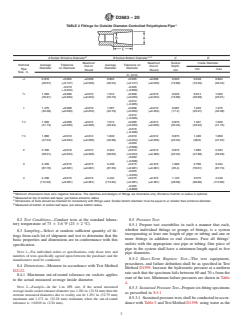
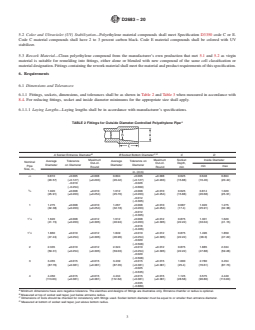
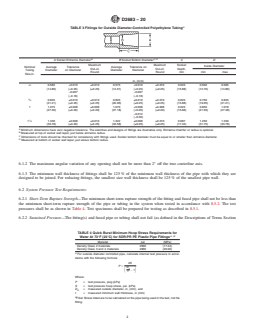
6.1.1 Fittings, sockets, dimensions, and tolerances shall be as shown in Table 2 and Table 3 when measured in accordance with
8.4. For reducing fittings, socket and inside diameter minimums for the appropriate size shall apply.
6.1.1.1 Laying Lengths—Laying lengths shall be in accordance with manufacturer’s specifications.
A
TABLE 2 Fittings for Outside Diameter-Controlled Polyethylene Pipe
B C,D
A Socket Entrance Diameter B Socket Bottom Diameter C D
Maximum Maximum Socket
Inside Diameter
Average Tolerance Average Tolerance on
Nominal
Out-of- Out-of- Depth,
Diameter on Diameter Diameter Diameter
Pipe
min max
Round Round min
Size, in.,
in. (mm)
⁄2 0.810 +0.005 ±0.008 0.804 +0.005 ±0.008 0.625 0.648 0.804
(20.57) (+0.127) (±0.203) (20.42) (+0.127) (±0.203) (15.88) (16.46) (20.42)
−0.010 −0.026
(−0.254) (−0.660)
⁄4 1.020 ±0.008 ±0.010 1.012 +0.008 ±0.010 0.625 0.814 1.020
(25.91) (±0.203) (±0.254) (25.70) (+0.203) (±0.254) (15.88) (20.68) (25.91)
−0.012
(−0.305)
1 1.275 ±0.008 ±0.010 1.267 +0.008 ±0.010 0.687 1.020 1.275
(32.38) (±0.203) (±0.254) (32.18) (+0.203) (±0.254) (17.4) (25.91) (32.38)
−0.012
(−0.305)
1 ⁄4 1.620 ±0.008 ±0.012 1.612 +0.008 ±0.012 0.875 1.301 1.620
(41.15) (±0.203) (±0.305) (40.94) (+0.203) (±0.305) (22.22) (33.04) (41.15)
−0.016
(−0.406)
1 ⁄2 1.860 ±0.010 ±0.012 1.849 +0.010 ±0.012 0.875 1.496 1.859
(47.24) (±0.254) (±0.305) (46.96) (+0.254) (±0.305) (22.22) (38.0) (47.22)
−0.020
(−0.508)
2 2.335 ±0.010 ±0.012 2.324 +0.010 ±0.012 0.875 1.885 2.334
(59.31) (±0.254) (±0.305) (59.03) (+0.254) (±0.305) (22.22) (47.88) (59.28)
−0.020
(−0.508)
3 3.455 ±0.015 ±0.015 3.439 +0.015 ±0.015 1.000 2.780 3.454
(87.76) (±0.381) (±0.381) (87.35) (+0.381) (±0.381) (25.4) (70.61) (87.73)
−0.025
(−0.635)
4 4.450 ±0.015 ±0.015 4.434 +0.015 ±0.015 1.125 3.575 4.449
(113.03) (±0.381) (±0.381) (112.62) (+0.381) (±0.381) (28.58) (90.80) (113.00)
−0.035
(−0.889)
A
Minimum dimensions have zero negative tolerance. The sketches and designs of fittings are illustrative only. Entrance chamfer or radius is optional.
B
Measured at top of socket wall taper, just below entrance radius.
C
Dimensions of tools should be checked for consistency with fittings used. Socket bottom diameter must be equal to or smaller than entrance diameter.
D
Measured at bottom of socket wall taper, just above bottom radius.
D2683 − 20
A
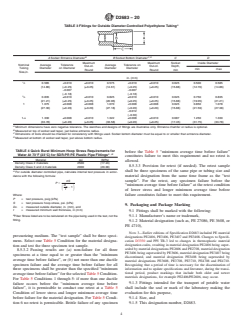
TABLE 3 Fittings for Outside Diameter-Controlled Polyethylene Tubing
B C,D
A Socket Entrance Diameter B Socket Bottom Diameter C D
Maximum Maximum Socket
Inside Diameter
Nominal Average Tolerance Average Tolerance on
Out-of- Out-of- Depth,
Tubing Diameter on Diameter Diameter Diameter
min max
Round Round min
Size,in.
in. (mm)
⁄2 0.585 +0.010 ±0.010 0.575 +0.010 ±0.010 0.625 0.500 0.585
(14.86) (+0.25) (±0.25) (14.61) (+0.25) (±0.25) (15.88) (12.70) (14.86)
−0.007 −0.007
(−0.18) (−0.18)
⁄4 0.835 ±0.010 ±0.010 0.825 ±0.010 ±0.010 0.625 0.750 0.835
(21.21) (±0.25) (±0.25) (20.96) (±0.25) (±0.25) (15.88) (19.05) (21.21)
1 1.075 ±0.008 ±0.008 1.070 +0.008 ±0.008 0.625 0.850 1.078
(27.30) (±0.20) (±0.20) (27.18) (+0.20) (±0.20) (15.88) (21.59) (27.38)
−0.012
(−0.30)
1 ⁄4 1.330 ±0.008 ±0.010 1.322 ±0.008 ±0.010 0.687 1.250 1.330
(33.78) (±0.20) (±0.25) (33.58) (±0.20) (±0.25) (17.45) (31.75) (33.78)
A
Minimum dimensions have zero negative tolerance. The sketches and designs of fittings are illustrative only. Entrance chamfer or radius is optional.
B
Measured at top of socket wall taper, just below entrance radius.
C
Dimensions of tools should be checked for consistency with fittings used. Socket bottom diameter must be equal to or smaller than entrance diameter.
D
Measured at bottom of socket wall taper, just above bottom radius.
6.1.2 The maximum angular variation of any opening shall not be more than 2° off the true centerline axis.
6.1.3 The minimum wall thickness of fittings shall be 125 % of the minimum wall thickness of the pipe with which they are
designed to be joined. For reducing fittings, the smallest size wall thickness shall be 125 % of the smallest pipe wall.
6.2 System Pressure Test Requirements:
6.2.1 Short-Term Rupture Strength—The minimum short-term rupture strength of the fitting and fused pipe shall not be less than
the minimum short-term rupture strength of the pipe or tubing in the system when tested in accordance with 8.5.2. The test
pressures shall be as shown in Table 4. Test specimens shall be prepared for testing as described in 8.5.1.
6.2.2 Sustained Pressure—The fitting(s) and fused pipe or tubing shall not fail (as defined in the Descriptions of Terms Section
TABLE 4 Quick Burst Minimum Hoop Stress Requirements for
A ,B
Water At 73°F (23°C) for SDR-PR PE Plastic Pipe Fittings
Material psi (MPa)
Density Class 2 materials 2500 (17.24)
Density Class 3 and 4 materials 2900 (20.00)
A
For outside diameter controlled pipe, calculate internal test pressure in accor-
dance with the following formula:
2S
P 5
D
o
S D
t
Where:
P = test pressure, psig (kPa)
S = test pressure hoop stress, psi. (kPa)
D = measured outside diameter, in. (mm), and
O
t = measured mini
...