

ASTM C208-22
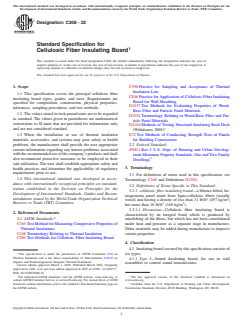
(Specification)Standard Specification for Cellulosic Fiber Insulating Board
General Information
- Abstract
ABSTRACT
This specification covers the principal cellulosic fiber insulating board types, grades, and sizes. Insulating board covered by this specification consists of six types: Types I, II (Grades 1 and 2), III (Grades 1 and 2), IV (Grades 1 and 2), V, and VI. Cellulosic fiber insulating board shall be manufactured from refined or partially refined ligno-cellulosic (wood or cane) fibers, by felting or molding process, into homogeneous panels. The insulating board shall conform to the physical properties specified.
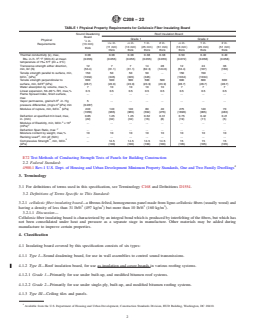
SCOPE
1.1 This specification covers the principal cellulosic fiber insulating board types, grades, and sizes. Requirements are specified for composition, construction, physical properties, tolerances, sampling procedures, and test methods.
1.2 The values stated in inch-pound units are to be regarded as standard. The values given in parentheses are mathematical conversions to SI units that are provided for information only and are not considered standard.
1.3 When the installation or use of thermal insulation materials, accessories, and systems may pose safety or health problems, the manufacturer shall provide the user appropriate current information regarding any known problems associated with the recommended use of the company's products and shall also recommend protective measures to be employed in their safe utilization. The user shall establish appropriate safety and health practices and determine the applicability of regulatory requirements prior to use.
1.4 This international standard was developed in accordance with internationally recognized principles on standardization established in the Decision on Principles for the Development of International Standards, Guides and Recommendations issued by the World Trade Organization Technical Barriers to Trade (TBT) Committee.
- Status
- Published
- Publication Date
- 28-Feb-2022
- Technical Committee
- C16 - Thermal Insulation
- Drafting Committee
- C16.22 - Organic and Nonhomogeneous Inorganic Thermal Insulations
Overview
ASTM C208-22: Standard Specification for Cellulosic Fiber Insulating Board is a critical ASTM standard developed by ASTM International. This specification covers the principal types, grades, and sizes of cellulosic fiber insulating board - panels manufactured from refined or partially refined wood or cane fibers. The standard details the requirements for composition, construction, physical properties, tolerances, sampling procedures, and test methods for these insulating boards.
The document is widely referenced within the building and construction industries, particularly for applications requiring roof insulation, wall sheathing, ceiling panels, and sound deadening materials. By ensuring consistency and quality, ASTM C208-22 underpins energy efficiency, acoustical performance, and structural reliability in modern buildings.
Key Topics
Types and Grades: The standard identifies six types of insulating board (Types I to VI), with certain types subdivided into grades for specific performance attributes.
- Type I: Sound deadening board (for acoustic control)
- Type II: Roof insulation board (Grades 1 and 2)
- Type III: Ceiling tiles and panels (Grades 1 and 2)
- Type IV: Wall sheathing (Grades 1 and 2)
- Type V: Backer board
- Type VI: Roof deck
Material Composition: Boards are manufactured from felting or molding ligno-cellulosic fibers, commonly wood, into homogeneous panels. Additional materials may be introduced to enhance properties such as strength and moisture resistance.
Physical Properties: The specification sets requirements for key attributes, including:
- Thermal conductivity
- Strength (transverse, tensile)
- Water absorption
- Linear expansion
- Flame spread index (for certain applications)
- Moisture content
Dimensional Requirements: Strict tolerances are defined for board length, width, and thickness, supporting reliable use in construction systems.
Workmanship and Appearance: The surface finish must be free of defects such as cracks or excessive warping, and edge details are specified based on intended application.
Testing and Sampling: Reference is made to standardized ASTM test methods, ensuring products meet performance criteria prior to installation.
Applications
Cellulosic fiber insulating board is valued for its versatility, sustainability, and thermal performance in a range of construction and building insulation applications:
- Wall Sheathing: Improves insulation and provides structural support or bracing in frame construction.
- Roof Insulation and Roof Decking: Used under various roofing systems to enhance thermal efficiency, protect against condensation, and extend roof life.
- Sound Deadening: Reduces sound transmission in walls and ceilings, supporting acoustic comfort in residential, commercial, and institutional buildings.
- Ceiling Tiles and Panels: Offers both decorative and sound-absorbing solutions for interior design.
- Backer Board: Serves as a non-structural substrate behind exterior finishes.
Manufacturers, designers, and builders depend on ASTM C208-22 for specifying fiberboard insulation that meets rigorous performance needs, while addressing safety, regulatory, and efficiency objectives.
Related Standards
For comprehensive building envelope solutions and compliance, ASTM C208-22 references several important related ASTM standards:
- ASTM C209: Test Methods for Cellulosic Fiber Insulating Board
- ASTM C165: Measuring Compressive Properties of Thermal Insulations
- ASTM C390: Sampling and Acceptance of Thermal Insulation Lots
- ASTM C846: Application of Cellulosic Fiber Insulating Board for Wall Sheathing
- ASTM C168: Terminology Relating to Thermal Insulation
- ASTM D1037 / D1554: Evaluating Properties and Terminology of Wood-Base Fiber and Particle Panel Materials
Selecting the correct standards and compliant materials is key to achieving desired building performance, code compliance, and long-term durability. Always verify the latest edition of the standard and coordinate with manufacturers on any special project requirements.
Relations
- Effective Date
- 15-Apr-2024
- Effective Date
- 01-Mar-2024
- Effective Date
- 15-Mar-2020
- Effective Date
- 01-Sep-2019
- Effective Date
- 15-Apr-2018
- Effective Date
- 01-Jun-2017
- Effective Date
- 15-Oct-2015
- Effective Date
- 01-Oct-2015
- Effective Date
- 01-Jun-2015
- Effective Date
- 01-Jul-2014
- Refers
ASTM E72-14 - Standard Test Methods of Conducting Strength Tests of Panels for Building Construction - Effective Date
- 01-Jun-2014
- Effective Date
- 01-Nov-2013
- Effective Date
- 01-Nov-2013
- Refers
ASTM E72-13 - Standard Test Methods of Conducting Strength Tests of Panels for Building Construction - Effective Date
- 01-Oct-2013
- Effective Date
- 01-Apr-2013
Get Certified
Connect with accredited certification bodies for this standard

DIBt (Deutsches Institut für Bautechnik)
German Institute for Building Technology.
DIN CERTCO
DIN Group product certification.

Aboma Certification B.V.
Specialized in construction, metal, and transport sectors.
Sponsored listings
Frequently Asked Questions
ASTM C208-22 is a technical specification published by ASTM International. Its full title is "Standard Specification for Cellulosic Fiber Insulating Board". This standard covers: ABSTRACT This specification covers the principal cellulosic fiber insulating board types, grades, and sizes. Insulating board covered by this specification consists of six types: Types I, II (Grades 1 and 2), III (Grades 1 and 2), IV (Grades 1 and 2), V, and VI. Cellulosic fiber insulating board shall be manufactured from refined or partially refined ligno-cellulosic (wood or cane) fibers, by felting or molding process, into homogeneous panels. The insulating board shall conform to the physical properties specified. SCOPE 1.1 This specification covers the principal cellulosic fiber insulating board types, grades, and sizes. Requirements are specified for composition, construction, physical properties, tolerances, sampling procedures, and test methods. 1.2 The values stated in inch-pound units are to be regarded as standard. The values given in parentheses are mathematical conversions to SI units that are provided for information only and are not considered standard. 1.3 When the installation or use of thermal insulation materials, accessories, and systems may pose safety or health problems, the manufacturer shall provide the user appropriate current information regarding any known problems associated with the recommended use of the company's products and shall also recommend protective measures to be employed in their safe utilization. The user shall establish appropriate safety and health practices and determine the applicability of regulatory requirements prior to use. 1.4 This international standard was developed in accordance with internationally recognized principles on standardization established in the Decision on Principles for the Development of International Standards, Guides and Recommendations issued by the World Trade Organization Technical Barriers to Trade (TBT) Committee.
ABSTRACT This specification covers the principal cellulosic fiber insulating board types, grades, and sizes. Insulating board covered by this specification consists of six types: Types I, II (Grades 1 and 2), III (Grades 1 and 2), IV (Grades 1 and 2), V, and VI. Cellulosic fiber insulating board shall be manufactured from refined or partially refined ligno-cellulosic (wood or cane) fibers, by felting or molding process, into homogeneous panels. The insulating board shall conform to the physical properties specified. SCOPE 1.1 This specification covers the principal cellulosic fiber insulating board types, grades, and sizes. Requirements are specified for composition, construction, physical properties, tolerances, sampling procedures, and test methods. 1.2 The values stated in inch-pound units are to be regarded as standard. The values given in parentheses are mathematical conversions to SI units that are provided for information only and are not considered standard. 1.3 When the installation or use of thermal insulation materials, accessories, and systems may pose safety or health problems, the manufacturer shall provide the user appropriate current information regarding any known problems associated with the recommended use of the company's products and shall also recommend protective measures to be employed in their safe utilization. The user shall establish appropriate safety and health practices and determine the applicability of regulatory requirements prior to use. 1.4 This international standard was developed in accordance with internationally recognized principles on standardization established in the Decision on Principles for the Development of International Standards, Guides and Recommendations issued by the World Trade Organization Technical Barriers to Trade (TBT) Committee.
ASTM C208-22 is classified under the following ICS (International Classification for Standards) categories: 91.100.60 - Thermal and sound insulating materials. The ICS classification helps identify the subject area and facilitates finding related standards.
ASTM C208-22 has the following relationships with other standards: It is inter standard links to ASTM C168-24, ASTM C390-08(2024), ASTM C209-20, ASTM C390-08(2019), ASTM C168-18, ASTM C168-17, ASTM C168-15a, ASTM C209-15, ASTM C168-15, ASTM E72-14a, ASTM E72-14, ASTM E72-13a, ASTM C390-08(2013), ASTM E72-13, ASTM C168-13. Understanding these relationships helps ensure you are using the most current and applicable version of the standard.
ASTM C208-22 is available in PDF format for immediate download after purchase. The document can be added to your cart and obtained through the secure checkout process. Digital delivery ensures instant access to the complete standard document.
Standards Content (Sample)
This international standard was developed in accordance with internationally recognized principles on standardization established in the Decision on Principles for the
Development of International Standards, Guides and Recommendations issued by the World Trade Organization Technical Barriers to Trade (TBT) Committee.
Designation:C208 −22
Standard Specification for
Cellulosic Fiber Insulating Board
This standard is issued under the fixed designation C208; the number immediately following the designation indicates the year of
original adoption or, in the case of revision, the year of last revision. A number in parentheses indicates the year of last reapproval. A
superscript epsilon (´) indicates an editorial change since the last revision or reapproval.
This standard has been approved for use by agencies of the U.S. Department of Defense.
1. Scope C390Practice for Sampling and Acceptance of Thermal
Insulation Lots
1.1 This specification covers the principal cellulosic fiber
C846Practice forApplication of Cellulosic Fiber Insulating
insulating board types, grades, and sizes. Requirements are
Board for Wall Sheathing
specified for composition, construction, physical properties,
D1037Test Methods for Evaluating Properties of Wood-
tolerances, sampling procedures, and test methods.
Base Fiber and Particle Panel Materials
1.2 The values stated in inch-pound units are to be regarded
D1554Terminology Relating to Wood-Base Fiber and Par-
as standard. The values given in parentheses are mathematical
ticle Panel Materials
conversions to SI units that are provided for information only
D2164Methods of Testing Structural Insulating Roof Deck
and are not considered standard.
(Withdrawn 2005)
1.3 When the installation or use of thermal insulation E72Test Methods of Conducting Strength Tests of Panels
for Building Construction
materials, accessories, and systems may pose safety or health
problems, the manufacturer shall provide the user appropriate
2.2 Federal Standard:
current information regarding any known problems associated
4900.1Rev-1 U.S. Dept. of Housing and Urban Develop-
withtherecommendeduseofthecompany’sproductsandshall
ment Minimum Property Standards, One and Two Family
also recommend protective measures to be employed in their
Dwellings
safe utilization. The user shall establish appropriate safety and
3. Terminology
health practices and determine the applicability of regulatory
requirements prior to use.
3.1 For definitions of terms used in this specification, see
1.4 This international standard was developed in accor- Terminology C168 and Definitions D1554.
dance with internationally recognized principles on standard-
3.2 Definitions of Terms Specific to This Standard:
ization established in the Decision on Principles for the
3.2.1 cellulosic fiber insulating board—a fibrous-felted, ho-
Development of International Standards, Guides and Recom-
mogeneous panel made from ligno-cellulosic fibers (usually
mendations issued by the World Trade Organization Technical
3 3
wood) and having a density of less than 31 lb/ft (497 kg/m )
Barriers to Trade (TBT) Committee. 3 3
but more than 10 lb/ft (160 kg/m ).
3.2.1.1 Discussion—Cellulosic fiber insulating board is
2. Referenced Documents
characterized by an integral bond which is produced by
2.1 ASTM Standards:
interfelting of the fibers, but which has not been consolidated
C165Test Method for Measuring Compressive Properties of under heat and pressure as a separate stage in manufacture.
Thermal Insulations
Other materials may be added during manufacture to improve
C168Terminology Relating to Thermal Insulation certain properties.
C209Test Methods for Cellulosic Fiber Insulating Board
4. Classification
4.1 Insulatingboardcoveredbythisspecificationconsistsof
six types:
This specification is under the jurisdiction of ASTM Committee C16 on
Thermal Insulation and is the direct responsibility of Subcommittee C16.22 on
4.1.1 Type I—Sound deadening board, for use in wall
Organic and Nonhomogeneous Inorganic Thermal Insulations.
assemblies to control sound transmissions.
Current edition approved March 1, 2022. Published March 2022. Originally
ε2
approved in 1946. Last previous edition approved in 2017 as C208–12(2017) .
DOI: 10.1520/C0208-22.
2 3
For referenced ASTM standards, visit the ASTM website, www.astm.org, or The last approved version of this historical standard is referenced on
contact ASTM Customer Service at service@astm.org. For Annual Book of ASTM www.astm.org.
Standards volume information, refer to the standard’s Document Summary page on Available from the U.S. Department of Housing and Urban Development,
theASTM website. Construction Standards Division, HUD Building, Washington, DC 20410.
Copyright © ASTM International, 100 Barr Harbor Drive, PO Box C700, West Conshohocken, PA 19428-2959. United States
C208−22
4.1.2 Type II—Roof insulation board, for use as insulation certain properties such as strength and water resistance, in
and cover boards in various roofing systems. addition to surface finishes for decorative products and special
4.1.2.1 Grade 1—Primarily for use under built-up, and coatings which impart resistance to flame spread. The material
modified bitumen roof systems. is subjected to such drying temperatures as to effect complete
4.1.2.2 Grade 2—Primarily for use under single-ply, built- destruction of rot producing fungi.
up, and modified bitumen roofing systems.
5.2 The finished board may be either single or multiple ply.
4.1.3 Type III—Ceiling tiles and panels.
When multiple-ply boards are supplied, a suitable moisture-
4.1.3.1 Grade 1—Nonacoustical, for use as decorative wall
resistant adhesive shall be used to join the plies.
and ceiling coverings.
4.1.3.2 Grade 2—Acoustical, for use as decorative, sound 6. Physical Properties
absorbing wall and ceiling coverings.
6.1 The insulating board shall conform to the physical
4.1.4 Type IV—Wall Sheathing.
properties in Table 1.
4.1.4.1 Grade 1—Regular, for use as wall sheathing in
6.2 Type II roof insulation products may be laminated from
frame construction.
multiple plies of thinner board stock. For those thicknesses of
4.1.4.2 Grade 2—Structural, for use as wall sheathing in
roof insulation products not listed in Table 1, and which are
frameconstruction.WheninstalledinaccordancewithPractice
laminated from thinner board stock, the thinner board stock
C846, structural wall sheathing provides adequate racking
shall be tested for conformance to physical property require-
resistance for use as exterior wall bracing.
ments of the respective thinner board stock’s grade and
4.1.5 Type V—Backer board, for use behind exterior finish
thickness listed in Table 1.
in wall assemblies where there are no structural requirements.
4.1.6 Type VI—Roof deck, for use as roof decking for flat,
7. Dimensions, Mass, and Permissible Variations
pitched, or shed-type, open-beamed, ceiling-roof construction.
7.1 The materials covered by this specification are available
4.2 On occasion these products are used for other applica-
in the sizes shown in Table 2.
tions.Themanufacturerandthepurchasershallagreeuponany
7.2 Length and Width Tolerances—Unless otherwise
special requirements for such end uses.
specified, the tolerance for length and width of any size panel
5. Materials and Manufacture shall by+0,− ⁄16 in. per ft (+0,−5.2 mm⁄m), but the total
tolerance in any dimension shall not exceed+0,− ⁄8 in. (+0
5.1 Cellulosic fiber insulating board shall be manufactured
mm,−10 mm).
fromrefinedorpartiallyrefinedligno-cellulosic(usuallywood)
fibers, by a felting or molding process, into homogeneous 7.3 Thickness Tolerance—The thickness tolerances are
panels. Other ingredients may be added to provide or improve shown in Table 3.
TABLE 1 Physical Property Requirements for Cellulosic Fiber Insulating Board
Sound Deadening Roof Insulation Board
Board
Grade 1 Grade 2
Physical 1
⁄2 in.
7 1 1
⁄16 in. ⁄2 in. 1in. 2in. ⁄2 in. 1in. 2in.
Requirements
(13 mm)
(11 mm) (13 mm) (25 mm) (51 mm) (13 mm) (25 mm) (51 mm)
thick
thick thick thick thick thick thick thick
Thermal conductivity (k), max, 0.38 0.38 0.38 0.38 0.38 0.50 0.40 0.40
Btu· in./h· ft ·°F (W/m·K) at mean (0.055) (0.055) (0.055) (0.055) (0.055) (0.072) (0.058) (0.058)
temperature of 75± 5°F (24 ± 3°C)
Transverse strength either direction, 12 7 7 14 28 12 24 36
min, lbf (N) (53.4) (31.1) (31.1) (62.3) (124.6) (53.4) (107) (160)
Tensile strength parallel to surface, min, 150 50 50 50 . 150 150 .
B
lbf/in. (kPa) (1034) (345) (345) (345) (1034) (1034)
Tensile strength perpendicular to 600 500 500 500 500 600 600 600
surface, min, lbf/ft (kPa) (28.7) (23.9) (23.9) (23.9) (23.9) (28.7) (28.7) (28.7)
Water absorption by volume, max,% 7 10 10 10 10 7 7 7
Linear expansion, 50–90 % RH, max,% 0.5 0.5 0.5 0.5 0.5 0.5 0.5 0.5
Flame Spread Index, finish surface, . . . . . . . .
max
Vapor permeance, grains/h·ft ·in. Hg 5 . . . . . . .
pressure differential, (mg/s·m ·kPa) min (0.287)
Modulus of rupture, min, lbf/in. (kPa) 240 140 140 80 40 275 140 70
(1655) (965) (965) (552) (276) (1896) (965) (483)
Deflection at specified min load, max, 0.85 1.25 1.25 0.62 0.31 0.75 0.42 0.21
in. (mm) (22) (32) (32) (16) (8) (19) (11) (5)
2 3
Modulus of Elasticity, min, lbf/in. ×10 . . . . . . . .
F
(mPa)
F
Deflection Span Ratio, max . . . . . . . .
Moisture content by weight, max,% 10 10 10 10 10 10 10 10
G
Racking Load , min plf (N/m) . . . . . . . .
H 2
Compressive Strength , min, lbf/in. . 14.5 14.5 14.5 14.5 15 15 15
(kPa) (100) (100) (100) (100) (105) (105) (105)
C208−22
TABLE 1 Physical Property Requireme
...
This document is not an ASTM standard and is intended only to provide the user of an ASTM standard an indication of what changes have been made to the previous version. Because
it may not be technically possible to adequately depict all changes accurately, ASTM recommends that users consult prior editions as appropriate. In all cases only the current version
of the standard as published by ASTM is to be considered the official document.
´2
Designation: C208 − 12 (Reapproved 2017) C208 − 22
Standard Specification for
Cellulosic Fiber Insulating Board
This standard is issued under the fixed designation C208; the number immediately following the designation indicates the year of
original adoption or, in the case of revision, the year of last revision. A number in parentheses indicates the year of last reapproval. A
superscript epsilon (´) indicates an editorial change since the last revision or reapproval.
This standard has been approved for use by agencies of the U.S. Department of Defense.
ε NOTE—Editorially added missing SI conversions in September 2017.
ε NOTE—Editorially corrected Table 1 in November 2019.
1. Scope
1.1 This specification covers the principal cellulosic fiber insulating board types, grades, and sizes. Requirements are specified for
composition, construction, physical properties, tolerances, sampling procedures, and test methods.
1.2 The values stated in inch-pound units are to be regarded as standard. The values given in parentheses are mathematical
conversions to SI units that are provided for information only and are not considered standard.
1.3 When the installation or use of thermal insulation materials, accessories, and systems may pose safety or health problems, the
manufacturer shall provide the user appropriate current information regarding any known problems associated with the
recommended use of the company’s products and shall also recommend protective measures to be employed in their safe
utilization. The user shall establish appropriate safety and health practices and determine the applicability of regulatory
requirements prior to use.
1.4 This international standard was developed in accordance with internationally recognized principles on standardization
established in the Decision on Principles for the Development of International Standards, Guides and Recommendations issued
by the World Trade Organization Technical Barriers to Trade (TBT) Committee.
2. Referenced Documents
2.1 ASTM Standards:
C165 Test Method for Measuring Compressive Properties of Thermal Insulations
C168 Terminology Relating to Thermal Insulation
C209 Test Methods for Cellulosic Fiber Insulating Board
C390 Practice for Sampling and Acceptance of Thermal Insulation Lots
C846 Practice for Application of Cellulosic Fiber Insulating Board for Wall Sheathing
D1037 Test Methods for Evaluating Properties of Wood-Base Fiber and Particle Panel Materials
D1554 Terminology Relating to Wood-Base Fiber and Particle Panel Materials
D2164 Methods of Testing Structural Insulating Roof Deck (Withdrawn 2005)
This specification is under the jurisdiction of ASTM Committee C16 on Thermal Insulation and is the direct responsibility of Subcommittee C16.22 on Organic and
Nonhomogeneous Inorganic Thermal Insulations.
Current edition approved Sept. 1, 2017March 1, 2022. Published December 2017March 2022. Originally approved in 1946 . Last previous edition approved in 20122017
ε2
as C208 – 12.C208 – 12 (2017) . DOI: 10.1520/C0208-12R17E02.10.1520/C0208-22.
For referenced ASTM standards, visit the ASTM website, www.astm.org, or contact ASTM Customer Service at service@astm.org. For Annual Book of ASTM Standards
volume information, refer to the standard’s Document Summary page on the ASTM website.
The last approved version of this historical standard is referenced on www.astm.org.
Copyright © ASTM International, 100 Barr Harbor Drive, PO Box C700, West Conshohocken, PA 19428-2959. United States
C208 − 22
TABLE 1 Physical Property Requirements for Cellulosic Fiber Insulating Board
Sound Deadening Roof Insulation Board
Board
Grade 1 Grade 2
Physical
⁄2 in.
7 1 1
⁄16 in. ⁄2 in. 1 in. 2 in. ⁄2 in. 1 in. 2 in.
Requirements
(13 mm)
(11 mm) (13 mm) (25 mm) (51 mm) (13 mm) (25 mm) (51 mm)
thick
thick thick thick thick thick thick thick
Thermal conductivity (k), max, 0.38 0.38 0.38 0.38 0.38 0.50 0.40 0.40
Btu· in./h· ft ·°F (W/m·K) at mean (0.055) (0.055) (0.055) (0.055) (0.055) (0.072) (0.058) (0.058)
temperature of 75± 5°F (24 ± 3°C)
Transverse strength either direction, 12 7 7 14 28 12 24 36
min, lbf (N) (53.4) (31.1) (31.1) (62.3) (124.6) (53.4) (107) (160)
Tensile strength parallel to surface, min, 150 50 50 50 . 150 150 .
B
lbf/in. (kPa) (1034) (345) (345) (345) (1034) (1034)
Tensile strength perpendicular to 600 500 500 500 500 600 600 600
surface, min, lbf/ft (kPa) (28.7) (23.9) (23.9) (23.9) (23.9) (28.7) (28.7) (28.7)
Water absorption by volume, max,% 7 10 10 10 10 7 7 7
Linear expansion, 50–90 % RH, max,% 0.5 0.5 0.5 0.5 0.5 0.5 0.5 0.5
Flame Spread Index, finish surface, . . . . . . . .
max
Vapor permeance, grains/h·ft ·in. Hg 5 . . . . . . .
pressure differential, (mg/s·m ·kPa) min (0.287)
Modulus of rupture, min, lbf/in. (kPa) 240 140 140 80 40 275 140 70
(1655) (965) (965) (552) (276) (1896) (965) (483)
Deflection at specified min load, max, 0.85 1.25 1.25 0.62 0.31 0.75 0.42 0.21
in. (mm) (22) (32) (32) (16) (8) (19) (11) (5)
2 3
Modulus of Elasticity, min, lbf/in. × 10 . . . . . . . .
F
(mPa)
F
Deflection Span Ratio, max . . . . . . . .
Moisture content by weight, max,% 10 10 10 10 10 10 10 10
G
Racking Load , min plf (N/m) . . . . . . . .
H 2
Compressive Strength , min, lbf/in. . 14.5 14.5 14.5 14.5 15 15 15
(kPa) (100) (100) (100) (100) (105) (105) (105)
E72 Test Methods of Conducting Strength Tests of Panels for Building Construction
2.2 Federal Standard:
4900.1 Rev-1 U.S. Dept. of Housing and Urban Development Minimum Property Standards, One and Two Family Dwellings
3. Terminology
3.1 For definitions of terms used in this specification, see Terminology C168 and Definitions D1554.
3.2 Definitions of Terms Specific to This Standard:
3.2.1 cellulosic fiber insulating board—a fibrous-felted, homogeneous panel made from ligno-cellulosic fibers (usually wood) and
3 3 3 3
having a density of less than 31 lb/ft (497 kg/m ) but more than 10 lb/ft (160 kg/m ).
3.2.1.1 Discussion—
Cellulosic fiber insulating board is characterized by an integral bond which is produced by interfelting of the fibers, but which has
not been consolidated under heat and pressure as a separate stage in manufacture. Other materials may be added during
manufacture to improve certain properties.
4. Classification
4.1 Insulating board covered by this specification consists of six types:
4.1.1 Type I—Sound deadening board, for use in wall assemblies to control sound transmissions.
4.1.2 Type II—Roof insulation board, for use as insulation and cover boards in various roofing systems.
4.1.2.1 Grade 1—Primarily for use under built-up, and modified bitumen roof systems.
4.1.2.2 Grade 2—Primarily for use under single-ply, built-up, and modified bitumen roofing systems.
4.1.3 Type III—Ceiling tiles and panels.
Available from the U.S. Department of Housing and Urban Development, Construction Standards Division, HUD Building, Washington, DC 20410.
C208 − 22
4.1.3.1 Grade 1—Nonacoustical, for use as decorative wall and ceiling coverings.
4.1.3.2 Grade 2—Acoustical, for use as decorative, sound absorbing wall and ceiling coverings.
4.1.4 Type IV—Wall Sheathing.
4.1.4.1 Grade 1—Regular, for use as wall sheathing in frame construction.
4.1.4.2 Grade 2—Structural, for use as wall sheathing in frame construction. When installed in accordance with Practice C846,
structural wall sheathing provides adequate racking resistance for use as exterior wall bracing.
4.1.5 Type V—Backer board, for use behind exterior finish in wall assemblies where there are no structural requirements.
4.1.6 Type VI—Roof deck, for use as roof decking for flat, pitched, or shed-type, open-beamed, ceiling-roof construction.
4.2 On occasion these products are used for other applications. The manufacturer and the purchaser shall agree upon any special
requirements for such end uses.
5. Materials and Manufacture
5.1 Cellulosic fiber insulating board shall be manufactured from refined or partially refined ligno-cellulosic (usually wood) fibers,
by a felting or molding process, into homogeneous panels. Other ingredients may be added to provide or improve certain properties
such as strength and water resistance, in addition to surface finishes for decorative products and special coatings which impart
resistance to flame spread. The material is subjected to such drying temperatures as to effect complete destruction of rot producing
fungi.
5.2 The finished board may be either single or multiple ply. When multiple-ply boards are supplied, a suitable moisture-resistant
adhesive shall be used to join the plies.
6. Physical Properties
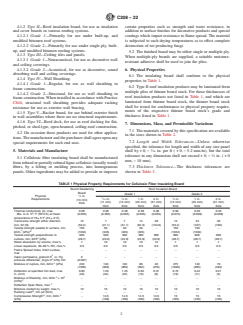
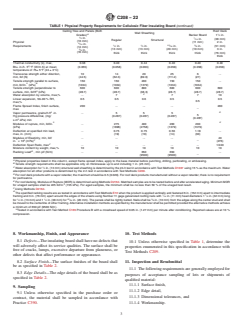
6.1 The insulating board shall conform to the physical properties in Table 1.
1 1
6.2 Roof products with a thickness of 1 in., 1Type II roof insulation products may be laminated from multiple plies of ⁄2 in., 2 ⁄2
in. (25 mm, 38 mm, 64 mm), or greater, are post-laminated using thinner board stock whose properties are covered thinner board
stock. For those thicknesses of roof insulation products not listed in Table 1. When laminated, tests shall be performed on the thin
board stock. , and which are laminated from thinner board stock, the thinner board stock shall be tested for conformance to physical
property requirements of the respective thinner board stock’s grade and thickness listed in Table 1.
7. Dimensions, Mass, and Permissible Variations
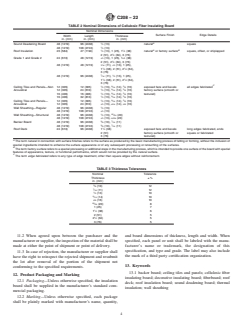
7.1 The materials covered by this specification are available in the sizes shown in Table 2.
7.2 Length and Width Tolerances—Unless otherwise specified, the tolerance for length and width of any size panel shall
1 3
by + 0, − ⁄16 in. per ft ( + 0, − 5.2 mm ⁄m), but the total tolerance in any dimension sh
...