

ASTM C1850-17(2021)
(Guide)Standard Guide for Improved Laboratory Accelerated Tests to Predict the Weathering and for Use in Developing Protocols to Predict the Design Life of Building Sealant Systems
General Information
- Abstract
SIGNIFICANCE AND USE
4.1 This guide is intended to serve as a reference of recommended methodology for users developing relevant, reliable and valid tests for predicting natural weathering effects and for use in developing methods to determine design life of building sealant systems through the use of accelerated test protocols. The proposed standard corrects for some of the deficiencies of existing laboratory accelerated tests of sealants.
4.2 The development of accelerated weathering tests capable of being used in protocols to reliably and accurately predict the long-term in-service performance of building sealant systems have limitations due to:
4.2.1 The external factors that affect functional properties, which are numerous and require effort to quantify, so that many existing accelerated procedures do not include all factors of importance, and
4.2.2 The sealant specimens are often tested in configurations different from those used in-service.
SCOPE
1.1 This guide describes the steps for developing improved laboratory accelerated weathering tests for predicting the natural weathering effects on building sealant systems and for using those tests in development of methods for design life prediction of the systems.
1.2 This guide outlines a systematic approach to development of laboratory accelerated weathering tests of building sealant systems including the identification of needed information, the development of accelerated tests, the application of data, and the reporting of results.
1.3 This international standard was developed in accordance with internationally recognized principles on standardization established in the Decision on Principles for the Development of International Standards, Guides and Recommendations issued by the World Trade Organization Technical Barriers to Trade (TBT) Committee.
- Status
- Published
- Publication Date
- 30-Apr-2021
- Technical Committee
- C24 - Building Seals and Sealants
- Drafting Committee
- C24.20 - General Test Methods
Overview
ASTM C1850-17(2021), published by ASTM International, provides a comprehensive guide for developing improved laboratory accelerated tests to predict natural weathering effects and to formulate protocols for estimating the design life of building sealant systems. This standard addresses limitations found in traditional accelerated weathering tests, delivering a systematic methodology that enhances the reliability and validity of such predictions. By guiding test developers and product evaluators, this standard contributes significantly to the durability assessment and longevity planning of sealant systems in construction.
Key Topics
- Development of Accelerated Weathering Tests: Outlines recommended steps for creating laboratory tests that simulate natural environmental conditions impacting building sealants.
- Identification of Degradation Factors: Highlights the importance of recognizing all critical degradation mechanisms, including weathering, chemical, biological, mechanical, incompatibility, and use factors.
- Establishing Performance Criteria: Focuses on determining and measuring critical performance characteristics and minimum acceptable levels for in-service durability.
- Data Application and Reporting: Recommends mathematical approaches for comparing laboratory and in-service degradation rates and provides guidance on comprehensive result reporting.
- Systematic Testing Procedures: Describes pre-testing, in-service testing, and laboratory procedures to accurately estimate design life and assess relative durability.
- International Standardization: Developed in alignment with World Trade Organization principles, ensuring global relevance and cross-border acceptance.
Applications
ASTM C1850-17(2021) is highly valuable for stakeholders in the building and construction industry looking to predict the long-term performance of building sealant systems under various environmental conditions. Key practical applications include:
- Product Development: Manufacturers can improve sealant formulations by closely simulating real-world degradation factors in laboratory settings, leading to more durable products.
- Quality Assurance and Specification: Building owners and specifiers can use data from standardized accelerated weathering tests to compare products, establish quality benchmarks, and make informed selection decisions.
- Risk Mitigation and Maintenance Planning: Facilities managers are better equipped to anticipate maintenance needs and plan replacement cycles based on test-driven design life estimates.
- Regulatory Compliance: Demonstrates adherence to internationally recognized testing protocols, facilitating acceptance in global markets and supporting compliance with building codes.
- Research and Innovation: Provides a framework for academic and industrial research focused on understanding material degradation mechanisms and developing next-generation sealant systems.
Related Standards
When applying ASTM C1850-17(2021), it is beneficial to consider the following related ASTM standards:
- ASTM C717: Terminology of Building Seals and Sealants - Provides definitions critical to understanding concepts within ASTM C1850.
- ASTM G113: Terminology Relating to Natural and Artificial Weathering Tests of Nonmetallic Materials - Offers foundational terminology for weathering tests applied to sealants and similar materials.
- Other construction and weathering-related standards that detail specific test methods for building materials.
By adopting ASTM C1850-17(2021), organizations standardize the prediction of weathering impacts and sealant longevity, leading to improved building envelope performance and extended service life. This guide is an essential tool for anyone involved in the laboratory assessment and lifecycle forecasting of building sealant systems.
Relations
- Effective Date
- 01-Mar-2019
- Effective Date
- 01-Mar-2018
- Effective Date
- 01-Nov-2017
- Effective Date
- 01-Jan-2017
- Effective Date
- 15-Nov-2016
- Effective Date
- 01-Sep-2016
- Effective Date
- 01-May-2014
- Effective Date
- 01-Mar-2014
- Effective Date
- 01-Feb-2014
- Effective Date
- 01-Nov-2013
- Effective Date
- 01-Dec-2012
- Effective Date
- 01-May-2012
- Effective Date
- 15-Jan-2012
- Effective Date
- 01-Mar-2011
- Effective Date
- 15-Jan-2011
Get Certified
Connect with accredited certification bodies for this standard

DIBt (Deutsches Institut für Bautechnik)
German Institute for Building Technology.
DIN CERTCO
DIN Group product certification.

Aboma Certification B.V.
Specialized in construction, metal, and transport sectors.
Sponsored listings
Frequently Asked Questions
ASTM C1850-17(2021) is a guide published by ASTM International. Its full title is "Standard Guide for Improved Laboratory Accelerated Tests to Predict the Weathering and for Use in Developing Protocols to Predict the Design Life of Building Sealant Systems". This standard covers: SIGNIFICANCE AND USE 4.1 This guide is intended to serve as a reference of recommended methodology for users developing relevant, reliable and valid tests for predicting natural weathering effects and for use in developing methods to determine design life of building sealant systems through the use of accelerated test protocols. The proposed standard corrects for some of the deficiencies of existing laboratory accelerated tests of sealants. 4.2 The development of accelerated weathering tests capable of being used in protocols to reliably and accurately predict the long-term in-service performance of building sealant systems have limitations due to: 4.2.1 The external factors that affect functional properties, which are numerous and require effort to quantify, so that many existing accelerated procedures do not include all factors of importance, and 4.2.2 The sealant specimens are often tested in configurations different from those used in-service. SCOPE 1.1 This guide describes the steps for developing improved laboratory accelerated weathering tests for predicting the natural weathering effects on building sealant systems and for using those tests in development of methods for design life prediction of the systems. 1.2 This guide outlines a systematic approach to development of laboratory accelerated weathering tests of building sealant systems including the identification of needed information, the development of accelerated tests, the application of data, and the reporting of results. 1.3 This international standard was developed in accordance with internationally recognized principles on standardization established in the Decision on Principles for the Development of International Standards, Guides and Recommendations issued by the World Trade Organization Technical Barriers to Trade (TBT) Committee.
SIGNIFICANCE AND USE 4.1 This guide is intended to serve as a reference of recommended methodology for users developing relevant, reliable and valid tests for predicting natural weathering effects and for use in developing methods to determine design life of building sealant systems through the use of accelerated test protocols. The proposed standard corrects for some of the deficiencies of existing laboratory accelerated tests of sealants. 4.2 The development of accelerated weathering tests capable of being used in protocols to reliably and accurately predict the long-term in-service performance of building sealant systems have limitations due to: 4.2.1 The external factors that affect functional properties, which are numerous and require effort to quantify, so that many existing accelerated procedures do not include all factors of importance, and 4.2.2 The sealant specimens are often tested in configurations different from those used in-service. SCOPE 1.1 This guide describes the steps for developing improved laboratory accelerated weathering tests for predicting the natural weathering effects on building sealant systems and for using those tests in development of methods for design life prediction of the systems. 1.2 This guide outlines a systematic approach to development of laboratory accelerated weathering tests of building sealant systems including the identification of needed information, the development of accelerated tests, the application of data, and the reporting of results. 1.3 This international standard was developed in accordance with internationally recognized principles on standardization established in the Decision on Principles for the Development of International Standards, Guides and Recommendations issued by the World Trade Organization Technical Barriers to Trade (TBT) Committee.
ASTM C1850-17(2021) is classified under the following ICS (International Classification for Standards) categories: 91.100.50 - Binders. Sealing materials. The ICS classification helps identify the subject area and facilitates finding related standards.
ASTM C1850-17(2021) has the following relationships with other standards: It is inter standard links to ASTM C717-19, ASTM C717-18, ASTM C717-17a, ASTM C717-17, ASTM C717-16a, ASTM C717-16, ASTM C717-14a, ASTM G113-14, ASTM C717-14, ASTM C717-13, ASTM C717-12b, ASTM C717-12a, ASTM C717-12, ASTM C717-11a, ASTM C717-11. Understanding these relationships helps ensure you are using the most current and applicable version of the standard.
ASTM C1850-17(2021) is available in PDF format for immediate download after purchase. The document can be added to your cart and obtained through the secure checkout process. Digital delivery ensures instant access to the complete standard document.
Standards Content (Sample)
This international standard was developed in accordance with internationally recognized principles on standardization established in the Decision on Principles for the
Development of International Standards, Guides and Recommendations issued by the World Trade Organization Technical Barriers to Trade (TBT) Committee.
Designation:C1850 −17 (Reapproved 2021)
Standard Guide for
Improved Laboratory Accelerated Tests to Predict the
Weathering and for Use in Developing Protocols to Predict
the Design Life of Building Sealant Systems
This standard is issued under the fixed designation C1850; the number immediately following the designation indicates the year of
original adoption or, in the case of revision, the year of last revision. A number in parentheses indicates the year of last reapproval. A
superscript epsilon (´) indicates an editorial change since the last revision or reapproval.
1. Scope 3.2.2 building sealant system component—a part of a build-
ing sealant system that may include a combination of building
1.1 This guide describes the steps for developing improved
materials, such as cladding, substrates or the sealant.
laboratory accelerated weathering tests for predicting the
3.2.3 building sealant system material—a material that may
natural weathering effects on building sealant systems and for
be used in a building sealant system.
using those tests in development of methods for design life
prediction of the systems.
3.2.4 critical performance characteristic(s)—a property, or
group of properties, of a building sealant system that must be
1.2 This guide outlines a systematic approach to develop-
maintained above a certain minimum level.
ment of laboratory accelerated weathering tests of building
sealant systems including the identification of needed
3.2.5 degradation mechanism—the chemical reactions in-
information, the development of accelerated tests, the applica-
duced in a building component or material by one or more
tion of data, and the reporting of results.
degradation factors resulting in changes in one or more of the
critical performance characteristics.
1.3 This international standard was developed in accor-
dance with internationally recognized principles on standard-
3.2.6 incompatibility factor—any of the group of degrada-
ization established in the Decision on Principles for the
tion factors that result from detrimental chemical and physical
Development of International Standards, Guides and Recom-
interactions between building components or materials.
mendations issued by the World Trade Organization Technical
3.2.7 in-service test—a test in which building components
Barriers to Trade (TBT) Committee.
ormaterialsareexposedtodegradationfactorsunderin-service
conditions.
2. Referenced Documents
2 3.2.8 performance criterion—a quantitative statement of a
2.1 ASTM Standards:
level of properties for a selected characteristic of a component
C717 Terminology of Building Seals and Sealants
or material needed to ensure compliance with a functional
G113 Terminology Relating to Natural andArtificial Weath-
requirement.
ering Tests of Nonmetallic Materials
3.2.9 property measurement test—a test for measuring one
3. Terminology
or more properties of building components or materials.
3.1 Definitions—For definitions of terms used in this guide,
3.2.10 load stress factor—anydegradationfactorsthatresult
refer to Terminologies C717 and G113.
fromexternallyappliedsustainedorperiodicmechanicalloads.
3.2 Definitions of Terms Specific to This Standard:
3.2.11 use factor—any factor that affects the material as a
3.2.1 biological degradation factor—degradation factors di-
result of the design of the system, installation and maintenance
rectly associated with living organisms, including
procedures, normal wear and tear, and user abuse. (Example:
microorganisms, fungi, and bacteria.
abrasion of foot traffic.)
3.2.12 weathering factors—any degradation factors associ-
ThisguideisunderthejurisdictionofASTMCommitteeC24onBuildingSeals
ated with the natural environment, including radiation,
and Sealants and is the direct responsibility of Subcommittee C24.20 on General
temperature, rain and other forms of water, freezing and
Test Methods.
thawing.
Current edition approved May 1, 2021. Published May 2021. Originally
approved in 2017. Last previous edition approved in 2017 as C1850–17. DOI:
4. Significance and Use
10.1520/C1850-17R21.
For referenced ASTM standards, visit the ASTM website, www.astm.org, or
4.1 This guide is intended to serve as a reference of
contact ASTM Customer Service at service@astm.org. For Annual Book of ASTM
recommended methodology for users developing relevant,
Standards volume information, refer to the standard’s Document Summary page on
the ASTM website. reliable and valid tests for predicting natural weathering effects
Copyright © ASTM International, 100 Barr Harbor Drive, PO Box C700, West Conshohocken, PA 19428-2959. United States
C1850−17 (2021)
and for use in developing methods to determine design life of on sealants and for use in development of methods for
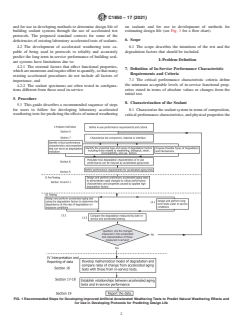
building sealant systems through the use of accelerated test estimating design life (see Fig. 1 for a flow chart).
protocols. The proposed standard corrects for some of the
6. Scope
deficiencies of existing laboratory accelerated tests of sealants.
6.1 The scope describes the intentions of the test and the
4.2 The development of accelerated weathering tests ca-
degradation factors that should be included.
pable of being used in protocols to reliably and accurately
predict the long-term in-service performance of building seal-
I–Problem Definition
ant systems have limitations due to:
4.2.1 The external factors that affect functional properties,
7. Definition of In-Service Performance Characteristic
whicharenumerousandrequireefforttoquantify,sothatmany
Requirements and Criteria
existing accelerated procedures do not include all factors of
7.1 The critical performance characteristic criteria define
importance, and
the minimum acceptable levels of in-service functional prop-
4.2.2 The sealant specimens are often tested in configura-
erties stated in terms of absolute values or changes from the
tions different from those used in-service.
initial test.
5. Procedure
8. Characterization of the Sealant
5.1 This guide describes a recommended sequence of steps
for users to follow for developing laboratory accelerated 8.1 Characterize the sealant system in terms of composition,
weathering tests for predicting the effects of natural weathering critical performance characteristics, and physical properties the
FIG. 1Recommended Steps for Developing Improved Artificial Accelerated Weathering Tests to Predict Natural Weathering Effects and
for Use in Developing Protocols for Predicting Design Life
C1850−17 (2021)
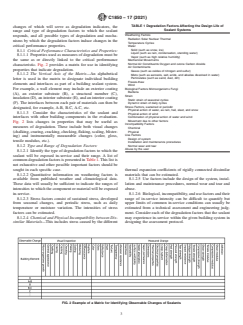
TABLE 1 Degradation Factors Affecting the Design Life of
changes of which will serve as degradation indicators, the
Sealant Systems
range and type of degradation factors to which the sealant
Weathering Factors
responds, and all possible types of degradation and mecha-
Radiation Solar Nuclear Thermal
nisms by which the degradation factors induce changes in the
Temperature Cycles
critical performance properties.
Water
Solid (such as snow, ice)
8.1.1 Critical Performance Characteristics and Properties:
Liquid (such as rain, condensation, standing water)
8.1.1.1 Properties used as measures of degradation must be
Vapor (such as high relative humidity)
the same as or directly linked to the critical performance Mechanical Movements
Normal Air Constituents Oxygen and ozone Carbon dioxide
characteristic. Fig. 2 provides a matrix for use in identifying
Air Contaminants
properties that indicate degradation.
Gases (such as oxides of nitrogen and sulfur)
8.1.1.2 The Vertical Axis of the Matrix—An alphabetical Mists (such as aerosols, salt, acids, and alkalies dissolved in water)
Particulates (such as sand, dust, dirt)
letter is used in the matrix to designate individual building
Freeze-thaw
elements and interfaces as part of a building sealant system.
Wind
For example, a wall element may include an exterior coating Biological Factors Microorganisms Fungi
Bacteria
(A), an exterior substrate (B), a structural member (C),
Strain
insulation (D), an interior substrate (E), and an interior coating
Static strain of seasonal cycles
(F). The interfaces between each pair of materials can then be Dynamic strain of daily cycles
Stress Factors, sustained or periodic
designated, for example, A-B, B-C, A-C, etc.
Physical action of water, as rain, hail, sleet, and snow
8.1.1.3 Consider the characteristics of the sealant and
Physical action of wind
interfaces with other building components in the evaluation. Combination of physical action of water and wind
Movement due to other factors
Fig. 2 lists changes in properties that may be useful as
Incompatibility Factors
measures of degradation. These include both visual changes
Chemical
Physical
(chalking, crazing, cracking, checking, flaking, scaling, blister-
Use Factors
ing) and instrumentally measurable changes (color, gloss,
Design of system
tensile modulus, etc.).
Installation and maintenance procedures
8.1.2 Type and Range of Degradation Factors: Normal wear and tear
Abuse by the user
8.1.2.1 Identify the type of degradation factors to which the
sealant will be exposed in-service and their range. A list of
common degradation factors is presented in Table 1.This list is
not exhaustive and other possible important factors should be
sought in each specific case. thermal expansion coefficients of rigidly connected dissimilar
8.1.2.2 Quantitative information on weathering factors is materials that can be estimated.
available from published weather and climatological data. 8.1.2.5 Use factors include the design of the system, instal-
These data will usually be sufficient to indicate the ranges of lation and maintenance procedures, normal wear and tear and
intensities to which the component or material will be exposed
abuse.
in-service. 8.1.2.6 Biological, incompatibility, and use factors and their
8.1.2.3 Stress factors consist of sustained stress, developed range of in-service intensity can be difficult to quantify but
from seasonal changes, and periodic stress, such as daily upper limits of common in-service conditions can usually be
temperature or moisture variation. The intensities of stress estimated from a technical assessment and engineering judg-
factors can be estimated. ment. Consider each of the degradation factors that the sealant
8.1.2.4 Chemical andPhysicalIncompatibilitybetweenDis- may experience in-service within the given building system in
similar Materials—This includes stress caused by the different designing the assessment protocol.
FIG. 2Example of a Matrix for Identifying Observable Changes of Sealants
C1850−17 (2021)
8.1.3 Postulation of Types of Degradation—This step of the warm, moist locations; chemical incompatibility may only be
...