

ASTM D7206/D7206M-19
(Guide)Standard Guide for Cyclic Deactivation of Fluid Catalytic Cracking (FCC) Catalysts with Metals
General Information
- Abstract
SIGNIFICANCE AND USE
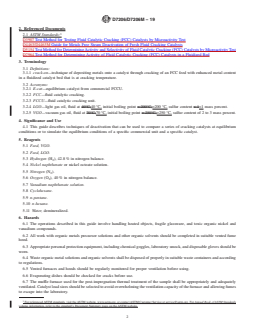
4.1 This guide describes techniques of deactivation that can be used to compare a series of cracking catalysts at equilibrium conditions or to simulate the equilibrium conditions of a specific commercial unit and a specific catalyst.
SCOPE
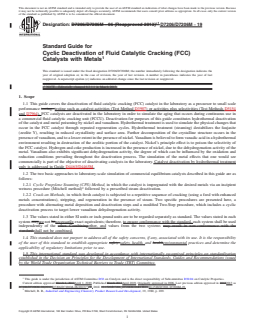
1.1 This guide covers the deactivation of fluid catalytic cracking (FCC) catalyst in the laboratory as a precursor to small scale performance testing such as catalyst activities (Test Method D3907) or activities plus selectivities (Test Methods D5154 and D7964). FCC catalysts are deactivated in the laboratory in order to simulate the aging that occurs during continuous use in a commercial fluid catalytic cracking unit (FCCU). Deactivation for purposes of this guide constitutes hydrothermal deactivation of the catalyst and metal poisoning by nickel and vanadium. Hydrothermal treatment is used to simulate the physical changes that occur in the FCC catalyst through repeated regeneration cycles. Hydrothermal treatment (steaming) destabilizes the faujasite (zeolite Y), resulting in reduced crystallinity and surface area. Further decomposition of the crystalline structure occurs in the presence of vanadium, and to a lesser extent in the presence of nickel. Vanadium is believed to form vanadic acid in a hydrothermal environment resulting in destruction of the zeolitic portion of the catalyst. Nickel’s principle effect is to poison the selectivity of the FCC catalyst. Hydrogen and coke production is increased in the presence of nickel, due to the dehydrogenation activity of the metal. Vanadium also exhibits significant dehydrogenation activity, the degree of which can be influenced by the oxidation and reduction conditions prevailing throughout the deactivation process. The simulation of the metal effects that one would see commercially is part of the objective of deactivating catalysts in the laboratory. Catalyst deactivation by hydrothermal treatment only is addressed in Guide D4463/D4463M.
1.2 The two basic approaches to laboratory-scale simulation of commercial equilibrium catalysts described in this guide are as follows:
1.2.1 Cyclic Propylene Steaming (CPS) Method, in which the catalyst is impregnated with the desired metals via an incipient wetness procedure (Mitchell method)2 followed by a prescribed steam deactivation.
1.2.2 Crack-on Methods, in which fresh catalyst is subjected to a repetitive sequence of cracking (using a feed with enhanced metals concentrations), stripping, and regeneration in the presence of steam. Two specific procedures are presented here, a procedure with alternating metal deposition and deactivation steps and a modified Two-Step procedure, which includes a cyclic deactivation process to target lower vanadium dehydrogenation activity.
1.3 The values stated in either SI units or inch-pound units are to be regarded separately as standard. The values stated in each system are not necessarily exact equivalents; therefore, to ensure conformance with the standard, each system shall be used independently of the other, and values from the two systems shall not be combined.
1.4 This standard does not purport to address all of the safety concerns, if any, associated with its use. It is the responsibility of the user of this standard to establish appropriate safety, health, and environmental practices and determine the applicability of regulatory limitations prior to use.
1.5 This international standard was developed in accordance with internationally recognized principles on standardization established in the Decision on Principles for the Development of International Standards, Guides and Recommendations issued by the World Trade Organization Technical Barriers to Trade (TBT) Committee.
- Status
- Published
- Publication Date
- 31-Mar-2019
- Technical Committee
- D32 - Catalysts
- Drafting Committee
- D32.04 - Catalytic Properties
Buy Documents
ASTM D7206/D7206M-19 - Standard Guide for Cyclic Deactivation of Fluid Catalytic Cracking (FCC) Catalysts with Metals
REDLINE ASTM D7206/D7206M-19 - Standard Guide for Cyclic Deactivation of Fluid Catalytic Cracking (FCC) Catalysts with Metals
Overview
ASTM D7206/D7206M-19 is the standard guide published by ASTM International that details laboratory techniques for the cyclic deactivation of fluid catalytic cracking (FCC) catalysts with metals, such as nickel and vanadium. FCC catalysts are fundamental in the petroleum refining process, enabling the breakdown of heavy hydrocarbons into lighter, more valuable fractions like gasoline and olefins. Over their operational lifespan, these catalysts undergo deactivation due to hydrothermal conditions and metal contamination, which adversely affect catalyst activity and selectivity.
This guide provides standardized methodologies to simulate the performance and aging of commercial FCC catalysts under laboratory conditions. By mirroring the exposure to hydrothermal stress and metal poisoning experienced in a commercial fluid catalytic cracking unit (FCCU), laboratories can evaluate catalyst formulations, compare performance, and predict catalyst lifetimes.
Key Topics
- Simulation of Catalyst Aging: Details laboratory-scale procedures for replicating the deactivation mechanisms-hydrothermal and metallic-that FCC catalysts face in operational refinery environments.
- Types of Deactivation: Focuses on deterioration from steam (hydrothermal treatment) causing structural changes, and the impact of metals, particularly nickel and vanadium, on catalyst performance.
- Experimental Procedures: Describes two core approaches:
- Cyclic Propylene Steaming (CPS) Method: Involves metal impregnation followed by steam deactivation.
- Crack-on Methods: Involve repetitive cracking, stripping, and regeneration cycles using feeds enhanced with metals.
- Evaluation Ready Samples: Outlines how to prepare catalysts for further performance tests, such as activity and selectivity assessments per referenced ASTM methods.
- Safety and Good Laboratory Practices: Emphasizes the handling of hazardous reagents, equipment safety, waste disposal, and regulatory compliance.
Applications
- Refinery Catalyst Evaluation: Enables refiners and catalyst manufacturers to assess new or modified FCC catalysts under conditions that closely emulate those in commercial FCCUs.
- Research and Development: Supports catalyst R&D by providing standardized protocols for simulating product lifetimes and identifying catalyst resilience to deactivation.
- Quality Assurance and Benchmarking: Facilitates direct comparison between batches of FCC catalysts or between competitor products under consistent laboratory conditions.
- Process Optimization: Guides operational decisions in refineries by simulating the effects of different metal contamination scenarios and enabling informed catalyst selection.
Related Standards
- ASTM D3907: Test Method for Testing Fluid Catalytic Cracking (FCC) Catalysts by Microactivity Test
- ASTM D5154: Test Method for Determining Activity and Selectivity of FCC Catalysts by Microactivity Test
- ASTM D7964: Test Method for Determining Activity of FCC Catalysts in a Fluidized Bed
- ASTM D4463/D4463M: Guide for Metals-Free Steam Deactivation of Fresh Fluid Cracking Catalysts
Practical Value
Compliance with ASTM D7206/D7206M-19 enhances the credibility, safety, and reliability of FCC catalyst testing across research, manufacturing, and production environments. By following this standard, users ensure consistent catalyst deactivation methodologies, optimize catalyst performance evaluation, and minimize risks associated with laboratory operations. This standard is vital for laboratories and refineries seeking ISO, regulatory, or internal quality compliance in catalyst testing and performance validation.
Relations
- Effective Date
- 01-Apr-2019
- Effective Date
- 01-Apr-2012
- Effective Date
- 01-Apr-2010
- Effective Date
- 01-Apr-2008
- Effective Date
- 01-Oct-2005
- Effective Date
- 01-Oct-2003
- Effective Date
- 01-Oct-2003
- Effective Date
- 01-Apr-2019
Buy Documents
ASTM D7206/D7206M-19 - Standard Guide for Cyclic Deactivation of Fluid Catalytic Cracking (FCC) Catalysts with Metals
REDLINE ASTM D7206/D7206M-19 - Standard Guide for Cyclic Deactivation of Fluid Catalytic Cracking (FCC) Catalysts with Metals
Get Certified
Connect with accredited certification bodies for this standard

ECOCERT
Organic and sustainability certification.

Eurofins Food Testing Global
Global leader in food, environment, and pharmaceutical product testing.

Intertek Bangladesh
Intertek certification and testing services in Bangladesh.
Sponsored listings
Frequently Asked Questions
ASTM D7206/D7206M-19 is a guide published by ASTM International. Its full title is "Standard Guide for Cyclic Deactivation of Fluid Catalytic Cracking (FCC) Catalysts with Metals". This standard covers: SIGNIFICANCE AND USE 4.1 This guide describes techniques of deactivation that can be used to compare a series of cracking catalysts at equilibrium conditions or to simulate the equilibrium conditions of a specific commercial unit and a specific catalyst. SCOPE 1.1 This guide covers the deactivation of fluid catalytic cracking (FCC) catalyst in the laboratory as a precursor to small scale performance testing such as catalyst activities (Test Method D3907) or activities plus selectivities (Test Methods D5154 and D7964). FCC catalysts are deactivated in the laboratory in order to simulate the aging that occurs during continuous use in a commercial fluid catalytic cracking unit (FCCU). Deactivation for purposes of this guide constitutes hydrothermal deactivation of the catalyst and metal poisoning by nickel and vanadium. Hydrothermal treatment is used to simulate the physical changes that occur in the FCC catalyst through repeated regeneration cycles. Hydrothermal treatment (steaming) destabilizes the faujasite (zeolite Y), resulting in reduced crystallinity and surface area. Further decomposition of the crystalline structure occurs in the presence of vanadium, and to a lesser extent in the presence of nickel. Vanadium is believed to form vanadic acid in a hydrothermal environment resulting in destruction of the zeolitic portion of the catalyst. Nickel’s principle effect is to poison the selectivity of the FCC catalyst. Hydrogen and coke production is increased in the presence of nickel, due to the dehydrogenation activity of the metal. Vanadium also exhibits significant dehydrogenation activity, the degree of which can be influenced by the oxidation and reduction conditions prevailing throughout the deactivation process. The simulation of the metal effects that one would see commercially is part of the objective of deactivating catalysts in the laboratory. Catalyst deactivation by hydrothermal treatment only is addressed in Guide D4463/D4463M. 1.2 The two basic approaches to laboratory-scale simulation of commercial equilibrium catalysts described in this guide are as follows: 1.2.1 Cyclic Propylene Steaming (CPS) Method, in which the catalyst is impregnated with the desired metals via an incipient wetness procedure (Mitchell method)2 followed by a prescribed steam deactivation. 1.2.2 Crack-on Methods, in which fresh catalyst is subjected to a repetitive sequence of cracking (using a feed with enhanced metals concentrations), stripping, and regeneration in the presence of steam. Two specific procedures are presented here, a procedure with alternating metal deposition and deactivation steps and a modified Two-Step procedure, which includes a cyclic deactivation process to target lower vanadium dehydrogenation activity. 1.3 The values stated in either SI units or inch-pound units are to be regarded separately as standard. The values stated in each system are not necessarily exact equivalents; therefore, to ensure conformance with the standard, each system shall be used independently of the other, and values from the two systems shall not be combined. 1.4 This standard does not purport to address all of the safety concerns, if any, associated with its use. It is the responsibility of the user of this standard to establish appropriate safety, health, and environmental practices and determine the applicability of regulatory limitations prior to use. 1.5 This international standard was developed in accordance with internationally recognized principles on standardization established in the Decision on Principles for the Development of International Standards, Guides and Recommendations issued by the World Trade Organization Technical Barriers to Trade (TBT) Committee.
SIGNIFICANCE AND USE 4.1 This guide describes techniques of deactivation that can be used to compare a series of cracking catalysts at equilibrium conditions or to simulate the equilibrium conditions of a specific commercial unit and a specific catalyst. SCOPE 1.1 This guide covers the deactivation of fluid catalytic cracking (FCC) catalyst in the laboratory as a precursor to small scale performance testing such as catalyst activities (Test Method D3907) or activities plus selectivities (Test Methods D5154 and D7964). FCC catalysts are deactivated in the laboratory in order to simulate the aging that occurs during continuous use in a commercial fluid catalytic cracking unit (FCCU). Deactivation for purposes of this guide constitutes hydrothermal deactivation of the catalyst and metal poisoning by nickel and vanadium. Hydrothermal treatment is used to simulate the physical changes that occur in the FCC catalyst through repeated regeneration cycles. Hydrothermal treatment (steaming) destabilizes the faujasite (zeolite Y), resulting in reduced crystallinity and surface area. Further decomposition of the crystalline structure occurs in the presence of vanadium, and to a lesser extent in the presence of nickel. Vanadium is believed to form vanadic acid in a hydrothermal environment resulting in destruction of the zeolitic portion of the catalyst. Nickel’s principle effect is to poison the selectivity of the FCC catalyst. Hydrogen and coke production is increased in the presence of nickel, due to the dehydrogenation activity of the metal. Vanadium also exhibits significant dehydrogenation activity, the degree of which can be influenced by the oxidation and reduction conditions prevailing throughout the deactivation process. The simulation of the metal effects that one would see commercially is part of the objective of deactivating catalysts in the laboratory. Catalyst deactivation by hydrothermal treatment only is addressed in Guide D4463/D4463M. 1.2 The two basic approaches to laboratory-scale simulation of commercial equilibrium catalysts described in this guide are as follows: 1.2.1 Cyclic Propylene Steaming (CPS) Method, in which the catalyst is impregnated with the desired metals via an incipient wetness procedure (Mitchell method)2 followed by a prescribed steam deactivation. 1.2.2 Crack-on Methods, in which fresh catalyst is subjected to a repetitive sequence of cracking (using a feed with enhanced metals concentrations), stripping, and regeneration in the presence of steam. Two specific procedures are presented here, a procedure with alternating metal deposition and deactivation steps and a modified Two-Step procedure, which includes a cyclic deactivation process to target lower vanadium dehydrogenation activity. 1.3 The values stated in either SI units or inch-pound units are to be regarded separately as standard. The values stated in each system are not necessarily exact equivalents; therefore, to ensure conformance with the standard, each system shall be used independently of the other, and values from the two systems shall not be combined. 1.4 This standard does not purport to address all of the safety concerns, if any, associated with its use. It is the responsibility of the user of this standard to establish appropriate safety, health, and environmental practices and determine the applicability of regulatory limitations prior to use. 1.5 This international standard was developed in accordance with internationally recognized principles on standardization established in the Decision on Principles for the Development of International Standards, Guides and Recommendations issued by the World Trade Organization Technical Barriers to Trade (TBT) Committee.
ASTM D7206/D7206M-19 is classified under the following ICS (International Classification for Standards) categories: 71.040.30 - Chemical reagents. The ICS classification helps identify the subject area and facilitates finding related standards.
ASTM D7206/D7206M-19 has the following relationships with other standards: It is inter standard links to ASTM D7206/D7206M-06(2013)e1, ASTM D4463/D4463M-96(2012)e1, ASTM D5154-10, ASTM D3907-03(2008), ASTM D5154-05, ASTM D5154-03, ASTM D3907-03, ASTM D4463/D4463M-19. Understanding these relationships helps ensure you are using the most current and applicable version of the standard.
ASTM D7206/D7206M-19 is available in PDF format for immediate download after purchase. The document can be added to your cart and obtained through the secure checkout process. Digital delivery ensures instant access to the complete standard document.
Standards Content (Sample)
This international standard was developed in accordance with internationally recognized principles on standardization established in the Decision on Principles for the
Development of International Standards, Guides and Recommendations issued by the World Trade Organization Technical Barriers to Trade (TBT) Committee.
Designation: D7206/D7206M − 19
Standard Guide for
Cyclic Deactivation of Fluid Catalytic Cracking (FCC)
Catalysts with Metals
This standard is issued under the fixed designation D7206/D7206M; the number immediately following the designation indicates the
year of original adoption or, in the case of revision, the year of last revision. A number in parentheses indicates the year of last
reapproval. A superscript epsilon (´) indicates an editorial change since the last revision or reapproval.
1. Scope incipient wetness procedure (Mitchell method) followed by a
prescribed steam deactivation.
1.1 This guide covers the deactivation of fluid catalytic
1.2.2 Crack-onMethods,inwhichfreshcatalystissubjected
cracking (FCC) catalyst in the laboratory as a precursor to
to a repetitive sequence of cracking (using a feed with
small scale performance testing such as catalyst activities (Test
enhancedmetalsconcentrations),stripping,andregenerationin
Method D3907) or activities plus selectivities (Test Methods
the presence of steam. Two specific procedures are presented
D5154 and D7964). FCC catalysts are deactivated in the
here, a procedure with alternating metal deposition and deac-
laboratory in order to simulate the aging that occurs during
tivation steps and a modified Two-Step procedure, which
continuous use in a commercial fluid catalytic cracking unit
includesacyclicdeactivationprocesstotargetlowervanadium
(FCCU). Deactivation for purposes of this guide constitutes
dehydrogenation activity.
hydrothermal deactivation of the catalyst and metal poisoning
by nickel and vanadium. Hydrothermal treatment is used to 1.3 The values stated in either SI units or inch-pound units
simulate the physical changes that occur in the FCC catalyst are to be regarded separately as standard. The values stated in
through repeated regeneration cycles. Hydrothermal treatment each system are not necessarily exact equivalents; therefore, to
(steaming) destabilizes the faujasite (zeolite Y), resulting in ensure conformance with the standard, each system shall be
reduced crystallinity and surface area. Further decomposition used independently of the other, and values from the two
of the crystalline structure occurs in the presence of vanadium, systems shall not be combined.
and to a lesser extent in the presence of nickel. Vanadium is
1.4 This standard does not purport to address all of the
believed to form vanadic acid in a hydrothermal environment
safety concerns, if any, associated with its use. It is the
resulting in destruction of the zeolitic portion of the catalyst.
responsibility of the user of this standard to establish appro-
Nickel’s principle effect is to poison the selectivity of the FCC
priate safety, health, and environmental practices and deter-
catalyst. Hydrogen and coke production is increased in the
mine the applicability of regulatory limitations prior to use.
presence of nickel, due to the dehydrogenation activity of the
1.5 This international standard was developed in accor-
metal. Vanadium also exhibits significant dehydrogenation
dance with internationally recognized principles on standard-
activity,thedegreeofwhichcanbeinfluencedbytheoxidation
ization established in the Decision on Principles for the
and reduction conditions prevailing throughout the deactiva-
Development of International Standards, Guides and Recom-
tionprocess.Thesimulationofthemetaleffectsthatonewould
mendations issued by the World Trade Organization Technical
see commercially is part of the objective of deactivating
Barriers to Trade (TBT) Committee.
catalysts in the laboratory. Catalyst deactivation by hydrother-
mal treatment only is addressed in Guide D4463/D4463M.
2. Referenced Documents
1.2 The two basic approaches to laboratory-scale simulation
2.1 ASTM Standards:
of commercial equilibrium catalysts described in this guide are
D3907 Test Method for Testing Fluid Catalytic Cracking
as follows:
(FCC) Catalysts by Microactivity Test
1.2.1 Cyclic Propylene Steaming (CPS) Method, in which
D4463/D4463M Guide for Metals Free Steam Deactivation
the catalyst is impregnated with the desired metals via an
Mitchell, B. R., Industrial and Engineering Chemistry Product Research and
This guide is under the jurisdiction ofASTM Committee D32 on Catalysts and Development, 19, 1980, p. 209.
is the direct responsibility of Subcommittee D32.04 on Catalytic Properties. For referenced ASTM standards, visit the ASTM website, www.astm.org, or
Current edition approved April 1, 2019. Published April 2019. Originally contact ASTM Customer Service at service@astm.org. For Annual Book of ASTM
approved in 2006. Last previous edition approved in 2013 as D7206/ Standards volume information, refer to the standard’s Document Summary page on
ɛ1
D7206M–06(2013) . DOI: 10.1520/D7206_D7206M-19. the ASTM website.
Copyright © ASTM International, 100 Barr Harbor Drive, PO Box C700, West Conshohocken, PA 19428-2959. United States
D7206/D7206M − 19
of Fresh Fluid Cracking Catalysts 6.4 Waste organic metal solutions and organic solvents shall
D5154 TestMethodforDeterminingActivityandSelectivity be disposed of properly in suitable waste containers and
of Fluid Catalytic Cracking (FCC) Catalysts by Microac- according to regulations.
tivity Test
6.5 Vented furnaces and hoods should be regularly moni-
D7964 Test Method for DeterminingActivity of Fluid Cata-
tored for proper ventilation before using.
lytic Cracking (FCC) Catalysts in a Fluidized Bed
6.6 Evaporating dishes should be checked for cracks before
use.
3. Terminology
6.7 The muffle furnace used for the post-impregnation
3.1 Definitions:
thermal treatment of the sample shall be appropriately and
3.1.1 crack-on—technique of depositing metals onto a cata-
adequately ventilated. Catalyst load sizes should be selected to
lyst through cracking of an FCC feed with enhanced metal
avoidoverwhelmingtheventilationcapacityofthefurnaceand
content in a fluidized catalyst bed that is at cracking tempera-
allowing fumes to escape into the laboratory.
ture.
3.2 Acronyms: 6.8 To avoid the potential hazard of explosion in the muffle
3.2.1 E-cat—equilibrium catalyst from commercial FCCU. furnace, impregnated samples shall be completely dry of
pentane prior to beginning the thermal post-treatment.
3.2.2 FCC—fluid catalytic cracking.
6.9 Material safety data sheets (MSDS) for all materials
3.2.3 FCCU—fluid catalytic cracking unit.
used in the deactivation should be read and understood by
3.2.4 LGO—light gas oil, fluid at 40 °C, initial boiling point
operators and should be kept continually available in the
<200 °C, sulfur content <1 mass percent.
laboratory for review.
3.2.5 VGO—vacuum gas oil, fluid at 70 °C, initial boiling
point >250 °C, sulfur content of 2 to 3 mass percent.
7. CPS Method
7.1 Summary of Practice—A fresh FCC catalyst is impreg-
4. Significance and Use
nated with nickel, or vanadium, or both. Nickel and vanadium
4.1 This guide describes techniques of deactivation that can
levels are controlled by a predetermined concentration for the
beusedtocompareaseriesofcrackingcatalystsatequilibrium
sample. The catalyst is wetted with a mixture of pentane and
conditions or to simulate the equilibrium conditions of a
nickel naphthenate, or vanadium naphthenate, or solutions of
specific commercial unit and a specific catalyst.
both and then mixed to dryness. After drying, the sample is
thermally treated to remove residual naphthenates. The sample
5. Reagents
is then ready for hydrothermal treatment as desired.
5.1 Feed, VGO.
7.2 Procedure:
5.2 Feed, LGO.
7.2.1 Catalyst Pre-treatment Before Impregnation—For a
muffle furnace pre-treatment (standard), place the sample in a
5.3 Hydrogen (H ), 42.8 % in nitrogen balance.
dish using a shallow bed ( ⁄2 in. maximum). Calcine the sample
5.4 Nickel naphthenate or nickel octoate solution.
for 1 h at 204 °C [400 °F], then3hat593°C[1100 °F]. The
sample is then removed and allowed to cool to room tempera-
5.5 Nitrogen (N ).
ture. Catalyst should be returned to a sealed container as soon
5.6 Oxygen (O ), 40 % in nitrogen balance.
as it is cool.
5.7 Vanadium naphthenate solution.
7.2.2 Steam Deactivation Pre-treatment—Typical condi-
tions included hydrothermal treatment for2hat816°C
5.8 Cyclohexane.
[1500 °F], 100 % steam, and 0 psi. The catalyst is charged to a
5.9 n-pentane.
pipereactor,fluidizedinair,andthenloweredovera3 hperiod
5.10 n-hexane.
into a 816 °C [1500 °F] sand bath furnace.Air flow is switched
off and steam introduced for 2 h. The reactor is then removed
5.11 Water, demineralized.
from the furnace and allowed to cool to room temperature
under a nitrogen purge.
6. Hazards
7.2.3 Preparation of Nickel and Vanadium Mixture—The
6.1 The operations described in this guide involve handling
desired nickel/vanadium levels are calculated for the quantity
heated objects, fragile glassware, and toxic organic nickel and
of sample to be impregnated. The mass of nickel or vanadium
vanadium compounds.
naphthenate used to obtain the desired levels on the catalyst
6.2 All work with organic metals precursor solutions and sample are determined as follows:
other organic solvents should be completed in suitable vented
N 5 T/S 3W (1)
fume hood.
where:
6.3 Appropriate personal protection equipment, including
N = naphthenate (nickel or vanadium mass used to obtain
chemical goggles, laboratory smock, and disposable gloves
the desired metal level on the catalyst),
should be worn.
D7206/D7206M − 19
TABLE 1 Standard CPS Procedure
T = target level (the desired mass percent of nickel or
vanadium, or both, to be loaded on the catalyst),
NOTE 1—This scheme is considered standard and represents the case in
which the treatment ends in a state of reduction. A similar scheme in
S = metal solution (the known mass percent of nickel or
which the cycles end in oxidation can also be configured.
vanadium in the naphthenate solution), and
Catalyst pre-treatment 1 h at 204 °C [400 °F] followed by3hat593°C [1100°F]
W = mass of catalyst sample to be impregnated.
Impregnation 2000 ppm nickel and 3000 ppm vanadium
Post-treatment 1 h at 204 °C [400 °F] followed by 3 h at 593 °C [1100 °F]
7.2.4 Impregnation:
Steam deactivation 788 °C [1450 °F], 50 % steam, 0 psig, 20 h (30 cycles)
7.2.4.1 Catalyst is poured into an evaporating dish.The dish
Cycles consist of: 10 min, 50 % mass percent N
shallbelargeenoughtoallowforacatalystbedheightof ⁄2in.
10 min, 50 % mass percent 4000 ppm SO in air
10 min, 50 mass percent N
7.2.4.2 Slowly pour the dissolved metals solution into the
10 min, 50 mass percent propylene-N mixture
dish with catalyst while mixing at the same time. Wash the
(5 % propylene in N )
residual naphthenate from the glass beaker with pentane and
add the wash to the catalyst.
7.2.4.3 Stir the sample with a spoonula until it is completely
8.1.2 The crack-on method involves depositing metals on
dry. The appearance of very small lumps in the catalyst after
thecatalystatcrackingtemperatureusingafeedwithenhanced
drying is normal. Large lumps indicate improper drying and
metals content. The catalyst is regenerated after each cracking
shall be avoided. This can be done by adding enough pentane
cycle.
to moisten the catalyst then repeating the stirring process. High
8.1.3 In Crack-on Approach 1, the catalyst is subjected to
levelsofvanadiumnaphthenatewillcausethesampletoappear
severe hydrothermal deactivation after each cracking and
gummy and is normal.
regenerationcycle.Bythismethod,significantdeactivationhas
7.2.4.4 High Levels of Vanadium Naphthenate—When an
taken place by the time the metals addition is complete.
impregnation calls for more than 5000 ppm vanadium, the
8.2 Procedure:
impregnation should be done in two steps. Otherwise, the
8.2.1 Preparation of the Catalyst—Optionally screen the
volume of naphthenate will overwhelm the volume of catalyst
catalyst to remove coarse contaminants and fine particles that
used, affecting the accuracy in reaching the target level. If over
would be lost during fluidization.
5000 ppm vanadium is required, divide the required volume of
8.2.2 Prepare the Feed:
vanadium naphthenate in half, impregnate, post-treat, and
8.2.2.1 Weigh out and transfer the appropriate amount of
impregnate again by adding the second half followed by a
LGO into the feed vessel. The minimum amount of LGO will
second post-treat. If nickel is also requested, this should be
equal the number of cracking cycles times the amount fed per
divided and added to the catalyst along with the vanadium.
cycle.
7.2.4.5 Antimony Addition—If antimony is requested, triph-
8.2.2.2 Individually add the organic metal compounds. The
enylantimony is added to the catalyst after the nickel and
massofeachmetaladdedshallbecalculatedtogivethedesired
vanadium have been added and the post treatment has been
metalloadingonthecatalyst.Ifusingthistechniquetoperform
completed. The impregnation procedure is the same as the
an E-cat simulation, the metal target may have to be substan-
nickel and vanadium impregnation except that cyclohexane is
tially reduced by 25 to 50 % of the actual E-
...
This document is not an ASTM standard and is intended only to provide the user of an ASTM standard an indication of what changes have been made to the previous version. Because
it may not be technically possible to adequately depict all changes accurately, ASTM recommends that users consult prior editions as appropriate. In all cases only the current version
of the standard as published by ASTM is to be considered the official document.
´1
Designation: D7206/D7206M − 06 (Reapproved 2013) D7206/D7206M − 19
Standard Guide for
Cyclic Deactivation of Fluid Catalytic Cracking (FCC)
Catalysts with Metals
This standard is issued under the fixed designation D7206/D7206M; the number immediately following the designation indicates the
year of original adoption or, in the case of revision, the year of last revision. A number in parentheses indicates the year of last
reapproval. A superscript epsilon (´) indicates an editorial change since the last revision or reapproval.
ε NOTE—Editorially changed 8.2.1.1 in March 2013.
1. Scope
1.1 This guide covers the deactivation of fluid catalytic cracking (FCC) catalyst in the laboratory as a precursor to small scale
performance testing. testing such as catalyst activities (Test Method D3907) or activities plus selectivities (Test Methods D5154
and D7964). FCC catalysts are deactivated in the laboratory in order to simulate the aging that occurs during continuous use in
a commercial fluid catalytic cracking unit (FCCU). Deactivation for purposes of this guide constitutes hydrothermal deactivation
of the catalyst and metal poisoning by nickel and vanadium. Hydrothermal treatment is used to simulate the physical changes that
occur in the FCC catalyst through repeated regeneration cycles. Hydrothermal treatment (steaming) destabilizes the faujasite
(zeolite Y), resulting in reduced crystallinity and surface area. Further decomposition of the crystalline structure occurs in the
presence of vanadium, and to a lesser extent in the presence of nickel. Vanadium is believed to form vanadic acid in a hydrothermal
environment resulting in destruction of the zeolitic portion of the catalyst. Nickel’s principle effect is to poison the selectivity of
the FCC catalyst. Hydrogen and coke production is increased in the presence of nickel, due to the dehydrogenation activity of the
metal. Vanadium also exhibits significant dehydrogenation activity, the degree of which can be influenced by the oxidation and
reduction conditions prevailing throughout the deactivation process. The simulation of the metal effects that one would see
commercially is part of the objective of deactivating catalysts in the laboratory. Catalyst deactivation by hydrothermal treatment
only is addressed in Guide D4463/D4463M.
1.2 The two basic approaches to laboratory-scale simulation of commercial equilibrium catalysts described in this guide are as
follows:
1.2.1 Cyclic Propylene Steaming (CPS) Method, in which the catalyst is impregnated with the desired metals via an incipient
wetness procedure (Mitchell method) followed by a prescribed steam deactivation.
1.2.2 Crack-on Methods, in which fresh catalyst is subjected to a repetitive sequence of cracking (using a feed with enhanced
metals concentrations), stripping, and regeneration in the presence of steam. Two specific procedures are presented here, a
procedure with alternating metal deposition and deactivation steps and a modified Two-Step procedure, which includes a cyclic
deactivation process to target lower vanadium dehydrogenation activity.
1.3 The values stated in either SI units or inch-pound units are to be regarded separately as standard. The values stated in each
system mayare not benecessarily exact equivalents; therefore, to ensure conformance with the standard, each system shall be used
independently of the other. Combiningother, and values from the two systems may result in non-conformance with the
standard.shall not be combined.
1.4 This standard does not purport to address all of the safety concerns, if any, associated with its use. It is the responsibility
of the user of this standard to establish appropriate safety safety, health, and healthenvironmental practices and determine the
applicability of regulatory limitations prior to use.
1.5 This international standard was developed in accordance with internationally recognized principles on standardization
established in the Decision on Principles for the Development of International Standards, Guides and Recommendations issued
by the World Trade Organization Technical Barriers to Trade (TBT) Committee.
This guide is under the jurisdiction of ASTM Committee D32 on Catalysts and is the direct responsibility of Subcommittee D32.04 on Catalytic Properties.
Current edition approved March 1, 2013April 1, 2019. Published March 2013April 2019. Originally approved in 2006. Last previous edition approved in 20122013 as
ɛ1
D7206/D7206M–06(2012)D7206/D7206M–06(2013) e1. DOI: 10.1520/D7206_D7206M-06R13E01.10.1520/D7206_D7206M-19.
Mitchell, B. R., Industrial and Engineering Chemistry Product Research and Development, 19, 1980, p. 209.
Copyright © ASTM International, 100 Barr Harbor Drive, PO Box C700, West Conshohocken, PA 19428-2959. United States
D7206/D7206M − 19
2. Referenced Documents
2.1 ASTM Standards:
D3907 Test Method for Testing Fluid Catalytic Cracking (FCC) Catalysts by Microactivity Test
D4463/D4463M Guide for Metals Free Steam Deactivation of Fresh Fluid Cracking Catalysts
D5154 Test Method for Determining Activity and Selectivity of Fluid Catalytic Cracking (FCC) Catalysts by Microactivity Test
D7964 Test Method for Determining Activity of Fluid Catalytic Cracking (FCC) Catalysts in a Fluidized Bed
3. Terminology
3.1 Definitions:
3.1.1 crack-on—technique of depositing metals onto a catalyst through cracking of an FCC feed with enhanced metal content
in a fluidized catalyst bed that is at cracking temperature.
3.2 Acronyms:
3.2.1 E-cat—equilibrium catalyst from commercial FCCU.
3.2.2 FCC—fluid catalytic cracking.
3.2.3 FCCU—fluid catalytic cracking unit.
3.2.4 LGO—light gas oil, fluid at 40°C,40 °C, initial boiling point < 200°C,<200 °C, sulfur content < 1<1 mass percent.
3.2.5 VGO—vacuum gas oil, fluid at 70°C,70 °C, initial boiling point > 250°C,>250 °C, sulfur content of 2 to 3 mass percent.
4. Significance and Use
4.1 This guide describes techniques of deactivation that can be used to compare a series of cracking catalysts at equilibrium
conditions or to simulate the equilibrium conditions of a specific commercial unit and a specific catalyst.
5. Reagents
5.1 Feed, VGO.
5.2 Feed, LGO.
5.3 Hydrogen (H ), 42.8 % in nitrogen balance.
5.4 Nickel naphthenate or nickel octoate solution.
5.5 Nitrogen (N ).
5.6 Oxygen (O ), 40 % in nitrogen balance.
5.7 Vanadium naphthenate solution.
5.8 Cyclohexane.
5.9 n-pentane.
5.10 n-hexane.
5.11 Water, demineralized.
6. Hazards
6.1 The operations described in this guide involve handling heated objects, fragile glassware, and toxic organic nickel and
vanadium compounds.
6.2 All work with organic metals precursor solutions and other organic solvents should be completed in suitable vented fume
hood.
6.3 Appropriate personal protection equipment, including chemical goggles, laboratory smock, and disposable gloves should be
worn.
6.4 Waste organic metal solutions and organic solvents shall be disposed of properly in suitable waste containers and according
to regulations.
6.5 Vented furnaces and hoods should be regularly monitored for proper ventilation before using.
6.6 Evaporating dishes should be checked for cracks before use.
6.7 The muffle furnace used for the post-impregnation thermal treatment of the sample shall be appropriately and adequately
ventilated. Catalyst load sizes should be selected to avoid overwhelming the ventilation capacity of the furnace and allowing fumes
to escape into the laboratory.
For referenced ASTM standards, visit the ASTM website, www.astm.org, or contact ASTM Customer Service at service@astm.org. For Annual Book of ASTM Standards
volume information, refer to the standard’s Document Summary page on the ASTM website.
D7206/D7206M − 19
6.8 To avoid the potential hazard of explosion in the muffle furnace, impregnated samples shall be completely dry of pentane
prior to beginning the thermal post-treatment.
6.9 Material safety data sheets (MSDS) for all materials used in the deactivation should be read and understood by operators
and should be kept continually available in the laboratory for review.
7. CPS Method
7.1 Summary of Practice—A fresh FCC catalyst is impregnated with nickel, or vanadium, or both. Nickel and vanadium levels
are controlled by a predetermined concentration for the sample. The catalyst is wetted with a mixture of pentane and nickel, nickel
naphthenate, or vanadium naphthenate, or solutions of both and then mixed to dryness. After drying, the sample is thermally treated
to remove residual naphthenates. The sample is then ready for hydrothermal treatment of analysis as desired.
7.2 Procedure:
7.2.1 Catalyst Pre-treatment Before Impregnation—For a muffle furnace pre-treatment (standard), place the sample in a dish
using a shallow bed ( ⁄2 in. maximum). Calcine the sample for 1 h at 204°C [400°F],204 °C [400 °F], then 3 h at 593°C
[1100°F].593 °C [1100 °F]. The sample is then removed and allowed to cool to room temperature. Catalyst should be returned to
a sealed container as soon as it is cool.
7.2.2 Steam Deactivation Pre-treatment—Typical conditions included hydrothermal treatment for 2 h at 816°C [1500°F],816 °C
[1500 °F], 100 % steam, and 0 psi. The catalyst is charged to a pipe reactor, fluidized in air, and then lowered over a 3-h3 h period
into a 816°C [1500°F]816 °C [1500 °F] sand bath furnace. Air flow is switched off and steam introduced for 2 h. The reactor is
then removed from the furnace and allowed to cool to room temperature under a nitrogen purge.
7.2.3 Preparation of Nickel and Vanadium Mixture—The desired nickel/vanadium levels are calculated for the quantity of
sample to be impregnated. The mass of nickel or vanadium naphthenate used to obtain the desired levels on the catalyst sample
are determined as follows:
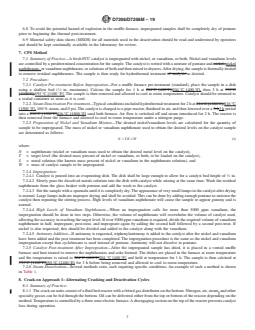
N 5 T/S 3W (1)
where:
N = naphthenate (nickel or vanadium mass used to obtain the desired metal level on the catalyst),
T = target level (the desired mass percent of nickel or vanadium, or both, to be loaded on the catalyst),
S = metal solution (the known mass percent of nickel or vanadium in the naphthenate solution), and
W = mass of catalyst sample to be impregnated.
7.2.4 Impregnation:
7.2.4.1 Catalyst is poured into an evaporating dish. The dish shall be large enough to allow for a catalyst bed height of ⁄2 in.
7.2.4.2 Slowly pour the dissolved metals solution into the dish with catalyst while mixing at the same time. Wash the residual
naphthenate from the glass beaker with pentane and add the wash to the catalyst.
7.2.4.3 Stir the sample with a spoonula until it is completely dry. The appearance of very small lumps in the catalyst after drying
is normal. Large lumps indicate improper drying and shall be avoided. This can be done by adding enough pentane to moisten the
catalyst then repeating the stirring process. High levels of vanadium naphthenate will cause the sample to appear gummy and is
normal.
7.2.4.4 High Levels of Vanadium Naphthenate—When an impregnation calls for more than 5000 ppm vanadium, the
impregnation should be done in two steps. Otherwise, the volume of naphthenate will overwhelm the volume of catalyst used,
affecting the accuracy in reaching the target level. If over 5000 ppm vanadium is required, divide the required volume of vanadium
naphthenate in half, impregnate, post-treat, and impregnate again by adding the second half followed by a second post-treat. If
nickel is also requested, this should be divided and added to the catalyst along with the vanadium.
7.2.4.5 Antimony Addition—If antimony is requested, triphenylantimony is added to the catalyst after the nickel and vanadium
have been added and the post treatment has been completed. The impregnation procedure is the same as the nickel and vanadium
impregnation except that cyclohexane is used instead of pentane. Antimony will not dissolve in pentane.
7.2.5 Catalyst Post-treatment After Impregnation—After the impregnated sample has dried, it is placed in a vented muffle
furnace and heat treated to remove the naphthenates and coke formed. The dishes are placed in the furnace at room temperature
and the temperature is raised to 204°C [400°F]204 °C [400 °F] and held at temperature for 1 h. The sample is then calcined at
593°C [1100°F]593 °C [1100 °F] for 3 h before being removed and allowed to cool to room temperature.
7.2.6 Steam Deactivation—Several methods exist, each requiring specific conditions. An example of such a method is shown
in Table 1.
8. Crack-on Approach 1: Alternating Cracking and Deactivation Cycles
8.1 Summary of Practice:
8.1.1 The crack-on units consist of a fluid bed reactor with a fritted gas distributor on the bottom. Nitrogen, air, steam, and other
specialty gasses can be fed through the bottom. Oil can be delivered either from the top or bottom of the reactor depending on the
method. Temperature is controlled by a three zone electric furnace. A disengaging section on the top of the reactor prevents catalyst
loss during operation.
D7206/D7206M − 19
TABLE 1 Standard CPS Procedure
NOTE 1—This scheme is considered standard and represents the case in
which the treatment ends in a state of reduction. A similar scheme in
which the cycles end in oxidation can also be configured.
Catalyst pre-treatment 1 h at 204°C [400°F] followed by 3 h at 593°C [1100°F]
Impregnation 2000 ppm nickel and 3000 ppm vanadium
Post-treatment 1 h at 204°C [400°F] followed by 3 h at 593°C [1100°F]
Steam deactivation 788°C [1450°F], 50% steam, 0 psig, 20 h (30 cycles)
Cycles consist of: 10 min, 50% mass percent N
10 min, 50% mass percent 4000 ppm SO in air
10 min, 50 mass percent N
10 min, 50 mass percent propylene-N mixture
(5% propylene in N )
TABLE 1 Standard CPS Procedure
NOTE 1—This scheme is considered standard and represents the case in
which the treatment ends in a state of reduction. A similar scheme in
which the cycles end in oxidation can also be configured.
Catalyst pre-treatment 1 h at 204 °C [400 °F] followed by 3 h at 593 °C [1100 °F]
Impregnation 2000 ppm nickel and 3000 ppm vanadium
Post-treatment 1 h at 204 °C [400 °F] followed by 3 h at 593 °C [1100 °F]
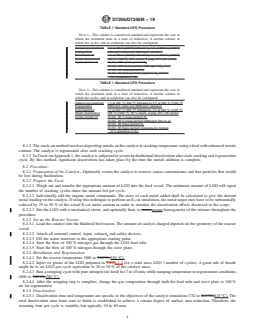
Steam deactivation 788 °C [1450 °F], 50 % steam, 0 psig, 20 h (30 cycles)
Cycles consist of: 10 min, 50 % mass percent N
10 min, 50 % mass percent 4000 ppm SO in air
10 min, 50 mass percent N
10 min, 50 mass percent propylene-N mixture
(5 % propylene in N )
8.1.2 The crack-on method involves depositing metals on the catalyst at cracking temperature using a fe
...