

ASTM D7277-16(2023)
(Test Method)Standard Test Method for Performance Testing of Articulating Concrete Block (ACB) Revetment Systems for Hydraulic Stability in Open Channel Flow
General Information
- Abstract
SIGNIFICANCE AND USE
5.1 An articulating concrete block revetment system is comprised of a matrix of individual concrete blocks placed together to form an erosion-resistant revetment with specific hydraulic performance characteristics. The system includes a filter layer compatible with the subsoil which allows infiltration and exfiltration to occur while providing particle retention. The filter layer may be comprised of a geotextile, properly graded granular media, or both. The concrete blocks within the matrix shall be dense and durable, and the matrix shall be flexible and porous.
5.2 ACB revetment system are used to provide erosion protection to underlying soil materials from the forces of flowing water. The term “articulating,” as used in this standard, implies the ability of individual concrete blocks of the system to conform to changes in subgrade while remaining interconnected by virtue of geometric interlock, cables, ropes, geotextiles, geogrids, or combination thereof.
5.3 The definition of ACB revetment system does not distinguish between interlocking and non-interlocking block geometries, between cable-tied and non-cable-tied systems, between vegetated and non-vegetated systems or between methods of manufacturing or placement. Furthermore, the definition does not restrict or limit the block size, shape, strength, or longevity; however, guidelines and recommendations regarding these factors are incorporated into this standard. Blocks are available in either open-cell or closed-cell configurations.
SCOPE
1.1 The purpose of this test method is to provide specifications for the hydraulic testing of full-scale articulating concrete block (ACB) revetment systems under controlled laboratory conditions for purposes of identifying stability performance in steep slope, high-velocity flows. The testing protocols, including system installation, test procedures, measurement techniques, analysis techniques, and reporting requirements are described in this test method.
1.2 The values stated in inch-pound units are to be regarded as standard. The values given in parentheses are mathematical conversions to SI units that are provided for information only and are not considered standard. Reporting or use of units other than inch-pound shall not be considered non-conformance as long as the selected parameters described regarding flume construction by the inch-pound system used in this method are met as a minimum.
1.2.1 The gravitational system of inch-pound units is used when dealing with inch-pound units. In this system, the pound (lbf) represents a unit of force (weight), while the unit for mass is slugs. The rationalized slug unit is not given, unless dynamic (F = ma) calculations are involved.
1.3 All observed and calculated values shall conform to the guidelines for significant digits and rounding established in Practice D6026.
1.3.1 The procedures used to specify how data are collected, recorded and calculated in this Guide are regarded as the industry standard. In addition they are representative of the significant digits that generally be retained. The procedures used do not consider material variation, purpose of obtaining the data, special purpose studies or any considerations for the user’s objectives; and it is common practice to increase or reduce significant digits of reported data to be commensurate with these considerations. It is beyond the scope of this standard to consider significant digits used in analysis methods for engineering design.
1.4 This standard does not purport to address all of the safety concerns, if any, associated with its use. It is the responsibility of the user of this standard to establish appropriate safety, health, and environmental practices and determine the applicability of regulatory limitations prior to use.
Note 1: The quality of the result produced by this standard is dependent on the competence of the personnel performing it and the suitability of t...
- Status
- Published
- Publication Date
- 31-Jul-2023
- Technical Committee
- D18 - Soil and Rock
- Drafting Committee
- D18.25 - Erosion and Sediment Control Technology
Overview
ASTM D7277-16(2023), titled "Standard Test Method for Performance Testing of Articulating Concrete Block (ACB) Revetment Systems for Hydraulic Stability in Open Channel Flow," is an internationally recognized standard developed by ASTM. This standard provides comprehensive testing procedures to evaluate the hydraulic stability performance of articulating concrete block (ACB) revetment systems, specifically in open channel flows subject to steep slopes and high velocities.
An ACB revetment system consists of a matrix of interconnected concrete blocks designed for effective erosion protection of soil materials exposed to flowing water. The system typically incorporates a filter layer, such as geotextiles or granular media, to facilitate water infiltration and particle retention, while ensuring overall durability and flexibility of the revetment matrix.
Key Topics
- Testing Protocols: Outlines laboratory-based hydraulic testing methods for full-scale ACB revetment systems, including system installation, preparation of soil subgrade, and data collection during controlled flow conditions.
- Performance Assessment: Identifies stability thresholds of ACB systems under increasing flow rates, focusing on parameters such as permissible shear stress, velocity, and deformation resistance.
- System Flexibility: Emphasizes the "articulating" property, allowing individual concrete blocks to adapt to subgrade shifts while maintaining structural integrity through interlocking, cabling, or connected geosynthetics.
- Design Versatility: Covers various ACB configurations-open-cell or closed-cell, tied or untied, vegetated or non-vegetated, with no restrictions on block size, shape, or placement method.
- Measurement and Reporting: Specifies protocols for collecting, analyzing, and reporting data, ensuring consistency and reliability in evaluating ACB system performance.
Applications
ASTM D7277-16(2023) plays a crucial role in multiple fields requiring robust erosion control along channels with varying hydraulic conditions:
- Erosion Control in Waterways: Engineers use this standard to assess and select ACB revetment systems for riverbanks, drainage channels, spillways, and stormwater outfalls, ensuring effective soil stabilization and channel lining integrity.
- Infrastructure Protection: Applied in the design and maintenance of transportation corridors, embankments, and levees where open channels are exposed to severe hydraulic forces.
- Environmental Restoration: Facilitates the use of ACB systems in environmentally sensitive projects, including vegetated solutions for habitat restoration while providing necessary hydraulic performance.
- Comparative Product Evaluation: Manufacturers and designers utilize this standard to benchmark different ACB systems, supporting informed product selection and compliance with regulatory requirements.
Related Standards
To ensure comprehensive material evaluation and conformance, the following ASTM standards are referenced alongside ASTM D7277:
- ASTM D653: Terminology related to soil, rock, and contained fluids.
- ASTM D698: Test methods for laboratory compaction of soil.
- ASTM D1556/D1556M: Test methods for in-place density and unit weight of soil.
- ASTM D2216: Methods for determining water (moisture) content of soil and rock by mass.
- ASTM D2487: Soil classification for engineering purposes.
- ASTM D6026: Practice for using significant digits and data records in geotechnical data.
- ASTM D4318: Test methods for Atterberg limits (liquid, plastic limit, and plasticity index) of soils.
Practical Value
Implementing ASTM D7277-16(2023) guarantees standardized, repeatable, and verifiable laboratory evaluations of ACB revetment systems. By following its specific methodologies, engineers, manufacturers, and regulatory agencies can confidently assess hydraulic stability under open channel flow, support robust design decisions, and ensure long-term erosion control solutions compliant with recognized international standards.
Keywords: articulating concrete block revetment system, hydraulic stability, erosion control, channel lining, open-channel flow, ASTM D7277, soil retention, geotextile filters, performance testing.
Relations
- Effective Date
- 01-Nov-2023
- Effective Date
- 01-Oct-2019
- Effective Date
- 01-Mar-2019
- Effective Date
- 15-Dec-2017
- Effective Date
- 15-Dec-2017
- Effective Date
- 01-Jun-2017
- Refers
ASTM D4318-17 - Standard Test Methods for Liquid Limit, Plastic Limit, and Plasticity Index of Soils - Effective Date
- 01-Jun-2017
- Effective Date
- 01-Feb-2015
- Effective Date
- 01-Feb-2015
- Effective Date
- 01-Aug-2014
- Effective Date
- 01-May-2012
- Effective Date
- 01-May-2012
- Effective Date
- 01-May-2012
- Effective Date
- 01-Mar-2012
- Effective Date
- 01-Sep-2011
Get Certified
Connect with accredited certification bodies for this standard

DIBt (Deutsches Institut für Bautechnik)
German Institute for Building Technology.
DIN CERTCO
DIN Group product certification.

Aboma Certification B.V.
Specialized in construction, metal, and transport sectors.
Sponsored listings
Frequently Asked Questions
ASTM D7277-16(2023) is a standard published by ASTM International. Its full title is "Standard Test Method for Performance Testing of Articulating Concrete Block (ACB) Revetment Systems for Hydraulic Stability in Open Channel Flow". This standard covers: SIGNIFICANCE AND USE 5.1 An articulating concrete block revetment system is comprised of a matrix of individual concrete blocks placed together to form an erosion-resistant revetment with specific hydraulic performance characteristics. The system includes a filter layer compatible with the subsoil which allows infiltration and exfiltration to occur while providing particle retention. The filter layer may be comprised of a geotextile, properly graded granular media, or both. The concrete blocks within the matrix shall be dense and durable, and the matrix shall be flexible and porous. 5.2 ACB revetment system are used to provide erosion protection to underlying soil materials from the forces of flowing water. The term “articulating,” as used in this standard, implies the ability of individual concrete blocks of the system to conform to changes in subgrade while remaining interconnected by virtue of geometric interlock, cables, ropes, geotextiles, geogrids, or combination thereof. 5.3 The definition of ACB revetment system does not distinguish between interlocking and non-interlocking block geometries, between cable-tied and non-cable-tied systems, between vegetated and non-vegetated systems or between methods of manufacturing or placement. Furthermore, the definition does not restrict or limit the block size, shape, strength, or longevity; however, guidelines and recommendations regarding these factors are incorporated into this standard. Blocks are available in either open-cell or closed-cell configurations. SCOPE 1.1 The purpose of this test method is to provide specifications for the hydraulic testing of full-scale articulating concrete block (ACB) revetment systems under controlled laboratory conditions for purposes of identifying stability performance in steep slope, high-velocity flows. The testing protocols, including system installation, test procedures, measurement techniques, analysis techniques, and reporting requirements are described in this test method. 1.2 The values stated in inch-pound units are to be regarded as standard. The values given in parentheses are mathematical conversions to SI units that are provided for information only and are not considered standard. Reporting or use of units other than inch-pound shall not be considered non-conformance as long as the selected parameters described regarding flume construction by the inch-pound system used in this method are met as a minimum. 1.2.1 The gravitational system of inch-pound units is used when dealing with inch-pound units. In this system, the pound (lbf) represents a unit of force (weight), while the unit for mass is slugs. The rationalized slug unit is not given, unless dynamic (F = ma) calculations are involved. 1.3 All observed and calculated values shall conform to the guidelines for significant digits and rounding established in Practice D6026. 1.3.1 The procedures used to specify how data are collected, recorded and calculated in this Guide are regarded as the industry standard. In addition they are representative of the significant digits that generally be retained. The procedures used do not consider material variation, purpose of obtaining the data, special purpose studies or any considerations for the user’s objectives; and it is common practice to increase or reduce significant digits of reported data to be commensurate with these considerations. It is beyond the scope of this standard to consider significant digits used in analysis methods for engineering design. 1.4 This standard does not purport to address all of the safety concerns, if any, associated with its use. It is the responsibility of the user of this standard to establish appropriate safety, health, and environmental practices and determine the applicability of regulatory limitations prior to use. Note 1: The quality of the result produced by this standard is dependent on the competence of the personnel performing it and the suitability of t...
SIGNIFICANCE AND USE 5.1 An articulating concrete block revetment system is comprised of a matrix of individual concrete blocks placed together to form an erosion-resistant revetment with specific hydraulic performance characteristics. The system includes a filter layer compatible with the subsoil which allows infiltration and exfiltration to occur while providing particle retention. The filter layer may be comprised of a geotextile, properly graded granular media, or both. The concrete blocks within the matrix shall be dense and durable, and the matrix shall be flexible and porous. 5.2 ACB revetment system are used to provide erosion protection to underlying soil materials from the forces of flowing water. The term “articulating,” as used in this standard, implies the ability of individual concrete blocks of the system to conform to changes in subgrade while remaining interconnected by virtue of geometric interlock, cables, ropes, geotextiles, geogrids, or combination thereof. 5.3 The definition of ACB revetment system does not distinguish between interlocking and non-interlocking block geometries, between cable-tied and non-cable-tied systems, between vegetated and non-vegetated systems or between methods of manufacturing or placement. Furthermore, the definition does not restrict or limit the block size, shape, strength, or longevity; however, guidelines and recommendations regarding these factors are incorporated into this standard. Blocks are available in either open-cell or closed-cell configurations. SCOPE 1.1 The purpose of this test method is to provide specifications for the hydraulic testing of full-scale articulating concrete block (ACB) revetment systems under controlled laboratory conditions for purposes of identifying stability performance in steep slope, high-velocity flows. The testing protocols, including system installation, test procedures, measurement techniques, analysis techniques, and reporting requirements are described in this test method. 1.2 The values stated in inch-pound units are to be regarded as standard. The values given in parentheses are mathematical conversions to SI units that are provided for information only and are not considered standard. Reporting or use of units other than inch-pound shall not be considered non-conformance as long as the selected parameters described regarding flume construction by the inch-pound system used in this method are met as a minimum. 1.2.1 The gravitational system of inch-pound units is used when dealing with inch-pound units. In this system, the pound (lbf) represents a unit of force (weight), while the unit for mass is slugs. The rationalized slug unit is not given, unless dynamic (F = ma) calculations are involved. 1.3 All observed and calculated values shall conform to the guidelines for significant digits and rounding established in Practice D6026. 1.3.1 The procedures used to specify how data are collected, recorded and calculated in this Guide are regarded as the industry standard. In addition they are representative of the significant digits that generally be retained. The procedures used do not consider material variation, purpose of obtaining the data, special purpose studies or any considerations for the user’s objectives; and it is common practice to increase or reduce significant digits of reported data to be commensurate with these considerations. It is beyond the scope of this standard to consider significant digits used in analysis methods for engineering design. 1.4 This standard does not purport to address all of the safety concerns, if any, associated with its use. It is the responsibility of the user of this standard to establish appropriate safety, health, and environmental practices and determine the applicability of regulatory limitations prior to use. Note 1: The quality of the result produced by this standard is dependent on the competence of the personnel performing it and the suitability of t...
ASTM D7277-16(2023) is classified under the following ICS (International Classification for Standards) categories: 91.100.30 - Concrete and concrete products. The ICS classification helps identify the subject area and facilitates finding related standards.
ASTM D7277-16(2023) has the following relationships with other standards: It is inter standard links to ASTM D3740-23, ASTM D3740-19, ASTM D2216-19, ASTM D2487-17e1, ASTM D2487-17, ASTM D4318-17e1, ASTM D4318-17, ASTM D1556/D1556M-15, ASTM D1556/D1556M-15e1, ASTM D653-14, ASTM D698-12, ASTM D698-12e1, ASTM D3740-12a, ASTM D3740-12, ASTM D653-11. Understanding these relationships helps ensure you are using the most current and applicable version of the standard.
ASTM D7277-16(2023) is available in PDF format for immediate download after purchase. The document can be added to your cart and obtained through the secure checkout process. Digital delivery ensures instant access to the complete standard document.
Standards Content (Sample)
This international standard was developed in accordance with internationally recognized principles on standardization established in the Decision on Principles for the
Development of International Standards, Guides and Recommendations issued by the World Trade Organization Technical Barriers to Trade (TBT) Committee.
Designation: D7277 − 16 (Reapproved 2023)
Standard Test Method for
Performance Testing of Articulating Concrete Block (ACB)
Revetment Systems for Hydraulic Stability in Open Channel
Flow
This standard is issued under the fixed designation D7277; the number immediately following the designation indicates the year of
original adoption or, in the case of revision, the year of last revision. A number in parentheses indicates the year of last reapproval. A
superscript epsilon (´) indicates an editorial change since the last revision or reapproval.
1. Scope standard to consider significant digits used in analysis methods
for engineering design.
1.1 The purpose of this test method is to provide specifica-
1.4 This standard does not purport to address all of the
tions for the hydraulic testing of full-scale articulating concrete
safety concerns, if any, associated with its use. It is the
block (ACB) revetment systems under controlled laboratory
responsibility of the user of this standard to establish appro-
conditions for purposes of identifying stability performance in
priate safety, health, and environmental practices and deter-
steep slope, high-velocity flows. The testing protocols, includ-
mine the applicability of regulatory limitations prior to use.
ing system installation, test procedures, measurement
techniques, analysis techniques, and reporting requirements are
NOTE 1—The quality of the result produced by this standard is
described in this test method.
dependent on the competence of the personnel performing it and the
suitability of the equipment and facilities used. Agencies that meet criteria
1.2 The values stated in inch-pound units are to be regarded
of Practice D3740 are generally considered capable of competent and
as standard. The values given in parentheses are mathematical
objective testing. Users of this standard are cautioned that compliance
conversions to SI units that are provided for information only
with Practice D3740 does not in itself assure reliable results. Reliable
results depend on many factors and Practice D3740 provides a means of
and are not considered standard. Reporting or use of units other
evaluating some of these factors.
than inch-pound shall not be considered non-conformance as
1.5 This international standard was developed in accor-
long as the selected parameters described regarding flume
construction by the inch-pound system used in this method are dance with internationally recognized principles on standard-
ization established in the Decision on Principles for the
met as a minimum.
1.2.1 The gravitational system of inch-pound units is used Development of International Standards, Guides and Recom-
mendations issued by the World Trade Organization Technical
when dealing with inch-pound units. In this system, the pound
Barriers to Trade (TBT) Committee.
(lbf) represents a unit of force (weight), while the unit for mass
is slugs. The rationalized slug unit is not given, unless dynamic
2. Referenced Documents
(F = ma) calculations are involved.
2.1 ASTM Standards:
1.3 All observed and calculated values shall conform to the
D422 Test Method for Particle-Size Analysis of Soils (With-
guidelines for significant digits and rounding established in
drawn 2016)
Practice D6026.
D653 Terminology Relating to Soil, Rock, and Contained
1.3.1 The procedures used to specify how data are collected,
Fluids
recorded and calculated in this Guide are regarded as the
D698 Test Methods for Laboratory Compaction Character-
industry standard. In addition they are representative of the
istics of Soil Using Standard Effort (12,400 ft-lbf/ft (600
significant digits that generally be retained. The procedures
kN-m/m ))
used do not consider material variation, purpose of obtaining
D1556/D1556M Test Method for Density and Unit Weight
the data, special purpose studies or any considerations for the
of Soil in Place by Sand-Cone Method
user’s objectives; and it is common practice to increase or
D2216 Test Methods for Laboratory Determination of Water
reduce significant digits of reported data to be commensurate
(Moisture) Content of Soil and Rock by Mass
with these considerations. It is beyond the scope of this
1 2
This guide is under the jurisdiction of ASTM Committee D18 on Soil and Rock For referenced ASTM standards, visit the ASTM website, www.astm.org, or
and is the direct responsibility of Subcommittee D18.25 on Erosion and Sediment contact ASTM Customer Service at service@astm.org. For Annual Book of ASTM
Control Technology. Standards volume information, refer to the standard’s Document Summary page on
Current edition approved Aug. 1, 2023. Published August 2023. Originally the ASTM website.
approved in 2008. Last previous edition approved in 2016 as D7277 - 16. DOI: The last approved version of this historical standard is referenced on
10.1520/D7277-16R23. www.astm.org.
Copyright © ASTM International, 100 Barr Harbor Drive, PO Box C700, West Conshohocken, PA 19428-2959. United States
D7277 − 16 (2023)
–1
D2487 Practice for Classification of Soils for Engineering 3.1.11 uniform flow, (LT ), n—in hydraulics, the condition
Purposes (Unified Soil Classification System) of flow where the rate of energy loss due to frictional and form
D3740 Practice for Minimum Requirements for Agencies resistance is equal to the bed slope of the channel.
Engaged in Testing and/or Inspection of Soil and Rock as 3.1.11.1 Discussion—Where uniform flow exists, the slopes
Used in Engineering Design and Construction of the energy grade line, the water surface, and the channel bed
D4318 Test Methods for Liquid Limit, Plastic Limit, and are identical. Cross-sectional area and velocity of flow do not
Plasticity Index of Soils change from cross section to cross section in uniform flow.
–1
D5195 Test Method for Density of Soil and Rock In-Place at
3.1.12 velocity, V, (LT ), n—in channel flow, time rate of
Depths Below Surface by Nuclear Methods
linear motion in a given direction.
D6026 Practice for Using Significant Digits and Data Re-
cords in Geotechnical Data
4. Summary of Test Method
4.1 The test method is designed to determine the stability
3. Terminology
threshold values of shear stress and velocity of articulating
3.1 Definitions: concrete block (ACB) revetment systems under controlled
laboratory conditions of steep-slope, high-velocity flow (flume
3.1.1 For common definitions of technical terms in this test
test). Systems are tested as full-scale production units.
method, refer to Terminology D653.
3.1.2 articulating concrete block (ACB) revetment system,
4.2 The procedures associated with test set-up, testing, data
n—in erosion control, a matrix of interconnected concrete
collection, and reporting are provided in this test method.
block units for erosion protection. Units are typically con-
5. Significance and Use
nected by geometric interlock, cables, ropes, geotextile,
geogrids or a combination thereof and typically include a
5.1 An articulating concrete block revetment system is
geotextile underlayment.
comprised of a matrix of individual concrete blocks placed
3.1.3 depth of flow, y , (L), n—in hydraulics, the distance together to form an erosion-resistant revetment with specific
o
hydraulic performance characteristics. The system includes a
from the channel thalweg to the water surface, measured
normal to the direction of flow, for a given discharge. filter layer compatible with the subsoil which allows infiltration
and exfiltration to occur while providing particle retention. The
3 –1
3.1.4 design discharge, Q , (L T ), n—in erosion control,
d
filter layer may be comprised of a geotextile, properly graded
the volumetric quantity of water flow within a channel which
granular media, or both. The concrete blocks within the matrix
is typically used in determining required channel dimensions
shall be dense and durable, and the matrix shall be flexible and
and suitable lining materials for ensuring adequate channel
porous.
capacity and stability.
5.2 ACB revetment system are used to provide erosion
3.1.4.1 Discussion—The discharge associated with a speci-
protection to underlying soil materials from the forces of
fied frequency of recurrence, for example, an n-year flood. The
flowing water. The term “articulating,” as used in this standard,
n-year flood event has a probability of 1/n of being equaled or
implies the ability of individual concrete blocks of the system
exceeded in any given year.
to conform to changes in subgrade while remaining intercon-
3 –1
3.1.5 discharge, Q, (L T ), n—in channel flow, the volume
nected by virtue of geometric interlock, cables, ropes,
of water flowing through a cross-section in a unit of time,
geotextiles, geogrids, or combination thereof.
including sediment or other solids that may be dissolved in or
5.3 The definition of ACB revetment system does not
mixed with the water; usually cubic feet per second (ft /s) or
distinguish between interlocking and non-interlocking block
cubic meters per second (m /s).
geometries, between cable-tied and non-cable-tied systems,
3.1.6 hydraulic radius, (L), n—in channel flow, the cross-
between vegetated and non-vegetated systems or between
sectional area of flow divided by the wetted perimeter.
methods of manufacturing or placement. Furthermore, the
3 –1
3.1.7 local velocity, (L T ), n—in channel flow, the veloc- definition does not restrict or limit the block size, shape,
ity at a specific point in the flow region. May be defined as a strength, or longevity; however, guidelines and recommenda-
direction-dependent quantity with components V , V , or V . tions regarding these factors are incorporated into this stan-
x y z
–1 dard. Blocks are available in either open-cell or closed-cell
3.1.8 mean velocity, (LT ), n—in hydraulics, the average
configurations.
velocity throughout a channel cross section. Defined as the
discharge divided by the cross-sectional area of flow usually
6. Preparation of Test Section
expressed in meters per second (m/s) or feet per second (ft/s).
6.1 Soil Subgrade Construction:
–1
3.1.9 subcritical flow, (LT ), n—in channel flow, a charac-
6.1.1 The testing program includes the construction of an
teristic of flowing water whereby gravitational forces dominate
earthen test subgrade compacted between vertical walls of the
over inertial forces, quantified by a Froude Number less than 1.
testing flume (Fig. 1). The soil subgrade shall be placed and
–1
3.1.10 supercritical flow, (LT ), n—in channel flow, a compacted in horizontal lifts of 4 to 6 in. (100 to 150 mm) in
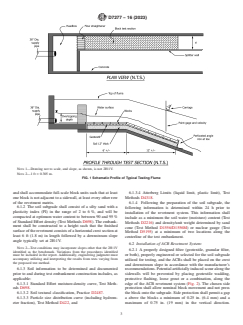
characteristic of flowing water whereby inertial forces domi- thickness to a minimum subgrade thickness of 12 in. (300 mm).
nate over gravitational forces, quantified by a Froude Number The distance between the walls shall be a minimum of 4.0 ft
greater than 1. (1.2 m); installation shall be reflective of standard field usage
D7277 − 16 (2023)
NOTE 1—Drawing not to scale, and slope, as shown, is not 2H:1V.
NOTE 2—1 ft = 0.305 m.
FIG. 1 Schematic Profile of Typical Testing Flume
and shall accommodate full-scale block units such that at least 6.1.3.4 Atterberg Limits (liquid limit, plastic limit), Test
one block is not adjacent to a sidewall, at least every other row Methods D4318.
of the revetment matrix.
6.1.4 Following the preparation of the soil subgrade, the
6.1.2 The soil subgrade shall consist of a silty sand with a
following information is determined within 24 h prior to
plasticity index (PI) in the range of 2 to 6 %, and will be
installation of the revetment system. This information shall
compacted at optimum water content to between 90 and 95 %
include as a minimum the soil water (moisture) content (Test
of Standard Effort density (Test Methods D698). The embank-
Methods D2216) and density/unit weight determined by sand
ment shall be constructed to a height such that the finished
cone (Test Method D1556/D1556M) or nuclear gauge (Test
surface of the revetment consists of a horizontal crest section at
Method D5195) at a minimum of two locations along the
least 6 ft (1.8 m) in length followed by a downstream slope
centerline of the test embankment.
angle typically set at 2H:1V.
6.2 Installation of ACB Revetment System:
NOTE 2—Test conditions may incorporate slopes other that the 2H:1V
6.2.1 A properly designed filter (geotextile, granular filter,
identified as the benchmark. Variations from the procedures identified
or both), properly engineered or selected for the soil subgrade
must be included in the report. Additionally, engineering judgment must
accompany utilizing and interpreting the results from tests varying from
utilized for testing, and the ACBs shall be placed on the crest
the proposed test method.
and downstream slope in accordance with the manufacturer’s
6.1.3 Soil information to be determined and documented recommendations. Potential artificially induced scour along the
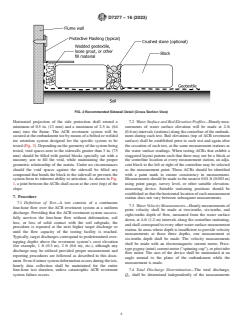
prior to and during test embankment construction includes, as sidewalls will be prevented by placing geotextile wadding,
applicable: protective flashing, loose grout or a combination, along the
6.1.3.1 Standard Effort moisture-density curve, Test Meth- edge of the ACB revetment system (Fig. 2). The chosen side
ods D698. protection shall allow nominal block movement and not press
6.1.3.2 Soil textural classification, Practice D2487. the block onto the subgrade. Side protection shall permit a gap
6.1.3.3 Particle size distribution curve (including hydrom- a above the bl
...