

ASTM E3222-20a
(Classification)Standard Classification for Determination of High-frequency Impact Sound Ratings
General Information
- Abstract
SIGNIFICANCE AND USE
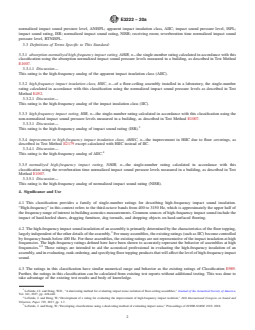
4.1 This classification provides a family of single-number ratings for describing high-frequency impact sound insulation. “High-frequency” in this context refers to the third-octave bands from 400 to 3150 Hz, which is approximately the upper half of the frequency range of interest in building acoustics measurements. Common sources of high-frequency impact sound include the impact of hard-heeled shoes, dragging furniture, dog toenails, and dropping objects on hard-surfaced flooring.
4.2 The high-frequency impact sound insulation of an assembly is primarily determined by the characteristics of the floor topping, largely independent of the other details of the assembly.3 For many assemblies, the existing ratings (such as IIC) become controlled by frequency bands below 400 Hz. For these assemblies, the existing ratings are not representative of the impact insulation at high frequencies. The high-frequency ratings defined here have been shown to accurately represent the behavior of assemblies at high frequencies.4,5 These ratings are intended to aid the acoustical professional in evaluating the high-frequency insulation of an assembly, and in evaluating, rank-ordering, and specifying floor topping products that will affect the level of high-frequency impact sound.
4.3 The ratings in this classification have similar numerical range and behavior as the existing ratings of Classification E989. Further, the ratings in this classification can be calculated from existing test reports without additional testing. This was done to take advantage of the existing test results and body of knowledge.
4.4 This classification describes only the high-frequency range of impact sound and no other aspects of impact noise. It does not address impact sound below 400 Hz, such as thudding from footfalls, and additional ratings are required to describe impact sound in these frequency ranges. This classification does not replace Classification E989 (Impact Insulation Class) and is not i...
SCOPE
1.1 This classification provides methods for calculating single-number ratings of high-frequency impact sound transmission, based on one-third-octave-band impact sound pressure levels generated by the standard tapping machine as described in Test Methods E492, E1007, and E2179.
1.2 This classification defines ratings that are not defined in other standards. Within their purview, other standards shall define additional ratings based on the methods of this classification.
1.3 This standard does not purport to address all of the safety concerns, if any, associated with its use. It is the responsibility of the user of this standard to establish appropriate safety, health, and environmental practices and determine the applicability of regulatory limitations prior to use.
1.4 This international standard was developed in accordance with internationally recognized principles on standardization established in the Decision on Principles for the Development of International Standards, Guides and Recommendations issued by the World Trade Organization Technical Barriers to Trade (TBT) Committee.
- Status
- Published
- Publication Date
- 31-Oct-2020
- Technical Committee
- E33 - Building and Environmental Acoustics
- Drafting Committee
- E33.10 - Structural Acoustics and Vibration
Buy Documents

ASTM E3222-20a - Standard Classification for Determination of High-frequency Impact Sound Ratings
REDLINE ASTM E3222-20a - Standard Classification for Determination of High-frequency Impact Sound Ratings
Overview
ASTM E3222-20a: Standard Classification for Determination of High-frequency Impact Sound Ratings provides a method for classifying and rating the high-frequency impact sound insulation of floor-ceiling assemblies. The standard focuses on the frequency range from 400 to 3150 Hz, which covers the upper half of building acoustics of interest, specifically targeting noises such as impacts from hard-heeled shoes, dragging furniture, dog toenails, and items dropped on hard flooring.
This classification enables acoustical professionals, architects, and building designers to evaluate, specify, and compare floor covering products based on their performance in controlling high-frequency impact noise. ASTM E3222-20a introduces a set of single-number ratings, filling a critical gap not addressed by other standards that mainly focus on lower-frequency noise.
Key Topics
- High-frequency Impact Sound Insulation: The standard addresses impact noise in the frequency range of 400–3150 Hz. These sounds are typically generated by hard or sharp materials impacting hard surfaces.
- Single-number Ratings: The classification defines ratings such as:
- HIIC (High-frequency Impact Insulation Class): For laboratory-measured normalized impact sound levels.
- HIR (High-frequency Impact Rating): For building-measured non-normalized impact sound levels.
- NHIR (Normalized High-frequency Impact Rating): Adjusted for reverberation in buildings.
- AHIR (Absorption-normalized High-frequency Impact Rating): Accounts for absorption as measured in the field.
- ΔHIIC: Measures the improvement due to floor coverings.
- Calculation Methods: Ratings are based on measured one-third-octave-band impact sound pressure levels using a standard tapping machine (as per ASTM E492, E1007, and E2179).
- Assessment Scope: The classification applies only to high-frequency impact noises and does not replace the Impact Insulation Class (IIC, ASTM E989) standard, which focuses on lower frequencies.
Applications
- Specification and Comparison of Flooring Systems: Enables accurate evaluation and specification of hard surface floorings and their toppings based on high-frequency impact sound insulation performance.
- Acoustic Design Guidance: Provides important metrics for acoustical consultants to assess and improve indoor acoustic comfort, especially in residential, commercial, and multi-story buildings where minimizing disruptive, high-frequency impact noise is critical.
- Product Testing and Certification: Manufacturers and labs can use existing acoustic test data to calculate the new high-frequency impact sound ratings without requiring additional testing.
- Compliance Demonstration: Ratings can be reported alongside existing IIC metrics to present a fuller picture of floor performance for regulatory authorities, project owners, and design teams.
Related Standards
- ASTM E492: Laboratory Measurement of Impact Sound Transmission Through Floor-Ceiling Assemblies Using the Tapping Machine.
- ASTM E1007: Field Measurement of Tapping Machine Impact Sound Transmission Through Floor-Ceiling Assemblies.
- ASTM E2179: Laboratory Measurement of the Effectiveness of Floor Coverings in Reducing Impact Sound Transmission Through Concrete Floors.
- ASTM E989: Classification for Determination of Single-Number Metrics for Impact Noise.
- ASTM C634: Terminology Relating to Building and Environmental Acoustics.
Practical Value
Implementing ASTM E3222-20a brings precision to high-frequency impact noise assessment, offering meaningful data to help select flooring systems that effectively reduce the audible impact of daily activities in buildings. It enriches sound insulation metrics, streamlines decision-making for floor coverings, and supports healthier, more comfortable indoor environments. For acoustic consultants, architects, and builders, compliance with E3222-20a ensures projects meet modern acoustic performance expectations-crucial for tenant satisfaction and regulatory approval.
Relations
- Effective Date
- 01-Oct-2016
- Effective Date
- 01-Sep-2014
- Effective Date
- 15-Oct-2013
- Effective Date
- 01-Oct-2013
- Effective Date
- 01-Sep-2013
- Effective Date
- 01-Apr-2013
- Refers
ASTM E989-06(2012) - Standard Classification for Determination of Impact Insulation Class (IIC) - Effective Date
- 01-Sep-2012
- Effective Date
- 01-Dec-2011
- Effective Date
- 01-Mar-2011
- Effective Date
- 01-Mar-2011
- Effective Date
- 01-Sep-2010
- Effective Date
- 01-Jun-2010
- Effective Date
- 01-Apr-2009
- Effective Date
- 01-Apr-2009
- Effective Date
- 01-Apr-2009
Buy Documents
ASTM E3222-20a - Standard Classification for Determination of High-frequency Impact Sound Ratings
REDLINE ASTM E3222-20a - Standard Classification for Determination of High-frequency Impact Sound Ratings
Get Certified
Connect with accredited certification bodies for this standard

DIBt (Deutsches Institut für Bautechnik)
German Institute for Building Technology.
DIN CERTCO
DIN Group product certification.

Aboma Certification B.V.
Specialized in construction, metal, and transport sectors.
Sponsored listings
Frequently Asked Questions
ASTM E3222-20a is a standard published by ASTM International. Its full title is "Standard Classification for Determination of High-frequency Impact Sound Ratings". This standard covers: SIGNIFICANCE AND USE 4.1 This classification provides a family of single-number ratings for describing high-frequency impact sound insulation. “High-frequency” in this context refers to the third-octave bands from 400 to 3150 Hz, which is approximately the upper half of the frequency range of interest in building acoustics measurements. Common sources of high-frequency impact sound include the impact of hard-heeled shoes, dragging furniture, dog toenails, and dropping objects on hard-surfaced flooring. 4.2 The high-frequency impact sound insulation of an assembly is primarily determined by the characteristics of the floor topping, largely independent of the other details of the assembly.3 For many assemblies, the existing ratings (such as IIC) become controlled by frequency bands below 400 Hz. For these assemblies, the existing ratings are not representative of the impact insulation at high frequencies. The high-frequency ratings defined here have been shown to accurately represent the behavior of assemblies at high frequencies.4,5 These ratings are intended to aid the acoustical professional in evaluating the high-frequency insulation of an assembly, and in evaluating, rank-ordering, and specifying floor topping products that will affect the level of high-frequency impact sound. 4.3 The ratings in this classification have similar numerical range and behavior as the existing ratings of Classification E989. Further, the ratings in this classification can be calculated from existing test reports without additional testing. This was done to take advantage of the existing test results and body of knowledge. 4.4 This classification describes only the high-frequency range of impact sound and no other aspects of impact noise. It does not address impact sound below 400 Hz, such as thudding from footfalls, and additional ratings are required to describe impact sound in these frequency ranges. This classification does not replace Classification E989 (Impact Insulation Class) and is not i... SCOPE 1.1 This classification provides methods for calculating single-number ratings of high-frequency impact sound transmission, based on one-third-octave-band impact sound pressure levels generated by the standard tapping machine as described in Test Methods E492, E1007, and E2179. 1.2 This classification defines ratings that are not defined in other standards. Within their purview, other standards shall define additional ratings based on the methods of this classification. 1.3 This standard does not purport to address all of the safety concerns, if any, associated with its use. It is the responsibility of the user of this standard to establish appropriate safety, health, and environmental practices and determine the applicability of regulatory limitations prior to use. 1.4 This international standard was developed in accordance with internationally recognized principles on standardization established in the Decision on Principles for the Development of International Standards, Guides and Recommendations issued by the World Trade Organization Technical Barriers to Trade (TBT) Committee.
SIGNIFICANCE AND USE 4.1 This classification provides a family of single-number ratings for describing high-frequency impact sound insulation. “High-frequency” in this context refers to the third-octave bands from 400 to 3150 Hz, which is approximately the upper half of the frequency range of interest in building acoustics measurements. Common sources of high-frequency impact sound include the impact of hard-heeled shoes, dragging furniture, dog toenails, and dropping objects on hard-surfaced flooring. 4.2 The high-frequency impact sound insulation of an assembly is primarily determined by the characteristics of the floor topping, largely independent of the other details of the assembly.3 For many assemblies, the existing ratings (such as IIC) become controlled by frequency bands below 400 Hz. For these assemblies, the existing ratings are not representative of the impact insulation at high frequencies. The high-frequency ratings defined here have been shown to accurately represent the behavior of assemblies at high frequencies.4,5 These ratings are intended to aid the acoustical professional in evaluating the high-frequency insulation of an assembly, and in evaluating, rank-ordering, and specifying floor topping products that will affect the level of high-frequency impact sound. 4.3 The ratings in this classification have similar numerical range and behavior as the existing ratings of Classification E989. Further, the ratings in this classification can be calculated from existing test reports without additional testing. This was done to take advantage of the existing test results and body of knowledge. 4.4 This classification describes only the high-frequency range of impact sound and no other aspects of impact noise. It does not address impact sound below 400 Hz, such as thudding from footfalls, and additional ratings are required to describe impact sound in these frequency ranges. This classification does not replace Classification E989 (Impact Insulation Class) and is not i... SCOPE 1.1 This classification provides methods for calculating single-number ratings of high-frequency impact sound transmission, based on one-third-octave-band impact sound pressure levels generated by the standard tapping machine as described in Test Methods E492, E1007, and E2179. 1.2 This classification defines ratings that are not defined in other standards. Within their purview, other standards shall define additional ratings based on the methods of this classification. 1.3 This standard does not purport to address all of the safety concerns, if any, associated with its use. It is the responsibility of the user of this standard to establish appropriate safety, health, and environmental practices and determine the applicability of regulatory limitations prior to use. 1.4 This international standard was developed in accordance with internationally recognized principles on standardization established in the Decision on Principles for the Development of International Standards, Guides and Recommendations issued by the World Trade Organization Technical Barriers to Trade (TBT) Committee.
ASTM E3222-20a is classified under the following ICS (International Classification for Standards) categories: 91.120.20 - Acoustics in building. Sound insulation. The ICS classification helps identify the subject area and facilitates finding related standards.
ASTM E3222-20a has the following relationships with other standards: It is inter standard links to ASTM E1007-16, ASTM E1007-14, ASTM E1007-13b, ASTM E1007-13a, ASTM C634-13, ASTM E1007-13, ASTM E989-06(2012), ASTM C634-11, ASTM E1007-11e1, ASTM E1007-11, ASTM C634-10a, ASTM C634-10, ASTM E492-09, ASTM C634-09, ASTM E2179-03(2009). Understanding these relationships helps ensure you are using the most current and applicable version of the standard.
ASTM E3222-20a is available in PDF format for immediate download after purchase. The document can be added to your cart and obtained through the secure checkout process. Digital delivery ensures instant access to the complete standard document.
Standards Content (Sample)
This international standard was developed in accordance with internationally recognized principles on standardization established in the Decision on Principles for the
Development of International Standards, Guides and Recommendations issued by the World Trade Organization Technical Barriers to Trade (TBT) Committee.
Designation:E3222 −20a
Standard Classification for
Determination of High-frequency Impact Sound Ratings
This standard is issued under the fixed designation E3222; the number immediately following the designation indicates the year of
original adoption or, in the case of revision, the year of last revision. A number in parentheses indicates the year of last reapproval. A
superscript epsilon (´) indicates an editorial change since the last revision or reapproval.
1. Scope Ceiling Assemblies and Associated Support Structures
E2179 Test Method for Laboratory Measurement of the
1.1 This classification provides methods for calculating
Effectiveness of Floor Coverings in Reducing Impact
single-number ratings of high-frequency impact sound
Sound Transmission Through Concrete Floors
transmission, based on one-third-octave-band impact sound
pressure levels generated by the standard tapping machine as
3. Terminology
described in Test Methods E492, E1007, and E2179.
3.1 The following terms used in this classification have
1.2 This classification defines ratings that are not defined in
specific meaning that are defined in Terminology C634: aver-
other standards. Within their purview, other standards shall
age sound pressure level; decibel; flanking transmission; im-
define additional ratings based on the methods of this classifi-
pact insulation class; level; octave band; sound insulation;
cation.
sound isolation; sound pressure; sound pressure level.
1.3 This standard does not purport to address all of the
3.2 The following terms used in this classification have
safety concerns, if any, associated with its use. It is the
specific meaning that are defined in Test Method E1007:
responsibility of the user of this standard to establish appro-
absorption normalized impact sound pressure level, ANISPL;
priate safety, health, and environmental practices and deter-
apparent impact insulation class, AIIC; impact sound pressure
mine the applicability of regulatory limitations prior to use.
level, ISPL; impact sound rating, ISR; normalized impact
1.4 This international standard was developed in accor-
sound rating, NISR; receiving room; reverberation time nor-
dance with internationally recognized principles on standard-
malized impact sound pressure level, RTNISPL.
ization established in the Decision on Principles for the
3.3 Definitions of Terms Specific to This Standard:
Development of International Standards, Guides and Recom-
3.3.1 absorption-normalized high-frequency impact rating,
mendations issued by the World Trade Organization Technical
AHIR, n—the single-number rating calculated in accordance
Barriers to Trade (TBT) Committee.
with this classification using the absorption normalized impact
sound pressure levels measured in a building, as described in
2. Referenced Documents
Test Method E1007.
2.1 ASTM Standards:
3.3.1.1 Discussion—This rating is the high-frequency ana-
C634 Terminology Relating to Building and Environmental
log of the apparent impact insulation class (AIIC).
Acoustics
3.3.2 high-frequency impact insulation class, HIIC, n—of a
E492 Test Method for Laboratory Measurement of Impact
floor-ceiling assembly installed in a laboratory, the single-
Sound Transmission Through Floor-Ceiling Assemblies
number rating calculated in accordance with this classification
Using the Tapping Machine
usingthenormalizedimpactsoundpressurelevelsasdescribed
E989 Classification for Determination of Single-Number
in Test Method E492.
Metrics for Impact Noise
3.3.2.1 Discussion—This rating is the high-frequency ana-
E1007 Test Method for Field Measurement of Tapping
log of the impact insulation class (IIC).
Machine Impact Sound Transmission Through Floor-
3.3.3 high-frequency impact rating, HIR, n—the single-
number rating calculated in accordance with this classification
This classification is under the jurisdiction of ASTM Committee E33 on
using the non-normalized impact sound pressure levels mea-
Building and Environmental Acoustics and is the direct responsibility of Subcom-
sured in a building, as described in Test Method E1007.
mittee E33.10 on Structural Acoustics and Vibration.
3.3.3.1 Discussion—This rating is the high-frequency ana-
Current edition approved Nov. 1, 2020. Published November 2020. Originally
log of impact sound rating (ISR).
approved in 2020. Last previous edition approved in 2020 as E3222 – 20. DOI:
10.1520/E3222-20A.
For referenced ASTM standards, visit the ASTM website, www.astm.org, or
contact ASTM Customer Service at service@astm.org. For Annual Book of ASTM LoVerde, J.J. and Dong, W.D., “A dual-rating method for evaluating impact
Standards volume information, refer to the standard’s Document Summary page on noise isolation of floor-ceiling assemblies,” Journal of the Acoustical Society of
the ASTM website. America, Vol. 141, 2017, pp. 428-440.
Copyright © ASTM International, 100 Barr Harbor Drive, PO Box C700, West Conshohocken, PA 19428-2959. United States
E3222−20a
3.3.4 improvement in high-frequency impact insulation andisnotinterchangeablewithit.Forexample,theHIICrating
class, ∆HIIC, n—the improvement in HIIC due to floor of an assembly does not determine its IIC rating and cannot be
coverings, as described in Test Method E2179 except calcu- used to show compliance with an IIC requirement. The
lated with HIIC instead of IIC. expectation is that the high-frequency ratings would be re-
3.3.4.1 Discussion—This rating is the high-frequency ana- ported alongside the existing ratings.
log of ∆IIC.
4.5 The family of ratings described use the same calculation
3.3.5 normalized high-frequency impact rating, NHIR,
method and differ only in the origin of the third-octave data
n—the single-number rating calculated in accordance with this
used in the calculation. There is a high-frequency version of
classification using the reverberation time normalized impact
each existing impact rating, in which this classification is used
sound pressure levels measured in a building, as described in
instead of Classification E989 to calculate the single-number
Test Method E1007.
rating.
3.3.5.1 Discuss
...
This document is not an ASTM standard and is intended only to provide the user of an ASTM standard an indication of what changes have been made to the previous version. Because
it may not be technically possible to adequately depict all changes accurately, ASTM recommends that users consult prior editions as appropriate. In all cases only the current version
of the standard as published by ASTM is to be considered the official document.
Designation: E3222 − 20 E3222 − 20a
Standard Classification for
Determination of High-frequency Impact Sound Ratings
This standard is issued under the fixed designation E3222; the number immediately following the designation indicates the year of
original adoption or, in the case of revision, the year of last revision. A number in parentheses indicates the year of last reapproval. A
superscript epsilon (´) indicates an editorial change since the last revision or reapproval.
1. Scope
1.1 This classification provides methods for calculating single-number ratings of high-frequency impact sound transmission, based
on one-third-octave-band impact sound pressure levels generated by the standard tapping machine as described in Test Methods
E492, E1007, and E2179.
1.2 This classification defines ratings that are not defined in other standards. Within their purview, other standards shall define
additional ratings based on the methods of this classification.
1.3 This standard does not purport to address all of the safety concerns, if any, associated with its use. It is the responsibility
of the user of this standard to establish appropriate safety, health, and environmental practices and determine the applicability of
regulatory limitations prior to use.
1.4 This international standard was developed in accordance with internationally recognized principles on standardization
established in the Decision on Principles for the Development of International Standards, Guides and Recommendations issued
by the World Trade Organization Technical Barriers to Trade (TBT) Committee.
2. Referenced Documents
2.1 ASTM Standards:
C634 Terminology Relating to Building and Environmental Acoustics
E492 Test Method for Laboratory Measurement of Impact Sound Transmission Through Floor-Ceiling Assemblies Using the
Tapping Machine
E989 Classification for Determination of Single-Number Metrics for Impact Noise
E1007 Test Method for Field Measurement of Tapping Machine Impact Sound Transmission Through Floor-Ceiling Assemblies
and Associated Support Structures
E2179 Test Method for Laboratory Measurement of the Effectiveness of Floor Coverings in Reducing Impact Sound
Transmission Through Concrete Floors
3. Terminology
3.1 The following terms used in this classification have specific meaning that are defined in Terminology C634: average sound
pressure level; decibel; flanking transmission; impact insulation class; level; octave band; sound insulation; sound isolation; sound
pressure; sound pressure level.
3.2 The following terms used in this classification have specific meaning that are defined in Test Method E1007: absorption
This classification is under the jurisdiction of ASTM Committee E33 on Building and Environmental Acoustics and is the direct responsibility of Subcommittee E33.10
on Structural Acoustics and Vibration.
Current edition approved Jan. 1, 2020Nov. 1, 2020. Published February 2020November 2020. Originally approved in 2020. Last previous edition approved in 2020 as
E3222 – 20. DOI: 10.1520/E3222-20.10.1520/E3222-20A.
For referenced ASTM standards, visit the ASTM website, www.astm.org, or contact ASTM Customer Service at service@astm.org. For Annual Book of ASTM Standards
volume information, refer to the standard’s Document Summary page on the ASTM website.
Copyright © ASTM International, 100 Barr Harbor Drive, PO Box C700, West Conshohocken, PA 19428-2959. United States
E3222 − 20a
normalized impact sound pressure level, ANISPL; apparent impact insulation class, AIIC; impact sound pressure level, ISPL;
impact sound rating, ISR; normalized impact sound rating, NISR; receiving room; reverberation time normalized impact sound
pressure level, RTNISPL.
3.3 Definitions of Terms Specific to This Standard:
3.3.1 absorption-normalized high-frequency impact rating, AHIR, n—the single-number rating calculated in accordance with this
classification using the absorption normalized impact sound pressure levels measured in a building, as described in Test Method
E1007.
3.3.1.1 Discussion—
This rating is the high-frequency analog of the apparent impact insulation class (AIIC).
3.3.2 high-frequency impact insulation class, HIIC, n—of a floor-ceiling assembly installed in a laboratory, the single-number
rating calculated in accordance with this classification using the normalized impact sound pressure levels as described in Test
Method E492.
3.3.2.1 Discussion—
This rating is the high-frequency analog of the impact insulation class (IIC).
3.3.3 high-frequency impact rating, HIR, n—the single-number rating calculated in accordance with this classification using the
non-normalized impact sound pressure levels measured in a building, as described in Test Method E1007.
3.3.3.1 Discussion—
This rating is the high-frequency analog of impact sound rating (ISR).
3.3.4 improvement in high-frequency impact insulation class, ΔHIIC, n—the improvement in HIIC due to floor coverings, as
described in Test Method E2179 except calculated with HIIC instead of IIC.
3.3.4.1 Discussion—
This rating is the high-frequency analog of ΔIIC.
3.3.5 normalized high-frequency impact rating, NHIR, n—the single-number rating calculated in accordance with this
classification using the reverberation time normalized impact sound pressure levels measured in a building, as described in Test
Method E1007.
3.3.5.1 Discussion—
This rating is the high-frequency analog of normalized impact sound rating (NISR).
4. Significance and Use
4.1 This classification provides a family of single-number ratings for describing high-frequency impact sound insulation.
“High-frequency” in this context refers to the third-octave bands from 400 to 3150 Hz, which is approximately the upper half of
the frequency range of interest in building acoustics measurements. Common sources of high-frequency impact sound include the
impact of hard-heeled shoes, dragging furniture, dog toenails, and dropping objects on hard-surfaced flooring.
4.2 The high-frequency impact sound insulation of an assembly is primarily determined by the characteristics of the floor topping,
largely independent of the other det
...