

ASTM D7975-22
(Test Method)Standard Test Method for Determination of Vapor Pressure of Crude Oil: VPCRx-F(Tm°C) (Manual Expansion Field Method)
General Information
- Abstract
SIGNIFICANCE AND USE
5.1 Vapor pressure of crude oil at various vapor/liquid ratios is an important physical property for transport, storage, and refinery operations.
5.2 Vapor pressure of crude oil is important to crude oil producers, regulators, transporters and refiners for general handling, transportation, and initial refinery treatment.
5.3 The direct sample collection and subsequent, in place, vapor pressure measurement without the need for further sample handling eliminates the potential loss of light hydrocarbon material from the sample. The combination of sampling and testing may produce higher results than Test Method D323.
5.4 Chilling and air saturation of the sample prior to the vapor pressure measurement (as required in Test Method D323) is not required in this test method.
SCOPE
1.1 This test method covers the use of manual vapor pressure instruments to determine the vapor pressure of crude oils exerted in a vacuum. This test method is suitable for testing samples that exert a vapor pressure between 25 kPa and 180 kPa at 37.8 °C at vapor/liquid ratios from 4:1 to 0.25:1 (X = 4 to 0.25, see 3.2.4).
Note 1: This test method is suitable for the determination of the vapor pressure of crude oils at temperatures from 0 °C to 60 °C and pressures up to 500 kPa, but the precision and bias statements (see Section 15) may not be applicable.
1.2 This test method is meant primarily for use under field conditions for immediate evaluation of vapor pressure for storage, transport, or operational uses.
1.3 This test method is not intended for use in custody transfer applications. Test Method D6377 shall be used for custody transfer applications.
1.4 This test method provides a reasonable confirmation for the presence of light ends in the source material given that the partial pressure of low boiling components contribute significantly to total vapor pressure.
1.5 This test method allows both sample collection and subsequent vapor pressure measurement of crude oil samples directly from the sample source. The collected sample may also be transferred to an automated vapor pressure instrument such as used for Test Method D6377. The field test apparatus is suitable for transportation provided suitable over-pack is used to meet the regulations for the transportation of dangerous goods in the transportation jurisdiction(s).
1.6 This test method allows the determination of vapor pressure for crude oil samples having pour points below 0 °C and flow at the sampling conditions to allow inlet to the apparatus.
1.7 The values stated in SI units are to be regarded as standard.
1.7.1 Exception—Other units of measurement are included in this standard for ease of use in multiple jurisdictions.
1.8 This standard does not purport to address all of the safety concerns, if any, associated with its use. It is the responsibility of the user of this standard to establish appropriate safety, health, and environmental practices and determine the applicability of regulatory limitations prior to use.
1.9 This international standard was developed in accordance with internationally recognized principles on standardization established in the Decision on Principles for the Development of International Standards, Guides and Recommendations issued by the World Trade Organization Technical Barriers to Trade (TBT) Committee.
- Status
- Published
- Publication Date
- 30-Nov-2022
- Technical Committee
- D02 - Petroleum Products, Liquid Fuels, and Lubricants
- Drafting Committee
- D02.08 - Volatility
Buy Documents
ASTM D7975-22 - Standard Test Method for Determination of Vapor Pressure of Crude Oil: <brk/>VPCR<inf >x</inf>-F(Tm°C) (Manual Expansion Field Method)
REDLINE ASTM D7975-22 - Standard Test Method for Determination of Vapor Pressure of Crude Oil: <brk/>VPCR<inf >x</inf>-F(Tm°C) (Manual Expansion Field Method)
Overview
ASTM D7975-22 sets forth the Standard Test Method for Determination of Vapor Pressure of Crude Oil-specifically, VPCRₓ-F(Tm°C) using the manual expansion field method. Vapor pressure is a critical physical property of crude oil, influencing its safe handling, storage, transport, and initial treatment within refineries. This manual method offers a practical, field-oriented approach for immediate evaluation, minimizing sample handling to maintain the integrity of light hydrocarbon components. It supports operations across the crude oil industry by providing reliable vapor pressure data under field conditions.
Key Topics
Vapor Pressure Measurement Range
Suitable for crude oil samples exerting vapor pressures from 25 kPa to 180 kPa at 37.8 °C, with vapor/liquid ratios ranging from 4:1 to 0.25:1.Field Testing Method
Utilizes manual expansion instruments, allowing direct sample collection and in situ vapor pressure determination without preliminary chilling or air saturation.Significance of Vapor Pressure Data
Vital for:- Crude oil producers, regulators, and refiners
- Pipeline and tanker operators
- Safe transport and storage
- Regulatory compliance and environmental safety
Preservation of Light Hydrocarbons
Direct sampling in the field eliminates the risk of losing volatile components, ensuring more accurate vapor pressure readings than some laboratory-based methods.Measurement Versatility
Usable at temperatures from 0 °C to 60 °C and pressures up to 500 kPa, though precision statements apply primarily within the 25-180 kPa range at 37.8 °C.Not for Custody Transfer
The standard is not intended for custody transfer measurements. For those applications, ASTM D6377 should be used.
Applications
ASTM D7975-22 is widely applied in the following scenarios:
Field Operations
Enables fast, on-site vapor pressure assessments for immediate decision-making regarding storage, transport, blending, or preliminary treatment.Crude Oil Handling and Transportation
Helps operators manage safety and regulatory risks associated with the volatility of live and dead crude oils. Knowing vapor pressure at different vapor/liquid ratios aids in simulating transport and storage conditions (such as typical 20% outage situations in vessels).Refinery Input Validation
Supports refiners in verifying incoming crude oil properties and tailoring initial processing operations to the material’s volatility profile.Regulatory Compliance
Provides a standardized approach for demonstrating compliance with volatility and transportation safety requirements, especially for materials classified as dangerous goods.Confirmation of Light Ends Presence
The method is effective in confirming the contribution of low boiling components (light ends) to total vapor pressure.Adaptability
The collected sample can also be tested in automated vapor pressure instruments, broadening the applicability of the field-collected data.
Related Standards
- ASTM D323 - Test Method for Vapor Pressure of Petroleum Products (Reid Method)
- ASTM D5191 - Mini Method for Vapor Pressure of Petroleum Products and Liquid Fuels
- ASTM D6377 - Determination of Vapor Pressure of Crude Oil (suitable for custody transfer)
- ASTM D4175 - Terminology relating to petroleum products, liquid fuels, and lubricants
- ASTM D5853 - Test Method for Pour Point of Crude Oils
- ASTM D1193 - Specification for Reagent Water
Practical Value
- Minimizes Volatile Loss: Direct sampling and measurement reduce errors from traditional laboratory transfer, critical for maintaining regulatory compliance and safety standards.
- Rapid Results: Field-based method expedites operational decisions and enhances the responsiveness of crude oil logistics.
- Industry Acceptance: Developed in accordance with internationally recognized standardization principles, ensuring acceptance in regulatory and commercial applications globally.
Keywords: ASTM D7975-22, crude oil vapor pressure, field method, VPCR-F, volatility, manual expansion, petroleum testing standards, refinery safety, oil transport, vapor/liquid ratio.
Relations
- Refers
ASTM D4175-23a - Standard Terminology Relating to Petroleum Products, Liquid Fuels, and Lubricants - Effective Date
- 15-Dec-2023
- Refers
ASTM D4175-23e1 - Standard Terminology Relating to Petroleum Products, Liquid Fuels, and Lubricants - Effective Date
- 01-Jul-2023
- Effective Date
- 01-Dec-2018
- Effective Date
- 01-Dec-2016
- Effective Date
- 01-Oct-2015
- Effective Date
- 01-Apr-2015
- Effective Date
- 01-Oct-2014
- Effective Date
- 01-Dec-2013
- Effective Date
- 01-Sep-2012
- Effective Date
- 01-Jun-2011
- Effective Date
- 01-Oct-2010
- Effective Date
- 01-Jul-2010
- Effective Date
- 01-May-2010
- Effective Date
- 15-Apr-2009
- Effective Date
- 01-Jul-2008
Buy Documents
ASTM D7975-22 - Standard Test Method for Determination of Vapor Pressure of Crude Oil: <brk/>VPCR<inf >x</inf>-F(Tm°C) (Manual Expansion Field Method)
REDLINE ASTM D7975-22 - Standard Test Method for Determination of Vapor Pressure of Crude Oil: <brk/>VPCR<inf >x</inf>-F(Tm°C) (Manual Expansion Field Method)
Get Certified
Connect with accredited certification bodies for this standard

Element Materials Technology
Materials testing and product certification.

ABS Group Brazil
ABS Group certification services in Brazil.

ABS Quality Evaluations Inc.
American Bureau of Shipping quality certification.
Sponsored listings
Frequently Asked Questions
ASTM D7975-22 is a standard published by ASTM International. Its full title is "Standard Test Method for Determination of Vapor Pressure of Crude Oil: <brk/>VPCR<inf >x</inf>-F(Tm°C) (Manual Expansion Field Method)". This standard covers: SIGNIFICANCE AND USE 5.1 Vapor pressure of crude oil at various vapor/liquid ratios is an important physical property for transport, storage, and refinery operations. 5.2 Vapor pressure of crude oil is important to crude oil producers, regulators, transporters and refiners for general handling, transportation, and initial refinery treatment. 5.3 The direct sample collection and subsequent, in place, vapor pressure measurement without the need for further sample handling eliminates the potential loss of light hydrocarbon material from the sample. The combination of sampling and testing may produce higher results than Test Method D323. 5.4 Chilling and air saturation of the sample prior to the vapor pressure measurement (as required in Test Method D323) is not required in this test method. SCOPE 1.1 This test method covers the use of manual vapor pressure instruments to determine the vapor pressure of crude oils exerted in a vacuum. This test method is suitable for testing samples that exert a vapor pressure between 25 kPa and 180 kPa at 37.8 °C at vapor/liquid ratios from 4:1 to 0.25:1 (X = 4 to 0.25, see 3.2.4). Note 1: This test method is suitable for the determination of the vapor pressure of crude oils at temperatures from 0 °C to 60 °C and pressures up to 500 kPa, but the precision and bias statements (see Section 15) may not be applicable. 1.2 This test method is meant primarily for use under field conditions for immediate evaluation of vapor pressure for storage, transport, or operational uses. 1.3 This test method is not intended for use in custody transfer applications. Test Method D6377 shall be used for custody transfer applications. 1.4 This test method provides a reasonable confirmation for the presence of light ends in the source material given that the partial pressure of low boiling components contribute significantly to total vapor pressure. 1.5 This test method allows both sample collection and subsequent vapor pressure measurement of crude oil samples directly from the sample source. The collected sample may also be transferred to an automated vapor pressure instrument such as used for Test Method D6377. The field test apparatus is suitable for transportation provided suitable over-pack is used to meet the regulations for the transportation of dangerous goods in the transportation jurisdiction(s). 1.6 This test method allows the determination of vapor pressure for crude oil samples having pour points below 0 °C and flow at the sampling conditions to allow inlet to the apparatus. 1.7 The values stated in SI units are to be regarded as standard. 1.7.1 Exception—Other units of measurement are included in this standard for ease of use in multiple jurisdictions. 1.8 This standard does not purport to address all of the safety concerns, if any, associated with its use. It is the responsibility of the user of this standard to establish appropriate safety, health, and environmental practices and determine the applicability of regulatory limitations prior to use. 1.9 This international standard was developed in accordance with internationally recognized principles on standardization established in the Decision on Principles for the Development of International Standards, Guides and Recommendations issued by the World Trade Organization Technical Barriers to Trade (TBT) Committee.
SIGNIFICANCE AND USE 5.1 Vapor pressure of crude oil at various vapor/liquid ratios is an important physical property for transport, storage, and refinery operations. 5.2 Vapor pressure of crude oil is important to crude oil producers, regulators, transporters and refiners for general handling, transportation, and initial refinery treatment. 5.3 The direct sample collection and subsequent, in place, vapor pressure measurement without the need for further sample handling eliminates the potential loss of light hydrocarbon material from the sample. The combination of sampling and testing may produce higher results than Test Method D323. 5.4 Chilling and air saturation of the sample prior to the vapor pressure measurement (as required in Test Method D323) is not required in this test method. SCOPE 1.1 This test method covers the use of manual vapor pressure instruments to determine the vapor pressure of crude oils exerted in a vacuum. This test method is suitable for testing samples that exert a vapor pressure between 25 kPa and 180 kPa at 37.8 °C at vapor/liquid ratios from 4:1 to 0.25:1 (X = 4 to 0.25, see 3.2.4). Note 1: This test method is suitable for the determination of the vapor pressure of crude oils at temperatures from 0 °C to 60 °C and pressures up to 500 kPa, but the precision and bias statements (see Section 15) may not be applicable. 1.2 This test method is meant primarily for use under field conditions for immediate evaluation of vapor pressure for storage, transport, or operational uses. 1.3 This test method is not intended for use in custody transfer applications. Test Method D6377 shall be used for custody transfer applications. 1.4 This test method provides a reasonable confirmation for the presence of light ends in the source material given that the partial pressure of low boiling components contribute significantly to total vapor pressure. 1.5 This test method allows both sample collection and subsequent vapor pressure measurement of crude oil samples directly from the sample source. The collected sample may also be transferred to an automated vapor pressure instrument such as used for Test Method D6377. The field test apparatus is suitable for transportation provided suitable over-pack is used to meet the regulations for the transportation of dangerous goods in the transportation jurisdiction(s). 1.6 This test method allows the determination of vapor pressure for crude oil samples having pour points below 0 °C and flow at the sampling conditions to allow inlet to the apparatus. 1.7 The values stated in SI units are to be regarded as standard. 1.7.1 Exception—Other units of measurement are included in this standard for ease of use in multiple jurisdictions. 1.8 This standard does not purport to address all of the safety concerns, if any, associated with its use. It is the responsibility of the user of this standard to establish appropriate safety, health, and environmental practices and determine the applicability of regulatory limitations prior to use. 1.9 This international standard was developed in accordance with internationally recognized principles on standardization established in the Decision on Principles for the Development of International Standards, Guides and Recommendations issued by the World Trade Organization Technical Barriers to Trade (TBT) Committee.
ASTM D7975-22 is classified under the following ICS (International Classification for Standards) categories: 75.080 - Petroleum products in general. The ICS classification helps identify the subject area and facilitates finding related standards.
ASTM D7975-22 has the following relationships with other standards: It is inter standard links to ASTM D4175-23a, ASTM D4175-23e1, ASTM D5191-18a, ASTM D5853-16, ASTM D6377-15, ASTM D323-15, ASTM D6377-14, ASTM D5191-13, ASTM D5191-12, ASTM D5853-11, ASTM D6377-10, ASTM D5191-10a, ASTM D5191-10, ASTM D5853-09, ASTM D6377-08. Understanding these relationships helps ensure you are using the most current and applicable version of the standard.
ASTM D7975-22 is available in PDF format for immediate download after purchase. The document can be added to your cart and obtained through the secure checkout process. Digital delivery ensures instant access to the complete standard document.
Standards Content (Sample)
This international standard was developed in accordance with internationally recognized principles on standardization established in the Decision on Principles for the
Development of International Standards, Guides and Recommendations issued by the World Trade Organization Technical Barriers to Trade (TBT) Committee.
Designation: D7975 − 22
Standard Test Method for
Determination of Vapor Pressure of Crude Oil:
VPCR -F(Tm°C) (Manual Expansion Field Method)
x
This standard is issued under the fixed designation D7975; the number immediately following the designation indicates the year of
original adoption or, in the case of revision, the year of last revision. A number in parentheses indicates the year of last reapproval. A
superscript epsilon (´) indicates an editorial change since the last revision or reapproval.
1. Scope* 1.7.1 Exception—Other units of measurement are included
in this standard for ease of use in multiple jurisdictions.
1.1 This test method covers the use of manual vapor
pressure instruments to determine the vapor pressure of crude
1.8 This standard does not purport to address all of the
oilsexertedinavacuum.Thistestmethodissuitablefortesting
safety concerns, if any, associated with its use. It is the
samples that exert a vapor pressure between 25 kPa and
responsibility of the user of this standard to establish appro-
180 kPa at 37.8 °C at vapor/liquid ratios from 4:1 to 0.25:1 (X
priate safety, health, and environmental practices and deter-
= 4 to 0.25, see 3.2.4).
mine the applicability of regulatory limitations prior to use.
NOTE 1—This test method is suitable for the determination of the vapor
1.9 This international standard was developed in accor-
pressure of crude oils at temperatures from 0 °C to 60 °C and pressures up
dance with internationally recognized principles on standard-
to 500 kPa, but the precision and bias statements (see Section 15) may not
ization established in the Decision on Principles for the
be applicable.
Development of International Standards, Guides and Recom-
1.2 This test method is meant primarily for use under field
mendations issued by the World Trade Organization Technical
conditions for immediate evaluation of vapor pressure for
Barriers to Trade (TBT) Committee.
storage, transport, or operational uses.
1.3 This test method is not intended for use in custody
2. Referenced Documents
transfer applications. Test Method D6377 shall be used for
2.1 ASTM Standards:
custody transfer applications.
D323 TestMethodforVaporPressureofPetroleumProducts
1.4 This test method provides a reasonable confirmation for
(Reid Method)
the presence of light ends in the source material given that the
D1193 Specification for Reagent Water
partial pressure of low boiling components contribute signifi-
D4175 Terminology Relating to Petroleum Products, Liquid
cantly to total vapor pressure.
Fuels, and Lubricants
1.5 This test method allows both sample collection and
D5191 Test Method for Vapor Pressure of Petroleum Prod-
subsequent vapor pressure measurement of crude oil samples
ucts and Liquid Fuels (Mini Method)
directly from the sample source. The collected sample may
D5853 Test Method for Pour Point of Crude Oils
also be transferred to an automated vapor pressure instrument
D6377 Test Method for Determination of Vapor Pressure of
such as used for Test Method D6377. The field test apparatus
Crude Oil: VPCR (Expansion Method)
x
is suitable for transportation provided suitable over-pack is
usedtomeettheregulationsforthetransportationofdangerous
3. Terminology
goods in the transportation jurisdiction(s).
3.1 Definitions:
1.6 This test method allows the determination of vapor
3.1.1 For definitions of terms used in this test method, refer
pressure for crude oil samples having pour points below 0 °C
to Terminology D4175.
and flow at the sampling conditions to allow inlet to the
3.1.2 vapor/liquid ratio (V/L), n—the ratio of the vapor
apparatus.
volumetotheliquidvolumeofspecimen,inequilibrium,under
1.7 The values stated in SI units are to be regarded as
specified conditions.
standard.
3.2 Definitions of Terms Specific to This Standard:
This test method is under the jurisdiction of ASTM Committee D02 on
Petroleum Products, Liquid Fuels, and Lubricants and is the direct responsibility of
Subcommittee D02.08 on Volatility. For referenced ASTM standards, visit the ASTM website, www.astm.org, or
Current edition approved Dec. 1, 2022. Published January 2023. Originally contact ASTM Customer Service at service@astm.org. For Annual Book of ASTM
approved in 2014. Last previous edition approved in 2014 as D7975 – 14. DOI: Standards volume information, refer to the standard’s Document Summary page on
10.1520/D7975-22. the ASTM website.
*A Summary of Changes section appears at the end of this standard
Copyright © ASTM International, 100 Barr Harbor Drive, PO Box C700, West Conshohocken, PA 19428-2959. United States
D7975 − 22
3.2.1 dead crude oil, n—a term usually employed for crude sample. The test specimen is mixed during the measuring
oils that, when exposed to normal atmospheric pressure at procedure by shaking the measuring chamber to achieve
room temperature, will not result in actual boiling of the pressure equilibrium in a reasonable time of 1 min to 5 min.
sample.
4.3 For results related to Test Method D323, the final
3.2.1.1 Discussion—These crudes will have vapor pressures
volume of the measuring chamber shall be five times the test
below atmospheric pressure at room temperature.
specimen volume (4:1 V/L ratio) and the measuring tempera-
3.2.1.2 Discussion—This method will provide vapor pres-
ture shall be 37.8 °C. The 4:1 V/L ratio is based on filling the
sureinformationthatwillallowtheusertodetermineifacrude
measurement chamber 20 % full with liquid with vapor expan-
oil is considered “dead” or “live.” A crude oil shall always be
sion to 100 %.
considered “live” until the vapor pressure can be established.
4.4 For the purpose of transportation, a lower V/L ratio is
Sampling and handling of dead crude oils can usually be done
desirable to simulate the vapor pressure in vessel with 20 %
without concern in normal, non-pressurized sample containers,
outage. Filling the measurement chamber with 80 % liquid and
such as cans and other atmospheric containers.
expanding to 100 % will provide a 0.25:1 V/L ratio.
3.2.2 light ends, n—components that cannot be maintained
as a liquid at atmospheric pressure at temperatures greater than
5. Significance and Use
0 °C.
5.1 Vaporpressureofcrudeoilatvariousvapor/liquidratios
3.2.2.1 Discussion—This includes any materials that have
is an important physical property for transport, storage, and
atmospheric boiling points below 0 °C including methane,
refinery operations.
ethane, propane, butane, and fixed gases such as H S, CO ,N ,
2 2 2
5.2 Vapor pressure of crude oil is important to crude oil
O,H , CO.
2 2
producers, regulators, transporters and refiners for general
3.2.3 live crude oil, n—a term usually employed for crude
handling, transportation, and initial refinery treatment.
oils contained in pressurized systems that, when brought to
normal atmospheric pressure at room temperature, will result 5.3 The direct sample collection and subsequent, in place,
in actual boiling of the sample. vapor pressure measurement without the need for further
3.2.3.1 Discussion—Sampling and handling of samples of sample handling eliminates the potential loss of light hydro-
livecrudeoilswillnecessitatetheuseofthefieldtestapparatus carbon material from the sample.The combination of sampling
andtestingmayproducehigherresultsthanTestMethodD323.
and preclude the use of normal sample containers, such as cans
and other atmospheric containers.
5.4 Chilling and air saturation of the sample prior to the
3.2.4 vapor pressure of crude oil field measurement vapor pressure measurement (as required in Test Method
(VPCR -F), n—the pressure exerted in an evacuated chamber
D323) is not required in this test method.
X
at a vapor-liquid ratio of X:1 by conditioned or unconditioned
6. Interferences
crude oil, which may contain gas, air or water, or a combina-
tion thereof, where X may vary from 4 to 0.25.
6.1 Exposure of a sample to the atmosphere will result in air
3.2.4.1 Discussion—This measurement is performed using
saturation of the sample and loss of volatile material. At low
the field test apparatus described herein.
V/L ratios, the pressure exerted by air saturation can have a
material effect on the vapor pressure measurement. Sample
3.3 Abbreviations:
exposure to the atmosphere is avoided by sampling directly
3.3.1 ARV, n—accepted reference value.
into the field test apparatus (see 7.1) from the sample source.
3.3.2 RVP, n—Reid Vapor Pressure.
The sample source shall not be an atmospheric container, such
3.3.3 V/L, n—vapor/liquid ratio.
as a can or bottle, since vapor pressure measurement results
3.3.4 VPCR -F(Tm°C), n—vapor pressure of crude oil field can be impacted by air saturation and loss of volatile material.
x
(-F) measurement at X vapor/liquid ratio at (Tm°C) measured
7. Apparatus
temperature.
7.1 Field Test Apparatus —The apparatus is shown in Fig.
3.3.5 STP, n—Standard Pressure (101.325 kPa) and Tem-
1 and described in detail in Annex A1.
perature (0 °C)
7.1.1 The measuring chamber shall be designed to have a
4. Summary of Test Method total volume of 100 mL to 120 mL and shall be capable of
maintaining a V/L of 4:1 to 0.25:1. The accuracy of the
4.1 Usingaportablevariablevolumemeasurementchamber
adjusted V/L shall be within 60.01.
with a built-in piston, a sample of crude oil of known volume
is drawn from the sample point or sample container into the NOTE2—Themeasuringchambersemployedbytheinstrumentsusedin
generatingtheprecisionandbiasstatementswereconstructedasperA1.1,
field test apparatus (see 7.1). After sealing the chamber, the
volume is expanded by moving the piston until the final
volumeproducesthedesiredV/Lvalue.Thetemperatureofthe
The sole source of supply of the apparatus known to the committee at this time
measuring chamber is then regulated to a specific measuring
is Parkes Scientific Inc. 17360-108 Ave NW, Edmonton, AB, Canada T5S 1E8,
temperature if required (see 7.2). (780) 484-1849. If you are aware of alternative suppliers, please provide this
information to ASTM International Headquarters. Your comments will receive
4.2 After temperature and pressure equilibrium, the mea-
careful consideration at a meeting of the responsible technical committee, which
sured pressure is recorded as the VPCR -F(Tm°C) of the you may attend.
X
D7975 − 22
FIG. 1 Field Test Apparatus
withatotalvolumeof100 mLto120 mL.Measuringchambersexceeding
7.3 Temperature Controlled Bath Temperature Measuring
a 120 mL capacity and different design can be used, but the precision and
Device (Optional)—An electronic measuring device such as a
bias statement (see Section 15) may not be applicable.
resistance device or thermocouple capable of measuring the
7.1.2 The vapor pressure apparatus shall have provisions to
temperatureofthetemperaturecontrolbathwitharesolutionof
measure the sample vapor pressure (vapor pressure measure-
0.5 °C and an accuracy of 62 °C.
ment gauge) and shall have a minimum operational range from
7.4 Vapor Pressure Apparatus Temperature Measuring De-
0 kPa to 200 kPa with a minimum resolution of 5 kPa and a
vices (Acceptable Devices):
minimum accuracy of 62 kPa (see A1.1.1.3).
7.4.1 Asurfacetemperaturemeasuringdevice,suchasanIR
NOTE 3—Many gauges will provide a positive and negative scale with
thermal gun or surface mounted liquid crystal thermometer,
zero considered barometric pressure (101.325 kPa at STP). For example:
capable of measuring the temperature of the measurement
Gauge scales will read –100 kPa to 100 kPa but the overall operating
cylinder with a resolution of 0.5 °C and an accuracy of 62 °C.
range is 200 kPa.
7.4.2 An electronic measuring device such as a resistance
7.1.3 The vapor pressure apparatus shall have provisions to
device or thermocouple inserted into a thermal well within the
measure the sample source pressure (source pressure measure-
piston rod capable of measuring the temperature of the
ment gauge) and shall have a minimum operational range from
measurement cylinder with a resolution of 0.5 °C and an
0 kPa to 400 kPa with a minimum resolution of 20 kPa and a
accuracy of 62 °C.
minimum accuracy of 610 kPa.
7.5 Portable Barometer—A barometer with minimum pres-
7.1.4 Thevaporpressureapparatusshallhaveprovisionsfor
sure range of 95 kPa and 105 kPa with an accuracy of 60.5 %
rinsing the measuring chamber with the next sample to be
of reading and a resolution of 0.05 kPa.
tested or with a solvent of low vapor pressure.
7.1.5 The vapor pressure apparatus shall be of such configu-
7.6 Top Loading Balance—A top loading balance with a
rationastobeeasilyshakenduringthemeasurementprocedure
capacity of 500 g to 3 digits accuracy 60.001 g.
with a minimum frequency of 1 cycle per second. Shaking is
7.7 Vacuum Pump—A vacuum pump capable of generating
intended to be performed by hand or could be performed by
a minimum vacuum of 1.3 kPa.
mechanical shaker or equivalent.
7.8 Low Pressure Tubing—6.35 mm ( ⁄4 in.) inert flexible
7.1.6 The vapor pressure apparatus shall be equipped with a
tubing for transferring fluids at atmospheric pressure.
pressure relief device set to a maximum pressure of 700 kPa
(nominal 100 psi). 1
7.9 Low Pressure Tubing—3.175 mm ( ⁄8 in.) inert flexible
tubing for transferring fluids at atmospheric pressure.
7.2 Temperature Controlled Bath (Optional)—A water or
other suitable liquid bath capable of maintaining the desired 1
7.10 High Pressure Tubing—6.35 mm ( ⁄4 in.) inert flexible
test temperature between 0 °C and 60 °C. Temperature con-
tubing for transferring fluids up to 689 kPa (100 psi).
trolled bath shall be suitable in length, width and depth to
7.11 Purge Container—A container suitable for purging
completely immerse the measurement chamber while it is in a
fluids during sampling operations.
horizontalposition.Othersuitableheatingdevicesmaybeused
provided the test temperatures are within the manufacturer’s
8. Reagents and Materials
specification for the measurement gauges. Examples of other
suitableheatingdevicesmayinclude:ovens,airbaths,jacketor 8.1 Purity of Reagents—Use chemicals of at least 99 %
hot-block type heaters. purity for verification of instrument performance (see Section
D7975 − 22
11). Unless otherwise indicated, it is intended that all reagents 9. Preparation of Apparatus
conform to the specifications of the Committee on Analytical
9.1 Rinse the measuring chamber, if necessary, with a
Reagents of the American Chemical Society where such
solvent (see 8.4). Toluene has a low vapor pressure and has
specifications are available. Other grades may be used, pro-
been used successfully. The measuring chamber is rinsed by
videditisfirstascertainedthatthereagentisofsufficientpurity
drawingthesolventintothechamberbyextensionofthepiston
to permit its use without lessening the accuracy of the
and expulsion of the solvent into the waste container by
determination.
compressing the piston (see 12.2 Sampling Procedure).
8.2 Purity of Water—Unless otherwise indicated, references
9.2 To avoid contamination of the test specimen with the
to water shall be understood to mean reagent water as defined
previous sample or the solvent, rinse the measuring chamber a
by Type II in Specification D1193.
minimum of three times with the sample to be tested. Fill the
8.2.1 The chemicals in 8.3.1, 8.3.2, and 8.3.3 are suggested
measuring chamber with sample to at least half the total
for verification of instrument performance (see Section 11),
volume of the chamber for each rinse. This rinsing procedure
based on the air saturated reference fuels analyzed in the Test
shall always be carried out immediately before the sampling
Method D5191 2003 inter-laboratory study (ILS) (see Table
and measuring procedure (see section 12.3).
1). Ptot used in Test Method D5191 is equivalent to VPCR4-
F(37.8 °C) used in this test method. Table 1 identifies the
10. Calibration and Standardization
accepted reference value (ARV) and uncertainty limits, as well
10.1 Cylinder Dead Volume Calibration:
as the acceptable testing range for each of the reference fuels
10.1.1 CLOSE valves A and B and compress the cylinder
listed.
piston into the cylinder body completely. See Fig. 2-A.
8.2.2 The chemicals in 8.4.1 and 8.4.2 are suggested for use
10.1.2 CONNECT valve A to a vacuum source.
as rinsing solvents capable of cleaning the measuring chamber,
the valves and the inlet and outlet tubes. 10.1.3 OPEN valve A to begin evacuation of the apparatus.
10.1.4 OPEN valve B and confirm vacuum pressure is
8.3 Verification Fluids:
greater than 85 kPa (25 inHg) below atmospheric pressure.
8.3.1 2,2-Dimethylbutane, (Warning—2,2-dimethylbutane
is flammable and a health hazard.)
NOTE 4—Some vacuum gauges read in negative values and use
atmospheric pressure as zero.
8.3.2 2,3-Dimethylbutane, (Warning—2,3-dimethylbutane
is flammable and a health hazard.)
10.1.5 Allow 5 min to evacuate.
8.3.3 Pentane, (Warning—Pentane is flammable and a
10.1.6 CLOSE valve A and monitor the pressure for a
health hazard.)
further 2 min.
10.1.6.1 If there is no change in vacuum pressure, then
8.4 Solvents:
proceed to 10.1.7.
8.4.1 Toluene, (Warning—Toluene is flammable and a
health hazard.) 10.1.6.2 If there is a loss of vacuum pressure, then the
system has a leak that shall be resolved prior to proceeding.
8.4.2 Acetone, (Warning—Acetone is flammable and a
health hazard.) Follow procedures in Annex A1 regarding the apparatus.
10.1.7 DISCONNET vacuum source from valve A.
8.5 Silicon-based or perfluorocarbon based lubricant is rec-
10.1.8 CONNECT a short length of 3.175 mm ( ⁄8 in.)
ommended for hydraulic cylinder piston lubrication.
tubing to valve A (copper, vinyl, or TFE-fluorocarbon tubing
8.6 Water.
arecommonlyavailable).Thislengthshouldbekeptasshortas
possible.
10.1.9 FILL a 500 mL beaker with approximately 300 mL
water.
10.1.10 PLACE the beaker on the top loading balance.
ACS Reagent Chemicals, Specifications and Procedures for Reagents and
10.1.11 INSERT the tubing from the cylinder in the water
Standard-Grade Reference Materials, American Chemical Society, Washington,
filled beaker without touching the sides or bottom of the
DC. For suggestions on the testing of reagents not listed by theAmerican Chemical
Society, see Analar Standards for Laboratory Chemicals, BDH Ltd., Poole, Dorset,
beaker. Suspending the tubing using a ring stand or other
U.K., and the United States Pharmacopeia and National Formulary, U.S. Pharma-
meanswillallowthetubingtobeinthebeakerbutnottouching
copeial Convention, Inc. (USPC), Rockville, MD.
5 it. See Fig. 2-B.
Supporting data have been filed at ASTM International Headquarters and may
beobtainedbyrequestingResearchReportRR:D02-1619.ContactASTMCustomer
Service at service@astm.org.
A
TABLE 1 Accepted Reference Value (ARV) and Acceptable Testing Range for Air Saturated Reference Fluids
Acceptable Testing Range
ARV [P ] ± Uncertainty,
tot
Reference Fluid for Reference Material [P ],
tot
(kPa) @ V/L 4:1 (37.8 °C)
(kPa)
Pentane 112.8 ± 0.2 112.8 ± 1.2 (111.6 to 114.0)
2,2 Dimethylbutane 74.1 ± 0.2 74.1 ± 1.2 (72.9 to 75.3)
2,3 Dimethylbutane 57.1 ± 0.2 57.1 ± 1.2 (55.9 to 58.3)
A
Supporting data have been filed at ASTM International Headquarters and may be obtained by requesting Research Report RR:D02-1619.
D7975 − 22
FIG. 2 Dead Volume Calibration
10.1.12 CLOSE valve B to avoid filling the vapor pressure 10.2.1 Starting from 10.1.16 with the dead volume full of
measurement gauge with water. water. See Fig. 3-A.
10.1.13 RECORD the mass of water in the beaker as the
10.2.2 PULL the cylinder piston out enough to allow the
initial mass of water (W1).
insertionofthevolumemeasurement20 %guide.SeeFig.3-B.
10.1.14 OPEN valve A to allow water to be displaced into
10.2.3 With the guide in place and the piston firmly pressed
the apparatus filling the dead volume. See Fig. 2-C.
to the guide, wait for the mass of water to stabilize.
10.1.15 RECORD the mass of water in the beaker as the
10.2.4 Once the mass of water has been stable for 5 s,
final mass of water (W2).
RECORD the mass of water in the beaker as W3.
10.1.16 RECORD the water temperature and locate the
10.2.5 REMOVE the 20 % guide and PULL the piston out
water density at that temperature.
enough to allow insertion of the 80 % guide. See Fig. 3-C.
10.1.17 CALCULATE the dead volume using Eq 1.
10.2.6 With the guide in place and the piston firmly pressed
W1 2 W2
to the guide, WAIT for the mass of water to stabilize.
DV 5 (1)
S D
DW
10.2.7 Once the mass of water has been stable for 5 s,
RECORD the mass of water in the beaker as W4.
where:
10.2.8 REMOVE the 80 % guide and PULL the piston to
W1 = initial mass of water in the beaker (g),
the fully extended position.
W2 = final mass of water in the beaker (g),
10.2.9 With the piston in the fully extended position,
DW = density of water at the calibration temperature (g/
RECORD the mass of water in the beaker as W5.
mL), and
DV = dead volume (mL). 10.2.10 CALCULATE the cylinder volume, guide volume
and guide volume percent as Eq 2 through Eq 5.
10.1.18 Continue directly to 10.2 to proceed with the
10.2.11 For other volume guides, see Annex A1.
cylinder volume guide calibration. DO NOT move the piston
or add or remove water from the beaker. W 2 2 W 3
~ !
GV1 5 1DV (2)
F G
10.1.19 If any component of the apparatus is altered or
DW
replaced after calibration repeat 10.1.1 to 10.1.16.
W 2 2 W 4
~ !
GV2 5 1DV (3)
F G
10.2 Cylinder Volume Guide Calibration: DW
D7975 − 22
FIG. 3 Cylinder Volume Guide Calibration
W 2 2 W 5
~ ! 11. Quality Control Checks
TV 5 1DV (4)
F G
DW
11.1 Use a verification fluid (see 8.3) of known volatility as
~GV !
X an independent check against the instrument calibration as
GP 5 3100 (5)
F G
TV
required. For pure compounds, multiple test specimens may be
taken from the same container over time. Air saturate the
where:
verification fluid at temperatures between 0 °C to 1 °C as
GV1 = 20 % Guide volume (mL),
described in Test Method D5191 (see 8.4). Transfer the
GV2 = 80 % Guide volume (mL),
verificationfluidintothemeasuringcellusingatransfertubeor
TV = total cylinder volume (mL),
a syringe. The temperature of the verification fluid shall be at
GP = guide volume percent (percent by volume),
0 °C to 1 °C during the sample introduction, and the measuring
W2 = final mass of water in the beaker after dead volume
procedure shall be in accordance with Section 12 with a V/L
calibration (g),
ratio of 4:1 and a measuring temperature of 37.8 °C.
W3 = mass of water in the beaker required to fill cylinder
to the 20 % guide (g),
11.1.1 Table 1 provides the accepted reference value (ARV)
W4 = mass of water in the beaker required to fill cylinder
[P ] and uncertainty limits (at least 95 % confidence interval)
tot
to the 80 % guide (g),
of reference fluids tested in the 2003Test Method D5191 ILS.
W5 = mass of water in the beaker required to fill the fully
Asstatedin8.2.1,P usedinTestMethodD5191isequivalent
tot
extended cylinder (g),
to VPCR4-F(37.8 °C) used in this test method.
DW = density of water at the calibration temperature (g/
11.2 For the purpose of this field method, an acceptable
mL),
tolerance value, based on the method precision, was used to
GV = guide volume with x as the specific guide (GV1 or
x
establish the acceptable testing range for the reference fuels to
GV2),
verify instrument performance.
DV = dead volume of the apparatus from 10.1.17 (mL),
and
11.3 Values obtained within the acceptable testing range
GP = guide volume percent (volume percent).
intervals in Table 2 indicate that the instrument is performing
D7975 − 22
TABLE
...
This document is not an ASTM standard and is intended only to provide the user of an ASTM standard an indication of what changes have been made to the previous version. Because
it may not be technically possible to adequately depict all changes accurately, ASTM recommends that users consult prior editions as appropriate. In all cases only the current version
of the standard as published by ASTM is to be considered the official document.
Designation: D7975 − 14 D7975 − 22
Standard Test Method for
Determination of Vapor Pressure of Crude Oil:
VPCR -F(Tm°C) (Manual Expansion Field Method)
x
This standard is issued under the fixed designation D7975; the number immediately following the designation indicates the year of
original adoption or, in the case of revision, the year of last revision. A number in parentheses indicates the year of last reapproval. A
superscript epsilon (´) indicates an editorial change since the last revision or reapproval.
1. Scope Scope*
1.1 This test method covers the use of manual vapor pressure instruments to determine the vapor pressure of crude oils exerted
in a vacuum. This test method is suitable for testing samples that exert a vapor pressure between 25 kPa and 180 kPa at 37.8 °C
at vapor/liquid ratios from 4:1 to 0.25:1 (X = 4 to 0.25, see 3.2.4).
NOTE 1—This test method is suitable for the determination of the vapor pressure of crude oils at temperatures from 0 °C to 60 °C and pressures up to
500 kPa, but the precision and bias statements (see Section 15) may not be applicable.
1.2 This test method is meant primarily for use under field conditions for immediate evaluation of vapor pressure for storage,
transport, or operational uses.
1.3 This test method is not intended for use in custody transfer applications. Test Method D6377 shall be used for custody transfer
applications.
1.4 This test method provides a reasonable confirmation for the presence of light ends in the source material given that the partial
pressure of low boiling components contribute significantly to total vapor pressure.
1.5 This test method allows both sample collection and subsequent vapor pressure measurement of crude oil samples directly from
the sample source. The collected sample may also be transferred to an automated vapor pressure instrument such as used for Test
Method D6377. The field test apparatus is suitable for transportation provided suitable over-pack is used to meet the regulations
for the transportation of dangerous goods in the transportation jurisdiction(s).
1.6 This test method allows the determination of vapor pressure for crude oil samples having pour points below 0 °C and flow
at the sampling conditions to allow inlet to the apparatus.
1.7 The values stated in SI units are to be regarded as standard.
1.7.1 Exception—Other units of measurement are included in this standard for ease of use in multiple jurisdictions.
1.8 This standard does not purport to address all of the safety concerns, if any, associated with its use. It is the responsibility
of the user of this standard to establish appropriate safety safety, health, and healthenvironmental practices and determine the
applicability of regulatory limitations prior to use.
This test method is under the jurisdiction of ASTM Committee D02 on Petroleum Products, Liquid Fuels, and Lubricants and is the direct responsibility of Subcommittee
D02.08 on Volatility.
Current edition approved Dec. 1, 2014Dec. 1, 2022. Published February 2015January 2023. Originally approved in 2014. Last previous edition approved in 2014 as
D7975 – 14. DOI: 10.1520/D7975-14.10.1520/D7975-22.
*A Summary of Changes section appears at the end of this standard
Copyright © ASTM International, 100 Barr Harbor Drive, PO Box C700, West Conshohocken, PA 19428-2959. United States
D7975 − 22
1.9 This international standard was developed in accordance with internationally recognized principles on standardization
established in the Decision on Principles for the Development of International Standards, Guides and Recommendations issued
by the World Trade Organization Technical Barriers to Trade (TBT) Committee.
2. Referenced Documents
2.1 ASTM Standards:
D323 Test Method for Vapor Pressure of Petroleum Products (Reid Method)
D1193 Specification for Reagent Water
D4175 Terminology Relating to Petroleum Products, Liquid Fuels, and Lubricants
D5191 Test Method for Vapor Pressure of Petroleum Products and Liquid Fuels (Mini Method)
D5853 Test Method for Pour Point of Crude Oils
D6377 Test Method for Determination of Vapor Pressure of Crude Oil: VPCR (Expansion Method)
x
3. Terminology
3.1 Definitions:
3.1.1 For definitions of terms used in this test method, refer to Terminology D4175.
3.1.2 vapor/liquid ratio (V/L), n—the ratio of the vapor volume to the liquid volume of specimen, in equilibrium, under specified
conditions.
3.2 Definitions of Terms Specific to This Standard:
3.2.1 dead crude oil, n—a term usually employed for crude oils that, when exposed to normal atmospheric pressure at room
temperature, will not result in actual boiling of the sample.
3.2.1.1 Discussion—
These crudes will have vapor pressures below atmospheric pressure at room temperature.
3.2.1.2 Discussion—
This method will provide vapor pressure information that will allow the user to determine if a crude oil is considered “dead” or
“live.” A crude oil shall always be considered “live” until the vapor pressure can be established. Sampling and handling of dead
crude oils can usually be done without concern in normal, non-pressurized sample containers, such as cans and other atmospheric
containers.
3.2.2 light ends, n—components that cannot be maintained as a liquid at atmospheric pressure at temperatures greater than 0 °C.
3.2.2.1 Discussion—
This includes any materials that have atmospheric boiling points below 0 °C including methane, ethane, propane, butane, and fixed
gases such as H S, CO , N , O , H , CO.
2 2 2 2 2
3.2.3 live crude oil, n—a term usually employed for crude oils contained in pressurized systems that, when brought to normal
atmospheric pressure at room temperature, will result in actual boiling of the sample.
3.2.3.1 Discussion—
Sampling and handling of samples of live crude oils will necessitate the use of the field test apparatus and preclude the use of
normal sample containers, such as cans and other atmospheric containers.
3.2.4 vapor pressure of crude oil field measurement (VPCR -F), n—the pressure exerted in an evacuated chamber at a vapor-liquid
X
ratio of X:1 by conditioned or unconditioned crude oil, which may contain gas, air or water, or a combination thereof, where X
may vary from 4 to 0.25.
3.2.4.1 Discussion—
This measurement is performed using the field test apparatus described herein.
3.3 Abbreviations:
3.3.1 ARV, n—accepted reference value.
3.3.2 RVP, n—Reid Vapor Pressure.
For referenced ASTM standards, visit the ASTM website, www.astm.org, or contact ASTM Customer Service at service@astm.org. For Annual Book of ASTM Standards
volume information, refer to the standard’s Document Summary page on the ASTM website.
D7975 − 22
3.3.3 V/L, n—vapor/liquid ratio.
3.3.4 VPCR -F(Tm°C), n—vapor pressure of crude oil field (-F) measurement at X vapor/liquid ratio at (Tm°C) measured
x
temperature.
3.3.5 STP, n—Standard Pressure (101.325 kPa) and Temperature (0 °C)
4. Summary of Test Method
4.1 Using a portable variable volume measurement chamber with a built-in piston, a sample of crude oil of known volume is
drawn from the sample point or sample container into the field test apparatus (see 7.1). After sealing the chamber, the volume is
expanded by moving the piston until the final volume produces the desired V/L value. The temperature of the measuring chamber
is then regulated to a specific measuring temperature if required (see 7.2).
4.2 After temperature and pressure equilibrium, the measured pressure is recorded as the VPCR -F(Tm°C) of the sample. The test
X
specimen is mixed during the measuring procedure by shaking the measuring chamber to achieve pressure equilibrium in a
reasonable time of 1 min to 5 min.
4.3 For results related to Test Method D323, the final volume of the measuring chamber shall be five times the test specimen
volume (4:1 V/L ratio) and the measuring temperature shall be 37.8 °C. The 4:1 V/L ratio is based on filling the measurement
chamber 20 % full with liquid with vapor expansion to 100 %.
4.4 For the purpose of transportation, a lower V/L ratio is desirable to simulate the vapor pressure in vessel with 20 % outage.
Filling the measurement chamber with 80 % liquid and expanding to 100 % will provide a 0.25:1 V/L ratio.
5. Significance and Use
5.1 Vapor pressure of crude oil at various vapor/liquid ratios is an important physical property for transport, storage, and refinery
operations.
5.2 Vapor pressure of crude oil is important to crude oil producers, regulators, transporters and refiners for general handling,
transportation, and initial refinery treatment.
5.3 The direct sample collection and subsequent, in place, vapor pressure measurement without the need for further sample
handling eliminates the potential loss of light hydrocarbon material from the sample. The combination of sampling and testing may
produce higher results than Test Method D323.
5.4 Chilling and air saturation of the sample prior to the vapor pressure measurement (as required in Test Method D323) is not
required in this test method.
6. Interferences
6.1 Exposure of a sample to the atmosphere will result in air saturation of the sample and loss of volatile material. At low V/L
ratios, the pressure exerted by air saturation can have a material effect on the vapor pressure measurement. Sample exposure to
the atmosphere is avoided by sampling directly into the field test apparatus (see 7.1) from the sample source. The sample source
shall not be an atmospheric container, such as a can or bottle, since vapor pressure measurement results can be impacted by air
saturation and loss of volatile material.
D7975 − 22
7. Apparatus
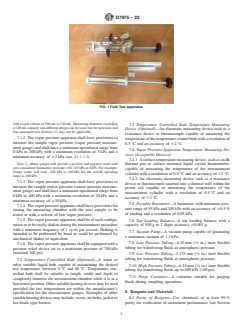
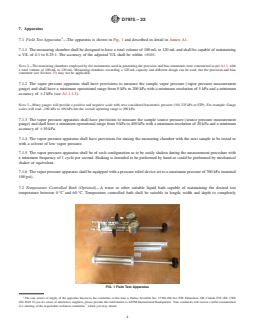
7.1 Field Test Apparatus —The apparatus is shown in Fig. 1 and described in detail in Annex A1.
7.1.1 The measuring chamber shall be designed to have a total volume of 100 mL to 120 mL and shall be capable of maintaining
a V/L of 4:1 to 0.25:1. The accuracy of the adjusted V/L shall be within 60.01.
NOTE 2—The measuring chambers employed by the instruments used in generating the precision and bias statements were constructed as per A1.1, with
a total volume of 100 mL to 120 mL. Measuring chambers exceeding a 120 mL capacity and different design can be used, but the precision and bias
statement (see Section 15) may not be applicable.
7.1.2 The vapor pressure apparatus shall have provisions to measure the sample vapor pressure (vapor pressure measurement
gauge) and shall have a minimum operational range from 0 kPa to 200 kPa with a minimum resolution of 5 kPa and a minimum
accuracy of 62 kPa (see A1.1.1.3).
NOTE 3—Many gauges will provide a positive and negative scale with zero considered barometric pressure (101.325 kPa at STP). For example: Gauge
scales will read –100 kPa to 100 kPa but the overall operating range is 200 kPa.
7.1.3 The vapor pressure apparatus shall have provisions to measure the sample source pressure (source pressure measurement
gauge) and shall have a minimum operational range from 0 kPa to 400 kPa with a minimum resolution of 20 kPa and a minimum
accuracy of 610 kPa.
7.1.4 The vapor pressure apparatus shall have provisions for rinsing the measuring chamber with the next sample to be tested or
with a solvent of low vapor pressure.
7.1.5 The vapor pressure apparatus shall be of such configuration as to be easily shaken during the measurement procedure with
a minimum frequency of 1 cycle per second. Shaking is intended to be performed by hand or could be performed by mechanical
shaker or equivalent.
7.1.6 The vapor pressure apparatus shall be equipped with a pressure relief device set to a maximum pressure of 700 kPa (nominal
100 psi).
7.2 Temperature Controlled Bath (Optional)—A water or other suitable liquid bath capable of maintaining the desired test
temperature between 0 °C and 60 °C. Temperature controlled bath shall be suitable in length, width and depth to completely
FIG. 1 Field Test Apparatus
The sole source of supply of the apparatus known to the committee at this time is Parkes Scientific Inc. 17360-108 Ave NW, Edmonton, AB, Canada T5S 1E8, (780)
484-1849. If you are aware of alternative suppliers, please provide this information to ASTM International Headquarters. Your comments will receive careful consideration
at a meeting of the responsible technical committee, which you may attend.
D7975 − 22
immerse the measurement chamber while it is in a horizontal position. Other suitable heating devices may be used provided the
test temperatures are within the manufacturer’s specification for the measurement gauges. Examples of other suitable heating
devices may include: ovens, air baths, jacket or hot-block type heaters.
7.3 Temperature Controlled Bath Temperature Measuring Device (Optional)—An electronic measuring device such as a resistance
device or thermocouple capable of measuring the temperature of the temperature control bath with a resolution of 0.5 °C and an
accuracy of 62 °C.
7.4 Vapor Pressure Apparatus Temperature Measuring Devices (Acceptable Devices):
7.4.1 A surface temperature measuring device, such as an IR thermal gun or surface mounted liquid crystal thermometer, capable
of measuring the temperature of the measurement cylinder with a resolution of 0.5 °C and an accuracy of 62 °C.
7.4.2 An electronic measuring device such as a resistance device or thermocouple inserted into a thermal well within the piston
rod capable of measuring the temperature of the measurement cylinder with a resolution of 0.5 °C and an accuracy of 62 °C.
7.5 Portable Barometer—A barometer with minimum pressure range of 95 kPa and 105 kPa with an accuracy of 60.5 % of
reading and a resolution of 0.05 kPa.
7.6 Top Loading Balance—A top loading balance with a capacity of 500 g to 3 digits accuracy 60.001 g.
7.7 Vacuum Pump—A vacuum pump capable of generating a minimum vacuum of 1.3 kPa.
7.8 Low Pressure Tubing—6.35 mm ( ⁄4 in.) inert flexible tubing for transferring fluids at atmospheric pressure.
7.9 Low Pressure Tubing—3.175 mm ( ⁄8 in.) inert flexible tubing for transferring fluids at atmospheric pressure.
7.10 High Pressure Tubing—6.35 mm ( ⁄4 in.) inert flexible tubing for transferring fluids up to 689 kPa (100 psi).
7.11 Purge Container—A container suitable for purging fluids during sampling operations.
8. Reagents and Materials
8.1 Purity of Reagents—Use chemicals of at least 99 % purity for verification of instrument performance (see Section 11). Unless
otherwise indicated, it is intended that all reagents conform to the specifications of the Committee on Analytical Reagents of the
American Chemical Society where such specifications are available. Other grades may be used, provided it is first ascertained that
the reagent is of sufficient purity to permit its use without lessening the accuracy of the determination.
8.2 Purity of Water—Unless otherwise indicated, references to water shall be understood to mean reagent water as defined by Type
II in Specification D1193.
A
TABLE 1 Accepted Reference Value (ARV) and Acceptable Testing Range for Air Saturated Reference Fluids
Acceptable Testing Range
ARV [P ] ± Uncertainty,
tot
Reference Fluid for Reference Material [P ],
tot
(kPa) @ V/L 4:1 (37.8 °C)
(kPa)
Pentane 112.8 ± 0.2 112.8 ± 1.2 (111.6 to 114.0)
2,2 Dimethylbutane 74.1 ± 0.2 74.1 ± 1.2 (72.9 to 75.3)
2,3 Dimethylbutane 57.1 ± 0.2 57.1 ± 1.2 (55.9 to 58.3)
A
Supporting data have been filed at ASTM International Headquarters and may be obtained by requesting Research Report RR:D02-1619.
Reagent Chemicals, American Chemical Society Specifications,ACS Reagent Chemicals, Specifications and Procedures for Reagents and Standard-Grade Reference
Materials, American Chemical Society, Washington, DC. For suggestions on the testing of reagents not listed by the American Chemical Society, see Analar Standards for
Laboratory Chemicals, BDH Ltd., Poole, Dorset, U.K., and the United States Pharmacopeia and National Formulary, U.S. Pharmacopeial Convention, Inc. (USPC),
Rockville, MD.
D7975 − 22
8.2.1 The chemicals in 8.3.1, 8.3.2, and 8.3.3 are suggested for verification of instrument performance (see Section 11), based on
the air saturated reference fuels analyzed in the Test Method D5191 2003 inter-laboratory study (ILS) (see Table 1). Ptot used
in Test Method D5191 is equivalent to VPCR4-F(37.8°C)VPCR4-F(37.8 °C) used in this test method. Table 1 identifies the
accepted reference value (ARV) and uncertainty limits, as well as the acceptable testing range for each of the reference fuels listed.
8.2.2 The chemicals in 8.4.1 and 8.4.2 are suggested for use as rinsing solvents capable of cleaning the measuring chamber, the
valves and the inlet and outlet tubes.
8.3 Verification Fluids:
8.3.1 2,2-Dimethylbutane, (Warning—2,2-dimethylbutane is flammable and a health hazard.)
8.3.2 2,3-Dimethylbutane, (Warning—2,3-dimethylbutane is flammable and a health hazard.)
8.3.3 Pentane, (Warning—Pentane is flammable and a health hazard.)
8.4 Solvents:
8.4.1 Toluene, (Warning—Toluene is flammable and a health hazard.)
8.4.2 Acetone, (Warning—Acetone is flammable and a health hazard.)
8.5 Silicon-based or perfluorocarbon based lubricant is recommended for hydraulic cylinder piston lubrication.
8.6 Water.
9. Preparation of Apparatus
9.1 Rinse the measuring chamber, if necessary, with a solvent (see 8.4). Toluene has a low vapor pressure and has been used
successfully. The measuring chamber is rinsed by drawing the solvent into the chamber by extension of the piston and expulsion
of the solvent into the waste container by compressing the piston (see 12.2 Sampling Procedure).
9.2 To avoid contamination of the test specimen with the previous sample or the solvent, rinse the measuring chamber a minimum
of three times with the sample to be tested. Fill the measuring chamber with sample to at least half the total volume of the chamber
for each rinse. This rinsing procedure shall always be carried out immediately before the sampling and measuring procedure (see
section 12.3).
10. Calibration and Standardization
10.1 Cylinder Dead Volume Calibration:
10.1.1 CLOSE valves A and B and compress the cylinder piston into the cylinder body completely. See Fig. 2-A.
10.1.2 CONNECT valve A to a vacuum source.
10.1.3 OPEN valve A to begin evacuation of the apparatus.
10.1.4 OPEN valve B and confirm vacuum pressure is greater than 85 kPa (25 inHg) below atmospheric pressure.
NOTE 4—Some vacuum gauges read in negative values and use atmospheric pressure as zero.
10.1.5 Allow 5 min to evacuate.
Supporting data have been filed at ASTM International Headquarters and may be obtained by requesting Research Report RR:D02-1619. Contact ASTM Customer
Service at service@astm.org.
D7975 − 22
FIG. 2 Dead Volume Calibration
10.1.6 CLOSE valve A and monitor the pressure for a further 2 min.
10.1.6.1 If there is no change in vacuum pressure, then proceed to 10.1.7.
10.1.6.2 If there is a loss of vacuum pressure, then the system has a leak that shall be resolved prior to proceeding. Follow
procedures in Annex A1 regarding the apparatus.
10.1.7 DISCONNET vacuum source from valve A.
10.1.8 CONNECT a short length of 3.175 mm ( ⁄8 in.) tubing to valve A (copper, vinyl, or TFE-fluorocarbon tubing are commonly
available). This length should be kept as short as possible.
10.1.9 FILL a 500 mL beaker with approximately 300 mL water.
10.1.10 PLACE the beaker on the top loading balance.
10.1.11 INSERT the tubing from the cylinder in the water filled beaker without touching the sides or bottom of the beaker.
Suspending the tubing using a ring stand or other means will allow the tubing to be in the beaker but not touching it. See Fig. 2-B.
10.1.12 CLOSE valve B to avoid filling the vapor pressure measurement gauge with water.
10.1.13 RECORD the mass of water in the beaker as the initial mass of water (W1).
10.1.14 OPEN valve A to allow water to be displaced into the apparatus filling the dead volume. See Fig. 2-C.
10.1.15 RECORD the mass of water in the beaker as the final mass of water (W2).
D7975 − 22
10.1.16 RECORD the water temperature and locate the water density at that temperature.
10.1.17 CALCULATE the dead volume using Eq 1.
W12 W2
DV 5 (1)
S D
DW
where:
W1 = initial mass of water in the beaker (g),
W2 = final mass of water in the beaker (g),
DW = density of water at the calibration temperature (g/mL), and
DV = dead volume (mL).
10.1.18 Continue directly to 10.2 to proceed with the cylinder volume guide calibration. DO NOT move the piston or add or
remove water from the beaker.
10.1.19 If any component of the apparatus is altered or replaced after calibration repeat 10.1.1 to 10.1.16.
10.2 Cylinder Volume Guide Calibration:
10.2.1 Starting from 10.1.16 with the dead volume full of water. See Fig. 3-A.
10.2.2 PULL the cylinder piston out enough to allow the insertion of the volume measurement 20 % guide. See Fig. 3-B.
FIG. 3 Cylinder Volume Guide Calibration
D7975 − 22
10.2.3 With the guide in place and the piston firmly pressed to the guide, wait for the mass of water to stabilize.
10.2.4 Once the mass of water has been stable for 5 s, RECORD the mass of water in the beaker as W3.
10.2.5 REMOVE the 20 % guide and PULL the piston out enough to allow insertion of the 80 % guide. See Fig. 3-C.
10.2.6 With the guide in place and the piston firmly pressed to the guide, WAIT for the mass of water to stabilize.
10.2.7 Once the mass of water has been stable for 5 s, RECORD the mass of water in the beaker as W4.
10.2.8 REMOVE the 80 % guide and PULL the piston to the fully extended position.
10.2.9 With the piston in the fully extended position, RECORD the mass of water in the beaker as W5.
10.2.10 CALCULATE the cylinder volume, guide volume and guide volume percent as Eq 2 through Eq 5.
10.2.11 For other volume guides, see Annex A1.
W 2 2 W 3
~ !
GV15 1DV (2)
F G
DW
~W 2 2 W 4!
GV25 1DV (3)
F G
DW
W 2 2 W 5
~ !
TV 5 1DV (4)
F G
DW
GV
~ !
X
GP 5 3100 (5)
F G
TV
where:
GV1 = 20 % Guide volume (mL),
GV2 = 80 % Guide volume (mL),
TV = total cylinder volume (mL),
GP = guide volume percent (percent by volume),
W2 = final mass of water in the beaker after dead volume calibration (g),
W3 = mass of water in the beaker required to fill cylinder to the 20 % guide (g),
W4 = mass of water in the beaker required to fill cylinder to the 80 % guide (g),
W5 = mass of water in the beaker required to fill the fully extended cylinder (g),
DW = density of water at the calibration temperature (g/mL),
GV = guide volume with x as the specific guide (GV1 or GV2),
x
DV = dead volume of the apparatus from 10.1.17 (mL), and
GP = guide volume percent (volume percent).
11. Quality Control Checks
11.1 Use a verification fluid (see 8.3) of known volatility as an independent check against the instrument calibration as required.
For pure compounds, multiple test specimens may be taken from the same container over time. Air saturate the verification fluid
at temperatures between 0 °C to 1 °C as described in Test Method D5191 (see 8.4). Transfer the verification fluid into the
measuring cell using a transfer tube or a syringe. The temperature of the verification fluid shall be at 0 °C to 1 °C during the sample
introduction, and the measuring procedure shall be in accordance with Section 12 with a V/L ratio of 4:1 and a measuring
temperature of 37.8 °C.
11.1.1 Table 1 provides the accepted reference value (ARV) [P ] and uncertainty limits (at least 95 % confidence interval) of
tot
reference fluids tested in the 2003 Test Method D5191 ILS. As stated in 8.2.1, P used in Test Method D5191 is equivalent to
tot
VPCR4-F(37.8 °C) used in this test method.
11.2 For the purpose of this field method, an acceptable tolerance value, based on the method precision, was used to establish the
acceptable testing range for the reference fuels to verify instrument performance.
D7
...