

ASTM D3554-20e1
(Specification)Standard Specification for Track-Resistant Thermoplastic High-Density Polyethylene Insulation for Wire and Cable, 75 °C Operation
General Information
- Abstract
ABSTRACT
This specification covers track-resistant black thermoplastic high-density polyethylene insulation for conducting wires and cables operating continuously at a specified conductor temperature. The insulation is suitable for use for power transmission in overhead spaced-line service that is exposed to sunlight and other atmospheric environments. The prescribed tests cannot be performed unless the insulation is formed around a conductor, but these are done solely to determine the insulation properties and not to test the conductor or completed cable. Each test sample should be subjected to an ac or dc voltage withstand test at voltages that are based on the nominal thickness of the insulation and should comply with the required values for aging, heat distortion, cold blend, U-bend discharge, track resistance, tensile strength, elongation at rupture, environmental cracking, and surface resistivity.
SCOPE
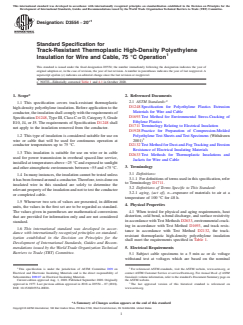
1.1 This specification covers track-resistant thermoplastic high-density polyethylene insulation. Before application to the conductor, the insulation shall comply with the requirements of Specification D1248, Type III, Class C or D, Category 5, Grade E10, J4, or J5. The requirements of Specification D1248 shall not apply to the insulation removed from the conductor.
1.2 This type of insulation is considered suitable for use on wire or cable that will be used for continuous operation at conductor temperatures up to 75 °C.
1.3 This insulation is suitable for use on wire or in cable used for power transmission in overhead spaced-line service, installed at temperatures above −25 °C and exposed to sunlight and other atmospheric environments between −55 and +75 °C.
1.4 In many instances, the insulation cannot be tested unless it has been formed around a conductor. Therefore, tests done on insulated wire in this standard are solely to determine the relevant property of the insulation and not to test the conductor or completed cable.
1.5 Whenever two sets of values are presented, in different units, the values in the first set are to be regarded as standard. The values given in parentheses are mathematical conversions that are provided for information only and are not considered standard.
1.6 This international standard was developed in accordance with internationally recognized principles on standardization established in the Decision on Principles for the Development of International Standards, Guides and Recommendations issued by the World Trade Organization Technical Barriers to Trade (TBT) Committee.
- Status
- Published
- Publication Date
- 31-Jul-2020
- Technical Committee
- D09 - Electrical and Electronic Insulating Materials
- Drafting Committee
- D09.07 - Electrical Insulating Materials


Overview
ASTM D3554-20e1: Standard Specification for Track-Resistant Thermoplastic High-Density Polyethylene Insulation for Wire and Cable, 75 °C Operation, published by ASTM International, specifies requirements for track-resistant thermoplastic high-density polyethylene (HDPE) insulation. This insulation is primarily used for conducting wires and cables that operate continuously at conductor temperatures up to 75 °C, particularly in overhead spaced-line service exposed to sunlight and challenging atmospheric environments. The standard supports the safety and reliability of power transmission by defining comprehensive physical and electrical properties of HDPE insulation intended for outdoor and high-stress applications.
Key Topics
- Material Requirements: Insulation must comply with the prerequisites specified in ASTM D1248, namely Type III, Class C or D, Category 5, and certain grades before application to the conductor.
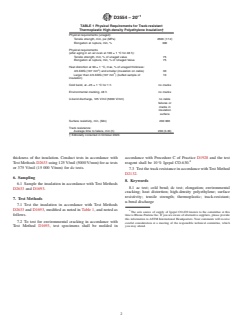
- Performance Testing: Includes tensile strength, elongation at rupture, aging, heat distortion, cold bend, environmental cracking, U-bend discharge, track resistance, surface resistivity, and voltage withstand testing.
- Environmental Durability: Designed for installation and operation in temperature ranges from -55 °C to +75 °C, and must resist effects caused by sunlight and other atmospheric conditions.
- Testing Conditions: All insulation tests are carried out with the material formed around a conductor. Tests examine insulation characteristics, not the conductor or complete cable.
- Physical Properties: Insulation must achieve specified benchmarks for performance both before and after aging, ensuring longevity and robustness for continuous operation.
- Dual Unit Specification: Standard values are provided in SI and US customary units for global accessibility.
Applications
ASTM D3554-20e1 is vital for manufacturers, quality control laboratories, and utilities dealing with insulated wire and cable for power transmission. Its practical applications include:
- Overhead Spaced-Line Power Transmission: Used for insulating wire and cable installed on poles and supports, where exposures to weather and sunlight necessitate superior track resistance and durability.
- Outdoor Electrical Installations: Suitable for outdoor environments where cables encounter extreme temperature fluctuations and direct solar radiation.
- Utility and Distribution Networks: Supports reliable operation of electrical grids, distribution circuits, and rural electrification projects.
- Compliance and Quality Assurance: The standard provides clear criteria for inspection and testing, aiding organizations in demonstrating compliance with international electrical safety regulations.
Related Standards
ASTM D3554-20e1 references and aligns with several related standards, including:
- ASTM D1248: Specification for Polyethylene Plastics Extrusion Materials for Wire and Cable - baseline material requirements.
- ASTM D1693: Test Method for Environmental Stress-Cracking of Ethylene Plastics.
- ASTM D1711: Terminology Relating to Electrical Insulation.
- ASTM D2132: Test Method for Dust-and-Fog Tracking and Erosion Resistance of Electrical Insulating Materials.
- ASTM D2633: Test Methods for Thermoplastic Insulations and Jackets for Wire and Cable.
- International Standards: Developed following the WTO Technical Barriers to Trade (TBT) Committee principles, ensuring global recognition and acceptance.
Practical Value
Adhering to ASTM D3554-20e1 helps ensure that thermoplastic HDPE insulation delivers robust performance under real-world environmental stresses, increasing the lifespan and safety of power transmission infrastructure. The specification aids manufacturers, utilities, and inspectors in selecting, producing, and certifying products that meet demanding operational conditions while complying with recognized international standards for electrical insulation. Utilizing track-resistant HDPE insulation specified by ASTM D3554-20e1 ensures high reliability in both new installations and maintenance of existing electrical distribution systems.
Relations
- Effective Date
- 01-Mar-2024
- Effective Date
- 01-Nov-2018
- Effective Date
- 15-Nov-2016
- Effective Date
- 01-Nov-2015
- Effective Date
- 01-Nov-2014
- Effective Date
- 01-May-2014
- Effective Date
- 01-Nov-2013
- Effective Date
- 01-Apr-2013
- Effective Date
- 01-Apr-2012
- Effective Date
- 01-Apr-2012
- Effective Date
- 01-Jan-2012
- Effective Date
- 01-Aug-2011
- Effective Date
- 15-Apr-2011
- Effective Date
- 01-May-2008
- Effective Date
- 01-Mar-2008
Get Certified
Connect with accredited certification bodies for this standard

IMQ S.p.A. (Certification)
Italian electrical product certification.

SLG Prüf- und Zertifizierungs GmbH
German testing and certification body.

UL Solutions
Global safety science company with testing, inspection and certification.
Sponsored listings
Frequently Asked Questions
ASTM D3554-20e1 is a technical specification published by ASTM International. Its full title is "Standard Specification for Track-Resistant Thermoplastic High-Density Polyethylene Insulation for Wire and Cable, 75 °C Operation". This standard covers: ABSTRACT This specification covers track-resistant black thermoplastic high-density polyethylene insulation for conducting wires and cables operating continuously at a specified conductor temperature. The insulation is suitable for use for power transmission in overhead spaced-line service that is exposed to sunlight and other atmospheric environments. The prescribed tests cannot be performed unless the insulation is formed around a conductor, but these are done solely to determine the insulation properties and not to test the conductor or completed cable. Each test sample should be subjected to an ac or dc voltage withstand test at voltages that are based on the nominal thickness of the insulation and should comply with the required values for aging, heat distortion, cold blend, U-bend discharge, track resistance, tensile strength, elongation at rupture, environmental cracking, and surface resistivity. SCOPE 1.1 This specification covers track-resistant thermoplastic high-density polyethylene insulation. Before application to the conductor, the insulation shall comply with the requirements of Specification D1248, Type III, Class C or D, Category 5, Grade E10, J4, or J5. The requirements of Specification D1248 shall not apply to the insulation removed from the conductor. 1.2 This type of insulation is considered suitable for use on wire or cable that will be used for continuous operation at conductor temperatures up to 75 °C. 1.3 This insulation is suitable for use on wire or in cable used for power transmission in overhead spaced-line service, installed at temperatures above −25 °C and exposed to sunlight and other atmospheric environments between −55 and +75 °C. 1.4 In many instances, the insulation cannot be tested unless it has been formed around a conductor. Therefore, tests done on insulated wire in this standard are solely to determine the relevant property of the insulation and not to test the conductor or completed cable. 1.5 Whenever two sets of values are presented, in different units, the values in the first set are to be regarded as standard. The values given in parentheses are mathematical conversions that are provided for information only and are not considered standard. 1.6 This international standard was developed in accordance with internationally recognized principles on standardization established in the Decision on Principles for the Development of International Standards, Guides and Recommendations issued by the World Trade Organization Technical Barriers to Trade (TBT) Committee.
ABSTRACT This specification covers track-resistant black thermoplastic high-density polyethylene insulation for conducting wires and cables operating continuously at a specified conductor temperature. The insulation is suitable for use for power transmission in overhead spaced-line service that is exposed to sunlight and other atmospheric environments. The prescribed tests cannot be performed unless the insulation is formed around a conductor, but these are done solely to determine the insulation properties and not to test the conductor or completed cable. Each test sample should be subjected to an ac or dc voltage withstand test at voltages that are based on the nominal thickness of the insulation and should comply with the required values for aging, heat distortion, cold blend, U-bend discharge, track resistance, tensile strength, elongation at rupture, environmental cracking, and surface resistivity. SCOPE 1.1 This specification covers track-resistant thermoplastic high-density polyethylene insulation. Before application to the conductor, the insulation shall comply with the requirements of Specification D1248, Type III, Class C or D, Category 5, Grade E10, J4, or J5. The requirements of Specification D1248 shall not apply to the insulation removed from the conductor. 1.2 This type of insulation is considered suitable for use on wire or cable that will be used for continuous operation at conductor temperatures up to 75 °C. 1.3 This insulation is suitable for use on wire or in cable used for power transmission in overhead spaced-line service, installed at temperatures above −25 °C and exposed to sunlight and other atmospheric environments between −55 and +75 °C. 1.4 In many instances, the insulation cannot be tested unless it has been formed around a conductor. Therefore, tests done on insulated wire in this standard are solely to determine the relevant property of the insulation and not to test the conductor or completed cable. 1.5 Whenever two sets of values are presented, in different units, the values in the first set are to be regarded as standard. The values given in parentheses are mathematical conversions that are provided for information only and are not considered standard. 1.6 This international standard was developed in accordance with internationally recognized principles on standardization established in the Decision on Principles for the Development of International Standards, Guides and Recommendations issued by the World Trade Organization Technical Barriers to Trade (TBT) Committee.
ASTM D3554-20e1 is classified under the following ICS (International Classification for Standards) categories: 29.035.20 - Plastics and rubber insulating materials. The ICS classification helps identify the subject area and facilitates finding related standards.
ASTM D3554-20e1 has the following relationships with other standards: It is inter standard links to ASTM D1711-24, ASTM D2132-12(2018), ASTM D1248-16, ASTM D1711-15, ASTM D1711-14a, ASTM D1711-14, ASTM D1711-13, ASTM D1693-13, ASTM D1248-12, ASTM D1693-12, ASTM D2132-12, ASTM D1711-11a, ASTM D2132-11, ASTM D1711-08, ASTM D1693-08. Understanding these relationships helps ensure you are using the most current and applicable version of the standard.
ASTM D3554-20e1 is available in PDF format for immediate download after purchase. The document can be added to your cart and obtained through the secure checkout process. Digital delivery ensures instant access to the complete standard document.
Standards Content (Sample)
This international standard was developed in accordance with internationally recognized principles on standardization established in the Decision on Principles for the
Development of International Standards, Guides and Recommendations issued by the World Trade Organization Technical Barriers to Trade (TBT) Committee.
´1
Designation:D3554 −20
Standard Specification for
Track-Resistant Thermoplastic High-Density Polyethylene
Insulation for Wire and Cable, 75 °C Operation
This standard is issued under the fixed designation D3554; the number immediately following the designation indicates the year of
original adoption or, in the case of revision, the year of last revision.Anumber in parentheses indicates the year of last reapproval.A
superscript epsilon (´) indicates an editorial change since the last revision or reapproval.
ε NOTE—Editorially corrected Table 1 and 4.1 in October 2020.
1. Scope* 2. Referenced Documents
2.1 ASTM Standards:
1.1 This specification covers track-resistant thermoplastic
D1248Specification for Polyethylene Plastics Extrusion
high-density polyethylene insulation. Before application to the
Materials for Wire and Cable
conductor,theinsulationshallcomplywiththerequirementsof
D1693Test Method for Environmental Stress-Cracking of
SpecificationD1248,TypeIII,ClassCorD,Category5,Grade
Ethylene Plastics
E10, J4, or J5. The requirements of Specification D1248 shall
D1711Terminology Relating to Electrical Insulation
not apply to the insulation removed from the conductor.
D1928Practice for Preparation of Compression-Molded
1.2 This type of insulation is considered suitable for use on
PolyethyleneTest Sheets andTest Specimens (Withdrawn
wire or cable that will be used for continuous operation at 2001)
conductor temperatures up to 75 °C. D2132Test Method for Dust-and-Fog Tracking and Erosion
Resistance of Electrical Insulating Materials
1.3 This insulation is suitable for use on wire or in cable
D2633Test Methods for Thermoplastic Insulations and
used for power transmission in overhead spaced-line service,
Jackets for Wire and Cable
installedattemperaturesabove−25°Candexposedtosunlight
3. Terminology
and other atmospheric environments between −55 and +75 °C.
3.1 Definitions:
1.4 Inmanyinstances,theinsulationcannotbetestedunless
3.1.1 Fordefinitionsoftermsusedinthisspecification,refer
ithasbeenformedaroundaconductor.Therefore,testsdoneon
to Terminology D1711.
insulated wire in this standard are solely to determine the
3.2 Definitions of Terms Specific to This Standard:
relevantpropertyoftheinsulationandnottotesttheconductor
3.2.1 aging, (act of), n—exposure of materials to air at a
or completed cable.
temperature of 100 °C for 48 h.
1.5 Whenever two sets of values are presented, in different
4. Physical Properties
units, the values in the first set are to be regarded as standard.
The values given in parentheses are mathematical conversions 4.1 When tested for physical and aging requirements, heat
distortion, cold bend, u-bend discharge, and surface resistivity
that are provided for information only and are not considered
inaccordancewithTestMethodsD2633,environmentalcrack-
standard.
ing in accordance with Test Method D1693, and track resis-
1.6 This international standard was developed in accor-
tance in accordance with Test Method D2132, the track-
dance with internationally recognized principles on standard-
resistant thermoplastic high-density polyethylene insulation
ization established in the Decision on Principles for the
shall meet the requirements specified in Table 1.
Development of International Standards, Guides and Recom-
5. Electrical Requirements
mendations issued by the World Trade Organization Technical
Barriers to Trade (TBT) Committee.
5.1 Subject cable specimens to a 5 min ac or dc voltage
withstand test at voltages which are based on the nominal
1 2
This specification is under the jurisdiction of ASTM Committee D09 on For referenced ASTM standards, visit the ASTM website, www.astm.org, or
Electrical and Electronic Insulating Materials and is the direct responsibility of contact ASTM Customer Service at service@astm.org. For Annual Book of ASTM
Subcommittee D09.07 on Electrical Insulating Materials. Standards volume information, refer to the standard’s Document Summary page on
Current edition approved Aug. 1, 2020. Published September 2020. Originally the ASTM website.
approved in 1977. Last previous edition appr
...