

ASTM D6895-21
(Test Method)Standard Test Method for Rotational Viscosity of Heavy Duty Diesel Drain Oils at 100 °C
General Information
- Abstract
SIGNIFICANCE AND USE
5.1 Rotational viscosity measurements allow the determination of the non-Newtonian, shear thinning property of drain oil. Rotational viscosity values can be compared at a shear rate of 100 s-1 by this test method.2,3
SCOPE
1.1 This test method covers the determination of the rotational viscosity and the shear thinning properties of heavy duty diesel engine drain oils at 100 °C, in the shear rate range of approximately 10 s-1 to 300 s-1, in the shear stress range of approximately 0.1 Pa to 10 Pa and the viscosity range of approximately 12 mPa·s to 35 mPa·s. Rotational viscosity values can be compared at a shear rate of 100 s-1 by this test method.2,3
1.2 This standard does not purport to address all of the safety concerns, if any, associated with its use. It is the responsibility of the user of this standard to establish appropriate safety, health, and environmental practices and determine the applicability of regulatory limitations prior to use.
1.3 This international standard was developed in accordance with internationally recognized principles on standardization established in the Decision on Principles for the Development of International Standards, Guides and Recommendations issued by the World Trade Organization Technical Barriers to Trade (TBT) Committee.
- Status
- Published
- Publication Date
- 31-Oct-2021
- Technical Committee
- D02 - Petroleum Products, Liquid Fuels, and Lubricants
- Drafting Committee
- D02.07 - Flow Properties
Buy Documents
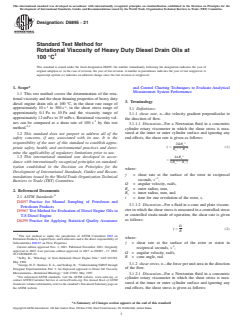
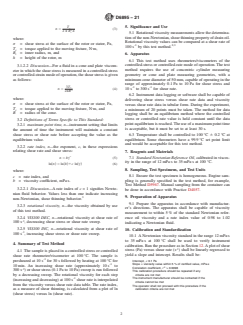
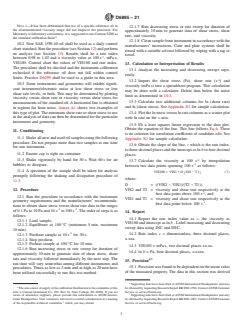
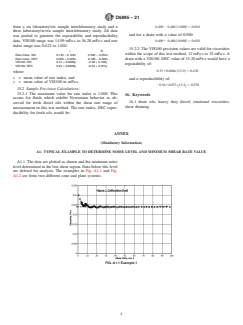
ASTM D6895-21 - Standard Test Method for Rotational Viscosity of Heavy Duty Diesel Drain Oils at 100 °C
REDLINE ASTM D6895-21 - Standard Test Method for Rotational Viscosity of Heavy Duty Diesel Drain Oils at 100 °C
Overview
ASTM D6895-21 specifies the Standard Test Method for measuring the rotational viscosity of heavy duty diesel drain oils at 100 °C. Developed by ASTM International, this method enables laboratories and quality control professionals to determine the non-Newtonian, shear-thinning properties of used diesel engine oils within a defined shear rate (10 s⁻¹ to 300 s⁻¹) and shear stress range (0.1 Pa to 10 Pa). The test is significant for monitoring engine oil condition, comparing properties across oil samples, and supporting quality assurance programs in the heavy duty diesel sector.
Key Topics
- Rotational Viscosity Measurement
The standard employs rheometers/viscometers to measure the viscosity of used diesel engine oils at 100°C, focusing on their response to different shear rates and shear stresses. - Shear-Thinning Properties
The method is tailored to evaluate non-Newtonian behavior, allowing determination of how viscosity decreases under increased shear (shear thinning), vital for understanding oil performance during engine operation. - Shear Rate Comparison
Results provide rotational viscosity values at a reference shear rate of 100 s⁻¹, facilitating comparisons between oils and over time. This metric is valuable for benchmarking and monitoring oil degradation. - Quality Control
The procedure supports calibration and routine quality control using Newtonian reference oils and standardized protocols to ensure reliable, reproducible results. - Applicability
Suitable for use with heavy duty diesel drain oils within a viscosity range of approximately 12 mPa·s to 35 mPa·s.
Applications
- Engine Oil Condition Monitoring
Enables fleet operators, maintenance teams, and laboratories to track degradation and performance of heavy duty diesel engine oils by assessing their viscosity under realistic conditions. - Oil Formulation and Development
Used by oil formulators and researchers to compare the shear thinning properties of new and used oil formulations, informing design for improved engine protection and longevity. - Laboratory and Field Testing
Standardizes viscosity measurement across laboratories, supporting inter-laboratory studies, product certifications, and compliance with industry requirements. - Preventive Maintenance Programs
Integral for developing oil change schedules based on actual changes in oil properties rather than fixed intervals, minimizing wear and maximizing engine life. - Statistical Quality Assurance
Facilitates the implementation of control charts and trend analysis to detect shifts in oil performance, leveraging statistical quality control techniques for continuous improvement.
Related Standards
- ASTM D4057: Practice for Manual Sampling of Petroleum and Petroleum Products
Standardizes sampling procedures to ensure test specimen integrity. - ASTM D5967: Test Method for Evaluation of Diesel Engine Oils in T-8 Diesel Engine
Provides guidelines for engine-based oil evaluation procedures. - ASTM D6299: Practice for Applying Statistical Quality Assurance and Control Charting Techniques
Supports robust quality control of analytical measurements in petroleum testing.
Relevant Keywords: rotational viscosity, heavy duty diesel, drain oils, shear thinning, viscosity measurement, ASTM D6895-21, engine oil condition, rheometers, non-Newtonian oils, oil quality monitoring.
By adhering to ASTM D6895-21, users gain a reliable, standardized approach for quantifying rotational viscosity and assessing the performance of heavy duty diesel engine drain oils, supporting both oil maintenance decisions and research in lubricant technology.
Relations
- Effective Date
- 01-Dec-2023
- Effective Date
- 15-Dec-2017
- Effective Date
- 15-Nov-2017
- Refers
ASTM D5967-17 - Standard Test Method for Evaluation of Diesel Engine Oils in T-8 Diesel Engine - Effective Date
- 01-May-2017
- Effective Date
- 01-Jan-2017
- Refers
ASTM D5967-15a - Standard Test Method for Evaluation of Diesel Engine Oils in T-8 Diesel Engine - Effective Date
- 01-Oct-2015
- Refers
ASTM D5967-15 - Standard Test Method for Evaluation of Diesel Engine Oils in T-8 Diesel Engine - Effective Date
- 01-Apr-2015
- Refers
ASTM D5967-14 - Standard Test Method for Evaluation of Diesel Engine Oils in T-8 Diesel Engine - Effective Date
- 01-Oct-2014
- Effective Date
- 01-Oct-2013
- Refers
ASTM D5967-13 - Standard Test Method for Evaluation of Diesel Engine Oils in T-8 Diesel Engine - Effective Date
- 01-May-2013
- Refers
ASTM D5967-12a - Standard Test Method for Evaluation of Diesel Engine Oils in T-8 Diesel Engine - Effective Date
- 01-Dec-2012
- Refers
ASTM D5967-12 - Standard Test Method for Evaluation of Diesel Engine Oils in T-8 Diesel Engine - Effective Date
- 15-Apr-2012
- Refers
ASTM D4057-06(2011) - Standard Practice for Manual Sampling of Petroleum and Petroleum Products - Effective Date
- 01-Jun-2011
- Refers
ASTM D5967-10a - Standard Test Method for Evaluation of Diesel Engine Oils in T-8 Diesel Engine - Effective Date
- 01-Oct-2010
- Refers
ASTM D5967-11 - Standard Test Method for Evaluation of Diesel Engine Oils in T-8 Diesel Engine - Effective Date
- 01-Oct-2010
Buy Documents
ASTM D6895-21 - Standard Test Method for Rotational Viscosity of Heavy Duty Diesel Drain Oils at 100 °C
REDLINE ASTM D6895-21 - Standard Test Method for Rotational Viscosity of Heavy Duty Diesel Drain Oils at 100 °C
Get Certified
Connect with accredited certification bodies for this standard

Element Materials Technology
Materials testing and product certification.

ABS Group Brazil
ABS Group certification services in Brazil.

ABS Quality Evaluations Inc.
American Bureau of Shipping quality certification.
Sponsored listings
Frequently Asked Questions
ASTM D6895-21 is a standard published by ASTM International. Its full title is "Standard Test Method for Rotational Viscosity of Heavy Duty Diesel Drain Oils at 100 °C". This standard covers: SIGNIFICANCE AND USE 5.1 Rotational viscosity measurements allow the determination of the non-Newtonian, shear thinning property of drain oil. Rotational viscosity values can be compared at a shear rate of 100 s-1 by this test method.2,3 SCOPE 1.1 This test method covers the determination of the rotational viscosity and the shear thinning properties of heavy duty diesel engine drain oils at 100 °C, in the shear rate range of approximately 10 s-1 to 300 s-1, in the shear stress range of approximately 0.1 Pa to 10 Pa and the viscosity range of approximately 12 mPa·s to 35 mPa·s. Rotational viscosity values can be compared at a shear rate of 100 s-1 by this test method.2,3 1.2 This standard does not purport to address all of the safety concerns, if any, associated with its use. It is the responsibility of the user of this standard to establish appropriate safety, health, and environmental practices and determine the applicability of regulatory limitations prior to use. 1.3 This international standard was developed in accordance with internationally recognized principles on standardization established in the Decision on Principles for the Development of International Standards, Guides and Recommendations issued by the World Trade Organization Technical Barriers to Trade (TBT) Committee.
SIGNIFICANCE AND USE 5.1 Rotational viscosity measurements allow the determination of the non-Newtonian, shear thinning property of drain oil. Rotational viscosity values can be compared at a shear rate of 100 s-1 by this test method.2,3 SCOPE 1.1 This test method covers the determination of the rotational viscosity and the shear thinning properties of heavy duty diesel engine drain oils at 100 °C, in the shear rate range of approximately 10 s-1 to 300 s-1, in the shear stress range of approximately 0.1 Pa to 10 Pa and the viscosity range of approximately 12 mPa·s to 35 mPa·s. Rotational viscosity values can be compared at a shear rate of 100 s-1 by this test method.2,3 1.2 This standard does not purport to address all of the safety concerns, if any, associated with its use. It is the responsibility of the user of this standard to establish appropriate safety, health, and environmental practices and determine the applicability of regulatory limitations prior to use. 1.3 This international standard was developed in accordance with internationally recognized principles on standardization established in the Decision on Principles for the Development of International Standards, Guides and Recommendations issued by the World Trade Organization Technical Barriers to Trade (TBT) Committee.
ASTM D6895-21 is classified under the following ICS (International Classification for Standards) categories: 75.080 - Petroleum products in general. The ICS classification helps identify the subject area and facilitates finding related standards.
ASTM D6895-21 has the following relationships with other standards: It is inter standard links to ASTM D6299-23a, ASTM D6299-17b, ASTM D6299-17a, ASTM D5967-17, ASTM D6299-17, ASTM D5967-15a, ASTM D5967-15, ASTM D5967-14, ASTM D6299-13e1, ASTM D5967-13, ASTM D5967-12a, ASTM D5967-12, ASTM D4057-06(2011), ASTM D5967-10a, ASTM D5967-11. Understanding these relationships helps ensure you are using the most current and applicable version of the standard.
ASTM D6895-21 is available in PDF format for immediate download after purchase. The document can be added to your cart and obtained through the secure checkout process. Digital delivery ensures instant access to the complete standard document.
Standards Content (Sample)
This international standard was developed in accordance with internationally recognized principles on standardization established in the Decision on Principles for the
Development of International Standards, Guides and Recommendations issued by the World Trade Organization Technical Barriers to Trade (TBT) Committee.
Designation: D6895 − 21
Standard Test Method for
Rotational Viscosity of Heavy Duty Diesel Drain Oils at
100 °C
This standard is issued under the fixed designation D6895; the number immediately following the designation indicates the year of
original adoption or, in the case of revision, the year of last revision.Anumber in parentheses indicates the year of last reapproval.A
superscript epsilon (´) indicates an editorial change since the last revision or reapproval.
1. Scope* and Control Charting Techniques to Evaluate Analytical
Measurement System Performance
1.1 This test method covers the determination of the rota-
tionalviscosityandtheshearthinningpropertiesofheavyduty
3. Terminology
diesel engine drain oils at 100°C, in the shear rate range of
-1 -1
approximately 10s to 300s , in the shear stress range of 3.1 Definitions:
approximately 0.1Pa to 10Pa and the viscosity range of
3.1.1 shear rate, n—the velocity gradient perpendicular to
approximately 12mPa·s to 35mPa·s. Rotational viscosity val-
the direction of flow.
-1
ues can be compared at a shear rate of 100 s by this test
3.1.1.1 Discussion—For a Newtonian fluid in a concentric
2,3
method.
cylinder rotary viscometer in which the shear stress is mea-
1.2 This standard does not purport to address all of the sured at the inner or outer cylinder surface and ignoring any
end effects, the shear rate is given as follows:
safety concerns, if any, associated with its use. It is the
responsibility of the user of this standard to establish appro- 2
2ΩR
o
γ˙ 5 (1)
priate safety, health, and environmental practices and deter- 2 2
R 2 R
o i
mine the applicability of regulatory limitations prior to use.
1.3 This international standard was developed in accor- 4πR
o
2 2
dance with internationally recognized principles on standard- t R 2 R
~ !
o i
ization established in the Decision on Principles for the
where:
Development of International Standards, Guides and Recom-
γ˙ = shear rate at the surface of the rotor in reciprocal
mendations issued by the World Trade Organization Technical
−1
seconds, s ,
Barriers to Trade (TBT) Committee.
Ω = angular velocity, rad/s,
R = outer radius, mm,
o
2. Referenced Documents
R = inner radius, mm, and
i
2.1 ASTM Standards:
t = time for one revolution of the rotor, s.
D4057Practice for Manual Sampling of Petroleum and
3.1.1.2 Discussion—For a fluid in a cone and plate viscom-
Petroleum Products
eterinwhichtheshearstressismeasuredinacontrolled-stress
D5967Test Method for Evaluation of Diesel Engine Oils in
or controlled strain mode of operation, the shear rate is given
T-8 Diesel Engine
as follows:
D6299Practice for Applying Statistical Quality Assurance
Ω
γ˙ 5 (2)
B
This test method is under the jurisdiction of ASTM Committee D02 on
where:
Petroleum Products, Liquid Fuels, and Lubricants and is the direct responsibility of
Subcommittee D02.07 on Flow Properties.
γ˙ = shear rate at the surface of the rotor or stator in
Current edition approved Nov. 1, 2021. Published November 2021. Originally -1
reciprocal seconds, s ,
approved in 2003. Last previous edition approved in 2017 as D6895–17. DOI:
Ω = angular velocity, rad/s,
10.1520/D6895-21.
2 B = cone angle, rad.
Selby, K., “Rheology of Soot–thickened Diesel Engine Oils,” SAE 981369,
May 1998.
3.1.2 shear stress, n—theforceperunitareainthedirection
George, H. F., Bardasz, E.A., and Soukup, B., “Understanding SMOTthrough
of the flow.
Designed Experimentation Part 3: An Improved approach to Drain Oil Viscosity
Measurements—Rotational Rheology,” SAE 97692, May 1997.
3.1.2.1 Discussion—For a Newtonian fluid in a concentric
For referenced ASTM standards, visit the ASTM website, www.astm.org, or
cylinder rotary viscometer in which the shear stress is mea-
contact ASTM Customer Service at service@astm.org. For Annual Book of ASTM
sured at the inner or outer cylinder surface and ignoring any
Standards volume information, refer to the standard’s Document Summary page on
the ASTM website. end effects, the shear stress is given as follows:
*A Summary of Changes section appears at the end of this standard
Copyright © ASTM International, 100 Barr Harbor Drive, PO Box C700, West Conshohocken, PA 19428-2959. United States
D6895 − 21
T 5. Significance and Use
r
σ 5 (3)
2 π R h
i
5.1 Rotationalviscositymeasurementsallowthedetermina-
tionofthenon-Newtonian,shearthinningpropertyofdrainoil.
where:
Rotational viscosity values can be compared at a shear rate of
σ = shear stress at the surface of the rotor or stator, Pa,
-1 2,3
100s by this test method.
T = torque applied to the moving fixture, N·m,
r
R = inner radius, m, and
i
6. Apparatus
h = height of the rotor, m
6.1 This test method uses rheometers/viscometers of the
controlled-stress or controlled-rate mode of operation.The test
3.1.2.2 Discussion—For a fluid in a cone and plate viscom-
method requires the use of concentric cylinder measuring
eterinwhichtheshearstressismeasuredinacontrolled-stress
geometry or cone and plate measuring geometries, with a
orcontrolled-strainmodeofoperation,theshearstressisgiven
minimumconediameterof50mm,capableofoperatinginthe
as follows:
range of approximately 0.1Pa to 10Pa for shear stress and
3T
r -1 -1
σ 5 (4) 10s to 300s for shear rate.
2πR
6.2 Instrument data logging or software shall be capable of
where:
delivering shear stress versus shear rate data and viscosity
σ = shear stress at the surface of the rotor or stator, Pa,
versus shear rate data in tabular form. During the experiment,
T = torque applied to the moving fixture, N·m, and
r
a minimum of 20 points must be taken. The method for data
R = radius of the cone.
logging shall be an equilibrium method where the controlled
stress or controlled rate value is held constant until the data
3.2 Definitions of Terms Specific to This Standard:
pointequilibriumisreached.Theuseofamaximumpointtime
3.2.1 maximum point time, n—instrument setting that limits
is acceptable, but it must be set to at least 30s.
the amount of time the instrument will maintain a constant
shear stress or shear rate before accepting the value as the 6.3 Temperature shall be controlled to 100°C 6 0.2°C at
equilibrium value. equilibrium. Some rheometers have a 99.9°C set point limit
and would be acceptable for this test method.
3.2.2 rate index, n—the exponent, c, in these expressions
relating shear rate and shear stress:
7. Reagents and Materials
c
σ 5 bγ˙ (5) 7.1 Standard Newtonian Reference Oil,calibratedinviscos-
ity in the range of 12mPa·s to 35mPa·s at 100°C.
ln σ 5ln b 1c ln γ˙ (6)
~ ! ~ ! ~ !
8. Sampling, Test Specimens, and Test Units
where:
8.1 Ensure the test specimen is homogeneous. Engine sam-
c = rate index, and
pling is generally specified in the test method, for example,
b = viscosity coefficient, mPa·s.
Test Method D5967. Manual sampling from the container can
3.2.2.1 Discussion—A rate index of c = 1 signifies Newto-
be done in accordance with Practice D4057.
nian fluid behavior. Values less than one indicate increasing
9. Preparation of Apparatus
non-Newtonian, shear thinning behavior.
9.1 Prepare the apparatus in accordance with manufactur-
3.2.3 rotational viscosity, n—the viscosity obtained by use
er’s directions. The apparatus shall be capable of viscosity
of this test method.
measurement to within 5% of the standard Newtonian refer-
3.2.4 VIS100 DEC, n—rotational viscosity at shear rate of
ence oil viscosity and a rate index value of 0.98 to 1.02
-1
100s , decreasing shear stress or shear rate sweep. indicating a Newtonian fluid.
3.2.5 VIS100 INC, n—rotational viscosity at shear rate of
10. Calibration and Standardization
-1
100s , increasing shear stress or shear rate sweep.
10.1 ANewtonian viscosity standard in the range 12mPa·s
to 35mPa·s at 100°C shall be used to verify instrument
4. Summary of Test Method
calibration.RuntheprocedureasinSection12.Aplotofshear
-1
stress (Pa) versus shear rate (s ) shall be linearly regressed to
4.1 The sample is placed in a controlled stress or controlled
yield a slope and intercept. Results shall be:
shear rate rheometer/viscometer at 100°C. The sample is
-1
presheared at 10 s for 30s followed by heating at 100°C for Intercept, < 0.1 Pa
-1
Slope = viscosity value within 5 % of certified value, mPa·s
10min. An increasing shear rate (approximately 10s to
Correlation coefficient, r > 0.9998
-1
300s ) or shear stress (0.1Pa to 10Pa) sweep is run followed
This calibration procedure should be repeated if any
by a decreasing sweep. The rotational viscosity for each step criteria are not met
-1
The instrument manufacturer should be contacted if the
(increasing and decreasing) at 100s shear rate is interpolated
criteria cannot be met
from the viscosity versus shear rate data table. The rate index,
The operator shall not proceed with this procedure if the
calibration criteria are not met
as a measure of shear thinning, is calculated from a plot of ln
(shear stress) versus ln (shear rate).
D6895 − 21
NOTE 1—It has been determined that use of a specific reference oil in
12.1.7 Run decreasing stress or rate sweep for duration of
the aforementioned viscosity range did not improve the precision. For
approximately 10min to generate data of shear stress, shear
laboratorytolaboratoryconsistency,itissuggestedtouseCannonS200as
rate, and viscosity.
the standard calibration fluid.
12.1.8 Cleansamplefrominstrumentinaccordancewithth
...
This document is not an ASTM standard and is intended only to provide the user of an ASTM standard an indication of what changes have been made to the previous version. Because
it may not be technically possible to adequately depict all changes accurately, ASTM recommends that users consult prior editions as appropriate. In all cases only the current version
of the standard as published by ASTM is to be considered the official document.
Designation: D6895 − 17 D6895 − 21
Standard Test Method for
Rotational Viscosity of Heavy Duty Diesel Drain Oils at
100 °C
This standard is issued under the fixed designation D6895; the number immediately following the designation indicates the year of
original adoption or, in the case of revision, the year of last revision. A number in parentheses indicates the year of last reapproval. A
superscript epsilon (´) indicates an editorial change since the last revision or reapproval.
1. Scope*
1.1 This test method covers the determination of the rotational viscosity and the shear thinning properties of heavy duty diesel
-1 -1
engine drain oils at 100 °C, in the shear rate range of approximately 10 s to 300 s , in the shear stress range of approximately
0.1 Pa to 10 Pa and the viscosity range of approximately 12 mPa·s to 35 mPa·s. Rotational viscosity values can be compared at
-1 2,3
a shear rate of 100 s by this test method.
1.2 This standard does not purport to address all of the safety concerns, if any, associated with its use. It is the responsibility
of the user of this standard to establish appropriate safety safety, health, and healthenvironmental practices and determine the
applicability of regulatory limitations prior to use.
1.3 This international standard was developed in accordance with internationally recognized principles on standardization
established in the Decision on Principles for the Development of International Standards, Guides and Recommendations issued
by the World Trade Organization Technical Barriers to Trade (TBT) Committee.
2. Referenced Documents
2.1 ASTM Standards:
D4057 Practice for Manual Sampling of Petroleum and Petroleum Products
D5967 Test Method for Evaluation of Diesel Engine Oils in T-8 Diesel Engine
D6299 Practice for Applying Statistical Quality Assurance and Control Charting Techniques to Evaluate Analytical Measure-
ment System Performance
3. Terminology
3.1 Definitions:
3.1.1 shear rate, n—the velocity gradient in fluid perpendicular to the direction of flow.
3.1.1.1 Discussion—
For a Newtonian fluid in a concentric cylinder rotary viscometer in which the shear stress is measured at the inner or outer cylinder
surface and ignoring any end effects, the shear rate is given as follows:
This test method is under the jurisdiction of ASTM Committee D02 on Petroleum Products, Liquid Fuels, and Lubricants and is the direct responsibility of Subcommittee
D02.07 on Flow Properties.
Current edition approved Jan. 1, 2017Nov. 1, 2021. Published February 2017November 2021. Originally approved in 2003. Last previous edition approved in 20122017
as D6895 – 06 (2012).D6895 – 17. DOI: 10.1520/D6895-17.10.1520/D6895-21.
Selby, K., “Rheology of Soot–thickened Diesel Engine Oils,” SAE 981369, May 1998.
George, H. F., Bardasz, E. A., and Soukup, B., “Understanding SMOT through Designed Experimentation Part 3: An Improved approach to Drain Oil Viscosity
Measurements—Rotational Rheology,” SAE 97692, May 1997.
For referenced ASTM standards, visit the ASTM website, www.astm.org, or contact ASTM Customer Service at service@astm.org. For Annual Book of ASTM Standards
volume information, refer to the standard’s Document Summary page on the ASTM website.
*A Summary of Changes section appears at the end of this standard
Copyright © ASTM International, 100 Barr Harbor Drive, PO Box C700, West Conshohocken, PA 19428-2959. United States
D6895 − 21
2ΩR
o
γ˙ 5 (1)
2 2
R 2 R
o i
4πR
o
2 2
t R 2 R
~ !
o i
where:
−1
γ˙ = shear rate at the surface of the rotor in reciprocal seconds, s ,
Ω = angular velocity, rad/s,
R = outer radius, mm,
o
R = inner radius, mm, and
i
t = time for one revolution of the rotor, s.
3.1.1.2 Discussion—
For a fluid in a cone and plate viscometer in which the shear stress is measured in a controlled-stress or controlled strain mode
of operation, the shear rate is given as follows:
Ω
γ˙ 5 (2)
B
where:
-1
γ˙ = shear rate at the surface of the rotor or stator in reciprocal seconds, s ,
Ω = angular velocity, rad/s,
B = cone angle, rad.
3.1.2 shear stress, n—the motivating force per unit area for fluid in the direction of the flow.
3.1.2.1 Discussion—
For a Newtonian fluid in a concentric cylinder rotary viscometer in which the shear stress is measured at the inner or outer cylinder
surface and ignoring any end effects, the shear stress is given as follows:
T
r
σ 5 (3)
2 π R h
i
D6895 − 21
where:
σ = shear stress at the surface of the rotor or stator, Pa,
T = torque applied to the moving fixture, N—m,
r
R = inner radius, m, and
i
h = height of the rotor, m
3.1.2.2 Discussion—
For a fluid in a cone and plate viscometer in which the shear stress is measured in a controlled-stress or controlled-strain mode
of operation, the shear stress is given as follows:
3T
r
σ 5 (4)
2πR
where:
σ = shear stress at the surface of the rotor or stator, Pa,
T = torque applied to the moving fixture, N—m, and
r
R = radius of the cone.
3.2 Definitions of Terms Specific to This Standard:
3.2.1 maximum point time—time, n—instrument setting that limits the amount of time the instrument will maintain a constant shear
stress or shear rate before accepting the value as the equilibrium value.
3.2.2 rate index—index, n—the exponent, c, in these expressions relating shear rate and shear stress:
c
σ 5 bγ˙ (5)
ln σ 5 ln b 1c ln γ˙ (6)
~ ! ~ ! ~ !
where:
c = rate index, and
b = viscosity coefficient, mPa·s.
3.2.2.1 Discussion—
A rate index of c = 1 signifies Newtonian fluid behavior. Values less than one indicate increasing non-Newtonian, shear thinning
behavior.
3.2.3 rotational viscosity—viscosity, n—the viscosity obtained by use of this test method.
-1
3.2.4 VIS100 DEC—DEC, n—rotational viscosity at shear rate of 100 s , decreasing shear stress or shear rate sweep.
-1
3.2.5 VIS100 INC—INC, n—rotational viscosity at shear rate of 100 s , increasing shear stress or shear rate sweep.
4. Summary of Test Method
4.1 The sample is placed in a controlled stress or controlled shear rate rheometer/viscometer at 100 °C. The sample is presheared
-1 -1 -1
at 10 s for 30 s followed by heating at 100 °C for 10 min. An increasing shear rate (approximately 10 s to 300 s ) or shear stress
(0.1 Pa to 10 Pa) sweep is run followed by a decreasing sweep. The rotational viscosity for each step (increasing and decreasing)
-1
at 100 s shear rate is interpolated from the viscosity versus shear rate data table. The rate index, as a measure of shear thinning,
is calculated from a plot of ln (shear stress) versus ln (shear rate).
5. Significance and Use
5.1 Rotational viscosity measurements allow the determination of the non-Newtonian, shear thinning property of drain oil.
-1 2,3
Rotational viscosity values can be compared at a shear rate of 100 s by this test method.
6. Apparatus
6.1 This test method uses rheometers/viscometers of the controlled-stress or controlled-rate mode of operation. The test method
D6895 − 21
requires the use of concentric cylinder measuring geometry or cone and plate measuring geometries, with a minimum cone
-1 -1
diameter of 50 mm, capable of operating in the range of approximately 0.1 Pa to 10 Pa for shear stress and 10 s to 300 s for
shear rate.
6.2 Instrument data logging or software shall be capable of delivering shear stress versus shear rate data and viscosity versus shear
rate data in tabular form. During the experiment, a minimum of 20 points must be taken. The method for data logging shall be
an equilibrium method where the controlled stress or controlled rate value is held constant until the data point equilibrium is
reached. The use of a maximum point time is acceptable, but it must be set to at least 30 s.
6.3 Temperature shall be controlled to 100 °C 6 0.2 °C at equilibrium. Some rheometers have a 99.9 °C set point limit and would
be acceptable for this test method.
7. Reagents and Materials
7.1 Standard Newtonian Reference Oil, calibrated in viscosity in the range of 12 mPa·s to 35 mPa·s at 100 °C.
8. Sampling, Test Specimens, and Test Units
8.1 Ensure the test specimen is homogeneous. Engine sampling is generally specified in the test method, for example, Test Method
D5967. Manual sampling from the container can be done in accordance with Practice D4057.
9. Preparation of Apparatus
9.1 Prepare the apparatus in accordance with manufacturersmanufacturer’s directions. The apparatus shall be capable of viscosity
measurement to within 5 % of the standard Newtonian reference oil viscosity and a rate index value of 0.98 to 1.02 indicating a
Newtonian fluid.
10. Calibration and Standardization
10.1 A Newtonian viscosity standard in the range 12 mPa·s to 35 mPa·s at 100 °C shall be used to verify instrument calibration.
-1
Run the procedure as in Section 12. A plot of shear stress (Pa) versus shear rate (s ) shall be linearly regressed to yield a slope
and intercept. Results shall be:
Intercept, < 0.1 Pa
Slope = viscosity value within 5 % of certified value, mPa·s
Correlation coefficient, r > 0.9998
This calibration procedure should be repeated if any
criteria are not met
The instrument manufacturer should be contacted if the
criteria cannot be met
The operator shall not proceed with this procedure if the
calibration criteria are not met
D6895 − 21
NOTE 1—It has been determined that use of a specific reference oil in the aforementioned viscosity range did not improve the precision. For laboratory
to laboratory consistency, it is suggested to use Cannon S200 as the standard calibration fluid.
10.2 New SAE 15W-40 oil shall be used as a daily contr
...