

ASTM B769-11(2021)
(Test Method)Standard Test Method for Shear Testing of Aluminum Alloys
General Information
- Abstract
SIGNIFICANCE AND USE
5.1 The intent of this method is to provide a means of measuring the ultimate shear strength of aluminum-alloy wrought and cast products. Data obtained by this method are used to calculate minimum properties that can be utilized in the design of structural members such as found in aircraft. It is recognized that loading conditions developed by this method, and by most others, are not ideal in that they do not strictly satisfy the definition of pure shear. However, rarely do pure shear conditions exist in structures.
Note 2: This method is not interchangeable with that described in Test Method B565. Shear strengths obtained by Test Method B565 are about 10 % lower than those developed by this test method.
5.2 The presence of a lubricant on the surface of the specimen and fixture may result in shear strengths up to 3 % lower than those determined in the absence of lubrication (see 8.1 and Test Method B565).
SCOPE
1.1 This test method covers double-shear testing of wrought and cast aluminum products to determine shear ultimate strengths.
Note 1: The values stated in inch-pound units are to be regarded as the standard. The values given in parentheses are provided for information only.
1.2 This standard does not purport to address all of the safety concerns, if any, associated with its use. It is the responsibility of the user of this standard to establish appropriate safety, health, and environmental practices and determine the applicability of regulatory limitations prior to use.
1.3 This international standard was developed in accordance with internationally recognized principles on standardization established in the Decision on Principles for the Development of International Standards, Guides and Recommendations issued by the World Trade Organization Technical Barriers to Trade (TBT) Committee.
- Status
- Published
- Publication Date
- 30-Nov-2021
- Technical Committee
- B07 - Light Metals and Alloys
- Drafting Committee
- B07.05 - Testing

Overview
ASTM B769-11(2021): Standard Test Method for Shear Testing of Aluminum Alloys is an international standard published by ASTM International. This standard outlines the procedures for double-shear testing of wrought and cast aluminum products to determine their ultimate shear strength. The results derived from this method are essential in calculating minimum properties that inform the engineering and design of critical structural components, especially in industries such as aerospace, automotive, and construction.
The test utilizes a cylindrical specimen subjected to double-shear loading using a specialized fixture and a tension or compression testing machine. While the method aims to subject material to near-pure shear stress, it is recognized that pure shear conditions are rare in actual structures. Hence, the data obtained are representative of real-world applications where shear stress might not be strictly "pure."
Key Topics
- Shear Testing Procedure: The standard describes double-shear testing, preparing cylindrical specimens, loading configurations, and precise measurement methods.
- Ultimate Shear Strength Data: Ultimate shear strength is measured and used for structural calculations.
- Applicability to Wrought and Cast Aluminum: Methods apply to both wrought and cast aluminum alloys, supporting a broad range of product forms.
- Influence of Lubrication: Presence of lubrication on specimen surfaces can reduce measured shear strengths by up to 3%.
- Specimen Orientation and Loading Direction: Accurate results require noting the orientation and grain direction, which impacts shear strength.
- Reporting and Precision: Clear guidance is provided on test reporting, including material identification, specimen details, and test results. The standard also references its precision characteristics based on interlaboratory studies.
Applications
ASTM B769-11(2021) is essential for industries that rely on the mechanical properties of aluminum alloys, such as:
- Aerospace: Engineers use shear strength data to design aircraft structural members, particularly those subjected to shear stresses, ensuring safety and performance.
- Automotive and Rail: Shear testing data are critical for lightweight yet strong components exposed to multi-axial stresses.
- Construction: Evaluation of aluminum alloy structural elements like beams, brackets, and connectors relies on standardized shear testing.
- Manufacturing: Material suppliers and fabricators use this method for quality control and to certify materials for critical applications.
By following this standard, organizations can ensure consistent and reliable determination of shear properties, supporting technical requirements and regulatory compliance for safety-critical products.
Related Standards
Several ASTM and international standards complement ASTM B769-11(2021), including:
- ASTM B565: Test Method for Shear Testing of Aluminum and Aluminum-Alloy Rivets and Cold-Heading Wire and Rods. Notably, shear strengths determined by B565 are about 10% lower than those from B769.
- ASTM E4: Practices for Force Calibration and Verification of Testing Machines. Ensures accuracy in testing equipment.
- ASTM E6: Terminology Relating to Methods of Mechanical Testing. Provides consistent language for mechanical testing methods.
- ASTM E177: Practice for Use of the Terms Precision and Bias in ASTM Test Methods.
- ASTM E691: Practice for Conducting an Interlaboratory Study to Determine the Precision of a Test Method.
These documents together form a comprehensive foundation for reliable, repeatable, and well-understood shear testing of aluminum alloys, supporting both technical excellence and regulatory compliance.
Keywords: ASTM B769, shear testing, aluminum alloys, ultimate shear strength, double-shear, wrought aluminum, cast aluminum, material testing, mechanical properties, structural design.
Relations
- Effective Date
- 01-Jun-2014
- Effective Date
- 01-May-2014
- Effective Date
- 01-May-2013
- Effective Date
- 01-May-2013
- Effective Date
- 01-Nov-2011
- Effective Date
- 01-Oct-2010
- Effective Date
- 01-Jun-2010
- Effective Date
- 01-May-2010
- Effective Date
- 01-Nov-2009
- Effective Date
- 15-May-2009
- Effective Date
- 15-May-2009
- Effective Date
- 01-Apr-2009
- Effective Date
- 01-Apr-2009
- Effective Date
- 01-Jan-2009
- Effective Date
- 01-Dec-2008
Get Certified
Connect with accredited certification bodies for this standard

Element Materials Technology
Materials testing and product certification.

Inštitut za kovinske materiale in tehnologije
Institute of Metals and Technology. Materials testing, metallurgical analysis, NDT.
Sponsored listings
Frequently Asked Questions
ASTM B769-11(2021) is a standard published by ASTM International. Its full title is "Standard Test Method for Shear Testing of Aluminum Alloys". This standard covers: SIGNIFICANCE AND USE 5.1 The intent of this method is to provide a means of measuring the ultimate shear strength of aluminum-alloy wrought and cast products. Data obtained by this method are used to calculate minimum properties that can be utilized in the design of structural members such as found in aircraft. It is recognized that loading conditions developed by this method, and by most others, are not ideal in that they do not strictly satisfy the definition of pure shear. However, rarely do pure shear conditions exist in structures. Note 2: This method is not interchangeable with that described in Test Method B565. Shear strengths obtained by Test Method B565 are about 10 % lower than those developed by this test method. 5.2 The presence of a lubricant on the surface of the specimen and fixture may result in shear strengths up to 3 % lower than those determined in the absence of lubrication (see 8.1 and Test Method B565). SCOPE 1.1 This test method covers double-shear testing of wrought and cast aluminum products to determine shear ultimate strengths. Note 1: The values stated in inch-pound units are to be regarded as the standard. The values given in parentheses are provided for information only. 1.2 This standard does not purport to address all of the safety concerns, if any, associated with its use. It is the responsibility of the user of this standard to establish appropriate safety, health, and environmental practices and determine the applicability of regulatory limitations prior to use. 1.3 This international standard was developed in accordance with internationally recognized principles on standardization established in the Decision on Principles for the Development of International Standards, Guides and Recommendations issued by the World Trade Organization Technical Barriers to Trade (TBT) Committee.
SIGNIFICANCE AND USE 5.1 The intent of this method is to provide a means of measuring the ultimate shear strength of aluminum-alloy wrought and cast products. Data obtained by this method are used to calculate minimum properties that can be utilized in the design of structural members such as found in aircraft. It is recognized that loading conditions developed by this method, and by most others, are not ideal in that they do not strictly satisfy the definition of pure shear. However, rarely do pure shear conditions exist in structures. Note 2: This method is not interchangeable with that described in Test Method B565. Shear strengths obtained by Test Method B565 are about 10 % lower than those developed by this test method. 5.2 The presence of a lubricant on the surface of the specimen and fixture may result in shear strengths up to 3 % lower than those determined in the absence of lubrication (see 8.1 and Test Method B565). SCOPE 1.1 This test method covers double-shear testing of wrought and cast aluminum products to determine shear ultimate strengths. Note 1: The values stated in inch-pound units are to be regarded as the standard. The values given in parentheses are provided for information only. 1.2 This standard does not purport to address all of the safety concerns, if any, associated with its use. It is the responsibility of the user of this standard to establish appropriate safety, health, and environmental practices and determine the applicability of regulatory limitations prior to use. 1.3 This international standard was developed in accordance with internationally recognized principles on standardization established in the Decision on Principles for the Development of International Standards, Guides and Recommendations issued by the World Trade Organization Technical Barriers to Trade (TBT) Committee.
ASTM B769-11(2021) is classified under the following ICS (International Classification for Standards) categories: 77.150.10 - Aluminium products. The ICS classification helps identify the subject area and facilitates finding related standards.
ASTM B769-11(2021) has the following relationships with other standards: It is inter standard links to ASTM E4-14, ASTM E177-14, ASTM E691-13, ASTM E177-13, ASTM E691-11, ASTM E177-10, ASTM E4-10, ASTM B565-04(2010), ASTM E4-09a, ASTM E6-09be1, ASTM E6-09b, ASTM E4-09, ASTM E6-09a, ASTM E6-09, ASTM E4-08. Understanding these relationships helps ensure you are using the most current and applicable version of the standard.
ASTM B769-11(2021) is available in PDF format for immediate download after purchase. The document can be added to your cart and obtained through the secure checkout process. Digital delivery ensures instant access to the complete standard document.
Standards Content (Sample)
This international standard was developed in accordance with internationally recognized principles on standardization established in the Decision on Principles for the
Development of International Standards, Guides and Recommendations issued by the World Trade Organization Technical Barriers to Trade (TBT) Committee.
Designation: B769 − 11 (Reapproved 2021)
Standard Test Method for
Shear Testing of Aluminum Alloys
This standard is issued under the fixed designation B769; the number immediately following the designation indicates the year of
original adoption or, in the case of revision, the year of last revision. A number in parentheses indicates the year of last reapproval. A
superscript epsilon (´) indicates an editorial change since the last revision or reapproval.
1. Scope Determine the Precision of a Test Method
1.1 This test method covers double-shear testing of wrought
3. Terminology
and cast aluminum products to determine shear ultimate
3.1 The definitions of terms relating to shear testing in
strengths.
Terminology E6 are applicable to the terms used in this test
NOTE1—Thevaluesstatedininch-poundunitsaretoberegardedasthe
method.
standard. The values given in parentheses are provided for information
only. 4. Summary of Test Method
1.2 This standard does not purport to address all of the
4.1 This test method consists of subjecting a machined
safety concerns, if any, associated with its use. It is the
cylindrical test specimen to double-shear loading in a test
responsibility of the user of this standard to establish appro-
fixture using a tension (or compression) testing machine to
priate safety, health, and environmental practices and deter-
determine the shear stress required to fracture the specimen,
mine the applicability of regulatory limitations prior to use.
that is, the shear strength.
1.3 This international standard was developed in accor-
5. Significance and Use
dance with internationally recognized principles on standard-
ization established in the Decision on Principles for the
5.1 The intent of this method is to provide a means of
Development of International Standards, Guides and Recom-
measuring the ultimate shear strength of aluminum-alloy
mendations issued by the World Trade Organization Technical
wrought and cast products. Data obtained by this method are
Barriers to Trade (TBT) Committee.
usedtocalculateminimumpropertiesthatcanbeutilizedinthe
design of structural members such as found in aircraft. It is
2. Referenced Documents
recognized that loading conditions developed by this method,
and by most others, are not ideal in that they do not strictly
2.1 The following documents of the issue in effect on the
satisfy the definition of pure shear. However, rarely do pure
dateofmaterialpurchase,unlessotherwisenotedformapartof
shear conditions exist in structures.
this specification to the extent referenced herein:
NOTE 2—This method is not interchangeable with that described inTest
2.2 ASTM Standards:
Method B565. Shear strengths obtained by Test Method B565 are about
B565 Test Method for Shear Testing of Aluminum and
10 % lower than those developed by this test method.
Aluminum-Alloy Rivets and Cold-Heading Wire and
5.2 The presence of a lubricant on the surface of the
Rods
specimen and fixture may result in shear strengths up to 3 %
E4 Practices for Force Calibration and Verification of Test-
lower than those determined in the absence of lubrication (see
ing Machines
8.1 and Test Method B565).
E6 Terminology Relating to Methods of Mechanical Testing
E177 Practice for Use of the Terms Precision and Bias in
6. Apparatus
ASTM Test Methods
6.1 Testing Machines—The testing machines shall conform
E691 Practice for Conducting an Interlaboratory Study to
to the requirements of Practices E4. The loads used to
determine the shear strength shall be within the loading range
of the testing machine as defined in Practices E4.
This test method is under the jurisdiction of ASTM Committee B07 on Light
Metals and Alloys and is the direct responsibility of Subcommittee B07.05 on
6.2 Loading Device:
Testing.
6.2.1 The loading device shall be a double-shear test fixture
Current edition approved Dec. 1, 2021. Published December 2021. Originally
of the type shown in Fig. 1. The fixture shall be made of tool
approved in 1987. Last previous edition approved in 2016 as B769 – 11 (2016).
DOI: 10.1520/B0769-11R21.
steel having a Rockwell hardness from 60 to 62 HRC. A
For referenced ASTM standards, visit the ASTM website, www.astm.org, or
suitable alternative is to use a lower-strength steel for the main
contact ASTM Customer Service at service@astm.org. For Annual Book of ASTM
frame of the fixture and have only the steel inserts hardened
Standards volume information, refer to the standard’s Document Summary page on
the ASTM website. from 60 to 62 HRC.
Copyright © ASTM International, 100 Barr Harbor Drive, PO Box C700, West Conshohocken, PA 19428-2959. United States
B769 − 11 (2021)
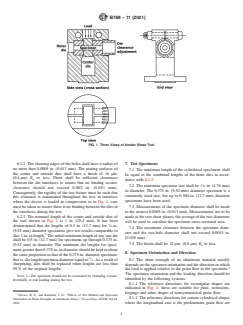
FIG. 1 Three Views of Amsler Shear Tool
6.2.2 The shearing edges of the holes shall have a radius of 7. Test Specimens
no more than 0.0005 in. (0.013 mm). The mating surfaces of
7.1 The minimum length of the cylindrical specimens shall
the center and outside dies shall have a finish of 16 µin.
be equal to the combined lengths of the three dies in accor-
(0.4 µm) R or less. There shall be sufficient clearances
a
dance with 6.2.3.
between the die interfaces to ensure that no binding occurs;
7.2 The minimum specimen size shall be ⁄16 in. (4.76 mm)
clearance should not exceed 0.002 in. (0.051 mm).
in diameter. The 0.375-in. (9.52-mm) diameter specimen is a
Consequently, the rigidity of the test fixture must be such that
commonly used size, but up to 0.500-in. (12.7-mm) diameter
this clearance is maintained throughout the test; in instances
specimens have been used.
where the device is loaded in compression as in Fig. 1, care
must be taken to ensure there is no binding between the dies at 7.3 Measurements of the specimen diameter shall be made
the interfaces during the test.
to the nearest 0.0005 in. (0.013 mm). Measurements are to be
6.2.3 The nominal length of the center and outside dies of made at the two shear planes; the average of the two diameters
the tool shown in Fig. 1 is 1 in. (25.4 mm). It has been
will be used to calculate the specimen cross-sectional area.
demonstrated that die lengths of 0.5 in. (12.7 mm) for ⁄8-in.
7.4 The maximum clearance between the specimen diam-
(9.52 mm) diameter specimens give test results comparable to
eter and the test-hole diameter shall not exceed 0.0015 in.
dies 1 in. in length. The initial minimum length of any one die
(0.038 mm).
shall be 0.5 in. (12.7 mm) for specimens up through 0.375 in.
7.5 The finish shall be 32 µin. (0.8 µm) R or less.
a
(9.52 mm) in diameter. The minimum die lengths for speci-
mens greater than 0.375 in. in diameter should be kept in about
8. Specimen Orientation and Direction
the same proportion as that of the 0.375-in. diameter specimen;
that is, die length/specimen diameter equal to ⁄3 .As a result of
8.1 The shear strength of an aluminum material usually
sharpening, dies shall be replaced when lengths are less than
depends on the specimen orientation and the direction in which
95 % of the original lengths.
the load is applied relative to the grain flow in the specimen.
The specimen orientation and the loading direction should be
NO
...